Monday, May 29, 2006

Stuff the ceremonies

Prince Philip is at it again. I love it.

"I am truly fed up with the opening and closing ceremonies. They are a pain in the neck," said the Queen's husband, renowned for his outspoken views and political gaffes.

"Opening and closing ceremonies ought to be banned. Absolute bloody nuisances. I have been to one that was absolutely, appallingly awful."

Philip said he hoped to do "as little as possible" during the London Olympics in 2012.

Yet another hui.....

The usual bunch of suspects get together and make all the predictable noises.The scene, a workshop about families;

Governor-General Dame Silvia Cartwright told delegates New Zealand family life had undergone dramatic and rapid change. Fewer people were marrying, women were choosing to have fewer children and at a later age, and single-parent and multiple-parent families were becoming "very common".

But she said the changes were exciting and families had not lost their importance in society.


Interesting choice of word don't you think?

Judge Beecroft, in juxtaposition said, "Building strong functioning families with strong male role models is perhaps the fundamental crime-fighting initiative we could deliver to the community."

Honestly. And this is a job for the state? Perhaps he thinks if the state undid it then the state can put it back together again.

And what great wisdom from the Children's Commissioner?

Dr Kiro, who first mooted the ID proposal, said it was important that every child had "a set direction and a plan".

The assessments, which are likely to include health, reading and literacy tests, would take into account the "whole child" across a range of agencies.


Oh thank goodness "they" know what they are doing. "They" are going to take care of my children. Now if anything goes wrong it'll be "their" fault - not mine.

That'll make me a much better parent.

Precious

Look out! Here comes Tana and he's got Mum's handbag.

Sunday, May 28, 2006

Welfare pre-industrial times

Today I was told there was no welfare system in pre-industrial times. I pointed out that in England the Elizabethan Poor Law required parishes to tax and provide assistance to the poor - the aged, the unemployed, widows and deserted wives.

But, according to another person, I am confusing charity and welfare.

From this I gather that because the church (parish) was involved the welfare provided was deemed "charity".

But the church, at that time, was very much part of the state machinery. The law required tax to be collected and redistributed through the parish. This is "public" welfare. Charity is "private" welfare. It is a matter of private individuals giving to a cause voluntarily either of their time or from their pocket (although there is some blurring today with many organisations classed as charities also getting govt grants.)

I am going to use the words of author David Thomson to briefly describe the Britain most of our settlers came out of.

There had been a long "historical cycle of alternation between personal and public responsibilities in welfare matters."

During the seventeenth and eighteenth centuries "dependence on public support (was) a signal part of the English way of Life".

But the nineteenth century saw a turn against public assistance. During the early 1800's there were, "Repeated government investigations of work and poor relief through those years, which stressed the failure of employemnt subsidy in the stagnating and impoverished south, while free-market progress was booming in the north...there were also increased penalties against those who refuse to work or who failed to maintain their children....during the late 1860's...arguments against public assistance and in favour of the individual and family responsibility reached a new crusading pitch....self-help, independence, opposition to compulsory public support, and the lauding of voluntary effort were all standard features of the later-nineteenth century in western Europe and North America, as well as Australasia."

Unfortunately intergenerational memory is weak and during the twentieth century most western nations began to rebuild their public assistance programmes. This is what people now commonly refer to as the "welfare state". But it's not new.

And now we are once more out on the extreme of the pendulum trajectory, with state or public support having run to its useful and sustainable limits.

Meanwhile, back in Naenae...

Interest in Naenae seems to be gaining traction around the blogs. Here's another insight from Big News and a cautionary note from Oswald Bastable.
I missed my weekly visit to Naenae this past but had the pleasure of spending time in and around some Wellington council houses which are in even worse repair than the state ones I have seen. There's no getting away from mould resulting from the use of acrylic paint in bathrooms but cracks in windows can be hidden if you don't open the curtains.

I don't until "I do"

Kids that make chastity pledges are not keeping them. Well I never.

The debate over sex education vs abstinence rages on in the US. There are pitfalls with either approach. But a comment by an abstinence advocate who tours schools caught my eye;

(Yet) the effect of all that “sex ed”, argued Keith Deltano, a former teacher who tours schools advocating abstinence, is that the average American is exposed to between 240,000 and 480,000 sex acts before reaching the age of 18.

I have no idea what he means. Do you?

Saturday, May 27, 2006

Subsidies create greater need

We have a community constable in Eastbourne who writes a monthly column in our local Herald. Today he explains that because Wainuiomata is short-staffed, unbeknown to us, he has been working over there. And will be until further notice.

For decades we've sudsidised education, health and welfare in our poorer neighbouring community, for no great social gain, because their law and order needs still take precedence.

There is a small bonus. He has promised to give us some "insight" into life "over the hill". It will be superfluous to my needs but a few people who read his column could do with some enlightenment.

Here is his first installment;

One thing I saw while working in Wainui was four very young kids, one a near newborn, who slept in the same room as their parents with the telly blaring. It was around midnight and not all were asleep. The other bedroom couldn't be used. They were all living in very sparse conditions to say the least, and I did'nt see much food about either.

What astounded me was the most expensive item in the house - a late model and flash Playstation with stereo etc., for the father to spend his days on. No, he did not have a job.


News for Sue Bradford

Whether or not minimum wages (and increases to them) affect employment is reasonably controversial. The question is also highly topical given Sue Bradford's push to scrap the minimum youth rate. The following is from this week's Featherston and Molesworth and worth a read.

Minimum wage and unemployment
Nobel laureate in economics and author of the best-selling economics text in hiostory Paul Samuelson once reputedly commented, “When the economic theorist turns to the general problem of wage determination and labour economics, his voice becomes muted and his speech halting. If he is honest with himself, he must confess to a tremendous amount of uncertainty and self-doubt concerning even the most basic and elementary parts of the subject.”
No such halting speech or uncertainty from the Auckland ‘University’ of Technology, which announced Maori would be most adversely affected by a rise in the minimum wage. The claim is based on a study by economics lecturer Gail Pacheco.
“There are high numbers of Maori and Pacific Island people on minimum wage. Together they account for more than a fifth of minimum and sub-minimum wage workers, therefore they’ll attract more negative impact if the wage rise drives employers to reassess their options,” she argued.
“My study found for Maori who find the minimum wage binding, a ten percent rise in the real minimum wage would see a 15.8 percentage point fall in employment propensity, a drop of 13.5 hours usually worked each week, a 5.7 percentage point increase in unemployment propensity and a 10.9 percentage point increase in inactivity, that is, not working or studying.”
These are dramatic findings: A substantial fall in numbers who have jobs and a staggering one third drop in average hours worked if the minimum wage increases by around a dollar.
The study is all the more dramatic because its certainty conflicts with the weight of international academic evidence on the topic. A 1998 International Labour Organisation study (Minimum Wages and Youth Unemployment, ILO Employment and Training Papers) found the relationship between minimum wages and the employment of youth can’t be usefully considered in isolation from other influences on the labour market - elasticity of labour supply, wages and demand for labour along with “reservation wages” (that is, the availability of welfare).
The ILO noted the key question is productivity.
Obviously, at some level a minimum wage would cause unemployment; and if there were no minimum wage and no welfare payments, there might be no unemployment because anyone could find employment for a dollar a day. But cartoonish examples do not tell us much about what happens when the minimum wage is a modest fraction of the average wage and it increases mildly.
Increases in the minimum wage entice some low skilled workers to join the workforce. They also increase purchasing power (by consumers who are most likely to spend their entire income) and therefore stimulate economic activity. It’s also clear that low value jobs can be destroyed (it’s hard to get your shoes shined in countries with a realistic minimum wage).
The AUT study goes further in attributing the employment effects not just to youth, but to Maori.
Claims a higher minimum wage affects racial groups differently were investigated and rejected in a major 1983 study published in the peer reviewed Journal of Human Resources.
“Minimum wage effects differ very little by sex, and there is no strong evidence that the effects vary by race,” it found. [Time-Series Evidence of the Effect of the Minimum Wage on Youth Employment and Unemployment; Brown, Gilroy & Kohen, Journal of Human Resources, Vol. 18, No. 1 (Winter, 1983) , pp. 3-31.] That study, found a ten percent increase in the US minimum wage would reduce teenage employment by about 1 percent. But it also found the unemployment effects would be negligible because low-skilled workers would withdraw from the labour force.
A 2003 survey reports only 46 percent of academic economists in the US agree with the statement, “a minimum wage increases unemployment among young and unskilled workers”.
Another 28 percent partly agreed and 27 percent disagreed.
M&F WEEKEND UPDATE 26 MAY 2006

That's daring

The Scotsman reports, the pensions revolution is here;

"The message is this: if you want anything more than the basic pension in retirement, the state isn't going to do that any more. You have to do it yourself." - LORD TURNER


The British government have bitten the bullet and announced a raise in the pension age to 68. When? Wait for it.....2044!!

Some perspective

Expert says,"The social cost of alcohol is huge, and P pales in comparison to the danger alcohol causes."

This is bald fact yet we get constant hysteria about P from various sources unable to see the forest for the trees.

Friday, May 26, 2006

Hawkes Bay Today rates

The tenor and quality of the various regional editorials is fairly predictable - in this case, fortunately. Here's another well-written and well-informed offering from the Hawkes Bay Today. My response follows;

EDITORIAL: Bradford smacks of UN humbug

26.05.2006

One of the most frustrating aspects of MP Sue Bradford's intention to repeal Section 59 of the Crimes Act (1961) is the extraordinary claim made of it that it will "end the abuse of children".

Add to that the implicit assumption that anyone opposed to repealing the law is far less concerned with preventing child abuse than with the retaining right to beat kids and it is not hard to see why the bill, which would criminalise smacking, has had such a rocky road.

Apart from an irresistible urge to supplant parents by deciding what's best for everyone, motivation for the change has come from United Nations criticism of Section 59 (sufficient reason, one would have thought, not to repeal it).

The UN says our law violates its Convention on the Rights of the Child because parents are justified in "using force by way of correction of a child if the force used is reasonable in the circumstance".

Those who inveigh against Ms Bradford's amendment bill are not a creepy regiment of child abusers but people who worry that the law could define any parent who smacks a child as a criminal.

Unlike its sponsor, many of the bill's opponents probably recognise that while any smacking is regrettable, most of it is not abuse, that in an imperfect world parents do smack (though they may have cause to regret it) and that one simply cannot hope to prescribe in detail how people can, and should, behave.

Most, one hopes, would regard with extreme abhorrence the reality that violence can be found in many homes but would resist the childlike assumption that repealing section 59 of the crimes Act will cure it.

Ms Bradford has now taken a step back, saying her amendment bill should not outlaw "light smacking". Just how that concession might be made is anybody's guess.

She suggested a rewording of the bill or a commentary. How will a commentary assist? The police have already indicated that with the removal of Section 59 they will still be required to investigate complaints about smacking. Neither should any comfort be found in airy assurances that police are far too busy with more important crime than wanting to chase up petty smacking incidents.

Repealing section 59 so that the law echoes the pious sentiments of those who condemn any smacker as a child abuser is not the answer. The bill deserves to wither on the vine; not because nothing should be done about the abuse of children, but for the opposite reason: It will do nothing to make them safer.

It would be more useful (but grab fewer headlines) if Ms Bradford et all directed their energies where they might hope to make a difference.

The complexity of the causes of violence in the home will continue to elude lawmakers for as long as they seize on gestures to maintain the illusion that something's being done.

Ignorant, brutal parents who understand discipline only as beating children will continue to do so ... and allowances will continue to be made for them.


Dear Editor

Your editorial, May 26, re Sue Bradford's anti-smacking bill suggested, "It would be more useful (but grab fewer headlines) if Ms Bradford et all directed their energies where they might hope to make a difference."

NZ research has shown that children from benefit-dependent homes were four times more likely to become subjects of Care and Protection notifications to CYF. Yet Ms Bradford is an advocate of welfare expansion and an avid proponent of the DPB. Politicians should confine themselves to reform of damaging social policies.

Meanwhile, volunteer work in these homes is probably one of the most effective ways of reducing the chance or severity of child abuse. In many cases parents are mistrustful of state agencies. Giving those agencies even more discretionary power, the effect of passing Bradford's bill, would only exacerbate this.

Unsustainable lightbulbs ? Unsustainable logic

Having recently spent a small amount of time with Heather Simpson, Act on Campus President, I was impressed with her style, her affability and her mind. She stands in for Heather Roy this week (another in a very good series of proxies) with a column which, amongst other things, points out the absurdity and hypocrisy of students urging the government to ban unsustainable light bulbs.

It's only a matter of time

Voluntary euthanasia is an issue which is not going away. Lesley Martin is still very busy and you can read about her activities here. I'm not sure she is the right person for the job. But I was pleased to see Peter Brown's Death with Dignity Bill is back in the ballot box.

Another Hobson's choice

Lung cancer or diabetes? Many people worry that if they give up smoking they will gain weight. One of the target groups for anti-smoking campaigners is teenage girls. Appearance is often top of their priority list.

Some US economic research into the growth of obesity has found, "The rapid increase in obesity in the 1980s is partly an 'unintended consequence of the campaign to reduce smoking'." But the most important link the researchers found was between BMI and the number of restaurants in a given area.

Which reminds me, the US is the only place I have been where they sell anti-acids in restaurants.

Thursday, May 25, 2006

"They wouldn't have been microchipped "

A herd of sheep were killed on a lifestyle block north of Hamilton. The owners had videoed the destruction and it appeared on TV3 tonight. The owner shot the two pig dogs responsible. Neither had collars. Labour MP, Nanaia "One law for all dogs" Mahuta was on the scene saying microchipping would have meant the dogs could have been identified. The owner disagreed. He said the dog's owners would not have bothered to microchip the dogs as they weren't even registered. We all know this (except for our learned politicians). But it was sobering to see the obvious shortcomings of this proposal so graphically illustrated. Some of the sheep had to be destroyed after the attacks due to the degree of mutilation.

Hoodwinked

The multi-million dollar Families Commission was the price government paid to keep United Future sweet after the 2002 election. Of course it was always going to be hyjacked by the Left so the government wasn't too bothered. Remember the first hassles over the definition of a "family"?

United Future created the exact opposite of what they envisaged. This was once again obvious today with Families Commissioner, Rajen Prasad backing Sue Bradford's bill at a select committee submission.

How the right-wing christians were hoodwinked.

United Future position; New Zealand families will lose their children to CYFS zealots if Sue Bradford’s anti-smacking Bill passes into law, United Future deputy leader Judy Turner said today.

United Future policy; Give the Families Commission responsibility for co-ordinating and promoting parenting education programmes, as well as initiating public education campaigns promoting parenting skills.

United Future achievements; secured $28 million of funding over four years and the passage of legislation to establish the Families Commission, which will ensure that all government legislation will be tested for its impact on families (as per the supply and confidence agreement)

Russia grapples with low fertility

Russia is planning large subsidies to women who bear a second child but the Wall Steet Journal thinks it will be difficult to halt their population decline. According to the CIA World Factbook Russia's fertility rate is 1.28. (I am a bit hesitant about their information because they give New Zealand's as 1.79 which in not correct).

Nice Quote

Just as centralized economic planning has failed, centralized ecological planning will fail. The solution to our environmental problems will not be found in more government agencies, bureaucrats, and arbitrary regulations. Rather, we need an approach which relies on individual responsibility and its concomitants, individual liberty and private-property rights.

— Chuck Olson, The Stanford Review [November 1, 1992]

(Thanks FFF)

What is National's policy?

Was it your impression that National's policy was to spend based on need, not race?

Yesterday a shouting match erupted over the Minister of Maori Affairs' apparent negligence in not bidding for more money for Maori in the Budget. I'd expect strong criticism from the Maori Party but look who was most upset.

National MP Georgina te Heuheu said Mr Horomia's admission made him a laughing stock and her colleague Tau Henare, a former Maori Affairs Minister, called it "reprehensible".....Mr Horomia and Mr Henare shouted at each other during the Maori Affairs committee hearing.

Wednesday, May 24, 2006

"Shooting galleries "

The United Kingdom are having another look at introducing hygenic environments for addicts to inject themselves. Have a read before you dismiss the idea. We already dispense methadone to thousands of NZ addicts daily.

Welcoming the report, chief executive of drugs education charity DrugScope Martin Barnes said: "This carefully-considered report will test the extent to which we are able to have an informed, rational and calm debate about drugs policy and reducing drug-related harms."

Finnish and French state-lovers

A group of Finns have founded the Happy Taxpayers Association and the French have banned vending machines in shools (the French vice-President was in NZ today recommending we do the same.)

Go away!

Give us facts, not feel-good fabrications

Why does David Benson-Pope constantly play us for fools?

Minister: Family support telephone pilot helping one in four families

Mr Benson-Pope says actual Family Helpline calls over the past year have confirmed this: In the period of 20 March 2005 to 15 May 2006, the 211 Helpline answered 15,918 calls. Given that there are approximately 64,000 families in the region this is equivalent to one call from every four families.

It might also be that one in sixteen families called the line four times.

Either he doesn't have the information or he isn't saying. Either is bad.

UPDATE; And here's another couple of things. The period he quotes is not a year and there are 75,100 families in the Bay of Plenty region. Why does it matter? Because based on the "success" of this trial he will roll it out right around the country.
Thank YOU very much for your kind donation.

Hobson's Choice

In a church hall 34 years ago political candidates gathered for an election meeting. Parties represented were Social Credit, Values, Labour and National. The hot issue was housing rents.

Mrs Harvey, the Social Credit candidate, said rent racketeering in the Hutt was very bad. She had had the experience of house hunting and soon found people were not there to make friends, but to make money. Social Credit would help by offering money for houses at only 3 percent interest.

Mr Colman, one of two Labour candidates, said his party would match that AND would impose rent control under a body of people who would serve at no cost.

Mr Overton, speaking on behalf of the Values Party said the problem was population growth. The more people you have, the more houses you will want. Half of the babies being born were unplanned. If people would just plan their families New Zealand could achieve zero population growth.

Finally Mr Fowler, the National nominee, said local and central government should acquire land and sell it, not to make a profit but to offer it cheaper. He said that speculators were the problem, purchasing land to their own advantage.

This was reported in the Hutt News on the eve of the 1972 general election.

Good God. What a choice. Where's Bob Jones when you need him?

Good on the Clutha District Council

A rare bouquet to local government;

The Clutha District Council plans to largely ignore legislation requiring dog owners to microchip all pups being registered for the first time after July 1.

Staff would not insist dog owners had their pups microchipped. Instead, they would only enforce microchipping if dogs were impounded or classified as dangerous and menacing, planning and environment manager Murray Brass said yesterday.

I wouldn’t say we are defying the law. I would say we are giving enforcement a low priority, he said.

The real story

There is outrage at the plight of a Christchurch grandmother, who cares for an eight year-old grand daughter, who was sent home after major cancer surgery without any home help. I'm appalled too but would direct my outrage elsewhere, in the first instance.
Where are her family and friends for goodness sake?
This is a classic example of civil society missing-in-action.

Chilling contrast

Experts believe that if someone on their way to the top of Everest had been prepared to forgo success to help a distressed climber who had run out of oxygen, he might not have died. When I read this I couldn't help but think about the Tasmanian miners who risked their lives each day to rescue their trapped workmates.

Tuesday, May 23, 2006

Bradford should check her priorities

Sue Bradford now maintains that her bill to repeal section 59 of the Crimes Act was never intended to ban smacking. It is about preventing child abuse.

Since 1990 only 1.4 court cases per year have involved the use of section 59 as a defence.

Statistically, children from DPB homes are four times more likely to be the subject of a CYFS care and protection notification.

Yet you will never hear Bradford say a word against the DPB.

Crime - NZ versus UK

Nottingham, England is now apparently the most dangerous city in the UK.

Nottingham is the most dangerous city in England and Wales with a crime rate four times greater than the safest towns such as Southend and Poole, according to a study released today.

According to the public services think tank Reform, Nottingham had 115 crimes per 1000 people in 2005 compared to just 30 in Southend, Essex and 32 in Poole, Dorset.

Nottingham also had a far higher crime level than areas of similar size such as Wolverhampton (49 crimes per 1000 people) and Reading (43 per 1000).


So how do we compare. These are the 2005 recorded crimes per 1,000 for the Wellington region;

Kapiti-Mana 80
Lower Hutt 92
Upper Hutt 105
Wairarapa 103
Wellington 91

Counties Manukau region;
Central 139
East 71
South 109
West 128

Canterbury region;
Central 283 (Holy Cow!)
Mid South 74
Northern 69
Southern 67

Go here if you want to see other regions.

On paper we are looking considerably more dangerous than the UK. Then again, it is entirely possible that we are simply recording more crime or (less likely) measuring different types of crime.

Spotlight on Auckland

Remember, the country has just experienced a sustained period of low unemployment and strong economic growth.

Numbers of working aged Domestic Purposes Benefit recipients (aged 18–64 years), at the end of March 2001, at the end of March 2005, and at the end of March 2006, by service centre

Number of recipients who were registered in: Mar 2001 Mar 2005 Mar 2006
Albany and Browns Bay 666 712 748
Auckland, Queen Street and Queen Street Super Centre 254 251 305
Avondale 759 751 768
Birkenhead 864 798 783
Clendon 1,450 1,548 1,623
Glen Innes 1,106 1,021 1,046
Glenfield 891 671 637
Glenmall and Kelston 1,105 1,255 1,269
Helensville 297 330 338
Highland Park 1,057 1,086 1,125
Hunters Corner and Hunters Corner Super Centre 605 590 582
Mangere 2,725 2,785 2,724
Manukau 1,368 1,370 1,401
Manurewa 1,830 2,283 2,278
Mt Albert 601 611 632
Mt Eden 498 378 376
New Lynn 1,206 959 921
Onehunga 661 661 616
Orewa 845 824 881
Otahuhu 869 871 835
Otara 1,118 1,304 1,319
Panmure 959 889 938
Papakura 1,941 2,105 2,117
Paptoetoe 740 830 877
Pt Chevalier 306 264 256
Pukekohe 1,040 1,071 1,098
Surrey Crescent/Ponsonby 485 376 343
Takapuna and Takapuna Super Centre 679 615 587
Three Kings 910 861 881
Waiheke Island 356 294 293
Waitakere 2,643 2,809 2,728
Waiuku 324 351 331
Warkworth 418 468 459
West Gate 1,283 1,225 1,265

Number of working aged (aged 18–64 years) Domestic Purposes Benefit recipients 32,859 33,217 33,380

57 percent of recipients are Maori/ Pacific people and 46 percent have been on a benefit continuously for four or more years.

"The beast that will not die"

A very clever comic strip from Reason
Trying to stop America's seemingly unstoppable "War on Drugs" by P Bagge.

Monday, May 22, 2006

There's a turn up

Just watching the TV3 News. The Prime Minister and Speaker, Margaret Wilson were formally approaching the Maori Queen at celebrations today. Who was sitting on the Maori Queen's left? Bishop Brian Tamaki.
UPDATE: Paul Holmes this morning, Will she be brassed-off seeing Bishop Brian, the man who has denounced her as a "satanist" for imposing her homosexual agenda on the country, will she be brassed-off seeing him sitting up there, next to the Maori Queen? What do you think!!

Double standards

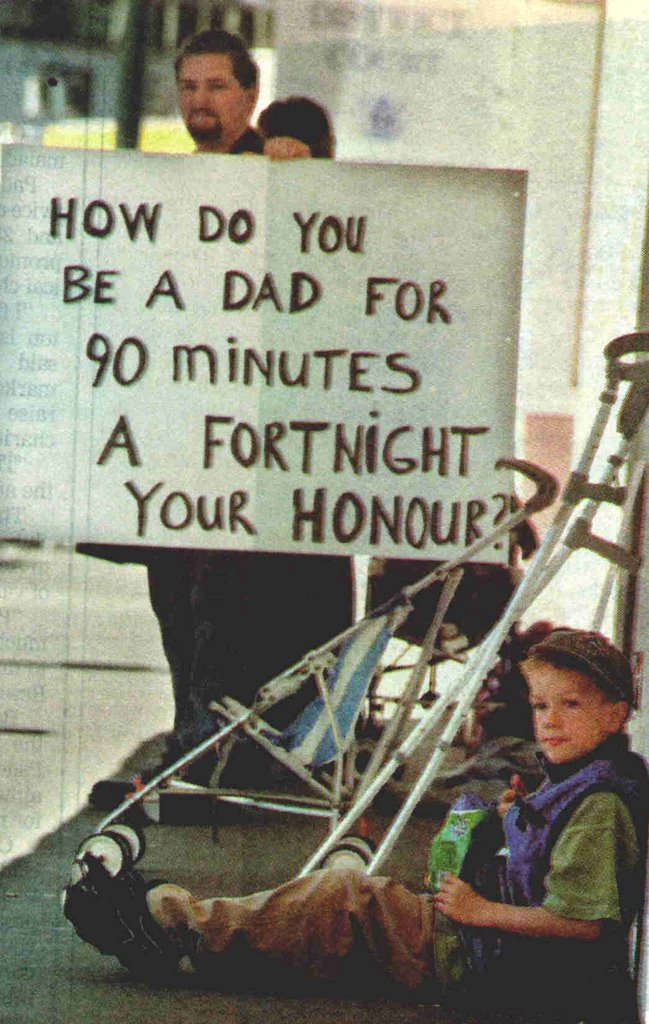
I took a friend to the Social Services Select Committee a couple of years back. They were taking submissions on the Care of Children Bill. He wasn't very articulate and blew all the arrangements we'd made beforehand about how we would present. He might even have come across as slightly wild-eyed. But that didn't change his story. He had fought for the custody of his three children for eight years. He feared for their safety. The court-appointed counsel for children constituted a huge barrier. Eventually he gave up. Soon after his ex appeared with the children and left them. She never returned. He still has them and they seem to be doing well.

When we look at the guys currently protesting it pays to consider what they have endured. In the seventies feminists decided it was cruel to remove children from their natural mothers. Society all but dispensed with adoption. As with mothers, in most cases, it is equally cruel to remove children from their fathers.

Strange headline


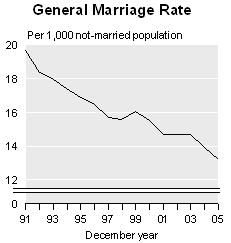
The headline that accompanies this graph from NZ Statistics is "Marriages Maintain Momentum"

I wonder what the chart accompanying "Marriages Lose Momentum" would look like.

UPDATE; Stuff don't see it quite that way with their headline "Fewer Kiwis saying 'I do'".

Welfare spending budget projections

Here are welfare expenditure figures in $ million;

The first is 2005 actual, the second is 2010 forecast and finally the percentage change

Super 6,083 7,902 +30%
DPB 1,547 1,582 +2
Unemployment 831 985 +19
Accommodation Supplement 750 961 +28
Invalids Benefit 1,026 1,282 +25
(Sickness Benefit 510 682 +34
Disability allowance 267 328 +23
Income related rents 370 471 +27
Family Support 846 2,072 +144
Child Tax Credit 141 9 -936
Special benefit 175 15 -914
In Work Payment 0 526
Benefits paid in Australia 91 48 -47
Paid Parental Leave 76 160 +111
Other Benefits 613 835 +36

Total 13,326 17,858 +36

(Excluding Super 7,243 9,956 +37)

Add to these:

Departmental expenses 781 782
Non-Departmental 423 433
Rehab and compensation 152 173

Total 14,682 19,246 +31

...and I've left out the pension fund.

Put into context working-age welfare will increase by 37 percent, Health by 23 percent and Education by 20 percent.

Mania for management

It is bad enough that spending on health "managers, administrators, supervisors and clerical staff" etc has reached $500 million but don't forget the added burden as these people extract their pound of flesh from the frontliners. With extra bureaucracy comes more analysis of systems, more paperwork, more meetings, more change for the sake of change. The productive time of medical staff is reduced. No wonder the government has put 50 percent more in and got less out.

Dilemma for do-gooders

In the 60s and 70s the abiding angst was over skinny, anaemic kids who got hustled off to health camps. Skinny = bad.

By the 80s we were witnessing the beginnings of massive paranoia over the anorexia nervosa 'epidemic'. Then we had the PC backlash calling for non-judgementalism about body shape lest we create an unhealthy, even fatal, obsession.

Now that's all out of the window. Apparently "self esteem" is no longer the flavour of the day, as we unrelentingly highlight obese kids in an attempt to legislate them into 'healthy' conventionality. Fat = bad.

In the UK, "From next year, however, parents of any obese 4- or 10-year-olds can expect a letter telling them their child faces long-term health damage unless they lose weight. The about-turn came after MPs dismissed as 'drivel' claims that telling parents the results could lead to children being bullied."

Obesity campaigners say the danger to obese children's future health is so great it outweighs any fears of bullying.

What a dilemma for those who would stick their beaks into other people's lives. Which is more important. Physical or emotional health?

Sunday, May 21, 2006

Redistribution NZ- Style

Did you know that;

- 12 percent of people are paying 50 percent of the income tax collected?

- 65 percent of people are paying 20 percent of the income tax collected?

Consider this:

Average family gross income: ($)
- couple with children 88,661
- couple with no children 70,184
- sole parent 27,806
- single person 27,740

(Includes benefits and other non-wage income for year ended June 2007).

Couples with children are, on average, the highest income earners. Yet this is the group current economic policy targets for increased redistribution receipt.

A family with two children qualifies for Family Support up to $65,940 and the In-Work payment up to $81,540. The highest cut-off point for family income assistance is now $109,880.

The childless have three options; have kids, pay for somebody else's or leave the country.

Police "trickery" backfires

Here's an interesting story from Scotland.

THREE men who were on trial for armed robbery walked free from court after a judge ruled that their human rights had been breached when police listened in to conversations in their cells.

Saturday, May 20, 2006

Do you care?

National law and order spokesman Simon Power said the public would be shocked to know that drivers could be 10 per cent more drunk than their breath tests showed.

"We've always been told the limit's the limit," he told the Dominion Post newspaper.

The legal limit is 400 micrograms of alcohol per litre of breath for adults on a full license, and 150mcg for those aged under 20.

But New Zealand breath-tests will not return a positive result unless drivers have 440mcg or 170mcg in their breath.

Shocked? Big deal. Really. I'm shocked he can be bothered. I accept there needs to be limits on drinking before driving but not that people are categorically "drunk" at a specified level. Saying somebody is "ten percent more drunk" is silly.

Eye to Eye

Eye to Eye at 9.30 on TV 1 looks to be another brawl. Subject: What's in the budget for Maori? Apparently Hone Harawira says the only thing in the budget for Maori is more police to arrest them. Must away and watch it.

UPDATE; Well, I was right. It was a brawl. Clayton Cosgrove and Shane Jones on the left and John Key and Hone Harawira on the right. Willie Jackson in the middle goading them on. You know, the more I see of Shane Jones, the great Maori hope, the less I want to see of him. He is a smart arse but not a very good one. With lines like, "I want to ask Willie if he is a casting agent because Hone is acting" and "I want all New Zealanders to wake up because John has just put them to sleep" and "Give me the lotto numbers Hone if you can read my mind." Oh, save me.

Hone is one angry man. He thumbs it with his dress and language and comes over as a streetfighter. He is mad as hell at Shane Jones who he sees as a traitor to the Maori cause. "What really pisses me off is Shane understands this shit. These other guys don't."

Clayton Cosgrove had to try and get down and dirty with the boys and came out with probably the nastiest remark of all (which had nothing to do with the subject). "Don Brash stands up in Parliament everyday and you can smell the embalming fluid and formaldehyde on his breath." Having got Don off his chest he had a go at Rodney. "Rodney Hide will win (Dancing with the Stars) because he has two dances; the Hussle, which we all know he's very good at and the Limbo - no-one goes lower than Rodney."

John Key said that there was nothing in the budget for Maori because there was nothing in the budget for anyone! He kept calm and good-humoured throughout and won the match by default.

Truly. This programme is theatre. It isn't political debate. It replays Tuesday night.

Friday, May 19, 2006

A different perspective (cont)

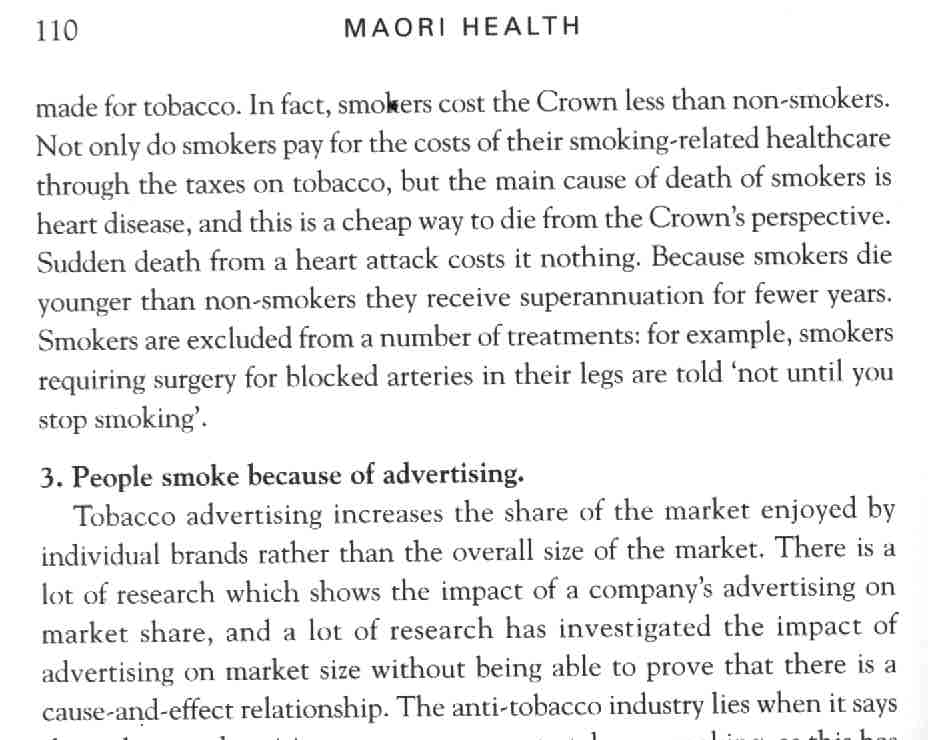
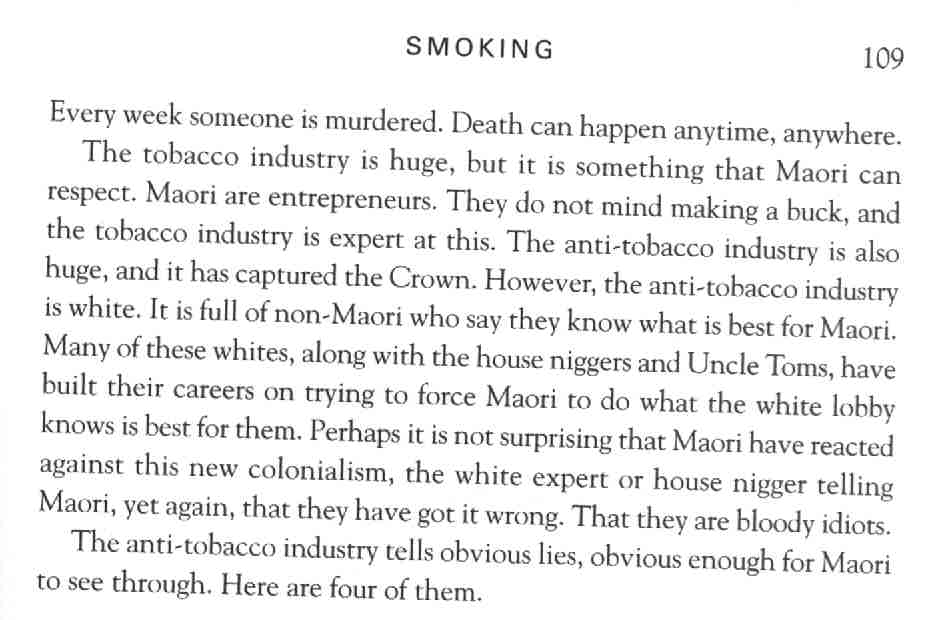
...The anti-tobacco industry tells obvious lies, obvious enough for Maori to see through. Here are four of them;


A different perspective

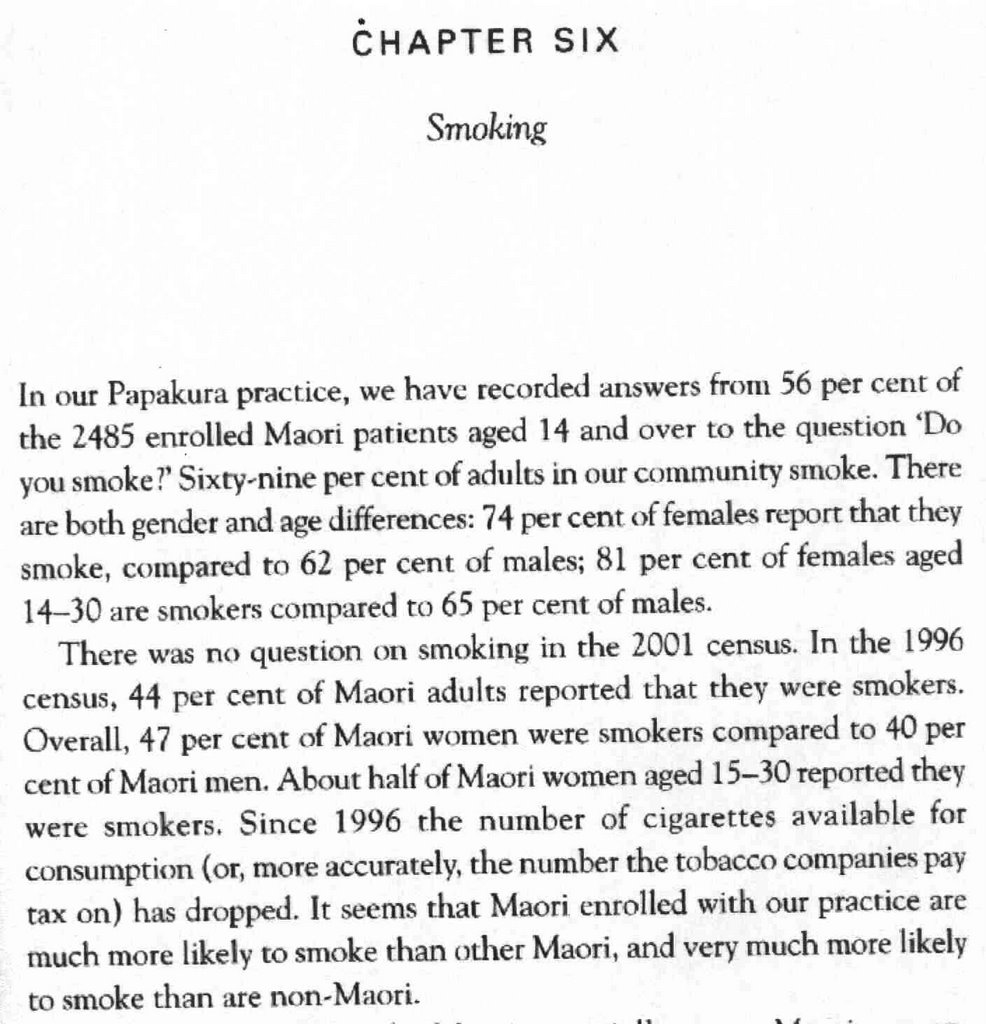
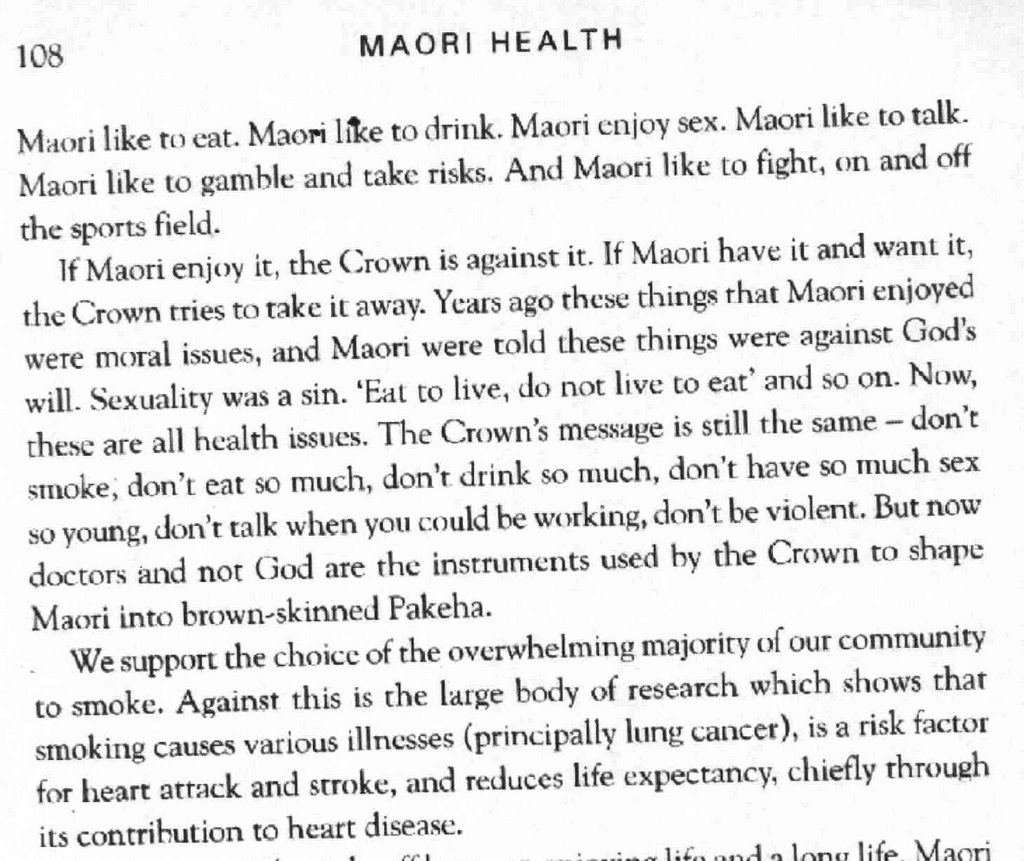
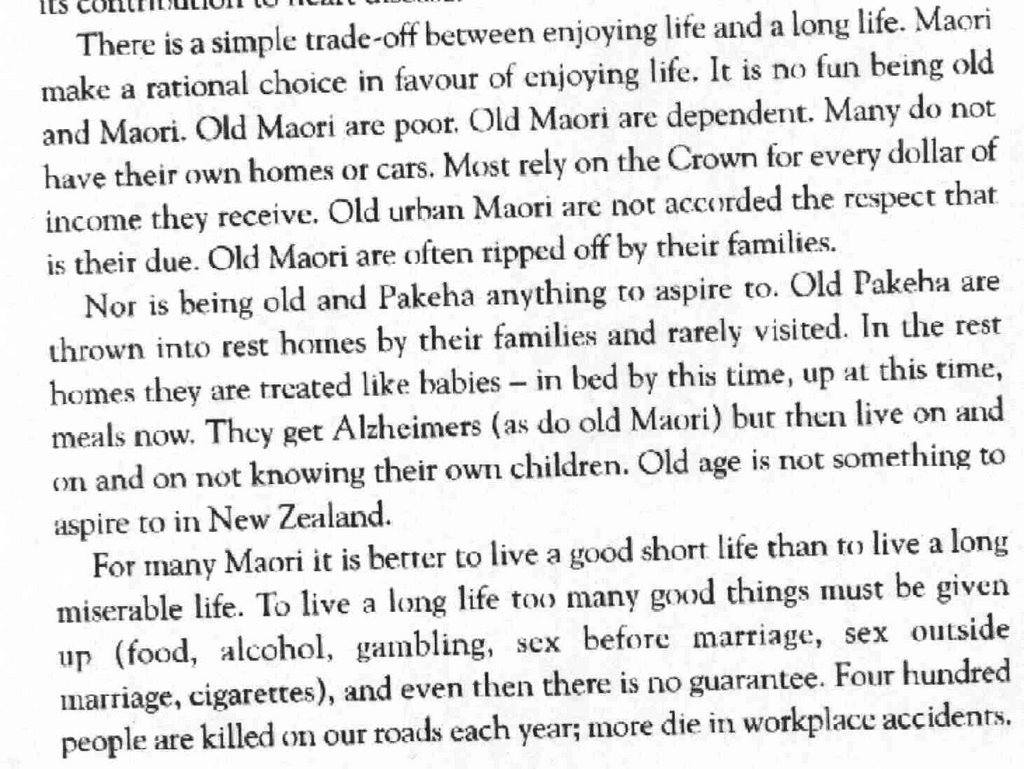
I got this book out of the library called Maori Health and I don't want to give it back. If Hone Harawira is North these guys, Peter Caccioppoli (Ngati Kahungunu) and GP Rhys Cullen, are South. It's deliciously forthright. When you spend too much time trawling through tracts of unctuous material put out by state agencies and state-sponsored do-gooders you need an antidote. This is it;


(Let me know if you want the rest)

Spreading ideas

Here's my media release from yesterday. It went out to a number of National MPs, including Judith Collins. In it I said, "It is bad news for children that the Child Poverty Action Group has today won the right to take the government to court over what it calls a 'discriminatory' In Work payment......Welfare breeds poverty".

Here's a NewstalkZB item this morning in which Judith Collins says, "It is bad news for children that the government can be taken to the Human Rights Review Tribunal for not extending 'In Work' payments to beneficiaries....Welfare breeds poverty."

It's a surreal feeling when you hear your words followed by somebody else's name.

Post-budget thoughts

What I enjoy about post-budget day is the graphs depicting government spending get prominence in all the papers and people, for at least one day of the year, look at where the money is going. Wow. We are spending as much on the DPB as we spend on Defence. Well, actually, we spend more on people on the DPB. An extra 1 percent is hidden away in "other" benefits. (1 percent equates to over half a billion dollars).

Of course, the big story with welfare spending is that it's static. If this is what we get after the 'up' stage of the economic cycle what can we expect after the 'down'?

And why all the focus on National Identity? I think there is a word conveniently missing off the end. What is the government softening us up for? Think Britain and Blair.


Hey Diddle Diddle
Cullen's on the Fiddle
The Cow's just Over the Moon
The Poodle laughed to see such fun
As the Pork Barrels rolled into June

Thursday, May 18, 2006

Intent on state dependence

The Ministry of Social Development releases a Statement of Intent to accompany the 2006 Budget.

What do they intend? To ..... provide income-tested benefits to almost 1.2 million New Zealanders

The provisional population estimate for 15+ year-olds in 2006 is 3,257,480.

Well over a third receive an income-tested benefit.

When Child, Youth and Family merges with the MSD on 1 July 2006 the Ministry will have 9,000 staff. Hallelujah.

Serious stuff from the socialists

Ooooh, this is scary. According to the Worldwide Socialist Website, Clark has been throwing dust in the eyes of the electorate while she secretly cosies up to the Bush administration. Even the Poodle is part of a clever conspiracy to deceive.

CPAG get green light

According to Stuff, the Child Poverty Action Group (CPAG) has won its bid to take legal action against the Government's Working for Families package.

....in a reserved decision in the High Court today, Justice Ronald Young dismissed the (government's)challenge to the case going ahead.


Simply, Working for Families introduced an In Work payment that only single parents working a minimum of twenty hours or partnered parents, 30 hours, would qualify for. CPAG claim this discriminates against children of beneficiaries. I argue against the proposition here.

Just this morning I read a statement by author Margaret McClure. "As early as 1979 the New Zealand Planning Council had feared that 'the welfare state faces a built-in problem that it is almost impossible to stop doing what has been done before.'"

Ain't that the truth.

" The GDP needs our misfortune"

Pita Sharples is making a big hit in some quarters. He has charisma and presence. He is also off the planet. Here he argues that GDP grows on the back of Maori misery. That building prisons creates economic activity and treating heart attacks, which Maori men suffer more of, brings money into the country.

The construction of new prisons is not just good news for GDP - it is great news! New buildings, new jobs, associated industries and a flurry of economic activity.....

The life expectancy for Maori is significantly lower than the life expectancy of the total population; with a difference of about 7.6 years between Maori and the total population.

Heart attacks are counted to mean something in the GDP.

They bring cash in to the economy - through drugs, hospital beds, medical supplies, nurses, doctors, theatre and intensive care staff, heart surgeons and community workers who support coronary care.

I'm not an economist but this looks like Henry Hazlitt's broken window fallacy.

A vandal throws a brick through a shopkeeper's window. The shopkeeper will have to purchase a new window from a glass shop for a sum of money, say $250. A crowd of people who see the broken window decide that the broken window may have positive benefits:

"After all, if windows were never broken, what would happen to the glass business? Then, of course, the thing is endless. The glazier will have $250 more to spend with other merchants, and these in turn will have $250 to spend with still other merchants, and so ad infinitum. The smashed window will go on providing money and employment in ever-widening circles. The logical conclusion from all this would be ... that the little hoodlum who threw the brick, far from being a public menace, was a public benefactor." (p. 23 - Hazlitt)

The crowd is correct in realizing that the local glass shop will benefit from this act of vandalism. They have not considered, however, what the shopkeeper would have spent the $250 on something else if he did not have to replace the window. He might have been saving that money for a new set of golf clubs, but since he has now spent the money, he cannot and the golf shop has lost a sale. He might have used the money to purchase new equipment for his business, or to take a vacation, or to purchase new clothing. So the glass store's gain is another store's loss, so there hasn't been a net gain in economic activity. In fact, there has been a decline in the economy:

"Instead of [the shopkeeper] having a window and $250, he now has merely a window. Or, as he was planning to buy the suit that very afternoon, instead of having both a window and a suit he must be content with the window or the suit. If we think of him as a part of the community, the community has lost a new suit that might otherwise have come into being, and is just that much poorer." (p. 24 - Hazlitt)

When we lock somebody up, or we treat their heart attack, it takes money that could have been spent elsewhere adding value.

"I know - it sounds crazy," Pita says.

It sounds crazy because it is crazy.

United Future - saps

Last night United Future voted with the government against the Green's micro-chipping amendment which would have seen this pathetic idea sent back to select committee for review. The amendment was defeated 61 to 60.

In March Gordon Copeland argued vehemently for farm dog exemption, then later conceded all the arguments applied to non-farmdogs. But given the opportunity to demonstrate this concession wouldn't take it. How foolish he looks. As Hone would say, that's politix.

Wednesday, May 17, 2006

"Babies having babies"

On Monday I blogged about out-of control Eltham youths. Last night 300 people turned out to a public meeting to discuss what to do (300 in a town the size of Eltham is an amazing turn-out).

Resident Mavis Higgins told the meeting, organised by the local Lions club, that petty crime, vandalism and bullying was caused principally by "too many babies having too many babies".

"They don't know how to bring up their kids and we've let the situation happen because we've sat back and done nothing," she said.


I'd have to disagree with Mavis. We've done plenty to encourage "babies having babies."

Horomia; "It is very hard working with Maori"

If you can be bothered, read through these exchanges from today's question time. Listening to it was worse. Tau tackles Te Puni Kokiri but gets tripped up with trivia, Horomia eventually tells us what he really thinks and Tariana says the opposite of what she intended.

12. Hon TAU HENARE (National) to the Minister of Mâori Affairs: Does he stand by his translated statement in the House yesterday regarding Te Puni Kôkiri that it is not right to say here whether his ministry is “a waste of time for Mâori”; if so, where does he believe Te Puni Kôkiri should be held to account?

Hon PAREKURA HOROMIA (Minister of Mâori Affairs): Yes, I stand by the interpretation of my statement. It is not right to say here that Te Puni Kôkiri is a waste of time for Mâori. Te Puni Kôkiri is held to account in a number of ways to this House through the parliamentary process, which includes financial reviews.

Hon Tau Henare: Does he stand by his chief executive’s position that the laws of New Zealand, passed by this very Parliament and enforced by the courts, are not prescriptive but rather merely a set of guidelines one can follow if one wishes?

Hon PAREKURA HOROMIA: Part of that I agree with, but certainly I believe that people in glasshouses should not throw stones; that certain members who should abide by the legislation that binds this House to good governance go out and leak documents from financial review committees.

Dave Hereora: What will be the specific focus of Te Puni Kôkiri over the next 12 months?

Hon PAREKURA HOROMIA: Te Puni Kôkiri is on a roll. Certainly, I remember—[Interruption] Te Puni Kôkiri’s Mâori Business Facilitation Service—and I can tell that member that this Minister of Health is going to be here for a long time—won the Vero award for the best participation development between the private sector and the public sector, and we are going to do a lot more about that. We are about keeping Mâori out of prison, about putting more Mâori into jobs, and about helping Mâori achieve a higher level of education. That is what we will do.

Tariana Turia: Tçnâ koe, Madam Speaker; tçnâ tâtou te Whare. Further to the Minister’s answer yesterday, that monitoring reports were to be found in Te Puni Kôkiri’s annual report to Parliament, and in light of Te Puni Kôkiri’s 2005 annual report, which failed to provide any information on the output purchased monitoring of other State sector agency initiatives, can he tell this Parliament what monitoring reports Te Puni Kôkiri has produced and where they are?

Hon PAREKURA HOROMIA: Te Puni Kôkiri takes its monitoring and liaising role very seriously. Te Puni Kôkiri is meeting its responsibilities under its legislation and it is doing that well—and a whole lot more. The Office of the Controller and Auditor-General found in its audit for the last financial year that there were no significant legislative breaches, and it is noted that the office gave Te Puni Kôkiri a good assessment.

Hon Tau Henare: Given the Minister’s answer to my supplementary question, which asked: “Does he stand by his chief executive’s position that the laws of New Zealand, passed by this very Parliament and enforced by the courts, are not prescriptive but rather merely a set of guidelines one can follow if one wishes?”, which part of that question does he agree with?

Hon PAREKURA HOROMIA: I agree with most of it. But I want to talk about that former Minister when National had its time in Government, in the sense of the endless reports that that Government produced on negative statistics. We should look at what this Government is doing. It should not be about leaking and it should not be about members in this House who use it to ignore the rules.

Tariana Turia: Will he direct Te Puni Kôkiri to monitor the health of nearly 50 percent of Mâori children, some 93,423 children, who will benefit from the heavily promoted in-work payment because their parents are beneficiaries; or is the monitoring of the health and well-being of tangata whenua also a waste of time?

Hon PAREKURA HOROMIA: It is a role that the Ministry of Health, steered by this Government, is managing very well. I assure the member that we have delivered reports, and supports, and those developments that we take very seriously. Working for Families is about that, and making sure that those parents and those children are being looked after is something this Government takes very, very seriously.

Tariana Turia: I seek leave to table the annual report of Te Puni Kôkiri, which clearly shows that no monitoring of other State agencies was done.

Leave granted.

Hon Phil Goff: Can the Minister confirm that during his time as Minister in charge of Te Puni Kôkiri, Mâori unemployment has halved and that the real waste of time for Mâori people was the Minister from 1996 to 1998, Tau Henare, who promised to halve unemployment among Mâori but instead increased it by 5 percent?

Hon PAREKURA HOROMIA: Mâori unemployment has decreased by exactly 61 percent. Mâori enjoy being in work, and they enjoy being paid. That member set up three commissions, wasted a lot of money, and got nothing done for Mâori. We have done plenty for Mâori.

Hon Tau Henare: Is the Minister concerned that the recent financial review of his ministry found that it could not even answer questions about the delivery of its local level solutions programme; and when is he going to brief his ministry on what he is doing for his $180,000 per year?

Hon PAREKURA HOROMIA: It is actually $195,000. I tell that member that we have moved on, and the issue is that we are going to focus on Mâori potential. We are going to use those good deeds out of local level solutions that my friend Tariana Turia was involved in, and we are making better use of them—more Mâori in jobs, more Mâori in high level education, and more Mâori getting into asset development. It is great stuff.

Hon Phil Goff: Did the Minister find in that financial review that one Tau Henare had yet paid back the $47 he owed the department as a beneficiary, which he said he would not be paying back?

Hon PAREKURA HOROMIA: I am not too sure about that. But what did concern me is that that member flouted the laws and the rules of this great bastion of governance. He did that. He leeched us.

Hon Tau Henare: Does the Minister stand by his support of Mita Ririnui’s statement—support he gave in this House on 14 March this year—that advocacy of Mâori is tiresome; if so, what new career is he looking at now that he is tired of advocating for his people?

Hon PAREKURA HOROMIA: I do not believe that my colleague made such a statement. But if we are honest, and we are in this party, it is stressful at times—[Interruption] Totally honest! Those members should ask Dr Sharples. They should ask Hone Harawira. It is very hard working with Mâori. Tariana Turia will tell members that. So I do not know what people he is talking about, because our people are trying at times. But me and Mita Ririnui love them, and we will do our best while we are in Government to make sure they go forward, not backwards.

Hon Tau Henare: I seek leave to table the speech of Mita Ririnui—the one where the Minister of Mâori Affairs actually supported him.

Madam SPEAKER: Leave is sought to table that document. Is there any objection? There is.

Hon Tau Henare: I wish to make a personal statement relating to the accusations that the Hon Phil Goff just raised. I advise the House that some years ago, when this issue was raised, I did pay back the $47 to the then Minister of Social Welfare, Roger Sowry.

Hon Phil Goff: I seek leave to table an extract from the Sunday Star-Times of December 2000, in which Tau Henare said he would not be paying back a social welfare payment of $47, a debt he had incurred as a beneficiary 20 years ago.

Madam SPEAKER: Leave is sought to table that document. Is there any objection? There is objection.

Hon Tau Henare: I raise a point of order, Madam Speaker. Just a matter of clarification, I actually said that when I was in the House. I was not in the House in 2000.

Ron Mark: Does the Minister believe that the role played by Te Puni Kôkiri in promoting the ahu whenua awards and promoting Mâori excellence in farming such as that showcased in Rotorua last Friday evening is work of value, and what feedback did Te Puni Kôkiri receive from AgResearch, Federated Farmers, Dairy InSight, and the other key players in the agricultural industry in respect of Mâori farming and Mâori development?

Hon PAREKURA HOROMIA: It was all positive, and Te Puni Kôkiri has been involved in it. The big companies and the industry training organisations were there and they reaffirmed the 1,375 Mâori who are working in the agricultural industry training organisations and whom we will move on, and up, and into employment.

Gerry Brownlee: I raise a point of order, Madam Speaker.

Madam SPEAKER: This is not in the guise of a supplementary question, I hope, Mr Brownlee.

Gerry Brownlee: No, it is not. I am extremely worried by the revelation in the House today that the Hon Parekura Horomia is getting a salary of $195,000. I am wondering whether we can seek leave to have him explain whether perhaps that is his salary, while other Ministers’ salaries are $216,000?

Madam SPEAKER: That is not a point of order; nor was it a supplementary question.

ENDS

"Buy Kiwi-made" is another immoral programme

Apart from the anti-trade nature of this $11.5 million programme there is another aspect I find repugnant.

Importers are forced to pay government to encourage people away from their products. They are doubly-diddled.

If a bunch of NZ producers want to get together to promote Buy Kiwi-made, fine. But it should not be funded from taxation.

Misery loves company?

Why on earth would anyone google "misery"? Auckland has more people googling the word "misery" than any other city in the world.

Update; I gave in and googled "misery". This might have something to do with it:-)

What Hone thinks

Hone Harawira has launched a newsletter, Tokerau Times. As well as urging people to join the Maori roll he presses them to tune into Parliament;

LISTEN TO PARLIAMENT 882 AM

Most of it is crap, but whenever the Maori Party speaks, it’s always worth listening to!

Ka Kite!!


Well, he's not wrong. And the Maori Party speeches are always entertaining if not for the sheer audacity of their ideas. Is it just me or has Parliament really degenerated of late?

Benefits of the War on Drugs

In the interests of balance here is an article about the benefits of keeping drugs illegal.

(Link from Reason.com)

Tuesday, May 16, 2006

Census cost doubles

Thanks to parliamentary questions from Chris Tremain we now know that the budgeted cost for the 2006 Census is $74.2 million (excluding GST). This total includes the development of the online Census option. The actual costs are not yet available as the processing and output phases of the Census are still underway. The total budget for the 2001 Census was $37.9 million (excluding GST). The actual cost was approximately $39.1 million (excluding GST).

That is one heck of a lot of money, one heck of a big rise.

Imagine if, in 2011, they funded it directly. You would be presented with an invoice with your forms, billing you around $20 per person in the household. Of course the poor wouldn't be charged meaning the "rich" would have to pay considerably more - maybe $40 per person. That might focus a few minds on where the money goes.

Priorities

The government is going to spend an extra $500 million on 1,000 police.

Given the amount of offending that occurs before we lock criminals up and the level of re-offending that occurs when we let them out, wouldn't we be better using the half billion on the justice system and prisons? After all, the stated aim here is reducing the number of victims.

My understanding was (some years back) that police demoralisation was largely about delivering criminals to a court system which returned them to the community.

Pensioning the Politicians

I am not hugely fussed one way or the other about Rodney Hide's participation in Dancing with the Stars. Given there wouldn't be an ACT party without him, he can write his own ticket. But I was musing about some role reversal, perhaps a similar series called "Pensioning the Politicians."

High profile contestants would partner an MP, one from each party, who would coach them on parliamentary performance. Every week each contestant would get a question and several supplementaries, and be required to make at least five points of order. The press gallery would comment and score their performance and the public would vote.

Each week we would eliminate not only the contestant but his or her buddy MP! What a great way to dump six MPs.

And, of course, as the best parliamentarian, this is the contest Rodney would win.

Very funny


Heard about this on the radio yesterday. The BBC interviewed the wrong bloke. (Thanks to the WelfareStateWe'reIn for the link.)

IDAHO....

...stands for International Day Against Homophobia. (The 'O' is unexplained). Tomorrow is the second such day. Apart from the irritation these done-to-death "days of this " and "weeks of that" cause me, the following I found just plain baffling.

"Many people who are subjected to homophobic bullying or violence may not even identify as gay or lesbian. Schoolboys who are called “sissy” or abused for “playing like a girl”; girls labelled as tomboys; transgender women and men abused or beaten for their gender identity – are all victims of homophobia."

I don't get this. I was frequently described as a tomboy. My daughter is too. Is she a victim of homophobia?

I support the aim of, " ....ensuring that homosexual people here and throughout the world can live in freedom without fear," but this sort of silliness does GAP's cause no favours.

Don't tell the PM

Better hide this from HC. Her grand plan could kill two birds with one stone - fighting obesity and pumping up production.

Juggling a career along with being a wife or partner and parent may help to keep women healthy, scientists said this week....

...in the study published in the Journal of Epidemiology and Community Health, McMunn and her team analysed self-reported health records of more than 2,000 women at the ages of 26 and 54 and their body mass index, a method of measuring obesity.

Information on their marital status, work history and whether they had children was also included.

The researchers found that women who had been homemakers most of their lives were most likely to report poor health, followed by single mothers and childless women.

Homemakers tended to gain weight more quickly and had the highest rate of obesity at 38 per cent while women who were employees, wives and mothers had the lowest.

Monday, May 15, 2006

Careless comment from Commissioner

The Canadian Council on Social Development publishes a quarterly journal, Perception. In their Spring 2005 edition an article appeared; View from down under, Lessons from the New Zealand Experience. The writer interviewed Graham Kelly, New Zealand's High Commissioner to Canada;

New Zealand offers a cautionary tale of how bad thing can get when government wields a machete over its social programmes......

Through the 1990s, New Zealand’s government was known not for progressive social policy, but rather the opposite – radical dismantlement of government.

Graham Kelly, a former Labour MP who for 16 years “mostly represented poor people,” refers to that period as “a revolution.”

“When Stalin sold the wheat crop to industrialize, six million people starved. It was about that scale in NZ,” says Kelly, who is now New Zealand’s High Commissioner to Canada.


Graham Kelly has been trouble before when he made careless remarks about Maori and other ethnic minorities. I am astounded that our High Commissioner to Canada would make such an ignorant statement.

CCSD published this article. Their president, Marcel Lauziere, is currently serving a two-year stint as Deputy Chief Executive of our Ministry of Social Development.

A tragic trend

In 2004 436 people died on the roads.

In 2004 488 babies were still-born.

I contrast the two because the clamour over the first is constant and strident. What have you heard about the second, beyond one or two high profile incidents?

A stillbirth is a terrible tragedy. Miscarriages are bad enough but if you go on to conceive again quite quickly the result is you have a gorgeous child who otherwise wouldn't have been. There is nothing good comes from a stillbirth. Just loss.

The rate of stillbirths steadily dropped up until 1995. The definition of a stillbirth was changed in August that year resulting in a larger number than in 1994. Since, the numbers have fluctuated in the 300's. In 2004 there was a significant jump - 40 percent up on 2003. I will post the 2005 figure when it becomes available.

There is something amiss here.

Update; In 2005 there were 362 stillbirths. A drop back to "normal" range. But still one a day.

What to do?

On one hand we wonder about stories like this, where a Turangi teenager kills another and this, where Eltham youths, "thieves, taggers, vandals and thugs" run riot.

On the other we get reports about kids who nobody will provide a home to - not even their own parents.

I'm afraid I don't see anything but our prison population continuing to rise.

UK govt to advise home births best

Given the state of the NHS perhaps it shouldn't come as a surprise that the government is considering a new policy - official advice; stay at home for the birth of your baby. Perhaps the balance has tipped and home is indeed now the safer option. Even in NZ (seven years ago at least) the maternity ward wasn't as clean as my own home. I'll spare you the details.

The Independent on Sunday reported yesterday that Tony Blair's Labour Government is planning a "strategic shift" in childbirth policy away from hospital delivery and has commissioned research to support the case for home births. and "challenge the assumption that births should take place in hospitals".

The Secretary of State wants to "demedicalise" pregnancy


Where Britain goes, we usually follow. Given the huge push over the past 2-3 decades to shorten the maternity stay (even resorting to bribes), having no stay at all should look pretty appealing to struggling health boards.

Sunday, May 14, 2006

Disenchantment with the State

The enormous cost of a handful of Christchurch crime families made news this week. Here is an excellent Hawkes Bay Today editorial by the consistently good Louis Pierard.

....a study in Hawke's Bay would likely show families that perpetuate the plundering of others with equal enthusiasm and cost; families for whom "parenting" is merely the biological imperative of reproduction; in which the young are schooled exclusively and extensively in the parasitic arts and in exploiting the law that is supposed to be discouraging them.

When Canterbury's statistics are extrapolated nationwide, it is little wonder disenchantment - of public and police - runs so deep at the State's record of protecting its citizens from crime.

"The man who would be Gordon's guru"

Fraser Nelson of the Spectator talks to libertarian author Charles Murray.

"Here's what I don't understand. Gordon Brown is very well-read, including books he doesn't agree with. He will have noticed things are getting worse. Things have not just failed to improve as welfare has increased; civil society in lower-income Britain is going off a cliff. So why doesn't he ask whether there could possibly be a relationship between the welfare efforts he is making, and the deterioration observed?"

"Cruelty consists of a glib assumption that government support for children can compensate for the absence of the father. That is an assumption which is now refuted by a mountain of data. In the United States, unlike Britain, there has been a wealth of studies on children in different marital situations. You can control for income, race, all the usual suspects. Again and again the same findings come out: children do best raised by both biological parents, whether you measure depinquency, truancy, psychological development, anything."


"A divorced mother is next best. Doesn't really matter if she remarries or not, step-fathers don't do much good. And way down the ladder, right at the bottom, are the outcomes of children born to single women. This has been proven again and again, yet when I go over the England and talk, scholars over there are not even aware that this literature exists in the United States. It's a kind of head-in-the-sand thing, yet what we are talking about is empirical fact, with which Britain refuses to come to grips."

"I think the Left finds it very difficult to give up its power to stage-manage the lives of the people it is trying to help. Allowing people to do what they want causes them deep distress. Gordon Brown seems to show this as much as anybody."

But will Murray's thinking shape the Conservatives? Murray holds out little hope.

"Just look at the Tories, including my dear friend David Willetts, calling for a softer, kinder Conservative Party. It's hopeless. For some reason, in England you still cannot say,'I want to slash all those welfare programmes because they are screwing poor people to the wall.'"


My note. You can't say it in New Zealand either.

Funding Women's Refuge 2

Earlier in the week I was critical of the Women’s Refuge asking for more taxpayer money when the major cause of their under-funding seemed to come from the big jump in the average length of stay. I asked why refuges were being used as an accommodation source when the government provides state housing and accommodation supplements.

This reveals that around 400 women, staying in refuges for sometimes over a year, are immigrants who don’t qualify for benefits. It should also be said that the rise in domestic violence is due in part to growth of some ethnic populations.

Getting this sort of information out to the public is critical. I am more inclined to put my hand in my own pocket now I understand the problem.

Saturday, May 13, 2006

It's true, Oswald!


OK. Where's 290 degrees? 250 and two notches more must be it. Whack it up. Leave one hour, as per instructions. Hell's bells. Smoke billowing out of oven, out of house... oven is still filthy. Grab conventional heavy duty oven cleaner. Spray on madly. AAAaaah. All gasping and gagging as the smoke carries caustic fumes throughout. All don emergency teatowels burkha-style. Slam oven shut. Re-read instructions.

"If using caustic oven cleaners in the Oven, remove all Self-Clean panels prior to application." (Emphasis by oven manufacturer.)

Ohhhhh bugger. Chill bottle of wine - quick. Deep freeze usually chills in couple of hours. Forgot just cleared out massive icebergs and is now ops normal. 2 hours later - one frozen solid bottle of ... oh, who cares. Anything that comes out of the bottle will do.

Could've been worse. Could've been Mother's Day.

The rich are getting richer......

How many times have you heard that? The rich are getting richer and the poor are getting poorer. Why, just the other day I read it in an editorial in that lefty rag, the Manawatu Evening Standard.

This is a graph from the UK, released by National Statistics yesterday, where income inequality is falling.

It illustrates well how incomes are flattened by the tax and benefit system. I'd like to see an equivalent one for NZ, especially since the introduction of Working For Families. Note the final columns and the gap between them. That's the financial cost of state redistribution. The social costs are another matter......

!@#$%^&*&^%$#@!

Do the persons who invented a/ self-cleaning ovens and b/ frost-free freezers read this blog perchance?

If you do I have a message for you.......!@#$%^&*(*&^%$#@!......there are only two lies bigger than the ones you told.

There's got to be better ways to spend a sunny Saturday......

More on breeding in bonnie Scotland

Here's a good idea. Either put contraceptive into prescribed methadone or link the contraceptive regime to the methadone administration.

The Scotsman reports;
"Why are we in a situation where so many who are addicted to drugs are having children? As a first step, we should explore putting some form of oral contraception in methadone or using other methods. In that way we could reduce these problems and prevent some of these children coming into harm" - Duncan McNeil, Labour MSP for Greenock and Inverclyde

As long as the addict consents I can't see a problem.

From the sublime to the ridiculous

Last week we heard about the oldest mum-to-be in the UK. Now it's the youngest.

Her 34 year grandmother-to-be is very "proud" of her 12 year-old daughter who only smokes 20 cigarettes a day, according to the Scottish Sun.

Friday, May 12, 2006

Half full, half empty

The Maori Party serves at least one useful purpose. Spats periodically break out between their MPs and the Maori Labour MPs. Today it is between Parekura Horomia who is trumpeting Maori unemployment hitting a record low at 8.6 percent and Pita Sharples, Maori Party co-leader who is aghast that the Minister for Maori Affairs should be pleased with coming last.

Just as with any other group of individuals Maori have different ideas about what it takes to succeed and what constitutes success. The Maori Party believe in a collective view but, ironically, will provide the proof it can't be forced on all of their people. And I was encouraged that a few thousand Maori have actually moved from the Maori roll to the General roll during the recent electoral campaign.

On the subject of unemployment and Maori individuals, a teenage boy lives in a beneficiary home where there is genuine sickness and inability for the mother to work. He's not at school fulltime but he is involved with one-to-one educational catch-up for part of his day and has a job at Burger King for the other part. Things are looking up for him....except WINZ are set to cut his family support because he is too old to be a dependent, wiping $80 off his mother's income despite his still being at home.

WINZ recommendation to his mother is he goes on the unemployment benefit. But he doesn't want to go on the benefit, she says. He's got a job. If he has to give her his small wage he'll have none left for himself. He's proud of making his own money, but if he does what WINZ recommends he will have some to give his mother and some for himself. But he can't do that and work, unless he lies about it. Notice too, if he takes the second option the taxpayer will be even further out of pocket. It's a mess. It's so damn typical.

That's big-state bureaucracy. Their massive welfare agency can't be flexible or assess a situation based on its distinct characteristics. They have to stick to rules which keep people dependent, dispirited and directionless. Damn them again.

ME Awareness Day

No, it's not all about me. It's about ME.
Usual story. Government isn't doing enough.

Chronic Fatigue Syndrome. Any experience or theories?

Thursday, May 11, 2006

Parliament is a serious business

To Minister of Police, Annette King, regarding the use of uniformed civilians in police roles, National MP Simon Power asked, How do rural members of the public know, when they approach a person in police uniform and in an emergency situation, whether that person is a sworn and fully trained police officer, a decoy cop, or the lead singer from the Village People?

Parliament votes in more welfare

A commentor on the previous post said the lack of personal responsibility in NZ is a top-down phenomenon. He's only partly right. I see the lack of it coming from all directions. For instance, last night Parliament extended Paid Parental Leave, with cross party support.

Well, if you are going to pay unemployed mothers to stay home then it's hard to argue against paying working mums to stay home, and if you are going to pay working mums then it's hard to argue against paying ALL working mums. Now father's rights activists want it extended to them, as of right.

Rather than do away with policies which undermine personal responsibility Parliament just keeps on extending them. Has anybody ever heard of the PNR? And where was the opposition??

What a crock

"While we are disappointed our ranking has declined, this has more to do with changes in overall economic conditions, many of which are cyclical, than any genuine deterioration in our competitiveness."

That's Minister of Finance, Michael Cullen weasling his way out of dropping 6 places in the World Competitiveness Yearbook. SIX places.

Dole down - unemployment up 2

December 2005 Unemployment benefit = 51,426 Official unemployment rate = 3.6%
March 2006 Unemployment benefit = 44,549 Official unemployment rate = 3.9%

Hypothesis;

- the anomaly is caused by the lag between becoming unemployed and going on the dole
- the unemployed are on other benefits
- people went off the dole for reasons other than becoming employed eg went to Aussie
- the figures are wrong

Dole down - unemployment up

Back in early April I was critical of NZ Statistics for their sluggishness in releasing HLFS results. The US and Australia had their March 2006 quarter unemployment figures out within days. Over one month later our HLFS results are available.

Unemployment is up from 3.6 to 3.9 percent.

One area I monitor closely is the number of single parents with dependent children who are in "none employed" households. As the number of people on the DPB dropped by just under 3,000 from Dec 2005 to March 2006 I was expecting a drop in the "none employed" households. In fact, the result is the reverse of that. There was a rise of 2,700 taking the total to 46.6 percent of all One Parent with dependent children only.

Which would indicate the people who moved off the DPB did so for reasons other than work. Typically the main reasons would be transfer to another benefit, change of marital circumstances or leaving the country.

One mystery is solved though. Now I know why David Benson-Pope left it till yesterday to trumpet the March quarter dole numbers. Perhaps he knew today he'ed have to tell us the official unemployment rate has gone up. Confused?

.....an end to cats in the city!

So says the cat-curmudgeon Ray Springer. He wants $10 million from Christchurch rate-payers to operate his cat control programme which includes euthanising cats who break a curfew and microchipping.

"Get a goldfish" he says. I am sure there are plenty of Christchurch residents busting to tell him what he can get.

Blame it on the eighties

According to the NZ Herald, Members of Parliament's health select committee heard yesterday how New Zealand had experienced a "profound change" in the increase of obesity numbers in the late 1980s and a range of action was urgently needed to bring the numbers down.

Don't be surprised if some bright spark doesn't pop up today blaming obesity on the economic reforms.

Four years ago UNICEF published a report, "When the Invisible Hand Rocks the Cradle" which blamed New Zealand's child poverty problem on the eighties economic reforms. It's legitimate to consider what role they played. Unfortunately, having already decided what the cause was, the authors confined themselve's to the mid-eighties on. Any effects of the reforms were implicitly tied up with developments earlier than that. And, of course, we can never chart what the effects of NOT instigating the reforms would have been.

Wednesday, May 10, 2006

Good News

"The Welfare State We're In" is soon to be published in paperback AND the Sunday Telegraph will be serialising it. What we need is a New Zealand version.

Mothering isn't everything

Conservatists argue for at-home mothering but in some instances a child has improved life chances when they experience structured and quality child-care and early education.

Noble prize-winning economist, James Heckman of the University of Chicago says that the way a person's brain develops is heavily influenced by their interaction with their mother, father and any other care giver. The environment a new brain needs is one that is nourishing, nurturing and both intellectually and emotionally stimulating. Children often lack these if they come from families that are disadvantaged by poverty, the absence of a parent, the absence of wider family support or by the parents' lack of education or child-rearing skills.

Heckman did a follow-up study on a group of black children in Michigan who had been identified as having low intelligence and given special pre-school training that helped boost their IQ. The Perry intervention programme, which lifted the children's IQs initially, was later deemed a failure because the gain these children made seemed to be lost by the time they reached age 10. But 30 years later, compared to a control group, the Perry programme children had finished high school in the minimum amount of time, earned more money, owned their own homes, had never been on welfare and were less likely to have been arrested. Heckman says the difference was the "emotional intelligence" the children obtained during their special pre-school training when their brains were forming.

Emotional intelligence is how well people get along with others, how motivated they are and their ability to persevere and be tenacious. These are the attributes — combined with IQ — that helps people succeed. Heckman concludes that the emotional intelligence that disadvantaged children can gain from early childhood intervention results in their doing better in school, raises their productivity as workers, reduces welfare dependency and reduces crime. Heckman says the community benefits by eight-fold the cost of the early childhood intervention programme.


NB That's not to say I am advocating an increased role for state.

Things I would never think of

Reading this news from Australia about their "Dob-in-a-welfare cheat" scheme I was reminded of the latest dodge revealed to me. Get yourself into a position where WINZ agrees to subsidise or pay your power bill and then stick a fork in the electricity meter. Very soon you'll have a credit on your power statement. Don't know what the chances are of getting a cash refund but they were giving it a go!