Wednesday, April 29, 2020

Don Brash: Have we been conned?

Have we been conned? (originally published in elocal April 2020)

Perhaps it is dangerous to write about such a fast-moving situation as the Covid-19 pandemic when what I write may not be published for 10 days or more, but at time of writing my strong impression is that the public believe that the Government has done a remarkably good job of suppressing, perhaps even eliminating, the spread of Covid-19 in New Zealand, and that they deserve warm applause.

I believe the public has been conned.

To begin with, in common with most of the countries in Europe and North America but quite unlike the countries of East Asia, the New Zealand Government was very slow to take the virus seriously. Despite the Ministry of Health issuing a statement in late January talking of the extremely serious threat posed by the disease, the Government did little or nothing to prepare for its arrival on our shores for more than a month.

By contrast, and perhaps because they had had experience of the SARS epidemic some years ago, countries like South Korea, Taiwan, Singapore and Hong Kong swung swiftly into action with far-reaching testing and tracing. As a result, for example, Taiwan – geographically and economically much closer to the source of the virus in China than New Zealand – has vastly few total Covid- 19 cases than New Zealand has had. Indeed, on a per capita basis, New Zealand has had some 17 times as many cases as Taiwan has had.

As late as the middle of March, there had been no suggestion that the very large public ceremony to mark the anniversary of the Christchurch massacre would be cancelled, even though a crowded public event would have been the perfect way of spreading the virus.

On 17 March, the Minister of Finance announced what he called a “$12.1 billion support for New Zealanders and business”. Some of that was well targeted – including an extra $500 million for the health sector and a substantial wage subsidy to help businesses retain staff. Other parts were very poorly targeted, including a permanent increase in benefit levels and a change in the depreciation rules around commercial buildings. And the Government made it clear that they intended that a further increase in the minimum wage would still take place on 1 April, making it certain that whatever impact the virus had on employment would be made worse by a significant increase in the cost of employing people.

On 23 March, the Prime Minister announced that two days later the country was moving into an Alert Level 4 lockdown for four weeks. We had to do this, we were told, because otherwise “tens of thousands” of New Zealanders would die from the disease and our hospital system – especially the availability of ICU hospital beds – would be overwhelmed. Yes, there would an economic cost it was acknowledged, but faced with a choice between saving lives and worrying about dollars, the Prime Minister was clear that she placed a higher value on lives saved than on dollars.

Has it worked? Superficially yes. The number of new cases yesterday (I’m writing on 18 April) was just eight, only 14 people were in hospital, and only three were in ICU beds. Only 11 people have died from the virus. Perhaps we could even look forward to the day when New Zealand has no cases of Covid- 19, and we can all get back to work, though with our international borders permanently closed, or at least closed until an effective vaccine is discovered and deployed.

But very serious questions must be asked.

First, it is now clear that “tens of thousands of deaths” were never likely. Yes, some of the projections made by epidemiologists at Otago University suggested that deaths could rise to between 8,600 and 14,400 – not exactly “tens of thousands” but certainly a very large number – but those numbers assumed that the Ministry of Health would abandon its trace, test and isolate strategy. As Ian Harrison of Tailrisk Economics has noted, the same model “configured with effective tracing and isolation, and some other plausible assumptions, generated about 160 deaths” 1. And given that we have had 1,409 identified cases at this stage, and only 11 deaths as a result, it appears that the fatality rate is not much over 1% (I’m allowing for a few more deaths from those who, at time of writing, had contracted the disease but had not yet recovered).

Second, it also seems clear that Australia has had fewer cases of Covid-19 than New Zealand has had, on a per capita basis, despite having a much more relaxed attitude to “lock-down”.

Third, without exception all those who have died of Covid-19 in New Zealand are people who were over 70 (and most were over 80), all with one or more other serious “health issues”. While clearly overseas experience confirms that younger people can die of Covid-19, it appears that in other countries too those who have succumbed to the virus have overwhelmingly been over 70, and overwhelmingly people with other health issues. At no time has our hospital system even looked like being overwhelmed, and typically no more than three or four ICU beds have been occupied at one time – of the several hundred ICU beds which either are, or could quickly be, available.

More serious still is the fact that the Prime Minister seems to think that by locking the economy down tightly she is showing that she cares more about lives than about dollars. If she imagines for a single moment that locking the economy down tightly has no effect on lives lost she is even less well informed than I had imagined. We all know that four weeks of isolation in our respective bubbles has seen a marked spike in domestic violence. We can guess that seeing a business that one has spent years or decades building up destroyed in the course of a few weeks has led to an increase in suicide. And suddenly being unable to bring home a wage or salary will be having a similarly devastating effect on the mental health and lives of many tens of thousands of employees.

Professor John Gibson, one of New Zealand’s leading academic economists, has drawn attention to the fact that life expectancy is to some extent a function of real GDP per capita. He has noted in a recent paper that “if real per capita GDP in New Zealand falls by 10% due to the lockdown and other effects associated with Covid-19, life expectancy would be predicted to fall by 1.4 years” 2. Of course, not all the fall in real GDP per capita is a result of the lockdown: earnings from international tourism, and the education of foreign students, were going to fall precipitously, almost no matter how severe our cdomestic lockdown had been.

But there can be little doubt that severely locking down much of the economy will have cost a great many lives, and very probably many more than the lives clost to Covid-19 to date. As the Prime Minister must surely know, every time cthe Government decides to spend money on improving road safety, or cincreasing the Pharmac budget, or increasing the school lunch programme, they are implicitly (and often explicitly) calculating how many dollars they are willing to spend to save a life. I strongly suspect that in adopting perhaps the strictest lockdown regime in the world, the  government has cost more lives than it has saved.

Don Brash
April 2020

[1]The Ministry of Health’s modeling of the impact of the Coronavirus on New Zealand: A look behind the headlines, April 2020, Ian Harrison.

[2] Quoted in Croaking Cassandra, a blog by former Reserve Bank economist Michael Reddell, on 16 April 2020.

Dancing on the grave of Radio Sport

I recently wrote a piece about the forced  feminization of society.

Here's another blow for the boys. The death of Radio Sport, much to the delight of someone called Zoe George who, if the internet links are up-to-date, is paid by the state via RNZ.

She must have listened in to Radio Sport's farewell episode on Monday furiously scrawling her complaints, counting how many times sportswomen women weren't mentioned, taking offence at the blokiness and a derogatory mention of Paris Hilton (who I am sure subscribes to the adage '... any publicity is good publicity'), fulminating whilst formulating  "Why Radio Sport missed the mark."

"Only four female voices were heard among the sea of middle-aged men on Monday's show."

She quotes a female journalist who worked there briefly saying, "Radio Sport was never able to shake that macho appeal."

Well here's a thought. Perhaps it didn't want to.

Just where can men be men anymore?

A commercial enterprise, Radio Sport doubtless died from the lack of sport, sponsorship, advertising etc. under lock down conditions. More Covid collateral.

But no. Along comes this publicly-funded person to tell us all that it failed, "missed the mark"  because it refused to submit to feminization.

In conclusion she crows,"By taking all these blokes off the airwaves, the percentage of female sports journalists is higher than ever before."

Says it all really doesn't it?


Tuesday, April 28, 2020

"Eliminated" or "eradicated" it?

"Hammered" or "nailed" it?

Doesn't really matter. 

It's going to hurt.


Monday, April 27, 2020

Saturday, April 25, 2020

Why did the world go ballistic over Covid 19?

I keep trying to figure out why the world went ballistic over Covid 19.

There's been a string of scary viruses but  international panic didn't ensue. Deadly influenza circulates but international panic didn't ensue.

Yes, first world societies have become increasingly risk averse and legislated to reflect that. Health and safety is a suffocating, saturating blanket which employs thousands directly and indirectly. Its tentacles reach further and wider.

But I think there's more. The world has been primed with hysteria over the spectre of rising seas, the extinction of species, and searing temperatures that will become frankly non survivable. In the very near future no less. The masses appear to believe these predictions based mostly on modelling, some manipulated imagery and an acceptance that the science was settled and the scientists infallible. We are collectively cowering and unable to control our destiny.

Then, along comes a new and unknown threat. Covid 19.

The threat pretty quickly magnifies with modelling. We are conditioned to trust modelling because modelling gave us all the climate change predictions which are now part of our wall paper. Our articles of faith.

So a critical mass is already scared witless. The media provides evidence of that daily.

BUT at last a threat we can exercise some control over. We can don our masks and keep our distance. Make lifestyle changes with immediate individual consequences if not collective. Quickly we are aided and abetted by the authorities. Perhaps most importantly, validated.

Lock down, Stay home, Stay safe.

What relief.

Trouble is, one man's relief is another man's aggravation.


"Millions of cases; small amount of death"

I spent an hour watching this and found it rather compelling.

Two practicing doctors - specializing in immunology and microbiology - who are trying persuade the governor of California to end their lock down. This is the press conference they called on Wednesday last week.

"Acclaim for the PM boosts Labour in the polls – but voters may not be so kind as the recession bites"

A cut and paste from Point of Order:

"...is it   a  winning  narrative  first to exaggerate the  catastrophic  number of  deaths  likely from the coronvirus,  striking panic  into  the population,   and  then to claim “We saved you”?

That narrative  will not  resonate  with  small  business  owners   whose  dreams have been  shattered  by  the way the government   has operated  in the Covid-19  lockdown. Already many  are  convinced  the government’s  lockdown rules   have  been  far  too stringent,  an over-reaction  to  academic  modelling  that  was  wildly   inaccurate.

They are  asking   why   NZ  didn’t  follow   Australia’s  example  in  allowing  small and  medium  businesses  to continue  operating .

Then there is the problem with the  word  “kindness”.   It worked very well  for the  Prime  Minister   as  she steered the country through  the threatened  crisis.   But  how   will  that  go  if  unemployment   reaches  10% or  more of  the  workforce?

The danger  for the PM  and her ministers  is  that hundreds  of thousands  of  voters   may come to believe   they were  hoodwinked  into  being confined  in  their  cells  for the duration.

That belief,  if  mixed    with  socialist  policy solutions  for the  blitz  on  the economy  subsequent  to  the  pandemic,  could   prove a    fatal  political  cocktail.  The  record  shows  the  Ardern  coalition  carries too  much deadweight  in Cabinet   when it comes to framing  and implementing  policy.

Peter Dunne   summed it up  neatly:

“Critical to this whole process of crisis management is there being an actual crisis to manage.  That has been clearly the case in places like the US, Britain, Italy and Spain, for example, as the numbers of cases and deaths have been spiralling out of control and the public reaction has been one of desperate panic.

“While the potential impact for NZ was just as serious, the perverse consequence of acting early to avert the extent of the crisis has been that the extremes seen overseas have been averted. But an inevitable consequence is that some now question whether there was ever a crisis here in the first place”

What won’t  escape voters  is that  the  billions of  dollars    being spent  by the government as a  result of its decision to  fight  the pandemic in the  way   it did   will have to  be repaid,  not  just  by the  current generation of   taxpayers but by future  generations — and the  prosperity  which New Zealanders were  enjoying just a few  months  ago  may  not   return    any  time   soon.

So,   as   voters  approach the  ballot  box to cast their votes,  will   phrases like  “ Be  kind”  and  “we are  all  in this  together”   still be ringing in  their  ears?"

Complete article here

Personally I don't think there are any 'buts' or 'maybes' about it. It is one of the few comforting thoughts I have currently. She's gone come September ...

Thursday, April 23, 2020

NZ - The little engine that couldn't

NZ has always been  'the little engine that could.' It's endearing imagery but  also powerfully symbolic.

But thanks to our leadership and their reckless decision-making now compounded by dogmatic digging-in, we are fast becoming the little engine that couldn't.

Today exactly what many have predicted has begun. Pharmac backtracks on a cancer drug that could have saved 1,400 lives a year because, "it can no longer afford to make the investment." In a headlong rush to save the lives of an unknown but over-stated quantity,  the lives of a known number will be lost.

The economy, our very lifeblood, was all but switched off with no advice from people whose job it is to understand and appreciate  its criticality. I still can't work out why. Maybe Grant Robertson thought that NZ was  in a relatively strong position debt-wise and he could take risks, enormous risks with it. But I am dismayed and disgusted by how many people think it's a mere matter of switch off - switch on. Just like that. Hence their patronising chiding of the rest of us to 'just be patient. 'It's only a few more days in your bubble'. Or worse, their snitching to the authorities.

Hell's bells. Have these idiots (many deriving their security from Super or a public service salary)  really thought any further than the end of their twitchy noses? They seem incapable of joining the dots beyond just A to B. Austerity will come as a rude and rough shock and they will deserve it.

Everyone of us is a domino to some degree.

Many have all ready fallen over. Tragically, today it was lung cancer patient's turn

"A government big enough to give you everything you want, is a government big enough to take away everything that you have." 

Monday, April 20, 2020

ANYONE FOR A PROTEST?

OK. People everywhere are banging away on their keyboards (especially on KiwiBlog) and that's fine. But all the angry frustrated commenting  does is dissipate the anger and frustration.

The economy is dying in front of us.

The modelling that caused the move to level 4 has been subsequently discredited.

There is enough evidence now to convince that the cure IS worse than the disease.

Every day business cannot operate their prognosis worsens.

I would go and stand on the lawn at Parliament with a banner conveying any one of these messages (and there are more) but I'd be swiftly removed under the new laws the police have been given (though the sole climate change protester stayed there for weeks).

Three people made sense to me yesterday and none was the PM. Sir Ray Avery (we cannot eliminate Covid), Oliver Hartwich (the economy is getting sicker by the day - exponentially) and Ian Harrison (the modelling the govt relied on was flawed.)

We should be moving out of Level 4 right now and to 2 if not 1.

If you are in the Wellington area and feel like I do email me.

"The Statisticians That Killed New Zealand"

A response to the Covid crisis strategy from Sir Ray Avery (if you haven't already seen it):

The most worrisome of words routinely used by Jacinda Adern, Ashley Bloomfield and Shaun Hendy is the rhetoric around New Zealand's mission to eradicate COVID-19 in New Zealand .
This has no scientific validity and if we continue on this course to get our infection rates down to zero then our country will become bankrupt for no good reason.

Over-Arderned

The Dominion Post features no less than five images of Jacinda Ardern this morning. On the front page, pages 7 and 8, and 13 and 14. Perhaps an editorial decision was taken to fill the void left by avoidable women's mags.

This led me to reflect yet again how visible previous leaders would have been in a similar crisis.

I cannot for instance imagine Helen Clark appearing daily to make housekeeping-type  announcements.Neither can I envisage John Key being so heavily involved in the minutiae.

Not a big fan of the whole societal love of 'leadership'  I do accept that at a certain level good leaders are vital.The best I have experienced are delegaters; people who nurture the abilities  around them and who keep their powder dry for the really important stuff.

As someone who will never vote for Labour the PM's 'over-exposure' is my perception and my problem - not hers.

But will it remain that way? The cult of personality is very fickle. The biggest fans can become the greatest detractors. Quite quickly.

Sunday, April 19, 2020

Six in 10 of the 'employed' now on a wage subsidy

The most recent data for the employed was December 2019 when 2,648,000 people were working.

We now know that at April 10, a week ago, 1,236,875 people were being paid a wage subsidy.

47% of the country's workers are sitting idle.


Update: Treasury is providing different data saying "The number of Jobseeker Support beneficiaries has jumped sharply. Total wage subsidies payments reached $8.9 billion on 9 April, benefiting 1.4 million people." That would represent 53% of workers.

Update two: According to this source, 1.6 million at Friday April 17 - 60%

The article says, "By Friday afternoon, the government's wage subsidy was supporting 1.6 million workers - half the entire work force." I am using a different denominator - the closest approximation available of the number working before the crisis. The workforce includes people who were not.


The article also says, "Not every worker receiving the wage subsidy will lose their job - many are in construction, which is one of the areas tipped for boom times once the lockdown restrictions end."

Tipped by who? That's not what I am hearing firsthand.

Saturday, April 18, 2020

What use is empathy?


But the ambulance at the bottom of the cliff isn’t empty. It is crammed full of casualties. Right now 1.4 million existing on wage subsidies wondering if or when they will work again. 30,000 more eking out an existence on a benefit wondering if or when they will work again.

Empathy is a rather useless trait because it merely requires you to 'walk a mile' in EVERYONE else's shoes. Leading exactly where? 

The decisions required from a government should be utilitarian. Based on the greatest good for the greatest number. I see no evidence that they have been.


Friday, April 17, 2020

Jobseeker benefit numbers and wage subsidies at April 10, 2020


Source

The cost of the wage subsidy is now twice that of the ANNUAL spend on working age benefits (see my previous post)

Thursday, April 16, 2020

The lie I really take issue with

This is the lie I really take issue with.

Verbatim from the Prime Minister at today's  press conference:


"Three and a half weeks ago NZ was in a unique position. Unlike other countries we had enough lead-in before Covid 19 reached our shores. That meant we could make a choice.
We could allow a wave of devastation to hit us like it has in other countries or we could take decisive  preemptive action by going hard and early into lock down to stop the spread of the disease in its tracks. We chose action and the indications at this stage are promising. We will never know what would have happened if we'd taken the first path but the projections were for thousands of deaths if the virus got away on us, many more sick and in hospital and the COUNTRY AND OUR ECONOMY GRINDING TO A HALT REGARDLESS."
Why would the economy have ground to a halt?

Can anybody explain that to me?

We know that Covid 19 is relatively harmless to the working age, those who keep the economy afloat. Hospitals in crisis would be a dreadful but a contained catastrophe. As it stands nobody has been going there anyway.


Lives have a value. Pharmac calculates it somehow. Hospital administrators do it all the time when juggling waiting lists.  New Zealand may have sustained much greater loss of life if it hadn't gone into lock down BUT the economy, notwithstanding the damage from external factors beyond our control, would not have ground to a halt.

It would have been hurting, undoubtedly, but the government, with an unholy rush of blood to the head committed the proverbial extremely unkind act of 'kicking a man when he's down.'


Wage subsidy cost already supersedes ANNUAL working-age welfare benefit bill

Wage subsidy data at April 3:


Just to give you an idea of how much $5.361 billion is, it equates to:

MORE than the ANNUAL combined Jobseeker, Supported Living Payment and Sole Parent Support cost of $4.525 billion

or

37 percent of the ANNUAL Super bill at $14.562 billion


Not that I begrudge the claimants. I save my bitter resentment for this reckless government.


Wednesday, April 15, 2020

Bit of much-needed excitement


Amazing display by mother nature today. You can see the 3-4 metre wall of wave in Muritai Bay and in the foreground is sea where it has never been before. Not in the 25 years I have lived here.
A park bench and pontoon had both disappeared. A young man sped past on his motor scooter heading south with surfboard tucked under his arm. I smiled quietly wondering how the police launch was going to cope with that.


And while I enjoy a bracing bumpy flight into Wellington Airport (remember airports??) you can leave me out of ferry trips across heaving seas.


Monday, April 13, 2020

Good example of the confusion that abounds

The opinion of a Timaru lawyer, questioning the legality of the lockdown, a better communicator than dear leader:

"In the meantime, if we comply with the rules, enforceable or not - because they are good law - then we will get to the end of the 4 weeks, flatten the curve, and carry on in restricted fashion with a health service able to cope with whatever comes its way, which is the point of all this. After all, the virus has cemented its place in our health environment and in the fashion of viruses, has secured its own survival by not killing everyone it meets." (My emphasis)

This guy makes sense to me and yet when I click on the embedded link midway through the article I read this:

Alert level 4 - eliminate

And yesterday: "Almost two-thirds of New Zealanders are willing to have the current lockdown extended so Covid-19 can be eradicated, a new survey has found."

There is a distinct whiff of the Mad Hatters tea party about all of this. And it's getting stronger by the day.

Still we've had all manner of bureaucratic bullshit going on for a while in this country. Smokefree Aotearoa 2025, Predator Free 2050 and most recently Road to Zero - the elimination of all road deaths. We haven't even achieved that in the lockdown!


Saturday, April 11, 2020

Australia versus NZ in Covid cases

Interesting graph from Michael Reddell's Croaking Cassandra another of the blogs I follow, just more spasmodically:


I'm away to take in the excellent Easter racing coming in from Royal Randwick in Sydney this afternoon featuring some of New Zealand's best horses and jockeys.

Nothing to watch in this country.

New Corona Virus Assistance Announced

Due to the current upset situation caused by the Corona Virus in the economy, the Government has decided to implement a scheme to put workers of 50 years of age and above on early, mandatory retirement, thus creating jobs and reducing unemployment. This scheme will be known as RAPE (Retire Aged People Early).

Persons selected to be RAPED can apply to the Government to be considered for the SHAFT program (Special Help After Forced Termination).

Persons who have been RAPED and SHAFTED will be reviewed under the SCREW program (System Covering Retired-Early Workers).

A person may be RAPED once, SHAFTED twice and SCREWED as many times as the Government deems appropriate.

Persons who have been RAPED could get AIDS (Additional Income for Dependents & Spouse) or HERPES (Half Earnings for Retired Personnel Early Severance).

Obviously persons who have AIDS or HERPES will not be SHAFTED or SCREWED any further by the Government.

Persons who are not RAPED and are staying on will receive as much SHIT (Special High Intensity Training) as possible. The Government has always prided themselves on the amount of SHIT they give our citizens.

Should you feel that you do not receive enough SHIT, please bring this to the attention of your Congressman, who has been trained to give you all the SHIT you can handle.

Sincerely,
The Committee for Economic Value of Individual Lives (E.V.I.L.)

PS - Due to recent budget cuts as well as current market conditions, The
Light at the End of the Tunnel has been turned off.

At least the blogs aren't in lockdown

The bloggers I read daily have sprung to life over the last two weeks. People never short on opinion have provided me with much needed entertainment and solace.

My favourite female blogger, the arch contrarian, Cactus Kate, who I would gladly adopt if she ever becomes orphaned, the epitome of everything Jacinda tells us not to be, is off the leash and utterly unrestrained.

Tribal National farmer Ele Ludemann writing from the Home Paddock is altogether more pragmatic, sensible and measured - to be taken in smaller doses. At least she's not a leftie. And she quotes Thomas Sowell frequently.

The assorted old codgers at No Minister produce some startlingly good insights but regular trolls turn the response room into a biff and bash session where quite thoughtless and stupid things are said by people who I suspect aren't usually thoughtless and stupid. That may be overly charitable on my part.

Over at Kiwiblog the comments are far more interesting than the posts (gems from David Garret especially). But new parents... they lose it for a while.

Being a libertarian slacker now made to sit up ramrod-straight by unprecedented government 'interventions' (Ele would approve of my restraint) I go to Not PC for my obligatory objectivism lesson (I don't often reach the end of them shhh).

Bob Jones needs no intro from me. He promising a big reveal on Easter Monday. How droll.

And my Pahiatua friend has presented us with a window onto Main St seen through his particular sometimes perverse lens.

At a time when the locked-up, who are losing the will to live, are being commanded to be gushingly thankful to those who still have jobs and incomes, can I say I am genuinely grateful to the bloggers who make me laugh out loud.

Friday, April 10, 2020

COVID knocks off Wahine Day acknowledgement

I thought I'd wait till well into the day to see if the media were going to do the usual Wahine Day remembrance. Zilch.
The Wahine heavily listing shortly before sinking in Wellington Harbour on April 10, 1968. Lifeboats are just visible on the left.
It is April 10. But COVID obsession overrode recall of New Zealand's worst ever maritime disaster.
The day and date is etched on my memory.

I don't get it

Apparently our leader is a great communicator. She spells stuff out really clearly. For example 'Stay home' and 'Act like you have covid 19' and 'Be kind'. All unambiguous instructions.

But it isn't easy to follow instructions if you don't understand why. Here's a simple analogy. I'd never used a clothes drier before. I was told it was important to remove the fluff from the container where it accumulates. Because I didn't know why it was important I always let it build up. Then one day I was told you need to remove the fluff because it might catch fire. SAY WHAT? Now I remove it regularly.

So, the great communicator hasn't told me why I have to follow her clear instructions.

1/ To stop the hospitals being overrun?

They are currently at around 50 percent capacity apparently. Casual staff are redundant. How long can that state of affairs persist?

2/ To eradicate the virus?

So our borders will be permanently closed thereafter? That makes no sense whatsoever.

3/ To wait for a vaccine?

We're in lock down for a year or more? Anyway the flu kills more people and I've never had a flu jab. Along with thousands of others.

I'm not a massively smart person. My attention  span leaves a lot to be desired. But I don't get it.

And everyone else seems to because they just keep saying 'look at Italy, look at the US'. Yes? And we have nothing like that happening here right now. Touch wood the numbers are trending down even.

Yet every day that passes the government persists with more wealth destruction and more borrowing.

And more messages about 'staying the distance'. But still no explanation about why.

Thursday, April 09, 2020

Second-guessing the economy

Many commentators refer to the Global Financial Crisis and the unemployment rate peak of 6.7% in September 2012 as a reference for how high the rate might go in the next few months.

There are two earlier periods which we will probably surpass.

"... in September 1933 almost 80 000 men were registered as unemployed or were working in subsidised employment; that figure—at about 12 percent of the work-force—does not include boys or men who did not register because they were not eligible for relief."

Then after the eighties recession unemployment reached 11.1% in March 1992.

There is an entire industry, tourism, which accounts for one in 12 workers or 8% of the workforce which has died for the mean time. There are thousands of retail workers who won't resume because spending power won't allow it. Many small businesses will survive but with a straitened structure and fewer employees. The tertiary education sector which relied so heavily on overseas students will struggle. Media is shedding badly. Forestry stalled. Etc.

In December 2019 unemployment sat at 4%.

The rate is measured by surveying a sample of the population continuously (while refreshing that sample.) The next figure due for report is the end of the March quarter. That will only provide a preliminary number.

Apparently Grant Robertson has been promising up- to- date data on benefit numbers, also not due to be released until late April. Maybe we will see something today. Paul Goldsmith has rightly been putting the pressure on.

Expect increases across all benefits but obviously and especially on the Jobseeker benefit.

I will make a prediction with all the confidence that I try to pick the score in an All Black match at the TAB.

At end of March 2020 an unemployment rate of 8 percent rising to over 12 by the end of the June quarter.

A rise in Jobseeker numbers from 147,000 to over 200,000 at the end of March rising to over 300,000 by the end of the June quarter.

Watch also for the Sole Parent Support Benefit to climb as couples decide they are either psychologically and/or financially better off 'separated'. And the Supported Living Benefit to climb - but to a lesser degree - as people with psychiatric and psychological conditions increase, and elective surgery is delayed.

These numbers are very conservative.

1/ Some made redundant will have earning parents and partners which will mean they cannot qualify for a benefit. Families can and will absorb albeit their discretionary dollar will vanish.
2/ The wage-subsidies will also suppress numbers temporarily.
3/ New Zealanders will take up the jobs that can't be filled by overseas workers
4/ And we have one major difference between now and the Depression , and even the early nineties. Credit availability.

It is nevertheless entirely reasonable to expect that half a million people will be on benefits by mid winter. The thought chills me. I'd love to be proved wrong.

Update: Report from the Epidemic Response Committee. A tad over 1 in 25 applications granted? Must be a typo. (Since checked with reporter and it was a typo.) But even 25,000 in one week is one hell of a lot of applications.

Sepuloni said that as of the end of March, there had been an 8.2 percent increase on a year ago in people receiving the main benefit, and revealed a 15 percent increase in people receiving Jobseeker support. 

But Sepuloni clarified that the data only goes up to 27 March, so it doesn't cover the entire March period, and Upston said because of that, it doesn't even reflect the scale of the crisis. 

"What's been happening since 27 March?"

Sepuloni replied, "You can expect an increase, that's for sure."

She said last week MSD received 250,000 benefit applications, but siad some of them were duplicates and some applications may not be eligible, so it's not an accurate reflection of how many people have been approved since 27 March. 

Last week, 10,700 benefits were granted, the majority of which were Jobseeker benefits.

Tuesday, April 07, 2020

We are not all in this together

The feminization of society isn't  the overlay of feminist values. No. It's the overlay of natural feminine tendencies. Don't tell me they don't exist. Most females become mothers. They are biologically designed to nurture. To bond through touch and soft murmurs. To provide their bodies to their babies (and lovers) as cushions and warmth. They placate, they adjudicate. They practice kindness with reasonable ease because that is at the core of the jigsaw puzzle piece they are.

Mine is a traditional but organic view of what a women is. She is not less than a man. And she is not more.

Now we get state-sponsored kindness shoved down our throats ad nauseum. It's unnatural. And it isn't what everyone can or should be expected to show.

Each of us has their own very personal ways of contributing not necessarily recognized as conventional kindness.

Right now some of those ways have been stolen from us. A man shows his care by providing what his family needs to function. That's his demonstration of commitment. He may not particularly like what he has to do to 'bring home the bacon' but there is some reward in the knowledge he keeps the family going and together.

Yes, this is my own overlay - hopelessly old-fashioned given so many parents both work; sometimes only the mother works and the father does most of the daytime parenting.

But I speak here about the essence of what still lies at the core of the male/female differences. And always will.

The new mental health campaign in the middle of the Covid 19 lock up is terribly nice in its messaging but it is going to make as much sense to a redundant male as Arabic on the back of a bus. Worse, it'll piss him off.

He didn't get sacked because he did something wrong. He lost his job, his source of self-esteem because the government shut down the economy.

Now the head of that government is telling him to 'wave to people and say Hi', that 'You are not alone'.

Cut off from the very people who would normally laugh off this smothering feminization of society he's never felt more alone.


Sunday, April 05, 2020

Thank you Adrian Orr

Apart from my musings about Winston's end, this too made me smile. More, it made me laugh out loud:
"Support each other, think beyond just the next six months, and visualise the role you can and will play in the vibrant, refreshed, sustainable, inclusive New Zealand economy.
He para i te huarahi ki tua – To carve a path forward into the future."
 PC pap on steroids.

Saturday, April 04, 2020

What can't be seen right now

RNZ reports Ashley Bloomfield said today the number of new Covid 19 cases appears to be leveling off now.

If we come out of the lock down with just one death we will be told, and we will be tempted to think, that the lock down was a roaring success.


But if  unemployment has shot up to around 12 percent

If the country's debt has gone from around 20 to 35 percent

If GDP has shrunk by 30 percent

If harm from domestic violence, gambling, and binge drinking has increased

If the suicide rate climbs

If rates of death from cancers rises


Is that a roaring success?

Yes, some of the negative picture I have painted would have happened anyway as a result of what other countries did. But our own actions compounded the harm.


The End of Winston

As I mow the lawns listening to the racing coming in from Caulfield and Randwick and eight other Australian venues; and as I reflect on the millions of speculation dollars flowing across the Tasman into the Aussie industry as our racecourses lay dormant,  I am slightly warmed by the prospect of the end of Winston, at last.

His industry backers now have no reason to fund him.The Deputy Prime Minister, the great Saviour of the racing industry, couldn't persuade the PM to do what the Australians managed. He is redundant.

Finally waking up

This is a pretty good analysis of what is happening and published as the major opinion piece in today's Dompost.

New Zealand's so-called universal healthcare system is actually rationed healthcare. The government gives it a certain amount of money each year and district health boards ration the care in various ways based on how sick people are, or through waiting lists. Pharmac – the  state's drug buyer – is the same. If the cost-benefit ratio for a drug isn't high enough, it isn't funded and people die.
These decisions are made all the time – the difference is that these are not acute cases happening all at once, but around the country, all the time. Unless waiting lists get particularly long for some procedures, no-one seems to mind too much. The point is not that we should not care that people die, but that we should have some perspective.

Friday, April 03, 2020

"We can't survive without business"


And a very sad column from Listener writer Joanne Black on the demise of the Listener in particular, a great New Zealand institution. She concludes, "I remain more afraid of the economic fallout of New Zealand's response to Covid-19 than I am of the virus itself."

Thursday, April 02, 2020

At the mercy of governments

Governments around the world are making the rules up as they go along.  Their commands are arbitrary and inconsistent.

The latest 'lock-down' to be announced:
All Tasmanians will need to stay at home for the next four weeks under new requirements from the state government to fight coronavirus spread... Gutwein said order would be in place for a month from Tuesday and reviewed over that time. Premier Peter Gutwein said people would need to be at home unless they were going to work, school, getting exercise or essential supplies, or providing or receiving medical or compassionate care.
Remember that? Going to work?

Questions

Each morning I wake up and the questions start immediately.

1/ Is hysteria even more contagious than covid-19?

2/ Why have people who didn't trust the government's policy response to climate change science (not settled) trusted their response to coronavirus? Eg Peter Williams.

3/ Is this the end of globalization?

4/ Will we return to the days of a command economy where we do a whole lot of stuff that we can never do efficiently and pay for the folly of it?

5/ Why is the Prime Minister on peak time telly talking about the price of cauliflowers?

6/ How is the world going to respond to the next virus?

7/ When a retrospective cost/benefit analysis is conducted into the lock-down will all of the people who died from other conditions or diseases because they couldn't get necessary treatment be included?

8/ Will New Zealand's obsession with retirement homes and voluntary mass segregation of the elderly turn out to be a godsend?

9/ With fewer than 20 hospitalized cases, is the unprecedented stress being reported by staff mainly about trying to keep out family members of non-covid cases and their response?

10/ What is the plan?


Wednesday, April 01, 2020

Two more voices in the wilderness

Donald S. Siegel is foundation professor and director at the School of Public Affairs, Arizona State University (Donald.Siegel.1@asu.edu). Robert M. Sauer is professor of economics at Royal Holloway, University of London (Robert.Sauer@rhul.ac.uk).

"...we call on all business owners and citizens who care about economic liberty and personal freedom to rise up and demand that politicians lift all bans on commerce. Let us get back to work!"
More

Sir Bob calls the lockdown "madness"

Read his brief column here.

I mused as I walked along the beach this morning in thick fog (unable to see the ferries and aeroplanes that aren't there) that pre-Covid19 the world was hysterical about climate change with increasing calls being made for population reduction policies. Now the panic is to save lives at ANY cost.

Tuesday, March 31, 2020

More 'informed' skepticism

Another alternative view for you. A NZ epidemiologist who doesn't equivocate . He concludes:

"It is important that the public health response matches the threat posed to our health. It is important we keep abreast of developments, such as tests of immunity, so that we can return to normality quickly.
We don't want to squash a flea with a sledgehammer and bring the house down. I believe that other countries, such as Sweden, are steering a more sensible course through this turbulent time."

In a similar vein, I watched most of this yesterday. More rates than you can shake a stick at. The friend who sent it to me, an economist, wrote:

The arithmetic is accurate.
As a benchmark, it's estimated the "Spanish flu" virus of 1918 infected up to one-third of the total global population, and on average killed up to 5% of those it infected (i.e. up to about 2% of the total global population), over the course of several years.  See  https://en.wikipedia.org/wiki/Spanish_flu
Without a miracle and instant mass vaccine (not likely to arrive), the coronavirus pandemic will end when the global population has developed sufficient "herd immunity", and not until then.  It seems unlikely that any particular national population can isolate itself from that reality for long. So we certainly are incurring vast economic and social cost for an uncertain benefit (if any).
And if your immune system doesn't save you, it's unlikely any "health system" will.…
Off to the gym!

Monday, March 30, 2020

"PETER HITCHENS: ... this Great Panic is foolish, yet our freedom is still broken and our economy crippled"

An alternative view for you. I was alerted to a Daily Mail column by Peter Hitchens on the Mike Hosking show.

Excerpt:

"Now, if you want a scientist who does not support Government policy, the most impressive of these is Prof Sucharit Bhakdi. If you desire experts, he is one.

He is an infectious medicine specialist, one of the most highly cited medical research scientists in Germany. He was head of the Institute for Medical Microbiology at the Johannes Gutenberg University of Mainz, one of Germany’s most distinguished seats of learning.

In a recent interview he had many uncomplimentary things to say about the shutdown policy being pursued by so many countries (there is a link on my blog to the interview, and a transcription).

But perhaps the most powerful was his reply to the suggestion that the closedown of society would save lives. He argued the contrary, saying this policy was ‘grotesque, absurd and very dangerous’.

He warned: ‘Our elderly citizens have every right to make efforts not to belong to the 2,200 [in Germany] who daily embark on their last journey. Social contacts and social events, theatre and music, travel and holiday recreation, sports and hobbies all help to prolong their stay on Earth. The life expectancy of millions is being shortened.’

He also gave this warning: ‘The horrifying impact on the world economy threatens the existence of countless people.

‘The consequences for medical care are profound. Already services to patients who are in need are reduced, operations cancelled, practices empty, hospital personnel dwindling.

‘All this will impact profoundly on our whole society.

‘I can only say that all these measures are leading to self-destruction and collective suicide because of nothing but a spook.’"


Sunday, March 29, 2020

Coronavirus and multi-generational households

Italy and Spain are experiencing high numbers of deaths particularly because they have high levels of multi-generational households. It is more common for the elderly live with the young.

In NZ there is limited publicly available data about multi-generational families.

The graph below has been constructed by people who probably paid for it:

Based on that trend New Zealand now has around a quarter million individuals living in three or more generation extended family households.

Friday, March 27, 2020

US versus NZ unemployment benefits

According to RNZ:
The number of Americans filing claims for unemployment benefits surged to a record of more than 3 million last week as strict measures to contain the coronavirus pandemic brought the country to a sudden halt.
That's less than 1 percent of the US population.

Source

The total number of people claiming benefits in all programs for the week ending March 7 was 2,006,363, a decrease of 80,856 from the previous week. There were 2,039,322 persons claiming benefits in all programs in the comparable week in 2019. 

In New Zealand, before the pandemic, there were 147,000 jobseekers claiming benefits - 3% of our population.

Yes there are all sorts of barriers to even claiming an unemployment benefit in the US, and over 3 million new claims in a week is extraordinary but some context is always useful and interesting.

We won't know here until later in April how our numbers are faring (unless a non-normal announcement is made). And then the numbers on Jobseeker will have to be set alongside the numbers on wage subsidies to provide a real measure of compensated 'unemployment'.

What we do know is that MSD is struggling to deal with the level of inquiry and application from individuals. People are reporting wait times of over two hours which is impossible to accommodate for some mobile phone users.


Thursday, March 26, 2020

Arbitrary and unjustified closure of businesses

A small community.

A smallish supermarket, a dairy, a butcher, a green grocer and a bottle store.

Now only the first two have state permission to continue to trade.

The butcher and green grocer have existed under the same owners for a long time. They know their clients - many elderly - very well. They deliver to them. They chat, are on first name basis. They have occupied their premises long-term and serve a community function beyond their brief. They provide an essential service.

In the time they have traded, the supermarket has changed hands 3 or 4 times. The current owners do not know the community to the same extent.

Under Covid 19 Level 4 powers, all of the trading ability has been stolen from 3 and gifted to 2.

Why?

With two open, people will continue to come to the village and shop. The supermarket will require more staff  increasing potential exposure between staff and customer, thereby nullifying the decrease in potential exposure between butcher, greengrocer and customer. The supermarket presents far more opportunity to touch produce and surfaces than the butcher and greengrocer where you ask for what you want.

This is another authoritarian ruling that is ill-founded and illogical.

(And I can't find a link but it seemed that Katherine Rich from the Food and Grocery Council was today hinting that the supermarkets may soon be able to supply liquor for delivery. A full hand.)

Wednesday, March 25, 2020

Coronavirus edicts

1/ Don't 'panic' buy, or stock up.

Better to go frequently to the supermarket for what you need so as to ... minimise contact?

MORE CONTACT

2/ Don't take your families in people-carriers to one of the many New Zealand beaches or reserves where it is eminently possible to find a quiet spot to hang out with your 'bubble' humans and animals privately.

Please stay home within the confines of your compressed, crowded house.

MOST POLICE TIME IS SPENT ON FAMILY VIOLENCE CALL OUTS

3/ Do not indulge in any truly solitary pursuits like hunting or fishing from your dinghy because you may have a mishap and require emergency services like the police.

They won't be available because they will be employed at checkpoints making sure that you don't go on any solitary pursuits

... or distracted by family violence call outs.


Before you go off at me for not 'getting with the programme', I am following directions unfailingly. Most people are at this stage.

But as pressure builds, illogical and inconsistent edicts will bring this endeavour down very quickly.


Sunday, March 22, 2020

Australia doubles benefit rates

Australia will double benefit rates to deal with coronavirus:


People newly made redundant will have financial commitments well beyond the prior Newstart Allowance (but wasn't that always the case for individuals before this crisis?)

To meet these needs, and as a result, everybody on a benefit pre-March 20 has it doubled. 

It's only for 6 months ...

BUT what will the reaction be when benefits are halved??


Wednesday, March 18, 2020

Stuff from a small town in New Zealand

From the hinterland, the back blocks of rural heartland, one of my favourite commentators and artists Mark Wahlberg has started a blog Inside Pahiatua looking Out. We aren't overly blessed with views directly from and about small towns in New Zealand. Especially not of this nature. Linking to it in 'blogs I read'.

Tuesday, March 17, 2020

It is desirable to close the margin between benefit and employment income

Oh wait. Did I get that right?

Here's a quote I used recently when opposing the linking of benefits to wage inflation:

 "...it is desirable to create a margin between being dependent on a benefit and being in employment....
The Labour Party isn’t the party that says living on a benefit is a preferred lifestyle. Its position has always been that the benefit system is a safety net for those who are unavoidably unable to participate in employment. From its history, the Labour Party has always been about people in employment."
Michael Cullen, 2008
Yes NZ is facing an economic crisis. But I fear government response will make it worse.

Wage subsidies come with the proviso that the employer pays the employee a minimum of 80 percent of his existing wages. So the employee will be taking a 20 percent cut in income.

At the same time the beneficiary will be getting an 11-17 percent increase in the Jobseeker rate (plus any annual increase for wage inflation and the winter energy payment).

Lifting benefits when wages are heading south seems particularly foolhardy. I am seriously worried that we may see a repeat of the early nineties when benefit dependency reached 16 percent and large numbers of  unemployed never worked again with many migrating to sickness and invalid benefits.

God forbid.


Thursday, March 12, 2020

Greens: "It doesn't matter why you can't work..."

In the permissive tradition made famous by Metiria Turei, Greens co-leader Marama Davidson says: "It doesn't matter why you can't work - you should be able to immediately receive support." She wants stand-down periods permanently abolished and benefit rates increased substantially. This is in response to the coronavirus. But their desire for a sanction-free, no-questions-asked benefit system is well known.

It is staggering how pervasive welfare has become since its very first inception as the stringently policed old-age pension. A prospective recipient had to make application to a magistrate with proof of age, citizenship and good character. The names of those granted a pension were published in daily newspapers.

Until the 1960s clauses remained in benefit legislation to the effect that the applicant had to be sober and of good character and must not have caused their own incapacity to work. These disappeared as gate-keeping became increasingly difficult and society adopted a more 'progressive' attitude to need.

From then numbers exploded.


While Davidson is effectively saying it doesn't matter if you make yourself unemployable, actually she is only giving voice to the current state of affairs anyway. Thousands of  addicts, and criminals - past and present -  have their livelihoods paid for by the law-abiding. Thousands of parents chose to rely on the taxpayer instead of a partner to raise their children. Thousands of individuals have become inter-generational dependents as a result.

Are we a better country for the Green's (current political manifestation) brand of liberalism and non-judgementalism?

We may be. But if I was going to bat for children I'd say 'no'.

(It is one thing to extend kindness and care working one-on-one with beneficiaries and prisoners. A personal relationship includes personal knowledge about circumstances. But it does not follow that a society should apply a blanket approach of unquestioning and uncritical 'compassion'.)

Wednesday, March 11, 2020

Labour's lack of consistent philosophy

These are extremely unusual times. 'Stay calm and carry on' is my preferred mode of action.

A side effect of this flux is the exposure of Labour's lack of a core, consistent approach to assistance.

Under Finance Minister, Bill English, National was developing a highly targeted approach to need. Actuarial analysis was used to find who the most economically vulnerable and potentially costly were and efforts concentrated accordingly.

Along comes Labour and puts up election bribes like:

- Fees Free first year

- Best Start

- Energy Winter Payment

Each of these was cash assistance regardless of assets or income.Not once did they explain why they were prepared to give money to people who didn't need it.

Now Grant Robertson (who I rate in that party) is talking about the government's targeted response. He stresses how careful the government must be to meet only genuine and urgent need. Quite rightly.

But square it please.


Monday, March 09, 2020

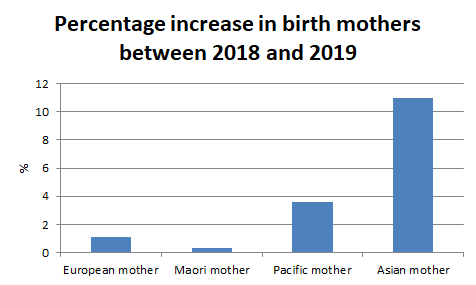
Increase in Asian mothers greater than all other groups combined

The matter of falling fertility caught my attention last year when I produced this paper for Family First.

NZ's fertility rate had dropped to an all-time low (like many other developed countries) in 2018. The 2019 data is now available and the birth rate has increased slightly to 1.75.

Predictably most of the increase is to mothers 30 and over. The increase in births by ethnicity is charted below. There were almost twice as many more Asian mothers than all the others combined. (1,203 versus 678)


Important note from data: "Each birth is included in every ethnic group specified. For this reason, some births are counted more than once and responses sum to more than the total number of births."

Birth data does not use a hierarchical system whereby Maori gets prioritised when there are multiple ethnicities. Here I have used 'mothers' as opposed to 'children' because mothers state fewer ethnicities than they do for their child, understandably. Mothers sum to 68,007 whereas children sum to 77,505. Total births for the year on the other hand is given as 59,637.

Tuesday, March 03, 2020

Parents on benefits continue having babies

Media Release: Parents on benefits continue having babies

March 3, 2020

Lindsay Mitchell, Welfare Commentator and researcher


In 2019 over 6,000 babies were added to an existing benefit.

"Information released to me under the OIA shows that 6,190 caregivers had added one or more 'subsequent children' aged less than 12 months to their benefit during 2019. That represents one in ten of all babies born last year.  For Maori the ratio doubles to one in five."

Having more babies when unable to independently provide for existing children entrenches long-term dependency. Children on a benefit from birth are more likely to experience abuse and neglect, material hardship, poorer health and educational outcomes, and contact with the justice system.

"To disincentivise adding children, in 2012 the National government introduced a policy whereby the requirement to return to part-time work when the youngest child turned five (later reduced to three) could not be delayed by having another baby. "

In the prior years 2006-2010 the annual average number of subsequent children born to parents on benefit was 4,800.* The situation appears to have worsened since.

"From July 2018 parents on benefits were paid an additional $60 weekly for new born children. 'Best Start' payments apply whether or not the baby is a 'subsequent child.' "

National disincentives and Labour incentives present a mixed and ultimately unsuccessful message as New Zealand fails to deal with the root of so many social problems.


*https://www.msd.govt.nz/documents/about-msd-and-our-work/publications-resources/regulatory-impact-statements/ris-welfare-reform-phase-one-social-security-amendment-bill-no1-.pdf

Indian migrants appearing in courts more often than Mongrel Mob members?

Shane Jones' adding- insult- to- injury comments are intriguing:

"I challenge anyone in New Zealand to disagree with me in terms of the sad regularity with which we are seeing egregious cases of abuse, in the media, coming from the Indian migrant community upon their own. In fact, they're appearing in courts with more regularity than the Mongrel Mob."
You would assume that "egregious" cases of abuse would earn at least a community sentence if not a term in prison. Yet Asian and other offenders make up just 4-5% of prisoners or offenders with a community sentence.


In 2015  nine percent of the prison population was Mongrel Mob. By 2018 the number had climbed to around 11 percent.

I suppose there could be some quirk such as all convicted Indian offenders are deported?? But even then they would serve their prison sentence first. Any other ideas that might back up Jones' claim?

Sunday, March 01, 2020

Growing failure of biological parents to care for their children

"Unsupported Child’s Benefit is a weekly payment which helps carers supporting a child or young person whose parents can't care for them because of a family breakdown."

"Orphan’s Benefit is a weekly payment which helps carers supporting a child or young person whose parents have died or can't be found, or can’t look after them because they have a long-term health condition or incapacity."

I included these when recently asking MSD how many more children were dependent on benefits.


Children on these benefits have risen by 18 percent from December 2017 to December 2019.

Yet again we see Maori children way over-represented. 

Many of these children will be in whangai, foster or grandparent care. Anecdotally (listening to grandparents raising grandchildren) drugs are a large part of the problem.

Apart from a small number of tragedies (Orphan's benefit only represents 2 percent of the total numbers) the growing columns largely reflect a failure of biological parents to provide care.

(The growth is not the result of the law change to allow dependent children to stay in foster care till an older age. In each and every single year age-band the numbers have increased. Babies under 1 year  increased by 44%)

Thursday, February 27, 2020

Just 7 percent of Jobseeker beneficiaries had part-time work at year end

One explanation for why Jobseeker numbers continue to climb despite the unemployment rate staying low might be part-time employment.

An individual can receive a Jobseeker benefit if they are working part-time. So under the OIA I asked MSD how many Jobseeker recipients had part-time jobs. I have graphed the data they supplied:


Only 7.3% of Jobseeker beneficiaries had a part-time job at December 31 - 5.2% of Maori and 9.4 percent of NZ European.

But this is point-in-time data and doesn't tell me about seasonal workers for example. MSD fact sheets once gave the percentage of beneficiaries who had earnings for the prior year.

Though obsolete it'd be useful to look at one of those fact sheets. The last to record this info was December 2012 - pre-welfare reforms. Of those on the old unemployment benefit:
12 percent had a current earnings declaration for their current spell on benefit. This indicates some participation in paid work (during the last 12 months) while receiving a main benefit.
Not a great deal higher.

Blog followers will know I have been particularly intrigued by the mismatch between low unemployed but high Jobseeker numbers for Maori.


Given all of the above I am still stumped as to why over 58,000 Maori are receiving a jobseeker benefit while fewer than 30,000 are unemployed.


(To be continued)

Wednesday, February 26, 2020

140% increase in housing wait list since 2017


Latest stats just released by MSD

Here's the longer term back story:

Tuesday, February 25, 2020

Almost 12,000 more children on benefits

Almost 12,000 more children on benefits

February 25, 2020

Lindsay Mitchell, Welfare commentator and researcher


Data released under the Official Information Act today reveals almost 12,000 more children are dependent on welfare benefits since December 2017.

"At 31 December 2019 there were 206,395 children aged 0-18 reliant on caregiver on a main benefit (185,930), Young Parent Payment (1,531) or Orphan/ Unsupported Child benefit (18,934). That's 6 percent higher than at December 31, 2017."

Of the 59,637 births during 2019 10,882 babies were welfare-dependent by year end. Nearly one in five. Over half - 57% - were added to an existing benefit.

New Zealand's child poverty problem cannot be solved when high numbers of children live in non-working homes. Raising benefits and reducing the income margin between work and welfare will only incentivise more people to opt for welfare. This normalises benefit dependency for their children and the habit becomes inter-generational.

In 2008 Finance Minister Michael Cullen said, "...it is desirable to create a margin between being dependent on a benefit and being in employment....
The Labour Party isn’t the party that says living on a benefit is a preferred lifestyle. Its position has always been that the benefit system is a safety net for those who are unavoidably unable to participate in employment. From its history, the Labour Party has always been about people in employment."

The more the current Labour government ignores this, the more intractable the child poverty problem will become.


Cullen wouldn't have linked benefits to wages

Indexing benefits to wages is setting a precedent. They've been indexed to inflation since 2001 but this move has always been resisted.


For many people the margin between income from a benefit and income from work is a cost they are prepared to pay. Fix that margin and they will always be prepared to pay it. Increase the margin and work becomes attractive.

The previous Labour government understood this.

 "...it is desirable to create a margin between being dependent on a benefit and being in employment....
The Labour Party isn’t the party that says living on a benefit is a preferred lifestyle. Its position has always been that the benefit system is a safety net for those who are unavoidably unable to participate in employment. From its history, the Labour Party has always been about people in employment."
Michael Cullen, 2008


Monday, February 24, 2020

Stop promising, Jacinda

Given child poverty reduction isn't playing well for Jacinda, she might reflect on this piece of realism and honesty from Don Brash as National opposition leader in 2005:
When asked to guarantee his policies would not lead to an increase in child poverty, Don Brash told Morning Report "look there's a cycle of these things, they go up and down. I can't promise anything in that area."
It's bat shit crazy to vow to reduce child poverty given  the many measures with relativity as the mainstay anyway.

Kids will do better when the adults and the country they live in does better.


Wednesday, February 19, 2020

Normalising methamphetamine

Reported in a soundbite during tonight's TV One News the italicised finding below.

The press release from which the soundbite arose:

Methamphetamine Use And Its Impact On Violence Laid Bare In World-first Study
Wednesday, 19 February 2020, 2:33 pm
Press Release: University of Otago
Almost a third of middle-aged New Zealanders have tried methamphetamine at least once, according to a new University of Otago, Christchurch study looking at the link between using the drug and violence in the general population.

"Almost a third" is 28%; "middle-aged" is 35 and  "New Zealanders" were 1,000 individuals born in Canterbury.

The other big market for meth is Australia. According to Flinders University in Adelaide:

In 2013, 7% of Australians reported that they had used methamphetamine in their lifetime, and 2% reported using in the past 12 months."

"In their lifetime" is a much larger window than by age 35 but read on.

Probably the most reliable NZ source for the prevalence of drug use is the Ministry of Health's  NZ Drug Survey which finds:

In 2015/16, 1.1 percent of adults (95% confidence interval, CI: 0.9–1.5) used amphetamines in the past year. This equates to about 34,000 New Zealanders.

1.1% is much lower than 2%, the Australian finding. Which calls into question the discrepancy between "middle-aged" and lifetime findings.

Back to the Christchurch Study press release:

"The findings show use of methamphetamine is common, as observed in the study’s cohort of middle-aged New Zealanders. According to Christchurch Health and Development data, methamphetamine is the third most common illicit drug after cannabis and ecstasy, Professor Boden says
...He cautions while methamphetamine use increases the risk of involvement in violence most people who used the drug did not engage in violence or experience violence in others.

I appreciate the study focuses on meth and associated violence and that is useful.

But what I heard - and subsequently read - was the message that methamphetamine usage is "common".

I've never used it. In my life I've used cannabis three times and wouldn't expect that to contribute to any claim about usage prevalence today.