BRITISH MUMS WANT MORE TIME AT HOME
British mothers are being offered tax credits and daycare places to help them hold down paid jobs but the majority do not like the policy, a survey among 1,736 mothers by First magazine shows. Six out of 10 thought the government "doesn't like traditional families" but favours single mothers and working parents. More than half also said they would send their child to a private school if they could afford it, and two-thirds thought grammar schools -- abolished in the 1970s -- were a good idea.
Among those surveyed, whose average age was 37, about a third worked full-time and a third part-time. Three-quarters of those working said they would reduce their working hours if they could, and nine out of 10 said that if a mother was married and wanted to stay at home, her tax allowance should be added to her husband's, allowing more women the option to be stay-at-home mothers.
They blamed the destruction of family life on "families not eating together" (72 per cent) mostly due to both parents having to work, "video games consoles" (46 per cent), "working mothers" (41 per cent), and "women becoming breadwinners" (23 per cent). The main reason mothers of young children returned to work was to meet basic needs (60 per cent). But with many outside influences, mothers said they were struggling to discipline their children - eight out of ten did not think their children were well disciplined either at home or school and a third admitted that their children swore at them.
The Health Secretary, Patricia Hewitt, admitted recently the government had probably erred in its approach. "If I look back over the last six years I do think that we have given the impression that we think all mothers should be out to work, preferably full-time as soon as their children are a few months old." ~ Telegraph, June 28
What do you make of all that?
I wonder if it has crossed the minds of many women that the cost of the welfare state, the biggest gobbler of their's and their partners taxes, has reduced their choices? Many appear to feel unable to control their family life due to financial pressures.
Friday, July 07, 2006

Ronald McDonald school house
In Victoria, Australia, state schools are so dilapidated private/public partnerships are being considered to rebuild them. Here's what one fan of the idea said;
"We'd certainly prefer to have public education funded by the Government," said Parents Victoria president Elaine Crowle.
"We'd hate to have a McDonald's-sponsored school or something."
Dingbat.
"We'd certainly prefer to have public education funded by the Government," said Parents Victoria president Elaine Crowle.
"We'd hate to have a McDonald's-sponsored school or something."
Dingbat.
Thursday, July 06, 2006
Brash on welfare
Interesting to read National Leader Don Brash stepping into the welfare debate.
“After seven years, Helen Clark expects the public to believe that Labour has had a 'Road to Damascus' experience when it comes to welfare. The language has changed but will the policies?”
Brash has always been outspoken about this issue, even as Reserve Bank Governor. Which reminds me of a prediction I made back in 2001;
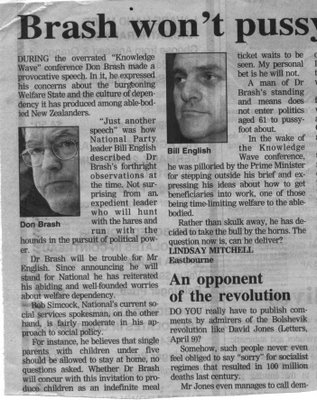
(left click on image to enlarge)
The headline read, Brash won't pussyfoot on welfare. Part of my prediction was right. He was trouble for English. And I still maintain given the chance he won't mess about with welfare. Let's just hope his colleagues don't wimp out on him.
“After seven years, Helen Clark expects the public to believe that Labour has had a 'Road to Damascus' experience when it comes to welfare. The language has changed but will the policies?”
Brash has always been outspoken about this issue, even as Reserve Bank Governor. Which reminds me of a prediction I made back in 2001;

(left click on image to enlarge)
The headline read, Brash won't pussyfoot on welfare. Part of my prediction was right. He was trouble for English. And I still maintain given the chance he won't mess about with welfare. Let's just hope his colleagues don't wimp out on him.
"Drug babies on the rise"
This report from the Australian probably has significance for New Zealand.
Cannabis smoking during pregnancy is a more dire problem in Australia than previously thought, and the effect on babies is severe, a world-first study has found.
The problem is compounded by the fact that 90 per cent of drug-addicted expectant mothers smoke cigarettes, raising further the risk to their babies.
An Early Start evaluation programme from Christchurch which looked at those families most in need of support services found that 63 percent of mothers smoked during pregnancy and one in six used cannabis. 90 percent were on welfare.
Cannabis smoking during pregnancy is a more dire problem in Australia than previously thought, and the effect on babies is severe, a world-first study has found.
The problem is compounded by the fact that 90 per cent of drug-addicted expectant mothers smoke cigarettes, raising further the risk to their babies.
An Early Start evaluation programme from Christchurch which looked at those families most in need of support services found that 63 percent of mothers smoked during pregnancy and one in six used cannabis. 90 percent were on welfare.
Wednesday, July 05, 2006
Evading the issue - on two counts
David Benson-Pope says, "Smart jobs, not smart cards," and promises to release "milestone" figures tomorrow showing what a great job Labour are doing getting beneficiaries into work.
These will be the June 2006 quarter benefit figures. There may be a substantial drop in DPB numbers because single parents who were working part-time but still getting a partial benefit will have moved onto the Working For families In Work payment. Smoke and mirrors really. The In Work payment comes from the IRD whereas the partial DPB came from WINZ.
I asked the Ministry of Social Development how many would fall into this category as of April 1, 2006. Here's what the CE said;
"When a client exits benefit, Work and Income does not record whether that person went on to receive an In-Work payment. I am also advised that when a person applies for the In-Work payment, Inland revenue does not record whether the person has just left benefit."
So if the government is trumpeting a drop in DPB numbers numbers tomorrow bear this in mind.
Apart from which, National's proposal about smart cards was aimed at a completely different group of beneficiaries from those amenable to working. People on the DPB trying to find a balance or transition between child-minding and work aren't the problem. Benson-Pope is simply trying to take the heat off an underclass festering away under his governance. It's disgusting.
These will be the June 2006 quarter benefit figures. There may be a substantial drop in DPB numbers because single parents who were working part-time but still getting a partial benefit will have moved onto the Working For families In Work payment. Smoke and mirrors really. The In Work payment comes from the IRD whereas the partial DPB came from WINZ.
I asked the Ministry of Social Development how many would fall into this category as of April 1, 2006. Here's what the CE said;
"When a client exits benefit, Work and Income does not record whether that person went on to receive an In-Work payment. I am also advised that when a person applies for the In-Work payment, Inland revenue does not record whether the person has just left benefit."
So if the government is trumpeting a drop in DPB numbers numbers tomorrow bear this in mind.
Apart from which, National's proposal about smart cards was aimed at a completely different group of beneficiaries from those amenable to working. People on the DPB trying to find a balance or transition between child-minding and work aren't the problem. Benson-Pope is simply trying to take the heat off an underclass festering away under his governance. It's disgusting.
More predictions
Last week I blogged about Matt Robson's Crystal Ball
Today's Robson-on-politics says,
Robson's crystal ball
I've had feed-back from my prediction National will lose again in 2008. Let me outline three reasons for my confidence:
The economy: The Labour-Progressive-Green (LPG) bloc won 47.6% (41.1% + 5.3% + 1.2%) of votes cast last September midway through a six-month period of zero economic growth.
The Nat-ACT-United-NZF (NAUN) alternative got 49% (39.1% + 1.5% + 2.7% + 5.7%), but National still managed to end up in Opposition. The economy will be much stronger in 2008 than it was during the zero growth second-half of 2005.
http://www.electionresults.govt.nz/partystatus.html
In-fighting on the Right: United and NZF promised to support the party with the most seats to form a government last year. ACT's capture of two seats was the most critical factor in last September's government-formation outcome.
Had National kept Epsom and those two ACT seats instead been National seats, then it would have been 50-50 seats a piece between National and Labour and there is no question that that would have delivered a National-United-NZ First government supported on confidence by the Maori Party.
Rodney was the Left's saviour last September and on-going in-fighting across NAUF will be even more intense in 2008.
Today's Robson-on-politics says,
Robson's crystal ball
I've had feed-back from my prediction National will lose again in 2008. Let me outline three reasons for my confidence:
The economy: The Labour-Progressive-Green (LPG) bloc won 47.6% (41.1% + 5.3% + 1.2%) of votes cast last September midway through a six-month period of zero economic growth.
The Nat-ACT-United-NZF (NAUN) alternative got 49% (39.1% + 1.5% + 2.7% + 5.7%), but National still managed to end up in Opposition. The economy will be much stronger in 2008 than it was during the zero growth second-half of 2005.
http://www.electionresults.govt.nz/partystatus.html
In-fighting on the Right: United and NZF promised to support the party with the most seats to form a government last year. ACT's capture of two seats was the most critical factor in last September's government-formation outcome.
Had National kept Epsom and those two ACT seats instead been National seats, then it would have been 50-50 seats a piece between National and Labour and there is no question that that would have delivered a National-United-NZ First government supported on confidence by the Maori Party.
Rodney was the Left's saviour last September and on-going in-fighting across NAUF will be even more intense in 2008.
CYF predictions accurate
Stuff reports in March there was a record number of child abuse and neglect notifications to CYF. This marries up with the CYF statement of intent predictions posted earlier. If CYF know how many cases there will be they know what is driving them.
The Government's child-protection agency is struggling to cope with its growing caseload, leaving even children in critical situations languishing on its books, new figures show.
Welfare groups say it is time Child, Youth and Family (CYF) admitted it could not handle its workload and contracted out more cases to qualified or experienced community groups.
In March, CYF received a record number of calls, with almost 6000 notifications from police or the community about possible child abuse or neglect.
And just stop for a moment. Think about this.
73,000+ cases per year represents 13 percent of under ten-year-olds. Of course some cases may represent the same child, some more than one child and some, children over ten, but this highly unscientific calculation serves to create some tangible idea of the scale of notifications.
The Government's child-protection agency is struggling to cope with its growing caseload, leaving even children in critical situations languishing on its books, new figures show.
Welfare groups say it is time Child, Youth and Family (CYF) admitted it could not handle its workload and contracted out more cases to qualified or experienced community groups.
In March, CYF received a record number of calls, with almost 6000 notifications from police or the community about possible child abuse or neglect.
And just stop for a moment. Think about this.
73,000+ cases per year represents 13 percent of under ten-year-olds. Of course some cases may represent the same child, some more than one child and some, children over ten, but this highly unscientific calculation serves to create some tangible idea of the scale of notifications.
Pearls of wisdom
 Here's a pearl of wisdom from Minister for Auckland, Judith Tizard. In her usual spot with Tau Henare on NewstalkZB this morning she was opposing any move to control how beneficiaries spend their money. She said this, "In order to learn the value of money they need to learn the value of money."
No Judith. In order to learn the value of money people need to earn it.
Got any more bright ideas?
What do we think about this proposal from National?
National is investigating smart cards to stop beneficiaries spending welfare payments on booze, drugs or gambling.
The proposal involves paying about one-third of benefits for seriously at-risk families directly to supermarkets.
The money could be accessed only with smart cards similar to existing loyalty cards, which would block the purchase of selected items, National welfare spokeswoman Judith Collins said. "It wouldn't have to be everybody who's a beneficiary, but for those who are clearly not looking after their kids in terms of being able to get them fed before they go to school, we should be looking at it."
Ummm. How would I rip this off? I know. I'll swap my food purchases with a mate for booze and ciggies.
She buys $30 worth of booze and ciggies. I buy $40 worth of food. We swap. She's got more food and I've still got my "luxuries". The kids are still going hungry but I don't care.
And I'm still getting two-thirds of the cash I was so I can still play the pokies. In fact I'll need to spend more on the pokies trying to recoup what WINZ aren't giving me.
No worries.
National is investigating smart cards to stop beneficiaries spending welfare payments on booze, drugs or gambling.
The proposal involves paying about one-third of benefits for seriously at-risk families directly to supermarkets.
The money could be accessed only with smart cards similar to existing loyalty cards, which would block the purchase of selected items, National welfare spokeswoman Judith Collins said. "It wouldn't have to be everybody who's a beneficiary, but for those who are clearly not looking after their kids in terms of being able to get them fed before they go to school, we should be looking at it."
Ummm. How would I rip this off? I know. I'll swap my food purchases with a mate for booze and ciggies.
She buys $30 worth of booze and ciggies. I buy $40 worth of food. We swap. She's got more food and I've still got my "luxuries". The kids are still going hungry but I don't care.
And I'm still getting two-thirds of the cash I was so I can still play the pokies. In fact I'll need to spend more on the pokies trying to recoup what WINZ aren't giving me.
No worries.
Could do better
Steve Maharey appeared on Close Up on Monday evening. Paul Henry discussed the issue of dyslexic children with the Minister of Education. You can see the interview here.
Yesterday, it triggered a storm of calls to talkback which persisted from 8.30 to midday. People were very angry with Mr Maharey who they felt was "arrogant" and "out of touch". He was maintaining support for dyslexic children was quite adequate whereas parents calling Justin du Fresne's show described quite a different situation.
At about 3 minutes to twelve Mr Maharey rang in. What he said went something like, You know I come from an academic background, my trade is as a sociologist. I want people to be reassured that I might be a new Minister for Education but I am very familiar with the subject of dyslexia. And on it went in this vein.
The impression created was Mr Maharey's ego had been dented and he had rung in to defend it. Given he had barely a couple of minutes airtime that is what was most important.
What he should have done is acknowledge the callers concerns and the lack of time to properly address them. Then he should have asked the host if he could come on air the next day, possibly to do an extended session during which people could ring in and speak with him. As it was he only made a bad situation worse.
It's not about you Steve.
Yesterday, it triggered a storm of calls to talkback which persisted from 8.30 to midday. People were very angry with Mr Maharey who they felt was "arrogant" and "out of touch". He was maintaining support for dyslexic children was quite adequate whereas parents calling Justin du Fresne's show described quite a different situation.
At about 3 minutes to twelve Mr Maharey rang in. What he said went something like, You know I come from an academic background, my trade is as a sociologist. I want people to be reassured that I might be a new Minister for Education but I am very familiar with the subject of dyslexia. And on it went in this vein.
The impression created was Mr Maharey's ego had been dented and he had rung in to defend it. Given he had barely a couple of minutes airtime that is what was most important.
What he should have done is acknowledge the callers concerns and the lack of time to properly address them. Then he should have asked the host if he could come on air the next day, possibly to do an extended session during which people could ring in and speak with him. As it was he only made a bad situation worse.
It's not about you Steve.
NCEA - No Correlation between Effort and Achievement
The NZ Herald reports on how students view the NCEA;
* "When you know you will pass anyway, why study? And after you have 80 credits there is no motivation to do better."
* "No need to try hard, no motivation to work hard. Can slack off for most of the year and still pass."
* "Higher achievers get the same amount of credits as the basic achievers - no incentive to gain higher marks."
* "I can look as good as someone who gets 100 per cent as long as I pass."
* "It encourages people to be average."
With two children who will go through this system this report is a real worry. One of them thrives on recognition - the other is more of a cruiser. It seems ridiculous that the NCEA system offers me more confidence that the second one will be all right but the first could struggle to stay motivated.
* "When you know you will pass anyway, why study? And after you have 80 credits there is no motivation to do better."
* "No need to try hard, no motivation to work hard. Can slack off for most of the year and still pass."
* "Higher achievers get the same amount of credits as the basic achievers - no incentive to gain higher marks."
* "I can look as good as someone who gets 100 per cent as long as I pass."
* "It encourages people to be average."
With two children who will go through this system this report is a real worry. One of them thrives on recognition - the other is more of a cruiser. It seems ridiculous that the NCEA system offers me more confidence that the second one will be all right but the first could struggle to stay motivated.
Tuesday, July 04, 2006
Entitlement mentality
Prompted by a comment on the previous post here are a couple of thoughts expressed in a speech given to the Freedom Summit in Rotorua in 2004;
I'd hazard a guess that some welfare dependants think money is merely something the government prints at will. There is no understanding that the money they receive is the product of somebody else's efforts. Because they don't understand this, they rationally resent their relatively small share.
Those who do understand the source of their income have an attitude that the productive person's money isn't rightfully theirs because they got it by exploiting others and they have too much of it anyway. There is no end of people who see themselves as victims of some sort of injustice or unfair treatment, be it of sexism, ageism, racism, capitalism or colonisation. These people, with their inevitable collectivist mentality, demand recompense from all of society.
Either thought process leads to the conclusion that the world owes them a living, and any avenue by which they subsequently obtain money is, to their mind, justifiable.
I'd hazard a guess that some welfare dependants think money is merely something the government prints at will. There is no understanding that the money they receive is the product of somebody else's efforts. Because they don't understand this, they rationally resent their relatively small share.
Those who do understand the source of their income have an attitude that the productive person's money isn't rightfully theirs because they got it by exploiting others and they have too much of it anyway. There is no end of people who see themselves as victims of some sort of injustice or unfair treatment, be it of sexism, ageism, racism, capitalism or colonisation. These people, with their inevitable collectivist mentality, demand recompense from all of society.
Either thought process leads to the conclusion that the world owes them a living, and any avenue by which they subsequently obtain money is, to their mind, justifiable.
Voice of experience
A self-explanatory letter sent from a good friend of mine to the DomPost. I reproduce it here because there is no guarantee the DomPost will publish what contains some unpalatable truths.
Dear Sir
The Kahui tragedy led to two points of view in the Dompost: the 29/6 editorial "Blame welfare, not colonialism" and Chris Trotter's column the next day: "Playing the Blame Game"
When I worked as a Plunketnurse from 1975 -1985, the corrosive effects of welfarism were blindingly obvious and predictable even then. Poor Pakeha as well as poor Maori women were living on the dole as single mums and continued to give birth to fatherless children. The dole was their meal ticket.
These women were no advertisement for their respective races, and, happily, neither did they represent the majority. Single Pakeha women could not claim colonialism for their plight, but what they did have in common with Maori single mums was an unshakeable feeling of entitlement to taxpayer funded support and make no mistake about it: they insisted on being given larger flats or statehouses for their growing FATHERLESS families
Just how to end or even change a "lifestyle" that has become so ingrained over several generations is far from clear to me.
Yours sincerely,
Eneka Odinot
Dear Sir
The Kahui tragedy led to two points of view in the Dompost: the 29/6 editorial "Blame welfare, not colonialism" and Chris Trotter's column the next day: "Playing the Blame Game"
When I worked as a Plunketnurse from 1975 -1985, the corrosive effects of welfarism were blindingly obvious and predictable even then. Poor Pakeha as well as poor Maori women were living on the dole as single mums and continued to give birth to fatherless children. The dole was their meal ticket.
These women were no advertisement for their respective races, and, happily, neither did they represent the majority. Single Pakeha women could not claim colonialism for their plight, but what they did have in common with Maori single mums was an unshakeable feeling of entitlement to taxpayer funded support and make no mistake about it: they insisted on being given larger flats or statehouses for their growing FATHERLESS families
Just how to end or even change a "lifestyle" that has become so ingrained over several generations is far from clear to me.
Yours sincerely,
Eneka Odinot
Ripples in a pond
Reporting on the Kahui case Radio New Zealand says , Twenty detectives are working on the double homicide inquiry.
Contrast this to a report from the Waikato Times;
Hamilton's detectives are being side-tracked from serious crime as the thin blue line is stretched ever further....At least 24 cases are sitting unallocated, some dealing with the sexual violation of children.
The Kahui's refusal to co-operate is surely demanding greater resources which are desperately needed elsewhere. They are the pebble thrown in a pond from which many ripples continue to grow.
Contrast this to a report from the Waikato Times;
Hamilton's detectives are being side-tracked from serious crime as the thin blue line is stretched ever further....At least 24 cases are sitting unallocated, some dealing with the sexual violation of children.
The Kahui's refusal to co-operate is surely demanding greater resources which are desperately needed elsewhere. They are the pebble thrown in a pond from which many ripples continue to grow.
"Blitz" the DPB
Media Release
BLITZ ON THE DPB MORE URGENT
Tuesday, July 4, 2006
While a "blitz" on the dole is welcome, even more urgent is a blitz on the DPB, according to Lindsay Mitchell, welfare commentator.
Appearing on Breakfast TV yesterday Mitchell said, "We must stop paying babies to have babies."
"Obviously the Prime Minister wasn't listening. According to the DomPost she has called for a blitz on the dole and identification of families that have been on welfare for three or four generations. While those on the dole may be fathering the babies it's the women on the DPB who are having them. They control that eventuality and they won't rely on a man's income if they don't have to. It is the DPB driving intergenerational dependency - not the dole."
"But why has it taken so long for the PM to make this call, as incomplete as it is? In 2004, when the dole 'no-go' zones were introduced, I asked the Prime Minister why they didn't apply to people on the DPB. She admitted then there are families in Northland and the East Coast where drug, alcohol, violence and crime problems were rife and some children hadn't seen their grandparents go to work, let alone their parents."
"In 2003 New Zealand data was analysed by the University of Auckland in an effort to define the degree of intergenerational benefit dependency. They found a correlation co-efficient of between one and two thirds. The 'results also suggested that transmission of welfare dependency from one generation to the next may be somewhat stronger among females and Maori youth.' "
"Just last year an evaluation of the Early Start programme in Christchurch, which looked at families most in need of support services found that 64 percent were single parent families. Of those over half of the mothers had been raised in single parent families. 90 percent of the families were on welfare."
"This problem has been staring us in the face for decades. The Prime Minister needs to get over her feminist inclinations and call for a blitz on both the dole and the DPB or is it only men who are to be scrutinised?"
BLITZ ON THE DPB MORE URGENT
Tuesday, July 4, 2006
While a "blitz" on the dole is welcome, even more urgent is a blitz on the DPB, according to Lindsay Mitchell, welfare commentator.
Appearing on Breakfast TV yesterday Mitchell said, "We must stop paying babies to have babies."
"Obviously the Prime Minister wasn't listening. According to the DomPost she has called for a blitz on the dole and identification of families that have been on welfare for three or four generations. While those on the dole may be fathering the babies it's the women on the DPB who are having them. They control that eventuality and they won't rely on a man's income if they don't have to. It is the DPB driving intergenerational dependency - not the dole."
"But why has it taken so long for the PM to make this call, as incomplete as it is? In 2004, when the dole 'no-go' zones were introduced, I asked the Prime Minister why they didn't apply to people on the DPB. She admitted then there are families in Northland and the East Coast where drug, alcohol, violence and crime problems were rife and some children hadn't seen their grandparents go to work, let alone their parents."
"In 2003 New Zealand data was analysed by the University of Auckland in an effort to define the degree of intergenerational benefit dependency. They found a correlation co-efficient of between one and two thirds. The 'results also suggested that transmission of welfare dependency from one generation to the next may be somewhat stronger among females and Maori youth.' "
"Just last year an evaluation of the Early Start programme in Christchurch, which looked at families most in need of support services found that 64 percent were single parent families. Of those over half of the mothers had been raised in single parent families. 90 percent of the families were on welfare."
"This problem has been staring us in the face for decades. The Prime Minister needs to get over her feminist inclinations and call for a blitz on both the dole and the DPB or is it only men who are to be scrutinised?"
Monday, July 03, 2006
How does she know?
Crackdown on benefits
3/07/2006 18:52:02
The Government's having a crack down on benefit abuse by entire families in the wake of the Kahui case.
During the course of the inquiry it was revealed that multiple members of the murdered twins' family are on benefits.
Prime Minister Helen Clark says the Government is looking at whether there are clusters of households like the Kahui family, which can be investigated to see if their benefits are being paid properly.
She says it is a problem which involves an extremely small proportion of beneficiaries who get in a cycle of dependency and do not work.
How does she know that?
When people give one address but are transient between others, when relationships aren't disclosed, when true living costs are not declared, when children get passed between families, how does she know that the problem involves an extremely small percentage of beneficiaries?
3/07/2006 18:52:02
The Government's having a crack down on benefit abuse by entire families in the wake of the Kahui case.
During the course of the inquiry it was revealed that multiple members of the murdered twins' family are on benefits.
Prime Minister Helen Clark says the Government is looking at whether there are clusters of households like the Kahui family, which can be investigated to see if their benefits are being paid properly.
She says it is a problem which involves an extremely small proportion of beneficiaries who get in a cycle of dependency and do not work.
How does she know that?
When people give one address but are transient between others, when relationships aren't disclosed, when true living costs are not declared, when children get passed between families, how does she know that the problem involves an extremely small percentage of beneficiaries?
Waikato has highest teenage birth rate
There are a couple of interesting confirmations in this article.
In the Waikato, 41 of every 1000 15-19 year-olds had babies, compared with the national average of 31.
The poorest women were – 10 times more likely to give birth than teenagers in the most well off situations.
They will all be going on welfare - long term.
Dr Craig said the birth rates differed significantly between races. Nationally, Maori were nearly five times more likely to have teenage births than Europeans, while Pacific Islanders were three times as likely.
None of this augers well at all. But Aunty Tariana will be pleased.
In the Waikato, 41 of every 1000 15-19 year-olds had babies, compared with the national average of 31.
The poorest women were – 10 times more likely to give birth than teenagers in the most well off situations.
They will all be going on welfare - long term.
Dr Craig said the birth rates differed significantly between races. Nationally, Maori were nearly five times more likely to have teenage births than Europeans, while Pacific Islanders were three times as likely.
None of this augers well at all. But Aunty Tariana will be pleased.
What we can look forward to
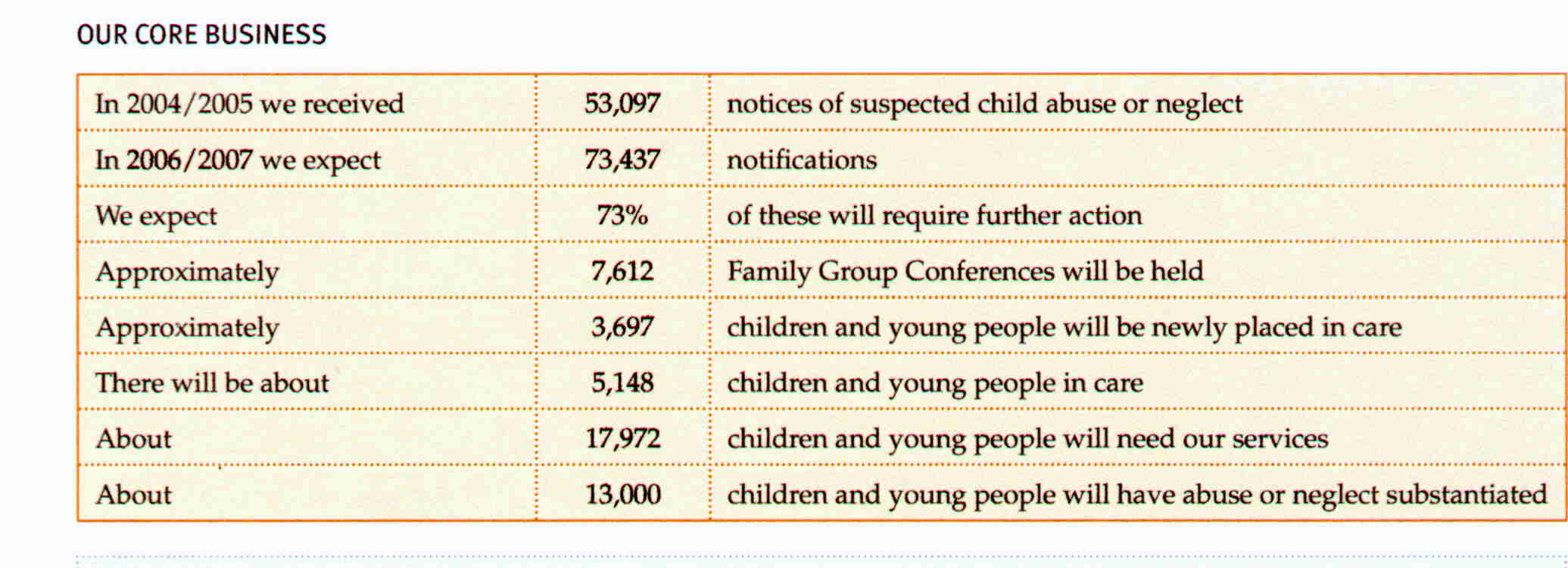

Is the Ministry of Social Development not the most perverse department?
Here are predictions from the CYF division Statement of Intent. They include a 38 percent increase in child neglect and abuse notifications and a 29 percent increase in referrals from the Police to CYF. This division is frantically try to get on top of their workload while another division, WINZ, are busy handing out benefits to the people who create all of this dysfunction. Go Figure.
Sunday, July 02, 2006
Saturday, July 01, 2006
prison vs work
In prison you spend the majority of your time in an 8'x10' cell. At work you spend most of your time in a 6'x8' cubicle.
In prison you get three meals a day. At work you only get a break for one meal and you have to pay for it.
In prison you get time off for good behavior. At work you get rewarded for good behavior with more work.
In prison a guard locks and unlocks all the doors for you. At work you must carry around a security card and unlock and open all the doors yourself.
In prison you can watch TV and play games. At work you get fired for watching TV and playing games.
In prison they allow your family and friends to visit. At work you cannot even speak to your family and friends.
In prison all expenses are paid by taxpayers with no work required. At work you get to pay all the expenses to go to work and then they deduct taxes from your salary to pay for prisoners.
In prison you spend most of your life looking through the bars from the inside wanting to get out. At work you spend your time wanting to get out and inside bars.
In prison you can join many programs which you can leave at any time. At work there are some programs you can never get out of.
In prison there are wardens who are often sadistic. At work there are managers.
Those are from the Adam Smith blog. I'm sure we can think of some more NZ examples, like...
In prison you can breastfeed. At work you can't.
In prison you get underfloor heating. At work you get legionnaires disease from the crappy air conditioning system.
In prison the gym is free. At work you have to pay a membership fee.
In prison a positive drug test means a longer sentence. At work a positive drug test means you are out on your ear.
In prison you can smoke. At work it is prohibited.
Got any more?
In prison you get three meals a day. At work you only get a break for one meal and you have to pay for it.
In prison you get time off for good behavior. At work you get rewarded for good behavior with more work.
In prison a guard locks and unlocks all the doors for you. At work you must carry around a security card and unlock and open all the doors yourself.
In prison you can watch TV and play games. At work you get fired for watching TV and playing games.
In prison they allow your family and friends to visit. At work you cannot even speak to your family and friends.
In prison all expenses are paid by taxpayers with no work required. At work you get to pay all the expenses to go to work and then they deduct taxes from your salary to pay for prisoners.
In prison you spend most of your life looking through the bars from the inside wanting to get out. At work you spend your time wanting to get out and inside bars.
In prison you can join many programs which you can leave at any time. At work there are some programs you can never get out of.
In prison there are wardens who are often sadistic. At work there are managers.
Those are from the Adam Smith blog. I'm sure we can think of some more NZ examples, like...
In prison you can breastfeed. At work you can't.
In prison you get underfloor heating. At work you get legionnaires disease from the crappy air conditioning system.
In prison the gym is free. At work you have to pay a membership fee.
In prison a positive drug test means a longer sentence. At work a positive drug test means you are out on your ear.
In prison you can smoke. At work it is prohibited.
Got any more?
Decentralising welfare
John Tamihere wants benefits paid to the National Maori Urban Authority so they can control how the final recipients spend them. It's not a new idea. It has advantages and disadvantages. In a way such a system resembles what happens in the US where the federal government provides funding to the states which then control the delivery. The states break it down further to counties. The smaller the unit the greater the intimacy between the provider and the recipient. Certainly more pressure can be brought to bear and more specialised and relevant support can be offered. I am also reminded of Switzerland where local government has retained control of welfare and there were over 3,000 different systems for seven million people (figures from the late nineties). But federalisation applies to all - not just one group of people.
What Tamihere is proposing means treating Maori differently which would face enormous political barriers. The risk of corruption and nepotism is very real, especially amongst people with tribal mentalities. The power concentrated in the hands of a few seems undesirable and a backward step for Maori.
On the plus side there would have to be compulsion involved which might not be a bad thing. If people didn't want to come under the control of the authority, didn't want to losing their spending autonomy, their best option would be to get job. That happened in the US when activity obligations were introduced. Many people made their own arrangements.
Decentralisation properly managed could be an improvement but would have to operate on an all or nothing basis.
The various responses to this idea are probably more interesting than the idea itself. Typically the Greens are prattling about "beneficiary rights"
Metiria Turei says,"We completely oppose attempts to impose centralised control over people's lives. They [the authority] have no right to decide for people how their income is spent. I find it offensive that Maori are proposing such a policy."
Alan Duff says,"The only way is to stop giving benefits entirely, and families will get by exactly the same as families do anywhere else on the planet where there are no benefits."
Duff's on the money.
What Tamihere is proposing means treating Maori differently which would face enormous political barriers. The risk of corruption and nepotism is very real, especially amongst people with tribal mentalities. The power concentrated in the hands of a few seems undesirable and a backward step for Maori.
On the plus side there would have to be compulsion involved which might not be a bad thing. If people didn't want to come under the control of the authority, didn't want to losing their spending autonomy, their best option would be to get job. That happened in the US when activity obligations were introduced. Many people made their own arrangements.
Decentralisation properly managed could be an improvement but would have to operate on an all or nothing basis.
The various responses to this idea are probably more interesting than the idea itself. Typically the Greens are prattling about "beneficiary rights"
Metiria Turei says,"We completely oppose attempts to impose centralised control over people's lives. They [the authority] have no right to decide for people how their income is spent. I find it offensive that Maori are proposing such a policy."
Alan Duff says,"The only way is to stop giving benefits entirely, and families will get by exactly the same as families do anywhere else on the planet where there are no benefits."
Duff's on the money.
Friday, June 30, 2006

SuperTrev - the "shameless self-promoter"
Not my words I hasten to add. The DomPost's Diary points out today that while some MPs are known to be shameless self-promoters, Trevor Mallard really must take the cake with his latest Trev's Tribune, delivered "free" to Hutt South homes. It has eight pages packed with no less than thirteen images of SuperTrev. For those of you not lucky enough to be the recipient of Trev's Tribute..sorry, Tribune, let me share a couple of them with you;

In the house....
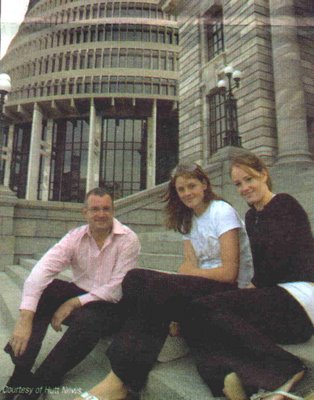
And outside the house.
Is that enough?
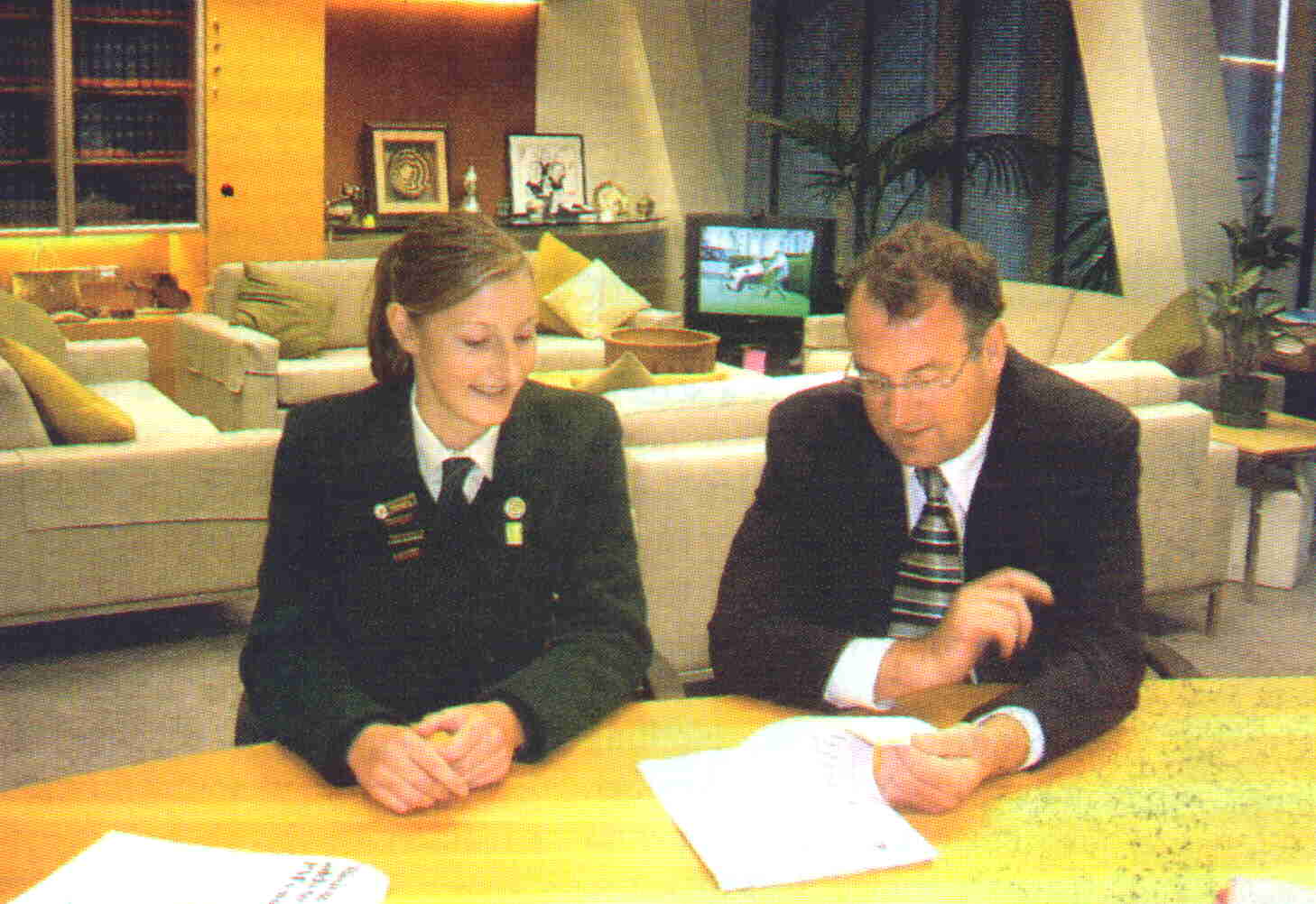
In the house....
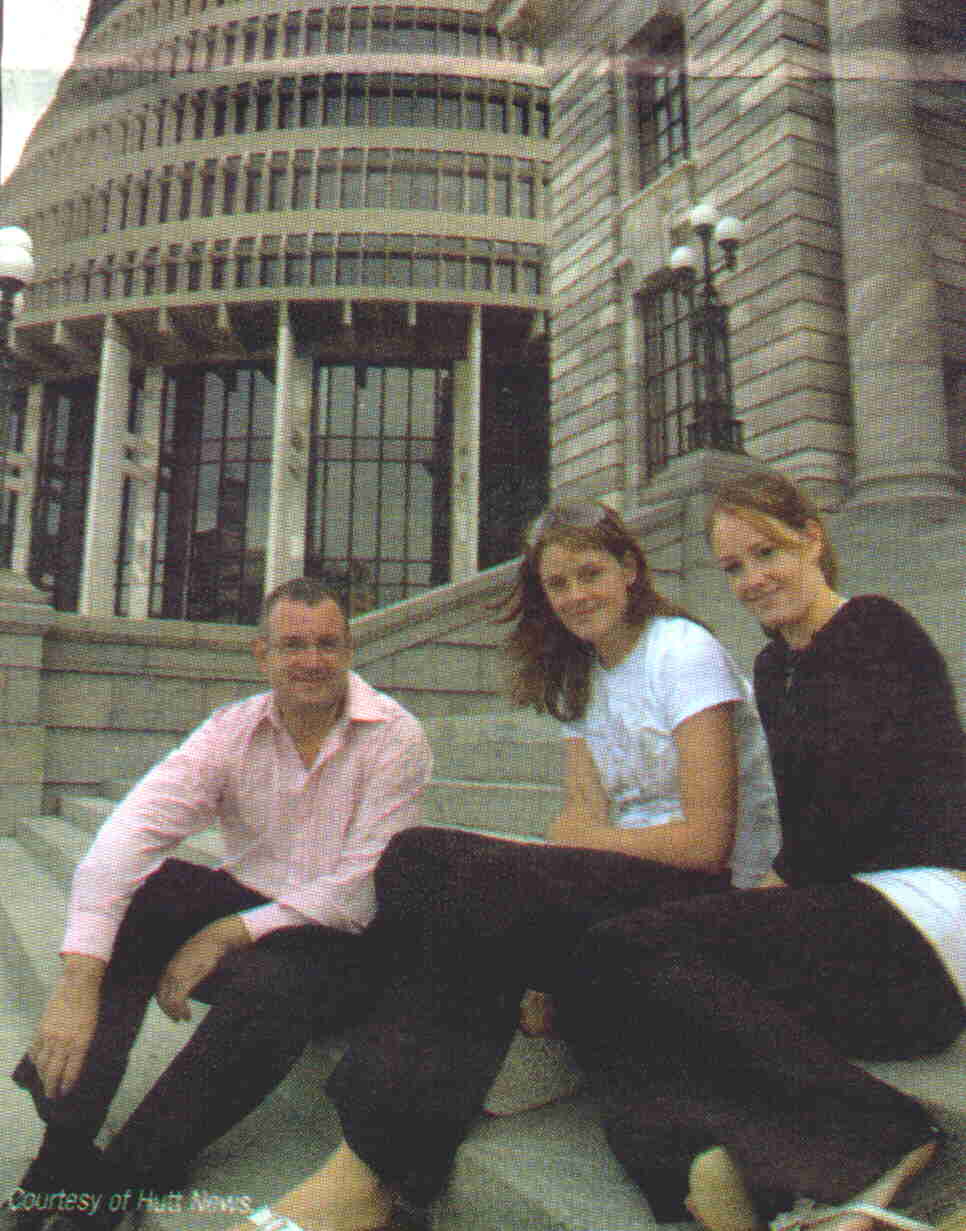
And outside the house.
Is that enough?
Juror lists
Is it any wonder people are reluctant to do jury service when you read a story like this. Is it standard practice for a district court to mail the names of jurors to the defendant? It looks like the only mistake the court made was to omit a covering letter which I am assuming tells the recipient that the information is confidential.
Judge not!
Chris Trotter, in today's Dompost, is in the pulpit asking who God would blame for the deaths of the Kahui twins. He uses this question to list everything he blames. To summarise;
- historical racism from journalists and politicians who casually referred to Maori as "niggers"
- cheap whiskey and syphilis brought by the European
- ingratitude to the 28th Maori Battalion
- state house ghettos
- booze barns
- envy and self-loathing due to TV advertising images of success and plenty in an ever-white world
- emulation of the black American underclass
- Rogernomics
- Tina
- cold-eyed and thin-lipped Winz workers
- unemployment
- theft of land last century, specifically that belonging to the Kahui's great-great-great-grandparents.
- P pushers
And finishes, Or would he whisper, softly:"Judge not, that ye not be judged."
- historical racism from journalists and politicians who casually referred to Maori as "niggers"
- cheap whiskey and syphilis brought by the European
- ingratitude to the 28th Maori Battalion
- state house ghettos
- booze barns
- envy and self-loathing due to TV advertising images of success and plenty in an ever-white world
- emulation of the black American underclass
- Rogernomics
- Tina
- cold-eyed and thin-lipped Winz workers
- unemployment
- theft of land last century, specifically that belonging to the Kahui's great-great-great-grandparents.
- P pushers
And finishes, Or would he whisper, softly:"Judge not, that ye not be judged."
US Welfare rules
Ten years after Bill Clinton introduced real welfare reform in the US they are renewing funding rules. Based on the 2005 caseloads federal funding to states now requires 50 percent of welfare recipients to be engaged in 30 hours of meaningful activity - playing the pokies or getting pissed doesn't qualify.
This comes after the sixty percent reduction in welfare rolls already achieved.
Liberals are naturally critical. Conservatives, however, say the new rules will push welfare recipients into private jobs. “What we learned the first time is that poor people are a lot more resilient and capable than the left presumes,” says Jason Turner, a Heritage Foundation visiting fellow who consults on welfare with about 25 states.
This comes after the sixty percent reduction in welfare rolls already achieved.
Liberals are naturally critical. Conservatives, however, say the new rules will push welfare recipients into private jobs. “What we learned the first time is that poor people are a lot more resilient and capable than the left presumes,” says Jason Turner, a Heritage Foundation visiting fellow who consults on welfare with about 25 states.
Thursday, June 29, 2006
Maybe I need glasses
Funny how you misread headlines sometimes;
Gremlin At RNZ - Broadcasts by Radio New Zealand have been hit by major technical gremlins this afternoon, seriously affecting news feeds and audio services.
I read it as Kremlin at RNZ.
Gremlin At RNZ - Broadcasts by Radio New Zealand have been hit by major technical gremlins this afternoon, seriously affecting news feeds and audio services.
I read it as Kremlin at RNZ.
Aussie rules
Australia is one of the few countries which has the same sort of single-parents-on-welfare problem that NZ faces. Here is their latest attempt to motivate people into work;
Under Welfare to Work - which takes effect from Saturday - those applying for the disability support pension or parenting payment will be forced onto the lower Newstart allowance if they are assessed as able to work 15 hours a week.
Those breaching certain rules - missing an interview, for example - three times in a year could lose payments for two months.
Under Welfare to Work - which takes effect from Saturday - those applying for the disability support pension or parenting payment will be forced onto the lower Newstart allowance if they are assessed as able to work 15 hours a week.
Those breaching certain rules - missing an interview, for example - three times in a year could lose payments for two months.
Children in prison
Sue Bradford's bill to allow women to keep their child in prison up until the age of two was sent unanimously to select committee last night. I support this move only because prison would appear to be the safer option for these children. Given the social environments their mothers come out of there is often nobody better to care for them.
BUT each situation should still be treated on a case by case basis. If there was a willing and stable alternative caregiver eg a grandparent, that person should be preferred. The child's interests should take precedence over the mothers. It isn't easy getting into prison. In most cases the mother will have already been given and failed to take second, third etc chances.
But many questions remain. What about a mother with an existing baby at the time of incarceration. A one year-old perhaps. Will that child be housed in prison or does the bill only apply to newborns?
If the woman is in for a very long sentence wouldn't it be better for the baby to be bonding with someone else?
What about the father? Where are his rights in the hierarchal order? If he is a perfectly good father (not highly likely) does her right to breastfeed take precedence over his desire for custody?
It'll be an interesting debate.
BUT each situation should still be treated on a case by case basis. If there was a willing and stable alternative caregiver eg a grandparent, that person should be preferred. The child's interests should take precedence over the mothers. It isn't easy getting into prison. In most cases the mother will have already been given and failed to take second, third etc chances.
But many questions remain. What about a mother with an existing baby at the time of incarceration. A one year-old perhaps. Will that child be housed in prison or does the bill only apply to newborns?
If the woman is in for a very long sentence wouldn't it be better for the baby to be bonding with someone else?
What about the father? Where are his rights in the hierarchal order? If he is a perfectly good father (not highly likely) does her right to breastfeed take precedence over his desire for custody?
It'll be an interesting debate.
Wednesday, June 28, 2006
In a different light
Matt Robson's crystal ball
 According to ex Progressive MP, Matt Robson, National is headed for its 4th consecutive election defeat in October 2008. It hasn't managed to be that incompetent since 1946. National isn't up to leading New Zealand.
 Not only does he know that National are going to lose - he knows which month the election is going to be held in.
I didn't know this, from Wikipedia, Despite having achieved high political office in New Zealand, Robson did not become a naturalised citizen until 2000. Under the terms of New Zealand's Electoral Act, anyone permanently resident before August 1975 has the right to vote and stand for election.
I thought that a candidate had to be a NZ Citizen to stand for Parliament. Did the Electoral Act change or am I wrong?
And on it goes
The paper came late this morning and I have only just seen the cover story about Lillibing's mother.
Here is another sadly pathetic young mother who keeps getting pregnant when she can't cope.
The journalist says Matiaha played no part in her daughter Lillybing's death in 2000. I think in a passive way she did. She neglected her. She constantly left the child in the care of her Aunts without supplying nappies or food or clothing. Her crime was one of ommission. When Lillybing died Matiaha was in hospital with another younger baby ill with dehydration. I wonder what happened to that little girl?
Now we learn she had twins in February this year. Born prematurely one has suffered continuing illness and the other died this month. Cot death is suspected. Although the mother lives in Wellington the death happened in the Wairarapa. The child arrived dead at Masterton hospital. That is the second Matiaha baby that has arrived dead at Masterton Hospital. I feel for the staff.
The other twin has now been taken into state care.
Here is another sadly pathetic young mother who keeps getting pregnant when she can't cope.
The journalist says Matiaha played no part in her daughter Lillybing's death in 2000. I think in a passive way she did. She neglected her. She constantly left the child in the care of her Aunts without supplying nappies or food or clothing. Her crime was one of ommission. When Lillybing died Matiaha was in hospital with another younger baby ill with dehydration. I wonder what happened to that little girl?
Now we learn she had twins in February this year. Born prematurely one has suffered continuing illness and the other died this month. Cot death is suspected. Although the mother lives in Wellington the death happened in the Wairarapa. The child arrived dead at Masterton hospital. That is the second Matiaha baby that has arrived dead at Masterton Hospital. I feel for the staff.
The other twin has now been taken into state care.
I'm a "blame merchant"
Tariana says, Over this last week the nation has been grasping for understanding to explain away the tragic deaths of three month old twin boys in Mangere. The blame merchants have been at it again, trotting out the same line, finger pointing, grabbing headlines - but no solutions.
It's true. I blame the individuals who have lost their humanity thanks to government's condoning their rotten lifestyles by paying them to perpetuate the manginess.
But I do have a solution. STOP DOING IT. Stop paying people to churn out babies and they will stop. Those babies weren't wanted. They were in the way. If they were wanted they wouldn't be dead.
Hell, if we are going to finance people's destructive drink and drug habits, let's pay them NOT to have babies. Even that would be an improvement.
It's true. I blame the individuals who have lost their humanity thanks to government's condoning their rotten lifestyles by paying them to perpetuate the manginess.
But I do have a solution. STOP DOING IT. Stop paying people to churn out babies and they will stop. Those babies weren't wanted. They were in the way. If they were wanted they wouldn't be dead.
Hell, if we are going to finance people's destructive drink and drug habits, let's pay them NOT to have babies. Even that would be an improvement.
More like it
Yesterday the NZ Herald had a go at estimating the benefits going into the Kahui/King families and put it at between $845 and $1,395. That seemed conservative to me.
Rodney Hide came up with a higher figure and asked Minister for Social Development David Benson-Pope whether he agreed.
Here's another thought.
Did productive tax-payers pay for the tangi as well?
Funeral Grant
This grant may be available to the partner, child, parent or guardian of someone who has died, to help towards the cost of the funeral. The grant of $1662.58 (as at 1 April 2006) is income and asset tested.
I prefaced tax-payers with productive because yesterday family 'spokesperson', Ani Hawke told Paul Holmes that she objected to these people being called bludgers. They pay tax, she said.
Indeed. Benefits are taxed.
That was after she had said to Holmes, "Don't sneer at me Paul. I thought you had more class than that mate." She had rung him by the way.
Rodney Hide came up with a higher figure and asked Minister for Social Development David Benson-Pope whether he agreed.
Here's another thought.
Did productive tax-payers pay for the tangi as well?
Funeral Grant
This grant may be available to the partner, child, parent or guardian of someone who has died, to help towards the cost of the funeral. The grant of $1662.58 (as at 1 April 2006) is income and asset tested.
I prefaced tax-payers with productive because yesterday family 'spokesperson', Ani Hawke told Paul Holmes that she objected to these people being called bludgers. They pay tax, she said.
Indeed. Benefits are taxed.
That was after she had said to Holmes, "Don't sneer at me Paul. I thought you had more class than that mate." She had rung him by the way.
Tuesday, June 27, 2006
Teenage parenthood traps young Maori
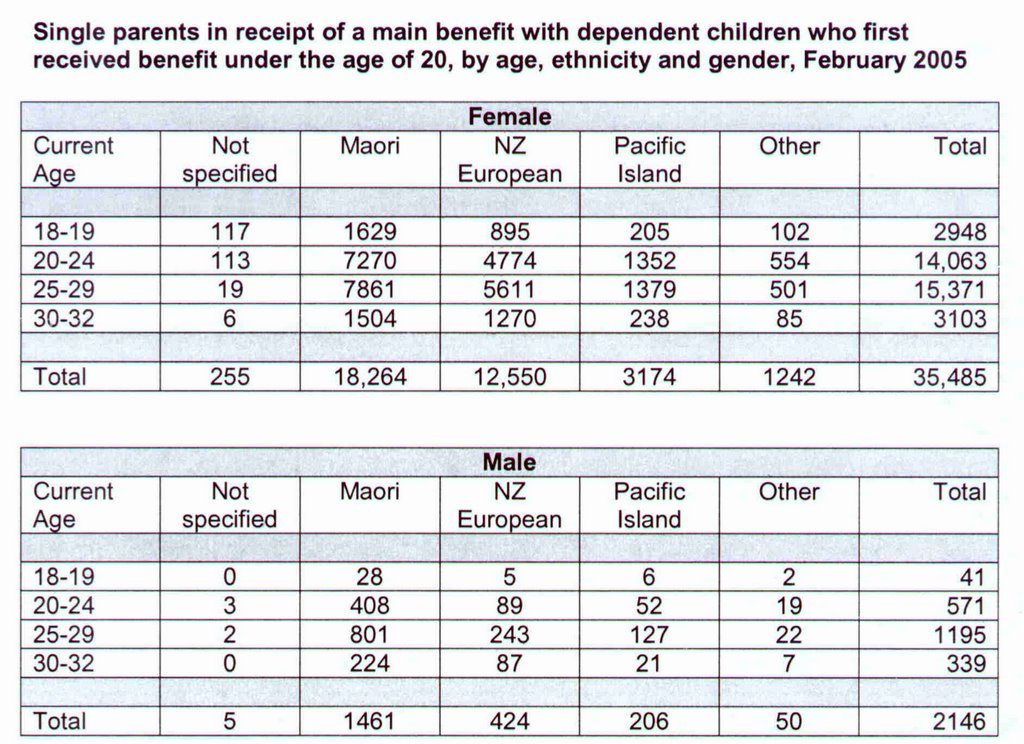
The majority of single parents who have been on a benefit since their teens are Maori.
In 2005 almost 20,000 benefit-dependent Maori single parents had first received a benefit under the age of twenty. In the care of these parents are around 33,500 children.
The equivalent figures for NZ European are just under 13,000 parents looking after approximately 19,000 children.
The availability of the Domestic Purpose's Benefit to 18 and 19 year-olds, and before that, the Emergency Maintenance Allowance to 16 and 17 year- olds, serves as a bigger trap for Maori than other group.
Many go down this road because that's all they have ever seen. Often they are too young and immature to cope with the responsibility of parenting, sometimes with tragic consequences. What these kids need is more time to grow up free from the temptation of the seemingly easy money that comes with babies.
Parenting is never easy but teenagers are prone to finding this out too late.
The government must end this neglectful policy and give young New Zealanders, Maori in particular, a chance to lead lives that aren't prematurely burdened with unwanted responsibility.
Note. The table only features up to 32 year-olds. This is because the MSD doesn't have the electronic data going back further. So these figures are minimum.
Child abuse statistics
According to the DomPost, More than 1000 Maori children were victims of abuse in the past year, a rate far higher than other ethnic groups, Child Youth and Family Services figures show.
It dealt with 1010 cases of physical abuse involving Maori children for 2005, compared with 613 Pakeha cases and 451 Pacific Island cases.
Yet the following table shows more than 13,000 cases of established abuse.

If both pieces of information are correct the difference must be accounted for with mental abuse, sexual abuse or neglect.
Notice the Pacific Island rate of physical abuse is also very high at 22 percent of the total reported. Pacific people make up around 7 percent of New Zealand's population, although that would rise in the lower age groups.
One more thought. There may be some over-reporting with some children recorded in more than one ethnic group. Typically the difference would not be highly significant.
It dealt with 1010 cases of physical abuse involving Maori children for 2005, compared with 613 Pakeha cases and 451 Pacific Island cases.
Yet the following table shows more than 13,000 cases of established abuse.

If both pieces of information are correct the difference must be accounted for with mental abuse, sexual abuse or neglect.
Notice the Pacific Island rate of physical abuse is also very high at 22 percent of the total reported. Pacific people make up around 7 percent of New Zealand's population, although that would rise in the lower age groups.
One more thought. There may be some over-reporting with some children recorded in more than one ethnic group. Typically the difference would not be highly significant.
Monday, June 26, 2006
Getting ugly
Iwi leader calls for restraint over twins’ death
Monday, 26 June 2006, 2:08 pm
Press Release: David Rankin
26 June 2006
Iwi leader calls for gang restraint over twins’ death
Nga Puhi leader David Rankin has called for gang members not to take the law into their own hands over the recent deaths of the three-month-old twins in South Auckland.
Mr Rankin has been approached by two gang representatives who have stated their wish to pursue muru (Maori justice) against those present when the twins were fatally injured.
‘I have urged them to allow the Pakeha justice system to take its course’, says Mr. Rankin, ‘but every day that passes, the desire for utu (revenge) is intensifying. I believe it is just a matter of time before gang retribution takes place’, he says.
Mr. Rankin wishes to urge the family at the centre of the investigations to cooperate fully with the Police for fear that if they do not, Maori forms of justice might start to appear.
‘My main concern is that no more harm is done’, says Mr. Rankin, ‘but it is getting to the point where preventing further violence will be like trying to holds back a tidal wave’
Monday, 26 June 2006, 2:08 pm
Press Release: David Rankin
26 June 2006
Iwi leader calls for gang restraint over twins’ death
Nga Puhi leader David Rankin has called for gang members not to take the law into their own hands over the recent deaths of the three-month-old twins in South Auckland.
Mr Rankin has been approached by two gang representatives who have stated their wish to pursue muru (Maori justice) against those present when the twins were fatally injured.
‘I have urged them to allow the Pakeha justice system to take its course’, says Mr. Rankin, ‘but every day that passes, the desire for utu (revenge) is intensifying. I believe it is just a matter of time before gang retribution takes place’, he says.
Mr. Rankin wishes to urge the family at the centre of the investigations to cooperate fully with the Police for fear that if they do not, Maori forms of justice might start to appear.
‘My main concern is that no more harm is done’, says Mr. Rankin, ‘but it is getting to the point where preventing further violence will be like trying to holds back a tidal wave’
Some insight
Deborah Coddington, Wellington host for NewstalkZB this week, interviewed Police Association head, Greg O'Connor about the Kahui business. He was unsurprised at the "circling the wagons" tactic. The police see this all the time with Black Power and Mongrel Mob. Obviously the practice has filtered down. What he suggests could be going on is the family are sorting out who will take the rap. Getting the facts of the matter will be incredibly difficult.
Corporate welfare
This is fairly staggering.
Businesses are receiving up to $17,000 from taxpayers for each beneficiary they employ, but Work and Income cannot say how many are kept on after the 12-month subsidy ends. The Job Plus scheme has subsidised the wages of 123,000 beneficiaries working as labourers, restaurant staff, builders, salespeople and machinery operators since it began in 1998. The scheme provides up to $214 a week for every participant.
I can't work out how $214 x 52 becomes $17,000 but anyway....is there any check on whether the subsidised employers keep the ex-beneficiary after the year-long subsidy ends?
According to Ray Smith, deputy CE of the Ministry of Social Development, "Our overall measure isn't whether the employers hang on to the individual, it's whether or not they come back on to a benefit".
If it became apparent that an employer was regularly accessing Job Plus and not providing work after the subsidy ended then Work and Income "would stop working with them".
Stop working with them. That's reassuring.
Businesses are receiving up to $17,000 from taxpayers for each beneficiary they employ, but Work and Income cannot say how many are kept on after the 12-month subsidy ends. The Job Plus scheme has subsidised the wages of 123,000 beneficiaries working as labourers, restaurant staff, builders, salespeople and machinery operators since it began in 1998. The scheme provides up to $214 a week for every participant.
I can't work out how $214 x 52 becomes $17,000 but anyway....is there any check on whether the subsidised employers keep the ex-beneficiary after the year-long subsidy ends?
According to Ray Smith, deputy CE of the Ministry of Social Development, "Our overall measure isn't whether the employers hang on to the individual, it's whether or not they come back on to a benefit".
If it became apparent that an employer was regularly accessing Job Plus and not providing work after the subsidy ended then Work and Income "would stop working with them".
Stop working with them. That's reassuring.
Gender-bias
The civil service seem obsessed with such concepts, to the point where they will pay $121,000 for a "gender-neutral job evaluation tool".
According to Stuff, The work being done was designed to ensure the evaluation was not gender-biased.
Not that I want any more tax-payer money thrown down the drain but the Ministry of Social Development could do with a "gender-neutral employment evaluation tool".
6324 (2006). Katherine Rich to the Minister for Social Development and Employment (31 May 2006): How many policy analysts does the Ministry employ broken down by gender?
Hon David Benson-Pope (Minister for Social Development and Employment) replied: As at the end of April 2006, the Ministry of Social Development employed 154 policy analysts of whom 103 were female and 51 male.
Then again, as long as the bias is running in the "right" direction, it's probably okay. You can breathe a sigh of relief.
According to Stuff, The work being done was designed to ensure the evaluation was not gender-biased.
Not that I want any more tax-payer money thrown down the drain but the Ministry of Social Development could do with a "gender-neutral employment evaluation tool".
6324 (2006). Katherine Rich to the Minister for Social Development and Employment (31 May 2006): How many policy analysts does the Ministry employ broken down by gender?
Hon David Benson-Pope (Minister for Social Development and Employment) replied: As at the end of April 2006, the Ministry of Social Development employed 154 policy analysts of whom 103 were female and 51 male.
Then again, as long as the bias is running in the "right" direction, it's probably okay. You can breathe a sigh of relief.
Sunday, June 25, 2006
Another major excuse-maker
Please read the link in the following post and then come back to this.
Tariana Turia says resources inadequate
The Maori Party believes inadequate resources are partly to blame for the country's appalling child abuse record.
Party co-leader Tariana Turia says the case of the Kahui twins highlights a group of people who have become marginalised.
Mrs Turia says she has shed many tears over the deaths of three-month-olds Cru and Chris Kahui, a week ago today.
She says the case points up the need for better understanding of families under pressure.
Tariana Turia says privacy laws are also a problem, because government agencies are often afraid to share information about families in trouble.
Alan Duff has a different viewpoint. He has no time for the current Maori leadership, particularly Tariana Turia. In this interview from Friday he says, "I have a theory. I believe all this excuse mongering has been going on so long we are believing it. Each bunch of do-gooders and absolvers lower the bar further."
Shame on Tariana Turia.
Tariana Turia says resources inadequate
The Maori Party believes inadequate resources are partly to blame for the country's appalling child abuse record.
Party co-leader Tariana Turia says the case of the Kahui twins highlights a group of people who have become marginalised.
Mrs Turia says she has shed many tears over the deaths of three-month-olds Cru and Chris Kahui, a week ago today.
She says the case points up the need for better understanding of families under pressure.
Tariana Turia says privacy laws are also a problem, because government agencies are often afraid to share information about families in trouble.
Alan Duff has a different viewpoint. He has no time for the current Maori leadership, particularly Tariana Turia. In this interview from Friday he says, "I have a theory. I believe all this excuse mongering has been going on so long we are believing it. Each bunch of do-gooders and absolvers lower the bar further."
Shame on Tariana Turia.
Typical
There seemed to be somthing amiss. This morning I read the mother of the Kahui twins is 27. The twins can't possibly have been her first birth, I thought. It doesn't fit with the profile.
Sure enough. She has had four other children. A former partner has them. If you need any more convincing that an underclass exists in this country read this;
(Note. The underclass is not confined to Maori).
Sure enough. She has had four other children. A former partner has them. If you need any more convincing that an underclass exists in this country read this;
(Note. The underclass is not confined to Maori).
Paradise lost........
People are sometimes tempted to believe New Zealand in the fifties and sixties was some sort of paradise, especially after a week like the last. But every period had its problems.
The following excerpts are from the Investors Chronicle written by a London correspondent in November 1959. He appraises New Zealand as a place to invest:
"It would be idle to pretend that everything is perfect in New Zealand. There are some big snags unadvertised, but definitely there is in every new country. New Zealand is no exception. Tucked away at one end of the world, it undoubtedly has a small-town outlook and its Governments of whatever party tend to grind out dreary 19th centuryish radicalism. It is under-populated with 2,500,000 inhabitants. Its potential has not yet been really tapped and the country remains primarily agricultural and pastoral".
Referring to the upward trend in brewery shares since the war, the correspondent says this has occurred in the face of considerable adversity, much of it artificial. The two big breweries still have to contend with a poll every three years for or against Prohibition, hamfisted hotel price control, and last year the doubling in one go of duty on beer. In spite of all this the rise in their shares has been almost sensational.
"Even these performances could have been bettered were it not for a drab egalitarianism which abhors the idea of luxury hotels and so prevents New Zealand with its magnificent scenery from being properly opened as a tourist resort," the correspondent continues.
"The balance of payments is a perennial worry to New Zealand. Last year things became really critical and the Government faced with the necessity of doing something desperate however unpopular, jumped up taxation in a big way, slashed import quotas and borrowed a lot of money abroad. However this year the terms of trade turned more favourable and the Government measures have been shown to be more panicky than wise. The extra taxation has proved crippling and has produced more income than was really necessary. Strict import quotas only lead to dishonesty and foreign credits were found to be larger than required."
"With an election in the offing next November, the Government could not admit to having been wrong and little was done to put matters right in the last Budget, so New Zealand has now supplanted the United Kingdom in the unenviable position of being the most heavily taxed country in the Commonwealth."
The following excerpts are from the Investors Chronicle written by a London correspondent in November 1959. He appraises New Zealand as a place to invest:
"It would be idle to pretend that everything is perfect in New Zealand. There are some big snags unadvertised, but definitely there is in every new country. New Zealand is no exception. Tucked away at one end of the world, it undoubtedly has a small-town outlook and its Governments of whatever party tend to grind out dreary 19th centuryish radicalism. It is under-populated with 2,500,000 inhabitants. Its potential has not yet been really tapped and the country remains primarily agricultural and pastoral".
Referring to the upward trend in brewery shares since the war, the correspondent says this has occurred in the face of considerable adversity, much of it artificial. The two big breweries still have to contend with a poll every three years for or against Prohibition, hamfisted hotel price control, and last year the doubling in one go of duty on beer. In spite of all this the rise in their shares has been almost sensational.
"Even these performances could have been bettered were it not for a drab egalitarianism which abhors the idea of luxury hotels and so prevents New Zealand with its magnificent scenery from being properly opened as a tourist resort," the correspondent continues.
"The balance of payments is a perennial worry to New Zealand. Last year things became really critical and the Government faced with the necessity of doing something desperate however unpopular, jumped up taxation in a big way, slashed import quotas and borrowed a lot of money abroad. However this year the terms of trade turned more favourable and the Government measures have been shown to be more panicky than wise. The extra taxation has proved crippling and has produced more income than was really necessary. Strict import quotas only lead to dishonesty and foreign credits were found to be larger than required."
"With an election in the offing next November, the Government could not admit to having been wrong and little was done to put matters right in the last Budget, so New Zealand has now supplanted the United Kingdom in the unenviable position of being the most heavily taxed country in the Commonwealth."
Agree?
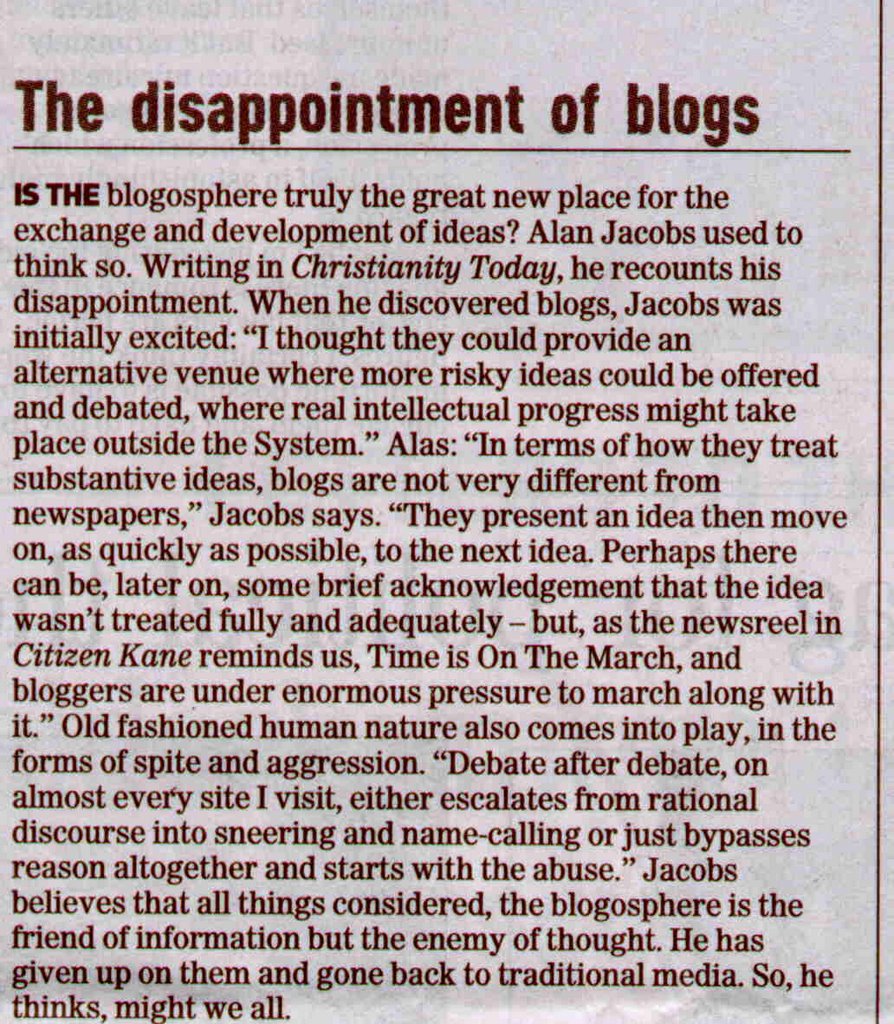
This is from the SST Denis Dutton's "Arts & Letters Daily".
I agree about the "spite and aggression" and thankfully, and thank you to readers of this blog, we don't get much of it here. Most comments of this type are easy to ignore because they say more about the mentality of the poster than the merit of their ideas.
Letters-to-the-editor aside, where there is a lack of immediacy and no guarantee of publication, newspapers aren't interactive. Just as talkback radio took off and is now a firmly established part of the media culture, blogs have a similar future. People want interaction. They want to be able to express their own view and hear others, though I suspect the first is more important.
As an "alternative venue" for testing riskier ideas, blogs have no parallel.
Saturday, June 24, 2006
Finding excuses
Pita Sharples has got involved in the Kahui case.
On TV3 last night he very upset that people were "Blaming Maori as though we are all responsible for what a Maori does." As an individualist I am sympathetic to this viewpoint. I wouldn't want to be blamed for what Donna Awatere-Huata did because she is a woman and so am I, or she was an ACT member and so am I.
But from the DomPost this morning, he said non-cooperation was a "cultural thing" relating to the family being dysfunctional and dispossessed.
Well now he is taking the opposite tack. Only a Maori family would have reasons of 'culture' and 'dispossession' put up for their actions. These are collective excuses.
If Sharples is going to promulgate them then he'll have to put up with the consequences.
On TV3 last night he very upset that people were "Blaming Maori as though we are all responsible for what a Maori does." As an individualist I am sympathetic to this viewpoint. I wouldn't want to be blamed for what Donna Awatere-Huata did because she is a woman and so am I, or she was an ACT member and so am I.
But from the DomPost this morning, he said non-cooperation was a "cultural thing" relating to the family being dysfunctional and dispossessed.
Well now he is taking the opposite tack. Only a Maori family would have reasons of 'culture' and 'dispossession' put up for their actions. These are collective excuses.
If Sharples is going to promulgate them then he'll have to put up with the consequences.
Friday, June 23, 2006
Unpaid fines? Be warned!
 Just heard a advertisement on radio saying if you don't want to see your name published in the newspaper then you better pay your fines. You wouldn't want your mum or your friends to know, the voice suggested. Do you think fine-dodgers will give a stuff? For that matter, with speed cameras widely believed to be a revenue gathering exercise, is there any particular stigma attached anyway?
 That's going to be one very big advertisement.
A very angry community
This morning Paul Holmes was doing one of his question and answer routines which, for those who don't listen, is a monologue with himself. "Is there growing community anger about the Kahui twins?" "OhhhhYesss"
With the latest press conference this afternoon revealing the family met after the twins had been taken to hospital and collectively decided not to co-operate with police enquiries, the issue is approaching boiling point. Apparently Pita Sharples is trying to reason with them.
With the latest press conference this afternoon revealing the family met after the twins had been taken to hospital and collectively decided not to co-operate with police enquiries, the issue is approaching boiling point. Apparently Pita Sharples is trying to reason with them.
A way forward
A commentor asked, given the DPB is so entrenched, how do we get rid of it?
Within the context of a government provided welfare system, go back the way we came. First make it strictly temporary. One year maximum for newcomers. That would act as a fairly effective deterrent - a major priority.
For those already on it, eligibility remains until their current youngest is 6 or one year from the time of change - whichever is longer.
The government could set up a voluntary contributory insurance scheme which gives cover for relationship breakdown where there are dependent children. This would provide extra cover. As with ACC a non-Labour government would privatise such a scheme.
Within the context of a government provided welfare system, go back the way we came. First make it strictly temporary. One year maximum for newcomers. That would act as a fairly effective deterrent - a major priority.
For those already on it, eligibility remains until their current youngest is 6 or one year from the time of change - whichever is longer.
The government could set up a voluntary contributory insurance scheme which gives cover for relationship breakdown where there are dependent children. This would provide extra cover. As with ACC a non-Labour government would privatise such a scheme.
radio host for a week
 Ex ACT MP, Deborah Coddington is hosting Justin du Fresne's NewstalkZB show next week. (Unless she is hosting Leighton Smith's programme and we are getting the Auckland broadcast which is what usually happens when Justin is away.)
"What ridiculous lawmaking is that?"
The Timaru Herald describes the practical difficulties with enforcing the micro-chipping legislation as it stands. But not before asking the question on thinking people's minds;
Wednesday night's vote on dog microchipping shows just what an ass the legislation is. The Green Party MPs who voted to exempt working dogs did so not with that aim, but to make microchipping as a whole unworkable. What ridiculous lawmaking is that?
Wednesday night's vote on dog microchipping shows just what an ass the legislation is. The Green Party MPs who voted to exempt working dogs did so not with that aim, but to make microchipping as a whole unworkable. What ridiculous lawmaking is that?
Sad loss
It is very sad news that Dave Bowman has passed away. Dave was a very public face fighting for the funding of cancer treatment. I sometimes heard him on the radio and watched the Inside New Zealand programme he made. It is amazing what some people can achieve even with deteriorating health. He certainly made sense of his losing his life prematurely. But it must be very hard for his young family.
Thursday, June 22, 2006
I don't care about people in prison....
Well, actually, I do. Believe it or not I have a strong humanitarian streak and find it very hard not to find some saving grace in most people. So let me put that in context. I don't care about people in prison as much as I care about people not in prison. So if we can protect law-abiding people from thugs by locking them up - the thugs that is - well I'm all for it. Here David Green makes the case for building more prisons. The same reasoning can be applied to the New Zealand situation.
(Thanks to The Welfare State We're In for the link)
(Thanks to The Welfare State We're In for the link)
Let the bribes begin
What will they think of to bribe voters with next?
Forget "free" doctors visits, free childcare, free school milk. Think free PC pornography filters. That's what the Federal government of Australia is promising.
Another compelling reason to pack our bags? I think not.
Forget "free" doctors visits, free childcare, free school milk. Think free PC pornography filters. That's what the Federal government of Australia is promising.
Another compelling reason to pack our bags? I think not.
Wednesday, June 21, 2006
What went wrong?
My thoughts have crystallised over the past few days. Welfare alone can't be blamed for the underclass that creates tragedies like the deaths of the Kahui twins. But it has a damn lot to do with matters;
A teenage Maori girl had just miscarried. It was suggested her mother made sure she was given contraceptives to prevent a recurrence of another unwanted pregnancy. "No point," came the answer. Why? Because she won't use them. Her and her mates are mad on having babies.
The girl has no job, no qualifications, no partner, no secure home. Her own family distrusts her because she is a compulsive liar.
But as sure as summer yields to autumn, this girl will become a mother. From her viewpoint it's a rational decision. She can sign up for the DPB, get priority for a state house and play mum. Of course, she'll still want to party with her mates of both sexes. She knows none of the discipline or sacrifice that bringing up a child requires. She has never learnt either.
This one is not going to be a good mother. Yet around the late 1960s an idea developed that all children, without exception, are better off with their birth mothers. The wave of opposition to adoption grew. Taking babies away from their birth mothers came to be seen as almost barbaric.
During the fifties and sixties a young mother could choose to keep her child. There were emergency sickness benefits which covered her for a few months while she breastfed the baby. But ultimately she would need family support, or work to pay for childcare, in order to keep her child.
From 1968 to 1972 a benefit called the domestic purposes emergency benefit became available. The social security department could grant this at their discretion. But in 1973 that benefit became statutory, which meant any single parent qualified - no questions asked. The reason for their single parenthood no longer had any bearing on whether the state would assist them.
Adoptions plummetted. Homes for unmarried mothers were no longer needed. The ex-nuptial birthrate soared. This was the new utopia feminists had pushed for.
By the early eighties street kids started to dominate the headlines. Hundreds were reckoned to be living rough in Auckland, in parks and derelict buildings. Many turned to crime and girls often became pregnant.
By 1982 the National Council of Women were advocating adult guardians for teenage mums whose own parents had abdicated any responsibility for. The first generation of children kept by mothers without the emotional or financial wherewithal to parent properly was already repeating the cycle.
Many of the worst cases of violence against children happen to those born to very young mums who continue to have a series of partners and more children by them. Their homes are chaotic and unkempt as are their children. The parent and her mates go on living just as they did before they brought the babies home. Their role as "carers" is a total misnomer because very little caring is going on. Often gang members are involved, tagging on to the mother's steady benefit income and cheap housing.
The lifestyle isn't confined to Maori although it seems to hold more appeal to this ethnic group than others. Newborns going into these "homes" are the acutely vulnerable. Researchers who analysed data from the nineties found children from DPB homes were four times more likely to become the subject of a CYF care and protection notification.
Everybody who works in the social services area can provide too much anecdotal evidence that the cycle of deprivation and depravation is driven, in part, by policy that encourages children to bear children. The idea that all birth mothers, without exception, are the best people to bring up their babies has had tragic consequences.
We must reconsider. While adoption might not have been ideal what we swapped it for has proven far worse for too many children.
A teenage Maori girl had just miscarried. It was suggested her mother made sure she was given contraceptives to prevent a recurrence of another unwanted pregnancy. "No point," came the answer. Why? Because she won't use them. Her and her mates are mad on having babies.
The girl has no job, no qualifications, no partner, no secure home. Her own family distrusts her because she is a compulsive liar.
But as sure as summer yields to autumn, this girl will become a mother. From her viewpoint it's a rational decision. She can sign up for the DPB, get priority for a state house and play mum. Of course, she'll still want to party with her mates of both sexes. She knows none of the discipline or sacrifice that bringing up a child requires. She has never learnt either.
This one is not going to be a good mother. Yet around the late 1960s an idea developed that all children, without exception, are better off with their birth mothers. The wave of opposition to adoption grew. Taking babies away from their birth mothers came to be seen as almost barbaric.
During the fifties and sixties a young mother could choose to keep her child. There were emergency sickness benefits which covered her for a few months while she breastfed the baby. But ultimately she would need family support, or work to pay for childcare, in order to keep her child.
From 1968 to 1972 a benefit called the domestic purposes emergency benefit became available. The social security department could grant this at their discretion. But in 1973 that benefit became statutory, which meant any single parent qualified - no questions asked. The reason for their single parenthood no longer had any bearing on whether the state would assist them.
Adoptions plummetted. Homes for unmarried mothers were no longer needed. The ex-nuptial birthrate soared. This was the new utopia feminists had pushed for.
By the early eighties street kids started to dominate the headlines. Hundreds were reckoned to be living rough in Auckland, in parks and derelict buildings. Many turned to crime and girls often became pregnant.
By 1982 the National Council of Women were advocating adult guardians for teenage mums whose own parents had abdicated any responsibility for. The first generation of children kept by mothers without the emotional or financial wherewithal to parent properly was already repeating the cycle.
Many of the worst cases of violence against children happen to those born to very young mums who continue to have a series of partners and more children by them. Their homes are chaotic and unkempt as are their children. The parent and her mates go on living just as they did before they brought the babies home. Their role as "carers" is a total misnomer because very little caring is going on. Often gang members are involved, tagging on to the mother's steady benefit income and cheap housing.
The lifestyle isn't confined to Maori although it seems to hold more appeal to this ethnic group than others. Newborns going into these "homes" are the acutely vulnerable. Researchers who analysed data from the nineties found children from DPB homes were four times more likely to become the subject of a CYF care and protection notification.
Everybody who works in the social services area can provide too much anecdotal evidence that the cycle of deprivation and depravation is driven, in part, by policy that encourages children to bear children. The idea that all birth mothers, without exception, are the best people to bring up their babies has had tragic consequences.
We must reconsider. While adoption might not have been ideal what we swapped it for has proven far worse for too many children.
Shocker story from the UK
This is a shocker.
A 43 year-old British women who contracted HIV from an Afro-Carribean man went on a "mission" to infect as many other men of the same ethnicity as possible. She has been jailed for 32 months. Spare a thought for her son.
A 43 year-old British women who contracted HIV from an Afro-Carribean man went on a "mission" to infect as many other men of the same ethnicity as possible. She has been jailed for 32 months. Spare a thought for her son.

Tuesday, June 20, 2006
Shame
So now we know that the Kahui house was a "party" house. Neighbours said it was difficult to tell how many people lived there because so many came and went. A small house which could have no more than three bedrooms with a media-reported 9 people living there. Broken windows, banged up boards, loud music. It makes me ill to know that two exceedingly vulnerable babies were taken to live there.
 What do you notice about this photo? It was taken in the 1950s at a Salvation Army home for unmarried mothers. I imagine most of these babies would have been adopted out. At that time a mother could only get an emergency sickness benefit for a few months while she breastfed the child, and less frequently, a longer term unemployment benefit was granted, but ultimately if she wanted to keep her child she had to make her own arrangements either with family support or care paid for while she worked. Be honest. Have we really improved matters with the statutory DPB?
More women in prison
The "soaring" female prison population is something I have been aware of for some time. Criminologist Greg Newbold's comment is really interesting and in keeping with a tendency he has to pour oil on troubled waters.
"The female population tends to be very volatile because it is quite small. There have been more women in prison, but there have been a lot more men in prison, too," he said.
Women's imprisonment rates had been higher in the 1940s and the 1880s, when they reached 16% of the total prison population, so the current situation should not be alarming, he said.
Now this is sheer speculation from me but in the 1940's the male population was severely depleted on the back of WW11. In the 1880s prostitution and drunkeness were rife. The Women's temperance movement was the reaction to this.
Comparing 2006 to the 1880s is probably more useful than to the 1940s.
"The female population tends to be very volatile because it is quite small. There have been more women in prison, but there have been a lot more men in prison, too," he said.
Women's imprisonment rates had been higher in the 1940s and the 1880s, when they reached 16% of the total prison population, so the current situation should not be alarming, he said.
Now this is sheer speculation from me but in the 1940's the male population was severely depleted on the back of WW11. In the 1880s prostitution and drunkeness were rife. The Women's temperance movement was the reaction to this.
Comparing 2006 to the 1880s is probably more useful than to the 1940s.
Monday, June 19, 2006
Contemplating pregnancy on a benefit
The New Zealand Medical Association deputy chairman, Don Simmers, today said that too many women are contemplating pregnancy on a benefit.
Statistics show that thousands of babies are born onto benefits each year. At July last year 26,126 children had been added to a current benefit.
This isn't just a matter of contraception failure. Anecdotal evidence says many of these babies have been planned. It is encouraging to hear Dr Simmers confirming his. With contraception highly accessible there can be no other explanation for this high rate of child-bearing on a benefit.
Too many women with tobacco, alcohol and drug habits which lead to benefit dependency are busy planning their next meal ticket. It is a crazy welfare system that encourages this by paying more cash with each child produced.
Statistics show that thousands of babies are born onto benefits each year. At July last year 26,126 children had been added to a current benefit.
This isn't just a matter of contraception failure. Anecdotal evidence says many of these babies have been planned. It is encouraging to hear Dr Simmers confirming his. With contraception highly accessible there can be no other explanation for this high rate of child-bearing on a benefit.
Too many women with tobacco, alcohol and drug habits which lead to benefit dependency are busy planning their next meal ticket. It is a crazy welfare system that encourages this by paying more cash with each child produced.
War on drugs "long lost"
Increasingly experts are lending legitimacy to the idea that the war on drugs is highly questionable. Here a former deputy chief constable declares the Scottish war on drugs is "long lost." Tom Wood now holds the "influential post of chairman of the Scottish Association of Alcohol and Drug Action Teams, a body which advises the Executive on future policy".
"In order to make a difference in the long term, education and deterrence have to go to the top of the pile. We have to have the courage and commitment to admit that we have not tackled the problem successfully in the past. We have to win the arguments and persuade young people that drugs are best avoided."
"In order to make a difference in the long term, education and deterrence have to go to the top of the pile. We have to have the courage and commitment to admit that we have not tackled the problem successfully in the past. We have to win the arguments and persuade young people that drugs are best avoided."
Foreign doctors
According to the College of Practitioners 34 percent of New Zealand GPs are trained overseas and the rural sector would collapse without them. Let's hear it for foreign doctors.
Assimilate or else....
The Dutch are considering introducing a very tough knowledge test for immigrants which would involve 600 hours of course-work. Amongst other subjects it would educate about Holland's traditionally liberal attitudes towards abortion, euthanasia and homosexuality. For those who do not pass, fines, cuts in benefits or termination of residence are proposed. In a population of about 16 million there are around 1.5 million immigrants.
School "fees"
Apparently the Ministry of Education is looking at changing rules about how schools extract donations. Donations must not be called "fees". Pressure must not be put on parents.
Mr English said the Government would be better off being honest with parents and admitting that free education was no longer a reality and that the costs were instead shared by the Government, parents and the community.
That's not really honest either. Free education was never a reality. The only people whose kids are getting a free education are those who are effectively not paying tax. With all the increased redistribution under Labour there should be more money available for school fees and donations.
Mr English said the Government would be better off being honest with parents and admitting that free education was no longer a reality and that the costs were instead shared by the Government, parents and the community.
That's not really honest either. Free education was never a reality. The only people whose kids are getting a free education are those who are effectively not paying tax. With all the increased redistribution under Labour there should be more money available for school fees and donations.
Mapp's bill will sink
Looks like Wayne Mapp's employment bill, which would see a 90-day probationary period introduced, has sunk. Pita Sharples is voting against it. That is a damn shame. A probationary period would have helped Maori in particular get a foot in the door. Without it there will be fewer opportunities.
Sunday, June 18, 2006
Another unnecessary, tragic death
Ironically, while I have been talking about the hysteria over child abuse, another baby has died from head injuries which appear to have been the result of assault.
Latest political polling
(Angus Reid Global Scan) – More voters in New Zealand are voicing support for the opposition National party, according to a poll by Roy Morgan International. 44.5 per cent of respondents would vote for National in the next election, while 40 cent would back the governing Labour party.
The Greens are in third place with 6.5 per cent, followed by New Zealand First with 4.5 per cent, United Future with two per cent, ACT with 1.5 per cent, and the Maori Party with one per cent.
I wonder what is behind that poor Maori Party result? The tobacco ban? Or, with the margin of error, is it just not significant?
The Greens are in third place with 6.5 per cent, followed by New Zealand First with 4.5 per cent, United Future with two per cent, ACT with 1.5 per cent, and the Maori Party with one per cent.
I wonder what is behind that poor Maori Party result? The tobacco ban? Or, with the margin of error, is it just not significant?
"Problems with images"
Following on from yesterday's post about the climate of hysteria surrounding child abuse, here's another hair-raising story, this time out of Florida and this time, a recent occurrence. A nanny was arrested and held in prison for two years after secret camera footage appeared to show her shaking a baby in her care. The baby had no injuries and the nanny has never been taken to trial or convicted. She is now suing the camera manufacturer;
In March, Broward County prosecutors said experts they had consulted concluded the footage was not reliable as evidence because its videotape was time-lapsed, meaning that the movements that appeared to be rough shaking might not have been as violent as they appeared.
Robert McKee, Muro's civil attorney, said the footage was misleading and consumers should be warned about problems with the images.
As an afterthought, the phrase "problems with images" reminded me of these TV images of Resident Doctor's Association secretary, Deborah Powell, used by the DomPost yesterday. It seems obvious the conveyance of a certain impression was intended;
The three photos on the left-right diagonal are quite distorted and reminiscent of a particular image which I will not post here. But this is a good example of the media exploiting images to suit their slant on matters.
In March, Broward County prosecutors said experts they had consulted concluded the footage was not reliable as evidence because its videotape was time-lapsed, meaning that the movements that appeared to be rough shaking might not have been as violent as they appeared.
Robert McKee, Muro's civil attorney, said the footage was misleading and consumers should be warned about problems with the images.
As an afterthought, the phrase "problems with images" reminded me of these TV images of Resident Doctor's Association secretary, Deborah Powell, used by the DomPost yesterday. It seems obvious the conveyance of a certain impression was intended;
The three photos on the left-right diagonal are quite distorted and reminiscent of a particular image which I will not post here. But this is a good example of the media exploiting images to suit their slant on matters.
Saturday, June 17, 2006
Gareth Morgan writes from Utah
 (Couldn't resist this photo from the NZ Herald):
Right in this town where we are today, Moab, Utah, the local school has surrendered its right to refuse some Christian mystic running his "Good News" club for students in the classroom right after school ends, since he threatened to use a Christian activist lobby, the American Centre of Law and Justice, to fight for the right.
As the school president commented, "We're a very small district. We don't have the funds to go all the way to the Supreme Court."
It's pathetic, really. If you take the libertarian view - as I do - that religion is your own business, don't ram it down the throats of us that think it's just another human frailty. It's another sign that the US is on a slide back toward the intolerant conservatism that its founding fathers escaped.
That El Presidente, reformed drunkard and born-again George Dubya, can declare he is doing God's work as he blunders around Iraq totally out of his depth, could only happen in a democracy that excuses it because the Christian God is on their leader's side. Nuts!
Who said this?
“"Don't buy a single vote more than necessary. I'll be damned if I'm going to pay for a landslide.”"
(Clue; It wasn't Helen Clark to Michael Cullen. Her instruction was, buy every vote you can. We're going to need every last one.)
(Clue; It wasn't Helen Clark to Michael Cullen. Her instruction was, buy every vote you can. We're going to need every last one.)
Abuse hysteria
During the week I saw this headline; "Abused kids should be taken from parents, claims US professor".
Dr Schmitt was brought to NZ by the Plunket Society as an expert on child abuse. He recommended more stringent intervention. In the US there was a mandatory reporting system where anyone who had anything to do with a child - a teacher, doctor, nurse - was required under the law to report any signs of abuse to social welfare, which then fully investigated the case. He said, "Termination of parental rights has been common in our country for some time. It gives judges the option to remove the child permanently from a family and put him or her up for adoption...people should be suspicious if there was more than one bruise, or bruises in different areas. When a child fell, they usually received only one bruise."
The professor was brought to New Zealand in 1982.
Question; Those of you who have youngsters, do they have any bruises on their legs? My seven year-old does. And she generally gets them at school where she is at her most active, swinging from bars, jumping from climbing frames, tripping over shoelaces, missing a step. Like many her age, she goes at everything full tilt and sometimes comes a cropper.
Anyway, coincidentally I came across a story in the LA Times today. Now, if you want to read about the real and tragic consequences of the hysteria surrounding child abuse, physical and sexual, that peaked in the eighties read on....
Dr Schmitt was brought to NZ by the Plunket Society as an expert on child abuse. He recommended more stringent intervention. In the US there was a mandatory reporting system where anyone who had anything to do with a child - a teacher, doctor, nurse - was required under the law to report any signs of abuse to social welfare, which then fully investigated the case. He said, "Termination of parental rights has been common in our country for some time. It gives judges the option to remove the child permanently from a family and put him or her up for adoption...people should be suspicious if there was more than one bruise, or bruises in different areas. When a child fell, they usually received only one bruise."
The professor was brought to New Zealand in 1982.
Question; Those of you who have youngsters, do they have any bruises on their legs? My seven year-old does. And she generally gets them at school where she is at her most active, swinging from bars, jumping from climbing frames, tripping over shoelaces, missing a step. Like many her age, she goes at everything full tilt and sometimes comes a cropper.
Anyway, coincidentally I came across a story in the LA Times today. Now, if you want to read about the real and tragic consequences of the hysteria surrounding child abuse, physical and sexual, that peaked in the eighties read on....
Friday, June 16, 2006
Ageing = happiness
The NZ Herald has a piece about the myth of ageing bringing unhappiness. Apparently many people expect to get unhappier as they age. Not me. I look forward to having more time, travelling more, grand children, tomorrow's test match, lots of things. And I am happier now than ever before (despite all the grizzling on my blog). The following made absolute sense to me;
There are a number of theories about why people may get happier as they get older, Lacey noted. For one, people may focus less on achievement and more on personal relationships and enjoying life, and also get better at managing their own moods.
There are a number of theories about why people may get happier as they get older, Lacey noted. For one, people may focus less on achievement and more on personal relationships and enjoying life, and also get better at managing their own moods.
Reason for rocketing invalid benefit numbers
Here James Bartholomew briefly puts his theory about the reason so many people are on an invalidity benefit in the UK. NZ has the same problem. My reckoning is that the higher payment rate is a factor but there are others.
If it isn't the govt nagging you.....

Not content to bitch about their own lives, some women have to bitch about men's lives as well. You are not doing enough housework. It's official. I read it in the Herald. Which is licence for me to nag you about it all weekend.
Never mind that you went to work for 6 out of 7 days which meant I didn't have to. Never mind that when you are at work you get nagged by your boss and for one day a week you'd like a bit of space. Never mind that I have oodles more free time and choice about what to do with it. Forget it. I want you doing your share of the housework so you can get fit and healthy and stick around for a few more years.
Otherwise, who would I have to nag?
Thursday, June 15, 2006
Medicinal cannabis back on the table
Green MP Metiria Turei has had a private member's bill to introduce medicinal cannabis pulled from the ballot. It might stand a chance of being passed if a few National MPs keep an open mind. United Future will fight it tooth and nail but there's only three of them. NZ First will probably oppose it but the Maori Party shouldn't.
11 - 14 year-old abortions
Statistics New Zealand has just released the 2005 abortion statistics which show a drop in the overall rate. One thing noticeable in the tables was the 11 - 14 year-old rate has reached 0.8 per 1000 females or 92 abortions. The rate has doubled what it was in the early nineties.
Abortions performed at 12 weeks made up;
1995 29 percent
1996 25.8
1997 22.8
1998 23.9
1999 24.1
2000 24
2001 26.7
2002 28.1
2003 29
2004 25.6
2005 28.1
I did these calculations to prove or disprove what we have been hearing from abortion practitioners - that the delay was getting longer. The figures don't support that BUT if late abortions are being performed in Australia they would be registered in Australia. Which then begs the question, is our rate really down or is the drop, 680 in absolute terms, due to abortions being performed off shore? It seems unlikely that number would have travelled to Australia.
The ethnic breakdown is;
European 51.6
Maori 20.6
Pacific 10.9
Asian 15.7
Other 1.2
Compared to thirteen other "selected low fertility" countries only the US has a higher rate (which may now be around the same as ours as it is dropping but no stats are given for the last two years.)
Abortions performed at 12 weeks made up;
1995 29 percent
1996 25.8
1997 22.8
1998 23.9
1999 24.1
2000 24
2001 26.7
2002 28.1
2003 29
2004 25.6
2005 28.1
I did these calculations to prove or disprove what we have been hearing from abortion practitioners - that the delay was getting longer. The figures don't support that BUT if late abortions are being performed in Australia they would be registered in Australia. Which then begs the question, is our rate really down or is the drop, 680 in absolute terms, due to abortions being performed off shore? It seems unlikely that number would have travelled to Australia.
The ethnic breakdown is;
European 51.6
Maori 20.6
Pacific 10.9
Asian 15.7
Other 1.2
Compared to thirteen other "selected low fertility" countries only the US has a higher rate (which may now be around the same as ours as it is dropping but no stats are given for the last two years.)
Maori and abortion
Oh Crikey has a post about abortion and his outrage at the government funding overseas Family Planning agencies which provide abortions. Somehow this develops into a strong objection to white feminists killing Maori babies.
For those who strongly oppose abortion, having to fund it just adds injury to insult. They shouldn't have to but there are a hundred and one things taxpayers object to paying for on moral grounds.
Women are not forced to have abortions. Some make the decision lightly, for others, it is agonising. Oh Crikey has framed it as both killing (Maori babies) and suicide (non-Maori). Which isn't unlike the Maori Smokefree Coalition describing smoking, another voluntary action, as genocide of Maori.
Oh Crikey and the Maori Smokefree Coalition openly and admittedly care more about the race they belong to. In my work this would be unthinkable. 'Sorry, I only want to help non-Maori people'. In fact, based on my limited experience, I should prefer to work with Maori and Pacific people because their need is genuine and they are more appreciative of help.
Then again, I wouldn't want to be Maori or Pacific because there are too many people like Oh Crikey's author telling me I am a victim, that I am not capable of making or responsible for my own decisions, that they are made for me by "psychotic white feticidal women". How patronising.
For those who strongly oppose abortion, having to fund it just adds injury to insult. They shouldn't have to but there are a hundred and one things taxpayers object to paying for on moral grounds.
Women are not forced to have abortions. Some make the decision lightly, for others, it is agonising. Oh Crikey has framed it as both killing (Maori babies) and suicide (non-Maori). Which isn't unlike the Maori Smokefree Coalition describing smoking, another voluntary action, as genocide of Maori.
Oh Crikey and the Maori Smokefree Coalition openly and admittedly care more about the race they belong to. In my work this would be unthinkable. 'Sorry, I only want to help non-Maori people'. In fact, based on my limited experience, I should prefer to work with Maori and Pacific people because their need is genuine and they are more appreciative of help.
Then again, I wouldn't want to be Maori or Pacific because there are too many people like Oh Crikey's author telling me I am a victim, that I am not capable of making or responsible for my own decisions, that they are made for me by "psychotic white feticidal women". How patronising.
The merits of hypocrisy
An interesting interview with Jeremy Lott, the author of a new book, "Defending Hypocrisy".
After interviewing a number of people about it and thinking the issue through, I decided that we should defend hypocrisy for a couple of reasons.
One, it usually forces us to hide and restrain some of our darker impulses in order to keep up appearances.
Two, it creates moral wiggle room for people to acknowledge the right thing—or speculate about what the right thing might be—even if they don't always do that thing.
After interviewing a number of people about it and thinking the issue through, I decided that we should defend hypocrisy for a couple of reasons.
One, it usually forces us to hide and restrain some of our darker impulses in order to keep up appearances.
Two, it creates moral wiggle room for people to acknowledge the right thing—or speculate about what the right thing might be—even if they don't always do that thing.
Wednesday, June 14, 2006
Released on bail
TV3 had some pretty awful stats tonight about the number of people awaiting trial who are realeased on bail. In the past year just under 10,000. A quarter were awaiting trials for violent crimes. Rick Barker came on and expressed a touching faith in the judges decisions. Ex-cop, National MP Chester Burrows was less impressed, saying many were ticking time bombs - the accused that is.
Dropped off waiting lists
1,800 Wellingtonians (or around 1.8 percent of the local population) are being dropped from specialist waiting lists.
Waiting lists have been with us for a long time. The situation has now deteriorated to having waiting lists to get on waiting lists.
Back in 1970 the Medical Association of New Zealand warned that medical graduates working abroad would not return to New Zealand because of the government's attitude to doctor pay and working conditions.
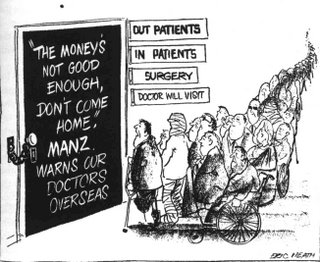
Not much chance of them returning now either.
The antagonism between doctors and the government is a permanent feature of New Zealand's public health system. It looks to be escalating.
Waiting lists have been with us for a long time. The situation has now deteriorated to having waiting lists to get on waiting lists.
Back in 1970 the Medical Association of New Zealand warned that medical graduates working abroad would not return to New Zealand because of the government's attitude to doctor pay and working conditions.
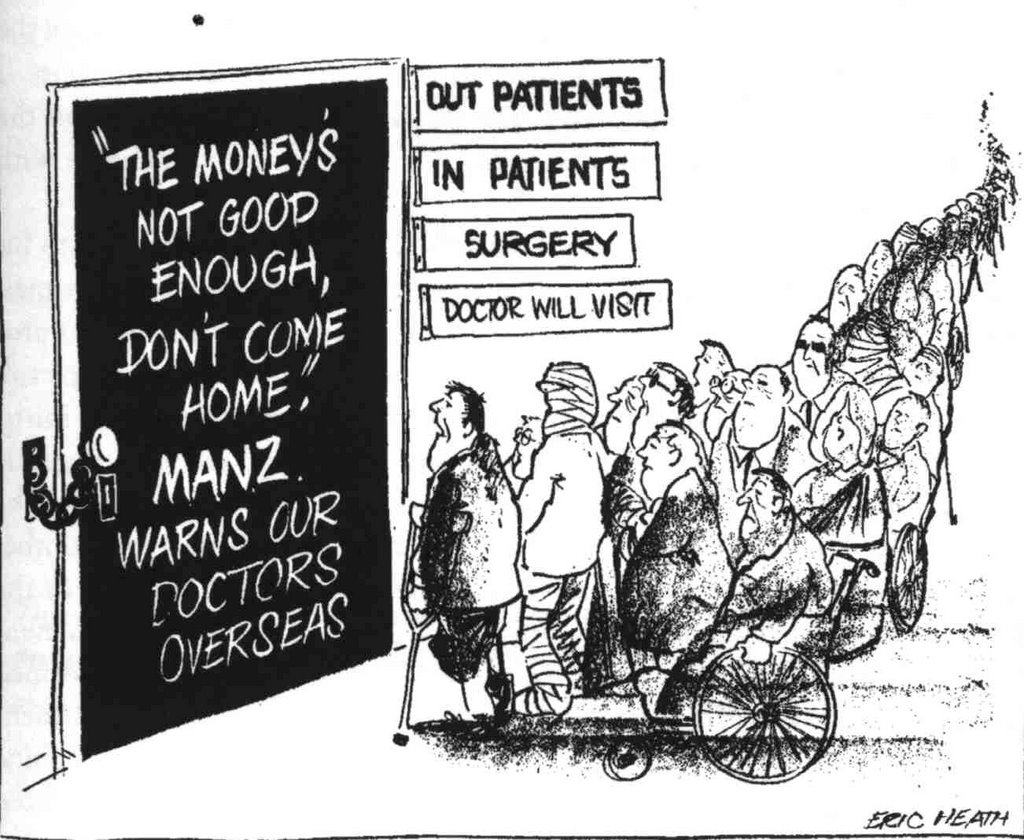
Not much chance of them returning now either.
The antagonism between doctors and the government is a permanent feature of New Zealand's public health system. It looks to be escalating.
Becoming more cultured
I always fancied myself as a highly cultured person. Now I have proof, thanks to Statistics NZ. But even more cultured than me are all those people with satellite dishes on their roofs and Aucklanders!!!
Information sharing
 The Housing Restructuring and Tenancy Matters (Information Matching) Amendment Bill is going through Parliament currently. Maori Party co-leader Tariana Turia has spoken to it, describing it as "big brother snooping around" and "ganging up on beneficiaries". The Greens are opposing it on the following basis;
The Green Party opposes this bill because we are concerned by the proliferation of information-matching programmes operating between Government agencies and the intrusion this represents into the personal lives of New Zealanders and the fact that this bill sets Housing New Zealand Corporation tenants apart from other tenants - only they will be subject to data matching with Work and Income.
Now I am no fan of government. Not snooping or sharing information. But these parties have only themselves to blame. They are desperate for government to provide assistance in the form of housing and benefits but when the government wants to put parameters and conditions on the recipients they cry, intrusion, intrusion.
They can't have it both ways.
I remember when Green MP Metiria Turei entered Parliament calling herself an anarchist! If she's an anarchist, I'm the next New Zealand Idol.
Irish DPB
Ireland are planning reforms to their welfare assistance for one parent families.
There are currently some 80,000 lone parents - almost 98% of them women - in receipt of One Parent Family Payments at a cost in 2005 of €770 million. When other supports and entitlements are taken into account, including Child Benefit, Rent Supplement and Family Income Supplement, total expenditure is over €1.3 billion. Despite the unprecedented growth of the Irish economy over the last decade and record spending on social welfare, lone parents remain one of the groups who are particularly vulnerable to poverty.
Ireland has virtually the same population as New Zealand. We have 110,000 single parents on benefit - 37.5 percent more.
There are currently some 80,000 lone parents - almost 98% of them women - in receipt of One Parent Family Payments at a cost in 2005 of €770 million. When other supports and entitlements are taken into account, including Child Benefit, Rent Supplement and Family Income Supplement, total expenditure is over €1.3 billion. Despite the unprecedented growth of the Irish economy over the last decade and record spending on social welfare, lone parents remain one of the groups who are particularly vulnerable to poverty.
Ireland has virtually the same population as New Zealand. We have 110,000 single parents on benefit - 37.5 percent more.
"Inspirational"
The NCPA reports on Sweden's "cradle to the grave" welfare system;
* Sweden's slope became most slippery from 1960 to 1980, when public spending increased from 31 percent of the economy to 60 percent in order to keep the Swedes rolling in government payments and to fund the bloated public sector.
* Sweden today ranks about equal with the fifth-poorest U.S. state in per capita income.
* Likewise, among the wealthy nations that make up the Organization for Economic Co-operation and Development (OECD), it slipped from fifth in income in 1970 to 15th in 2004.
This is the country Steve Maharey describes as "inspirational".
Perhaps when we are sitting at twentieth on the gdp per capita table, 15th does look pretty inspirational.
* Sweden's slope became most slippery from 1960 to 1980, when public spending increased from 31 percent of the economy to 60 percent in order to keep the Swedes rolling in government payments and to fund the bloated public sector.
* Sweden today ranks about equal with the fifth-poorest U.S. state in per capita income.
* Likewise, among the wealthy nations that make up the Organization for Economic Co-operation and Development (OECD), it slipped from fifth in income in 1970 to 15th in 2004.
This is the country Steve Maharey describes as "inspirational".
Perhaps when we are sitting at twentieth on the gdp per capita table, 15th does look pretty inspirational.
Tuesday, June 13, 2006
What's Trevor's beef?
Don't know what my electorate MP is up to today. During a snap debate over Auckland's power problem he repeatedly addressed the deputy speaker, Ross Robertson, as "Madame" speaker. When the speaker eventually asked him to use the word "Mister" Mallard refused and began using the terms "acting" and "deputy". His attitude to the chair was derisory and defiant. What's going on there? Any ideas?
Australian govt disallows civil unions
As best as I can make out, the Australian federal (central) government has overturned the Australian Central Territory government's civil union legislation. The federal government maintains it contravenes the Marriage Act. The Civil Union 2006 Act would become invalid from midnight tonight.
WFF rip-off
National MP John Key says self-employed earners are forming trusts that hide their true income in order to qualify for Working for Families payments.
Go back a step. People have already done this to minimise their child support payments, which are based on how much they earn, as opposed to what the child needs. Whether government threatens to punish or reward, many people will react in ways that others don't think are kosher. The best way to deal with it is get rid of the incentives to.
The Working for Families scheme is going to be the mother of unintended consequences.
Go back a step. People have already done this to minimise their child support payments, which are based on how much they earn, as opposed to what the child needs. Whether government threatens to punish or reward, many people will react in ways that others don't think are kosher. The best way to deal with it is get rid of the incentives to.
The Working for Families scheme is going to be the mother of unintended consequences.
US versus Britain
A Harvard history professor, who splits his time between the US and his British home, gives an economic comparison between the US and Britain. Relevant because the same would hold true if you substituted Britain with New Zealand;
Like the U.S., Britain has been enjoying a debt-propelled consumption boom. Household debt has grown at an accelerating pace since 1997 and exceeds 150% of post-tax income. Saving has plunged. As long as housing prices kept rising, the party could go on. But since the market cooled in the second half of 2004, the hangover has begun. Last year, Britain's economy grew by a miserable 1.8%.
The other source of growth in Brown's Britain has been public spending. Real government spending has surged since 1999 at an average rate of nearly 5% a year. Significantly, nearly a third of all the increase in employment since 1997 has been in the public sector, which now accounts for nearly 6 million workers.
As in the U.S., this splurge has been financed partly by borrowing. And, like the U.S., Britain also has a large current account deficit because imports have grown faster than exports.
Yet in the case of the United States, these vices are in large measured compensated for by the underlying vitality of its entrepreneurs and workers. Can the same be said for Britain? The answer is a resounding no.
Superficially, to be sure, British unemployment is low. But the official statistics are deceptive. In fact, about 5.3 million adults of working age are dependent on benefits, and 2.3 million of them have been living on welfare for more than five years. The reason they don't show up in the statistics is that many of them are counted as unfit for work rather than jobless. Every day, 23 teenagers in Britain sign up for disability benefits.
Like the U.S., Britain has been enjoying a debt-propelled consumption boom. Household debt has grown at an accelerating pace since 1997 and exceeds 150% of post-tax income. Saving has plunged. As long as housing prices kept rising, the party could go on. But since the market cooled in the second half of 2004, the hangover has begun. Last year, Britain's economy grew by a miserable 1.8%.
The other source of growth in Brown's Britain has been public spending. Real government spending has surged since 1999 at an average rate of nearly 5% a year. Significantly, nearly a third of all the increase in employment since 1997 has been in the public sector, which now accounts for nearly 6 million workers.
As in the U.S., this splurge has been financed partly by borrowing. And, like the U.S., Britain also has a large current account deficit because imports have grown faster than exports.
Yet in the case of the United States, these vices are in large measured compensated for by the underlying vitality of its entrepreneurs and workers. Can the same be said for Britain? The answer is a resounding no.
Superficially, to be sure, British unemployment is low. But the official statistics are deceptive. In fact, about 5.3 million adults of working age are dependent on benefits, and 2.3 million of them have been living on welfare for more than five years. The reason they don't show up in the statistics is that many of them are counted as unfit for work rather than jobless. Every day, 23 teenagers in Britain sign up for disability benefits.
Parliament's gym to close
The Labour government has announced it is closing down the Beehive gym. According to the Prime Minister, Helen Clark , there is no longer any need for a physical fitness programme. Everyone gets quite enough exercise jumping to conclusions, flying off the handle, running down the boss, flogging dead horses, knifing friends in the back, dodging responsibility, and pushing their luck.
Different Doctor view
The Press reports that the hours junior doctors are working is exaggerated.
According to one senior doctor, Many worked a 13-week cycle and the association quoted the worst week of about 70 hours, but his statistics showed most worked an average of between 40 and 60 hours a week.
Morton said that in the past two years he had worked with 220 British graduates, mainly junior house officers, and some senior registrars. "Generally, they find the conditions here are outstandingly good, except there's not enough to do."
Exit questionnaires showed many of the overseas doctors found there was less responsibility and less to do in their Canterbury District Health Board positions.
Of course, the hours worked may differ around the country.
A caller to talkback yesterday put an interesting slant on the issue. The young, single, female, high-earning doctors are being heavily taxed to subsidise staff with children, who work shorter hours but are benefitting from the Working for Families package. She suggested this is an additional source of resentment.
If that resentment is enough to drive them overseas the country loses twice; once through lost skills, and if they stay away, again through the lost potential to improve New Zealand's fertility rate.
According to one senior doctor, Many worked a 13-week cycle and the association quoted the worst week of about 70 hours, but his statistics showed most worked an average of between 40 and 60 hours a week.
Morton said that in the past two years he had worked with 220 British graduates, mainly junior house officers, and some senior registrars. "Generally, they find the conditions here are outstandingly good, except there's not enough to do."
Exit questionnaires showed many of the overseas doctors found there was less responsibility and less to do in their Canterbury District Health Board positions.
Of course, the hours worked may differ around the country.
A caller to talkback yesterday put an interesting slant on the issue. The young, single, female, high-earning doctors are being heavily taxed to subsidise staff with children, who work shorter hours but are benefitting from the Working for Families package. She suggested this is an additional source of resentment.
If that resentment is enough to drive them overseas the country loses twice; once through lost skills, and if they stay away, again through the lost potential to improve New Zealand's fertility rate.
Microchipping saga goes on
People frequently talk about MMP allowing minor parties to act as the tail wagging the dog. Now they literally are. This is really goofy politics from United Future.
MP Gordon Copeland sent a letter to deputy leader Michael Cullen and Local Government Minister Nanaia Mahuta yesterday with a clear message – exempt working dogs or don't count on United Future's vote.
"If they don't buy that then we are going to have to do some careful thinking," Mr Copeland said.
What kind of thinking have they done so far? The government wants to do something totally stupid, United Future something half-stupid (which in a way is even more stupid). National and the Greens belatedly want to stop the stupidity, now they have sensed the public mood. ACT was the only party who saw the stupidity for what it was in the first place.
MP Gordon Copeland sent a letter to deputy leader Michael Cullen and Local Government Minister Nanaia Mahuta yesterday with a clear message – exempt working dogs or don't count on United Future's vote.
"If they don't buy that then we are going to have to do some careful thinking," Mr Copeland said.
What kind of thinking have they done so far? The government wants to do something totally stupid, United Future something half-stupid (which in a way is even more stupid). National and the Greens belatedly want to stop the stupidity, now they have sensed the public mood. ACT was the only party who saw the stupidity for what it was in the first place.
Monday, June 12, 2006
Debate degenerates
Sue Bradford says the Section 59 debate is getting ugly and she is receiving abusive e-mails. If they get worse she says she will involve the police.
Abusive e-mails are sent by bullies and cowards and, as much as I dislike Sue Bradford's politics, I see no justification for this sort of tactic. Sue and I have met on a number of occasions and she is always civil and respectful. No purpose is served by politics getting personal.
OK, from time to time I might go overboard with a post but generally I try to stick to playing the ball. It's good discipline because without insults your arguments are all you have. They have to stand up.
Abusive e-mails are sent by bullies and cowards and, as much as I dislike Sue Bradford's politics, I see no justification for this sort of tactic. Sue and I have met on a number of occasions and she is always civil and respectful. No purpose is served by politics getting personal.
OK, from time to time I might go overboard with a post but generally I try to stick to playing the ball. It's good discipline because without insults your arguments are all you have. They have to stand up.
"Big girl's blouse"
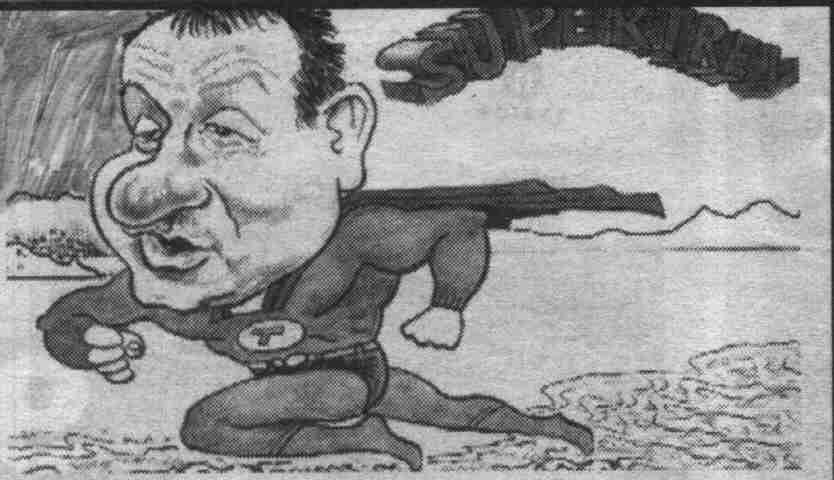 Umm. Wonder if Super Trev is up with the play? Apparently the new Superman is a "big girl's blouse".
Concerns have been mounting that the latest Superman, played by Brandon Routh, an unknown from Iowa, may not be “macho” enough for a key group of ticket-buyers: teenage boys. Earlier this month The Advocate, an influential gay magazine, proclaimed Routh’s Superman a homosexual icon, alongside Judy Garland and Cher, because he “lives a secret double life, wears tights and has lovely long eyelashes”.
Last week Bryan Singer, the film’s gay director and responsible for previous hits such as The Usual Suspects and the first two X-Men movies, compounded the anxiety by describing Superman Returns as a “chick flick about a superhero seen from a woman’s perspective, with qualities you’d want in a husband”. The woman is the ace reporter Lois Lane, played by Kate Bosworth.
“Young men do not want a soft Superman: they want the Man of Steel, even if he is 68 years old,” said one Hollywood executive last week.
There are good ideas and there are others
Newsroom reports, An Otago University researcher, who has just had a report on smoking published in an international medical journal, believes a countrywide ban on smoking is inevitable.
Shane Bradbrook of the Maori Smokefree Coalition was on the TV3 last night again pushing the idea of making tobacco available only thorugh pharmacies. Last week the DomPost ran a column by an Otago University law lecturer advancing the same idea. Watch it gain traction.
Here is my analysis of it:
Otago senior law lecturer Selene Mize advances the idea that a ban on tobacco sales (but not use) be implemented alongside an addict’s maintenance programme, similar to the one now providing methadone to heroin addicts through pharmacies. Maori Party MP Hone Harawira has also promoted such a plan.
Mize says,” Current tobacco users would have a set period of time in which to visit their GPs, be diagnosed as tobacco dependent, and receive a prescription that would enable them to purchase a set supply of tobacco from the pharmacy every two weeks or month.”
The theory is that with no legal tobacco for sale there will be no new smokers and existing addicts being supplied through a pharmacy will gradually give up or die. We will then be smokefree.
Unfortunately there is no evidence to back up this theory. Despite the methadone programme, the number of opioid dependents continues to grow. There is little documentation about the programme but a 2001 report estimated the number of dependents would continue to increase at the rate of 15 percent each year. Of the then estimated population of addicts, 13,500 to 26,600, only 3,774 were being treated through a methadone programme. Many were on waiting lists; many more, unofficially waiting.
There have always been problems with funding, client willingness and specialist addiction services. Despite opioid dependents costing the community an estimated $1,000 per week there seems to be little political will to expand the programme.
There are around 700,000 smokers in New Zealand. Even if half could be persuaded to quit if tobacco products disappeared from the supermarket and dairy shelves, the remainder would need to be managed through their GP and pharmacy. A GP would need to see an average of 125 tobacco addicts and a pharmacy around 395. Which raises obvious questions.
Have either got the resources to manage that level of “clients” and, for that matter, do they even want to? Pharmacists will have ethical concerns about dispensing products that damage health. Doctors will have qualms about prescribing a harmful substance. There may also be security fears. Pharmacies are already common targets for criminals operating in existing drug black markets.
And there can be no doubt that a tobacco black market will develop. Selene Mize believes with supply through pharmacies the black market will be small. But the market will be driven by price and accessibility. Illegal suppliers will make both more attractive, especially at the ban onset. Tobacco will present a lost-leader opportunity to expand market share of other illicit drugs, especially to young users. Has Mize failed to see use of the cannabis growing despite prohibition?
Methadone programmes have reduced the amount of crime committed by addicts and offered a chance of rehabilitation for a small number. These are not considerations affecting smokers.
Methadone programmes have done nothing to diminish the number of addicts or reduce the black market, both aims of a ban on tobacco sales. Denying the evidence is a facet of wishful, rather than innovative thinking.
Shane Bradbrook of the Maori Smokefree Coalition was on the TV3 last night again pushing the idea of making tobacco available only thorugh pharmacies. Last week the DomPost ran a column by an Otago University law lecturer advancing the same idea. Watch it gain traction.
Here is my analysis of it:
Otago senior law lecturer Selene Mize advances the idea that a ban on tobacco sales (but not use) be implemented alongside an addict’s maintenance programme, similar to the one now providing methadone to heroin addicts through pharmacies. Maori Party MP Hone Harawira has also promoted such a plan.
Mize says,” Current tobacco users would have a set period of time in which to visit their GPs, be diagnosed as tobacco dependent, and receive a prescription that would enable them to purchase a set supply of tobacco from the pharmacy every two weeks or month.”
The theory is that with no legal tobacco for sale there will be no new smokers and existing addicts being supplied through a pharmacy will gradually give up or die. We will then be smokefree.
Unfortunately there is no evidence to back up this theory. Despite the methadone programme, the number of opioid dependents continues to grow. There is little documentation about the programme but a 2001 report estimated the number of dependents would continue to increase at the rate of 15 percent each year. Of the then estimated population of addicts, 13,500 to 26,600, only 3,774 were being treated through a methadone programme. Many were on waiting lists; many more, unofficially waiting.
There have always been problems with funding, client willingness and specialist addiction services. Despite opioid dependents costing the community an estimated $1,000 per week there seems to be little political will to expand the programme.
There are around 700,000 smokers in New Zealand. Even if half could be persuaded to quit if tobacco products disappeared from the supermarket and dairy shelves, the remainder would need to be managed through their GP and pharmacy. A GP would need to see an average of 125 tobacco addicts and a pharmacy around 395. Which raises obvious questions.
Have either got the resources to manage that level of “clients” and, for that matter, do they even want to? Pharmacists will have ethical concerns about dispensing products that damage health. Doctors will have qualms about prescribing a harmful substance. There may also be security fears. Pharmacies are already common targets for criminals operating in existing drug black markets.
And there can be no doubt that a tobacco black market will develop. Selene Mize believes with supply through pharmacies the black market will be small. But the market will be driven by price and accessibility. Illegal suppliers will make both more attractive, especially at the ban onset. Tobacco will present a lost-leader opportunity to expand market share of other illicit drugs, especially to young users. Has Mize failed to see use of the cannabis growing despite prohibition?
Methadone programmes have reduced the amount of crime committed by addicts and offered a chance of rehabilitation for a small number. These are not considerations affecting smokers.
Methadone programmes have done nothing to diminish the number of addicts or reduce the black market, both aims of a ban on tobacco sales. Denying the evidence is a facet of wishful, rather than innovative thinking.
Sunday, June 11, 2006
 There isn't much to entice me to the big red shed but I concede their music DVDs are the cheapest and their selection the best.
Music DVDs are making available so much previously unseen or unheard of. Today I came across a Bonnie Rait concert with guests Jackson Browne, Bryan Adams, and Bruce Hornsby. Wonderful. Last week at concert by Bruce Hornsby with guests Gregory Hines, Don Henley and Pat Metheny. Don Henley perched on the end of Hornsby's piano stool dueting 'The End of the Innocence' is just beautiful. But today this one left me perplexed. Gordon Lightfoot's voice was always deep and rich. In this 2000 performance he sounds like he has inhaled helium. I did a search and found other people have commented on how thin and nasal his voice has become but can find no reason for this. It sounds as though he had some sort of surgery on either his nose or throat. The songs are still haunting but I don't feel compelled to watch it again.
Over-doing it
I've always been the sort that's in for a penny, in for a pound. If I get interested in something I get mega-interested. Maybe that's what is fashionably known as having an addictive personality. I'm not sure. But what I did work out is it paid to get interested in things good for me. Like painting and writing, as opposed to how to beat the TAB.
At one point somebody challenged me to run a marathon and as I was looking for a way to mark my 30th birthday I thought, this is it. Thing was, they wanted me to run the New York marathon in November and it was already early September. What the hell. I was living in London and started training like a maniac. I would run a two mile circuit from my flat. That way I could call it a day early if needed or just keep going...just one more...just one more.
Of course my body wasn't as keen as my mind. At around ten or eleven miles one knee would force me to stop so for the first time in my life I went to a physiotherapist who worked wonders. With her help I was able to push out the distance.
Three of us went to New York. The challenger was an experienced marathon runner. His brother and I were the novices. We each started separately. I ran thirteen miles and hobbled the rest, coming in at 5 hours and eighteen minutes. My place was around 23,000th. But the time would have been even longer if I hadn't been passed by the other novice about midpoint. From there on I refused to let him out of my sight.
We planned a great liquid celebration that night in Chinatown but by 8 o'clock all of our noses were in our chicken and sweetcorn soup. We crawled our way back to the hotel and flew out the next day. I remember landing at Heathrow and finding to my dismay we had to exit via steps. I needed assistance. My equally nutty companion lost his toenails later that week.
What brought on this trip down memory lane?
Well I was just reading about a ban on people who go to gyms and over-exercise. What difference will that make? People can exercise anywhere. If they are hellbent on wrecking their joints and tendons, they will.
Some people can't do "moderation" and frankly, thank goodness for that. There is a place in the world for passionate obsessives. And notice, politicians excepted, that they will rarely be found telling other people how to live their lives.
At one point somebody challenged me to run a marathon and as I was looking for a way to mark my 30th birthday I thought, this is it. Thing was, they wanted me to run the New York marathon in November and it was already early September. What the hell. I was living in London and started training like a maniac. I would run a two mile circuit from my flat. That way I could call it a day early if needed or just keep going...just one more...just one more.
Of course my body wasn't as keen as my mind. At around ten or eleven miles one knee would force me to stop so for the first time in my life I went to a physiotherapist who worked wonders. With her help I was able to push out the distance.
Three of us went to New York. The challenger was an experienced marathon runner. His brother and I were the novices. We each started separately. I ran thirteen miles and hobbled the rest, coming in at 5 hours and eighteen minutes. My place was around 23,000th. But the time would have been even longer if I hadn't been passed by the other novice about midpoint. From there on I refused to let him out of my sight.
We planned a great liquid celebration that night in Chinatown but by 8 o'clock all of our noses were in our chicken and sweetcorn soup. We crawled our way back to the hotel and flew out the next day. I remember landing at Heathrow and finding to my dismay we had to exit via steps. I needed assistance. My equally nutty companion lost his toenails later that week.
What brought on this trip down memory lane?
Well I was just reading about a ban on people who go to gyms and over-exercise. What difference will that make? People can exercise anywhere. If they are hellbent on wrecking their joints and tendons, they will.
Some people can't do "moderation" and frankly, thank goodness for that. There is a place in the world for passionate obsessives. And notice, politicians excepted, that they will rarely be found telling other people how to live their lives.
Subscribe to:
Posts (Atom)


