Tuesday, December 15, 2015

Child poverty - it IS a choice

The Children's Commissioner is leading a social media campaign to battle child poverty.

"Child poverty - it's not choice." That's the message that outgoing Children's Commissioner Dr Russell Wills wants to spread through social media in a challenge to Government policy.

It's not the choice of the children living in low income households.

But the majority of them end up there through the choices made by their parents.

When one in five children every year is being born directly onto a benefit or into precarious financial circumstances that will see them dependent on a benefit within their first year...


...somewhere along the line choices are made. They are the sole responsibility of the parent. Not you, not me and not the rest of NZ.

Yes, the government, as our representatives, makes choices about how the consequences of those choices are dealt with but the horse has bolted by then.

The Children's Commissioner does his charges no favours by refusing to acknowledge the facts behind child poverty. An illness cannot be cured if it is misdiagnosed and wrongly treated.

But it's an interesting choice of message, "Child poverty - it's not choice".

Clearly the public perception the anti-poverty advocates have identified and want to stamp out is the reverse.


Monday, December 14, 2015

New Zealanders are generous with their time and money

This is charted for the benefit of a discussion thread elsewhere.


69% helped a stranger
62% donated money
44% volunteered time

That was 2014.

Over a five year period NZ ranked 3rd.


Source

Thursday, December 10, 2015

Correlation between welfare and poor outcomes


Treasury released these graphs yesterday.

What stands out from the above  is that of those considered at 'extreme risk' of poor outcomes 62% are Maori while only 7% are Pasifika. This highlights yet again the ill-advised practice of referring to 'troubled youth' as Polynesians. The Pacific culture has protective factors at work that aren't always present for Maori.


The next stand-out feature (unsurprising) is the very high mental health service use by those at extreme risk.

But also look at the correlation between being on a benefit for 5 or more years (cumulatively between ages 25-34) and being at extreme or high risk of poor outcomes.

Of the total 15-24 population, 25,713 will be on a benefit 5 or more years but not at risk of poor outcomes.  However, 26,698 - a small majority - are at high or extreme risk of poor outcomes.

And their childhoods?

Why anyone wants to resist reforming welfare is beyond me.


Monday, December 07, 2015

A Corrections history substantially increases benefit dependency

Interesting fact:

Of all people with some form of Corrections history post-1960 that are still under the age of 65 (390,581 people), 28% (or 108,462 people) were receiving a main benefit at 30 June 2013. This compares with approximately 11% of the NZ working-age population as a whole.
Actually, I find this level of benefit dependency surprisingly low.

What it does show is people with criminal convictions have a good chance of becoming self-sustaining.  I expect though that if the data was further analysed, those who serve prison-time (as opposed to community sentences) would have a higher incidence of benefit receipt.

It looks like MSD will do further work in this area, so my expectation will be confirmed in time.

Good for David Seymour

Turning down significant ministerial roles to focus on what is really important - his voluntary euthanasia bill and his party - impresses me. In fact I don't think Seymour has put a foot wrong yet. Certainly not your typical snout- in- the- trough type.

Saturday, December 05, 2015

NBR keeps Xero on the hook

The world of business is foreign to me. When I first read about Xero I had no idea what kind of animal it was and had to ask Google.

Long time supporter of Dave Henderson, Rodney Hide (with friends like that you can afford enemies) has been chronicling his own and Henderson's wife's investigation by the state by stint of running businesses and being related by friendship or marriage to Mr Henderson. It's appalling.

The managing director of Xero is not covering himself in glory. First Xero denied divulging Henderson's wife's business data to the Official Assignee, than admitted they had been directed not to inform the owner of the information.

Even those who cleave to the axiom nothing to hide, nothing to fear should be repulsed and angered by this ability of the state to commandeer private information.


(Left click to enlarge)

Quote of the Day

The care of every man's soul belongs to himself. But what if he neglect the care of it? Well what if he neglect the care of his health or his estate, which would more nearly relate to the state. Will the magistrate make a law that he not be poor or sick? Laws provide against injury from others; but not from ourselves. God himself will not save men against their wills.

– Thomas Jefferson, Notes on Religion [1776]

Hat-tip FFF

Tuesday, December 01, 2015

Don't tell me what to do about the flag

Since childhood I've resented being told what I think or should think. If the opinion piece in today's NZ Herald is aimed at changing minds (and changing the flag)  it's a great big fail for me. It touched that resentful nerve:

Admit it, the ballot paper is still sitting on the sideboard while you wonder what to do. 
No it isn't. It's been binned.

 One or two of those designs are clearly better than the others.
Really? Isn't that a matter of subjective taste? Yet the writer (arrogantly) thinks his or her selection is superior.

 ... to ignore the ballot paper increases the risk of ending up with a flag we really dislike.

How exactly?
 When the Commonwealth leaders gathered at the weekend, very few flags outside their conference venue featured the Union Jack. It is only a matter of time before we remove it from ours. We might not be excited by the alternatives but we need one.
Or perhaps we'll be the last with it on the flag. Perhaps Australia should change theirs. Perhaps changing their flag should be made a forcible outcome for the loser of the next Rugby World Cup. That's only as silly as the current process has been.

 Please vote.

I will. In the next stage.

Sunday, November 29, 2015

Graph of the day


Many countries which fared far worse during the GFC would envy that household income line.

(Looking at the tables, the gap in income to housing costs ratios is growing between Auckland and the rest of the country, and largely driving up the steep rise in the bottom line. The difference in ratio in 2007, between Auckland and the rest of the North Island was only 1.4 points. Now it is 4.1 points -though the numbers are somewhat volatile.)

Source Household Economic Survey.

Saturday, November 28, 2015

Using police as arbiters of family disputes

Here's a familiar statement from today's NZ Herald:

Statistics show New Zealand has the highest rate of intimate partner violence in the OECD and on average police respond to a family violence incident every five minutes.

Do the maths. That's just over 105,000 'incidents' annually.

But here are some other stats to lay alongside.

Annual imprisonments for:

Acts intending to cause injury - 1,387
Sexual assault and related offences - 434
Dangerous or negligent acts endangering persons - 77
Homicide and related offences - 50
Abduction, harassment and other offences against the person - 189

All of the above might result from family violence incidents. I have purposefully gone to the other extreme ie the worst offences as demonstrated by an imprisonment outcome.

So a maximum of 2,137 men and women are imprisoned due to family violence incidents.

I understand that many many more will be charged and prosecuted and sentenced to lesser punishments but my thesis remains (as it does with child abuse and neglect statistics).

A good chunk of the calls to police represent individuals resorting to authority arbitration and administration of family disputes. As people have increasingly become dependent on the 'benevolent' welfare state so they have lost the initiative and intelligence to sort their own shit out.

Friday, November 27, 2015

High unemployment decides election outcomes?


Mike Hosking had a piece in the NZ Herald suggesting that National will be in trouble in 2017 if unemployment is over 6 percent.

He may be right. Below are the last four changes of government and what was happening with the unemployment rates at the time. Govt change happens when unemployment is 'relatively' high and trending up. The only exception on the trend was when National lost in 1999, but the downward trend was very slow and patchy through out the second half of the 1990s:


26 July 1984  (NA by current measurement but unemployment benefit numbers rising with a bullet)
2 November 1990    8%      trending up
10 December 1999  6.8%   trending down
19 November 2008  6.3%    trending up

Tuesday, November 24, 2015

"Won't someone please think of the childless?"

So said "libertarian" senator David Leyonhjelm from NSW supporting legislation to remove welfare from parents who won't immunise their children.

The central issue aside, what a difference to NZ discourse:

"To the childless people of Australia, I want to say, on behalf of this Parliament, thank you for being childless.
"You work for more years and become more productive than the rest of Australia. You pay thousands and thousands of dollars more tax than other Australians. You get next to no welfare ...
"But you pay when other people get pregnant, you pay when they give birth, you pay when they stay at home to look after their offspring ..." Senator Leyonhjelm said.
The Liberal Democrat said that he was sorry than instead of receiving thanks, Australians without children were "often ignored, pitied, considered strange, or even thought of as irresponsible".
"For your sake, I hope the children you are forced to support don't end up as juvenile delinquents, and I hope that they get immunised so that you don't end up getting sick. Because you'll pay then, too." 
I suppose the immediate objection is that a "libertarian" senator would not support the state forcing parents to immunise their children. But the state isn't. It is withdrawing other people's money from those who refuse to.

Further dumbing-down at RadioLive

The only remaining reason I listen to RadioLive is disappearing.

Image result for sean plunketVeteran broadcaster Sean Plunket has been axed from RadioLive's morning talkback show – and it is believed he could be replaced by long-time colleague Mark Sainsbury.

When MediaWorks sacked John Tamihere they killed the intellectual bite from the afternoon show. Now they are going to purge the pithy wit and humour that is Plunket.

Just what sort of audience they are seeking is a mystery to me. That stands to reason though, because I'm not it.


Sunday, November 22, 2015

I wish I'd never read this

Don't read this story of child abuse and murder if you don't want to start your day depressed.

Throughout I felt angry until the last line:

It is understood she has now had a baby with a new partner since her release from prison.

Then I just felt very sad.

Remember this one next time you hear some feminist bleeding-heart lecturing about the sanctity of female reproductive rights.

Friday, November 20, 2015

DomPost at it again

The DomPost is a highly manipulative paper. If they publish a piece that is in conflict with their own editorial viewpoint some trick will be employed to twist it.

Today's prime example is the appearance of this headline in BusinessDay:

Living wage good for singles


Naturally I look first for the author. Eric Crampton. Well there is no way Eric Crampton would be plumping for the living wage.

The guts of his column deals with how the living wage is not an effective tool for lifting the living standards of those with dependent families because of the commensurate loss of WFF assistance. The majority of council workers are not supporting families so the living wage fails in targeting those most in need. He says central govt is better placed to design income support via the tax system. He then works through some of the negative but "logical" effects of the WCC imposing the living wage on contractors (ruling pending in the courts).

The implication can be drawn that the living wage is good for singles despite not helping the partnered-with-children.

But is isn't good for the ratepayers (everyone directly or indirectly, including singles) if it leads to "higher rates, fewer services, or more debt" .

It also won't be good for singles, particularly the young, if it drives up unemployment.

Thursday, November 19, 2015

KidsCan talk up a problem they can't solve

A brief piece in today's DomPost describes how a "crisis" at KidsCan is leading to nearly 600 Wellington school children going without "basic healthcare, food and clothing from the charity".

Chapman said it cost about $8000 a child each year to provide the support. 
That is a staggering sum which poses the question, how much does it take to operate KidsCan?

The report then goes on to say that 260,000 children are living in poverty; 180,000 children are living without the basic needs of food, clothing and warmth.

To attend to all the need, KidsCan would require over $2 billion.

No wonder they had to get into the business of child sponsorship. Unfortunately they have over-promised and under-delivered. Which says something about what potential donors think about the cause.

I'll stick with funding the most-basic education of a  Nigerian child whose family is being provided with a hygienic toilet to prevent sickness and death.

Wednesday, November 18, 2015

"...being a beneficiary is a type of servitude"

Over a month ago I wrote about Tuhoe's desire to be paid out benefit money up front to invest in job creation. Today the NZ Herald has finally written about it. 

This post is simply to draw attention to a stunning statement from Tamati Kruger. He echoes what I and many others have come to believe. It's long been behind my opposition to welfare. I've hated being labelled a' beneficiary basher' for attacking welfare, though you can get used to anything. A white middle-class, middle-aged woman presents an obvious target for derision and denigration, but how does the leftist, pro-welfare lobby deal with the same expression of frustration when it comes from the heart of a subjugated community?

Tuhoe chief executive Kirsti Luke said a majority of Tuhoe people in that area were on benefits, and tribal leader Tamati Kruger said the iwi aimed to change that.
"We are declaring war on dependency," Mr Kruger said. "Our motivation is that if we want to be a vibrant people, to be a productive people who live up to their beliefs and to their faith as to what life is all about, and the honour that has to be part of humanity, then this is clearly what we have to overcome - because being a beneficiary is a type of servitude."

Tuesday, November 17, 2015

If best attack is hypocritical statistical manipulation, Labour's stuffed

From Question time today:

Grant Robertson: Is it correct that the 46,000 long-term unemployed is the highest level since 1999, other than two quarters in 2012?
Hon BILL ENGLISH: I would certainly want to investigate the number, because, as the member will be aware, in the welfare reform process there has been a lot of reclassification of people, and the product of that reclassification is that a lot more people are now regarded as available for work. They used to languish on the sickness benefit under the Labour Government, which decided they were hopeless and gave up on them. We do not give up on people like that. Even if they cannot get a job immediately, we try to help them get ready to get a job.

It was National that put a definition on "long-term" unemployed. In fact, long-term on any benefit was defined as 1 year plus.

There were 65,652 Jobseeker claimants who had been on a benefit for more than a year at September 2015. A substantial drop from 82,006 in September 2010.

Labour never officially defined long-term dependence on a benefit. Not until Robertson - in Opposition - decided it was 26 weeks or more....well, at least for the unemployment benefit.


Friday, November 13, 2015

Chris Trotter's feminist phonyism

Pompous prat Chris Trotter is parading his feminist solidarity by scolding Michelle Boag for not exhorting National women MPs to join the parliament walk-out earlier this week.

It's a feeble, non-factual play from the willfully ignorant Marxist.

Rather than pouring scorn on the women from the Opposition, Boag should have been upbraiding her sisters in the National Party for not having the courage to join the Opposition women’s protest. Then again, perhaps the National women were happy to go along with their party leader’s cynical exploitation of such emotionally-charged words as “rapist”, “murderer” and “child-molester” to distract the nation from their government’s failure to adequately defend the rights of New Zealanders detained in Australia’s concentration camps.
Perhaps, if New Zealand was blessed with a Women’s Minister who was happy to describe herself as a feminist, a mass walk-out of all women MPs might have been the result. Perhaps, if the last two Ministers for Social Development, both of them women, had been willing to educate their male colleagues about the endless, wearing, anxiety of being a woman without resources or influence, with two or three children to house, feed, educate and keep healthy on a Sole Parent Support benefit of $295.37 per week, there would have been no need.
This idiot arrogantly calls for "male" National MPs to be "educated", yet can't even educate himself.

The income he cites as causing "endless, wearing, anxiety" is under half of the actual average income a sole parent receives.

Not a sentence he writes is worth serious consideration when the substance behind them is so wanting.


Wednesday, November 11, 2015

Desperate to be victims

Several female opposition MPs declared that they are victims of sexual abuse, presumably to stake their credentials for a parliament walk-out today.

The day I declare myself a victim is the day I lose control of my life.

These are not "courageous" women. They are politicians doing what politicians do best - theatre.

How beneficiaries have experienced the welfare reforms

Left-wing beneficiary advocates have constantly criticised the use of sanctions (cuts to benefit payments)  to enforce work and social obligations. The CPAG has written entire papers about them. (Even Carmel Sepuloni jumps on the band wagon periodically despite Labour being the government that instigated the regime.)

Here's a typical example:

 Lisa Woolley, the president of the Council of Christian Social Services, said the numbers were shocking.
She said the first thing to go when budgets were cut was food, but some may also be struggling with rent, which could lead to overcrowding.
"The impact on the health for children on overcrowding is huge and also when you think of the children being moved from house to house, it's their education that gets impacted," she said.

MSD has now conducted some  qualitative research into how beneficiaries have perceived and experienced the welfare reforms. From the findings comes this:

Clients who had been sanctioned said the experience had encouraged them to swiftly visit their case manager, and had not impacted on their wellbeing
The few clients interviewed who said that they had been sanctioned reported that they had quickly fulfilled Work and Income requirements to restore their benefits.
While they did not feel that the sanctions had impacted their work search or their wellbeing, receiving notice of the sanction had encouraged a swift visit to their case manager.[My emphasis]

Granted the sample is very small. "Only five of the 140 clients spoken to in the evaluation remembered having their benefit suspended or reduced." But their actual experience is counter to the what anti-reformists want us to believe.

Generally, the overall responses are a mixed bag. There are misconceptions about changes (formed by listening to the media apparently), and adherence to old benefit names. However, a broad understanding that there's a much stronger emphasis on finding work has developed.

If your views of WINZ were formed solely on the negativity pushed by the left, the positivism and even appreciation among interviewees would surprise. The over-riding impression I am left with though is the case manager relationship is all important to beneficiaries experience of  and attitude to the reforms. The beneficiaries take on the reforms should not be discounted or downplayed. There is wisdom in the old adage, you can lead a horse to water but you cannot make it drink. I am a great believer in persuasion over force.

Monday, November 09, 2015

Little shows how well-qualified for the job he is

Politicians in particular are creatures who use statistics to suit their own purposes. They have no compunction in spinning the worst scenarios when in opposition and Andrew Little is right up there.

According to the NZ Herald:

[Little] said 305,000 children were living in poverty.
He selected the highest number he could find. Technically speaking, in 2014 there were 305,000 children living in homes that were below 60 percent of the median equivalised household income after housing costs as measured by 'moving line'.


But you can bet that if Labour ever regains power they will very quickly start looking for the smallest numbers they can find. For instance 90,000 children are living in  households experiencing severe material hardship as measured by European Union standards.


Sunday, November 08, 2015

Selfies illustrate how wealthy we all are

The latest expose of unequal wealth accumulation by Max Rashbrooke has the NZ Herald featuring photo shots of John Key's son Max and some other girl I've never heard of.

Wealth inequality is driving us back to the days of Victorian England, argues a new book which exposes the rise of the rich kid club.

The journalist continues:

Decadent lifestyles shown by social ­media's young elite have echoes of portraiture from the 18th century, says Rashbrooke.

As oil painters once sought to show off a subject's prestige, now selfies - where youth snap their Bollinger receipts - have the same ­effect of implying status and are in stark contrast to the austerity being forced on most of the West's economies.
Before photography only the very rich could commission oil renditions of family.Today the ability to take selfies extends  across society and wonderfully illustrates how much wealthier we all are. What those selfies portray is another matter....

But the facility to record all and sundry for posterity is nevertheless available to each and every New Zealander.

We've come a long way from Victorian England and we aren't heading back there.

Only sensible policy swapped for sugar showdown


The NZ Herald reports,


The Labour Party has officially dumped its policies to .... raise the retirement age.

Little says it sent the wrong message to people physically unable to work past 65.

Without a doubt those people are in a minority. Policy should be made for the majority and outliers dealt with differently. Someone physically and indefinitely unable to work currently goes on a Supported Living payment. Joining National in this stubborn adherence to Super entitlement at 65 has removed one of  Labour's major points of difference.

Meantime,

 The Labour Party will make food manufacturers reduce the sugar content of processed food and use prominent labels listing how many teaspoons of sugar and salt was in a product.
Labour's health minister Annette King set out the anti-obesity policy at the party's annual conference in Palmerston North today.
She said the Government's recent obesity package was a "feeble attempt" at addressing the problem.

Labour cannot beat John Key (and the National govt, which runs a distance behind the leader in popularity) by doing what he does better. And it seems unable to sufficiently differentiate itself with alternative ideas.

This situation highlights why politics gets in the way of good governance. In trying to win a popularity contest, the difficult calls are not made. Then, when the harder- to- swallow policy is dropped, there's no impetus to measure  public support for it. It's not on the agenda so can be swept under the carpet yet again.


Friday, November 06, 2015

State housing - it's about choice, not need

The government is reducing the number of times a prospective tenant can turn down a property from 3 to 1.

It's also increasing stated location preferences from a minimum of one to three.

That it even has to do this proves state housing is frequently not about need. It's about choice.

Nearly 10,000 social housing offers were made last year and of those 3,453 were declined, with 414 for unacceptable reasons such as wanting a garage or a bigger back yard.

Primarily people want a state house because they are cheaper than private rentals. Social agencies and budgeting organisations know this and work with the client to facilitate acquisition of state rentals.

There is an old adage "beggars can't be choosers" which means people with no other options must be content with what is offered.

They are not content because they have other options.

Yet this compromising centrist government still gets the jelly wobbles:
Under the changes people who refuse a property without a good reason may be removed from the social housing register for 13 weeks.
Why not much longer or permanently? The door is always left open to those who would play the system.

Wednesday, November 04, 2015

Herald hyping 'poverty' again

The Herald is running a series on educational under-achievement which starts today. Here's the opening gambit:

Disadvantage remains a major dictator of underachievement in schools. Poor children pass at rates well and a clear gulf in opportunities afforded to students at either end of the decile spectrum, educators say it’s below their wealthy peers, despite efforts to address the disparity. With poverty affecting one in four children, time to act, before another generation are consigned to the cycle.
Obviously there is a glaring omission in the second sentence (update: now fixed) but what struck me, after reading the entire piece, is that the media is the main party guilty of creating the stereotypes the students hate and talk about to the journalist.

It's the media, egged on by left-wing ideologues, that keeps telling children from low income homes that they are living in poverty; that poverty means deprivation, hardship, struggle and under-achievement. That poverty marks and excuses you.

Yet the 'one in four' statistic relates purely and only to relative low income.

Measuring material deprivation looks slightly different.


8 percent of children live in families that lacked seven or more of the above. 18 percent lacked 5 or more.

When will the media stop hyping 'poverty'? Young people clearly don't want or appreciate being stereotyped. 

Being a moderate type I sometimes cringe at Whale Oil's description of media, "Pimping the Poor".

But that's exactly what this series is. Using South Auckland school children to sell newspapers under the guise of social advocacy.


Tuesday, November 03, 2015

Aussies not unusually claiming undue kudos

I notice that Michelle Payne has a ride in the Melbourne Cup today. Good for her. Often there is no female presence. NZ is far more progressive in using and elevating women riders in our racing industry. It is entirely possible (and happens)  for NZ females riders to win the jockey premiership. Some say women have more affinity with their mounts. Michelle Payne's own trainer father though notes an old horsemanship saying; “Men fall like boiled eggs. Women fall like raw eggs.”

Anyway in checking out my facts I came across this from the Melbourne Cup Betting Directory:

 In 2003 the first female jockey to take part in the Melbourne Cup was Claire Lindop where she finished 19th out of twenty-three on Debben
Bull. The first female rider in the Melbourne Cup was NZ jockey, Maree Lyndon in 1987. Lindop was the first Aussie female rider.

Any way, I think I'll back Preferment today - not Payne's ride. NZ trainer based in Flemington. Any other picks out there?

Chance to be part of OIA survey

As part of the Ombudsman review, it's now the public's turn to voice their dissatisfaction with the OIA process.

User experiences of the OIA
The Chief Ombudsman now wants to hear from users of the OIA, including members of the public, journalists, Members of Parliament and their staff, people working for interest groups, and academics. We also want to hear from current and former employees and contractors in government departments and agencies.
To do this we have created three different surveys to learn about your experiences and perceptions of how the OIA is working in practice.  This will help us determine where improvements are most needed.

The only question now is can you find the time/ be bothered?

Apparently each survey takes between 20 and 45 minutes.

Thursday, October 29, 2015

Portable pensions


The just-released HLFS population estimates show that there are 642,700 people aged 65+. It's an estimate based on the last census, births, deaths etc but it's the best data available. The large majority - but not all - of this group would qualify for super.

Yet at September 2015 there were 693,409 people receiving Super or a veteran's pension.

Is the difference made up by younger partners sharing the Super?

Not according to the table which I requested from MSD earlier this year showing the numbers and ages of non-qualifying spouses receiving Super. (OK the data is 9 months apart but that wouldn't account for the discrepancy).


Does this mean that the HLFS estimate is significantly wrong? No.

The difference must lie in the number of pensions being paid to people who are not currently residing in New Zealand. Officially...

You can reside almost anywhere in the world and still get part or all of your New Zealand Superannuation or Veteran’s Pension payments. What you’ll get depends on where you go to and how long you’ve resided in New Zealand.

 Potentially there  could be upwards of 40,000 superannuitants living outside of NZ.

Tuesday, October 27, 2015

Groupies

Statistics NZ surveys on all sorts of things that are no business of government and serve no useful policy information requirements. The data is then presented in such a way as to be of relevance to the moment.

For instance here's the headline:

New Zealanders belong to a sporting nationAlmost two-thirds of Kiwis belong to a club or organisation, Statistics New Zealand said today. In keeping with a nation that takes great pride in the All Blacks, Silver Ferns, and All Whites, sporting clubs are the most popular. 
Yet 72 percent - almost three quarters - do not belong to a sporting club.

The second highest group membership belongs to religion - 21 percent. A header that said New Zealanders belong to a religious nation would be unthinkable. Especially from a government department. Yet the difference between membership of sporting and religious clubs is only 7 percentage points.


Saturday, October 24, 2015

Where does it stop?


So much more to be said.... like, individualised savings accounts would bypass a lot of the wrangling collectivised health and social security throws up, particularly of late. Of course that would require an element of compulsion.

And that this micro-management of people's lives isn't really about saving money, at least not in the overall scheme of government expenditure. It's about saving people from themselves. It's the imposition of a prescriptive set of behaviours that the state defines as acceptable, and the suppression of those it does not.

Friday, October 23, 2015

"Breaking the adoption 'taboo' "

A shift in thinking is gathering momentum in Australia as it should here. The same circumstances and questions apply in this country, where thousands of children are in state care next to a low number of adoptions.


Thursday, October 22, 2015

How much CYF resource is wasted?

New data shows a significant drop in substantiated findings of child abuse:


 Yet there were 150,905 notifications in 2014/15 - a  3 percent increase on the previous year.


Only 30 percent of notifications require further action.

16,472 substantiated findings from 150,905 notifications (allowing for some year on year overlap) represents 10.9  percent. Note though that multiple findings can apply to one child, just as multiple reports could apply to one child so it would be incorrect to simply state that 10.9 percent of notifications are substantiated. But you get the picture.

Reports are trending up; substantiations are trending down.

The level of notifications that are unnecessary - perhaps even vexatious - must be very high. Or perhaps the difference reflects a gap between CYF's standards and the community's. Certainly the public has been heavily encouraged to report their concerns, and the police are also  now required to make a notification if attending a family violence incident even if the child/ren are not directly involved.

Whatever the reasons for the difference in reports and substance are, it must be costing a fortune in resource.


Tuesday, October 20, 2015

Latest Better Public Service progress results out

The BPS target progress results have just been published. A selection of graphs of interest to this blog:


Not a lot to get excited about.

Still, setting public goals and charting progress is, of itself, an improvement in how government runs services.

You can view other graphs and each one's rating eg On Track  here.

Monday, October 19, 2015

New painting

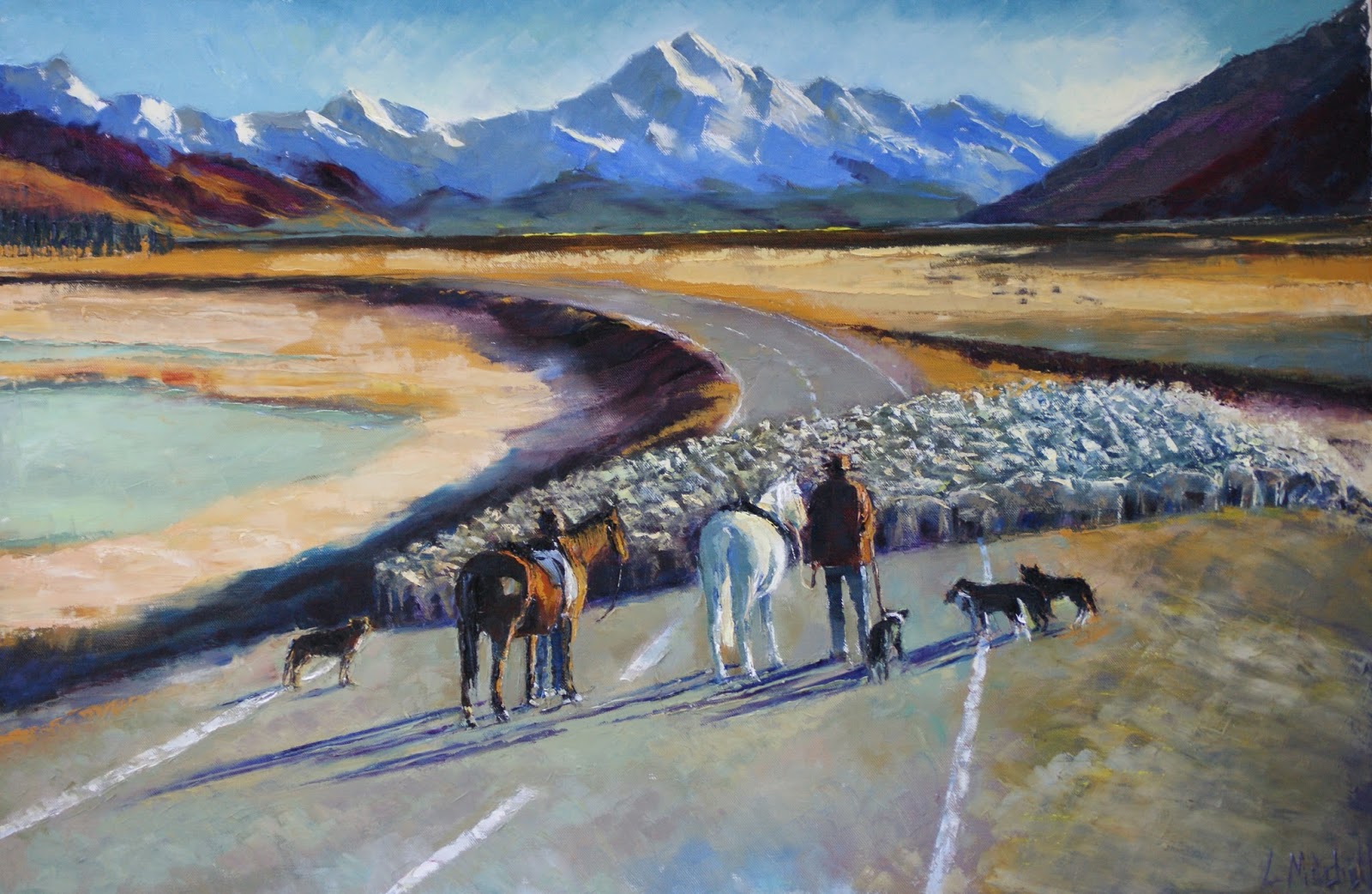
Updating my artist blog, this is a large palette knife painting of South Island drovers. It's based on a photograph (with a fair dose of artistic licence thrown in). Mt Cook in the background.

I don't often paint landscapes but the portrait commissions have been thin on the ground this year. Removed from my highly representational style this tends towards impressionistic. If the shapes and perspective are believable, the viewer's imagination will fill in the missing details. It would be truly laborious to depict each sheep.

Increasingly, painting with a knife using strong, often unmixed colours, is reducing my desire to paint with brushes and more 'natural' shades. Maybe my eyesight is degenerating.


Sunday, October 18, 2015

Abuse of the Official Information Act - Ombudsman had enough

The Ombudsman has had enough. The abuse of the Official Information Act by those subject to it must stop.

The Chief Ombudsman has slammed the Prime Minister for delay tactics of releasing official information.
Dame Beverley Wakem says she intends to introduce a new set of standards covering Official Information Act (OIA) releases, as part of a major review.
Thomas Jefferson once said "information is the currency of democracy", but it's not always easy to get information...
Information can be accessed from the Government and its agencies under the OIA. They must respond within 20 working days, but several examples have shown that is not always the case.
Several examples? That's the understatement of the year.

The Ombudsman told me that 110 complaints had been received against MSD in the 2013 financial year. 62 were about delays. Those statistics represent only the people who bothered to complain.

And that's just one department.

The TV3 report continues:

3D waited two years for information from Auckland police on burglary statistics.
A complaint to the Ombudsman's office has been with it for a year.
I've had a complaint lodged with the Ombudsman since September 18, 2014 and still no resolution.

Obviously they are unable to cope with the level of complaints being received.

It's not a good look for the National government and I am pleased to see mainstream media giving the issue some coverage.

Prime Minister John Key has previously admitted his office uses delaying tactics in releasing official information. Dame Beverley told The Nation that's unacceptable.
"There's a disregard for the law," she says.
From the top down.


Saturday, October 17, 2015

Paying out benefit-liability $ to Tuhoe

MSD has released a commissioned report about decentralising welfare to Tuhoe.

Tūhoe is a relatively young population with high levels of unemployment, welfare dependency and low incomes....
In 2011 the Crown entered into a relationship agreement with Tūhoe in which it acknowledged the mana motuhake of Tūhoe and its aspirations to self-govern. Tūhoe have their  aspirations to become independent of the Government, generate its own revenue and become self-sustaining. MSD has asked whether or not it is feasible to transfer a portion of the Crown’s liability to Tūhoe. 

 In plain English can benefits be paid forward in a lump sum to enable Tuhoe to establish employment initiatives and their own social services?

Tuhoe has high forward liability:

29 per cent of Tūhoe received a benefit payment (unemployment, sickness, invalid, or
domestic purposes) as a source of income at some time in the 12 months prior to the 2013 Census, compared to 24 percent of the Maori population, and 10 per cent of the total 


The above shows benefit receipt for the general population (col 1), then Maori, then Tuhoe.

That's snapshot data. Because young parenting and youth unemployment are high, the length of time spent on benefits is greater.

The research considers international attempts at self governance and suggests:

Experience shows that a goal of profitable business ventures is the most effective way to
increase employment opportunities in the long-run. 

It considers some NZ initiatives and describes them a s a "mixed bag". However the "risks" are less than the "lost opportunity".

The rest is essentially suggested scenarios for transferring the "liability" (cash resource) to Tuhoe.

Apparently MSD are in the process of assessing the actuarial liability of Tuhoe.

What does Tuhoe want to do with the funds?


With the return of Te Urewera together with Tūhoe current land interest brings land value in excess of 300,000 acres. Tūhoe have identified they are capable of developing a range of industries that will create employment opportunities and thereby reduce welfare
dependencies. The industries they have identified as possible within their rohe include the following:
• Pharmaceuticals
• Science and research
• Eco-tourism
• Food and technology
• Horticulture
• Agriculture
• Biodiversity
• Culture & Heritage.

Tūhoe have also identified a number of social sector initiatives such as:
• Development of charter schools that embrace tribal tikanga, set up in the rohe with
consolidated governance arrangements.
• Health centres in each of the four Tūhoe settlements that meet the needs of the rohe’s
population including mental health and addiction.

It's a reasonably lengthy document so take my speed-read summary on trust.

But I am left with questions. If it happened for Tuhoe, wouldn't it conceivably have to happen for any other tribe, group, or even individual, with a (expected)  forward liability?

And I wonder what Savage would have made of the evolution of  social security? I don't imagine his vision of providing income security to the poorest, most disadvantaged in the here and now extended to calculating forward lifetimes of income dependency to be paid in advance.

Then again the dependency is real and if Tuhoe can do a better job of reducing it than the state, why not?

And a pointless, after the fact final question. Wouldn't it have been better if the dependency hadn't been enabled in the first place?


Friday, October 16, 2015

Latest benefit numbers: continuing downward trend but.....

The general gradual downward trend, continues.

Over the year ending September 30, 2015, MSD says, "...the proportion of the working-age population in New Zealand receiving a main benefit fell slightly (from 10.7% to 10.2%)."


But here's the worrying statistic.

In the last quarter, while 43,369 people came off a benefit, 46,374 went on one. A net gain. Not such good news. In the Sept quarter last year 47,447 left; 47,566 arrived. So this year's net gain, over the same period, was significantly higher.

Now that cancellation data is being provided, I also note that the numbers leaving a benefit to go to prison are trending upwards. Interesting.


(Left click on image to enlarge)

Wednesday, October 14, 2015

On ACT and other matters

There was little chance of my voting elsewhere but David Seymour has guaranteed my tick for ACT in 2017 by lodging a new voluntary euthanasia bill. It's a huge task (if drawn) to front foot such a controversial issue as a single MP. What will stand him in good stead is the weight of opinion is now firmly on his side.

"Not working on it full-time" but you wouldn't need to be at $2000 a day. I'd have thought Rebstock negotiated a rate that is "twice the usual"? Is she worth it? I can't answer positively when another CYF  overhaul isn't the answer.

Should it be a crime to have your baby sleeping with you? It's not necessarily best practice if you are overweight and inebriated, but my second child constantly slept by my side. It was the only way any of us was going to get some rest. I fear charging a mother with "criminal nuisance" after a SUD death, with a possible jail term of one year, is a step too far. When will police begin checking bedrooms?

Tuesday, October 13, 2015

Carmel clutching at straws again

Here's Carmel Sepuloni clutching at straws again.

She is reported in today's DomPost:

Fewer people coming off a benefit and moving into work shows a "stalling economy" and a "failing Government", says Labour.

But the Government says Labour had gotten its maths wrong on figures the party obtained.

While the real numbers of beneficiaries moving into work had decreased, the overall percentage of people going into work had actually gone up, as the total pool of beneficiaries decreased, said Social Development Minister Anne Tolley.

At the end of March 2015, 284,260 working age people were receiving a main benefit.  That was down from 295,000 people in June 2014, according to the Ministry website.

"At the same time the New Zealand Income Survey shows an extra 27,500 people were receiving government transfers - primarily benefits and superannuation - as their main source of income compared to 12 months ago.

"Crucially, there was a 38.85 per cent increase in the number of people aged between 50 and 59 years on these transfers between 2014 and 2015," Sepuloni said.

The definition for 'government transfers' is

Government transfers: income from benefits, working for families tax credits, paid parental leave, student allowances, ACC payments, New Zealand Superannuation, and veteran's and war pensions.

At June 2015  1,193,800 people received income from government transfers.
At June 2014  1,166,300 people received income from government transfers.

There's the 27,500 increase she cites.

The increase relates almost entirely to people receiving Super (which is irrelevant to the working age arguments.)

In fact she could have checked exactly how many by consulting the Benefit data tables at MSD

The number of people receiving Super or a veteran's pension rose by 25,983 between June 2014 and June 2015.

The number receiving income from government transfers aged 50-59 rose from 32,600 to 40,500 or 24% not "38.85 percent". Some of this rise will be attributable to younger partners of newly qualified Super recipients becoming dependent on government transfers.


Monday, October 12, 2015

Christianity perverted

A Reverend has this to say about a landlord who is complaining about tenants taking advantage:

"He can afford for them to take advantage of him."

Is this the message of Christianity? If so, I'll stick with atheism.

People who "take advantage" of other people's generosity (in this landlord's case, child minding and rubbish removal) should be dumped or dumped on. It has nothing to do with power balance or material inequity.

A poor person can afford to be as fair as a rich person. Transactions between people, no matter what is involved, that aren't mutually satisfactory, will be very short-lived. Many people of means are generous. They enjoy being able to help. Often they want nothing in return. Their reward is the act of relieving a problem for someone else.

BUT it doesn't follow that when their generosity is abused they should turn the other cheek.

This reverend's attitude is at the heart of socialism and is essentially what makes socialism untenable. Values are not shared. Different rules apply to different people by dint of their economic status.

There is no excuse for abusing goodwill ever. Rich, poor or otherwise.