Some press releases from the Maori Party I regard with vague amusement but others are beyond the pale (excuse the unintentional pun). Here Tariana is clamouring about racism in asthma care.
There are no barriers to Maori accessing medicines and advice on their use that do not apply to any other race. There are factors that disproportionately affect Maori eg higher smoking rates, benefit dependence, poor diet, crowding in inadequate homes. However, none of these factors is beyond the control of the individual, in particular, the parent. I am not buying it.
Having worked as a child asthma educator I know we did our best to reach as many people as possible. But my experience was fewer Maori parents took up the opportunity.
Thursday, April 20, 2006

More on Mr Key
The Molesworth and Featherston has also noticed Mr Key's activities. (My criticism yesterday was not of what he did but how he drew further attention to it in such a self-serving manner.)
The Key to wealth and ignominy
National's finance spokesman John Key has always impressed us, as he has most political watchers. So, we are here to help.
You put your foot in a potentially steaming one, John, with that decision to take out a mortgage on the Wellington digs to take advantage of a perk available to MPs. (It became known through the otherwise innocuous – because it does not give details of size of wealth and assets – register of MP's assets.)Yes, most MPs structure their affairs to take advantage of the freebie. Yes, it is a rational economic decision. But are you not mega-wealthy? Can't you make more than the average wage on those Merrill Lynch shares every time the currency yawns and stretches? You are also fond of berating the Government for providing middle-class welfare through things like the Working for Families extension – as you did last week in this newsletter. Well, sorry John-boy.
Is this not middle class welfare capture extraordinaire? Do you need the cash? It is costing those poor taxpayers you are fond of saying need relief. Take our advice. Pay off the mortgage with your loose change and lance a potential boil before Labour wakes up to it.
The Key to wealth and ignominy
National's finance spokesman John Key has always impressed us, as he has most political watchers. So, we are here to help.
You put your foot in a potentially steaming one, John, with that decision to take out a mortgage on the Wellington digs to take advantage of a perk available to MPs. (It became known through the otherwise innocuous – because it does not give details of size of wealth and assets – register of MP's assets.)Yes, most MPs structure their affairs to take advantage of the freebie. Yes, it is a rational economic decision. But are you not mega-wealthy? Can't you make more than the average wage on those Merrill Lynch shares every time the currency yawns and stretches? You are also fond of berating the Government for providing middle-class welfare through things like the Working for Families extension – as you did last week in this newsletter. Well, sorry John-boy.
Is this not middle class welfare capture extraordinaire? Do you need the cash? It is costing those poor taxpayers you are fond of saying need relief. Take our advice. Pay off the mortgage with your loose change and lance a potential boil before Labour wakes up to it.
Artistic interference
Scotland imposed a smoking ban similar to ours on March 31. One theatre manager is defying the on-stage smoking ban because he believes it is "interference with art". (Perhaps Russell Crowe could try that one but it would pose the tougher question of whether his music constitutes art). Loved this quote;
The theatre and comedy producer David Johnson said: "The ban is ludicrous, it's pathetic, frankly. You can show sex on stage but you couldn't show them smoking afterwards."
The theatre and comedy producer David Johnson said: "The ban is ludicrous, it's pathetic, frankly. You can show sex on stage but you couldn't show them smoking afterwards."
The Greens are not left-wing.
 Who said so?
According to Vernon Small, writing in today's DomPost, Nandor Tanczos. Apparently he has written a paper explaining why the Greens are not a left-wing party as part of his bid for the co-leadership. Sadly it is available at their website but only to members. As I can't access it I am doing my best to imagine what it says.
The Greens are not left-wing because;
-They oppose massive redistribution of wealth
-They believe the state should reduce legislation that interferes with employment
-They believe free trade is fair trade
-They believe in private property rights
-They believe indigenous people have the same rights as other New Zealanders
Yeah. That sounds like the Green Party we all know and love.
Sympathy for the devil
This kid is locked up for ROBBERY. ROBBERY. I guarantee it won't be the first.
But the entire story is about why we should feel sorry for him. Don't tell me...the system is letting him down.
This unpleasant and uncomfortable experience might be the best thing that could happen to him if it's not already too late. If it were my son I'd be sick over it but at the same time I'd be telling him, this is the consequence of your actions.
But the entire story is about why we should feel sorry for him. Don't tell me...the system is letting him down.
This unpleasant and uncomfortable experience might be the best thing that could happen to him if it's not already too late. If it were my son I'd be sick over it but at the same time I'd be telling him, this is the consequence of your actions.
Wednesday, April 19, 2006
Eat your heart out, Tom
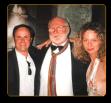 Is this the somewhat portly, grizzly and balding cartoonist Tom Scott who depicted Mick Jagger in the DomPost today asking, "If time really was on our side we'd look better than this surely?"
Scott is four years Jagger's junior.
Oh, the sacrifices....
Last week a letter appeared in the DomPost about John Key. If my memory serves me right it was the feature letter along with a photo of Key. Today his response appears, drawing further attention to the original complaint.
Guilty as charged
Ken Wilson asserts (Letters April 13) that by claiming a parliamentary accommodation allowance when I can afford not to do so, I am guilty of rorting the taxpayer.
Such logic can be applied to any of the genuine costs that I incur as an MP, including travel and related expenses.
Rather than my rorting the system, maybe Mr Wilson would like to tally up the immense contribution in terms of family time, the alternative income I could earn were I not in Parliament, and the considerable financial donations I make each year, and then reflect on whether I am rorting the system.
If that makes me guilty of a rort, I stand guilty as charged.
John Key, National MP, Helensville.
Guilty as charged
Ken Wilson asserts (Letters April 13) that by claiming a parliamentary accommodation allowance when I can afford not to do so, I am guilty of rorting the taxpayer.
Such logic can be applied to any of the genuine costs that I incur as an MP, including travel and related expenses.
Rather than my rorting the system, maybe Mr Wilson would like to tally up the immense contribution in terms of family time, the alternative income I could earn were I not in Parliament, and the considerable financial donations I make each year, and then reflect on whether I am rorting the system.
If that makes me guilty of a rort, I stand guilty as charged.
John Key, National MP, Helensville.
Mick Jagger is a Maniac

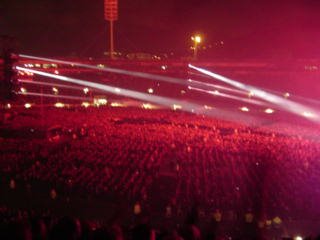 It isn't enough to say the Stones have still got it. They've got more than ever. More energy, more charisma, more lovability. And if there was ever a shining example of synergy this is it. We were up in the stands alongside the stage which runs the width of the ground, which Mick runs over and over. Dancing like a maniac with those long skinny arms and big hands flailing about but the hips and thighs pulling it all together with tight rhythmic and rapid movements. He is ageless.
Tuesday, April 18, 2006
Hardship assistance - where to from here?
 The Special Benefit, extra non-repayable hardship assistance, was scrapped on April 1 but those already receiving it would continue to.
 The Ministry of Social Development, through their official media statement, says one of the reasons the Special Benefit was replaced with Temporary Additional Support is, "Establishing upper limits on individual allowable costs helps to ensure people do not receive last resort hardship assistance for items that may not be affordable to other people on low incomes. For example, the maximum repayment cost for a television in Special Benefit was $70 per week. Repaid over 52 weeks, this allows the purchase of a television costing $3,600 - which is well out of the reach of most people on low and middle incomes."
So being without a TV, or a quality TV, was such a hardship the taxpayer had to pay for them. The beneficiary who received the money didn't have to pay it back and if they managed to "qualify" before April 1 for a TV costing $3,600 they will continue to get it paid for.
It is my guess that some people on benefits will be paying their cable subscriptions out of their main benefit and using the Special Benefit to pay for the wide-screen TV. I am sure it hasn't escaped the public's notice that satellite dishes proliferate amongst housing for the "neediest".
But back to the real problem with the Special Benefit. It was discretionary. Case managers could, and did, decline applications. Exercising discretion is too close to discriminating or even judging. So it has been scrapped for "a fairer rules based approach" which will make it "more transparent and easier for clients to understand and case managers to administer."
Now that nobody can be denied the extra hardship assistance, newly called Temporary Additional Support, how much will be allowed for TVs? And what was that about welfare being a safety net?
Car craziness
Talking about waste and abuse inherent in state welfare systems (referred to in a following essay) this article from today's DomPost, about the huge increase in the number of car-related payments made to beneficiaries, reminded me of something I was told last year.
This company is contracted by the state to tow away vehicles. When the owner turns up to collect said car they have to pay three or four hundred dollars. In the case of a beneficiary a quick call is made to WINZ and a payment is arranged.
How crazy is that? The state contracts to confiscate the car and then pays to return it.
This company is contracted by the state to tow away vehicles. When the owner turns up to collect said car they have to pay three or four hundred dollars. In the case of a beneficiary a quick call is made to WINZ and a payment is arranged.
How crazy is that? The state contracts to confiscate the car and then pays to return it.
The Separation of Charity and State
I've never posted an entire essay before but this is so good I can't resist.
The Separation of Charity and State
by Jacob G. Hornberger, Posted April 17, 2006
The primary function of the federal government these days is to help out others with federal welfare assistance. The assistance is dispensed in a variety of ways — directly, in the form of a money payment (Social Security); indirectly, by helping people with payments to third parties (Medicare and Medicaid); subsidies to government entities and private organizations (grants to public schools or corporate welfare); and in-kind benefits, such as housing or food. After the recent Hurricane Katrina disaster, federal officials even went so far as to disburse bank debit cards to hurricane victims.
Federal welfare assistance to Americans has become such an ingrained part of our lives that most Americans hardly give it a second thought. While “waste, fraud, and abuse” have become a standard part of the welfare-state lexicon, the answer for many is simply, “The system needs reform.”
Yet when recommended reforms are instituted, “waste, fraud, and abuse” inevitably rear their ugly heads again, which then generates the call for new reforms, perpetuating an endless cycle of problems and reforms.
All this fiddling avoids the central issue: Why not separate charity and the state, in the same manner our ancestors separated church and state? Why not get government totally out of the charity business? I’m suggesting that we do much more than simply repeal all welfare-state programs. I’m suggesting that we go further and elevate our vision to the same level as that of our American ancestors when they separated church and state. I’m suggesting the following amendment to the Constitution: “The federal government shall not provide any subsidy, grant, welfare, aid, loan, or other special privilege to anyone.”
(The amendment could, at the same time, bar the states from engaging in the same activity, pursuant to the principles of the Fourteenth Amendment, but for purposes of this discussion, the amendment will be limited only to the federal government.)
After all, think about what our ancestors bequeathed to us by providing similar language in the Constitution regarding religion. They could have provided for a system in which the federal government subsidized and regulated churches and other religious activity. If they had, today we would have the same cries of “waste, fraud, and abuse” that we hear about welfare-state programs and the same calls for “reform.”
Instead, the Founding Fathers raised their vision to a higher level and asked a much more fundamental question: Why not get the federal government totally out of the religion business? No subsidies and no regulations. And, thus, no “waste, fraud, and abuse” and no perpetual calls for “reforming” the system.
“But who will build the churches if the federal government doesn’t help out?”
“Where will the poor go to church, since they don’t have the money to build churches?”
“Who will protect us from unscrupulous church ministers?”
“Who will keep the churches operating?”
“What if rich people don’t give money to the churches?”
“What if everyone rejects God and religion?”
To our ancestors, what mattered above all else was freedom, even if the results of that freedom were not what everyone hoped for and anticipated. In other words, even if the result of a constitutional prohibition against federal assistance and regulation of religion was that no churches were built, or the poor had no churches to attend, or that rich people refused to donate to the churches, or that there were unscrupulous ministers, or that everyone rejected God and religion, those were consequences with which they could live. Even if every one of those consequences materialized, our ancestors would not have reversed their position against federal involvement in religious activity.
Of course, as history has shown, their decision to separate church and state not only produced religious freedom — that is, freedom from the federal government — it also produced a wondrous outcome in which there are hundreds of thousands of churches and countless religious activities for both rich and poor alike, all voluntarily funded and self-regulated. And those who don’t believe in God or who reject religious activity are free to follow their convictions as well.
Force and charity
Why not have the same vision with respect to charity?
After all, what meaning does charity have when it is engaged in by government? Charity connotes a willing heart of one person that reaches out to help another person. Yet government is based on force, and how can force be reconciled with any meaningful concept of charity?
Think of the process involved in government-provided welfare. The government requires everyone to send it a certain percentage of his income in order to provide the financial means for it to give welfare assistance to others. This requirement is not voluntary. Despite what any tax protester may tell you, if you don’t pay your taxes you are subjecting yourself to the distinct possibility of being hounded by the IRS and by federal prosecutors.
I repeat: the payment of your income taxes is not voluntary. In other words, it’s not like making donations to your church. If you stop donating to your church, the minister is not going to put a freeze on your bank account, garnish your wages, or put a lien on your home. The IRS, once it catches up with you, will do all those things. And it will enforce those levies and liens, even to the point of a foreclosure sale of your home. And if you resist with force (e.g., guns) the marshal’s enforcement of the foreclosure sale, which requires you to vacate your home and deliver possession to the new owner, you will be shot dead.
“But if people have democratically voted to impose such taxes on everyone so that the government can provide welfare for people, doesn’t that mean we’re free?”
Well, consider this: If people had democratically voted to impose taxes on everyone so that the government could provide financial assistance to churches, would that mean that we’re free? Of course not. Freedom pertains to individuals and it entails the right of people to decide what to do with their own money. If a bunch of us get together and vote to donate your money to our church, how does that make you free? The same principle of individual freedom with respect to the funding of churches applies to the funding of charity. Why shouldn’t each person have the right to decide that matter for himself with his own money? Isn’t that what genuine freedom is all about?
Proponents of the welfare state sometimes suggest that when federal officials dole out money to people, it reflects the goodness and compassion of the American people. But how can that be? When your employer withholds part of your income to send it to the IRS, does it reflect compassion for others either by you or your employer? Or does it instead reflect fear of IRS retaliation for nonpayment of taxes?
And when a federal bureaucrat sends money to someone in need, how does that make you a compassionate and caring person? It doesn’t. And it also doesn’t mean that the bureaucrat is a good and caring person, because he’s not donating his own money but instead doling out the money that the IRS has forcibly exacted from American taxpayers.
Welfare and morality
In fact, while proponents of the welfare state imply that their system is founded on moral principles, the situation is actually the opposite. The welfare-state system constitutes a grave violation of the principles of morality, not to mention the principles of freedom and free will.
Think of it this way: Suppose I hold a gun to someone’s head and force him to take $5,000 out his bank account at an ATM. I then go into the poorest part of Washington, D.C., and I give every cent of what I took from him to poor people.
Would anyone say that I had performed a moral or compassionate act? No. Everyone would clearly see that I had conducted myself in an immoral manner. If I want to help the poor, then I should do it with my own money or with money that people have voluntarily donated to me for that purpose. To use money that I have forced other people to give me doesn’t make me a caring and compassionate person and, for that matter, it doesn’t make the person from whom I’ve forcibly taken the money a caring and compassionate person, even though his money was given to the poor. It simply makes me a thief and him a victim of theft.
While everyone can clearly see the moral implications of that scenario, for some reason people’s reasoning becomes cloudy when government enters the picture. If government does the same thing, the feeling is that what would ordinarily be considered an immoral act is somehow converted into a moral act. Or the feeling is that if a majority of the people vote in favor of the action, somehow it becomes moral.
Isn’t that what the entire concept of the welfare state is based on: a perversion of moral values as well as a denial of the freedom of the individual to decide what to do with his own money? What would be wrong with a system in which people keep their own earnings and decide for themselves which charities, if any, they wish to donate to or which people they wish to help?
“What if no one donates to charity?”
“What if children turn their backs on their parents?”
“What if everyone hates the poor?”
“What if people refuse to help those in need?”
But aren’t those the same types of questions that would be asked in response to freedom of religion, that is, the separation of church and state? Sure, it’s theoretically possible that everyone will refuse to help others, but how likely is that? Anyway, if that really were the case, how likely is it that all those selfish people would democratically approve of a welfare state in which the federal bureaucrats have the power to take their money and give it to others?
What we need more than ever in this country at this point in our history is a rebirth of liberty. That entails Americans’ igniting a spark for individual freedom within themselves. It also entails the necessity of their gaining a sense of confidence and trust, not only in themselves but also in others and in freedom itself. Just as Americans don’t fear religious freedom and the potential adverse consequences that come with such freedom, they need to lose similar fears regarding charitable freedom. Once that day comes, Americans will be prepared to do with charity what our ancestors did with religion — separate charity and state.
The Separation of Charity and State
by Jacob G. Hornberger, Posted April 17, 2006
The primary function of the federal government these days is to help out others with federal welfare assistance. The assistance is dispensed in a variety of ways — directly, in the form of a money payment (Social Security); indirectly, by helping people with payments to third parties (Medicare and Medicaid); subsidies to government entities and private organizations (grants to public schools or corporate welfare); and in-kind benefits, such as housing or food. After the recent Hurricane Katrina disaster, federal officials even went so far as to disburse bank debit cards to hurricane victims.
Federal welfare assistance to Americans has become such an ingrained part of our lives that most Americans hardly give it a second thought. While “waste, fraud, and abuse” have become a standard part of the welfare-state lexicon, the answer for many is simply, “The system needs reform.”
Yet when recommended reforms are instituted, “waste, fraud, and abuse” inevitably rear their ugly heads again, which then generates the call for new reforms, perpetuating an endless cycle of problems and reforms.
All this fiddling avoids the central issue: Why not separate charity and the state, in the same manner our ancestors separated church and state? Why not get government totally out of the charity business? I’m suggesting that we do much more than simply repeal all welfare-state programs. I’m suggesting that we go further and elevate our vision to the same level as that of our American ancestors when they separated church and state. I’m suggesting the following amendment to the Constitution: “The federal government shall not provide any subsidy, grant, welfare, aid, loan, or other special privilege to anyone.”
(The amendment could, at the same time, bar the states from engaging in the same activity, pursuant to the principles of the Fourteenth Amendment, but for purposes of this discussion, the amendment will be limited only to the federal government.)
After all, think about what our ancestors bequeathed to us by providing similar language in the Constitution regarding religion. They could have provided for a system in which the federal government subsidized and regulated churches and other religious activity. If they had, today we would have the same cries of “waste, fraud, and abuse” that we hear about welfare-state programs and the same calls for “reform.”
Instead, the Founding Fathers raised their vision to a higher level and asked a much more fundamental question: Why not get the federal government totally out of the religion business? No subsidies and no regulations. And, thus, no “waste, fraud, and abuse” and no perpetual calls for “reforming” the system.
“But who will build the churches if the federal government doesn’t help out?”
“Where will the poor go to church, since they don’t have the money to build churches?”
“Who will protect us from unscrupulous church ministers?”
“Who will keep the churches operating?”
“What if rich people don’t give money to the churches?”
“What if everyone rejects God and religion?”
To our ancestors, what mattered above all else was freedom, even if the results of that freedom were not what everyone hoped for and anticipated. In other words, even if the result of a constitutional prohibition against federal assistance and regulation of religion was that no churches were built, or the poor had no churches to attend, or that rich people refused to donate to the churches, or that there were unscrupulous ministers, or that everyone rejected God and religion, those were consequences with which they could live. Even if every one of those consequences materialized, our ancestors would not have reversed their position against federal involvement in religious activity.
Of course, as history has shown, their decision to separate church and state not only produced religious freedom — that is, freedom from the federal government — it also produced a wondrous outcome in which there are hundreds of thousands of churches and countless religious activities for both rich and poor alike, all voluntarily funded and self-regulated. And those who don’t believe in God or who reject religious activity are free to follow their convictions as well.
Force and charity
Why not have the same vision with respect to charity?
After all, what meaning does charity have when it is engaged in by government? Charity connotes a willing heart of one person that reaches out to help another person. Yet government is based on force, and how can force be reconciled with any meaningful concept of charity?
Think of the process involved in government-provided welfare. The government requires everyone to send it a certain percentage of his income in order to provide the financial means for it to give welfare assistance to others. This requirement is not voluntary. Despite what any tax protester may tell you, if you don’t pay your taxes you are subjecting yourself to the distinct possibility of being hounded by the IRS and by federal prosecutors.
I repeat: the payment of your income taxes is not voluntary. In other words, it’s not like making donations to your church. If you stop donating to your church, the minister is not going to put a freeze on your bank account, garnish your wages, or put a lien on your home. The IRS, once it catches up with you, will do all those things. And it will enforce those levies and liens, even to the point of a foreclosure sale of your home. And if you resist with force (e.g., guns) the marshal’s enforcement of the foreclosure sale, which requires you to vacate your home and deliver possession to the new owner, you will be shot dead.
“But if people have democratically voted to impose such taxes on everyone so that the government can provide welfare for people, doesn’t that mean we’re free?”
Well, consider this: If people had democratically voted to impose taxes on everyone so that the government could provide financial assistance to churches, would that mean that we’re free? Of course not. Freedom pertains to individuals and it entails the right of people to decide what to do with their own money. If a bunch of us get together and vote to donate your money to our church, how does that make you free? The same principle of individual freedom with respect to the funding of churches applies to the funding of charity. Why shouldn’t each person have the right to decide that matter for himself with his own money? Isn’t that what genuine freedom is all about?
Proponents of the welfare state sometimes suggest that when federal officials dole out money to people, it reflects the goodness and compassion of the American people. But how can that be? When your employer withholds part of your income to send it to the IRS, does it reflect compassion for others either by you or your employer? Or does it instead reflect fear of IRS retaliation for nonpayment of taxes?
And when a federal bureaucrat sends money to someone in need, how does that make you a compassionate and caring person? It doesn’t. And it also doesn’t mean that the bureaucrat is a good and caring person, because he’s not donating his own money but instead doling out the money that the IRS has forcibly exacted from American taxpayers.
Welfare and morality
In fact, while proponents of the welfare state imply that their system is founded on moral principles, the situation is actually the opposite. The welfare-state system constitutes a grave violation of the principles of morality, not to mention the principles of freedom and free will.
Think of it this way: Suppose I hold a gun to someone’s head and force him to take $5,000 out his bank account at an ATM. I then go into the poorest part of Washington, D.C., and I give every cent of what I took from him to poor people.
Would anyone say that I had performed a moral or compassionate act? No. Everyone would clearly see that I had conducted myself in an immoral manner. If I want to help the poor, then I should do it with my own money or with money that people have voluntarily donated to me for that purpose. To use money that I have forced other people to give me doesn’t make me a caring and compassionate person and, for that matter, it doesn’t make the person from whom I’ve forcibly taken the money a caring and compassionate person, even though his money was given to the poor. It simply makes me a thief and him a victim of theft.
While everyone can clearly see the moral implications of that scenario, for some reason people’s reasoning becomes cloudy when government enters the picture. If government does the same thing, the feeling is that what would ordinarily be considered an immoral act is somehow converted into a moral act. Or the feeling is that if a majority of the people vote in favor of the action, somehow it becomes moral.
Isn’t that what the entire concept of the welfare state is based on: a perversion of moral values as well as a denial of the freedom of the individual to decide what to do with his own money? What would be wrong with a system in which people keep their own earnings and decide for themselves which charities, if any, they wish to donate to or which people they wish to help?
“What if no one donates to charity?”
“What if children turn their backs on their parents?”
“What if everyone hates the poor?”
“What if people refuse to help those in need?”
But aren’t those the same types of questions that would be asked in response to freedom of religion, that is, the separation of church and state? Sure, it’s theoretically possible that everyone will refuse to help others, but how likely is that? Anyway, if that really were the case, how likely is it that all those selfish people would democratically approve of a welfare state in which the federal bureaucrats have the power to take their money and give it to others?
What we need more than ever in this country at this point in our history is a rebirth of liberty. That entails Americans’ igniting a spark for individual freedom within themselves. It also entails the necessity of their gaining a sense of confidence and trust, not only in themselves but also in others and in freedom itself. Just as Americans don’t fear religious freedom and the potential adverse consequences that come with such freedom, they need to lose similar fears regarding charitable freedom. Once that day comes, Americans will be prepared to do with charity what our ancestors did with religion — separate charity and state.
Across the ditch
Almost a quarter million Australian men aged 25-44 are no longer looking for work according to The Age. As a percentage of that age group the figure has more than doubled from 4 in 1978 to 9 today. Almost half are living on disability pensions.
Meanwhile, the welfare lobby are calling for more welfare spending and John Howard is defending his version of Working for Families which has been branded "welfare for millionaires". The family tax credits are being attacked for "discouraging work and handing benefits to high income earners." Where have we heard that before? Only difference is, over there it is Labor doing the criticising.
So much confusion in the mushy middle. Rampant redistributionism reigns and the main parties merely bicker about the details. The same is happening here, Australia, the UK and the US. Whatever they call themselves, they are all big-spending governments.
Meanwhile, the welfare lobby are calling for more welfare spending and John Howard is defending his version of Working for Families which has been branded "welfare for millionaires". The family tax credits are being attacked for "discouraging work and handing benefits to high income earners." Where have we heard that before? Only difference is, over there it is Labor doing the criticising.
So much confusion in the mushy middle. Rampant redistributionism reigns and the main parties merely bicker about the details. The same is happening here, Australia, the UK and the US. Whatever they call themselves, they are all big-spending governments.
Monday, April 17, 2006
Rumsfeld is reporting to the Presidents' Cabinet. He says "3 Brazilian soldiers were killed today in Iraq."
The President says "Oh, my God" as he buries his head in his hands.
The entire Cabinet is stunned. Usually Bush shows no reaction whatsoever to these reports.
Just then Bush looks up and asks "How many is a brazilian?"
(Ta Dad)
The President says "Oh, my God" as he buries his head in his hands.
The entire Cabinet is stunned. Usually Bush shows no reaction whatsoever to these reports.
Just then Bush looks up and asks "How many is a brazilian?"
(Ta Dad)
Tummy taboo topsy-turvy
 US cheerleaders have been banned from showing their midriffs and the ban is about to extend to Australia. Will NZ be next? Isn't this ludicrous? The decent specimens made illegal while the somewhat less appealing types go freely amongst us. There should be midriff police slapping tickets on their big backsides while the svelte are encouraged to continue setting the standard.
Sunday, April 16, 2006
Compulsory health insurance
Something quite sensational is happening in Massachussets. The government has passed a law to make health insurance compulsory. Those who fail to buy insurance by July 2007 will be fined. For those below a certain level of income the govt will subsidise policies. This is highly controversial with some taking the view that getting the govt out of health care is the only way to go - it is afterall govt interference which pushed the cost of health insurance out of many people's reach. If the insurer's fail to respond to this move by lowering premiums the cost to the taxpayer will blow out. I confess to being rather confused about this issue (still seems like socialised health) but a couple of American readers may be able to shed some light.
The Libertarian argument."The arrogance of elected government officials never ceases. However, in a welfare-state society like that of the United States, one cannot expect anything less. The Massachusetts Legislature approved a bill last week that would force all residents of the state of Massachusetts to purchase health insurance. If they do not, then they will be forced to pay a fine, and if they do not pay the fine, they will be dragged off to jail for breaking the law."
The Libertarian argument."The arrogance of elected government officials never ceases. However, in a welfare-state society like that of the United States, one cannot expect anything less. The Massachusetts Legislature approved a bill last week that would force all residents of the state of Massachusetts to purchase health insurance. If they do not, then they will be forced to pay a fine, and if they do not pay the fine, they will be dragged off to jail for breaking the law."
Student allowances
Student allowances are another form of welfare administered by the Ministry of Social Development. Their latest Studylink newsletter details the widening of eligibility for Student Allowances which took effect on 1 January 2006 (it also covers the circumstances by which you can live and work overseas and still have your student loan interest written off). Eligibility for a Student Allowance is based on parental/partner income and NZ citizens, permanent residents and refugees qualify.
So I thought I'd take a quick look at who uses the scheme. Here's a quick comparison between 1999 and 2005
The amount distributed is fairly steady. In 2005 $360m up from $350m. Slightly more females are receiving student allowances at 53 up from 50 percent. The ethnic make-up is the most interesting aspect. In 1999 9 percent were Maori, Asians made up 12 percent. By 2005 Maori had increased to 11 percent and Asians to 22.
Twice as many Asians as Maori are taking up student allowances.
So I thought I'd take a quick look at who uses the scheme. Here's a quick comparison between 1999 and 2005
The amount distributed is fairly steady. In 2005 $360m up from $350m. Slightly more females are receiving student allowances at 53 up from 50 percent. The ethnic make-up is the most interesting aspect. In 1999 9 percent were Maori, Asians made up 12 percent. By 2005 Maori had increased to 11 percent and Asians to 22.
Twice as many Asians as Maori are taking up student allowances.
Saturday, April 15, 2006
Biggest highway privatisation deal
While we quibble about public-private partnerships to build roads (and John Key even uses the public/private concept to support government getting into the private sector ie KiwiBank buying into the home loan industry) here's a government getting out of maintaining existing highways.
In the biggest highway privatization deal in U.S. history, state officials Wednesday signed an agreement Wednesday to turn the 157-mile Indiana Toll Road over to a foreign consortium that will operate it for a profit for the next 75 years.
In the biggest highway privatization deal in U.S. history, state officials Wednesday signed an agreement Wednesday to turn the 157-mile Indiana Toll Road over to a foreign consortium that will operate it for a profit for the next 75 years.
Golly - madness
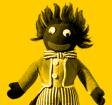 I supose the cops had nothing better to do. We all know the UK is a crime-free haven.
So Herefordshire police had time to seize three golliwogs from an alarmed shop-owner who thought, when he was urgently called to his premises on a Sunday, a break-in had occurred.
(Thanks Reason)
Public health - a permanent state of crisis
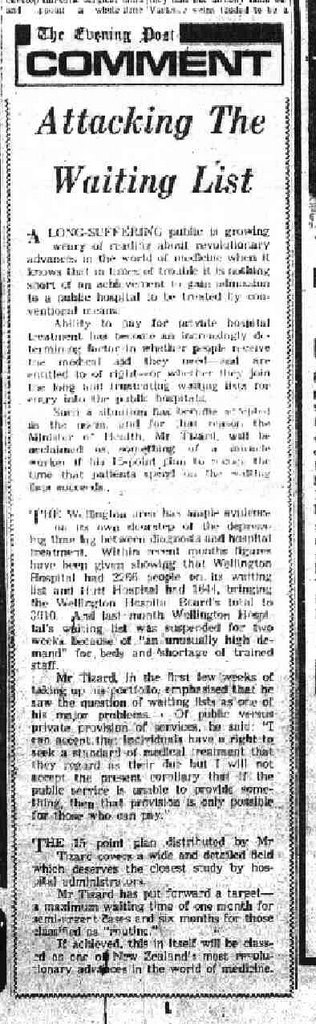 "The long suffering public is growing weary of reading about revolutionary advances in the world of medicine when it knows that in times of trouble it is nothing short of an achievement to gain admission to a public hospital to be treated by conventional means....last month Wellington Hospital's waiting list was suspended for two weeks because of an unusually high demand for beds and shortage of trained staff."
The column goes on to detail the numbers waiting for treatment at Wellington and Hutt hospitals and the new Health Minister's plan to cut the waiting times and lists. Can you guess which year this was?
(Clue; It's not 2006, cause Hodgson doesn't even have a plan.)
Friday, April 14, 2006
Tories axe speech-making
Stop thumping the tub, you're putting off women, Tories told
TUB-THUMPING speeches, the climax of selection contests in the Conservative Party for generations, have been axed by David Cameron to try to increase the number of women MPs.
New rules sent to 100 target seats this week say that set-piece speeches must be replaced by an interview in front of the full membership, to be conducted by a local dignitary, journalist or professional from outside the party.
The traditional barn-storming speech is thought to give men, with their deeper voices and often lengthy experience of public speaking, an advantage.
Speech-making is my achilles heel but I think it's requisite for an MP. Either you get better at it or compensate by being very good in other areas.... Then again politics is changing fast. Turn out for public meetings is very low. Getting your message to voters via the media is more important..... Then again, media cover meetings and won't be kind to a poor speech-maker. No. This seems like a mistake to me. What do you think?
TUB-THUMPING speeches, the climax of selection contests in the Conservative Party for generations, have been axed by David Cameron to try to increase the number of women MPs.
New rules sent to 100 target seats this week say that set-piece speeches must be replaced by an interview in front of the full membership, to be conducted by a local dignitary, journalist or professional from outside the party.
The traditional barn-storming speech is thought to give men, with their deeper voices and often lengthy experience of public speaking, an advantage.
Speech-making is my achilles heel but I think it's requisite for an MP. Either you get better at it or compensate by being very good in other areas.... Then again politics is changing fast. Turn out for public meetings is very low. Getting your message to voters via the media is more important..... Then again, media cover meetings and won't be kind to a poor speech-maker. No. This seems like a mistake to me. What do you think?
Tax Freedom Day last year
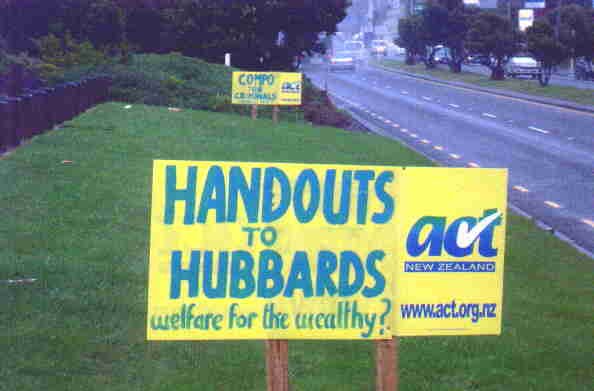
On the most apalling day weather-wise we set up a series of signs along the Esplanade, Petone, where the traffic crawls through at peak time. Here's the first;

...followed by example after example of government profligacy (spoilt for choice);

We made the Newstalkzb News and a Herald photographer took some shots. He said he couldn't resist coming down, after hearing my call to the radio, to see what sort of nuts would be protesting in a southerly storm. Committed ones.
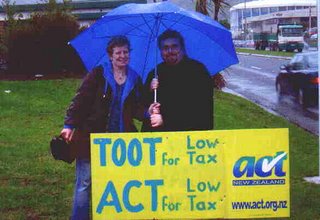
Me and Gavin.

...followed by example after example of government profligacy (spoilt for choice);
We made the Newstalkzb News and a Herald photographer took some shots. He said he couldn't resist coming down, after hearing my call to the radio, to see what sort of nuts would be protesting in a southerly storm. Committed ones.

Me and Gavin.
Tax Freedom Day this year
The US Tax Freedom Day is April 26, out 3 days from last year and ten from 2004.
In the UK it is really late - June 3rd. They illustrate it with this chart and question;
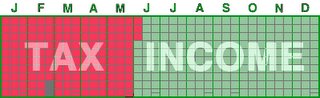
How long do we have to spend working for the government, rather than ourselves? The answer is nearly half the year.
Last year, Staples Rodway declared May 24 to be Tax Freedom Day in NZ and May 17 in Australia. According to the NBR Tax Freedom Day -- that magic point in the year when New Zealanders begin working for themselves, rather than the tax man -- will come a week or two later this year.
Enjoy your holiday because when you go back to work on Tuesday (or tomorrow) you'll still be working for the state!
In the UK it is really late - June 3rd. They illustrate it with this chart and question;
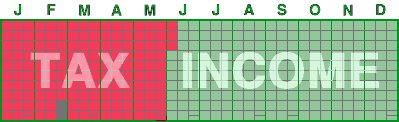
How long do we have to spend working for the government, rather than ourselves? The answer is nearly half the year.
Last year, Staples Rodway declared May 24 to be Tax Freedom Day in NZ and May 17 in Australia. According to the NBR Tax Freedom Day -- that magic point in the year when New Zealanders begin working for themselves, rather than the tax man -- will come a week or two later this year.
Enjoy your holiday because when you go back to work on Tuesday (or tomorrow) you'll still be working for the state!
Invalid benefit snapshot
In 1990 27,830 were on an invalid's benefit. Today there are 74,500.
People on this benefit for psychological or psychiatric reasons make up 27 percent, the highest incapacity group.
In 1990 48 percent of invalid beneficiaries were under 40 - that has dropped to 30 percent, which reflects our aging population.
The percentage that are female has grown from 40 to 47.
75.3 percent have been on this or another benefit continuously for four or more years.
(There is some discussion about the reasons for these steep increases in the comments section of "Sickness benefit snapshot".)
People on this benefit for psychological or psychiatric reasons make up 27 percent, the highest incapacity group.
In 1990 48 percent of invalid beneficiaries were under 40 - that has dropped to 30 percent, which reflects our aging population.
The percentage that are female has grown from 40 to 47.
75.3 percent have been on this or another benefit continuously for four or more years.
(There is some discussion about the reasons for these steep increases in the comments section of "Sickness benefit snapshot".)
Thursday, April 13, 2006
Sickness benefit snapshot
In 1990 28,351 people were on a sickness benefit. Today there are 46,862.
51 percent have been on it for more than a year. In 1990 only 29 percent had been on it for more than a year. Today, more people are sick and they are sick for longer. Really.
51 percent have been on it for more than a year. In 1990 only 29 percent had been on it for more than a year. Today, more people are sick and they are sick for longer. Really.
From Richard Worth's newsletter
Political Quote of the Week
"You know, doing what is right is easy. The problem is knowing what is right" - Lyndon B. Johnson - 37th US President
Richard Worth
It doesn't inspire me - as quotes go. In fact, in politics I would have thought, knowing what is right is easy, the problem is doing it. That would be a better motto for National.
"You know, doing what is right is easy. The problem is knowing what is right" - Lyndon B. Johnson - 37th US President
Richard Worth
It doesn't inspire me - as quotes go. In fact, in politics I would have thought, knowing what is right is easy, the problem is doing it. That would be a better motto for National.
What is going on?

This chart (the result of a PQ from Simon Power) shows the number of CYF placements over the past five years. Family/whanau placements, foster care or youth justice residences. The top figure is also included in the bottom but assuming the numbers have been recorded in the same way each year the increases are quite staggering.
Food stamps
It isn't unusual to hear people talking about routinely providing beneficiaries with a food voucher instead of cash, to ensure that children actually get fed. I point out that food stamps can also be manipulated and used as black market currency. Illinois, US has tried to get around this by using electronic cards regularly credited with funds to be used only at authorised foodstores. But that is still being ripped off.
The latest scam works like this:
A welfare recipient goes to a store with a Link card credited by the government with a dollar amount for groceries -- say, $100. The store clerk swipes the card through a government computer and takes credit for $100 in phony food sales. Then, the clerk hands $70 to the welfare recipient, keeping the rest as profit.
Food-stamp benefits can be legally used only to buy "food or food products for human consumption, plus seeds and plants for use in home gardens to produce food," according to the USDA.
But over and over, federal authorities have watched food-stamp recipients, who find out about crooked stores through word of mouth, use illegal cash from their Link cards to feed their drug habits, not their families.
Baker said the fraud is especially insidious because the family members of Link cardholders often wind up having to stand in line at food pantries for handouts because the Link benefits have been squandered on drugs.
And, just to add insult to injury, it appears that some of the ripped off funds are going to terrorist organisations.
The latest scam works like this:
A welfare recipient goes to a store with a Link card credited by the government with a dollar amount for groceries -- say, $100. The store clerk swipes the card through a government computer and takes credit for $100 in phony food sales. Then, the clerk hands $70 to the welfare recipient, keeping the rest as profit.
Food-stamp benefits can be legally used only to buy "food or food products for human consumption, plus seeds and plants for use in home gardens to produce food," according to the USDA.
But over and over, federal authorities have watched food-stamp recipients, who find out about crooked stores through word of mouth, use illegal cash from their Link cards to feed their drug habits, not their families.
Baker said the fraud is especially insidious because the family members of Link cardholders often wind up having to stand in line at food pantries for handouts because the Link benefits have been squandered on drugs.
And, just to add insult to injury, it appears that some of the ripped off funds are going to terrorist organisations.
Union threatens, patients could pay more
One thing the public always seem to support is more money for nurses. That is, when it comes from the government. It will be interesting to see if they are so keen when they are asked for it directly on their next visit to the doctor. The Nurses Union are threatening that GP fees will rise if the government doesn't stump up with the extra $22 million they want. On one hand, I am always pleased to see user-pays in action. On the other, people have already paid for the nurses through taxation. People should of course be angry and ask again, why are we paying twice?
 (This new negotiator isn't a very good comrade. Laila Harre would never have suggested such an idea. She would have known instinctively you don't get offside with the public by threatening to put your hand directly into their pocket. You do it stealthily, through the government. Laila was smart. And the public are, by and large, stupid.)
 (This new negotiator isn't a very good comrade. Laila Harre would never have suggested such an idea. She would have known instinctively you don't get offside with the public by threatening to put your hand directly into their pocket. You do it stealthily, through the government. Laila was smart. And the public are, by and large, stupid.)
Wednesday, April 12, 2006
The state by any other name ....
The British Conservatives have signed up to Labour's child poverty reduction target. BUT it is up to the supportive state to make child poverty disappear. So says Oliver Letwin, head of Conservative Party policy UK.
"It is a problem of demoralised neighbourhoods, of broken families, of drug and alcohol dependency, of poor schooling, of poor housing and decrepit estates, of unemployment and unemployability, of children growing up with too little hope and too much fear."
These problems, Mr Letwin said, could only be dealt with "bottom up, from the locality, from social enterprise meeting local needs" – local campaigners were the "heroes" and it was up to the state to set up the framework in which they could flourish.
"It is not the commanding state but the supportive state that we need: enabling society to support, inspire, mentor and lead young people out of deprivation," he wrote.
As long as the state keeps paying for all of the afore-mentioned, that is what we will get. How we describe the state won't make a blind bit of difference.
Then the Guardian asks, What would Margaret Thatcher think?
Certainly the Conservative switch is unlikely to have been entirely altruistic. Any party trying to remove its "nasty" label needs to do something dramatic. Inequality has become so familiar it is easy to forget just how rapid its growth was under the Conservatives in the 1980s. Three decades into the welfare state, both inequality and relative poverty in Britain were at their lowest points in 1979. Seven years later child poverty had tripled: from one in nine to one in three living below the poverty line. No other country except New Zealand suffered such a brutal reverse.
Child poverty is largely bound up with sole parenthood. Yet it is discussed in terms devoid of any association. The state paid for it - the state got it. When the state started doing it, the politicians of the day most certainly would have described themselves as proponents of a "supportive" state.
"It is a problem of demoralised neighbourhoods, of broken families, of drug and alcohol dependency, of poor schooling, of poor housing and decrepit estates, of unemployment and unemployability, of children growing up with too little hope and too much fear."
These problems, Mr Letwin said, could only be dealt with "bottom up, from the locality, from social enterprise meeting local needs" – local campaigners were the "heroes" and it was up to the state to set up the framework in which they could flourish.
"It is not the commanding state but the supportive state that we need: enabling society to support, inspire, mentor and lead young people out of deprivation," he wrote.
As long as the state keeps paying for all of the afore-mentioned, that is what we will get. How we describe the state won't make a blind bit of difference.
Then the Guardian asks, What would Margaret Thatcher think?
Certainly the Conservative switch is unlikely to have been entirely altruistic. Any party trying to remove its "nasty" label needs to do something dramatic. Inequality has become so familiar it is easy to forget just how rapid its growth was under the Conservatives in the 1980s. Three decades into the welfare state, both inequality and relative poverty in Britain were at their lowest points in 1979. Seven years later child poverty had tripled: from one in nine to one in three living below the poverty line. No other country except New Zealand suffered such a brutal reverse.
Child poverty is largely bound up with sole parenthood. Yet it is discussed in terms devoid of any association. The state paid for it - the state got it. When the state started doing it, the politicians of the day most certainly would have described themselves as proponents of a "supportive" state.
Michelle
 This is my friend Michelle. She sat for my portrait entry in this year's National Portrait Competition, currently showing at Shed 11. I am delighted to learn the painting is one of twelve selected for a further exhibition "Double Exposure 3" to be held next January in Wellington.
I believe it has been selected because of the subject. My aim was to capture Michelle's warmth. The painting itself was a rush job but it must have "connected".
Teenagers and welfare don't mix
Minister for Social Development, David Benson-Pope announces another scheme to spend taxpayer's money. "It's estimated that up to 45,000 15 to 19 year-olds do not enrol in tertiary study or get a job after leaving school. This is a waste of human potential," said Mr Benson-Pope.
That is as clear as mud. 45,000 over what period? Whatever the period, it is 45,000 too many. So the answer from the government is to pour more money into services to get these people into jobs. Wouldn't it be far simpler to take away the alternative to a job? Why oh why are we giving welfare to kids straight out of school?
And here's another thing. At May 2005 there were 37,631 single parents on a benefit who had started on welfare as a teenager. But not necessarily on the DPB. Here's the breakdown;
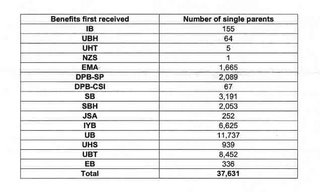
So sitting around on the dole or independent youth benefit is a pathway to pregnancy.
(I don't know how one managed to start their welfare career on NZ Super but nothing surprises me any more.)
That is as clear as mud. 45,000 over what period? Whatever the period, it is 45,000 too many. So the answer from the government is to pour more money into services to get these people into jobs. Wouldn't it be far simpler to take away the alternative to a job? Why oh why are we giving welfare to kids straight out of school?
And here's another thing. At May 2005 there were 37,631 single parents on a benefit who had started on welfare as a teenager. But not necessarily on the DPB. Here's the breakdown;

So sitting around on the dole or independent youth benefit is a pathway to pregnancy.
(I don't know how one managed to start their welfare career on NZ Super but nothing surprises me any more.)
Strange court case
Police have charged three men with the same drink-driving offence because they could not establish which one was driving the car. They surely cannot be convicted.
Defence counsel Sonia Vidal said she had huge concerns about the legality of the charge.
Police had charged all three because they did not know who had been driving.
They have no proof of who the driver was or the exact vehicle that was driven so police have entered the house and charged all three flatmates.
I have huge concerns about the legality of many steps in the process.
Queenstown men Cameron Milford Hoyle (23) and Phillip Parker (24) are also charged with dangerous driving and with driving with breath-alcohol levels of 856mcg and 763mcg respectively.
They are due to appear in the Queenstown court on April 24.
Judge Flatley said he could not understand how police would get over the burden-of-proof threshold.
Defence counsel Sonia Vidal said she had huge concerns about the legality of the charge.
Police had charged all three because they did not know who had been driving.
They have no proof of who the driver was or the exact vehicle that was driven so police have entered the house and charged all three flatmates.
I have huge concerns about the legality of many steps in the process.
Queenstown men Cameron Milford Hoyle (23) and Phillip Parker (24) are also charged with dangerous driving and with driving with breath-alcohol levels of 856mcg and 763mcg respectively.
They are due to appear in the Queenstown court on April 24.
Judge Flatley said he could not understand how police would get over the burden-of-proof threshold.
The same Frank Macskasy?
What a surprise to see the name Frank Macskasy on the front of the DomPost this morning. It usually appears on the letters page after another go at the failure of the 80's reforms. On more than one occasion Frank accused me of "living in a world of her own" or "determined to ignore the evidence". It was always his contention he dealt in the truth. Yesterday, in the Upper Hutt District Court, a Frank Macskasy admitted a fraud charge of stealing a dead baby's identity to obtain a passport. He was remanded for sentencing next month.


Tuesday, April 11, 2006
Hard to listen to
US Correspondent Steve Merczynski speaks to Newstalk ZB host Larry Williams about phone calls played in the trial of Zacarias Moussaoui. One is replayed from a young woman on the 83rd floor of the South Tower. I can't listen to it again. But we shouldn't forget the enormity of the horror, the great sadness of that day and the years following for families and friends of the dead.
On how many counts can Hone get it wrong?
 From a speech Tobacco Companies – It’s Time To Go, released today;
1/ And I have fired people for smoking in the wrong places.
It hasn’t made me the most popular son of the North, but as Errol Flynn once said “frankly I don’t give a damn”. Tobacco is killing my people, and I will use every weapon to defeat this monster.
2/ Liberals will say though that smoking is about Maori people making choices. But I say no. HELL NO!!!
3/ Addiction to cigarettes is also part of institutional racism,
because tobacco companies use their structures, their policies and their practices to oppress our people in the same way as government agencies have.
4/ And honestly folks, getting rid of tobacco is the only logical conclusion to the work you and many others have been doing for years. It makes more sense than just trying to manage the impact of tobacco.
5/ And I look forward to when Maori people can finally enjoy the same rights and privileges as everyone else, because we have given so much, and because we deserve better.
Student loans
Statistics from the Integrated Dataset on Student Loan Borrowers show that borrowers under 25 years, and those aged 60 years and over, had the highest median amount transferred for 2004 from StudyLink to Inland Revenue, Statistics New Zealand said today.
I have a question (when don't I have a question?) As a student loan only has to be repaid when a certain earning level is reached, $17,000, which is more than a single person's Super, do people over 60 expect to repay their loans?
I have a question (when don't I have a question?) As a student loan only has to be repaid when a certain earning level is reached, $17,000, which is more than a single person's Super, do people over 60 expect to repay their loans?

From the Strange Stories file
The Scotsman reports an Australian Federal Police officer was using a Scottish pyshic to help investigate a threat on PM John Howard's life.
The Australian Labour Party spokesman for homeland security, Arch Bevis, said he would be greatly concerned if the AFP was using clairvoyants to hunt criminals and terrorists. "I think, perhaps, this fellow has watched a few too many of the US detective shows," he said.
Or "Medium" maybe.
The Australian Labour Party spokesman for homeland security, Arch Bevis, said he would be greatly concerned if the AFP was using clairvoyants to hunt criminals and terrorists. "I think, perhaps, this fellow has watched a few too many of the US detective shows," he said.
Or "Medium" maybe.
Maori children on benefit
Some good work here by Simon Collins, the Herald's social issues reporter. He has attempted to establish how many Maori children have a parent on a benefit. He arrives at 45.9 percent.
Population estimates for June 2005 show around 264,000 Maori 0-17 year-olds which would put the percentage at 35. But, as Collins points out, there was some double-counting in the Census which, in turn, is used as a base for further estimates.
In 2001 it amounted to 130,000 children being counted twice. So who knows what the true percentage is. Here-in lies the problem of counting people in more than one ethnic group.
Which is also one of the reasons I oppose the statistical concept of two-home children. More double counting, more vagueness. Probably the best we can say currently is that between one in two and one in three Maori children are being raised on a benefit.
Population estimates for June 2005 show around 264,000 Maori 0-17 year-olds which would put the percentage at 35. But, as Collins points out, there was some double-counting in the Census which, in turn, is used as a base for further estimates.
In 2001 it amounted to 130,000 children being counted twice. So who knows what the true percentage is. Here-in lies the problem of counting people in more than one ethnic group.
Which is also one of the reasons I oppose the statistical concept of two-home children. More double counting, more vagueness. Probably the best we can say currently is that between one in two and one in three Maori children are being raised on a benefit.
Placebo politics
On opposite pages of the DomPost this morning we have two very different minds. One which sees the problem and another which thinks it does. The first is Michael Bassett with his column "Taming the feral breed". Bassett attacks the dog micro-chipping strategy as "placebo" politics and goes on to the broader picture in which the same sort of politics is now routinely practiced by our "student" politicians; "But till such time as the great welfare recruiting ground for under-achievement and consequent anti-social behaviour is faced up to, nothing offers more than temporary relief."
Then we have the benefit of the wisdom of Murray Edridge, Barnado's CE, urging the repeal of section 59 to "save lives". "The sooner NZ society stops giving ambiguous legal signals on violence in the home, the better it will be for our children. Our laws set a standard, and ensuring that standard is clear and unambiguous is the first step in social change. The standard in itself does not change behaviour. Our law is very clear and unambiguous, for example, about murder or theft. These crimes continue to occur, but in the knowledge they are wrong. In the same way, repeal of section 59 will make an unambiguous statement about the use of violence against children."
Convincing, isn't it? This guy likes to spend his time fawning around the likes of the Children's Commissioner, the Families Commission and the CPAG, all hand-wringing do-gooders whose careers turn on rhetoric and dalliance.....or, if I can borrow Mr Bassett's phrase, "placebo" politics.
Then we have the benefit of the wisdom of Murray Edridge, Barnado's CE, urging the repeal of section 59 to "save lives". "The sooner NZ society stops giving ambiguous legal signals on violence in the home, the better it will be for our children. Our laws set a standard, and ensuring that standard is clear and unambiguous is the first step in social change. The standard in itself does not change behaviour. Our law is very clear and unambiguous, for example, about murder or theft. These crimes continue to occur, but in the knowledge they are wrong. In the same way, repeal of section 59 will make an unambiguous statement about the use of violence against children."
Convincing, isn't it? This guy likes to spend his time fawning around the likes of the Children's Commissioner, the Families Commission and the CPAG, all hand-wringing do-gooders whose careers turn on rhetoric and dalliance.....or, if I can borrow Mr Bassett's phrase, "placebo" politics.
Monday, April 10, 2006
Who is right?
 “The Maori Party welcomes the decision by the Government to back down from a hastily thought through plan on managing our freshwater resources”.
“Water is a basic human right under international human rights law (United Nations Committee on Economic, Social and Cultural Rights)” said Mrs Turia.
ACT leader Rodney Hide says, "New Zealanders will be disappointed that instead of considering all the options, Labour has fallen back on its 'command and control' ideology.
"This is a strategy straight from the bankrupt former Soviet Union.
Why are we waiting?
Yesterday I was complaining about the sluggish release of the March 2006 quarter unemployment rate when compared with other countries. Just checked the release schedule for April and the HLFS release doesn't appear. The December quarter release was published on Feb 9. (It would appear) it takes us at least a month longer to publish than the US or Australia.
New Look "Letter"
 Richard Prebble's Letter appeared on Scoop today with a new byline:
The Letter Limited
PO Box 1551, Wellington, New Zealand
E-mail: admin@theletter.biz
Web: www.theletter.biz
Please Note: Formerly the column The Letter was circulated by the ACT Party. It no longer is.
NZ abortion delay-rate too high
Wellington doctor Carol Shand said yesterday delays were caused by abortion laws, which required women to go through a complex series of steps including numerous medical referrals before they could get an abortion.
This report doesn't surprise me having recently accompanied someone to an abortion clinic as support. First, the person has to see a counsellor. Then they have to see a doctor. Then they have to come back on another day to have the abortion. On this occasion the first two processes took three hours (and that was after some queue-jumping). People are herded in, some with partners and children in tow, at the rate of around one every ten-fifteen minutes. The consultations can't possibly keep up with the intake. There is one small women-only waiting room and then a much bigger area with a TV. There is no privacy. Some of the women looked quite distressed and tearful even.
This set-up is a sham. And it is leading to unacceptable delays.
This report doesn't surprise me having recently accompanied someone to an abortion clinic as support. First, the person has to see a counsellor. Then they have to see a doctor. Then they have to come back on another day to have the abortion. On this occasion the first two processes took three hours (and that was after some queue-jumping). People are herded in, some with partners and children in tow, at the rate of around one every ten-fifteen minutes. The consultations can't possibly keep up with the intake. There is one small women-only waiting room and then a much bigger area with a TV. There is no privacy. Some of the women looked quite distressed and tearful even.
This set-up is a sham. And it is leading to unacceptable delays.
There are no stats
Back in March I questioned how seven deaths that occurred as a result of domestic violence in 2006 alone could go unreported by the media (I did eventually find one in Chch in early January).
Women and children continue to suffer the overwhelming majority of domestic violence abuse, said Commissioner Joy Liddicoat.
The National Collective of Women’s Refuges has noted that seven women have died as a result of domestic violence in New Zealand since the start of 2006.
I wrote to the National Collective of Women's refuge asking where they got their stats from - no reply. I wrote to the police asking them for the relevant statistics. Here is the reply I received;

"....concerning the number of women that had died as a result of domestic violence.......official statistics for what you have requested no not exist."
So my question remains. How reliable is the data propagated by the National Collective of Women's refuge?
Women and children continue to suffer the overwhelming majority of domestic violence abuse, said Commissioner Joy Liddicoat.
The National Collective of Women’s Refuges has noted that seven women have died as a result of domestic violence in New Zealand since the start of 2006.
I wrote to the National Collective of Women's refuge asking where they got their stats from - no reply. I wrote to the police asking them for the relevant statistics. Here is the reply I received;

"....concerning the number of women that had died as a result of domestic violence.......official statistics for what you have requested no not exist."
So my question remains. How reliable is the data propagated by the National Collective of Women's refuge?
Compulsory obesity tests
Scottish politicians want to introduce obesity tests for all five year-olds;
Ministers claim that in order to shed Scotland's tag as the sick man of Europe, they need to intrude ever further into children's personal health and the private lives of families.
But the drastic measures were attacked last night as the latest attempt to dictate to parents how they should bring up their children.
Doubtless there are obesity obsessionists here who would leap at such an idea.
Ministers claim that in order to shed Scotland's tag as the sick man of Europe, they need to intrude ever further into children's personal health and the private lives of families.
But the drastic measures were attacked last night as the latest attempt to dictate to parents how they should bring up their children.
Doubtless there are obesity obsessionists here who would leap at such an idea.
Sunday, April 09, 2006
So you think you can dance
 Watch the s*** hit the fan on this one tomorrow. My kids have been watching this TV3 dance competition for the past few weeks and tonight was the first time that the TV audience could vote by phone. Unfortunately some of the phone numbers given on the programme don't match the contestant (at least one and three have been transposed). So you spend your dollar voting for Leonid and find you have voted for Justin. Couldn't they just count the intentions? Well, no, because when you think you must have pressed the wrong button and ring back, you waste another dollar on the wrong contestant, further skewing the votes.
I think they will have to refund the calls.
Corruption of thought
Here James Bartholomew comments on a UK TV programme called "On The Fiddle". He looks at how benefit fraud officers take a very lenient line with sole parents and makes this observation,
In all jobs, there is a tendency to 'go native'. This is true of diplomats, people sent to Brussels to work for the EU, journalists, lawyers and on and on. People in many jobs start thinking in terms themselves and of the people with whom they come into contact. Those who visit prisons often come to be more concerned about the prisoners they come in contact with than the victims of their crimes, whom they never see. I wonder whether benefit officials come to be more sympathetic to benefit frauds than to the taxpayers these fraudsters are stealing from?
I was making a similar point in this letter published in the Hutt News last week. It responds to a woman who advocates for beneficiaries.
I recently read a quote which went something like, just as thought can corrupt language so can language corrupt thought. There is an example of this in last week's Hutt News. Speaking about the looming abolition of the Special Benefit, which is a top-up on a main benefit, Teresa Homan said, "The Government has done away with the safety net."
It was always my understanding that any benefit is a safety net. But Ms Homan's words reveal that people who advocate for beneficiaries see main benefits as entitlements, with any extra assistance forming "safety nets". That is the viewpoint they impress on their clients.
Hence, being on welfare has morphed into a permanent lifestyle for thousands of people. Even the Labour Government has grown concerned about this state of affairs, especially when the newspapers are packed with job opportunities for both skilled and unskilled people.
Perhaps even a few hours work could be considered to replace any lost top-up, although I note the main thrust of the article was to urge beneficiaries to get in now before it is too late - in other words, anticipate your hardship.
In all jobs, there is a tendency to 'go native'. This is true of diplomats, people sent to Brussels to work for the EU, journalists, lawyers and on and on. People in many jobs start thinking in terms themselves and of the people with whom they come into contact. Those who visit prisons often come to be more concerned about the prisoners they come in contact with than the victims of their crimes, whom they never see. I wonder whether benefit officials come to be more sympathetic to benefit frauds than to the taxpayers these fraudsters are stealing from?
I was making a similar point in this letter published in the Hutt News last week. It responds to a woman who advocates for beneficiaries.
I recently read a quote which went something like, just as thought can corrupt language so can language corrupt thought. There is an example of this in last week's Hutt News. Speaking about the looming abolition of the Special Benefit, which is a top-up on a main benefit, Teresa Homan said, "The Government has done away with the safety net."
It was always my understanding that any benefit is a safety net. But Ms Homan's words reveal that people who advocate for beneficiaries see main benefits as entitlements, with any extra assistance forming "safety nets". That is the viewpoint they impress on their clients.
Hence, being on welfare has morphed into a permanent lifestyle for thousands of people. Even the Labour Government has grown concerned about this state of affairs, especially when the newspapers are packed with job opportunities for both skilled and unskilled people.
Perhaps even a few hours work could be considered to replace any lost top-up, although I note the main thrust of the article was to urge beneficiaries to get in now before it is too late - in other words, anticipate your hardship.
US unemployment rate falls
The Washington Times reports, Jobless rate dips to 4.7 percent. Unemployment declined to 4.7 percent last month, approaching a five-year low, as the economy churned out 211,000 new jobs -- a sign of steady economic growth and good news for cash-strapped consumers.
In the US "jobless" and "unemployed" are interchangeable terms but not so in New Zealand - a mistake journalists commonly make.
NZ's unemployment rate is 3.6 percent but our jobless rate is 6.4 percent.
Unless people are actively seeking work they are not officially unemployed.
The US gathers its employment statistics in the same way as New Zealand - through a Household Labour Force survey. Their unemployment rate measure is comparable to ours. However, they do not measure a separate category and call them "jobless".
And isn't it interesting that a country with a population 72 times the size of New Zealand can get their stats out quicker. Our March statistics have yet to appear.
In the US "jobless" and "unemployed" are interchangeable terms but not so in New Zealand - a mistake journalists commonly make.
NZ's unemployment rate is 3.6 percent but our jobless rate is 6.4 percent.
Unless people are actively seeking work they are not officially unemployed.
The US gathers its employment statistics in the same way as New Zealand - through a Household Labour Force survey. Their unemployment rate measure is comparable to ours. However, they do not measure a separate category and call them "jobless".
And isn't it interesting that a country with a population 72 times the size of New Zealand can get their stats out quicker. Our March statistics have yet to appear.
Aussie unemployment
The Aussies beat us to it as well. Their March 2006 unemployment rate is also out and good news for them down to 5 percent.
Saturday, April 08, 2006
Nuke 'em
 As a born and bred Mancunian I know what I'm talking about.........AMEN!
(...although, in its defence, historically Manchester was known for its strong adherence to free trade and laissez-faire doctrines.)
(Thanks to James for the photo).
Daycare decisions
 PARENTING GURU SAYS DAY CARE BAD FOR BABIES
 Australian parenting guru Steven Biddulph has done an about-face on day care and decided it is bad for babies. Biddulph, a psychologist with 30 years' experience and 4 million books sold, has spent five years examining the results of international studies on the subject.
This issue continues to be highly controversial. I am not convinced one way or the other because children are all different and standards of care vary, be it that of the daycare or that of the parent. But debate is good. We need information.
My problem is that the debate drives social policy. If the politicians can be persuaded daycare is bad for babies then they decide all mothers should be paid to stay home. The collective pays based on government edict. One person is forced to pay for another's decisions, over which he has no control.
What should happen is the individual(s) makes their own decision about what is best for their family and takes full responsibility for enacting that choice. That's freedom.
Up to a quarter million paid to Ngai Tahu
The Otago Daily Times is pursuing information about money paid to Ngai Tahu for advice and other help to Corrections in setting up a new 335 bed prison in Milburn, near Balclutha.
The department is obligated under the Resource Management Act to work with iwi in the construction of prisons. It pays iwi $45 an hour and up to $350 a day for this collaboration, which it said was consistent with rates paid in the public sector for the kind of work.
In a statement, new facilities development project manager Catherine Hall said it was vitally important the department involved Maori in the service provision, development and operation of the prison because Maori were overrepresented in the criminal justice system making up about half of all prisoners.
The department is obligated under the Resource Management Act to work with iwi in the construction of prisons. It pays iwi $45 an hour and up to $350 a day for this collaboration, which it said was consistent with rates paid in the public sector for the kind of work.
In a statement, new facilities development project manager Catherine Hall said it was vitally important the department involved Maori in the service provision, development and operation of the prison because Maori were overrepresented in the criminal justice system making up about half of all prisoners.
Friday, April 07, 2006
Richard Worth on suppressed information
National MP Richard Worth is considering drafting a Private Member's Bill to change the law regarding suppression of evidence. He needs caucus approval. Names of victims should be suppressed but not names of accused. He quoted a US Supreme court judge who said, sunlight is the best disinfectant.
A simple person like me thinks that the accused is still just that though.
A simple person like me thinks that the accused is still just that though.
A pointer to the future
Here is one of the tables from the Family Court Statistics just released;
Ethnicity Distribution of Children in Care and Protection Cases in 2004
New cases Reviews
% European 42 45
% Pacific 10 7
% Māori 45 45
% Asian 2 2
% Other 1 1
There were 5,983 cases involving 8,165 children.
I tend to take the view that "grown-ups" are big enough and ugly enough to look after themselves. But what of the children? A lot of these kids will move around in foster care and end up as statistics on other tables, very likely to do with crime.
Hard to see the ethnic make-up of our prisons changing much in the near future.
Ethnicity Distribution of Children in Care and Protection Cases in 2004
New cases Reviews
% European 42 45
% Pacific 10 7
% Māori 45 45
% Asian 2 2
% Other 1 1
There were 5,983 cases involving 8,165 children.
I tend to take the view that "grown-ups" are big enough and ugly enough to look after themselves. But what of the children? A lot of these kids will move around in foster care and end up as statistics on other tables, very likely to do with crime.
Hard to see the ethnic make-up of our prisons changing much in the near future.
Hot off the press
For those of you interested in these things, for the first time Family Court Statistics have just been released.
According to the Minister; Key findings within the report are:
- The number of guardianship cases has decreased between 2003 and 2004.
- The number of domestic violence cases dealt with in the Court has decreased.
- Care and protection case continue to increase but at a slower rate than previously.
- Mental health and relationship property cases are increasing.
According to the Minister; Key findings within the report are:
- The number of guardianship cases has decreased between 2003 and 2004.
- The number of domestic violence cases dealt with in the Court has decreased.
- Care and protection case continue to increase but at a slower rate than previously.
- Mental health and relationship property cases are increasing.
Govt, liberty and such matters
 These quotes are from Peter McWilliam's book "Ain't Nobody's Business If I Do" which explores the absurdity of consensual crime.
The trouble with the world is that the stupid are cocksure and the intelligent are full of doubt. Bertrand Russell
I can't understand why people are frightened of new ideas. I'm frightened of the old ones. John Cage
I don't make jokes - I just watch the government and report facts. Will Rogers
It is hard to fight an enemy who has outposts in your head. Sally Kempton
No government ever voluntarily reduces itself in size. Government programmes, once launched, never disappear. Actually, a government bureau is the nearest thing to eternal life we'll ever see on this earth! Ronald Reagan
Bureaucracy defends the status quo long past the time when the quo has lost its status. Laurence J.Peter
If a nation expects to be ignorant and free....it expects what never was and never will be. Thomas Jefferson
Government is like a baby. An alimentary canal with a big appetite at one end and no sense of responsibility at the other. Ronald Reagan
Award-winning IRD
 Shouldn't be surprised that the Best Government Website coincides with what they do best - take our money off us.
Pathetic
From the ODT; "Gareth Morgan earlier this week he would be giving away his share of the sale.
I have had thousands and thousands of letters, and 90% are basically asking for help with their mortgages, he told The New Zealand Herald.
Amongst that, there are some genuine needy cases, but I wonder if New Zealanders should look at themselves hard.
It’s no wonder the Government has such a job sorting out the benefits and has to employ armies to sort out the genuine cases from the freeloaders, he said.
He was shocked by people coveting his new-found millions after the Trade Me deal was announced. I am a bit surprised by the self-centred nature of it."
I have had thousands and thousands of letters, and 90% are basically asking for help with their mortgages, he told The New Zealand Herald.
Amongst that, there are some genuine needy cases, but I wonder if New Zealanders should look at themselves hard.
It’s no wonder the Government has such a job sorting out the benefits and has to employ armies to sort out the genuine cases from the freeloaders, he said.
He was shocked by people coveting his new-found millions after the Trade Me deal was announced. I am a bit surprised by the self-centred nature of it."
KiwiSaver scrutinised by the Wall St Journal
The Wall St Journal says KiwiSaver is a lemon. Here the NCPA identifies why;
More worryingly, KiwiSaver does little to address the root cause of New Zealanders' atrocious savings habits; namely, the country's generous welfare system:
* Today, Wellington guarantees 65 percent of the national average wage upon retirement at age 65.
* These payments aren't income or asset tested, meaning everyone receives the same treatment, regardless of wealth.
Observers ask: Why would New Zealanders save today if the government will look after them in their old age?
And, in the meantime, why should New Zealanders earn too much and accumulate assets when they'll lose their state benefits or be forced to start paying child support or paying back their student loans?
More worryingly, KiwiSaver does little to address the root cause of New Zealanders' atrocious savings habits; namely, the country's generous welfare system:
* Today, Wellington guarantees 65 percent of the national average wage upon retirement at age 65.
* These payments aren't income or asset tested, meaning everyone receives the same treatment, regardless of wealth.
Observers ask: Why would New Zealanders save today if the government will look after them in their old age?
And, in the meantime, why should New Zealanders earn too much and accumulate assets when they'll lose their state benefits or be forced to start paying child support or paying back their student loans?
Thursday, April 06, 2006
What happened to promised "transparency"?
I mentioned the other day the seemingly precarious disposition of Pete Hodgson, Minister of Health. This is a shocker. ACT MP, Heather Roy, has referred a directive from him to the Auditor General. He wants MPs to seek his permission before meeting with DHBs and to be provided with a meeting debrief from the DHB.
Whatever happened to the "transparent and accountable " government Clark promised us?
Whatever happened to the "transparent and accountable " government Clark promised us?
Times have changed
Here Jim Peron describes his experience of trying to deliver a lecture on political economics to an American high school class. It raised my eyebrows. Does anybody know how this would compare to a NZ high school?
How big is a billion?
 A billion hours ago, our ancestors were living in the Stone Age.
A billion minutes ago, Jesus was barely dead.
A billion seconds ago, it was 1974.
A billion dollars of NZ government spending ago was just 7 days, 2 hours and 24 minutes ago.
(adapted from the Adam Smith blog)
Update; My most cringing apologies. A reader has pointed out that a billion minutes ago Jesus would have been dead 105 years and a billion seconds ago it was 1974!
I did get the bit about govt spending right.
Once the cat is out of the bag.....
Further from the Hansard debate on the Social Security Amendment Bill which introduced the DPB (reading historical Hansard is preferable to listening to Parliament today).
Dr Wall (Labour); "Step by step we are moving to the situation where financial provisions, quite rightly, are being based on the economic requirements of the people who are being supported by our pension schemes of one form or another; but unless there is very close supervision we will see the economic considerations gradually producing economic pressures to alter the social structure of our community, particularly in the family sphere.
We see this overseas, particularly in Sweden, where some very drastic and far-reaching changes have occurred in the pattern of family life, and when one looks at the processes by which these developed one finds they are largely due to the step-by-step increases in benefits along the path we are now treading."
So some of the members knew they were taking a risk, that they might be letting a cat out of the bag. The "close supervision" never happened.
And look! We are still following in Sweden's footsteps.
Dr Wall (Labour); "Step by step we are moving to the situation where financial provisions, quite rightly, are being based on the economic requirements of the people who are being supported by our pension schemes of one form or another; but unless there is very close supervision we will see the economic considerations gradually producing economic pressures to alter the social structure of our community, particularly in the family sphere.
We see this overseas, particularly in Sweden, where some very drastic and far-reaching changes have occurred in the pattern of family life, and when one looks at the processes by which these developed one finds they are largely due to the step-by-step increases in benefits along the path we are now treading."
So some of the members knew they were taking a risk, that they might be letting a cat out of the bag. The "close supervision" never happened.
And look! We are still following in Sweden's footsteps.
Famous last words
Here is the low key, Evening Post, page 16, Dec 1, 1973 press clipping that announced the introduction of the DPB.
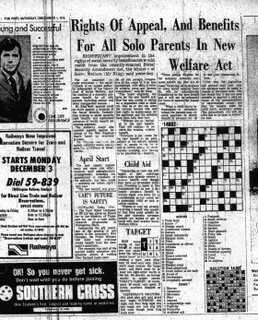
"The new benefit will provide all solo parents, irrespective of the cause of solo parenthood, with defined benefit criteria; rates and income exemptions," said Mr King (Minister of Social Welfare).
The next is the Hansard from 25 October, 1972, which shows Hon. L.R. Adams-Schneider, Minister of Social Welfare (soon to be replaced by a Labour government Minister as per above) detailing the expected cost of the DPB.
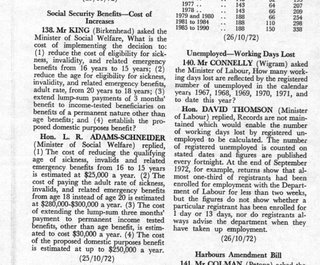
"The cost of the proposed domestic purposes benefit is estimated at up to $250,000 a year."
Adjusting for benefit inflation, that's around $4 million by today's standards.
So what is the bill for today's DPB recipients? $2.3 billion

"The new benefit will provide all solo parents, irrespective of the cause of solo parenthood, with defined benefit criteria; rates and income exemptions," said Mr King (Minister of Social Welfare).
The next is the Hansard from 25 October, 1972, which shows Hon. L.R. Adams-Schneider, Minister of Social Welfare (soon to be replaced by a Labour government Minister as per above) detailing the expected cost of the DPB.

"The cost of the proposed domestic purposes benefit is estimated at up to $250,000 a year."
Adjusting for benefit inflation, that's around $4 million by today's standards.
So what is the bill for today's DPB recipients? $2.3 billion
The goings-on of Christchurch gangs
Women and children of Aoteroa gang members who are in prison are being victimised by Mongrol Mob members. This makes my skin crawl frankly. There will be very young children and babies involved, quite probably the crimes won't just be against property.
A mother speaking to the media says; "I suppose the women's role is really to look after our kids – we are mothers. It's (gangs) a male thing – I don't see women with patches on. We might be around the gang scene but we don't get told anything. We are just the ones who get s... from it". The whole gang scene was "s... really", but it was a case of sleeping in the bed you made for yourself, she said.
A detective involved says, "Unfortunately, kids are being exposed to things they should not be seeing when they are kids. If these women believe they are the victims of crime we are quite happy to help them.
"In some ways they are victims of their own involvement. If they broke away from the people then they would not be subject to this type of intimidation from the other chapters. The trouble is, they find it hard to break away."
And you know who's funding all this misery don't you.
A mother speaking to the media says; "I suppose the women's role is really to look after our kids – we are mothers. It's (gangs) a male thing – I don't see women with patches on. We might be around the gang scene but we don't get told anything. We are just the ones who get s... from it". The whole gang scene was "s... really", but it was a case of sleeping in the bed you made for yourself, she said.
A detective involved says, "Unfortunately, kids are being exposed to things they should not be seeing when they are kids. If these women believe they are the victims of crime we are quite happy to help them.
"In some ways they are victims of their own involvement. If they broke away from the people then they would not be subject to this type of intimidation from the other chapters. The trouble is, they find it hard to break away."
And you know who's funding all this misery don't you.
Wednesday, April 05, 2006
Thank God for Working For Families
 From today's DomPost;
Benefit cheat spared prison
A young mother fraudulently pocketed thousands of dollars in benefit payments despite receiving generous financial support from her husband - and taking holidays to America.
Her lawyer says she can repay the $27,000 in domestic purposes benefit because she is now eligible for the Government's Working for Families welfare assistance.
I kid you not.
Lynley Hood
Lynley Hood, author of "A City Possessed", has written about the appointment of Howard Broad as Police Commissioner. She is not happy.
Are Facts Obsolete?
Is the question posed by Thomas Sowell in this excellent column
"People who have made up their minds and don't want to be confused by the facts are a danger to the whole society. Since the votes of such people count just as much as the votes of people who know what they are talking about, politicians have every incentive to pass laws and create policies that pander to ignorant notions, if those notions are widespread."
"People who have made up their minds and don't want to be confused by the facts are a danger to the whole society. Since the votes of such people count just as much as the votes of people who know what they are talking about, politicians have every incentive to pass laws and create policies that pander to ignorant notions, if those notions are widespread."
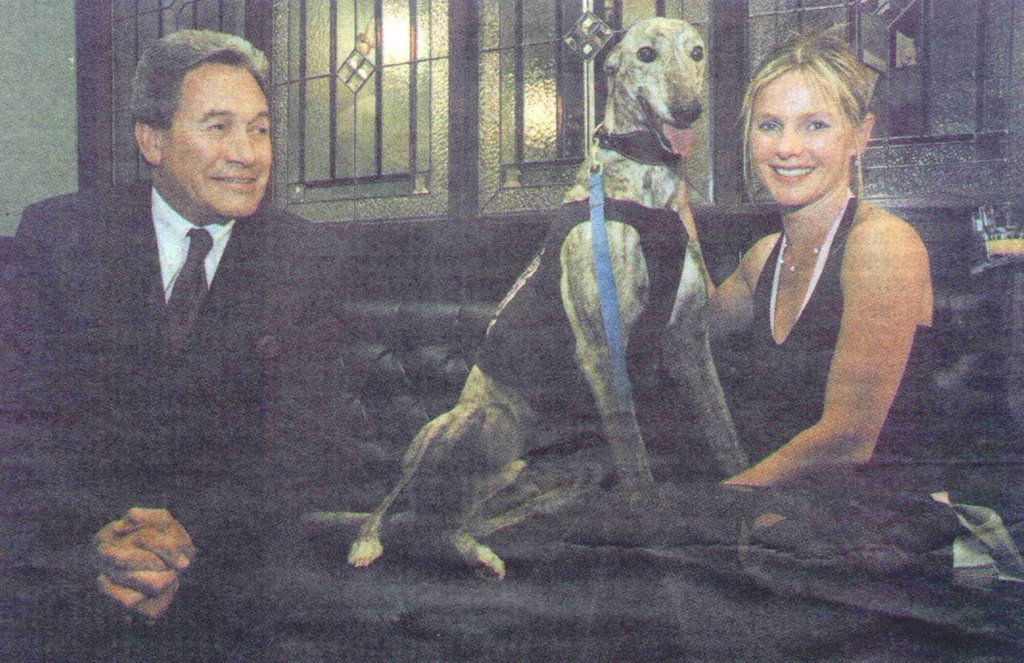
Police on trains
Scoop reports, Police are going to start travelling in train cabs.
From today motorists who try and race trains across level crossings could well find out their act of stupidity has been witnessed by police.
This is apparently to deter would-be racers. How? If anyone is that damn fool to play "chicken" with a train is the fact a cop's on board to see them do it going to make a blind bit of diference. Actually I think it might encourage them.
From today motorists who try and race trains across level crossings could well find out their act of stupidity has been witnessed by police.
This is apparently to deter would-be racers. How? If anyone is that damn fool to play "chicken" with a train is the fact a cop's on board to see them do it going to make a blind bit of diference. Actually I think it might encourage them.
Do nuns drive cars?
Just wondering as the spokesman of the Police Association, Greg O'Connor wants muslim women wearing burkas banned from driving. He says if their belief is that strong they should stay out of cars. Driving in a burka is just plain dangerous, he said.
Baby Boomers threat to road safety
This article misses an important point. While the growing number of ageing baby boomers will crowd the roads, and their accident rate is higher, even higher is the accident rate of young drivers and there will be fewer of them.
Scalping the scalpers
 Re the Rolling Stones show - Initially fans were told all the tickets had gone. I missed out after a morning spent just trying to get onto the Ticketek website. Then about two weeks ago a radio news report said more had been released. Forget the internet this time. I rang immediately and got 4. The cheapest at that stage, "gold", were $150. I notice in the paper this morning that more tickets have been released for the Wellington show. These are "diamond" at a cost of $350 each. This must be the new strategy for beating the scalpers.
Let the Private Sector in (2)
Heavens. Another. New Police Commissioner Howard Broad first hit the headlines when he devised a plan for a private police force. He says he will continue to think outside the square.
Let the Private Sector in
The Dompost reports on board member Peter McCardle's suggestion that the Hutt Valley DHB pays up to thirty percent of people's surgery costs if they go private. "I believe our hospitals and clinicians are doing a great job but the reality is across the nation that there is great need, particularly for people on active review. We must do better and we need to look at other ways of trying to help these people."
Peter is an ex ACT man (as well as being a former Minister of Social Welfare in the National govt and NZ First MP). Hutt also has two councillors who are both former ACT staffers. All good people pushing it up hill.
Peter is an ex ACT man (as well as being a former Minister of Social Welfare in the National govt and NZ First MP). Hutt also has two councillors who are both former ACT staffers. All good people pushing it up hill.
Tuesday, April 04, 2006
PM - We're all in this together
 In this week's Listener the Prime Minister says,"The post-Orewa period was very unpleasant, but, in a sense, it was therapeutic. A lot of people were able to get a lot of things off their chests. Eventually, a period of reflection sets in and people think,'Okay, all these things have been said, but at the end of the day, I go to work with Maori, I live in the same street as Maori, I'm in the same community organisations, the kids go to school with Maori, aren't we all in this together?'"
Absolutely. So why the Maori seats? Why the separatism?
Violent Crime
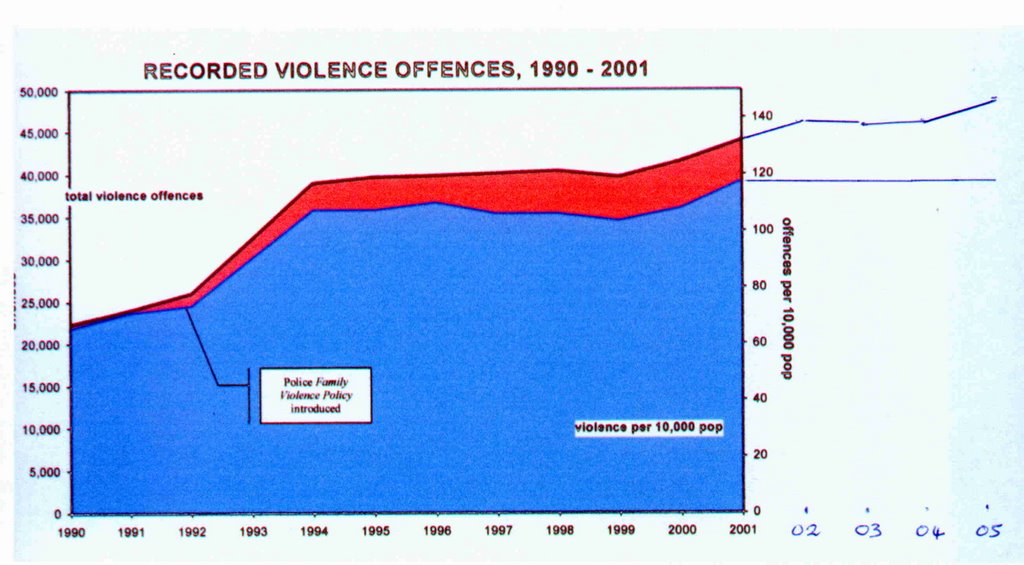
Not the best graph but it illustrates well the Labour spin.
Left side shows total violent crimes (from zero to 50,000)
Right side shows offences per 10,000 population (from zero to 140)
The lower line has flattened. Violent crime is steady.
The top line continues to grow. Violent crime is up.
Alice Springs Hospital

Came across this story about a NZ nurse's experience working in Alice Springs in the Taranaki Daily News. Dreadful state of affairs.
Two jokes
This is the "joke of the day" from the Adam Smith blog:
A man awoke one evening to discover prowlers in his storage shed. He immediately called the police, giving his address, to report a possible burglary. The operator at the other end asked "Are they in your house?" He replied they were not, only in his storage shed in back of the house. The operator said there were no cars available at that time. The man thanked the operator, rang off and waited 30 seconds before calling again.
"I just called you about prowlers in my storage shed. Well, you don't have to worry, as I just shot them all dead!" Within seconds there were 3 police cars, an ambulance and fire engine at the scene. After capturing the prowlers red-handed, the policeman asked the caller, "I thought you said you had shot them all?" The man answered, "And I thought you said there were no police available."
And is the "joke of the day" from the DomPost:Man hunts down car thief while police busy. John Creser is not surprised crime has risen in New Zealand – when his car was stolen, the Titahi Bay man had to investigate the theft himself.
A man awoke one evening to discover prowlers in his storage shed. He immediately called the police, giving his address, to report a possible burglary. The operator at the other end asked "Are they in your house?" He replied they were not, only in his storage shed in back of the house. The operator said there were no cars available at that time. The man thanked the operator, rang off and waited 30 seconds before calling again.
"I just called you about prowlers in my storage shed. Well, you don't have to worry, as I just shot them all dead!" Within seconds there were 3 police cars, an ambulance and fire engine at the scene. After capturing the prowlers red-handed, the policeman asked the caller, "I thought you said you had shot them all?" The man answered, "And I thought you said there were no police available."
And is the "joke of the day" from the DomPost:Man hunts down car thief while police busy. John Creser is not surprised crime has risen in New Zealand – when his car was stolen, the Titahi Bay man had to investigate the theft himself.
Tertiary "education"
Michael Cullen will today announce new funding plans for the tertiary sector. They want to clamp down on low grade courses (think Wananga).
Ministry of Education figures show about 38,000 domestic students completed non-degree courses in 2000. By 2004 that number had risen to more than 80,000.
But institutions are largely funded on enrolments and those figures do not take into account the vast numbers of students who fail to complete a course.
Labour are now entering a new period where they can no longer blame a previous administration for the problems they face. Watch the numbers on the dole start to rise.
Ministry of Education figures show about 38,000 domestic students completed non-degree courses in 2000. By 2004 that number had risen to more than 80,000.
But institutions are largely funded on enrolments and those figures do not take into account the vast numbers of students who fail to complete a course.
Labour are now entering a new period where they can no longer blame a previous administration for the problems they face. Watch the numbers on the dole start to rise.
Monday, April 03, 2006
DBP Interview with the Jobs Letter
 Excerpts from an interview with DBP in the latest Jobs Letter (my comments interspersed).
On WINZ offices; They're quite positive places. I joke that even the security guards smile and when we don't need them it will be even better.
When we don't need them? When we will that be?
But they are very welcoming places. And they've integrated Housing in a lot of those offices, and are now trying to convince IRD they want them there as well for obvious integration with taxation and the Working for Families issues. So that model now is going to Cabinet with a view to rolling it out across the whole country. It's called the New Service Model for want of a better name.
Convenient. Like a grand state redistribution one-stop-shop. I hope they have drive-through. And I guess they can all share security guards.
On the biggest challenge for the next three years; The biggest challenge for MSD is not in employment related matters, but the issue around the reintegration of Child Youth and Family. In the wider social sense I think that's a critical thing for the country. Cabinet took that opportunity because the chief executive went back to Canada unexpectedly and suddenly there was an opportunity and I guess it's a compliment to the operational level and delivery level of the Ministry right now that we felt they were able to do this. So I think that's their biggest challenge.
There are no problems - only opportunities. But hang on. What happened to the introduction of the Single Benefit?
Does he trust himself to do the job; I'm constantly touching base with my colleagues who have been there and know where we got to, so I don't go off on a harebrained idea that's mine and not appropriate.
Remind me again what is the point of this guy? It must be DBP's worst nightmare, doing something that's not appropriate.
On why do we need more young Maori and Pacific Islanders in work; I think when we realise the demographic change that we've got with the huge change in the percentage of young Maori and Pacific Peoples in this country, you and I need them to be working, to be purely selfish, to fund our superannuation in three or four decades.
Don't tell me we are going to have this guy around until he's in his nineties! Labour really are convinced they are the party of government.
On why we still have skills shortage; I think the first thing is the reliance, in the 90s on the free market to provide the training..... which — in typical free market fashion — didn't deliver. I'm not being trite or simplistic when I say that when no one's got the responsibility for work force supply, you end up with the problems we've inherited.
It's official. Benson Pope can do a better job than the market.
On preparedness to work; The simplest way we can enhance people's choices around getting involved in the workforce is to have places where their sons and daughters can be properly supervised and looked after. There are big social issues here and we're certainly not trying to force anyone in to work who doesn't want to work.
Run that by me again.
We don't actually try to make people do things, what we do try to do is make sure they have a freer choice about what they do — whether that's opportunity for young people to get schooling or opportunity for you or me or a carer who would like to work to be able to do so because the options are available. So no one's being forced off to the workforce. That's not to say we're not going to support people who need it … because we're the Labour Party, that's what we do.
Hello. Around two million working Kiwis are forced to pay tax so your clients won't be forced to get a job?? That's the Labour Party - that's what you do.
And (eventually) on Steve Maharey's grand plan, the single core benefit; while I can't say that we will be delivering a single core benefit certainly the system is going to be hugely simplified.
After all the song and dance, the media, the seminars, the hoopla, they are quietly dropping it. Be careful Mr Benson-Pope. Are you sure that's appropriate?
Unwarranted whinging
According to Stuff a new study released by the Human Rights Commission shows there are still too few women in leadership jobs.
Equal Employment Opportunity commissioner Judy McGregor said she "surprised and incredibly disappointed. . .the results show dismal progress".
The survey showed:
A total of 63 of the top 100 New Zealand companies had no women on their boards (46 women out of 645 directors), compared with the total workforce being 47 per cent women.
But women only make up 37.5 percent of the full-time workforce.
Full-time Part-time
Men 1,025,400 (90%) 113,800 (11%)
Women 617,400 (64%) 349,000 (36%)
Total 1,642,800 462,800
Overall % 78% 22%
"I'm not hard on it having to be 50-50, but I would ask why is half of New Zealand's potential ignored in terms of governance?"
Well clearly half of NZ's potential is not being ignored. 37 of 100 New Zealand companies had women on their boards and 32.2 per cent of Members of Parliament are women. Given thousands of women take time out of the workforce to raise families I would have thought these figures looked pretty good (if you care about gender representation anyway.)
Equal Employment Opportunity commissioner Judy McGregor said she "surprised and incredibly disappointed. . .the results show dismal progress".
The survey showed:
A total of 63 of the top 100 New Zealand companies had no women on their boards (46 women out of 645 directors), compared with the total workforce being 47 per cent women.
But women only make up 37.5 percent of the full-time workforce.
Full-time Part-time
Men 1,025,400 (90%) 113,800 (11%)
Women 617,400 (64%) 349,000 (36%)
Total 1,642,800 462,800
Overall % 78% 22%
"I'm not hard on it having to be 50-50, but I would ask why is half of New Zealand's potential ignored in terms of governance?"
Well clearly half of NZ's potential is not being ignored. 37 of 100 New Zealand companies had women on their boards and 32.2 per cent of Members of Parliament are women. Given thousands of women take time out of the workforce to raise families I would have thought these figures looked pretty good (if you care about gender representation anyway.)
What does Tariana mean?
Stuff reports; The Maori Party is warning National against continuing with its campaign to abolish the Maori seats in Parliament.
National leader Don Brash is worried about the number of Maori seats increasing and says getting rid of them is an important policy for his party.
Maori Party co-leader Tariana Turia said today Maori were "sick to death" of political opportunism.
I don't know what she means. Genuinely. I don't. Do you?
National leader Don Brash is worried about the number of Maori seats increasing and says getting rid of them is an important policy for his party.
Maori Party co-leader Tariana Turia said today Maori were "sick to death" of political opportunism.
I don't know what she means. Genuinely. I don't. Do you?
Support for prohibition
A TV3 poll found fifty percent support for banning tobacco. Maori Party MP Hone Harawira is apparently delighted. Many have obviously forgotten (or never learned) their lessons about prohibition and its effects.
"Expert" would turn back the clock
It was not enough to tell people to change their diet. The Government should change food pricing so that unhealthy foods were more expensive and "good" food was cheaper.
So says an overseas "expert". So all the people who eat "unhealthy" food in moderation should be penalised because some people stuff themselves with it. Come to think of it, who will decide which foods should merit higher taxes because they are "unhealthy", when they are only "unhealthy" when consumed in large quantities day in and day out?
Apart from which this guy doesn't understand that the international trend is towards economic liberalisation and away from govt intervention in markets. The answer lies in persuading individuals to eat better by making them responsible for their own health - not in govt market manipulation.
So says an overseas "expert". So all the people who eat "unhealthy" food in moderation should be penalised because some people stuff themselves with it. Come to think of it, who will decide which foods should merit higher taxes because they are "unhealthy", when they are only "unhealthy" when consumed in large quantities day in and day out?
Apart from which this guy doesn't understand that the international trend is towards economic liberalisation and away from govt intervention in markets. The answer lies in persuading individuals to eat better by making them responsible for their own health - not in govt market manipulation.
Sunday, April 02, 2006
On the Money , Don
 Newsroom reports, National Party Leader Don Brash has attacked an Electoral Enrolment Centre campaign to sign Maori onto the Maori Roll as "state sanctioned separatism ... that ultimately encourages a racially divided electoral model."
 I have no doubt that one of the reasons 100,000 Maori live in Australia is our increasingly separatist, cultural-identity politics. They are destructive politics. Mercifully we have a high profile politician prepared to say so.
Addicted to welfare
Muriel Newman refers to a new book which compares the rates of teenage pregnancy, cohabitation, divorce and sole parenting across the continent;
In Britain, where an anti-marriage agenda is being strongly promoted by the public service, universities and government funded social agencies, family problems are rife, with Britain topping the league tables in several of the most worrying indicators of breakdown, including divorce and teenage pregnancy. In Sweden, where a comprehensive social engineering programme has transferred many family responsibilities to the state - to a degree unseen outside of the Soviet bloc - there are even higher rates of out-of-wedlock births and cohabitation than Britain.
Italy, however, has effectively had no government intervention into the family, and is still the home of the traditional family unit. Divorce rates and out-of-wedlock births, including teenage pregnancies, are extremely low. Cohabitation is so rare as to be difficult to measure. Young people live with their parents until they get married, and, for most women, marriage will represent their first living-together relationship.
But what about the role of Catholicism?
James Bartholemew addresses that; Benefits influence behaviour in a big way. I suggest that the different benefits policy on lone parenting in Italy has been the primary reason for the low incidence of lone parenting there.
It will be said that no, it is all because the country is Catholic. But I believe, though I have not got the figures to hand, that Ireland has a much higher incidence of lone parenting, even though it, too, is Catholic. Also it is wrong to suggest that Sweden did not previously have a strong tradition of protestant religion and a culture of marriage and 'upright' behaviour. That culture has been undermined. Cultures, even ones heavily influenced by religion, can be changed and have been changed very dramatically around the world in the past 100 years.
Then a commentor on Bartholomew's blog points out that the fertility in Italy is very low at 1.2 (The replacement rate is 2.1) Who will pay for pensions, he asks?
See the bind we are in. Where sole parenting is subsidised birthrates are higher (but not necessarily the quality of parenting). So once again the welfare state perpetuates itself. The more of it we have, the more of it we need. The western world is addicted to welfare.
In Britain, where an anti-marriage agenda is being strongly promoted by the public service, universities and government funded social agencies, family problems are rife, with Britain topping the league tables in several of the most worrying indicators of breakdown, including divorce and teenage pregnancy. In Sweden, where a comprehensive social engineering programme has transferred many family responsibilities to the state - to a degree unseen outside of the Soviet bloc - there are even higher rates of out-of-wedlock births and cohabitation than Britain.
Italy, however, has effectively had no government intervention into the family, and is still the home of the traditional family unit. Divorce rates and out-of-wedlock births, including teenage pregnancies, are extremely low. Cohabitation is so rare as to be difficult to measure. Young people live with their parents until they get married, and, for most women, marriage will represent their first living-together relationship.
But what about the role of Catholicism?
James Bartholemew addresses that; Benefits influence behaviour in a big way. I suggest that the different benefits policy on lone parenting in Italy has been the primary reason for the low incidence of lone parenting there.
It will be said that no, it is all because the country is Catholic. But I believe, though I have not got the figures to hand, that Ireland has a much higher incidence of lone parenting, even though it, too, is Catholic. Also it is wrong to suggest that Sweden did not previously have a strong tradition of protestant religion and a culture of marriage and 'upright' behaviour. That culture has been undermined. Cultures, even ones heavily influenced by religion, can be changed and have been changed very dramatically around the world in the past 100 years.
Then a commentor on Bartholomew's blog points out that the fertility in Italy is very low at 1.2 (The replacement rate is 2.1) Who will pay for pensions, he asks?
See the bind we are in. Where sole parenting is subsidised birthrates are higher (but not necessarily the quality of parenting). So once again the welfare state perpetuates itself. The more of it we have, the more of it we need. The western world is addicted to welfare.
Saturday, April 01, 2006
Support for Rodney

Good to see some support for Rodney Hide in this editorial from the Gisborne Herald. I disagree with Roger Douglas that ACT would have won 7-8 percent of the vote if it had stuck to policy. The election was a two horse race. The public has reverted to first past-the-post mentality. That is where the battle lies. But if Sir Roger wants to run post mortems what might have made a difference was Rodney being supported to go for Epsom in 2002.
The tail wagging the dog
At a public meeting last year I unintentionally caused considerable offence to one lady (and maybe others who weren't prepared to say so) when I said, "The poor in this country are the tail wagging the dog." Of course, if you were mindful of everybody's sensitivities nothing would ever be said.
What I wanted to convey is, because some people can't afford to pay we have designed our entire system, with government as the middle man, around that premise. But we should let those who can pay sort out their own requirements and treat the needs of the poor as an entirely separate issue.
Everybody would benefit.
What I wanted to convey is, because some people can't afford to pay we have designed our entire system, with government as the middle man, around that premise. But we should let those who can pay sort out their own requirements and treat the needs of the poor as an entirely separate issue.
Everybody would benefit.
The Welfare State We're In
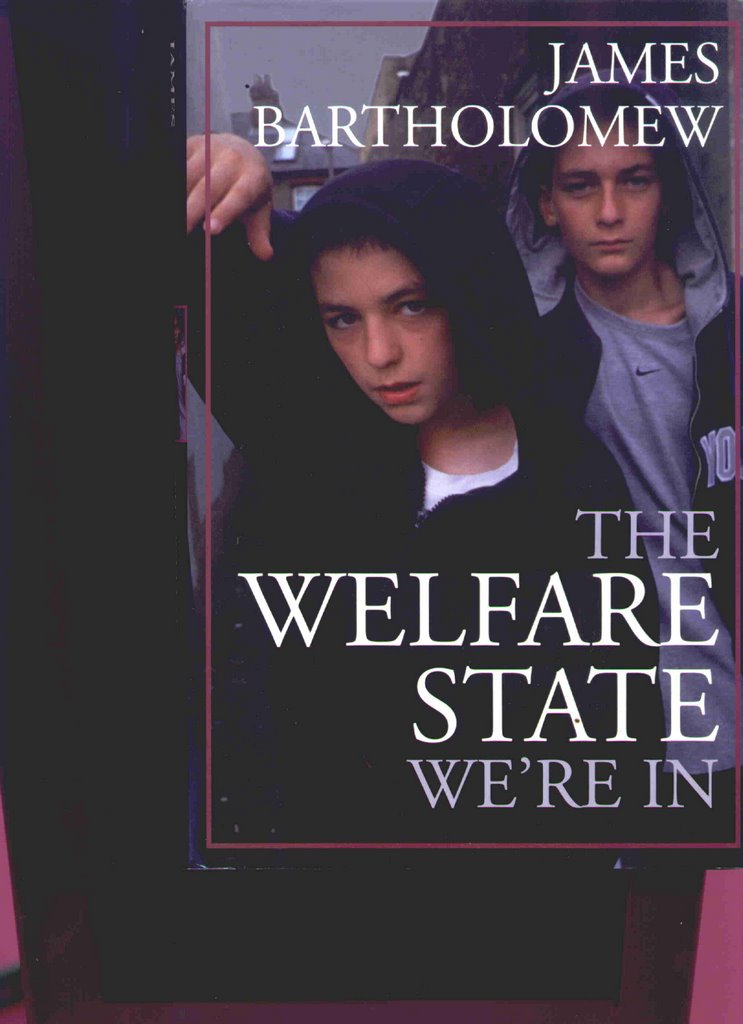
James Bartholomew has a website under the same name as his book, with regular updates pertinent to the welfare state.
Health reform
There is a highly readable article at Adam Smith which outlines the problem with the NHS (which pretty much reflects New Zealand's public health system). Unusually it also proposes a solution.
According to Doctors for Reform taxation-funded healthcare can never meet demand and compulsory insurance in Europe works much better. “The NHS as we know it has had its day”, said the founder of the group, the oncologist Professor Karol Sikora. He added, tax finance is simply no longer fair because people with a healthy lifestyle have to subsidize people, who knowingly damage their health in a variety of ways. Indeed the NHS provides incentives not to bother about one’s health and even to remain ill in order to get the most out of the NHS. It is another example of the welfare state that actually encourages people to the opposite of what it seeks to achieve.
According to Doctors for Reform taxation-funded healthcare can never meet demand and compulsory insurance in Europe works much better. “The NHS as we know it has had its day”, said the founder of the group, the oncologist Professor Karol Sikora. He added, tax finance is simply no longer fair because people with a healthy lifestyle have to subsidize people, who knowingly damage their health in a variety of ways. Indeed the NHS provides incentives not to bother about one’s health and even to remain ill in order to get the most out of the NHS. It is another example of the welfare state that actually encourages people to the opposite of what it seeks to achieve.
Friday, March 31, 2006
Verdict not guilty
NEWSFLASH: Not Guilty - Assistant Commissioner Clint Rickards and his two co-accused have been cleared of sex charges involving Louise Nicholas.
Just one thought. Given the history, is this the end of it?
Just one thought. Given the history, is this the end of it?
Subscribe to:
Posts (Atom)


