Wednesday, March 08, 2006

Another tax hike

The Press leads today with the news that Christchurch rates are about to take a 9.9 percent hike.

Christchurch homeowners face the largest rates rise in at least 20 years, with more financial pain feared.

Last month, the council decided on about $1.5 million of cost-cutting measures, including the possible closure of some suburban swimming pools and libraries. It also endorsed increased fees, notably in the cost of parking in the central city.

Cr Helen Broughton said the rates rise was too high, but she could not say where further cuts should be made.

She could look here. In December the salary of the Chief Executive was raised to $351,000 and a bonus of 8 percent paid. What was the bonus for? Keeping the ratepayer happy?

The symbolism of steak

Victoria University senior psychology lecturer Marc Wilson, an omnivore, and PhD student Michael Allen, a vegetarian, say meat is symbolic.

"Why do people eat meat? Partly, it's a way of expressing dominance or masculinity . . . Really masculine men eat more meat," Dr Wilson said.

National Party supporters and men who saw the world in a hierarchical way tended to eat more meat than Labour Party supporters and women – who saw the world in a more interconnected, less structured way, the researchers found.

Perhaps there is also the small matter of the price of a piece of steak....

OECD gravitates towards "enemies of liberty"

I thought the OECD was going soft. This news from the Independent Institute confirms it.

THE OECD DRIFT

For about half of its life, the Organisation for Economic Co-operation and Development (OECD) attempted to defend and promote economic liberty in the West. As Independent Institute Research Fellow Pierre Lemieux explains,however, in the past
two decades the OECD has drifted toward government intervention.

Beginning in the 1980s, the OECD began advocating "fair competition" and a "global playing field," rather than free trade. Since the 1990s, it has also pushed both "socially responsible" corporate governance, which puts the alleged claims of so-called community "stake holders" on par with the claims of stockholders, and "sustainable development," which asserts presumptuously that long-run development requires the government to prevent private developers from acting against their own rational self-interest.

Although the OECD still does some good work (Lemieux lauds its country surveys and research on comparative health-care systems), the recent selection of Angel Gurria of Mexico to head the OECD in June, rather than the market-oriented classical liberal candidate Alain Madelin of France, bodes poorly for the organization -- and for the future of economic liberty.

Writes Lemieux: "Alain Madelin believes that the OECD will be more and more carried into the world governance movement, which, he explains, is where the enemies of liberty have refocused their fight. He adds, pessimistically, 'It is the end of the OECD.'"

Tuesday, March 07, 2006

Can seven violent deaths go unreported?

According to Human Rights Commissioner, Joy Liddicoat, quoting the National Collective of Women's Refuges, seven women have been killed in domestic violence incidents this year alone. In trying to verify this I checked the Sensible Sentencing website.

It has recorded 9 murders this year. But none of them were women. Seven were men in either their late twenties or early thirties. The other two were a three year-old boy and a 14 month-old baby girl.

What am I missing here? There is no mention of this fact at the Women's Refuge website

I've searched "woman killed in domestic incident nz 2006" to no avail and I've searched the Police press releases, also to no avail.

According to Stop Violence Against Women historically a woman is killed by a partner or ex every five weeks or around 11 women a year. So if seven have been lost already something is seriously awry (as though it isn't anyway.)

I can only conclude that these seven deaths slipped completely beneath the media's radar.

UPDATE: Now it's in the newspaper so it must be true.

Prison Population Projections


Prison population projections have just been released.
No surprises that further increase is expected. But why the predictable seasonal fluctuations?

You Will Comply

This is nauseating stuff from collectivist compulsionists. A UK real estate agent painted his shop the wrong colour and was forced to pay three thousand punds in fines and legal fees. Check the link to see just what a dreadful shade of yellow he chose.

But look what this woman had to say;

Councillor Irene Ratcliffe, from Derbyshire Dales District Council, said the issue was not really the colour.

"It isn't about the colour - it is about complying and I believe we have to enforce it as we have to live together as a community."

Drugs and heartache

Methadone programmes allow registered heroin addicts to collect a daily supply of methadone from their local pharmacy. The methadone is usaully taken at the pharmacy. But in the case of days when the pharmacy is not open "takaways" are given. A programme operates in New Zealand but there is a queue to get on it.

What the programme offers is a chance to get clean by taking a reducing dose legally. It allows the addict to disassociate him or herself from criminal activity. It allows people to hold down a job.

In Scotland a two-year-old boy recently died from swallowing methadone stored at home. His two siblings are now in care. All three should have been in care.

"Drug and methadone dependency have reached epidemic proportions, with our social services left to pick up the pieces of government policy that lacks the will to tackle the issue head-on."

Some 20,000 drug addicts - nearly a third of the Scottish total - are on a methadone treatment programme. Figures from the General Register Office for Scotland show there were 80 methadone-related deaths in 2004, compared with 225 for heroin. The figures for 2003 were 87 and 175 respectively.


These figures don't tell us a lot about whether the programme is succeeding because the methadone-related deaths may not relate to people on the programme. The methadone may have been illegally obtained or sold by somebody on the programme.

In NZ there appears to be three outcomes of the programme. People actually get clean; the methadone becomes a crutch but it is still a better crutch than heroin; others continue to be involved in criminal activities which eventually catch up with them.

The Howard Penal Reform league says;
International research clearly demonstrates the short and long-term benefits of placing those with opioid dependence on methadone programmes as soon as addiction is apparent and help sought. Rapid access to treatment is shown to be beneficial even when initial or interim treatment is not comprehensive and involves less than optimal doses.


The risks with methadone programmes are real. But on balance the risks associated with an addiction to illegal heroin are worse. We need more legality. We need to get more people more quickly onto these programmes - not fewer.

Monday, March 06, 2006

"State teachers go private for own"

One of the problems facing parents in my electorate is the vast size of the major state secondary school. It has a roll of 1800. Many parents have no choice but to send their children to this school even when it doesn't suit their child's needs. Fortunately we could afford to 'pay twice' to get one child into an independent school with a small roll. The people who work there have their own children enrolled - unlike many teachers in the UK state system, who have been sharing their contempt for state schools and intentions to avoid them if at all possible;

STATE school teachers have admitted they are planning to educate their children in independent schools rather than send them to the comprehensives allocated by their local councils.

Teachers contributing to an education website last week complained of being made to “lump it” with “bottom of the league” schools where drugs and bullying were rife.

Alan Smithers, professor of education at Buckingham University, said he was concerned by the entries on the TES website, which is mainly used by state school teachers.

“Teachers know the school system best,” said Smithers. “If they are thinking it is not good enough for their children, that is an indication that something must be seriously wrong.”

The role of a government

There can be no doubt what National Finance spokesman, John Key, thinks the role of government is. This is from a speech delivered to the West Harbour Rotary Club today;

"At a national level, if we can generate more income in the future, we have more ability, collectively, to do things - to improve our public services and to strengthen our national institutions.

Health and education services are usually the first things people think about as benefiting from a stronger economy. I agree, but I also look further than that. I'm always impressed, for example, with the Australian Institute of Sport, and by the constant stream of gold medal winners and world champions who come out of it. Australia can afford a facility like this because it is a much wealthier country than we are. The quality of a national institution like this is reflected back again in a strong sense of national pride.

In a similar vein, I made the point last year in a speech that part of the reason we should strive to have a prosperous economy is so we can fund and enjoy things like our Symphony Orchestra."

Crisis? What crisis?

What can this story possibly be about;

....found the extent of the crisis....lack of time as the major problem...."This is a major concern to us" ....the same tragic story kicks in....too male-dominated ....unfriendly to female....lack a family atmosphere....the decline was even greater....there are many barriers....here are a number of issues which need to be addressed for the long-term good....expectations of an inclusive, socially interactive environment were quickly shattered....

So what is this crisis?

The Public Health System

Contrast these two stories.

Spending rises but surgery falls at city hospitals
Health spending has risen from about $6.6 billion a year when Labour took office to about $10 billion. But most of the extra spending has gone into rolling out the Primary Health Organisations.

Doctors warn no more care after hours
A South Island doctors' group representing 460 GPs is threatening to withdraw from providing after-hours care if workforce and funding problems are not fixed.


Is this as good as it gets?

Sunday, March 05, 2006

Rachealle Namana

I knew Namana was out. I'd looked her up on Garth McVicar's database some time ago. What happened to Lillybing changed my life because I reached the point when I no longer wanted to pay for people to live dissolute, destructive and deviant lifestyles and make the lives of children in their care utter misery. Somehow it made me complicit.

Let's not forget what happened (the italicised passages are the words of Pamela Stirling writing for the Listener in 2001).

One depositions witness said Lillybing had arrived at the kohanga reo that day with "shit running down her legs", bare feet "pinky purple" with cold and a snotty face. Other children teased Lilly bing because she smelt. The witness said she retched when she tried to change Lillybing's nappy.

Lillybing was not much more than a baby. A small 23 month-old constantly left in the care of her Aunty, Rachealle Namana, who had four children of her own. Namana resented being put upon. She was called on to breastfeed Lillybing when the biological mother was unable. Lillybing would be left with Namana, without nappies, which is why the toilet-training episode apparently occurred.

There was evidence that Namana hit Lillybing each time she fell from a little wooden platform in front of the adult-sized toilet during a toilet training session that started at around 8pm. It was after 11pm, said the thirteen year-old withness, crying through much of her evidence, that she found Lillybing alone on the toilet, clinging with her arms and legs 'to stop her falling in'.

But Namana was defrauding WINZ. "My sister left for Australia and I kept the benefit."

By Namana's own account she was getting an extra $400 a fortnight. Namana chainsmokes and there is money for alcohol. Namana claims only to go to the pub at lunchtime to put a $2 bet on the TAB, but at the Royal Oak her unborn child was known as "Jack"; short for Jack Daniels. Ask her about drinking during pregnancy and she says she only discovered she was pregnant at seven months. 'I was on the injection; it saves money on tampons.'

There was money for drugs and there was money for band equipment. The partner had a band called FUBAR, which stands for Fucked Up Beyond All Recognition. The first word Lillybing said most clearly was "f...".

On the day Lillybing died there was a birthday celebration for Namana and Hemopo's 8 year-old. Her present? A Sky cartoon channel subscription.

But Lillybing is the child who a health worker described in depositions as a 'woebegone little thing' and looking as though she 'never had enough cuddles'.

She fell over all the time. A bruise on her forehead was mistreated with a boiling cloth. Vaginal injuries and bleeding were ignored. At some stage on the day of her death Namana shook her violently causing a major cerebral injury. The Crown says she had also suffered some severe abdominal bruises at about the same time.

When Lillybing lay dead on the couch Namana had driven to her stepmother's house looking for a driver so she could "get on the piss".

Nothing has changed.

Hinewaoriki Rerenoa Merekara Karaitiana - Matiaha 7 Aug 1998 - 23rd July 2000

Gallery

A commentor asked if any of my work could be viewed on the web so I have set up a gallery here.

Privatisation of welfare - not

Saw the following on the Adam Smith blog.

Was I hallucinating when I heard British Gas are to offer a lump sum rebate for the aged or disadvantaged? I called BG. Sure – At the last monstrous price increase they agreed with government to offer a means tested benefit. They promise to mail details but it may just have been a dream. BG seemed unclear if this benefit is to be subsidized by the Government or by their shareholders. Can you believe that utilities are offering competing means tested benefits? Does this signal progressive privatization of welfare?

This isn't "welfare privatisation". Utility companies are not there to provide welfare. Privatising welfare would be about welfare agencies providing welfare services operating on voluntarily donated money. Like World Vision.
You see, thanks to the state, welfare has wrongly become synonomous with just the provision of money. It is much more.

Saturday, March 04, 2006

Hanging and judging...

Unlike David Benson-Pope I have been selected for hanging and final judging....

....at least my entry into the 2006 National Bienniel Portrait Competition has.

Till divorce do us part

The median age for men divorcing is 43 years; for women it's 40.4 years

The median age of bridegrooms is 32.3 years; for brides it's 30.2

I guess that means that for marriages which end in divorce the median length is about 10 years. Wonder what happened to the seven year itch?

In 2004 for every divorce granted two marriages took place.

In 1971 for every divorce granted, eight marriages took place. Interestingly divorces filed for and granted on the basis of adultery were more commonly filed by men (877 to 661) and the same for desertion (324 to 235). The median length of a marriage which ended in divorce was between thirteen and fourteen years.

Female parliamentary representation

Where would you expect NZ to rank? Have a guess and then check this remarkably up-to-date link

Friday, March 03, 2006

Had anything nicked from your car lately?

This editorial from the Hawkes Bay Today caught my eye. It begins;

How crazy our society has become when Napier is subjected to a car break-in epidemic, yet it is the naughty citizens who dare to leave their possessions in their cars who are being scolded by the police.

I well remember working in Liverpool in the late 80's and being agressively rounded-on by passersby when returning to my car. I'd left my handbag on the seat. They had stopped a ne'er-do-well from breaking in but I was the target of their anger.

New Zealand now has that level of crime. The editorial sheds some light on why.

Some offenders who have been eventually caught have committed up to 200 previous break-ins. That is a risk of half a percent, well worth taking, especially when the punishment for the few who are caught is inconsequential.

Juvenile offenders face little more than family group conferences or, at the extreme end of the scale, are placed in a secure house, which often proves to be anything but. Even those who can't hide behind their age don't really have much to fear. From the age of 17, thieves face being fined (generally around $400), or periodic detention and community service.

With a laptop computer and accessories worth upwards of $1500, stealing from cars can be a low-risk and lucrative career option.


But you see, good citizens, the justice system can't be held to account. It is all your fault. If you insist on having valuables in your car then you are as good as aiding and abetting criminals. Desist.

Why Mommy Is A Democrat

I once tried my hand at writing and illustrating a children's book. It was modelled on our dog whose nose was put very much out-of-joint when his position of first was supplanted by a newborn human. The publisher rejected it. Here's another that should have been given the thumbs down.


Here's what Reason had to say;

Why Mommy Is a Democrat, available online at littledemocrats.net, advertises itself as "a different kind of children's book," and that it is—a really bad kind that manages to insult the intelligence even of late-term fetuses. It pairs amateurish drawings of what appears to be a single-mother squirrel and her two offspring with mindless platitudes that ascribe all that is good and decent to the party of West Virginia Sen. Robert Byrd.

"Democrats make sure we are nice to people who are different, just like Mommy does," explains one lesson. "Democrats make sure sick people are able to see a doctor, just like Mommy does," says another. "Democrats make sure we all share our toys," threatens a third. You don't need to be Phyllis Schlafly to wonder just where the hell the daddy squirrel has gone to in this scenario, which reads like a Republican parody of Democratic devotion to an oddly feminized nanny state.


To be fair Reason also had a pop at a Republican book, "Help! Mom! There are Liberals Under My Bed!"

Two boys' parents refuse to buy them a swing set ("Mom and Dad always told them that having everything given to them would not make them feel good about themselves"), they decide to start a lemonade stand to earn the money. Before they do, they have a nightmare in which they become small business owners in "a very strange place called Liberaland." Once the boys' lemonade business is booming, "Mayor Leach" (get it?) comes around and squeezes them with a 50 percent tax. Next up is "Mr. Fussman" of the "Liberaland Civil Liberties Union" (haw haw haw!), who is offended by the picture of Jesus the brothers hang on their stand and demands they replace with it a picture of a big toe. Before you know it, a Hillaryesque "Congresswoman Clunkton" is demanding the boys force broccoli on all customers, and so on, until at last the lemonade stand is seized by the state and run into the ground.

Luckily, the boys wake up and their long, nationalized lemonade nightmare is revealed simply as a bad dream.


The second sounds more fun. Reason's beef was with sermonising on politics to kids who, in America apparently, have less and less free time to wile away aimlessly. Very funny article.

Bring Maori "savings" entitlement forward

That's what Hone Harawira called for yesterday in his speech addressing the KiwiSaver Bill;

"Mr Speaker, one of the key concerns we have with this Bill, is that quite simply, it discriminates against Maori.

The facts are that Maori just do not live past 65. What that means is that while Maori, like everyone else, will be encouraged to join the Kiwisaver scheme, less than 4% of Maori will actually live long enough to derive any benefits.

That Mr Speaker, is simple discrimination.....Give those with a lower life expectancy the entitlement at an earlier age."


The problems with this are glaringly obvious. Adjusting for varying life expectancy would mean allowing males to qualify earlier. Is that also Maori Party policy? Probably not. This isn't the sexist party. It's the racist party.

Is this some kind of joke?


Have I gone mad or is it the rest of the world? I read this with utter disbelief. Let me say that on occasion I have shared a drink bottle with my kids. If we hike the nearby hills we go as lightly as possible. My God, What was I thinking of??

Phrases such as bugger and sheep-shagger are acceptable – but apparently there is no place on the telly for an advertisement showing a father and son swigging fruit juice from the same bottle.

The Advertising Standards Complaints Board says the Keri fruit juice advertisement should be taken off air – because it is socially irresponsible. The ruling follows several decisions reflecting the growing number of complaints demanding that advertisers be more socially responsible.

The board acknowledged yesterday that the advert probably would have been acceptable a few years ago – but said society had moved on.


Moved on?? To what?

Trev vs Treasury

Economic Development Minister, Trevor Mallard follows Michael Cullen's policy of rejecting Treasury advice.

The NZ Herald reports; The Government will keep funding large-budget films despite the Treasury's reservations about the assistance scheme and a report that shows its economic impact could in the "worst case" result in a $38 million net loss....

....Treasury officials said there was not sufficient robust evidence to support the view that there were large spillover benefits to the economy to justify the subsidy programme.

The finding that the grant could have a negative economic impact raised doubts about its effectiveness, the Treasury said.


But Mr Mallard said yesterday that in his view the overall benefits outweighed the costs of the grant.

So the scheme will continue in accordance with Trev's view. I sometimes wonder what Treasury is for.

Thursday, March 02, 2006

Still-life

Finished my competition portrait so thought I'd have a change and try some still-lifes. This involves stopping direct daylight coming in and setting up an arrangement with a constant artificial light source. Then paint what you see. It's fun because in a darkened room it is quite difficult to discern colour variation so you end up with some quite interesting effects. After a couple of hours....

Nannying hasn't improved matters

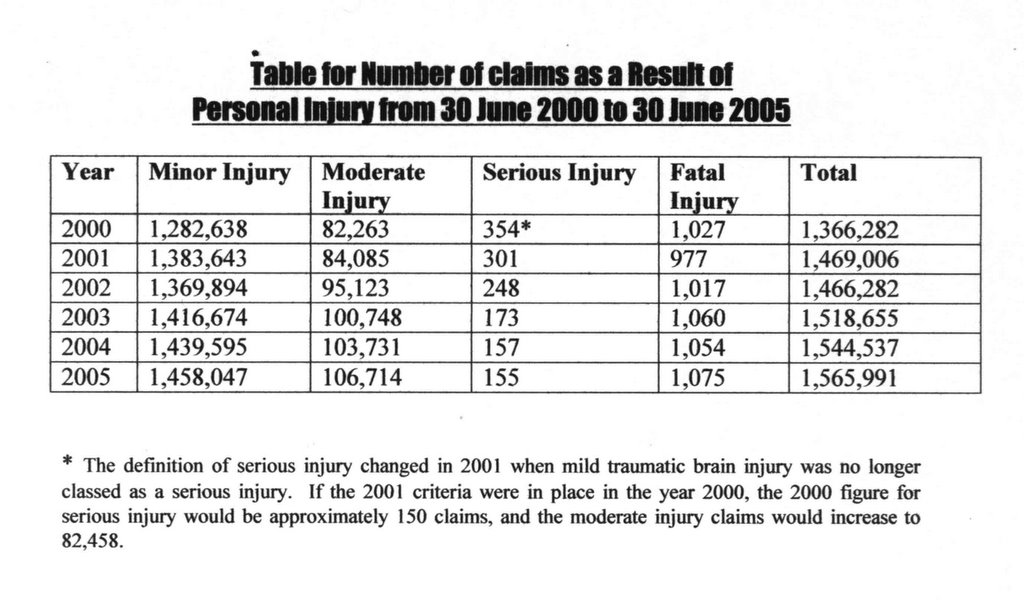
For the year ended 30 June 2005, ACC spent $39.8 million on Injury Prevention. The budget for the year ended 30 June 2006 is $46.7 million, which includes discounts for employers who are able to meet and maintain good health and safety management systems and performance.
ACC undertakes Injury Prevention programmes in five main focus areas. These areas are listed below with examples of particular programmes carried out in each area.

· Safer Communities - Alcohol and Drug-related harm, Family violence, Suicide prevention.
· Safer Homes – Slips, Trips and Falls, Child Safety for New Parents.
· Safer Workplaces - Safer industries programme, ACC partnership programme, Workplace safety management practices.
· Safer Sports – ACC Sportsmart, Sideline concussion, “the 11” prevention programme for soccer injuries, Snow safety programme, Water safety.
· Safer Road Use - Down with speed, Young driver training, Drink drive initiatives such as support for the NZ Police’s “Booze Bus” programme.

Now for the $46.7 million question.

Is it working?


The population has increased by 7 percent yet the number of accidents has increased by 15 percent. Don't tell me. We aren't spending enough.

(Info courtesy of PQs put by Dr Paul Hutchison.)

Joan Rivers

Joan Rivers is soon coming to NZ and has been doing some publicity interviews. She really is gorgeous. Paul Holmes was gushing all over her this morning.

"I've loved you for years," he drools.

"That's the trouble," she drawls."Where were you when I was young? I've only got two eggs left."

Overdue recognition

Good on the DomPost who swing in behind their Tuesday columnist, Michael Bassett with this editorial today;

Michael Bassett's critics – and he has a few – at least cannot accuse the one-time Labour Cabinet minister and Dominion Post columnist of cowardice, this newspaper writes in an editorial. This week, he bravely tackled the delicate issue of "careless breeding" by people who he believes should not keep having children they cannot afford.

More haggling over poverty levels

Debate over true poverty levels in the US heats up again. The left claim high and climbing poverty levels to stave off further welfare reform. Here the Census Bureau has made lower poverty estimates by including non-cash assistance. The level drops even further when calculations based on rent-sharing are included. "Poverty" is notoriously difficult to measure and official statistics should always be taken with a grain of salt. It is very easy for governments to boast great gains in the war on poverty by simple jiggery-pokery.

Fertility problems

Mention fertility problems and most people think about aging would-be mums who may left it too late. Here a Canadian newspaper looks at the national problem of low and possibly reducing fertility rates. NZ, by the way, is just below replacement level at 2.01. Canada's rate is 1.5

By the year 2015, for the first time in the history of Canadian population statistics, there will be more people over the age of 65 than under the age of 15. Even the normally staid national bureau of record-keeping, Statistics Canada, declared, "This would be an unprecedented situation in Canada," when it announced late last year the critical turning point in a population projections report.

These projections, which were shaped by various growth scenarios, predicted fertility rates ranging from a low of 1.3 babies per woman to a high of 1.7 babies per woman. That puts Canada in line with the growing roster of nations beset by declining fertility: France, 1.9; Australia, 1.7; Germany, 1.3; Italy and Spain, 1.2, Japan, 1.2; Korea, 1.1.

Only the United States is conspicuous among its industrialized neighbours for a fertility rate that continues to remain above what is known as replacement level, with 2.01 babies per woman. The main reason for this difference seems to be in the fertility rate among women aged 24-29, which has been cut almost in half in Canada and many of the other nations with declining fertility, but which remains virtually unchanged in the U.S., where more traditional values prevail, says demographer Alain Belanger, the demographer behind Statistics Canada's latest projections.


Traditional values? The reason that NZ and the US have higher rates is the higher rates of birth to minorities. They have bigger families and higher proportions of young women.

In 2001, non-Hispanic whites had an average of 1.9 births per woman, compared with 2.0 births among Asian Americans, 2.1 births among American Indians, 2.2 births among non-Hispanic blacks, and 3.2 births among Hispanics.

The comparatively high rate in New Zealand reflects the higher fertility rates of Māori (2.65 births per woman in 2004) and Pacific women (2.94 in 2000–2002). The non-Maori fertility rate is 1.86

Wednesday, March 01, 2006

Maori Party view on fiscal policy

If there is something postive to be said about Maori Party finance spokesman Hone Harawira it's that he is bringing some much-needed plain speaking to Parliament. But putting aside the style, the content is pretty awful.

"Government is planning to spend an extra thirteen billion dollars over the next four years but for some reason it can’t find the money to help the 250,000 poorest kids in Aotearoa."

The govt will spend around 11 billion on these kids and their families over the next four years. The more govt spends, the less responsibility their parents will assume.

"In terms of income and growth, we note that the country has a 3.8% growth rate, but that sixty percent of Maoridom still has an annual income of less than $20,000. And in fact, at the time of the election, the average income for Tai Tokerau Maori was less than $13,000."

Any tribe claiming an average income of $13,000 either isn't declaring their whole income or hasn't worked out what they can get from WINZ. Maori income is largely low due to their over-representation in the benefit system. 94,000 and their dependants are on a benefit.

"And then, at the other end of our population, we note that government is expecting to have nearly ten billion in the superannuation fund by 30 June, but for some reason there is still a massive difference in life expectancy between Maori and Pākehā. And while every Maori taxpayer, like everybody else, will be expected to contribute to that super fund, very few Maori will actually get to receive the benefits of it."

The Maori economy pays $2.4 billion in tax annually and receives $2.3 billion in cash benefits alone. Who is paying for their health, education etc?

There is more from Hone in today's Budget Policy Statement speech. Essentially it is about saving money by collectively stamping out undesirable and costly activities; including crime and smoking, but not benefit reliance.

NB As a proponent of individual rights I really don't want to write about Maori in collective terms but any response to the Maori Party requires me to.

The great fiction of the welfare state

Frederic Bastiat put it simply, "Government is the great fiction through which everybody endeavors to live at the expense of everybody else."

Here Thomas Sowell puts a bit more flesh on it in "Something for nothing?";

People who think that they are getting something for nothing, by having government provide what they would otherwise have to buy in the private market, are not only kidding themselves by ignoring the taxes that government has to take from them in order to give them the appearance of something for nothing. They are also ignoring the strings that are going to be attached to their own money when it comes back to them in government benefits.


That is not even counting the fact that government programs are usually less efficient than similar services provided by private enterprises.


Yet the illusion of something for nothing has kept the welfare state going — and expanding. If there is something for sale in the marketplace for ten dollars and you would not pay more than five dollars for it, some politician can always offer to get it for you free — as a newly discovered "basic right," or at least at a "reasonable" or "affordable" price.


Suppose that the "reasonable" or "affordable" price is three dollars. How do you suppose the government can produce something for three dollars that private industry cannot produce for less than ten dollars? Greater efficiency in government? Give me a break!


The fact that you pay only three dollars at the cash register means nothing. If it costs the government twelve dollars to produce and distribute what you are getting for three dollars, then the government is going to have to get another nine dollars in taxes to cover the difference.


One way or another, you are going to end up paying twelve dollars for something you were unwilling to buy for ten dollars or even six dollars. But so long as you think you are getting something for nothing, the politicians' shell game has worked and the welfare state can continue to expand.


Unbundling confiscation

The clamouring for Telecom regulation makes me uneasy but it's a call difficult to argue against. Bruce Sheppard, Shareholders Association Chairman, has an opinion piece, "Unbundling is confiscation by another name", in the DomPost this morning. Unfortunately it's not on-line. He charges that the Ministry Of Economic Development are actually working against the national interest in pressuring Telecom to invest more in the face of unbundling. He argues that shareholders will, rather than invest more, look to divest themselves of existing assets.

"Now the big issue. All first-world countries have two common features and if either one of them is taken away they relatively quickly descend into third-world status."

"The first is a functioning democratic process and the second is a robust rule of law that respects personal and property rights."

"Unbundling a private asset in the name of 'national interest' is, in effect, chipping away at the second foundation of any successful economy and in terms of international investment confidence, may do more harm to the national good than the short-term price advantages created for the telecommunications industry through the illusion of competition."


You'd have to say this Labour government has already done plenty of "chipping away" for lesser perceived benefit.

Tuesday, February 28, 2006

What a girl needs...


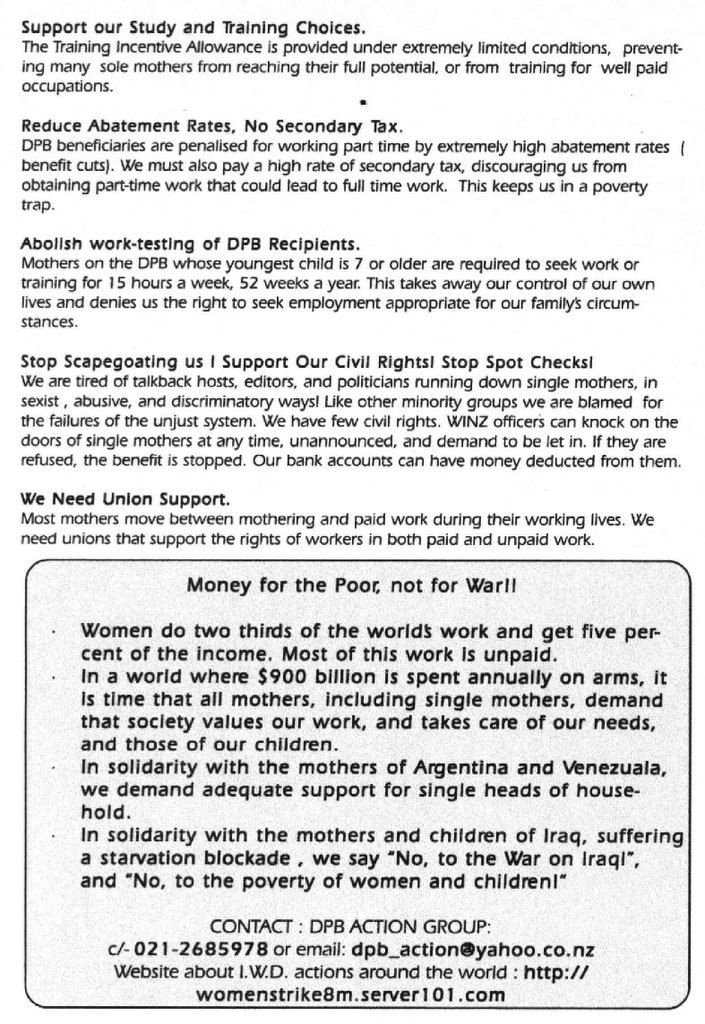
If you are unable to read this document it is a list of what the DPB Action Group wants. Let me summarise;

- reverse the 1991 benefit cuts which "devastated the social fabric of New Zealand.....government attacks on our livelihoods constitute violence against women and children."

- value the work done by sole mothers because "it is society's responsibility to support mothers and children."

- provide 100 percent free high quality childcare because "childcare is society's responsibility ...(and) stressed out mothers with young children need a break."

Next page to follow shortly.

What a girl wants...


- pay for our study and training choices because "many sole mothers are prevented from raeching their potential".

- reduce abatement rates and abolish secondary tax which "keeps us in a poverty trap".

- abolish work-testing which "denies us the right to seek employment appropriate to our family's circumstances.

- stop scapegoating us and support our civil rights

- women do two thirds of the world's work and get five percent of the income

- in solidarity with mothers of Venuzela and Argentina and Iraq we demand adequate support for single heads of households.

- it is time society values our work and takes care of our needs.

Imprisonment for drug offences

According to the LA Times article, posted yesterday;

The huge increases in federal and state prison populations during the 1980s and '90s (from 139 per 100,000 residents in 1980 to 482 per 100,000 in 2003) were mainly for drug convictions. In 1980, 580,900 Americans were arrested on drug charges. By 2003, that figure had ballooned to 1,678,200. We're making more arrests for drug offenses than for murder, manslaughter, forcible rape and aggravated assault combined. Feel safer?

I got to thinking about this overnight. NZ has the second highest imprisonment rate in the western world at 178 per 100,000. So how many people do we lock up for drug convictions? From 2003;


In the US;
Percent of sentenced
State inmates
1995 2002
Total 100 % 100 %
Violent 47 51
Property 23 20
Drug 22 21
Public-order 9 7

So although the percentage of people locked up for drug offences in the States is much higher than here, 21 percent as opposed to 9 percent, it is something of a myth that the high American prison rate of 486 per 100,000 in 2004 is solely due to drug offences (although many of the violent offences stem from the war on drugs). It might also be suggested that the percentage of non-violent drug offenders is higher in the States than in NZ.

Interesting that NZ separates "sex" crimes out from "violent".

Monday, February 27, 2006

End the war on drugs

A former Seattle police chief argues for an end to the war on drugs. He porposes an alternative model with "no apologies" to libertarians for taxation and regulation;

The demand for illicit drugs is as strong as the nation's thirst for bootleg booze during Prohibition. It's a demand that simply will not dwindle or dry up. Whether to find God, heighten sexual arousal, relieve physical pain, drown one's sorrows or simply feel good, people throughout the millenniums have turned to mood- and mind-altering substances.

They're not about to stop, no matter what their government says or does. It's time to accept drug use as a right of adult Americans, treat drug abuse as a public health problem and end the madness of an unwinnable war.

How extremists damage causes

"An article by the pastor of a Wanganui church sent widely around New Zealand has alleged that Green MP Sue Bradford is "under the control of Satan" because she is advocating the repeal of section 59 of the Crimes Act."

Of course, who is giving this article all the publicity? Sue Bradford. She headlines her press release with;

"Accusations of Satanism show nature of pro s59'ers."

I oppose the removal of section 59 because it puts power in the hands of CYF and the police as opposed to the court. A point that seems to get overlooked in the hysteria which, when it suits Bradford, she will further inflame to her advantage.

Savage Youth Crimes

"Juvenile offenders seem to be becoming harder and more sophisticated and our short-term institutions have become over filled with a disturbing influx of remand cases," Minister of Social Welfare, Mr King.

Who???

Mr Norm King was Social Welfare Minister in the Labour cabinet of 1973.

33 years on and we have the Principal Family Court judge, Andrew Beecroft, warning that serious crime by young people is becoming more savage.

I don't post this as an example of, the more things change the more they stay the same.

Mr King's comments came on the eve of the introduction of a new Child Welfare Bill which sought to keep keep young people out of court except where is was absolutely necessary to otherwise.

Didn't work, did it.

How we measure up

Some up-to-date figures from the US as they relaunch their welfare to work requirements;

Based on federal figures, 4.45 million men, women and children - or about 1.9 million families - are enrolled in the $16.7 billion welfare program called Temporary Assistance for Needy Families. The money includes cash payments to families, as well as subsidies for transportation to work, child care or job training.

Working on a straight per capita basis the US has 1.5 percent of its population on TANF. Doing a direct comprison with the DPB our figure is 6.8 percent.

What a lot of tosh

Political Commentator Graeme Hunt says Mr Benson-Pope has already come out relatively clean after one inquiry and it might be time to let the matter go.

He says National is clutching at straws by demanding the MPs removal and it is just another example of MMP allowing nasty allegations that have no substance, to be thrown around from both sides of the house.


What has this controversy got to do with MMP?

Not a dying business

Idle undertakers fear business is dying away. The already grim job of funeral directors is getting tougher as a lack of deaths causes a slump in business.

Oh Dear. Well, why not introduce Minimum Funeral Fee legislation?

Seriously, this is an industry which will just have to hold its breath for a wee while. With our ageing population they have boom times ahead. Undertaking has a big future.

Wellington - the subsidised city.

Leading the DomPost business pages today is a report about a survey which shows the majority of Wellington businesses approve of the rise in the minimum wage and the abolition of youth rates. This is at odds with a survey done in Auckland. Why would that be? You may recall that Wellington's economic growth is outstripping other regions. That's primarily due to the growth in the civil sector.

Business New Zealand chief executive Phil O'Reilly said the Wellington respondents were more likely than the Auckland ones to be involved in the domestic sector as retailers and small manufacturers, rather than in the exporting sector.

Considering the nature of the respondents' businesses, it was possible some would think an increase in the minimum wage would mean more spending, which could benefit them, particularly if they were retailers and small manufacturers.

It is also possible that those already paying over the minimum wage want their competitors forced to follow suit. There's the key word. FORCE. Notice that force is always used against the productive. We don't force people to get jobs but we force employers to pay those who do whatever arbitrary figure the govt wants to put on it.

Good on those employers who pay the extra. But why embrace turning choice into edict?

This morning Wellington is absolutely positively socialist.

Sunday, February 26, 2006

Aborigines choosing welfare

Many supporters of the welfare state deny that people choose welfare over work, even when evidence is as conclusive as this;

The Australian reports;
AUSTRALIA'S peak indigenous land management body wants the welfare rules for Aborigines tightened, after revealing more than 40 per cent of its workforce is white because Aborigines are refusing regular paid work.

The Indigenous Land Corporation, a taxpayer-funded body charged with buying land and businesses to support indigenous entrepreneurs, has put forward a "get to work" plan after years of frustration at trying to recruit and retain workers from Aboriginal communities.

The situation is so dire the ILC has had to recruit backpackers to run some of its eight cattle properties and tourist resorts, which are intended to provide work opportunities and hope for indigenous Australians.


Reminds me of the situation here with backpackers getting special work permits to pick the fruit local beneficiaries won't. Crazy.

From the pen of Theodore Dalrymple

Dalrymple is technically a very , very good writer. But his stuff is dark. This is an excerpt from a piece entitled, "The Frivolity of Evil". Read the whole thing if you can stand it. It is, I gather, Dalrymple's parting serve to Britain which he left in disgust after 14 years as a prison and slum hospital doctor. To be fair, I am sure there are other parts of the world just as bad. By the way, I think he is wrong about "libertarians on the Right". As he points out himself, the market is not the same as the welfare state. You may disagree.

...... a man aged 25 came into our ward, in need of an operation to remove foil-wrapped packets of cocaine that he had swallowed in order to evade being caught by the police in possession of them. (Had a packet burst, he would have died immediately.) As it happened, he had just left his latest girlfriend—one week after she had given birth to their child. They weren't getting along, he said; he needed his space. Of the child, he thought not for an instant.

I asked him whether he had any other children.

"Four," he replied.

"How many mothers?"

"Three."

"Do you see any of your children?"

He shook his head. It is supposedly the duty of the doctor not to pass judgment on how his patients have elected to live, but I think I may have raised my eyebrows slightly. At any rate, the patient caught a whiff of my disapproval.

"I know," he said. "I know. Don't tell me."

These words were a complete confession of guilt. I have had hundreds of conversations with men who have abandoned their children in this fashion, and they all know perfectly well what the consequences are for the mother and, more important, for the children. They all know that they are condemning their children to lives of brutality, poverty, abuse, and hopelessness. They tell me so themselves. And yet they do it over and over again, to such an extent that I should guess that nearly a quarter of British children are now brought up this way.

The result is a rising tide of neglect, cruelty, sadism, and joyous malignity that staggers and appalls me. I am more horrified after 14 years than the day I started.....


....The state, guided by the apparently generous and humane philosophy that no child, whatever its origins, should suffer deprivation, gives assistance to any child, or rather the mother of any child, once it has come into being. In matters of public housing, it is actually advantageous for a mother to put herself at a disadvantage, to be a single mother, without support from the fathers of the children and dependent on the state for income. She is then a priority; she won't pay local taxes, rent, or utility bills.

As for the men, the state absolves them of all responsibility for their children. The state is now father to the child. The biological father is therefore free to use whatever income he has as pocket money, for entertainment and little treats. He is thereby reduced to the status of a child, though a spoiled child with the physical capabilities of a man: petulant, demanding, querulous, self-centered, and violent if he doesn't get his own way. The violence escalates and becomes a habit. A spoiled brat becomes an evil tyrant.

But if the welfare state is a necessary condition for the spread of evil, it is not sufficient. After all, the British welfare state is neither the most extensive nor the most generous in the world, and yet our rates of social pathology—public drunkenness, drug-taking, teenage pregnancy, venereal disease, hooliganism, criminality—are the highest in the world. Something more was necessary to produce this result.

Here we enter the realm of culture and ideas. For it is necessary not only to believe that it is economically feasible to behave in the irresponsible and egotistical fashion that I have described, but also to believe that it is morally permissible to do so. And this idea has been peddled by the intellectual elite in Britain for many years, more assiduously than anywhere else, to the extent that it is now taken for granted. There has been a long march not only through the institutions but through the minds of the young. When young people want to praise themselves, they describe themselves as "nonjudgmental." For them, the highest form of morality is amorality.

There has been an unholy alliance between those on the Left, who believe that man is endowed with rights but no duties, and libertarians on the Right, who believe that consumer choice is the answer to all social questions, an idea eagerly adopted by the Left in precisely those areas where it does not apply. Thus people have a right to bring forth children any way they like, and the children, of course, have the right not to be deprived of anything, at least anything material. How men and women associate and have children is merely a matter of consumer choice, of no more moral consequence than the choice between dark and milk chocolate, and the state must not discriminate among different forms of association and child rearing, even if such non-discrimination has the same effect as British and French neutrality during the Spanish Civil War.

The consequences to the children and to society do not enter into the matter: for in any case it is the function of the state to ameliorate by redistributive taxation the material effects of individual irresponsibility, and to ameliorate the emotional, educational, and spiritual effects by an army of social workers, psychologists, educators, counselors, and the like, who have themselves come to form a powerful vested interest of dependence on the government.

Who will replace David Benson-Pope?

These are the Associate Ministers for Social Development and Employment;

# Parekura Horomia - Associate Minister
# Ruth Dyson - Associate Minister
# Luamanuvao Winnie Laban - Associate Minister
# Mahara Okeroa - Associate Minister

Would one of these people step into his shoes? It would be most appropriate to have a Maori or Pacific Minister for Social Welfare. But Dyson is the most experienced. I'll put my money on her. When she and Judith Collins square off, things will get interesting.

Saturday, February 25, 2006

Double vision

This piece, from Reason, has a similar theme to the one I posted yesterday from Maxim but it delves deeper into the philosophical thought processes;

How the neoconservative right adopted the worst errors of the left

".....neoconservative optimism about the prospects for global social engineering seemed to have triumphed any doubts that arose from that domestic skepticism."


The writer uses Thomas Sowell's theory of "constrained" (conservative) and "unconstrained" (left liberal) vision to show how the Bush administration has pretty much adopted the latter worldview. Not only in its approach to Iraq but in the domestic social programmes it is running.

Sowell's constrained vision in its purer forms is probably a shade too constrained, too ready to assume that old customs continue to serve their traditional functions under changed circumstances. But it is the worst features of the unconstrained vision—its hubris, its pretense to omnicompetence—that have taken hold of the right. And if there is wisdom in each of the two perspectives, it should be worrying that, for all the other differences between the major parties, between progressives and conservatives, in this one fundamental way the political landscape increasingly offers only half the picture—different refractions of the same unconstrained vision. With the waning of the constrained perspective's tempering influence, we're left with a political vision that's dangerously double.


Precisely. I suspect over the coming years, throughout the developed world, the only choice we will have is between big government and bigger.

Don't encourage them

From the Feminist Weekly News comes this revelation;

(A) survey found that single women have significantly lower incomes than men or married women, feel uninformed about politics, and doubt that their votes make a difference. Two-thirds of the women polled disapprove of President Bush, and the Iraq war, health care and the economy are their top concerns. Avis Jones-DeWeever, of the Institute for Women’s Policy Research, said, “Unmarried women don’t vote because the government doesn’t pay attention to them,” reports the San Jose Mercury News.

Gee. I wish the government would pay less attention to me. I wish the government would pay less attention to all of us, so we can live our lives. Maybe we all shouldn't vote.

Hand-wringing over prisons

The ODT and DomPost are running stories today about our failing prison system.

This is from December's Ombudsman report;

• Prison work has been cut officially from 43% to 35% of prisoners in the past three years, and only 19% are actually employed by the prisons’ business unit. The others have only part-time work, such as cleaning their cell blocks or serving the meals. • Education has been massively disrupted by overcrowding and resulting frequent transfers of prisoners when beds become available around the country. The prison education budget was underspent by 44% last year and training is forecast to be underachieved again by 33% in 2005-06. • Many prisons lack proper libraries and rely on donations of old books from the public or from public libraries. • Several prisons, including Mt Eden, Wanganui and Wellington, do not have gyms. • A new booking system for prison visits, combined with a doubling of prisoner transfers has cut visitor numbers, weakening prisoners’ links with family members who might motivate them to reform their lives. The crowding in jails has seen evening lock-up time brought back from 8.30pm to 5pm in many of the country’s 19 prisons, because guard numbers have not kept up with an unpredicted increase of almost 2000 extra prisoners since the Sentencing and Parole Acts were tightened in 2002.

This is terrible. Prisons without gyms.

Look, even I could be seduced by this kind of hand-wringing stuff. So I went back and read some of Stephen Franks stuff. Remember, we have been trying to rehabilate prisoners for decades to no avail - or very little;

Around 80% (of prisoners) reoffend soon after release.

That is up from approximately 45% when I started law practice over 30 years ago. Back then the idealists were claiming that prison didn't work. They used it to justify the loopy experiment we've been running for the last 30 years, hoping that if we are all nice enough for long enough to criminals they might decide to be nice back. It's been a complete failure.


Under the legal system we inherited from Britain, the State claimed the victim's right to retribution. "Leave it to us" worked for hundreds of years. Then the anointed in charge reneged on the bargain. They shudder at what they call "vengeance".

ACT does not. ACT shudders at the harm to the innocent since Sir Geoffrey Palmer's announcement 16 years ago that retribution had no place in the law of a civilised nation. We think the price for that political correctness is paid by the 45,000 bashed, robbed, raped or murdered last year, nearly 5000 per year more than when Helen Clark took over in 1999.


But here is a smattering of what various advocates are saying;

Being confined to their cells, they are restricted in what they can do. It’s turning them into vegetables, said the society’s secretary, John Whitty.

Howard League president Peter Williams said some young people would be psychologically harmed by being cooped up so long in cells which are about 3m square just big enough for a bed, a small desk on one wall and a stainless steel toilet with an attached hand basin on the pipe behind the toilet bowl.

In some older prisons, such as New Plymouth, Prison Chaplaincy Service manager David Connor said some cells are so small that you can stand in the cell and touch the two walls.


These same people champion the welfare system that produces many of our criminals. The only progress we can make is reform both systems. And I don't mean make them more generous. If we aren't tougher, as a society, we are going to keep on paying the rising social costs. Perhaps we just don't grasp what these costs are until personally affected. Then it is too late.

Friday, February 24, 2006

Quizz

For what was New Zealand ranked third in 2004, sixth in 2005 and ninth in 2006?

The answer is here.

Kids at school, still on benefit

Figures released under the Official Information Act show that 45,643 single parents with children aged 5 to 18 do not have even a part-time job.

Some of these parents will have genuine reasons for being unable to work. Around 4,000 are on a sickness or invalid benefit. Some may be involved in volunteering. But there is clearly a significant resource being wasted at a time when government has stated a clear priority to raise productivity.

At May 2004 37,000 single parents on the DPB had school-age children only but no other source of income. If the Ministry's figures are accurate, there is an increasing trend for single parents to stay on a benefit even after their kids start going to school.

The Chief Executive of the Ministry of Social Development and Employment, Peter Hughes, said in the letter containing these figures,"In many cases, (single parent's) social and environmental circumstances mean that seeking employment at this stage of their lives is not appropriate."

There is that word again. I guess it is appropriate for you to go to work so these people can stay at home.

Governments getting bigger

This is worth passing on. It comes from the Maxim Institute....I think:-) ;

My government is bigger than yours

The significant rise in public spending by the United States government seems to suggest that the party supposedly in favour of limited government, the Republican Party, now believes that big government is good government; as long as they are the ones governing. Federal spending is up eight percent since 2005, and 33 percent since 2001. The government spends more today per household than it has since the end of World War Two.

Closer to home, government spending continues with the roll-out of the Working for Families package. While the National Party continue to criticise administrative blunders, they have not articulately critiqued the assumptions regarding the legitimate role of government that underlie the package.

The question of legitimacy is all important when it concerns the use of power. Like the big-spending Republicans, all political parties make different assumptions about the value and nature of human freedom, and consequently, the degree to which government power should be both enforced and restrained in order to protect it. People are different and when free people act, they will experience different outcomes. This is why there is always a trade-off between freedom and equality which is usually paid for at the other's expense.

Two assumptions embedded in the extended Working for Families package are that take-home incomes should be subsidised in the interests of equality rather than need, and that it is a legitimate role of government to mitigate the outcomes of each individual's unique decisions. Raising a family is costly and couples who make that choice should be applauded and supported by the community which benefits from that decision. Thankfully, this is happening in New Zealand. Those tax-payers without dependent children already support families to a significant extent through the public provision of education and subsidised health-care. Society also provides a welfare safety-net for those in genuine need, but whether welfare should extend to income redistribution is an entirely different matter.

If we accept the assumption that the government is justified in using power to arbitrarily equalise incomes, what is left to restrain it from redistributing and spending further?

It is often said that oppositions have principles and governments have programmes. Sadly one assumption which eventually finds its way into nearly every cabinet room is that big government is good government as long as it is ours.

For a fleeting moment.....


A travelling salesman was passing through a small town in the West when he saw a little old man sitting in a rocking chair on the stoop of his house. The little old man looked so contented that the salesman couldn't resist going over and talking to him.
"You seem without a care in the world," the salesman told him, "What is your formula for a long and happy life?"
"Well," replied the little old man, "I smoke six packs of cigarettes a day, I drink a quart of bourbon every four hours and six cases of beer a week. I never wash and I go out every night."
"My goodness," exclaimed the salesman, "that's fantastic! How old are you?"
"Twenty-five," came the reply.

The Future US President?

My pick is private funding of education. But as long as the state is going to involve itself, vouchers are better than zoning. The following is a strange argument from Hillary Clinton described in Newsday


Sen. Hillary Rodham Clinton slammed private-school voucher proposals yesterday, predicting that vouchers would eventually lead to the creation of taxpayer-financed white supremacist academies - or even a government-funded "School of the Jihad."

Clinton, a longtime voucher foe who earned the backing of the city teachers union in 2000, says government financing of sectarian groups would incite ethnic and religious conflict - and encourage fringe groups to demand government cash to run their schools.

"First family that comes and says 'I want to send my daughter to St. Peter's Roman Catholic School' and you say 'Great, wonderful school, here's your voucher,'" Clinton said. "Next parent that comes and says, 'I want to send my child to the school of the Church of the White Supremacist ...' The parent says, 'The way that I read Genesis, Cain was marked, therefore I believe in white supremacy. ... You gave it to a Catholic parent, you gave it to a Jewish parent, under the Constitution, you can't discriminate against me.'"

As an adoring, if somewhat puzzled, audience of Bronx activists looked on, Clinton added, "So what if the next parent comes and says, 'I want to send my child to the School of the Jihad? ... I won't stand for it."

The former first lady said that vouchers would also accentuate divisions, singling out government-financed Protestant and Catholic schools in Northern Ireland and similar arrangements in the Netherlands as examples of poorly functioning systems.

She spoke during a breakfast at the South Bronx Overall Economic Development Corp., where she denounced Bush administration cuts to community development programs, offered advice to minority and women business owners and vowed to help bring more broadband access to the South Bronx.

Andrew Coulson, who works on education issues for the conservative Cato Institute, differed on the voucher issue, saying, "It's misleading because under federal law no one would be permitted to open a school that advocates violence against the country."

Thursday, February 23, 2006

Appropriate

At last, a good use for a much over-used word. It is somehow fitting that one of Parliament's least effective MPs, NZ First's Barbara Stewart, should have a bill to reduce the number of MPs from 121 to 100 pulled from the ballot box. In fact, this is probably the most useful thing she has done in the three and a half years she's been there.

Abortion ban closer

South Dakota is moving closer to passing legislation that will virtually ban abortions. In nearly all cases abortion would become a felony carrying a five year prison sentence or an $8,000 fine on doctors or others who perform them.

Bans do not work. Not only do they fail to control the 'undesirable' activity, they produce other negative effects.

Point of interest; NZ has a much higher abortion rate than South Dakota. Ours is around 45.5 per 10,000 of population; South Dakota's is 10.6

Births outside of marriage (2)

As stated yesterday, 45 percent of births are now ex-nuptial. Part of the reason ex-nuptial births have risen so sharply is the rise in de facto relationships. A commentor asks, what is the percentage of children born outside a marriage or a committed non-marriage?

I'm not aware of any data that conclusively answers that question. But I'll have an unscientific go.

A NZ study looked at children born in 1993 who had been on a main benefit by age seven. There were 58,866 registered births that year. Sixty percent of the children born had contact with the benefit system by age 7. Of those, the study estimated 40.8 percent were included on a benefit at birth. That's 14,410.

By age two the percentage of all children born in 1993 that had been on a main benefit was 45 percent or 26,489. Sixty two percent of these children had a single care-giver. That's 16,423.

I would suggest that there were at least this number of children born outside of a marriage or committed de facto relationship (one that endures beyond 2-3 years) in 1993.

Children born in the same circumstances who didn't go on a benefit are ommitted. The number won't be very high and could be offset by those children in the statistics whose caregiver is on a widow's benefit.

So I estimate that at least 28 percent of children born in 1993 were born outside of a marriage or committed relationship.

Given DPB numbers now are higher and total births slightly lower I don't think my estimate will have decreased.

The future for American blacks

From Anthony B. Bradley of the Acton Institute, a conservative, religious US think-tank comes this piece which considers, in Black History month, the future of blacks.

Tragically, more black men pass through the criminal justice system than through America’s college and university system. In Baltimore, for example, 52 percent of black men in their 20s are either incarcerated, on parole, or on probation. Imagine what type of city Baltimore would be if 52 percent of black males were instead college graduates or in college or graduate school?

.....we are slowly approaching the possibility that there will be progress only among the black elite and the rest will be left behind, enslaved to dependency or incarceration.

Unbalanced reporting in the gun

Media gaining access to the Family Court was an important step forward. If there is bias in the court it needs to be exposed. The media's limited access will be valueless if the subsequent reporting is also subject to questions of bias;

TVNZ is under fire from the Principal Family Court judge for unbalanced reporting following a news item which screened last weekend, which criticised the court for taking a two-month-old baby away from its mother while she was still breast feeding.


Judge Peter Boshier says it was not made clear that the mother had left the child after a New Year's Eve party, to allegedly go to a hotel room with a man. He says she did not return home for several days.


Judge Boshier intends to write to TVNZ to point out the newsroom did not report in accordance with The Care of Children Act. He says decisions in the Family Court are made for good reasons and parents should not be able to use the media to promote their case.

Over-priced book

Who would pay $800 to read what is fairly obvious to anybody who takes an interest in politics?

"The book also claims Social Development Minister David Benson-Pope is regarded by some colleagues as a pompous prat, Education Minister Steve Maharey is not as smart as he thinks he is, and Auckland Issues Minister Judith Tizard is not the hardest worker...occasionally a bully."

Parliament delivers disservice to all NZers

Rodney Hide's bill to define the principles of the Treaty of Waitangi was defeated last night.

According to Stuff, Mr Hide wanted the principles to be legally defined as: That the Crown exercises sovereignty over Maori and non-Maori New Zealanders, that the Crown has a duty to uphold property rights, and that all New Zealanders have equal rights before the law.

Let's be clear on this. Labour, NZ First, The Greens, United Future and the Maori Party rejected these principles.

The Maori Party said it would not promote Maori interests.

Doesn't that say it all.

Wednesday, February 22, 2006

Reason vs Emotion

This is an excerpt from a submission written by Peter Zohrab on the Crimes (Abolition of Force as a Justification for Child Discipline) Amendment Bill.

IRRATIONAL WOMEN

It is no accident that Sue Bradford has proposed this irrational Bill. As the Neuroscience article "Sex differences in functional activation patterns revealed by increased emotion processing demands*" shows, men's and women's brains process emotional stimuli in different ways. It states:

"These findings suggest that men tend to modulate their reaction to stimuli, and engage in analysis and association, whereas women tend to draw more on primary emotional reference."

To put it simply, women have evolved to get emotional about things, and men have evolved to be rational. Sue Bradford's Bill is evidence that women would be better off at home, indulging their emotions on their children, leaving the men to make decisions -- e.g. about legislation -- outside the home that require rational thinking in the face of emotional stimuli.

*by Geoffrey B.C. Hall, Sandra F. Wittelson, Henry Szechtman and Claude
Nahmias, in Neuroreport Vol. 15 2004, pp 219-223.


There is undoubtedly more than a grain truth in the assertion that females draw more on emotional reference. We see it in voting preferences. But to react emotionally is not to be irrational. There needs to be a balance.

I am reminded of something I read today attributed to Stalin; "One death is a tragedy. A million deaths is a statistic." Extreme rationality is as bad as extreme emotionality.

European vs NZ births outside marriage


The proportion of children born outside marriage in the UK has leapt from 12 percent in 1980 to 42 percent in 2004, according to the Office for National Statistics.

They haven't caught up with us yet. Our proportion in 2004 was 45 percent up from 21 percent in 1980.

Can't be bothered with it

Not often that I find myself in the majority;

A Stuff poll asks whether you will be watching South Park tonight.
The majority (at the moment) say,"No, I'm just not interested."

Equality myths

An article in Newsweek explores the effects of tax and welfare sytems on women in the workplace.

Here's a pop quiz on gender equality. In which part of the world are women most likely to reach the highest rungs of power? Choice A offers new moms 12 weeks of maternity leave, almost no subsidized child care, no paid paternity leave and has a notoriously hard-driving business culture. Choice B gives them five months to three years of paid time off from their jobs after having kids. Millions put their offspring into state-sponsored day-care centers for several hours a day. Government agencies, full of female directors and parliamentarians, protect workers at the expense of business and favor a kinder, gentler corporate culture. So which place is better for women who want to make it to the top? If you guessed A, the United States, you'd be right. If you chose B—Europe—think again.


According to a paper published by the International Labor Organization this past June, women account for 45 percent of high-level decision makers in America, including legislators, senior officials and managers across all types of businesses. In the U.K., women hold 33 percent of those jobs. In Sweden—supposedly the very model of global gender equality—they hold 29 percent.

Why is this? Simply put, Europe is killing its women with kindness—enshrined, ironically, in cushy welfare policies that were created to help them. By offering women extremely long work leaves after children, then pushing them to take the full complement via tax policies that discourage a second income, coupled with subsidies that serve to keep them at home, Europe is essentially squandering its female talent. Not only do women get off track for long periods, many simply never get back on.

NZ is mistakenly headed in the European direction.

Tuesday, February 21, 2006

Maori Party want to ban smoking

These are the most recent statistics from Te Puni Kokiri;

Māori smokers
Overall, Māori were twice as likely as non-Māori to smoke. Statistics from the 1996 Census indicate that 44% of the Māori population aged 15 years and over were smokers, compared to 21% of the non-Māori population (Table 1). Māori were also less likely than non-Māori to be ex-smokers.


Are Maori Party voters going to be angry about the now official policy to make smoking illegal? I have one received opinion which says, no. They are only interested in what the Maori Party can achieve in respect of the Treaty and property rights. Hone Harawira can get away with it because of his mana. He'll be seen to be doing what is best for his iwi.

I vehemently disagree. Otherwise I'd have to concede that Maori want to be told what to do.

Relevant Minister Missing

According to National MP, Judith Collins, Minister for Social Development and Employment, David Benson-Pope was supposed to speak at last week's international child abuse and neglect conference but was a late "withdrawal".

It was surprising to see the Prime Minister address the conference. Perhaps she delivered a speech that had been prepared for Mr Benson-Pope.

In it she said, "Children too need strong relationships and good self-esteem. They need to know that adults respect their rights, and that they have a voice."

It is fairly obvious the sort of cannon fodder this would have delivered to the opposition if Benson-Pope had said it.

Then again, given Clark's steadfast support for her Minister, perhaps the opportunity is not lost.

Peter Dunne - The Visionary

United Future began the year with a caucus and board retreat. According to united Future MP, Gordon Copeland, this is some of what Peter Dunne said.

“Here’s a vision.

It’s election night, 2008. A revived, re-activated, renewed United Future has campaigned hard at the general election, pointing out to the voters that

· we’ve held the Government together;
· we’ve achieved significant gains such as tax reform for business owners and charities;
· we’ve secured a commitment to income splitting;
· we’ve finally forced some commonsense into how we purchase and provide pharmaceuticals for ill New Zealanders;
· and we’ve reinforced our role as a solid, sensible, reliable centrist party that adds real value to any New Zealand government.

The public hears our message, responds positively and we gain 10% of the party vote, leading to a United Future team in Parliament of 12 MP’s.

That’s the vision; how do we get there?


Well, let's see what you did last time;

"During the election campaign Dunne and National Leader Don Brash publicly sat outside an Epsom café over a cup of tea as a demonstration to the electorate that Dunne could co-operate with the National Party. This demonstration saw the majority of National supporters in Ohariu-Belmont combine with United Future and other Dunne-supporters to return Peter Dunne with a comfortable majority. National comfortably won the party vote in his seat.

Dunne’s decision to work with Winston Peters also counterpointed Dunne's previous comments about Peters’ reliability. In one well-publicised press release Dunne reworded one of Peters’ well-publicised campaign phrases by saying "Can we trust him? No, we can’t!"


Words fail me.


Proof of global warming. The evidence is pretty robust...or at least, it used to be.

A different approach to poverty

Here British Conservative Leader David Cameron pits himself against Gordon Brown, Labour's PM-in-waiting. As political speeches go, it's really not bad.


"We desperately need new thinking if we're to tackle the problems of multiple deprivation.

We can't keep pulling the same levers and hope for different results.

We can't keep growing and growing the welfare state.

We must realise that Gordon Brown's ever-growing state cannot win the war on poverty on its own.

Gordon Brown says that only the state can guarantee fairness.

One look at his record exposes the hollowness of his claim.

If life in Calton and Drumchapel is his definition of fairness, I suggest he rethinks his guarantee."


Then he draws on the work of William Galston....


That much was demonstrated by William Galston, the liberal academic who inspired the Clinton-era welfare reforms.

His genius was to relate facts and figures to real lives lived by real people in the real world.

For instance, he found that three questions hold the key to whether an American citizen avoids poverty:

Did you finish high school?
Did you marry before having children?
Did you have children after 20?

He found that of the people who did all three, only 8% were poor; but of those who failed to do all three, 79% were poor.


....to sketch a plan for Britain. Worth a read.

Monday, February 20, 2006

Another unwinnable "war"

The collective war against child poverty is internationally fashionable. Another assault is about to be unleashed in London.

At the root of the London problem is one in three children live in a lone parent family but the ECPC (End Child Poverty Campaign) solution is, "A strong partnership between Central Government, the London Development Agency, the Greater London Authority, the Association of London Government and London boroughs is needed to devote greater resources to tackling poverty and unemployment in London."

Translated; through the vast and coercive machinery of state let's throw a whole lot more money at the problem.

It won't work, it has never worked. What will work is an army of self-deceiving do-gooders will experience salvational euphoria and jobs for life.

More NZers killing themselves

What a depressing headline.

In 2002, a total of 460 people died by suicide, compared with 507 in 2001 and 458 in 2000. The figure for 2003 has just been released. 515 people killed themselves.

Suicide rates for Maori are higher than for non-Maori.

Thirty five years ago the suicide rate for Maori was very low. Out of 237 suicides only 5 were by Maori. What happened?

High internet use explained

Business Analyst Roger Kerr suspects the reason NZers spend so much time on the internet is because it is so slow. New Zealanders are the secong highest users of internet in the world, apparently.

I disagree with his suggestion. Without broadband I would get tired of waiting for information to load, found using the internet a frequently frustrating experience and consequently used it less.

Is she planning any more?

With in vitro assistance, a 62 year-old californian woman has just given birth to a baby boy. When he's three she'll qualify for supplemental security income. Hope she can get by until then. Ooops. She already does qualify. She has been blind since birth.

University website security failure

Canterbury University's online services were shut down last night after a computer glitch made the private records of thousands of students available to anyone with a user code and password.

Looks like the Christchurch Press were tipped off about a Canterbury University computer problem.

"A Press reporter with a current student identification number yesterday logged on to the university's student web system and accessed several other students' details."

Isn't this a bit like admitting to looting. Has the reporter "stolen" information just because he or she could? Does it really matter when any of the other 12,000 students could have done the same?

The Varsity were very slow to shut down the system.

Sunday, February 19, 2006

Clinton on Close Up

Well, if he isn't he should be.

If the taxpayer is going to bankroll the security for this week's Auckland engagement then why not a quid pro quo.

Go on State telly and tell us about your greatest achievement as President of the United States. A good shot at killing off lifestyle welfare...or formally, passing the Personal Responsibility and Work Opportunity Reconciliation (PRWOR) legislation.

Bring on the day when NZ actually embodies the term Personal Responsibility in a legislative Act.

I Walk The Line

Went to see the movie this afternoon. I can't possibly say anything that would do it justice. The movie ends but much of the audience stays seated. Where's the rewind button? Occasionally a movie makes you feel an ache. You are missing the character like you miss a parent that's died.

The music was, if anything, better than the real thing. None of it was foreshortened, leaving you unsure whether you had just been to the best concert or the best movie.

It starts dark. His childhood was tough and tragic. So as his music emerges, literally dragged out of him in the Sam Phillips audition which nearly ends a career that has barely begun, you are lifted up with him.

Apart from the childhood years the entire movie is focussed on the middle years. And that's how you want it. The audience attachment to the youngish Cash character is so strong it would have been a mistake to break it.

I can't wait to see it again.

More on the growth of local government

One of the themes running in this blog is the growth of local government. (I see the Christchurch City Council is warning its rates may rise by ten percent.)

Reading the Listener I came across this, "In Britain, the Blair government last year announced plans to put more onus on local councils to provide childcare..."

It's true. The Telegraph reports, A separate Child Care Bill will place a new duty on councils to offer "affordable and flexible" child care for the under-14s. Local authorities will have to offer a minimum number of places, while Ofsted will have greater powers to inspect those caring for the under-fives.

Good grief. We can now see one of the ways the Local Government Can Do Anything Bill, passed here in 2003, may turn into a licence for much greater localised redistribution of income.

Amazing Dubai snowpark

A friend sent me a slideshow about the amazing Dubai snowpark which opened last December. This report is from the BBC.

The area under snow is the equivalent of three football pitches, with runs built inside a giant, slanting metal tube around 25 floors high.

All clothing and equipment is provided in the entrance price of $35, including black, knee-length padded coats for any Arabs who prefer to wear their traditional kandouras to visit the snow - but skiing in the robes will be banned.

The snow is made by shooting water at high pressure into an atmosphere maintained at around freezing point by coolers both below and above the slopes.

Until now Dubai has been a destination for warm beach holidays.

But the ski slope is likely to be most popular, especially for residents, during Dubai's harsh summer when temperatures reach well above 40C.

Crime comparisons

More British households have been victims of crime than American or Canadian. And North Americans have more confidence that police would protect them from violent crime than Britons.

In the UK, there has been argument about crime statistics for many years. Governments like to talk about reported crime statistics. But then a lot of crime goes unreported. Crime surveys, like these, reveal that the true level of crime is higher.

It will be interesting to see what our own Crime and Safety Survey 2006 produces.