Friday, November 13, 2015

Chris Trotter's feminist phonyism

Pompous prat Chris Trotter is parading his feminist solidarity by scolding Michelle Boag for not exhorting National women MPs to join the parliament walk-out earlier this week.

It's a feeble, non-factual play from the willfully ignorant Marxist.

Rather than pouring scorn on the women from the Opposition, Boag should have been upbraiding her sisters in the National Party for not having the courage to join the Opposition women’s protest. Then again, perhaps the National women were happy to go along with their party leader’s cynical exploitation of such emotionally-charged words as “rapist”, “murderer” and “child-molester” to distract the nation from their government’s failure to adequately defend the rights of New Zealanders detained in Australia’s concentration camps.
Perhaps, if New Zealand was blessed with a Women’s Minister who was happy to describe herself as a feminist, a mass walk-out of all women MPs might have been the result. Perhaps, if the last two Ministers for Social Development, both of them women, had been willing to educate their male colleagues about the endless, wearing, anxiety of being a woman without resources or influence, with two or three children to house, feed, educate and keep healthy on a Sole Parent Support benefit of $295.37 per week, there would have been no need.
This idiot arrogantly calls for "male" National MPs to be "educated", yet can't even educate himself.

The income he cites as causing "endless, wearing, anxiety" is under half of the actual average income a sole parent receives.

Not a sentence he writes is worth serious consideration when the substance behind them is so wanting.


Wednesday, November 11, 2015

Desperate to be victims

Several female opposition MPs declared that they are victims of sexual abuse, presumably to stake their credentials for a parliament walk-out today.

The day I declare myself a victim is the day I lose control of my life.

These are not "courageous" women. They are politicians doing what politicians do best - theatre.

How beneficiaries have experienced the welfare reforms

Left-wing beneficiary advocates have constantly criticised the use of sanctions (cuts to benefit payments)  to enforce work and social obligations. The CPAG has written entire papers about them. (Even Carmel Sepuloni jumps on the band wagon periodically despite Labour being the government that instigated the regime.)

Here's a typical example:

 Lisa Woolley, the president of the Council of Christian Social Services, said the numbers were shocking.
She said the first thing to go when budgets were cut was food, but some may also be struggling with rent, which could lead to overcrowding.
"The impact on the health for children on overcrowding is huge and also when you think of the children being moved from house to house, it's their education that gets impacted," she said.

MSD has now conducted some  qualitative research into how beneficiaries have perceived and experienced the welfare reforms. From the findings comes this:

Clients who had been sanctioned said the experience had encouraged them to swiftly visit their case manager, and had not impacted on their wellbeing
The few clients interviewed who said that they had been sanctioned reported that they had quickly fulfilled Work and Income requirements to restore their benefits.
While they did not feel that the sanctions had impacted their work search or their wellbeing, receiving notice of the sanction had encouraged a swift visit to their case manager.[My emphasis]

Granted the sample is very small. "Only five of the 140 clients spoken to in the evaluation remembered having their benefit suspended or reduced." But their actual experience is counter to the what anti-reformists want us to believe.

Generally, the overall responses are a mixed bag. There are misconceptions about changes (formed by listening to the media apparently), and adherence to old benefit names. However, a broad understanding that there's a much stronger emphasis on finding work has developed.

If your views of WINZ were formed solely on the negativity pushed by the left, the positivism and even appreciation among interviewees would surprise. The over-riding impression I am left with though is the case manager relationship is all important to beneficiaries experience of  and attitude to the reforms. The beneficiaries take on the reforms should not be discounted or downplayed. There is wisdom in the old adage, you can lead a horse to water but you cannot make it drink. I am a great believer in persuasion over force.

Monday, November 09, 2015

Little shows how well-qualified for the job he is

Politicians in particular are creatures who use statistics to suit their own purposes. They have no compunction in spinning the worst scenarios when in opposition and Andrew Little is right up there.

According to the NZ Herald:

[Little] said 305,000 children were living in poverty.
He selected the highest number he could find. Technically speaking, in 2014 there were 305,000 children living in homes that were below 60 percent of the median equivalised household income after housing costs as measured by 'moving line'.


But you can bet that if Labour ever regains power they will very quickly start looking for the smallest numbers they can find. For instance 90,000 children are living in  households experiencing severe material hardship as measured by European Union standards.


Sunday, November 08, 2015

Selfies illustrate how wealthy we all are

The latest expose of unequal wealth accumulation by Max Rashbrooke has the NZ Herald featuring photo shots of John Key's son Max and some other girl I've never heard of.

Wealth inequality is driving us back to the days of Victorian England, argues a new book which exposes the rise of the rich kid club.

The journalist continues:

Decadent lifestyles shown by social ­media's young elite have echoes of portraiture from the 18th century, says Rashbrooke.

As oil painters once sought to show off a subject's prestige, now selfies - where youth snap their Bollinger receipts - have the same ­effect of implying status and are in stark contrast to the austerity being forced on most of the West's economies.
Before photography only the very rich could commission oil renditions of family.Today the ability to take selfies extends  across society and wonderfully illustrates how much wealthier we all are. What those selfies portray is another matter....

But the facility to record all and sundry for posterity is nevertheless available to each and every New Zealander.

We've come a long way from Victorian England and we aren't heading back there.

Only sensible policy swapped for sugar showdown


The NZ Herald reports,


The Labour Party has officially dumped its policies to .... raise the retirement age.

Little says it sent the wrong message to people physically unable to work past 65.

Without a doubt those people are in a minority. Policy should be made for the majority and outliers dealt with differently. Someone physically and indefinitely unable to work currently goes on a Supported Living payment. Joining National in this stubborn adherence to Super entitlement at 65 has removed one of  Labour's major points of difference.

Meantime,

 The Labour Party will make food manufacturers reduce the sugar content of processed food and use prominent labels listing how many teaspoons of sugar and salt was in a product.
Labour's health minister Annette King set out the anti-obesity policy at the party's annual conference in Palmerston North today.
She said the Government's recent obesity package was a "feeble attempt" at addressing the problem.

Labour cannot beat John Key (and the National govt, which runs a distance behind the leader in popularity) by doing what he does better. And it seems unable to sufficiently differentiate itself with alternative ideas.

This situation highlights why politics gets in the way of good governance. In trying to win a popularity contest, the difficult calls are not made. Then, when the harder- to- swallow policy is dropped, there's no impetus to measure  public support for it. It's not on the agenda so can be swept under the carpet yet again.


Friday, November 06, 2015

State housing - it's about choice, not need

The government is reducing the number of times a prospective tenant can turn down a property from 3 to 1.

It's also increasing stated location preferences from a minimum of one to three.

That it even has to do this proves state housing is frequently not about need. It's about choice.

Nearly 10,000 social housing offers were made last year and of those 3,453 were declined, with 414 for unacceptable reasons such as wanting a garage or a bigger back yard.

Primarily people want a state house because they are cheaper than private rentals. Social agencies and budgeting organisations know this and work with the client to facilitate acquisition of state rentals.

There is an old adage "beggars can't be choosers" which means people with no other options must be content with what is offered.

They are not content because they have other options.

Yet this compromising centrist government still gets the jelly wobbles:
Under the changes people who refuse a property without a good reason may be removed from the social housing register for 13 weeks.
Why not much longer or permanently? The door is always left open to those who would play the system.

Wednesday, November 04, 2015

Herald hyping 'poverty' again

The Herald is running a series on educational under-achievement which starts today. Here's the opening gambit:

Disadvantage remains a major dictator of underachievement in schools. Poor children pass at rates well and a clear gulf in opportunities afforded to students at either end of the decile spectrum, educators say it’s below their wealthy peers, despite efforts to address the disparity. With poverty affecting one in four children, time to act, before another generation are consigned to the cycle.
Obviously there is a glaring omission in the second sentence (update: now fixed) but what struck me, after reading the entire piece, is that the media is the main party guilty of creating the stereotypes the students hate and talk about to the journalist.

It's the media, egged on by left-wing ideologues, that keeps telling children from low income homes that they are living in poverty; that poverty means deprivation, hardship, struggle and under-achievement. That poverty marks and excuses you.

Yet the 'one in four' statistic relates purely and only to relative low income.

Measuring material deprivation looks slightly different.


8 percent of children live in families that lacked seven or more of the above. 18 percent lacked 5 or more.

When will the media stop hyping 'poverty'? Young people clearly don't want or appreciate being stereotyped. 

Being a moderate type I sometimes cringe at Whale Oil's description of media, "Pimping the Poor".

But that's exactly what this series is. Using South Auckland school children to sell newspapers under the guise of social advocacy.


Tuesday, November 03, 2015

Aussies not unusually claiming undue kudos

I notice that Michelle Payne has a ride in the Melbourne Cup today. Good for her. Often there is no female presence. NZ is far more progressive in using and elevating women riders in our racing industry. It is entirely possible (and happens)  for NZ females riders to win the jockey premiership. Some say women have more affinity with their mounts. Michelle Payne's own trainer father though notes an old horsemanship saying; “Men fall like boiled eggs. Women fall like raw eggs.”

Anyway in checking out my facts I came across this from the Melbourne Cup Betting Directory:

 In 2003 the first female jockey to take part in the Melbourne Cup was Claire Lindop where she finished 19th out of twenty-three on Debben
Bull. The first female rider in the Melbourne Cup was NZ jockey, Maree Lyndon in 1987. Lindop was the first Aussie female rider.

Any way, I think I'll back Preferment today - not Payne's ride. NZ trainer based in Flemington. Any other picks out there?

Chance to be part of OIA survey

As part of the Ombudsman review, it's now the public's turn to voice their dissatisfaction with the OIA process.

User experiences of the OIA
The Chief Ombudsman now wants to hear from users of the OIA, including members of the public, journalists, Members of Parliament and their staff, people working for interest groups, and academics. We also want to hear from current and former employees and contractors in government departments and agencies.
To do this we have created three different surveys to learn about your experiences and perceptions of how the OIA is working in practice.  This will help us determine where improvements are most needed.

The only question now is can you find the time/ be bothered?

Apparently each survey takes between 20 and 45 minutes.

Thursday, October 29, 2015

Portable pensions


The just-released HLFS population estimates show that there are 642,700 people aged 65+. It's an estimate based on the last census, births, deaths etc but it's the best data available. The large majority - but not all - of this group would qualify for super.

Yet at September 2015 there were 693,409 people receiving Super or a veteran's pension.

Is the difference made up by younger partners sharing the Super?

Not according to the table which I requested from MSD earlier this year showing the numbers and ages of non-qualifying spouses receiving Super. (OK the data is 9 months apart but that wouldn't account for the discrepancy).


Does this mean that the HLFS estimate is significantly wrong? No.

The difference must lie in the number of pensions being paid to people who are not currently residing in New Zealand. Officially...

You can reside almost anywhere in the world and still get part or all of your New Zealand Superannuation or Veteran’s Pension payments. What you’ll get depends on where you go to and how long you’ve resided in New Zealand.

 Potentially there  could be upwards of 40,000 superannuitants living outside of NZ.

Tuesday, October 27, 2015

Groupies

Statistics NZ surveys on all sorts of things that are no business of government and serve no useful policy information requirements. The data is then presented in such a way as to be of relevance to the moment.

For instance here's the headline:

New Zealanders belong to a sporting nationAlmost two-thirds of Kiwis belong to a club or organisation, Statistics New Zealand said today. In keeping with a nation that takes great pride in the All Blacks, Silver Ferns, and All Whites, sporting clubs are the most popular. 
Yet 72 percent - almost three quarters - do not belong to a sporting club.

The second highest group membership belongs to religion - 21 percent. A header that said New Zealanders belong to a religious nation would be unthinkable. Especially from a government department. Yet the difference between membership of sporting and religious clubs is only 7 percentage points.


Saturday, October 24, 2015

Where does it stop?


So much more to be said.... like, individualised savings accounts would bypass a lot of the wrangling collectivised health and social security throws up, particularly of late. Of course that would require an element of compulsion.

And that this micro-management of people's lives isn't really about saving money, at least not in the overall scheme of government expenditure. It's about saving people from themselves. It's the imposition of a prescriptive set of behaviours that the state defines as acceptable, and the suppression of those it does not.

Friday, October 23, 2015

"Breaking the adoption 'taboo' "

A shift in thinking is gathering momentum in Australia as it should here. The same circumstances and questions apply in this country, where thousands of children are in state care next to a low number of adoptions.


Thursday, October 22, 2015

How much CYF resource is wasted?

New data shows a significant drop in substantiated findings of child abuse:


 Yet there were 150,905 notifications in 2014/15 - a  3 percent increase on the previous year.


Only 30 percent of notifications require further action.

16,472 substantiated findings from 150,905 notifications (allowing for some year on year overlap) represents 10.9  percent. Note though that multiple findings can apply to one child, just as multiple reports could apply to one child so it would be incorrect to simply state that 10.9 percent of notifications are substantiated. But you get the picture.

Reports are trending up; substantiations are trending down.

The level of notifications that are unnecessary - perhaps even vexatious - must be very high. Or perhaps the difference reflects a gap between CYF's standards and the community's. Certainly the public has been heavily encouraged to report their concerns, and the police are also  now required to make a notification if attending a family violence incident even if the child/ren are not directly involved.

Whatever the reasons for the difference in reports and substance are, it must be costing a fortune in resource.


Tuesday, October 20, 2015

Latest Better Public Service progress results out

The BPS target progress results have just been published. A selection of graphs of interest to this blog:


Not a lot to get excited about.

Still, setting public goals and charting progress is, of itself, an improvement in how government runs services.

You can view other graphs and each one's rating eg On Track  here.

Monday, October 19, 2015

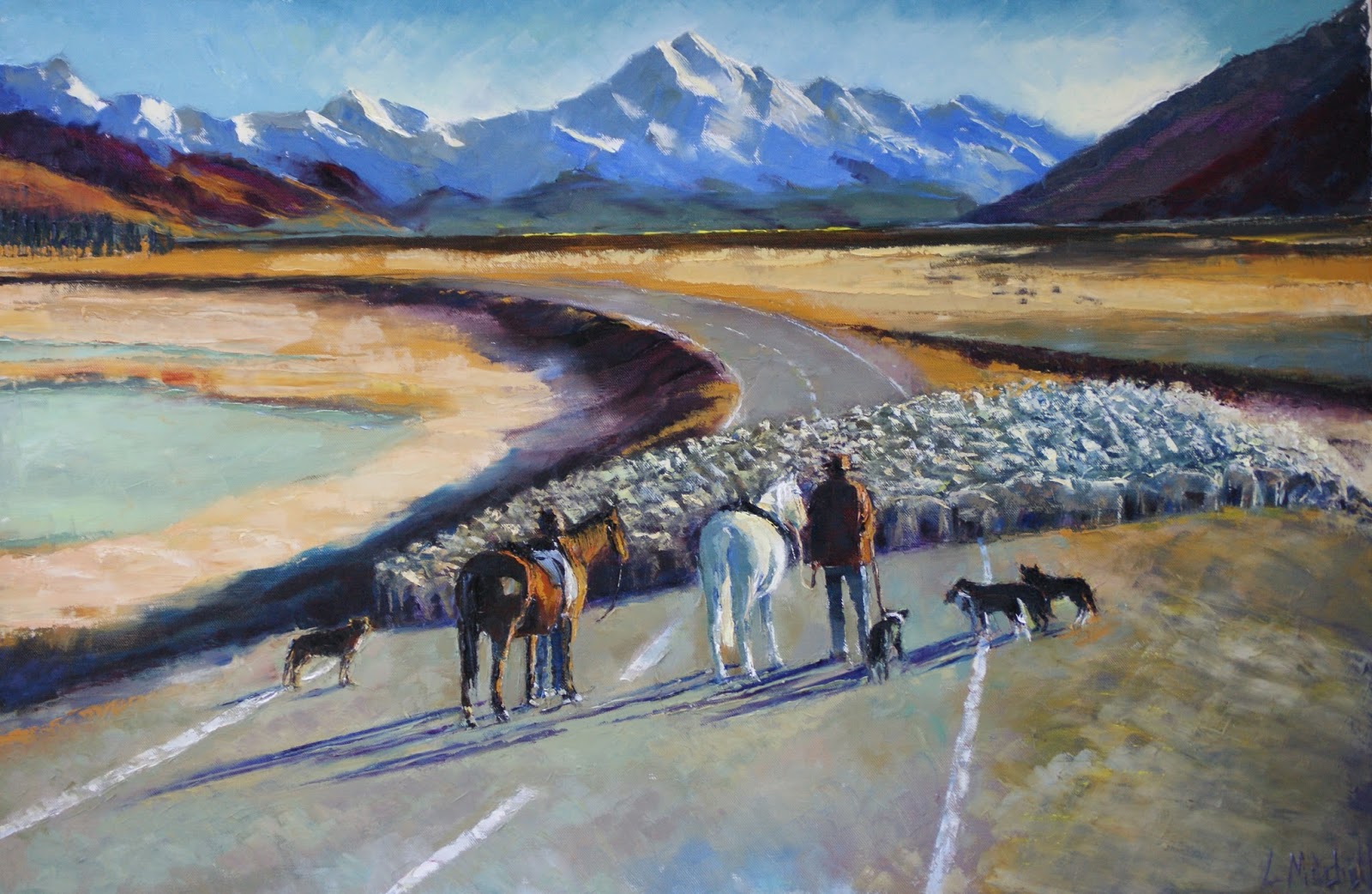
New painting

Updating my artist blog, this is a large palette knife painting of South Island drovers. It's based on a photograph (with a fair dose of artistic licence thrown in). Mt Cook in the background.

I don't often paint landscapes but the portrait commissions have been thin on the ground this year. Removed from my highly representational style this tends towards impressionistic. If the shapes and perspective are believable, the viewer's imagination will fill in the missing details. It would be truly laborious to depict each sheep.

Increasingly, painting with a knife using strong, often unmixed colours, is reducing my desire to paint with brushes and more 'natural' shades. Maybe my eyesight is degenerating.


Sunday, October 18, 2015

Abuse of the Official Information Act - Ombudsman had enough

The Ombudsman has had enough. The abuse of the Official Information Act by those subject to it must stop.

The Chief Ombudsman has slammed the Prime Minister for delay tactics of releasing official information.
Dame Beverley Wakem says she intends to introduce a new set of standards covering Official Information Act (OIA) releases, as part of a major review.
Thomas Jefferson once said "information is the currency of democracy", but it's not always easy to get information...
Information can be accessed from the Government and its agencies under the OIA. They must respond within 20 working days, but several examples have shown that is not always the case.
Several examples? That's the understatement of the year.

The Ombudsman told me that 110 complaints had been received against MSD in the 2013 financial year. 62 were about delays. Those statistics represent only the people who bothered to complain.

And that's just one department.

The TV3 report continues:

3D waited two years for information from Auckland police on burglary statistics.
A complaint to the Ombudsman's office has been with it for a year.
I've had a complaint lodged with the Ombudsman since September 18, 2014 and still no resolution.

Obviously they are unable to cope with the level of complaints being received.

It's not a good look for the National government and I am pleased to see mainstream media giving the issue some coverage.

Prime Minister John Key has previously admitted his office uses delaying tactics in releasing official information. Dame Beverley told The Nation that's unacceptable.
"There's a disregard for the law," she says.
From the top down.


Saturday, October 17, 2015

Paying out benefit-liability $ to Tuhoe

MSD has released a commissioned report about decentralising welfare to Tuhoe.

Tūhoe is a relatively young population with high levels of unemployment, welfare dependency and low incomes....
In 2011 the Crown entered into a relationship agreement with Tūhoe in which it acknowledged the mana motuhake of Tūhoe and its aspirations to self-govern. Tūhoe have their  aspirations to become independent of the Government, generate its own revenue and become self-sustaining. MSD has asked whether or not it is feasible to transfer a portion of the Crown’s liability to Tūhoe. 

 In plain English can benefits be paid forward in a lump sum to enable Tuhoe to establish employment initiatives and their own social services?

Tuhoe has high forward liability:

29 per cent of Tūhoe received a benefit payment (unemployment, sickness, invalid, or
domestic purposes) as a source of income at some time in the 12 months prior to the 2013 Census, compared to 24 percent of the Maori population, and 10 per cent of the total 


The above shows benefit receipt for the general population (col 1), then Maori, then Tuhoe.

That's snapshot data. Because young parenting and youth unemployment are high, the length of time spent on benefits is greater.

The research considers international attempts at self governance and suggests:

Experience shows that a goal of profitable business ventures is the most effective way to
increase employment opportunities in the long-run. 

It considers some NZ initiatives and describes them a s a "mixed bag". However the "risks" are less than the "lost opportunity".

The rest is essentially suggested scenarios for transferring the "liability" (cash resource) to Tuhoe.

Apparently MSD are in the process of assessing the actuarial liability of Tuhoe.

What does Tuhoe want to do with the funds?


With the return of Te Urewera together with Tūhoe current land interest brings land value in excess of 300,000 acres. Tūhoe have identified they are capable of developing a range of industries that will create employment opportunities and thereby reduce welfare
dependencies. The industries they have identified as possible within their rohe include the following:
• Pharmaceuticals
• Science and research
• Eco-tourism
• Food and technology
• Horticulture
• Agriculture
• Biodiversity
• Culture & Heritage.

Tūhoe have also identified a number of social sector initiatives such as:
• Development of charter schools that embrace tribal tikanga, set up in the rohe with
consolidated governance arrangements.
• Health centres in each of the four Tūhoe settlements that meet the needs of the rohe’s
population including mental health and addiction.

It's a reasonably lengthy document so take my speed-read summary on trust.

But I am left with questions. If it happened for Tuhoe, wouldn't it conceivably have to happen for any other tribe, group, or even individual, with a (expected)  forward liability?

And I wonder what Savage would have made of the evolution of  social security? I don't imagine his vision of providing income security to the poorest, most disadvantaged in the here and now extended to calculating forward lifetimes of income dependency to be paid in advance.

Then again the dependency is real and if Tuhoe can do a better job of reducing it than the state, why not?

And a pointless, after the fact final question. Wouldn't it have been better if the dependency hadn't been enabled in the first place?


Friday, October 16, 2015

Latest benefit numbers: continuing downward trend but.....

The general gradual downward trend, continues.

Over the year ending September 30, 2015, MSD says, "...the proportion of the working-age population in New Zealand receiving a main benefit fell slightly (from 10.7% to 10.2%)."


But here's the worrying statistic.

In the last quarter, while 43,369 people came off a benefit, 46,374 went on one. A net gain. Not such good news. In the Sept quarter last year 47,447 left; 47,566 arrived. So this year's net gain, over the same period, was significantly higher.

Now that cancellation data is being provided, I also note that the numbers leaving a benefit to go to prison are trending upwards. Interesting.


(Left click on image to enlarge)

Wednesday, October 14, 2015

On ACT and other matters

There was little chance of my voting elsewhere but David Seymour has guaranteed my tick for ACT in 2017 by lodging a new voluntary euthanasia bill. It's a huge task (if drawn) to front foot such a controversial issue as a single MP. What will stand him in good stead is the weight of opinion is now firmly on his side.

"Not working on it full-time" but you wouldn't need to be at $2000 a day. I'd have thought Rebstock negotiated a rate that is "twice the usual"? Is she worth it? I can't answer positively when another CYF  overhaul isn't the answer.

Should it be a crime to have your baby sleeping with you? It's not necessarily best practice if you are overweight and inebriated, but my second child constantly slept by my side. It was the only way any of us was going to get some rest. I fear charging a mother with "criminal nuisance" after a SUD death, with a possible jail term of one year, is a step too far. When will police begin checking bedrooms?

Tuesday, October 13, 2015

Carmel clutching at straws again

Here's Carmel Sepuloni clutching at straws again.

She is reported in today's DomPost:

Fewer people coming off a benefit and moving into work shows a "stalling economy" and a "failing Government", says Labour.

But the Government says Labour had gotten its maths wrong on figures the party obtained.

While the real numbers of beneficiaries moving into work had decreased, the overall percentage of people going into work had actually gone up, as the total pool of beneficiaries decreased, said Social Development Minister Anne Tolley.

At the end of March 2015, 284,260 working age people were receiving a main benefit.  That was down from 295,000 people in June 2014, according to the Ministry website.

"At the same time the New Zealand Income Survey shows an extra 27,500 people were receiving government transfers - primarily benefits and superannuation - as their main source of income compared to 12 months ago.

"Crucially, there was a 38.85 per cent increase in the number of people aged between 50 and 59 years on these transfers between 2014 and 2015," Sepuloni said.

The definition for 'government transfers' is

Government transfers: income from benefits, working for families tax credits, paid parental leave, student allowances, ACC payments, New Zealand Superannuation, and veteran's and war pensions.

At June 2015  1,193,800 people received income from government transfers.
At June 2014  1,166,300 people received income from government transfers.

There's the 27,500 increase she cites.

The increase relates almost entirely to people receiving Super (which is irrelevant to the working age arguments.)

In fact she could have checked exactly how many by consulting the Benefit data tables at MSD

The number of people receiving Super or a veteran's pension rose by 25,983 between June 2014 and June 2015.

The number receiving income from government transfers aged 50-59 rose from 32,600 to 40,500 or 24% not "38.85 percent". Some of this rise will be attributable to younger partners of newly qualified Super recipients becoming dependent on government transfers.


Monday, October 12, 2015

Christianity perverted

A Reverend has this to say about a landlord who is complaining about tenants taking advantage:

"He can afford for them to take advantage of him."

Is this the message of Christianity? If so, I'll stick with atheism.

People who "take advantage" of other people's generosity (in this landlord's case, child minding and rubbish removal) should be dumped or dumped on. It has nothing to do with power balance or material inequity.

A poor person can afford to be as fair as a rich person. Transactions between people, no matter what is involved, that aren't mutually satisfactory, will be very short-lived. Many people of means are generous. They enjoy being able to help. Often they want nothing in return. Their reward is the act of relieving a problem for someone else.

BUT it doesn't follow that when their generosity is abused they should turn the other cheek.

This reverend's attitude is at the heart of socialism and is essentially what makes socialism untenable. Values are not shared. Different rules apply to different people by dint of their economic status.

There is no excuse for abusing goodwill ever. Rich, poor or otherwise.

Friday, October 09, 2015

Stalled recovery?

Apropos of nothing in particular, here is the current state of unemployment. In terms of pre-GFC it's not pretty, particular for females.


Not to mention the rates for Maori and Pacific which would require a much taller graph.

The current Maori unemployment rate is 12.6% and Pacific is 11.3% (June quarter).

One thing I would note is that pre-GFC unemployment levels were unusually low. That's the only positive (spin) I can find. Oh, and NZ is still faring relatively well internationally. Though I doubt that is much consolation for the unemployed.


Wednesday, October 07, 2015

Asian upward mobility?

Statistics NZ released the latest Income Survey last Friday.

From the tables, the following caught my eye.

Asian median incomes are rising fast. Over the 2011 - 2015 period, their income from self-employment was also growing at the fastest rate; income from government transfers was the lowest and declining (largely reflecting a younger population).


In part the increases across all groups represent a recovery from the GFC but the Asian increase is a stand out.

('All people' = 15 and older.)

Tuesday, October 06, 2015

Bennett's biggest contribution

I had cause to make the following graph so thought I would post it here. The drop in Maori teenage birth is quite phenomenal. Though untested, the Youth Parent Payment reforms must be a factor. The point I was making to my correspondent was, I consider this Paula Bennett's biggest contribution as Social Development Minister. (The 10-14 years-old rates barely register but using Infoshare data I couldn't easily or quickly remove them.)


Monday, October 05, 2015

More political bias from DomPost

Page two of the DomPost has a large headline:

Complaints blamed on greater demand: MSD
 "A staggering increase in complaints by Work and Income clients have been written off by a government ministry which blames the increase on more Kiwis using its services.
Since National took office in 2008, the number of complaints about incorrect information being provided by Work and Income has risen by 122 percent - from 537 complaints in 2008 to 1197 this year."

Here is the table:


The first thing I notice is that the number of complaints requiring action has actually dropped from 2,298 in 2008/09 to 2,233 this year. If I were to look at a similar table depicting CYF notifications, I'd be primarily interested in the substantiations as an indicator of actual problems.

The journalist completely ignored the top line though and focused on the worst line - the one that would provide the biggest % increase. Even then, we cannot draw a conclusion because there is no breakdown of the complaints that actually required action.

Next, a journalist seeking to provide balanced information would have requested and published statistics from the  period prior to  National becoming government.(She may have but they didn't suit her purpose?)

At least  each parliamentary representative - government and opposition - was asked for comment.

Carmel Sepuloni duly provides and not unusually shoots herself in the foot in the process.

And it wasn't only beneficiaries having a tough time with Work and Income. "There's a whole lot of New Zealanders out there...like hardworking New Zealanders who should have access to things like childcare subsidies that are getting inaccurate information."[my emphasis]

Could that be 'deserving' New Zealanders?

To be fair the DomPost should be awarded some neutrality points for publishing that comment. Once again it highlights Labour's identity crisis. Who do they represent?

Friday, October 02, 2015

Duff rides again

Alan Duff has a go at Tuku Morgan, his greed and lack of a "self-regulation" button. He proceeds onto the lack of Treaty money spent on creating employment and helping "flax roots Maori."

Then he takes an interesting turn.

You live overseas for a few years and come to realise it's quite an advantage being part-Maori.
There's the warrior bit that makes you feel pretty safe in most situations and not afraid of being mugged or attacked on some dark city street. (And anyway, it just about never happens, or not in France; they're a civilised people, the French. Booze does not give them an excuse to be violent.)
There's the musical side, and when you get a group of Maori and a guitar or two, it is quite a neat feeling all singing together at least knowing you're in tune and by French musical standards pretty damn good.
Just being an expat Kiwi feels great - our friendliness, our love of rugby, the people we know in common.
By French drinking standards, we're a bit thirstier and definitely rowdier. However, we have all embraced the behavioural code here.
But I believe being a Maori in Enzed is a more negative experience. All that compulsion to live by the myth of whanau, hapu and iwi. Ask many Maori who have moved to Australia; they'll tell you living as an individual is infinitely better. If I was a benign dictator I'd pack every Maori off out of the country so they could realise what a wonderful thing it can be to be Maori and Kiwi and individualistic at the same time.
Many of our Maori leaders have to invest in this potential and step away from the Champagne tap.

(The "warrior bit" worked for him second-time around. First time he ended up in a British prison.)

Thursday, October 01, 2015

How many second chances when children involved?

The NZCPR has an expanded version of my earlier blog post as their guest commentary this week.

"New Zealand (as represented by the child protection authority and its practices) is currently officially anti-adoption. The anti-adoption groundswell that built over the nineteen seventies and eighties grew out of an abhorrence of the past removal of babies from unmarried mothers. Today most feel repugnance for the practice. 
But isn’t wholesale shunning of adoption an over-reaction? There are many instances whereby newborns go directly into the care of CYF. The prospects for these children are bleak yet their rights seem trumped by the rights accorded to their birth parent and extended family. Babies aren’t simply removed from mothers by dint of being ‘illegitimate’. These babies are removed because their mothers are criminal; are incarcerated or live on the streets; have abused prior siblings and pose a serious threat to their newborn. The principle of redemption or second chances is all well and good when offered to the adult individual. But how many times should a child be exposed to known risks in order to satisfy liberal impulse? 
Children’s lives shouldn’t be gambled with. And they needn’t be if we once more considered adoption."


Muriel Newman's associated column provides an excellent summation of the Expert Panel report into CYF and concludes:

"It is an unfortunate fact of life that at the heart of the child abuse crisis are government incentives for women to have children they are ill-equipped to provide for. Until the State stops paying women to have babies, children will continue to suffer. The State is no substitute for a loving mum and dad, and no role model for a child. In fact it’s a tragedy that idealists have exerted such influence on policy and brought us to the systemic failure we have today. 
The child abuse crisis is a national disgrace. Only the State could fail children on such a monumental scale. Anyone concerned should read the Expert Panel’s report. It helps to explain why, in spite of the very best efforts of those who are trying to help, the child abuse crisis continues unabated."

More

Tuesday, September 29, 2015

60 percent of rental properties subsidised

I frequently use my blog as a filing system. While I don't use 'labels', running a 'search'  for what I want inevitably leads to success.

So the reason for this post is primarily to record a new fact - new to me anyway.

60 per cent of all rentals in New Zealand are subsidised by the Government.

Six out of ten rented homes are subsidised by the taxpayer.

That's all....apart from..... I would also observe the speech from Bill English (source of the information) began with:
I am old enough to remember the mid-1980s. After leaving university, I was involved in farming. At that time we had a number of arrangements in New Zealand that meant people who were involved in farming weren’t getting the right price signals. Then, suddenly, they did. I was a part of communities that were drastically affected by that. Farm subsidy systems were abruptly removed. Our communities changed drastically and dramatically.That was a sharp personal lesson, and one that many New Zealanders also experienced.

A strong focus of our policy is to make sure our markets work.

Yet the rental property market is still heavily subsidised and still not working.

Child abuse hand-in-glove with benefit abuse

Yesterday I was on Larry William's show backing Anne Tolley's call for contraceptive intervention with mothers who have children already earmarked for removal by CYF at birth. I pointed out that many of these children will be damaged in utero by their mother's alcohol or drug addiction.

This morning's NZ Herald features the heart-breaking story of exactly the sort of child who is being failed first and foremost by his mother and father, but secondly, by CYF, who are tasked with the care and protection of children.

The only saving grace in this awful story is that one social worker recognised the mother's use of her child as "a cash cow".That's the next issue that needs open and honest debate (if an honest debate can be had about a dishonest practice). The use of children as meal-tickets. It disgusts me.

A severely disabled child was used as a "cash cow" by his alcoholic mother and her boyfriend to access up to $80,000 in benefits, according to notes in a Child, Youth and Family file.
In it, a social worker said of the boy's caregivers: "It would appear that it's more about receiving financial payment from Government agencies, than actually providing a home for Benjamin*."

Monday, September 28, 2015

Anne Tolley shows some gumption ...sort of

This'll cause an uproar among feminists ("don't interfere with my reproductive rights") and Maori who think like Tariana Turia ("I am intolerant of attempts to control our fertility"):

The Minister for Social Development wants to find a way of stopping the most at-risk beneficiaries from having more children.


Unfortunately Tolley is being somewhat timid.
 ... said she was talking about a small number of families, where Child Youth and Family was removing more than one child at birth, most from homes with a history of abuse and neglect. "I know of a case where they were taking the sixth child from that woman and of course the first question I ask is; 'So what sort of family planning advice is being made available to that woman, is it there immediately for her to think about?'
Every year, one in five children born will be benefit-dependent by the end of it.

In the 6 months to March 31, 2015, 6,347 babies were added to an existing benefit.

In that context Tolley's ambition looks lacking. But still upsetting for some.

Association of Social Workers chief executive Lucy Sandford-Reed said she felt uncomfortable about the minister's comments.
There's a big part  of the problem. A denier. Head of the Social Worker's union no less. She should be applauding the Minister for at least  having the gumption to publicly ask why some women keep having babies when they are incapable of providing for them or worse.

Sunday, September 27, 2015

"...stripping the influence of CYFS back to bare bones..."

The Daily Blog is defending CYF and state monopoly of child care and protection. This comment caught my eye:


Saturday, September 26, 2015

Inequality may be declining

Thanks to the reader who sent in this very interesting observation from the Economist blog:

ONE of the key aims of taxation and public spending is to redistribute income from rich to poor. The way most statisticians, economists and policymakers think about this is in terms of a cross-sectional snapshot: what the distribution of wealth or income is between different people in a population in a single year. But we might care more about lifetime incomes: in the modern labour market, many people now have very high incomes in certain parts of their lives, and much lower ones at other times.


NZ's Gini coefficient is very similar to the UK's cross sectional so it may very well be similar to their lifetime. I can't think why it wouldn't. In which case inequality may be declining.

Friday, September 25, 2015

Restructuring CYF is not the answer

Watching Paul Henry interview Anne Tolley about the latest CYF report was very dissatisfying. There was no discussion of getting to the real core of the problem. Only the terrible statistical outcome for those children who went into state care in 1991, then a lot of blaming of current hierarchy followed by dogged promises of change.

1/ There will always be children born into circumstances that warrant their removal. But when you pay people to reproduce there will be more.

2/ In the past most of these children were put up for adoption. That outcome wasn't always ideal but it was a better alternative than constant upheaval and removal from one placement to another. Adoption delivered a better result than the philosophy of striving to keep the child with its birth mother or blood family at any cost. Because ultimately the child ends up in state care anyway more damaged than it would have been if adopted out at birth.

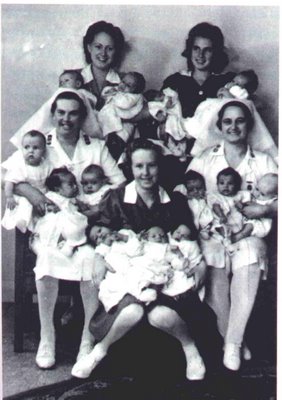
A Salvation Army home in the 1950s

3/ Increasingly there are people who want and cannot have children. That's abundantly clear from the burgeoning fertility treatment industry.

I've known a number of people who were adopted out at birth, and have read or heard other people's stories. Most have relished the fact that their adoptive parents raised and loved them as their own and they were provided with stability and security. Some have had emotional and behavioural problems coming to terms with the circumstances of their birth and being 'given up'. One I knew was getting into trouble with the law as a teenage boy; another was getting into trouble with the law because the family he was adopted into had strong gang links. But they were the exceptions.

Compare the now known results of "having a care placement" by age 21:

• Almost 90 per cent were on a benefit;
• More than 25 per cent were on a benefit with a child;
• Almost 80 per cent did not have NCEA Level 2;
• More than 30 per cent had a youth justice referral by the age of 18;
• Almost 20 per cent had had a custodial sentence;
• Almost 40 per cent had a community sentence;
• Overall, six out of every 10 children in care are Maori.


It doesn't matter how CYF is structured or how caregivers are reimbursed or how professionalised social workers are. What matters is reducing the incentives for people to produce children haphazardly, but, if they do, acting swiftly to get those children into a nurturing and stable home.

Thursday, September 24, 2015

Report on CYF

This post simply offers some cut and paste excerpts from the preliminary report to the Minister from the "independent expert panel" for those who have neither the time or inclination to read it. I've only selected information (largely statistical) that is new to me.

Although the overall number of children coming to the attention of CYF has been decreasing over the past six years, an increasing proportion of these children are already known to the agency. In 2004, most of the notifications made to CYF were for children not previously known to the agency. In 2014, six out of ten notifications were for children the agency already knew about. Many of these children had extensive history with the agency - on average, these children had engaged with CYF on three previous occasions.

This pattern of increasing repeat notifications is associated with an increasing delay between notification and subsequent intervention. In 2014, children having their first care and protection Family Group Conference had, on average, more than four prior reports of concern and this figure more than doubled between 2000 and 2014.

Child abuse and neglect occurs within families across all parts of the community. However, many of the children and young people who come to the attention of CYF are living in families who are experiencing the combined impacts of long-term unemployment, low income, unaddressed physical and mental health needs, parental alcohol and drug addictions and family violence.

To illustrate, of all children born between 2005 and 2007 who had come to the attention of CYF by age five, 70 per cent were in families where the Police had records of at least one family violence incidence involving the parents in the five years prior to the birth of the child and 37 per cent had a least one parent who had served a criminal sentence over that same period. 40 per cent had a mother who had been receiving a benefit for more than four out of the last five years prior to their birth. 


CYF currently works with about 3,500 caregivers, yet there is no national picture of the needs of our care population, the range and needs of caregivers, what works in their recruitment or retention and what kind of support is needed. There is no overarching, nationally co-ordinated approach to caregiver recruitment and there is an inability to predict and plan for future requirements. 

A high proportion of caregivers are in low income households and 42 per cent of the caregiver population are in receipt of a benefit. The majority of CYF caregivers are middle-aged, but a significant proportion are nearing the age of 60 years or older. This is a concern in that children who have complex and significant needs are being placed in households where resources may already be stretched and the capacity of the caregiver to meet needs may be constrained. 

CYF employs about 3,200 FTEs and relies on social work and social workers as the primary means of service delivery. There is currently fragmentation at a national level in social worker qualification and training, which is reflected in a lack of consistent practice within CYF. There is also a lack of workforce planning and reporting capability within CYF that results in a lack of long term planning to address these issues.


No shortage of marriageable men after all

A most interesting piece from Brookings challenges the traditional idea that there is a shortage of men in the marriage market.

The original definition of marriageability, from sociologist William Julius Wilson, was based on the ratio of employed men to all women of the same age. All women of the right age are assumed, under this definition, to be equally marriageable. But this is an outdated assumption, given cultural, economic, and social changes. A high percentage of women participate in the workforce; many have children from a prior relationship.  

On only one definition of marriageability—Wilson’s original one, comparing employed men to all women—do we find a ‘shortage’ of men so often lamented in the media. On all other measures, there is in fact a surplus

However the surplus disappears for black men and women. (Inter-racial marriage rates in the US are very low - in 2010 only 4.6% of married Black females had a non-black husband).


The writer says the difference is due to lower employment prospects, high rates of incarceration and shorter lives.

Terribly sad state of affairs.

Tuesday, September 22, 2015

Steve Maharey - still waffling

Ex Social Development Minister and "sociologist" Steve Maharey has a column in today's DomPost titled "Centre-Left needs a new vision".

It opens:

Perhaps the most interesting outcome of the election of Jeremy Corbyn as leader of the British Labour Party will not be his 60 per cent support but the 4.5 per cent support given to the "modernising" candidate Liz Kendall.
The need to "modernise" gripped parties of the centre-Left in the 1970s and 80s in the wake of the neo-liberal revolution led by British Prime Minister Margaret Thatcher and US Present Ronald Reagan. Welfare states were one by one replaced by the market.
I've heard this assertion from the academic Left before and it flummoxes me.

The welfare state is one where compulsory collective responsibility for social needs - education, health, and income assurance, especially in old-age - dominates.

While governments have pulled out of funding tertiary education to the past extent, in most English-speaking countries (especially the UK) responsibility for health, education and income assurance remains overwhelmingly in state hands.

Even in the United States, where reconfiguration (aka reform) of welfare was greatest, social security spending continues to grow and cause immense concern.

I struggled on with his waffle about how the centre left needs a new vision but am left with a question. How does it create a vision based on lies about the past?

Monday, September 21, 2015

Just not ready yet

The latest 3 News Reid Research poll has found only one in four people want to change the flag.

The process of change is often gradual. At an individual level people try to change something about themselves multiple times before actually succeeding.

Perhaps changing the flag is like trying to get voluntary euthanasia legalised. Parliamentarians failed in 1995; failed again in 2003, though it was a much closer run result. They failed because the weight of public opinion wasn't behind change.  I believe it'll be third time lucky for that particular battle.

And so it may be with the flag.

Sunday, September 20, 2015

Disregard for the facts

Over at the Daily Blog Mike Treen has a post entitled "Benefit cuts designed to help cut wages as well." There is a distinct lack of balance and I've left some corrections in a comment (now published).


Treen "The unemployment benefit was cut by 25% for young people, 20% for young sickness beneficiaries, and 17% for solo parents. "

DPB was cut 10.7% with one child; 8.9% with two children. The only sole parents who received a cut of 16.7% were those without dependent children.

Treen "They abolished the family benefit and made many workers ineligible for the unemployment benefit with a stand down period of up to a six months.......Universal entitlements like the family benefit were eliminated so assistance could be targeted to the deserving more accurately."

The universal Family Benefit was abolished but half was reallocated to into Family Support which went to beneficiary families with children. In other words the money was better targeted and made up some of the money lost through cuts to basic rates.

The six month stand down applied to people who had become voluntarily unemployed or had a redundancy payment.

Treen "Unemployment benefits were stopped for 16 and 17 year-olds and the youth rate for 18 & 19 year-olds extended to the age of 25."

The Independent Youth Benefit was created instead.

Source: Social Developments, Tim Garlick, p146,7.

Saturday, September 19, 2015

4 in 10 Superannuitants don't use the internet

MSD launched some new website yesterday. Money to burn.

This surprised me though.

61 per cent of New Zealanders over the age of 65 used the internet last year.

That's a truckload of people missing out on all the wonderful communication, knowledge and entertainment available through the web. Close to a quarter million.

39 percent non-users is higher than I would have thought. An elderly friend of mine recently lost her cat. I thought she would replace it but she feels she is just too old and it would outlive her. Last time I saw her though she was utterly animated and over the sadness. Her son had bought her a tablet and she was buzzing with everything she could do with it. I don't think elderly people actually understand that they can access a wealth of nostalgic material they never thought they'd enjoy again. All they see is the negative aspects of social media, and it's too easy to carp on about people losing communication skills etc.

They don't know what they are missing.

Friday, September 18, 2015

State confiscation of private wealth

State confiscation of private wealth. That's all it is. Appalling.


The Government's rejection of the Lochinver sale causes some issues, not the least being what happens to the station now.
It is owned by the Stevenson Group which wanted to complete the sale to free up capital to reinvest in other businesses such as expanding its quarry in Drury and investing in a West Coast coal mine.
It is unlikely a New Zealand buyer with $88 million can be found, reducing the value of the property on the open market.

Thursday, September 17, 2015

Beneficiary advocates could drive this into court

Asked yesterday by Radio NZ for a comment(s) about this incidence of seeming law-misinterpretation by the Ministry of Social Development that has seen new benefit grants paid out a day late, I said that beneficiary advocacy groups were like a dog with a bone. There are precedents where they have forced MSD into court and MSD has lost. So I wouldn't under-estimate what the taxpayer could be up for. By my calculation easily $200 million.  I don't know if the government can successfully retrospectively change the legislation to get MSD off the hook.

But the beneficiary advocates are over-egging the effect of a pay-out citing hardship and child poverty etc. Collectively the sum is large but individually the pay-outs are small. One grant would equate to an average of $40 or thereabouts. And the poorest beneficiaries - those on welfare long-term - would get the smallest payout or none at all.

I have no idea how a 'compensation'  process would work but if WINZ were to invite people to make a claim with the exact date of application and any other relevant details, it might just be too tough to bother.

Though who knows. That option might not be legal either.

I did say to the reporter that benefits, whilst an entitlement, are a privilege. New Zealand's welfare system is among the most generous in the world in terms of the length of time people can claim welfare for, and one day's payment wasn't a big deal in the scheme of things. The beneficiary advocates could find better bones to chew on.


Monday, September 14, 2015

Universities are going to hate this aren't they?

Just announced

Tertiary Education, Skills and Employment Minister Steven Joyce has today announced that from 2017 all Universities, Wānanga and Polytechnics will be required to publish information about the employment status and earnings of their graduates broken down by specific degrees and diplomas.
“This Government is committed to providing better information to assist students’ decisions. This is important so students can make the most of their time in tertiary education, and because of the significant investment students and taxpayers make,” says Mr Joyce.

This is a great move. User-pays has incentivised universities to get more bums on seats and, in some areas,  dumbed-down the level of  learning and graduate. But I don't think throwing out user-pays is the solution.

My son (in his last year at Uni) said, "I am going to become a statistic". I observed probably "compulsorily" as with other government surveys. At least this survey will provide really useful information.

Update: A reader sent the following graph which shows 'earning advantages from tertiary  vs secondary education ratio'


Sunday, September 13, 2015

A nation of inveterate moaners

New Zealanders are encouraged to moan about how hard done by they are by groups of people with political axes to grind, hobby horses to rock and incomes to generate. The strategy isn't just domestic - it is rife in the first world. Instead of righting any injustice though, it breeds bitterness, animosity and division.

Enough of the rant.

In practical terms, the dividers use statistics to support their chosen cause. But for those who can think for themselves, reference to official data (the best we have) will  always turn up a counter-balancing statistic.

For instance - and this presented itself randomly as I caught up with Statistics NZ latest - median incomes.  (Below is revised on the basis of Census data but the changes are not statistically significant so visually indiscernible).


Median incomes have risen steadily since 1997 except during the GFC.

But without inflation adjustment the graph is meaningless.

At 1998 the income level was around $300. By 2014 it had doubled. But what was $300 worth in 2014 $? Using general CPI here's what the Reserve Bank calculates:


Apart from housing, other goods and services measured -  transport, food, and clothing - cost far less in 2014. For instance, $300 in 2014 would buy double the amount of clothing it would in 1998.

But good news isn't exciting unless it's personal. Almost masochistically, people latch on to the bad news stories - inequality, poverty, disease, violence and premature death.

In reality, Fred Dagg said it best. And New Zealanders once believed it. We don't know how lucky we are.

News flash - it's still true.


Friday, September 11, 2015

"Drinkers subsidise non-drinkers"

Doug Sellman, look the other way now.

A study from IEA finds

"... estimates suggest that the net cost of alcohol to the state is minus £6.5 billion pounds, which is to say that drinkers subsidise non-drinkers to the order of £6.5 billion pounds a year. The government could halve all forms of alcohol duty and still receive more in tax than it spends dealing with alcohol-related problems."

I immediately noticed that the study does not consider the economic contribution alcohol makes in terms of job creation for instance (eg NZ's wine industry is purported worth in excess of $1 billion) but the paper later explains why:

We have also ignored all financial benefits except those that go directly to government, i.e. alcohol taxes. In line with Leontaridi’s methodology, we do not include benefits provided by the alcohol industry, such as job creation, corporation tax and income tax, on the basis that replacement goods, services and jobs would fill the void if alcohol did not exist. Since it is unclear whether substitute industries would lead to the government receiving more, less, or the same amount of revenue (aside from the loss
of alcohol taxes), we have ignored the economic contribution of the alcohol industry altogether.

Fair enough.

But with the public-cost arguments against drinking (and smoking) removed, hectoring academics are exposed for what they are. Well-paid agents of Nanny State hellbent on micro-managing your life because they know best.

Wednesday, September 09, 2015

'Victimhood' contextualised

Here's a plausible hypothesis;

"U.S. society is in the midst of a large-scale moral change in which we are experiencing the emergence of a victimhood culture that is distinct from the honor cultures and dignity cultures of the past. If true, this bodes really bad for future social and political peace."

The concept of victimhood has been talked about for some time but this is a new attempt at context and definition.

(For mine, feminists long postulated that a world ruled by women would be free from war. They failed to add that it wouldn't be free from conflict.)

Original paper noted at Reason

Poor reporting and poor thinking

A couple of items that caught my attention from the NZ Herald:

....health economist Dr Brian Easton says with certain rehabilitative and preventive methods, that figure could reduce over time as more young women learn about the harmful effects of drinking while pregnant.
Dr Easton is one of two keynote speakers at today's annual Research and Policy Forum to highlight World Fetal Alcohol Spectrum Disorder Awareness Day.
He has based his estimate on research that showed 1 per cent of the population was born with fetal alcohol spectrum disorder (FASD) each year.
"Each year about 6000 babies are born with FASD and 600 have Fetal Alcohol Syndrome."

So his estimate for FASD is 10 percent - not 1 percent.

Then this:

Auckland Women's Centre manager Leonie Morris agreed that society under-valued unpaid parenting work, as shown by the "stigma" imposed on beneficiaries who stayed home with children.
When beneficiaries stay home they are paid to look after their children. So society must put some value on parenting work. The "stigma" attaches to using scarce public money, in many instances, quite deliberately and quite ineffectively.


Tuesday, September 08, 2015

Parkin Prize: Is it art? Who cares

I'd forgotten all about the Parkin Prize until reading this morning on the DomPost front page that the $20,000 prize winner had entered a rubbing of her apartment floor.

Good for her. Is it art? Who cares. She spent hours and hours on her hands and knees, which is more than I did.

It had been literally decades since I'd drawn with a pencil but I had a first-time shot anyway. Left it till the very last minute - in fact I thought the deadline was midnight, not 4 pm. And I didn't get home till after five. But the on-line submission was auto-accepted at 6 pm. Wasn't surprised when it didn't make the cut. 443 submissions. Put up some decent prize money and everyone has a crack. This is the sketch; the finished painting is here.


Actually, as I have pondered over this whilst hanging out the washing, making breakfast etc it occurs that there is a lovely irony inherent in her work. Most artists making any money from their work are earning the minimum wage or less. But in this case repetitive grafting on  hands and knees, day after day reaped a much better hourly rate . Even if she took 300 hours to rub every floor in her apartment it's paid her $66.66 per. Getting up there with plumbers....

Monday, September 07, 2015

"Feminism damages children"

Muriel Newman's latest column at NZCPR, Feminism damages children

Child abuse has again been in the headlines over the last few weeks, most recently following the release of the Children’s Commissioner’s State of Care report into the treatment of children in the care of Child, Youth and Family (CYF). The report contained a number of recommendations, which the Minister of Social Development Anne Tolley has said will be taken into account in the major overhaul of the agency that is presently underway.
 Leading the review is Paula Rebstock, an economist and the former Chair of the Commerce Commission, who has already directed far-reaching reforms for the government into Social Welfare and the Department of Corrections. It is understood that a ‘social investment’ approach is being promoted for CYF, which will put children’s needs at its centre – as well as focussing on what works and how to get best value for money. The report is said to be with Cabinet and is expected to be released in its final form by the end of the year.
 However, no matter what structural changes to the child protection agency are introduced, nor what new processes are brought in, the problems of abused and damaged children will continue until the government stops paying women who are not in loving and stable relationships to have babies. 

  More

 Twinned with mine, Violence made viable

 Lots of people survive courtesy of a benefit. They do so because they are too sick to work, can’t find a job, have children who need feeding with no other source of income, and so on. There are a myriad of reasons why people receive welfare. Most of these people – 300,000 or thereabouts – are not violent. The same can be said of the general population. Yet the odds that violence will occur within the beneficiary population are much higher.
 That’s what the statistical evidence says. Violence – or more particularly – family violence, is relatively common in New Zealand. There are 100,000 family violence reports to police annually, yet the government thinks this represents only 20% of the actual level. The thought that half a million reports would better represent the actual state of affairs in Aoteoroa is chilling. And, frankly, hard to believe. (Perhaps a flag with a fist on it would best portray New Zealand?) 

  More