Thursday, October 29, 2020

Alarm bells

 RNZ reports on the Waitangi Tribunal hearing into the disproportionate number of Maori children in state care:

Dr Alison Green is completing her post-doctoral research at the University of Saskatchewan in Canada, comparing the policy for removing indigenous children from their families in both Canada and New Zealand.

She points to a federal government law passed in Canada last year as a mechanism New Zealand could draw from to put in place the structural changes needed to devolve power from Oranga Tamariki to Māori.

Bill C-92 gives First Nations, Inuit and Metis collectives in Canada the right to create and enforce legislation to look after their own children.

In January this year in the Canadian province of Saskatchewan, the Cowessess First Nation enacted their own legislation which gives them to the right to operate their own child protection services based on their cultural practices.

Green suggested those redesigning how Oranga Tamariki interacts with Māori children should approach the Cowessess First Nations.

The implementation of indigenous responsibility for indigenous children is not new in Canada. The provincial devolution of services to native tribes has been ongoing and not much has changed. Bill C-92, a federal law, only expands the scope of devolution. 

I urge you to read An Endless Cycle of Despair by Brian Giesbrecht an ex Provincial Court Judge in Manitoba, Canada.

Excerpt (picks up the story in the 1970s/80s):

Out-adoption was eventually abandoned in favour of devolution as provincial child welfare authorities relinquished most of their authority over reserves to local Indigenous agencies such as the DOCFS in Manitoba. As a sitting judge, I watched as this policy unfolded in real time.

Advocates assured provincial governments that as newly formed Indigenous agencies opened up and Indigenous leaders gained more control, the old problems would ease. Appropriate cultural influence would inevitably reduce the number of children in care. Some even claimed chronic Indigenous welfare problems would disappear altogether. I once expressed my skepticism to a highly placed welfare bureaucrat. He candidly, if naively, responded: “How could it possibly be worse than the current situation?”

As it turned out, it could. To the story of Lester Desjarlais, we have added the equally tragic stories of Tina Fontaine, Phoenix Sinclair, Serenity and Devon Freeman, to name just a few of the better-known entries from a long list of despair. In Manitoba, approximately 90 percent of the province’s 11,000 children under the care of a child welfare agency are Indigenous, either on or off reserve. The biological parents of these children are often themselves products of an Indigenized child welfare system.

And because off-reserve adoption has been so severely discouraged, many children are placed in temporary foster care instead of with permanent families. This means that when they reach adulthood they are often left to fend for themselves, without any reliable family supports. This is one major reason why the majority of homeless people on Winnipeg’s streets are believed to be former child welfare wards. Meanwhile, FASD takes its toll on reserves, generation after generation.

Many of the Indigenous organizations given responsibility for child welfare were initially incapable of protecting native kids. Training and education among staff were dramatically different from the provincially-run agencies and these problems were exacerbated by dysfunction and corruption within other reserve institutions, including school boards and local government, as the Lester Desjarlais inquiry painfully illustrated. Again, this is not a racially-motivated accusation; the size of many reserves’ polity leaves them especially prone to conflicts of interest and nepotism. The problem of “small democracies” is detailed in University of Calgary academic Tom Flanagan’s 2016 study Corruption and First Nations in Canada.

Today, staff at Indigenous-run agencies are much better credentialed and the organizations more professional. After several decades of devolution, the care provided to children at risk is now largely equivalent to provincially-run child welfare agencies. Yet the statistics continue to worsen. Indigenization alone is clearly not sufficient to remedy the massive problems facing Indigenous children. Regardless of who is in charge, the root causes remain: addiction, family breakdown and poor community oversight. It has even become common for Indigenous child welfare workers to be criticized for making the same difficult choices that federal and provincial child welfare workers once made during previous eras.


When devolution began, it was common for Indigenous agencies to declare that no native babies would ever be apprehended from maternity wards. Parental and cultural rights would trump the rights of children at risk. This belief is further embedded in Bill C-92 through its “cultural continuity” requirement. Yet Indigenous child welfare officials have lately come to realize that leaving a newborn baby with his or her mother can be so fraught with risk that immediate apprehension is the only safe option.

That was the situation in the high-profile G (DF) case, in which a Winnipeg-based Indigenous child welfare agency tried to detain an addicted pregnant mother for treatment. She had previously given birth to several brain-damaged babies, yet the Supreme Court of Canada ultimately decided that detention violated the mother’s rights and, hence, was unlawful. The child, and many others since, was therefore consigned to a fate of painfully low chances.

After more than 30 years on the bench, it was clear to me that governments and agencies have very little control over how parents actually care for their children, or the eventual outcomes. Child welfare workers, Indigenous or non-Indigenous, are all motivated by a deep desire to do what is best for children under their watch. If a child has become a permanent ward of the state, it is almost certain that his or her home life was thoroughly and irreparably dysfunctional. Accordingly, the only way to remedy the high number of native children in foster care is to tackle the root cases. Family dysfunction on reserves is not the fault of child welfare agencies. The blame lies with parents and their communities.

It is this difficult reality that the federal government was trying to cope with using residential schools, and the provinces with the Sixties Scoop. Given the subsequent failure of devolution to remedy the situation, it is impossible to imagine a further push to sever native child welfare from the rest of the country will yield the desired results.

If Canada truly wishes to reduce the number of Indigenous children in foster care – and all Canadians have a stake in this outcome − we must start by emphasizing the importance of sobriety, parental responsibility and family stability among all citizens. Instead, Ottawa has chosen to place the blame for native child welfare failures on past injustices such as colonialism and institutional racism.


Ring any bells? 

Wednesday, October 28, 2020

"...there's going to be fruit sitting on the ground rotting"

 Alexandra 387

Balclutha  594

Dunedin Central 3,241

Gore  562

Invercargill 3,033

Mosgiel 414

Oamaru 704

Queenstown 588

South Dunedin 984

Timaru 1,655

Total 12,162

These are the number of people on Jobseeker Support at September 30, 2020.

I post them on the back of a conversation between Mike Hosking, Mark Mitchell  and Stuart Nash on NewstalkZB this morning. Nash was in denial that there are thousands of people on the unemployment benefit who don't want to work whereas Mark Mitchell had been down to the Blossom festival in Alexandra and said there are "six and a half thousand jobs empty at the moment"  as a consequence "there's going to be fruit sitting on the ground rotting."

Tuesday, October 27, 2020

No lockdown for Lockey

 On the lighter side of life, prior to the first lockdown I was providing daycare for two extra dogs. The arrangement had run for about a year. Lockey, a chihuahua cross, was slow to warm to me. On our very first day together out walking he took off, me in vain pursuit and high-tailed it for home. I gathered up the other ward and my own, went home. We drove around to his house on the hill and coaxed him back into the car. The months passed and Lockey got surer about me. Then April came and the arrangement couldn't stand. But within days there was yapping at the front gate. Lockey had brought himself around. And so the habit has continued. Most days he turns up early and someone will collect him late in the day. We have all agreed that it works for him and it works for us.


Purposefully re-purposing motels

Apparently some moteliers have sold out to purchasers happy to accommodate the need for emergency housing. They charge way over the normal asking price per unit and seem prepared to operate this new 'model'. I've heard multiple reports of damage and trouble associated with some WINZ occupants (and it can't be pleasant for other WINZ occupants having to live amongst it either). 

Regardless, the practise and cost to the taxpayer is ballooning. In the last September quarter it was reported at $83 million - up from $9 million three years ago. 

The following recent post from a motel owner seems to suggest the conclusion I had arrived at - that the government would do better to buy these motels outright and modify or rebuild - is already afoot. Although asking prices will be inflated it is better the taxpayer gets stung once rather than repeatedly and indefinitely. And under three more years of Labour more state housing of one form or another is a given.

Anyway lest I be accused of 'beneficiary bashing' yet again, here is the owner of Tongariro River Motel's experience and explanation for why he will no longer accept WINZ clients:

TRM continue to receive regular requests for emergency accommodation from WINZ/MSD-type “clients”. They are easily recognised when they request two or three weeks and never ask the $ room rate! TRM have recently been questioned for refusing their applications with criticism – accused of being selfishly selective – which deserves response.

TRM are targeted as it has older style low density with larger family units offering more spacious living accommodation. Every unit has under cover parking and fully equipped kitchens with full sized ovens, fridge freezer units, microwaves, etc. particularly to cater for fishos wanting to stay several weeks every year. Many of them from across the ditch are missing in action this season so the continual requests to provide “emergency housing” have continued.

It is understandable or simple economics in other motels which have been left struggling to survive with the lack of tourist traffic. When MSD clients need emergency housing they cannot afford not to open their doors. The “clients” are allowed to choose the motel which suits them best.

TRM’s first WINZ client last year booked a studio through the iSite for one week. As it was quiet at the time the room rate was reduced by 20% and she was upgraded into a larger one bedroom unit. After booking in, the rest of her whanau moved in with two large guard dogs for the rest of the week. It was a disaster.

When we visited the local WINZ office to request their help to remove them they denied any responsibility claiming the guest had booked through the iSite. When their culpability was questioned they called their security guards and I was “escorted” off the premises. Unbelievable!

During the difficult covid lockdown period TRM remained open and reluctantly accepted two other desperate cases. Both had unfortunate issues which were incompatible with other fishy guests, who advised they would not return if TRM was going to accommodate these emergency guests. We had to agree with them. After property damage and thefts they were both forced to leave anyway.

So for an obviously selfish reason TRM have continued their “no-WINZ” clients policy. We trust you can understand why. It is hard to believe how other motels persevere with them at all. In Taupo and Rotorua we know of massive motel price hikes to compensate for the anticipated damage and trouble, but that is not our style. TRM management and inmates prefer the motel to be half empty to enjoy the jovial considerate company of anglers instead. It is such a cruel world out there.


Monday, October 26, 2020

On the PM going forward

 The election has come and gone and we have the same Prime Minister. She says she will govern "for all New Zealanders". If that was possible then our whole political system would be redundant. She can't govern for me because I disagree with her philosophical ideas about how to solve problems. If she could govern for all New Zealanders why did ACT garner so many votes? It's a fatuous statement accorded no critical analysis. What's more, she isn't a personality who can turn a diversity of opinion  into consensus because she is a polariser. New Zealanders either think she is The Second Coming, or see her as a signaller of little substance. No doubt she is smart and strong. That doesn't dictate that she has any sense of what she wants to achieve for New Zealand or how to go about it. The first three years have demonstrated that. If the problem was actually NZ First, or the Greens, she now has the golden opportunity to prove that. I'm sticking with my initial prediction that she won't make a dent in child poverty and the many regrettable statistics that show child wellbeing in NZ leaves much to be desired.

Wednesday, October 21, 2020

Bitter sweet nostalgia and a prediction I stand by

From my archives, a post written just prior to the 2017 election:

Jacinda versus Bill: TV One Debate

Jacinda would be great cast as the humble, charismatic  up-and-coming politician who wins hearts and minds. Tom Hanks would play the male equivalent.

But this is an election. Not Hollywood.

Bill wouldn't be cast by any director. He gets tongue-twisted, he misses his cues and he resides very much in the head space where facts are a given and don't need ardent defence or advocacy. They speak for themselves - thank goodness. Because he does't.

But on a more subtle level, Bill versus Jacinda found a perfect performance in him. There was not a skerrick of anything  unsightly or ugly. He looks like the man who continues to do the business; who gets what aspiring NZers are about, and is respectful. We might have preferred more sass and sparks but that wasn't going to happen.

Bill is a bit of a bumbler. The crew had to contain him when the show ended. He went to move away and then realised he was supposed to stay still. Is that the man who can't wait to get out of the limelight or the man who needs to move on to the next task?

Personally I just think it's the man who has a job to do and finds all of the media stuff an unwelcome intrusion and burden.

That's the kind of character I would to prefer running the country.

Let's never forget that as Minister for Social Welfare Steve Maharey spent his period in office defending welfare dependency. Bill English turned that on its head. He sought to understand what drove it and what would reduce it. English goes deep when it comes to social deprivation.

Jacinda would return to pulling the levers that drive it.


The longer we delay raising the Super age, the more painful it will be

 The country is facing  not only a cartload (polite descriptor) of debt to be repaid but burgeoning costs of supporting a rapidly expanding 65+ population.

An article from Stuff today compares NZ's system to others noting:

This year’s Global Pension Index from Mercer showed that New Zealand’s retirement income system had slipped down the rankings, from eighth to 10th.

Then the retirement commissioner points out:

...that might sound worrying but the country was still in the “B team”. Only Netherlands and Denmark scored an A. 

What is the retirement age in these two countries?

 In the Netherlands it is currently 66 years and 4 months and will reach 67 in 2024. Most interestingly, "For those born after 30 September 1957, the statutory retirement age is linked to life expectancy."

And in Denmark what was 65 is gradually rising to age 67 from 2019 to 2022 and to age 68 by 2030.

New Zealand is well out of step with most other nations notably those we most frequently align with - the UK, Australia and the US.

The longer we delay raising the Super age, the more rapid and painful the inevitable implementation will be.

Tuesday, October 20, 2020

Little will to get people into jobs


When people receive a benefit they have certain obligations eg to accept a job when one becomes available. If they fail to meet these obligations they lose part or all of their benefit.

Has that become an archaic idea?

Naturally the imposition of sanctions dropped off during the initial lock-down but since then the numbers have been very low.

I believe one reason is that WINZ has been so busy processing applicants for assistance other functions have been suspended.

But it is also likely that compaints from various sectors that they can't find workers is also connected with WINZ reticence/inability to actually chase people up to meet their obligations.

When Labour took office in 2017 they appointed the Welfare Expert Advisory Group to make recommendations on the overhaul of the welfare system. Here is an excerpt from one of the papers provided to the group:

Out of 40 [OECD] countries, New Zealand ranked:

 6th most strict for availability requirements and suitable work criteria

 20th (in the middle of the group) for strictness of job-search requirements and

monitoring

 27th for strictness of sanctions

 14th most strict overall (Langenbucher, 2015).

It'd be safe to say NZ will have fallen down those rankings since. 

Monday, October 19, 2020

Over a third of Maori children on welfare before first birthday


Around 36 percent of Maori children aged 0 were included in a benefit during the year ended July 2020. This is up from 33.7% in the year to July 2017. For non-Maori the proportion is 18% - up from 15.9% three years earlier.

These stats sit at the core of ongoing and disproportionate Maori disadvantage.

The answer isn't to increase benefit payment rates (which the new Labour government will come under enormous pressure to do.) It's to increase educational achievement and employment.


Saturday, October 17, 2020

"1pm Covid Health Update for 17th October, 2020"

 This is funny on a day when some of us will probably be in dire need a dose of levity by close.


Friday, October 16, 2020

Benefit numbers climb - a trend established pre-Covid


Since Labour took office the Jobseeker trend has been upward.

All main benefits which include sole parent and supported living payments have now exceeded GFC levels with an additional 534 recipients in the week to 9 October 2020. 

Since Covid:


Thursday, October 15, 2020

The Prime Minister's Big Fail


(Child data not publicly available. Graph compiled from OIA responses.)

Tuesday, October 13, 2020

Child poverty not driven by historic benefit cuts

The impoverishment of children after the infamous, historical  benefit cuts continues to be pushed by a host of leftists including the Children's Commissioner as a sound reason to now lift benefits substantially.

Here's a breakdown of state-dependent sole parent incomes in 1989 (Q1) and 2020 (Q2):

The tables are compiled from three sources:

The NZ Yearbook 1988/89, MSD Benefit Rate information, The Reserve Bank Inflation Calculator.


The first comparison has the 2020 sole parent receiving more.

But accommodation does make up a larger % of the total sum in 2020.

If I remove accommodation...


...the 2020 sole parent receives less.

If I configure a slightly different family size...

...and again remove the accommodation aspect...


...the 2020 sole parent is receiving  just 1.6% less.

But what must also be taken into account  is the greater availability and uptake of second and third tier assistance in 2020 - Temporary Additional Support and Special Benefit receipt, and Special Needs Grants. I don't have sufficient data at hand to factor these in but know their inclusion would push today's income example over that of 1989.

The narrative that has grown up around the 'notorious' neoliberal benefit cuts driving NZ children into poverty is simply unfounded. All that leads to is wrong diagnosis and wrong treatment.

We don't need a Minister for Child Poverty.

What we need is a Minister for Child Prioritisation (and it pains me to call for any kind of Minister).

People need to hear a strong and unified message that parents must prioritise their children above all else.

If you don't like the message then don't assume the responsibility.


Sunday, October 11, 2020

"Greens inviting Inland Revenue to your funeral"

Over at the Daily Blog Chris Trotter has characterised opposition to the Green's wealth tax as "the terrible power of selfishness."

Yes, the Taxpayer's Union has sent a personalised letter to people who own properties worth more than  $1 million (according to Trotter) warning about the Greens proposed wealth tax.

We don't live in a $1m house BTW but received a copy. I read through ours with interest. Here's the excerpt that grabbed my attention:


Trotter is terrified that this awareness campaign from the Taxpayer's Union could kill the Greens vote. But, he says, if it looks "over the next few days" like suceeding, Jacinda could give Chloe the nod in Auckland Central, or even tell Labour supporters to Party Vote Green. 

Problem is she's already been hurrying  her supporters to the polls and there might not be much left to manipulate come official polling day.

2 workers for every 1 beneficiary


Roger Douglas writing at the NZCPR this week:

 For the next 40 years, the number of beneficiaries will grow rapidly, whilst the number of workers, in relative terms, will decline (from around 3 workers to every 1 beneficiary now, to around 1.66 workers to every beneficiary by 2060).

I think this may be a tad optimistic.

Broadly there are 1.2 million people on either a main benefit, student allowance or super (respectively 369,300 + 40,890 + 815,391.)

According to StatsNZ:

For the week ended 23 August 2020, the 34-day series shows there were 2.195 million paid jobs, compared with 2.200 million in the previous week.

2.2 workers to 1.2 beneficiaries.

More like 2:1

To use Douglas' terminology, 2 workers for every 1 beneficiary.

UPDATE

I raised this with Muriel Newman and she clarifies:

...I think it is a question of terminology.

Roger is calling superannuitants 'beneficiaries', so he is only talking about "the costs of delivering pensions and healthcare for the retired" - he's not including people on income support.

He sort of explains it is the first bit of the quote:

"Significantly, we have begun to enter a 30-40 year welfare maturity period, where the costs of delivering pensions and healthcare for the retired is going to rise dramatically, year on year. For the next 40 years, the number of beneficiaries will grow rapidly, whilst the number of workers, in relative terms, will decline (from around 3 workers to every 1 beneficiary now, to around 1.66 workers to every beneficiary by 2060)."

It would have been clearer if he had used the terminology we are used to:

"For the next 40 years, the number of the retired will grow rapidly, whilst the number of workers, in relative terms, will decline (from around 3 workers to every 1 pensioner now, to around 1.66 workers to every pensioner by 2060)."

I hope that clarifies the situation.

I misinterpreted his meaning because his two opening paragraphs used the phrases 'welfare benefits', 'welfare crisis' and 'welfare policy'.


Thursday, October 08, 2020

Almost complete disregard of fathers

MSD has today released a study into child self-control using data from the Growing Up in New Zealand Study. The development of self control is important because, " ...children with high self-control in their early years have better educational achievement, less involvement with the criminal justice system, and better physical and mental health throughout life."

My interest is always in family background - the structure of it and extent of benefit dependence.

I can find just one reference to the fact that children have two parents. It appears as one of the factors which promotes development of self-control being "warm rather than hostile couple relationships."

Father is never mentioned. Mother comes up 69 times.

Paternal is never mentioned. Maternal comes up 78 times.

In a footnote I found this:

2 It is important to note that partner reported data was not used in any of our analysis as more data was available from the mothers, however the effects reported are likely to be similar for either parent.

That seems a rather broad assumption. 

'Parenting practices' looks only at maternal behaviours.

At the conclusion, as per normal practice, 'limitations' are acknowledged.

 Another limitation is that in this study we validated our index against maternal reports of child behaviours on the Strengths and Difficulties Questionnaire and did not explore the role that partners may play in the development of self control. Further validation of the indices is required from partner reported data and subsequent data collection waves as the children age.

Stunning. The exercise "...did not explore the role that partners may play in the development of self control."

Or, as importantly, the lack of.

Monday, October 05, 2020

Cheerleading for Labour with half-truths

Ex Labour MP Chris Carter, as part of Heather Du Plessis-Allan's political panel, insists that things just aren't as bad as people think.

He keeps saying "9,000 new jobs were created in August."

I had a look at Statistics NZ for the source.

Filled jobs were up 9,147 to 2.2 million in August 2020 compared with July. While the number of filled jobs in most industries remained similar to last month’s, for education and training it was up 7,409.

Much of the first half of the school and academic year was hampered by COVID-19, and it may be that filled jobs were down because of this, particularly for jobs outside of core teaching staff.  

Filled job numbers are usually lower in August than in March by a few thousand, but this year the difference was over 30,000 jobs.

'30,000 fewer jobs' doesn't sound as good as '9,000 new jobs.'


Thursday, October 01, 2020

Academia discovers reality

A comment on Kiwiblog and my reply:

Catgurl13

Labour made it so solo Mum’s don’t have to name the father’s of their children was the most stupid thing they have ever done. All it has done is encourage baby farming women to use children while on a benefit as income makers for them. A woman could have a child every couple of years to prevent them from working,all while the guy lives with them. At least that is what my neighbour has admitted to me. She said she has told MSD and HNZ she is a solo Mum while the 3 kids father is living there working full time(they are not married) So now she will never get caught doing it. She even tried to have a 4th kid last year but lost it. Then she’s always claiming poverty and not being able to afford to put the internet on there or to buy her 2 high school aged kids laptops or to fix their car. She is also driving unlicensed at 39ys old after being caught again recently. But she also said they spent 10k last year on a trip to Samoa for the 5 of them. She said she doesn’t feel.like working at the moment……makes me so mad but I can’t say anything since she told me not to.


Lindsay

Claiming sole parent benefit while partnered is widespread. In fact Auckland University of Technology knows it. Here they comment on the Growing Up in NZ longitudinal study which kicked off ten years ago: 

"The GUiNZ sample seems to have low sole-parent status compared to a 2009 study that found one-third of families with dependent children were headed by sole-parents (Ministry of Social Development, 2010). This could be because being partnered in the GUiNZ data is not the same as their domestic-purposes benefit status, from which partnership status is inferred by other studies. We find that 70% of those who say they receive the domestic-purposes benefit also answer yes to the question of whether they have a partner – confirming that the sole-parent status derived from GUiNZ is essentially different to those studies which rely on benefit status to infer partnership status.” 

Bingo!


Many more prisoners identifying as Ngapuhi

Corrections Volume Report 2019-20 has just been released. I had a quick scan through for anything particularly noticeable. These two graphs caught my eye:

(The Ngapuhi number is 609 - off the graph.)

The immediate inference is that iwi-affiliated offending and imprisonment is going through the roof. But consider this graph:


This is a conundrum. The iwi-identifying number is increasing whereas the Maori number is decreasing.

4,907 prisoners are Maori. 2,498 state one of the iwi affiliations above. About half.

My conclusion is that prisoners are increasingly identifying with an iwi. I wonder why? Bet there is some sort of incentive. Sudden radical changes in data are usually driven by a specific, but not necessarily obvious reason.

Is the Ngapuhi Treaty settlement actually going to happen??

But the plot thickens. In 2018, from the Minister:

Mr Davis said Māori make up over 50 percent of the prison population, and he wants that number reduced.

"Of that 50 percent, half again, are from Ngāpuhi, my own tribe, so this is personal.

"My tribe of Ngāpuhi is probably the most incarcerated tribe in the world, per head of population, so we really have to look at what we're going to do differently as a country, to turn these figures around."

Yet the just-released stats show there were 668 Ngapuhi prisoners in 2018.

Perhaps Mr Davis is encouraging the trend in order to validate his claim?


Wednesday, September 30, 2020

What was so offensive?

 I wrote the following letter to the DomPost which they published today:


You may well ask, clobbering ball for who?

My original letter said the statistic is "quickly becoming a clobbering ball for disaffected feminists."

The left of politics is dominated by them.

Censorship... 

Or paranoia on my part because they simply couldn't fit the extra three words in:-)

Tuesday, September 29, 2020

Labour: No target, no commitment, no improvement

The last National government set a series of Better Public Service targets. One was reducing working age benefit numbers to 220,451 by 2018. 

The National government was overt and explicit that reducing welfare dependency was desirable. Bill English was acutely aware of the role it plays in the many negative outcomes adults and children experience.


Labour took over in September 2017 and abandoned the targets. This particular administration has never committed to reducing benefit dependency.

And here's what happened next. I've picked up the line from December 2016 where the BPS graph finishes, and used the same scale on the vertical axis. 

A low of 273,387 was reached in March 2018 - 6 months after Labour took over. (A miss on National's  target by over 50,000.)

Since, the numbers have steadily risen (allowing for seasonal variation) well before the Covid response.


Name suppression

 Did anyone else notice that the killer of a New Zealand police officer in Croydon was named almost immediately whereas the killer of a New Zealand police officer in West Auckland still has name supression?

Sunday, September 27, 2020

It's the trend that matters

There is glee at poll numbers which show Labour can govern alone.

But look at the trend. 

Labour down 10.8% points.

The Thursday poll preceding the leaders debate was similar. Labour down 5 points. That's what I think really threw the Labour leader and led to a tense, unconfident performance.

There's just under three weeks to go and the rate of fall is sharp.

Neither place is comfortable - on a low number rising or high number falling.

But I'm a stickler for trends.

Stuff stubbornly refuse to issue "any correction or clarification"

Last week I posted about one of Stuff's 'The Whole Truth' columns which attempted to fact-check Judith Collins' claim that 400 people a week are losing their jobs. The BFD subsequently picked up my post and a BFD reader complained to Stuff about their column. Stuff then went back and conflated their original workings with the grants data I had used (which is publicly available). The editor in charge of The Whole Truth project wrote to the complainant:

 "The total number of people granted either the JS benefit or CIRP since the beginning of lockdown (using figures from the week ended 27/3/20) is 136,724 (103,772 JS and 32952 CIRP). The number of people who have gone off one of those benefits into work ("cancelled into work") is 31,854."

The latter number is then subtracted. Subtracting "cancellations into work" is wrong. The people cancelling a benefit in any given week are not the people losing their jobs. This type of calculation might be made to estimate the jobs the economy is losing (net difference between jobs dis-established and jobs created) but it doesn't tell us how many people are losing their jobs each week. For argument's sake, hypothetically, 100 people might have found a job last week but that doesn't alter the fact that 400 people lost one.

Recall Stuff's original article states:

"It was a refrain she [Judith Collins] had repeated several times throughout the debate - 400 people a day are losing their jobs under the current government."

Back to Stuff's reply to the BFD reader:

"You then need to subtract the number of people who have been transferred from JS to CIRP or vice versa (5887) so you're not double-counting."

That leaves a total of 98,984 people either still receiving JS or CIRP or have had it cancelled/ended for another (unknown) reason. This equates to 572 people a day (173 days between 23 March and 11 September). This assumes that of those, the 36,300 people who were on a benefit but are not anymore are all still jobless.

However, as outlined in the post, this likely overestimates the number of people who are on a benefit because they have lost their jobs, because it counts all Jobseeker recipients. We highlighted 'work-ready' recipients, subtracting those on the JS benefit for a health or disability reason. Normally, the proportion of 'work-ready' JS recipients is about 57 per cent; this has increased to about 65 per cent during Covid.

Re-running the numbers using 65 per cent of the Jobseeker total, you end up with 62,670 people either still on CIRP or JS or who've gone off it for a reason other than finding a job. This is 362 people a day - pretty much the conclusion our original post arrived at (355 jobs a day).

So now they have reverted back to the initial data they used which is net numbers of people on the Jobseeker Benefit. Not grants.

Having found a way back to their original guestimate- albeit via a different method - the editor goes on the say,

"In our view, the substance of the original post is not affected by these alternative calculations...For this reason, I do not intend to update the post or issue any correction or clarification."

They should.

I'll try to be succinct.

The data they used in their second attempt, the data that matters,  shows 136,724 grants of JS or CIRP over 173 days. Subtract the transfers between the two - 5,887 - which leaves 130,837. Divide that by 173 days and the number is 756. I repeat, cancellations are irrelevant.

Additionally, on the plus side (indicating a higher number), Stuff does not know how many people have lost their jobs and

1/ gone on an emergency benefit (for eg non-residents)

2/ gone on a sole parent benefit because they are single with dependent children under 14

3/ gone on Super full-time

4/ returned to a Supported Living Payment (disabled people also work despite not being required to)

5/ not gone on any benefit because they have savings, a secondary source of income into the household, or other reason

6/ returned to or taken up study and gone onto a student allowance

This is not an exhaustive list of alternatives to going on either Jobseeker or CIRP.

On the minus side, there are overseas returnees going on the Jobseeker benefit. They too may have lost their jobs (mainly in Australia) though it might be a stretch to claim Judith was including those people. And there will be people transferring to a Jobseeker benefit from other benefits eg when a sole parent's youngest turns 14 the parent is transferred from Sole Parent Support to Jobseeker.

Finally, from a journalistic integrity viewpoint, Stuff's email acknowledges "...her claim of '400 jobs lost per day' is likely to be within the right ballpark of what is happening."

Yet the original Stuff article begins in bold with this line:

Many jobs are being lost as a result of the Covid-19 pandemic. But not 400 a day.


It could be less. It could be more. Many more.

Stuff  need to acknowledge that the way they calculated how many people a week are losing their jobs was inadequate and therefore, inconclusive. Their article cannot represent 'The Whole Truth' when so many pieces of the jigsaw are missing.

Saturday, September 26, 2020

Blinkers where they shouldn't be

An article discussing the 'right to silence' laws on the back of another clamour to have it removed in the case of child abuse deaths quotes  "law expert and recent Parole Board appointee Khylee Quince".

Abolishing the right to silence would also have “huge gender implications”, she says.

“No one abuses children without abusing mothers. It could make things worse for people ... in relationships of violence and coercive control where their whole lives are really framed around managing violence of a male partner or a male member of the household.”

In many instances, those women, or extended family, will have sought help previously or tried to raise red flags, and failed.

I wonder if she sits on any women's prison parole boards? Perhaps not.

Since first data was collected in 1967 women have been killing children too.


Granted mothers are more likely to kill their babies shortly after birth or in a murder/suicide situation but they are not exempt from killing them through abuse or neglect. Note also the relatively high number of non-mother female caregivers responsible for CAN deaths.

The telling number though is the one related to step-fathers. And deaths are just the tip of the abuse iceberg.

Of course, the use of the term 'step-father' here is quite a departure. Step-fathers used to describe men that married and took on their new wife's children, usually after she was widowed. More recently, after divorce. That's a committment.

Today 'step-fathers' are just as  likely to be shiftless, ill-motivated, individuals looking for regular sex and somewhere to park themselves rent-free. 


Thursday, September 24, 2020

PM's perilous promise

Am I a bad person?

Because I would not don the hijab. Ever. It's not my culture, it has no meaning for me and while I accept someone else has reasons for wearing it, I don't share them.

True tolerance for each other would be demonstrated through side- by- side wearing of the hijab and going bare-headed.

The Al Noor mosque people are star-struck by Jacinda and she is besotted by them, and their terrible personal tragedies.

The senseless and violent murders that took away their family and friends forever were an evil act and must be an agony to live with. Our shared humanity as parents, children, brothers and sisters, tells us that.

But the risk of a repeat will never be eliminated by introducing hate speech laws. It could even be aggravated.

Yet that is what Jacinda promised the Muslim advocates for such a law change today. Down in Christchurch. In her hijab.

In France judges have ruled against implementation of recently introduced hate speech laws finding they did in fact impinge on freedom of speech:

The court said this [tech regulation] created an incentive for risk-averse platforms to indiscriminately remove flagged content, whether or not it was clearly hate speech.

The law’s provisions “therefore infringe upon the exercise of freedom of expression and communication in a way that is not necessary, suitable, and proportionate,” the court said in a statement.

New Zealand is still a free country (I write, with many 'buts' bumping around in my brain). And we will need to fight to remain so. We must not change our laws to appease groups whose safety will not be improved by the process. The PM must not emotionally over-identify with one group at great cost to the other. They need to learn, along with every other citizen, that laws have limitations in terms of desired effect, and that tolerance and persuasion are far more powerful impulses.

Boys, mistrust and violence

 A reader sent me this US 'City Journal' article, Breaking Things,  about boys, mistrust and violence.

We didn’t really believe that the adults in our lives cared about what we did. Seth got thrown out of his house and wouldn’t tell us why. Josh and Brandon’s dad had been divorced five times, and he was always traveling for work. My adoptive mother had recently moved to another town. When I called her every two weeks or so, I lied that my grades were good and that I was doing all my homework. Maybe if we did something severe enough, they would give us their attention. Maybe if we got into enough trouble, or needed enough help, they would be more like the parents we wanted. On some level, we had stopped caring about ourselves in order to get them to care for us. When adults let their children down, kids learn to make choices that let themselves down. Our disappointment with adults led us to believe that rules weren’t actually legitimate. They were invented by adults to keep us from having fun. Why should we listen? 

...Many pundits and commentators focus on economic deprivation or sociocultural factors—above all, racism—to explain the recent wave of urban anger, triggered by Floyd’s awful death. But the data show that American society has fewer people in poverty and less bigotry compared with decades past; and police use of force is far less pervasive than it was during higher-crime periods. What has been getting far worse, however, is family life. Stable families have been in free fall over the last few decades. In 1960, the out-of-wedlock birthrate in the U.S. was 3 percent. In 2000, it was about 30 percent. Today, it is 40 percent. (This figure obscures class divisions: for college graduates, only one out of ten children is born out of wedlock. For those with only a high school diploma, six out of ten are born to unmarried parents.)

The lack of stable families has contributed to the widespread mistrust of others and lack of social relationships among young people. It has, I believe, given rise to a sense of nihilism even in an era of relative material abundance, which has characterized some of the violent upheavals.


I concur with the writer. It's childhood stability that protects against negative social outcomes. The main change in my thinking about it over twenty years is that a stable lone parent is better than a lone parent who goes through a series of relationships. And better than a two parent family where the parents are at war with each other. Above all children need  a parent or caregiver who prioritises them above all else.

Wednesday, September 23, 2020

Stuff fact-checks Judith Collins' claim "400 people a day are losing their jobs"

 After looking solely at Jobseeker Benefit and Covid Income Relief Payment numbers the Stuff journalist says,

Many jobs are being lost as a result of the Covid-19 pandemic. But not 400 a day.

Towards the conclusion of the first leaders’ debate, Judith Collins said “the fact” that 400 people are losing their jobs every day is the thing that matters most to her this election.

It was a refrain she had repeated several times throughout the debate - 400 people a day are losing their jobs under the current government.

There is no argument that many, many people are out of work because of Covid-19; either laid off or on severely reduced hours. But are 400 people really losing their jobs every day?


The writer did not take this graph into account.


1,350 of the 4,123 grants were transfers from CIRP. That still leaves 555 jobs a day in a five day week (396 in a 7 day week).


Then there were an additional 1,206 CIRP grants suggesting a further 241 redundancies (or 172 in a 7 day week).

The trap the journalist has fallen into is looking only at net numbers - the difference between grants and cancels. Neither does she consider that some who lose their job will go on other benefits such as the emergency and sole parent support benefits. Or they might not even go on a benefit if it was a part-time second household income job.

Some grants will also be to people returning from overseas but they are still often people who have lost their jobs - just not in this economy!

If anything Judith may be understating it. Substantially.

Tuesday, September 22, 2020

Jacinda vs Judith: What a reveal

There's a lady on her way to the UN world stage. Jacinda told how the world is acclaiming and depending on us to lead climate change.

Judith on the other hand has NZ's interests first, especially farmers and small business owners.

The commentators following are quite critical of Jacinda seeming passionless. Not living up to her 'great communicator' reputation.

Ardern is simply not up to criticism and quick riposte. She kept looking to her right after questions. I don't know if those posing the questions were on set or on screen. But she needs physical affirmation.

She's spent too much time amongst accolytes. 

Judith hasn't.


Finding the answer you want and making the pieces fit

 Two more child abuse deaths and people start writing columns blaming social inequality. Here's an example published today:

But the issue is much more complicated than blaming dysfunctional parenting and family dynamics. Child abuse is more likely to happen in societies with high levels of social inequality.

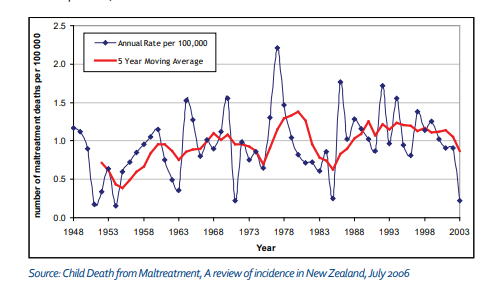
Intentional maltreatment death rates more than doubled in New Zealand in the 1980s - co-incidentally the same decade that neo-liberal economic policies were rolled out. The focus on neoliberal policies is on economic growth, with the idea that the 'trickle down' effect will lift all people.

It doesn't quite work like that. Since the 1980s we have had increasing levels of social inequality, child poverty and child abuse and deaths. Correlation is not necessarily causation, but in this case research demonstrates a strong link between social inequality and abuse.

Let's stop there. The writer is roughly correct in one respect: "Intentional maltreatment death rates more than doubled in New Zealand in the 1980s."

After halving in the prior period.


The writer wants neolibralism to be the explanation for this scourge but it isn't.


Sunday, September 20, 2020

Changing demographics could sort the housing crisis

We will have to wait a while but won't demographics eventually fix the housing crisis?

We have a very top-heavy population pyramid. NZ had the largest baby boom in the western world with respect to family size.

And the fastest growing household type is single.

I assume this reflects more widows/widowers, family breakdown and fewer people ever partnering.

The second  two trends will probably continue but as they do, more people are going to die (as a % of the population).

Fertility is trending down quite rapidly.

More deaths and fewer births will eventually solve the housing crisis.

Many of those retirement villages will be repurposed and more rental properties should be come available as inheritors become inadvertant landlords.

I  haven't however factored in immigration which could utterly negate my theory.

My guess is NZ will continue to attract and encourage high levels of foreign-born incomers because we want and need them.

So I have probably just written a pointless post. 


Saturday, September 19, 2020

Beliefs that fly in the face of evidence

 According to the British Adam Smith Institute:

It is a truth universally acknowledged that the UK is in something of a housing crisis. Home ownership has been declining for half a century. 90% of 25-34 year olds face average regional housing prices 3 to 4 times their income, up from less than half 20 years ago. Rent as a share of income has been rising, making the prospect of saving for mortgage deposit increasingly remote. 

Odd. Afterall the United Kingdom has a capital gains tax, apparently the solution to our housing crisis.

Unable to gain popular support for one here, Ardern still believes NZ should do the same:

Despite ruling out ever introducing a capital gains tax, Prime Minister Jacinda Ardern still believes New Zealand should have one.

Asked on Newshub Nation if she had "betrayed" Labour supporters by canning plans to introduce one after the 2020 election, Ardern said no.

"I've certainly not had that feedback from people that they take that view," she told host Simon Shepherd on Saturday morning.

"Did I believe in it? Yes. Still do."


Friday, September 18, 2020

Stuff: "Little evidence of child poverty coming down"

Stuff is writing a series called 'The Whole Truth' running up to the election. It aims to fact-check campaign claims, party policies and achievements. Today they feature a piece on child poverty which also appears in the Dominion Post. I've included the entire short piece (because it is the simplest summation of the measures I've read) and added  a few of my own comments:

"There is little evidence, on the Government’s own measures, of child poverty coming down.

As one of her Government’s earliest acts, Prime Minister Jacinda Ardern brought in the Child Poverty Act in 2018. It established ways of measuring poverty and laid out a series of targets against them.

There are three primary measures of poverty in the Act, two of which are income-based.

For these income measures, a mathematical model is used to “equivalise”, or flatten, the incomes of different households.

This allows a consistent measure to be applied across households of all different sizes. Larger households need more income to manage than smaller households do.As a result, there is no specific income figure under which all households are said to be living in poverty.

However, the government’s first measure for child poverty does say that a child is living in poverty if they’re in a home with an income less than half the average, equivalised disposable household income, before housing costs are deducted. 

(The average disposable household income, before housing costs, is currently $46,700 a year, according to Stats NZ.)

What do the numbers look like using this measure?

Ardern set a 2020/21 target of lifting 70,000 children above this line. That would mean shrinking the 2018 measure of 16.5 per cent of children to 10 per cent.

As of June 2019, the latest available figures, this measure was down by only 1.6 percentage points to 14.9 per cent. Instead of 183,500 children in poverty, there were 168,500.

There is another, similar sort of measure, which has recorded similar results to date.

Again, a child is considered in poverty if they’re in a home with an income less than half the average, equivalised disposable household income, but this time after housing costs are deducted.

(The average disposable housing income after housing costs is $35,800 a year.)

The target for this measure is a 4 per cent shift, or lifting 40,000 children from poverty. 

The 253,800 impoverished children first counted by this measure in 2018 reduced 2 percentage points in the year to June 2019, to 235,400 children.

A third measure goes more directly at material hardship. It defines a child as impoverished if they live in a home that lacks six or more key indicators, such as a home that lacks shoes, fresh fruit or vegetables, the ability to see a doctor, or the ability to pay power bills.  

This measure is favoured by Children’s Commissioner Judge Andrew Becroft, who says it’s a better measure of a child’s life at home. 

On this measure, the number of children in poverty has increased by 4100 in the year to June 2019, up 0.4 percentage points to 13.4 per cent. 

The shifts on all three measures are so small that they fall within the margins of error for each. 

And due to the lag in the data, it’s hard to know how recent events have affected New Zealand’s poorest children.

Despite this, Ardern has frequently cited a Treasury estimate that the number of children in poverty would reduce between 10 per cent and 12 per cent due to policies like the 2018 Families Package."

She also claims that poverty has fallen on 7 of the 9 measures. However only one of the small reductions is outside of the margin of error (-2% vs + or -1.9%). The margin of error exists because the results come from a survey of just 20,000 households. 

StatsNZ itself says, "...most of the changes likely reflect the expected uncertainties present in all sample surveys."

The Minister for Child Poverty Reduction also ignores that more children are now on benefits. That was the case BEFORE Covid. At December 2019 there were 12,000 more children on benefits than at December 2017. The number of children on welfare should actually represent one of the measures.

The writer, Thomas Manch, has unusually mentioned the equivalisation method. This means a large family with a relatively high income can appear in the poverty data. A household income gets equivalised down progressively based on household members.

Finally, the data is only till June 2019 - almost 15 months old. If the June 2020 data is released pre-election the PM will undoubtedly blame her lack of progress on Covid.

And that will represent yet another obfuscation.

Thursday, September 17, 2020

Where does NZ's GDP drop sit comparatively?

NZ's  GDP fell by 12.2% in the June Quarter.

Here are some other country comparisons:

(Click on source for interactive image)

The yellow bar (10.7%) represents the average of the G7 countries: Canada, France, Germany, Italy, Japan, the UK and US


Taxation out. Revenue Raising in.

Have you noticed that Labour no longer has a Tax Policy - only a Revenue Policy? Grant Robertson uses the term constantly. Now I see the Greens have joined in with a press release entitled, All Healthy, Now We Need To Revenue Raise.

They sound like a charity talking about the need to fundraise. But that involves persuading people to part with their money for a worthy cause.

Revenue raising requires legislated forcible removal of poeple's wealth for expenditure they may not agree with or benefit from. 

How stupid do they think we are?

Tax wasn't love and neither is revenue raising.

Wednesday, September 16, 2020

PREFU forecasts

Forecasts of Jobseeker and Emergency benefit numbers over the next few years are very fluid.

According to today's PREFU:

"The number of Jobseeker Support and Emergency Benefit recipients is expected to increase by 89,000 by 2020/21 compared with 2019/20 and then increase further in 2021/22 to peak at 279,000, before reducing to 246,000 recipients by 2023/24, 84,000 (an increase of 52%) more recipients than 2019/20." P56

That immediately struck me as lower than prior forecasts. This chart shows the earlier BEFU forcast:


Personally I still think it is too early to make any reasonable projections. 

You might argue the PREFU projection is more optimistic in the short term (more politically palatable?) but it is more pessimistic in the longer term.


Monday, September 14, 2020

Stop the world, I wanna get off

I've become a huge golf fan. Because I started playing. 

A close childhood friend came from Australia to celebrate our sixtieth birthdays together and she brought me her old clubs. Checked them in on her flight ensconsed in a bag and carrier. 

Briefly, around 32, I played for a few months and introduced her to the game. Then I got married, had a family and never held a club again. But she did. And she brought me her old clubs (replaced by a new supa dupa set) to rekindle my interest and entice me to go on an Australian golfing holiday with her at some future date.

So I joined the Hutt Park Club which has a slightly rumpty 9 hole course with a primary retail operation and driving range. Now I am addicted.

Every night I watch various instalments of the Master's Tournament. The players are my characters. It's like watching movies. Who will beat adversity this time? Who will hold his nerve this time?

Anyway, I'll get to the point of my post.

I'm watching the crowds following Tiger Woods ... in any of the five years in which he won the Green Jacket. And soaking up the sheer exuberance of the fans, his family and Tiger himself when he finally let's the emotion erupt at the 18th.

Is this jubilant, pressing crowd, thousands spread across the course, a thing of the past?

Are we ever going to come back to our senses as a world and relish what we love?

Golf is currently my thing. But you must have had that moment when you stopped in your tracks and said to yourself, "Is pre-Covid the freest we were ever going to be?"

Because it's not just Covid. We're are all well aware of it.

It's social media mindless collectivism which is powerful beyond reason. Think about that. Power beyond reason.

What is going to happen to Comedy in this aggressive, angry, anti-self expression age? When on-line self-appraised 'benign' bullies wield more power than those they wrongly label 'racists, xenophobes and misogynists.'

As we are progressively  sometimes literally held responsible for the so-called sins of our great grand fathers and denied the products of their culture, what great new standard is it we will all be made to hold ourselves to?

Can we not be imperfect humans, irrevant humans, irascible humans, imaginative humans from here on in?

If not, I'll vacate far more happily than should be the case.


Sunday, September 13, 2020

Damien Grant on cannabis legalisation

Good discussion from Damien Grant, a committed libertarian. I must be getting intellectually lazy because I want someone to convince me which way to vote instead of making my own mind up. And Grant seems like a good candidate coming down on the 'yes' side due only to the immorality of prohibition, my major impetus towards the same decision. But in the process he highlights the sheer nuttiness of the proposed legislation. This in particular rankles with me. With regard to the new governmental agency to be established, the Cannabis Regulatory Authority :

The Authority must prioritise non-for-profit applicants for licences and applicants that can “...demonstrate a commitment to delivering social benefit to the community or communities…”

I mean, why? The idea is to end the failed prohibition of marijuana by allowing pot-heads to buy their weed from a shop rather than a criminal gang, not tack onto a simple retail operation a range of social justice obligations.

More of the virtue signalling lunacy the Kiwibank is indulging in. Who knows what sort of legislation will develop once given the Green light. I keep feeling as if I am being sold a lemon. What's worse, a useless Green lemon.

So sorry Damien. I am still on the friggin' fence.

I may abstain.

Saturday, September 12, 2020

Labour's welfare plan: Recycled policy which flies in face of evidence

 According to RNZ today:

Under Labour's welfare plan, the training incentive allowance for higher skilled courses would be reinstated, and people on a benefit and working part-time would be able to earn more.

The training incentive allowance (TIA) was scrapped because of Treasury advice to the first Welfare Working Group (Rebstock 2009):

Fifty-one percent of DPB recipients participating in an intervention took the Training Incentive Allowance, which MSD found to have no effect on the time a beneficiary was likely to spend off benefit – in fact the study found there was a chance TIA slightly increased the average time spent on benefit. MSD did note there was a chance that TIA may have an unobserved long-term impact (after seven years) on time spent off benefit.

The TIA allowed people people to extend their study and spend more time dependent. Given National's goal was to reduce dependency it was decided to spend the money elsewhere. From memory in more basic skills training aimed at getting more people, particularly poorly educated mothers, into the workforce.

Labour would also increase abatement thresholds so people could earn more in part-time work - up to $160 a week, before their benefit is reduced, about eight hours on the minimum wage. At the moment benefits start reducing for any earnings over $90 a week for someone on Jobseeker support.

The thresholds would also increase for Sole Parent Support the Supported Living Payment.

"This will enable people to keep more of what they earn and increase the financial incentive to stay in or take up part-time work."

It actually encourages people to cap their work hours and spend the rest of the time on welfare. Instead of people becoming independent of welfare they take advantage of a mix.

Labour is truly devoid of new ideas in the welfare area and has spent three years simply undoing measures that National had implemented for good reasons in the previous nine. 

But it's even worse. They have undone policies championed by the last Labour government, such is the influence of the Green party.


Friday, September 11, 2020

Working age benefit receipt nudges up to 12.1%

Working age benefit receipt has nudged up to 12.1%. At the height of the GFC it reached 12.4%

In the week to September 4 a further 1,702 people went on a jobseeker benefit.

However 6,203 came off the Covid Income Relief payment (that's the difference between grants and cancels weekly.)

It seems odd that the two numbers aren't closer until you read that,

There were 7,538 cancels off CIRP for the reason ‘End of Entitlement’ during the week ending 4 September 2020. A CIRP client may not have received their full entitlement at the time of the cancellation, and will receive the remainder of the entitlement over subsequent pay-dates.

So there seems to be some lag in the system meaning cancellations won't immediately lead to a transfer to a Jobseeker benefit. And some people who have been recieving the CIRP won't qualify for the Jobseeker benefit either.

It's all a bit of a mess.

Thursday, September 10, 2020

Labour is no friend to low income Maori and beneficiaries

 I've spoken out against benefit dependence for a couple of decades. It's not personal. I have no bone to pick with individuals. My opposition has always been to the 'system' which draws people in and traps them, and the cockeyed incentives that reward lack of life-ownership. My idea of getting people off welfare was never to misery them into it. Letting them taste the experience of work and mates and good earning prospects is the best road to long term independence. Not forgetting that some people - a minority - have little choice but to stay on welfare due to accident and illness.

Here are two charts from Stats NZ showing how much of their income Maori and beneficiaries are forking out for rent and cigarettes compared to others. At the March 2020 quarter:


The Labour government kept up the tobacco tax hikes through to 2020 and significantly increased landlord costs driving up rents.

They are no friend of those they pretend to be.


Wednesday, September 09, 2020

Children's Commissioner thinks more children on benefits is OK


Since becoming Children's Commissioner, Andrew Becroft's strong left leanings have become increasingly apparent. In this interview he gets right into blaming Rogernomics and neoliberalism for child poverty. 

But this is the soundbite I heard:

Becroft says the present Government has done more than any previous regimes to help kids out of poverty. 

"We were well-placed to deliver this year, but I guess COVID wrecked all that. I just hope we don't drop the ball next year." 

He cited the Families Package and linking benefits to the average wage as achievements by the current government.

If NZ was "well-placed to deliver"  earlier this year then the Commissioner must be comfortable with 12,000 more children being on benefits.

At 31 December 2019 there were 206,395 children aged 0-18 reliant on caregiver on a main benefit (185,930), Young Parent Payment (1,531) or Orphan/ Unsupported Child benefit (18,934). That's 6 percent higher than at December 31, 2017.

Of the 59,637 births during 2019 10,882 babies were welfare-dependent by year end. Nearly one in five. Over half - 57% - were added to an existing benefit.

New Zealand's child poverty problem cannot be solved when high numbers of children live in non-working homes. Raising benefits and reducing the income margin between work and welfare will only incentivise more people to opt for welfare. This normalises benefit dependency for their children and the habit becomes inter-generational.

In 2008 Finance Minister Michael Cullen said, "...it is desirable to create a margin between being dependent on a benefit and being in employment....

The Labour Party isn’t the party that says living on a benefit is a preferred lifestyle. Its position has always been that the benefit system is a safety net for those who are unavoidably unable to participate in employment. From its history, the Labour Party has always been about people in employment."

The more the current Labour government ignores this, the more intractable the child poverty problem will become.

Same goes for the Children's Commissioner.