The government's temporary, boosted assistance for workers made redundant, ReStart, may play a role in deepening the recession. That is because, as usual, with welfare paid out of general taxes there will be distortional incentives.
The package is going to encourage these responses.
From employers;
1/ They will feel more comfortable laying off workers. An employer who might otherwise have worked with staff to share in a decreased return from the business might now mentally justify making one or two redundant. Especially if he is inclined to keep his own returns to a status quo.
The Minister has been explicit in urging employers to ring the 0800 number to find out what support can be provided if employers 'need' to make staff redundant. Some individuals take their 'morality' from the state. They will be assured they are doing the 'right' thing.
2/ Employers will be incentivised to minimise redundancy payments in order that employee qualifies for greater assistance.
From employees;
1/ As the extra assistance is means-tested the redundant worker may be tempted to take a lower redundancy payment, or dispose of any cash assets or investments within 20 days. He will find ways to maximise the assistance on offer even if conditions have been put on eligibility for reasons of 'fairness'.
2/ Employees will be encouraged to take voluntary redundancy where they might otherwise not have. For instance, low paid women who have left DPB to work 20 hours may find a return to benefit will see them in a better financial position (for up to 16 weeks at least).
These incentives then, could drive unemployment higher than it would otherwise have gone, thereby reducing desperately needed productivity. The rise could be compounding.
What will it cost?
The costing of ReStart is based on a 'worst case scenario' of 70,000 job losses over two years. As I have previously pointed out however, if Treasury predictions are right (and they are lower than other economists) and unemployment rises to 5.7 percent by 2010 then the total unemployed is likely to be over 135,000.
The costings of $50 million are far too modest. Even if they are based on 70,000 redundancies the figure assumes an average payout of $714. Using the Ministry's own examples of typical payouts, this assumes each person becomes re-employed within 8 weeks.
There are also difficulties with the concept of self-employed people effectively making themselves redundant. A self-employed person just scraping by, who was considering a move back to being an employee anyway, could be tempted to declare himself redundant in the interim.
Additionally there will be people who miss out on the help because of technicalities. For instance a worker with a long and stable employment history who just happened to have a break during the last 6 months will be ineligible.
In countries which operate dedicated unemployment insurance schemes it is normal to pay one claimant more than another based on the difference in the premiums that have been contributed. But that is not what is going to happen here. The extra assistance qualified for is based upon need, not contribution. Sounds fair but why is one family needier than the next? Perhaps one family has been living frugally in order to pay down their mortgage while the next has been living beyond their means. The family that will be eligible is the second because they have high mortgage repayments and no savings. (A cynical bureaucrat may point out that the first family, which is used to living frugally will manage better on just the basic dole whereas the second is accustomed to chomping through more money.) This is more of the socialist imperative of punishing responsibility and rewarding irresponsibility.
The good aspect of this development is the government employing the principle of temporary assistance. That is something we need to see more of. But not on top of indefinite entitlement benefits.
Tuesday, December 16, 2008

Monday, December 15, 2008
Crisis? What crisis?
There can be no doubt there is a strongly conservative mood afoot in the early 21st century. The prohibitionists of many flavours are more prevalent than they were during the last part of the 20th. Although certainly not exclusively females they do predominate. Strangely their political colours are varied. Often Green but just as often blueish. Fortunately the blueish ones have failed to secure an effective parliamentary presence with the failure of the Family and Kiwi Party's most recently.
My comments are provoked by the Dominion Post's headlines of the last two editions. Saturdays front page proclaimed, 'We are killing ourselves' and today's 'Weekend of drunken mayhem'. Both are strident rallying cries to clamp down on alcohol.
The voices come from people who work in A & E and alcohol watchdogs. On Saturday the solution pushed was a massive increase in the price of alcohol through higher taxes. Bugger the people who drink responsibly and the people who make their livings from producing and selling alcohol.
But when you look at the facts reported there is room for optimism. A booze bus operating in Levin and Otaki (potentially areas where a high result might be anticipated) only 9 out of 1,000 people tested were over the limit. Not even 1 percent. The Wellington police said the number of calls due to alcohol-related incidents was nothing out of the ordinary. And let's not forget that the number of calls is up due to the 'It's not OK' campaign - apparently. The police had processed all of 22 intoxicated people yesterday.
The front page of the Dominion Post is being used to promote the crusades of those who chose to work in areas where they know they will see the extremes of alcohol abuse but would nonetheless punish the rest of civilised society with their prohibitive solutions.
My comments are provoked by the Dominion Post's headlines of the last two editions. Saturdays front page proclaimed, 'We are killing ourselves' and today's 'Weekend of drunken mayhem'. Both are strident rallying cries to clamp down on alcohol.
The voices come from people who work in A & E and alcohol watchdogs. On Saturday the solution pushed was a massive increase in the price of alcohol through higher taxes. Bugger the people who drink responsibly and the people who make their livings from producing and selling alcohol.
But when you look at the facts reported there is room for optimism. A booze bus operating in Levin and Otaki (potentially areas where a high result might be anticipated) only 9 out of 1,000 people tested were over the limit. Not even 1 percent. The Wellington police said the number of calls due to alcohol-related incidents was nothing out of the ordinary. And let's not forget that the number of calls is up due to the 'It's not OK' campaign - apparently. The police had processed all of 22 intoxicated people yesterday.
The front page of the Dominion Post is being used to promote the crusades of those who chose to work in areas where they know they will see the extremes of alcohol abuse but would nonetheless punish the rest of civilised society with their prohibitive solutions.
Saturday, December 13, 2008
Just like the 'mother country'
“It is about the right to work. It is in the name of the party. It is the Labour party.”
Hah. That's a quote from Labour's Work and Pensions Minister, James Purnell, as he defends his proposed welfare 'reforms' on the eve of their announcement.
From what is already known, they are timid. They will have little effect, essentially asking beneficiaries to plan to go to work as opposed to stopping the inflow of young people or tightening up eligibility.
Asked why he wouldn't consider time-limiting benefits;
"The British people would think that was unfair, if you had very bad luck over five years and at the end of it there was an arbitrary limit to your support.”
James Bartholomew sums up the UK's performance in welfare over the last few years. He could just as easily be talking about New Zealand and our Labour Party's performance.
Britain has more than four million people who are of working age but who are claiming benefit on the basis that they are not working. This is the case after more than a decade of economic growth. The figure is likely to rise substantially now that we have entered a recession.
The numbers who are claiming benefits in this way are about four times the equivalent figure in the 1960s. This has been a massive increase and it shows particularly in the number claiming benefit on the basis that they are sick or incapable and then number claiming benefit as lone parents...
...The Labour government basically funked it. President Clinton had signed into law a radical change in the USA which resulted a 60 per cent reduction in the numbers claiming welfare benefits. Other countries, according to Professor Gregg, also sharply increased the conditionality of their welfare benefits. Britain has made only marginal progress. The welfare culture with the damaging effects it has on national culture has been allowed to continue.
Hah. That's a quote from Labour's Work and Pensions Minister, James Purnell, as he defends his proposed welfare 'reforms' on the eve of their announcement.
From what is already known, they are timid. They will have little effect, essentially asking beneficiaries to plan to go to work as opposed to stopping the inflow of young people or tightening up eligibility.
Asked why he wouldn't consider time-limiting benefits;
"The British people would think that was unfair, if you had very bad luck over five years and at the end of it there was an arbitrary limit to your support.”
James Bartholomew sums up the UK's performance in welfare over the last few years. He could just as easily be talking about New Zealand and our Labour Party's performance.
Britain has more than four million people who are of working age but who are claiming benefit on the basis that they are not working. This is the case after more than a decade of economic growth. The figure is likely to rise substantially now that we have entered a recession.
The numbers who are claiming benefits in this way are about four times the equivalent figure in the 1960s. This has been a massive increase and it shows particularly in the number claiming benefit on the basis that they are sick or incapable and then number claiming benefit as lone parents...
...The Labour government basically funked it. President Clinton had signed into law a radical change in the USA which resulted a 60 per cent reduction in the numbers claiming welfare benefits. Other countries, according to Professor Gregg, also sharply increased the conditionality of their welfare benefits. Britain has made only marginal progress. The welfare culture with the damaging effects it has on national culture has been allowed to continue.
Friday, December 12, 2008
Why National's DPB reforms aren't enough
The Americans reached a realisation that welfare was harming families and children during the 1990s. They decided that open-ended welfare must be transformed into temporary assistance only. They abolished Aid To Families With Dependent Children (AFDC) and introduced Temporary Assistance For Needy Families (TANF).
I came across this in the Delaware State Plan;
Five key principles form the foundation of TANF:
1. Work should pay more than welfare.
2. Welfare recipients must exercise personal responsibility in exchange for benefits.
3. Welfare should be transitional, not a way of life.
4. Both parents are responsible for supporting their children; and
5. The formation and maintenance of two-parent families should be encouraged, and teenage pregnancy and unwed motherhood should be discouraged.
If we held current New Zealand policy up to these principles, it would fail. As would National's work-testing-without-a-cap amendment. I will take each principle and show why with just one point;
1/ Having more children raises welfare income. People in work do not get a pay rise when they add children to their family. Hence welfare pays more than work.
2/ Adding children to an existing benefit highlights 5,000 acts of personal irresponsibility every year.
3/ A female can go from being supported as a dependent child on the DPB, to receiving the sickness benefit for her own pregnancy, to receiving the DPB as a sole parent, to receiving to DPB for Women Alone, to receiving Superannuation. Nearly 500 people moved from the DPB to Super in 2006. There is no legislation that prevents a person from choosing this pathway.
4/ The current child support/DPB system actively encourages non-support of children.
5/ Benefits for mothering are available to females from the age of 16 and very few, if any, conditions are imposed. In broad terms money is taken from two parent families and given to one parent families hence the 'formation and maintenance' of the first is discouraged.
All of this will continue unless National has plans afoot we are not yet privvy to.
I came across this in the Delaware State Plan;
Five key principles form the foundation of TANF:
1. Work should pay more than welfare.
2. Welfare recipients must exercise personal responsibility in exchange for benefits.
3. Welfare should be transitional, not a way of life.
4. Both parents are responsible for supporting their children; and
5. The formation and maintenance of two-parent families should be encouraged, and teenage pregnancy and unwed motherhood should be discouraged.
If we held current New Zealand policy up to these principles, it would fail. As would National's work-testing-without-a-cap amendment. I will take each principle and show why with just one point;
1/ Having more children raises welfare income. People in work do not get a pay rise when they add children to their family. Hence welfare pays more than work.
2/ Adding children to an existing benefit highlights 5,000 acts of personal irresponsibility every year.
3/ A female can go from being supported as a dependent child on the DPB, to receiving the sickness benefit for her own pregnancy, to receiving the DPB as a sole parent, to receiving to DPB for Women Alone, to receiving Superannuation. Nearly 500 people moved from the DPB to Super in 2006. There is no legislation that prevents a person from choosing this pathway.
4/ The current child support/DPB system actively encourages non-support of children.
5/ Benefits for mothering are available to females from the age of 16 and very few, if any, conditions are imposed. In broad terms money is taken from two parent families and given to one parent families hence the 'formation and maintenance' of the first is discouraged.
All of this will continue unless National has plans afoot we are not yet privvy to.
Women's troubles
It is never long between reports that women aren't getting a fair shake of the stick - in the workplace or in society.
Yet our biggest government department employs a staff that is 73 percent female. Yes, the Ministry of Social Development. They like to skite that their workforce is representative. It's true that the majority of beneficiaries are women.
The Families Commission does even better in employing a staff that is 83 percent female. Then they start acting like role models by being very family friendly with flexible hours, school holiday programmes at work, going home early on Families Day, etc. I guess the idea is walking the talk so they can justify lobbying for ever more workplace legislation along these lines. Think compulsory breastfeeding-stations.
But the people who work in these organisations don't live in the real world. They don't have shareholders to answer to and profits that must be made if they want jobs. They have budgets but they go over them routinely. If they don't go over them they won't appear to be working hard. The taxpayer's pocket is very deep.
Many of these women employees - and their 'clients' - would once have been supported by men and worked in unpaid caring roles. But the more paid caring roles that are created - DPB carers beget social workers for example - the more they have to be managed and studied and monitored. The whole kit and caboodle exists to expand.
Now New Zealand is being told off by UNICEF because it has too many children living in poverty, not enough Paid Parental Leave and not enough good quality childcare. Don't tell me. Another taxpayer cash injection is called for. Yet;
1/ Most of the children living in 'poverty' in NZ have mothers on the DPB.
2/ The DPB is permanent paid parental leave.
Paying people to produce and stay home with children has hardly been hugely successful to date.
If the government would keep its nose out of redistributing income to further what it sees as socially desirable ends, people would get back to relying on each other for committed support. In which case the DPB, PPL and subsidised childcare, as institutions, would all be redundant.
Need I say it? More government, and the many appendages of government, is not the answer.
Yet our biggest government department employs a staff that is 73 percent female. Yes, the Ministry of Social Development. They like to skite that their workforce is representative. It's true that the majority of beneficiaries are women.
The Families Commission does even better in employing a staff that is 83 percent female. Then they start acting like role models by being very family friendly with flexible hours, school holiday programmes at work, going home early on Families Day, etc. I guess the idea is walking the talk so they can justify lobbying for ever more workplace legislation along these lines. Think compulsory breastfeeding-stations.
But the people who work in these organisations don't live in the real world. They don't have shareholders to answer to and profits that must be made if they want jobs. They have budgets but they go over them routinely. If they don't go over them they won't appear to be working hard. The taxpayer's pocket is very deep.
Many of these women employees - and their 'clients' - would once have been supported by men and worked in unpaid caring roles. But the more paid caring roles that are created - DPB carers beget social workers for example - the more they have to be managed and studied and monitored. The whole kit and caboodle exists to expand.
Now New Zealand is being told off by UNICEF because it has too many children living in poverty, not enough Paid Parental Leave and not enough good quality childcare. Don't tell me. Another taxpayer cash injection is called for. Yet;
1/ Most of the children living in 'poverty' in NZ have mothers on the DPB.
2/ The DPB is permanent paid parental leave.
Paying people to produce and stay home with children has hardly been hugely successful to date.
If the government would keep its nose out of redistributing income to further what it sees as socially desirable ends, people would get back to relying on each other for committed support. In which case the DPB, PPL and subsidised childcare, as institutions, would all be redundant.
Need I say it? More government, and the many appendages of government, is not the answer.
Thursday, December 11, 2008
Too many cooks
The title of this post is too frivolous but sets the scene aptly.
This morning Minister for Social Development, Paula Bennett, told Breakfast TV host Paul Henry, that although she had called a halt to the Families Commission Summit, she had no intention of scrapping the Commission itself. Among other things she believed they had done a good job in the 'It's not OK' campaign. 'It's not OK' has almost become part of our vocabulary she said.
The 'It's not OK' campaign has apparently resulted in more reports to police of family violence. When the police respond to a report, if children are present in the home, they are bound to make a notification to CYF.
See below the effect this has had;

Now, the CYF Briefing to the Incoming Minister has this warning;
The volume of family violence notifications we receive from the Police is higher than ever. We received 33,569 in 2007/2008, compared to 26,348 in 2006/2007. This is an increase of just over 27 per cent. If this number continues to rise, it will have an impact on our ability to cope.
The growing number of family violence notifications provides further opportunities for a more effective community response. Most of these cases are best responded to by family violence workers, not Child, Youth and Family social workers.
Let's be clear about this. The campaign by one arm of government is causing a problem for the other.
In fact the campaign might feasibly be making life for children in genuine danger even riskier as those social workers with the power to remove them become less available. Theoretically one could even speculate that the FARs (Further Action Required) line in the graph above has dropped slightly as a direct result of the notifications increasing. Over-worked social workers will have reduced capacity to take further action.
This morning Minister for Social Development, Paula Bennett, told Breakfast TV host Paul Henry, that although she had called a halt to the Families Commission Summit, she had no intention of scrapping the Commission itself. Among other things she believed they had done a good job in the 'It's not OK' campaign. 'It's not OK' has almost become part of our vocabulary she said.
The 'It's not OK' campaign has apparently resulted in more reports to police of family violence. When the police respond to a report, if children are present in the home, they are bound to make a notification to CYF.
See below the effect this has had;

Now, the CYF Briefing to the Incoming Minister has this warning;
The volume of family violence notifications we receive from the Police is higher than ever. We received 33,569 in 2007/2008, compared to 26,348 in 2006/2007. This is an increase of just over 27 per cent. If this number continues to rise, it will have an impact on our ability to cope.
The growing number of family violence notifications provides further opportunities for a more effective community response. Most of these cases are best responded to by family violence workers, not Child, Youth and Family social workers.
Let's be clear about this. The campaign by one arm of government is causing a problem for the other.
In fact the campaign might feasibly be making life for children in genuine danger even riskier as those social workers with the power to remove them become less available. Theoretically one could even speculate that the FARs (Further Action Required) line in the graph above has dropped slightly as a direct result of the notifications increasing. Over-worked social workers will have reduced capacity to take further action.
Talking about the Families Commission
I was invited to join Radio New Zealand's Jim Mora for a discussion about the Families Commission and whether we need it. Funnily enough Chris Trotter, when on topic and not talking about the history of the Labour Party or the pressing need to build more state houses, agreed with me more than once. (Starts at 9:00)
I note too that the DomPost editorial today calls for the scrapping of the Families Commission.
This entity began life with Commissioners numbering up to seven and 20 support staff. According to their latest annual report there are now 41 staff. Like the Children's Commissioner, they are well over budget. Most of the staff are involved in policy and research but the Ministry of Social Development has another 330 people fulfilling similar functions within the main body.
Its pet project seems to be trying to convince the government to increase spending on Paid Parental Leave ten-fold. As far as I can ascertain its sole purpose is to influence greater redistribution of resources. To Swedenise New Zealand if you like.
National's plan to amalgamate it with the Children Commissioner's Office is nothing more than window dressing. Disband it.
I note too that the DomPost editorial today calls for the scrapping of the Families Commission.
This entity began life with Commissioners numbering up to seven and 20 support staff. According to their latest annual report there are now 41 staff. Like the Children's Commissioner, they are well over budget. Most of the staff are involved in policy and research but the Ministry of Social Development has another 330 people fulfilling similar functions within the main body.
Its pet project seems to be trying to convince the government to increase spending on Paid Parental Leave ten-fold. As far as I can ascertain its sole purpose is to influence greater redistribution of resources. To Swedenise New Zealand if you like.
National's plan to amalgamate it with the Children Commissioner's Office is nothing more than window dressing. Disband it.
Wednesday, December 10, 2008
How most New Zealanders see themselves?
There is an inordinate amount of squealing going on at the moment by those who have held sway for the last nine years. Here an academic takes on the thinking behind curbing local government and makes an interesting but unsubstantiated claim;
But deep down in this vein of thinking are more insidious ideological preconceptions about who we are as a society and what the legitimate role of government ought to be. Most Kiwis, apart from those to the far right, would feel uncomfortable with such views.
In this respect most New Zealanders see themselves having more in common with the worldviews of European social democrats than with those of American neo-conservatives.
Actually Labour fancied themselves as the New Zealand version of the social democrats. Their grand vision was to cement themselves as such as the natural party of government. The electorate just threw them out because they behaved as such.
As immigrants from Europe my parents were decidedly different to their siblings. So were their forbears. Their values drove them out of Europe. As did the values of many who journeyed, of their own volition, to Australia and the States. The people the writer mixes with may be Scandinavian wannabes but I am not convinced "most New Zealanders" are.
Somewhere along the line we have forgotten the description of New Zealanders as embodying rugged individualism. But there is still a strong strain of it simmering.
....councils should play a broad and proactive role in responding to community objectives and promote social, economic, cultural and environmental wellbeing.
Bollocks. The well-being of many ratepayers has been severely compromised by this very prescription. This is just code for greater and greater wealth redistribution by those who can't make a gainful living elsewhere.
But deep down in this vein of thinking are more insidious ideological preconceptions about who we are as a society and what the legitimate role of government ought to be. Most Kiwis, apart from those to the far right, would feel uncomfortable with such views.
In this respect most New Zealanders see themselves having more in common with the worldviews of European social democrats than with those of American neo-conservatives.
Actually Labour fancied themselves as the New Zealand version of the social democrats. Their grand vision was to cement themselves as such as the natural party of government. The electorate just threw them out because they behaved as such.
As immigrants from Europe my parents were decidedly different to their siblings. So were their forbears. Their values drove them out of Europe. As did the values of many who journeyed, of their own volition, to Australia and the States. The people the writer mixes with may be Scandinavian wannabes but I am not convinced "most New Zealanders" are.
Somewhere along the line we have forgotten the description of New Zealanders as embodying rugged individualism. But there is still a strong strain of it simmering.
....councils should play a broad and proactive role in responding to community objectives and promote social, economic, cultural and environmental wellbeing.
Bollocks. The well-being of many ratepayers has been severely compromised by this very prescription. This is just code for greater and greater wealth redistribution by those who can't make a gainful living elsewhere.
Talkfest torpedoed
It was unclear yesterday what Paula Bennett intended to do about a families Commission Summit to be held in February 2009 at the cost of 200,000 so I didn't comment. Now it is clear she is pulling the plug on the affair. Well done. If National continues with this habit there will certainly be less to criticise. With the talkfest torpedoed she might as well go a step further and disband the Commission itself. Apart from preserving paper-producing jobs (of which there are hundreds more within MSD) I can think of no reason to persist with it.
Tuesday, December 09, 2008
Wiping away tears
A 16-year-old wiped away tears as he appeared in Christchurch Youth Court today charged with the murder of Abdulrahaman Ikhtiari.
He should be taken to the home of the victim and made to wipe away the tears of his wife and children. Perhaps he might vaguely stumble upon the difference between tears of grief and tears of self-pity.
He should be taken to the home of the victim and made to wipe away the tears of his wife and children. Perhaps he might vaguely stumble upon the difference between tears of grief and tears of self-pity.
Taxing questions
I gather John Key's throne speech has been delivered and is no longer embargoed. No surprises. All the stuff we already knew about. But this has me nonplussed;
My Government is today tabling a Bill to reduce personal taxes from 1 April 2009. Its intention is to pass this new tax legislation by Christmas and it believes this tax reduction will equip New Zealanders with some much needed extra cash in tough economic times.
Personal taxes will be further reduced from 1 April 2010 and from 1 April 2011. As a result, by 1 April 2011 around 80% of New Zealand taxpayers will end up paying no more than 20c in tax for every additional dollar that they earn.
Additional to what? So we could have a higher tax rate than 20 percent up to a certain threshold and then a reduction above it? Or is 20 percent the top rate target by 2011? What am I missing here?
My Government is today tabling a Bill to reduce personal taxes from 1 April 2009. Its intention is to pass this new tax legislation by Christmas and it believes this tax reduction will equip New Zealanders with some much needed extra cash in tough economic times.
Personal taxes will be further reduced from 1 April 2010 and from 1 April 2011. As a result, by 1 April 2011 around 80% of New Zealand taxpayers will end up paying no more than 20c in tax for every additional dollar that they earn.
Additional to what? So we could have a higher tax rate than 20 percent up to a certain threshold and then a reduction above it? Or is 20 percent the top rate target by 2011? What am I missing here?
Memo to Greenpeace
Today's Dominion Post had a post-it note attached to the frontpage.
The one below is John's response (or the one I would like to see). Got any other ideas?

The one below is John's response (or the one I would like to see). Got any other ideas?

Is ACT becoming "socially conservative"?
Colin James makes this observation about ACT's chances of doubling its vote in 2011;
Act's best hope is the last option, to morph into a social conservative party, for which our liberal policy settings have left space and on to which it could tack radical economics in a minor key. Rodney Hide has taken the party partway there. But he is not there yet.
Is ACT becoming socially conservative? Do I care?
That wasn't a flippant remark. I stopped my automatic payment to ACT after many years because I don't know what I am supporting. I have always believed Rodney Hide was a libertarian but he has kept a pretty tight lid on any socially liberal views he holds. The votes matter most and I understand the pragmatism essential to success. I can't do that stuff. Abject failure at it. I have a compulsion to tell the truth as I see it. I don't always know what the truth is so searching for it tends to take priority. This compulsion (as some of my perceived truths have turned out to be self-deceptions) has gotten me into trouble at various times in my life. And I still tend to upset matters among family members by not being prepared to bite down hard on my tongue when misguided proclamations - especially political ones - are uttered. But I digress.
Looking at the ACT MPs other than Rodney I don't sense a true liberal amongst them. But then I don't know them very well. Is Colin James right? (and please don't leave comments about him in lieu of comments about his observation.)
Act's best hope is the last option, to morph into a social conservative party, for which our liberal policy settings have left space and on to which it could tack radical economics in a minor key. Rodney Hide has taken the party partway there. But he is not there yet.
Is ACT becoming socially conservative? Do I care?
That wasn't a flippant remark. I stopped my automatic payment to ACT after many years because I don't know what I am supporting. I have always believed Rodney Hide was a libertarian but he has kept a pretty tight lid on any socially liberal views he holds. The votes matter most and I understand the pragmatism essential to success. I can't do that stuff. Abject failure at it. I have a compulsion to tell the truth as I see it. I don't always know what the truth is so searching for it tends to take priority. This compulsion (as some of my perceived truths have turned out to be self-deceptions) has gotten me into trouble at various times in my life. And I still tend to upset matters among family members by not being prepared to bite down hard on my tongue when misguided proclamations - especially political ones - are uttered. But I digress.
Looking at the ACT MPs other than Rodney I don't sense a true liberal amongst them. But then I don't know them very well. Is Colin James right? (and please don't leave comments about him in lieu of comments about his observation.)
Monday, December 08, 2008
Xmas greetings of a different kind
The Manawatu Standard reports, in Central Districts, the police are sending out letters to families with a history of domestic violence warning them to behave over the Xmas period. This raises a number of questions and reactions from me;
1/ As members of the community we are now being constantly bombarded to act if we suspect family violence is happening. Yet this exercise clearly highlights that even when the police 'suspect' violence is occurring (which is surely why they are sending the letters) little can be done until a significant event has taken place, which is often too late.
2/ Will these letters raise stress levels resulting in the very problem they are trying to prevent? The article acknowledges that the letter can provoke a "negative reaction".
3/ Are police men and women social workers or law enforcement officers?
4/ Who signs the letter, because it is written in the first person? And who is the letter addressed to - the offender or the victim of past violence? Is there no problem with privacy or letters falling into the wrong hands? Or a letter being used to deliberately provoke someone?
5/ Are civil rights being ignored? If someone has been dealt with by the court should they be badgered by the police on the basis they 'might' re-offend? Or do we treat family violence offenders as a different class of people with no entitlement to the 'innocent until proven guilty' status?
6/ If an offender is told his or her home is being monitored is there a potential for the violence to simply shift elsewhere?
7/ If, heaven forbid, somebody is murdered in one of these families after receiving the letter, what are the legal implications for the police?
However, the same exercise was deemed to be a success in Counties-Manukau so maybe the risks and questionable interventions are worth taking. I just hope the police have thought it through thoroughly.
1/ As members of the community we are now being constantly bombarded to act if we suspect family violence is happening. Yet this exercise clearly highlights that even when the police 'suspect' violence is occurring (which is surely why they are sending the letters) little can be done until a significant event has taken place, which is often too late.
2/ Will these letters raise stress levels resulting in the very problem they are trying to prevent? The article acknowledges that the letter can provoke a "negative reaction".
3/ Are police men and women social workers or law enforcement officers?
4/ Who signs the letter, because it is written in the first person? And who is the letter addressed to - the offender or the victim of past violence? Is there no problem with privacy or letters falling into the wrong hands? Or a letter being used to deliberately provoke someone?
5/ Are civil rights being ignored? If someone has been dealt with by the court should they be badgered by the police on the basis they 'might' re-offend? Or do we treat family violence offenders as a different class of people with no entitlement to the 'innocent until proven guilty' status?
6/ If an offender is told his or her home is being monitored is there a potential for the violence to simply shift elsewhere?
7/ If, heaven forbid, somebody is murdered in one of these families after receiving the letter, what are the legal implications for the police?
However, the same exercise was deemed to be a success in Counties-Manukau so maybe the risks and questionable interventions are worth taking. I just hope the police have thought it through thoroughly.
Sunday, December 07, 2008
A product of the welfare state
Latest post from The Welfare State We're In. It concerns Karen Matthews and some of the 'opinion' she has provoked. I will assume you already know who she is. (My own brief comment appears at the end);
Karen Matthews 'a one-woman advertisement for urgent welfare reform. '
It is astonishing the way that news and opinion work in Britain. Today, suddenly there is a focus on the idea that the welfare state created Karen Matthews, the woman who arranged for the kidnap of her own daughter.
The key to this seems to be that one of her lovers asserted that she had given birth to more babies to increase her welfare benefits.
In my book, I put the argument that the welfare state had undermined the morality of those most affected by it, namely those at the poorer end of society. I suggested it had damaged our culture and caused misery on a massive scale.
It is fascinating to see the arguments I put very carefully and with as much relevant evidence that I could muster put now in a really pugnacious and blunt way.
I don't want to associate myself with all the views expressed in the Sun today but they certainly overlap with mine. I agree that Karen Matthews is a creation of the welfare state. I certainly agree with the Sun that the need for reform is urgent. Sadly, the beneficial effects of reform would take a generation to come through. When views such as these are expressed in the Guardian and by presenters of the Today programme on Radio 4 or on Newsnight, then there will be a chance of reform actually happening.
From the Sun editorial:
If ever there was a story to make you hold your head in disbelief, this is it.
How could a MOTHER have her own little girl drugged, kidnapped, tethered like an animal and stuffed in a drawer under a bed?
Vile Karen Matthews is a product of the sink-estate underclass of chaotic families that loaf away their days on easy welfare benefits.
She is a one-woman advertisement for urgent welfare reform.
Slumped in front of her big TV, chain-smoking 60 a day and stuffing herself with pizza, Matthews didn’t give a damn for her kids.
By 30 she’d had seven children by five fathers and was raking in £360 a week in handouts.
One of her grubby lovers said: “She used us just to get pregnant so she could grab more child benefit.”
From John Gaunt's column:
The tragedy is that — just as there will be another Baby P case — there are plenty more Shannons being dragged up in a life of grime that leads to a life of crime.
To blame are the feral parents who couldn’t spell the word parenthood, let alone know the meaning of it.
Whole estates are infested by this underclass. They are not working class — the clue is in the title — they don’t and won’t work.
They have no pride in their homes or areas. They have no respect for themselves, let alone their neighbours or children. They have a moral code that would make an alley cat blush.
They have a lawyer’s expert knowledge of their rights but, sadly, no idea of their responsibilities to their kids or society in general. This is an underclass that New Labour have allowed to fester with their lax “non-judgmental, all kinds of family are equal” social engineering attitude.
But these people aren’t equal to you and me, and they need to be told so before they are allowed to breed another generation that will only be more irresponsible and useless.
Welfare
We have a sickening situation where those of us who actually work spend more than £170billion of our taxes on social security. That is in addition to the £16billion spent on incapacity benefit.
It’s ironic that Matthews was convicted one day after Labour promised ANOTHER crackdown on welfare dependency.
Scrape beneath the surface of this new “get tough on benefit fraud” policy and you see it is the same old Labour spin. The depressing reality is that, even if the Government were serious, they have left it too late to crack down on the feral, feckless and long-term useless.
In large parts of the country people like Karen Matthews have won, and TV programmes like Shameless aren’t fiction but documentaries of their lives.
The welfare state was set up to be a safety net, not a lifestyle choice, and it is time to return to those principles.
Only those who have paid into the system through NI or tax contributions should be allowed to claim anything out of the pot. If this were applied, it would soon rule out junkies, new arrivals or people like Karen Matthews.
We should also time-limit benefits, as they have done in the US, to force the shirkers back to work.
We need to break the cycle.
These people have chosen a life of benefit dependency because they have been allowed to do so.
Never before, with the world in economic crisis, has there been such a need for urgent reform.
With hard-working people facing the prospect of losing their homes and their savings, I don’t see why the decent majority of Brits should shoulder the responsibility of the bone idle any longer.
Just as the death of Baby P must signal a complete change in social services, so must the conviction of Karen Matthews lead to a change in our Benefits R Us society.
If you have read this through it is pretty tough stuff. It goes without saying that there are deserving instances of welfare receipt. People like me would support them willingly through taxes or charity.
But every year in New Zealand around 5,000 babies are added to existing benefits. Try as I might I can't find any excuse for this or any reason to condone it. The idea that it should be stopped is only now just starting to seep into the collective consciousness. Writing like the above may be quite unpalatable to some but it is absolutely vital these ideas are expressed.
Karen Matthews 'a one-woman advertisement for urgent welfare reform. '
It is astonishing the way that news and opinion work in Britain. Today, suddenly there is a focus on the idea that the welfare state created Karen Matthews, the woman who arranged for the kidnap of her own daughter.
The key to this seems to be that one of her lovers asserted that she had given birth to more babies to increase her welfare benefits.
In my book, I put the argument that the welfare state had undermined the morality of those most affected by it, namely those at the poorer end of society. I suggested it had damaged our culture and caused misery on a massive scale.
It is fascinating to see the arguments I put very carefully and with as much relevant evidence that I could muster put now in a really pugnacious and blunt way.
I don't want to associate myself with all the views expressed in the Sun today but they certainly overlap with mine. I agree that Karen Matthews is a creation of the welfare state. I certainly agree with the Sun that the need for reform is urgent. Sadly, the beneficial effects of reform would take a generation to come through. When views such as these are expressed in the Guardian and by presenters of the Today programme on Radio 4 or on Newsnight, then there will be a chance of reform actually happening.
From the Sun editorial:
If ever there was a story to make you hold your head in disbelief, this is it.
How could a MOTHER have her own little girl drugged, kidnapped, tethered like an animal and stuffed in a drawer under a bed?
Vile Karen Matthews is a product of the sink-estate underclass of chaotic families that loaf away their days on easy welfare benefits.
She is a one-woman advertisement for urgent welfare reform.
Slumped in front of her big TV, chain-smoking 60 a day and stuffing herself with pizza, Matthews didn’t give a damn for her kids.
By 30 she’d had seven children by five fathers and was raking in £360 a week in handouts.
One of her grubby lovers said: “She used us just to get pregnant so she could grab more child benefit.”
From John Gaunt's column:
The tragedy is that — just as there will be another Baby P case — there are plenty more Shannons being dragged up in a life of grime that leads to a life of crime.
To blame are the feral parents who couldn’t spell the word parenthood, let alone know the meaning of it.
Whole estates are infested by this underclass. They are not working class — the clue is in the title — they don’t and won’t work.
They have no pride in their homes or areas. They have no respect for themselves, let alone their neighbours or children. They have a moral code that would make an alley cat blush.
They have a lawyer’s expert knowledge of their rights but, sadly, no idea of their responsibilities to their kids or society in general. This is an underclass that New Labour have allowed to fester with their lax “non-judgmental, all kinds of family are equal” social engineering attitude.
But these people aren’t equal to you and me, and they need to be told so before they are allowed to breed another generation that will only be more irresponsible and useless.
Welfare
We have a sickening situation where those of us who actually work spend more than £170billion of our taxes on social security. That is in addition to the £16billion spent on incapacity benefit.
It’s ironic that Matthews was convicted one day after Labour promised ANOTHER crackdown on welfare dependency.
Scrape beneath the surface of this new “get tough on benefit fraud” policy and you see it is the same old Labour spin. The depressing reality is that, even if the Government were serious, they have left it too late to crack down on the feral, feckless and long-term useless.
In large parts of the country people like Karen Matthews have won, and TV programmes like Shameless aren’t fiction but documentaries of their lives.
The welfare state was set up to be a safety net, not a lifestyle choice, and it is time to return to those principles.
Only those who have paid into the system through NI or tax contributions should be allowed to claim anything out of the pot. If this were applied, it would soon rule out junkies, new arrivals or people like Karen Matthews.
We should also time-limit benefits, as they have done in the US, to force the shirkers back to work.
We need to break the cycle.
These people have chosen a life of benefit dependency because they have been allowed to do so.
Never before, with the world in economic crisis, has there been such a need for urgent reform.
With hard-working people facing the prospect of losing their homes and their savings, I don’t see why the decent majority of Brits should shoulder the responsibility of the bone idle any longer.
Just as the death of Baby P must signal a complete change in social services, so must the conviction of Karen Matthews lead to a change in our Benefits R Us society.
If you have read this through it is pretty tough stuff. It goes without saying that there are deserving instances of welfare receipt. People like me would support them willingly through taxes or charity.
But every year in New Zealand around 5,000 babies are added to existing benefits. Try as I might I can't find any excuse for this or any reason to condone it. The idea that it should be stopped is only now just starting to seep into the collective consciousness. Writing like the above may be quite unpalatable to some but it is absolutely vital these ideas are expressed.
Saturday, December 06, 2008
Celebrating acquisition of other people's money
What an overt bludger the mayor of Palmerston North is. For years various community groups have wanted to set up a one-stop shop but couldn't raise the money. Obviously the local council didn't consider the idea worthwhile enough to put the money up. Now the money has been acquired through (mainly) the Department of Internal Affairs.
"That's not ratepayers' money, which is the best part about it," Mr Naylor said.
The "best part" even.
Yes, let the NZ taxpayer cough up for some questionable scheme that the locals don't want to pay for themselves. Socialism in a microchosm. And to think so many of our so-called best and brightest get their education and lessons in life there.
"That's not ratepayers' money, which is the best part about it," Mr Naylor said.
The "best part" even.
Yes, let the NZ taxpayer cough up for some questionable scheme that the locals don't want to pay for themselves. Socialism in a microchosm. And to think so many of our so-called best and brightest get their education and lessons in life there.
Friday, December 05, 2008
Talking about 'curses'...
On espying this headline I thought someone was going to blow the whistle on the superstitious nonsense some (I stress 'some') Maori believe and propagate.
"General curse" claimed Nia's life
But no. It's actually some egghead's misrepresentation of a family violence expert's description of Nia's death being the result of a "generational curse". We already knew that.
Perhaps copy writers suffer from a 'curse'. Here's another recent example I came across yesterday. From the NZ Herald;
Europeans (50 per cent) were twice as likely as Maori (23 per cent) to drown and the most at-risk age groups were people aged 15 to 24 or 65 and above.
This displays a complete misunderstanding of statistics. Of all the drownings in 2007 50 percent were European and 23 percent were Maori. In order to express that in terms of likelihood one would need to work out the drowning rate per capita of each ethnic group. It would work out about 0.16 drownings per 10,000 European and 0.44 per 10,000 Maori.
In fact Maori are almost three times more likely to drown than Europeans.
"General curse" claimed Nia's life
But no. It's actually some egghead's misrepresentation of a family violence expert's description of Nia's death being the result of a "generational curse". We already knew that.
Perhaps copy writers suffer from a 'curse'. Here's another recent example I came across yesterday. From the NZ Herald;
Europeans (50 per cent) were twice as likely as Maori (23 per cent) to drown and the most at-risk age groups were people aged 15 to 24 or 65 and above.
This displays a complete misunderstanding of statistics. Of all the drownings in 2007 50 percent were European and 23 percent were Maori. In order to express that in terms of likelihood one would need to work out the drowning rate per capita of each ethnic group. It would work out about 0.16 drownings per 10,000 European and 0.44 per 10,000 Maori.
In fact Maori are almost three times more likely to drown than Europeans.
Thursday, December 04, 2008
Legalising drugs and absurd arguments
Lucyna Maria has posted this argument by Theodore Dalrymple at her site as the final and definitive word against legalising drugs. Ordinarily a fan of Dalrymple's work, I find this argument incredibly weak and disappointing;
In claiming that prohibition, not the drugs themselves, is the problem, Nadelmann and many others—even policemen—have said that “the war on drugs is lost.” But to demand a yes or no answer to the question “Is the war against drugs being won?” is like demanding a yes or no answer to the question “Have you stopped beating your wife yet?” Never can an unimaginative and fundamentally stupid metaphor have exerted a more baleful effect upon proper thought.
Let us ask whether medicine is winning the war against death. The answer is obviously no, it isn’t winning: the one fundamental rule of human existence remains, unfortunately, one man one death. And this is despite the fact that 14 percent of the gross domestic product of the United States (to say nothing of the efforts of other countries) goes into the fight against death. Was ever a war more expensively lost? Let us then abolish medical schools, hospitals, and departments of public health. If every man has to die, it doesn’t matter very much when he does so.
If the war against drugs is lost, then so are the wars against theft, speeding, incest, fraud, rape, murder, arson, and illegal parking. Few, if any, such wars are winnable. So let us all do anything we choose.
Taking drugs is not comparable to fraud, rape, murder, arson and theft because there is no force or violence visited on another individual or their property. I accept that harm may be visited upon others indirectly but that may also be the case with adultery, gambling, drinking alcohol, smoking tobacco and viewing pornography, none of which is illegal.
The war on death is an absurd line. Death is inevitable. Medicine is a war against premature death. And guess what? We are winning it.
If Dalrymple wants to use medicine in his argument he might recall the idea expressed in the hippocratic oath; First, do no harm...
The war on drugs is creating more harm than it is preventing.
In claiming that prohibition, not the drugs themselves, is the problem, Nadelmann and many others—even policemen—have said that “the war on drugs is lost.” But to demand a yes or no answer to the question “Is the war against drugs being won?” is like demanding a yes or no answer to the question “Have you stopped beating your wife yet?” Never can an unimaginative and fundamentally stupid metaphor have exerted a more baleful effect upon proper thought.
Let us ask whether medicine is winning the war against death. The answer is obviously no, it isn’t winning: the one fundamental rule of human existence remains, unfortunately, one man one death. And this is despite the fact that 14 percent of the gross domestic product of the United States (to say nothing of the efforts of other countries) goes into the fight against death. Was ever a war more expensively lost? Let us then abolish medical schools, hospitals, and departments of public health. If every man has to die, it doesn’t matter very much when he does so.
If the war against drugs is lost, then so are the wars against theft, speeding, incest, fraud, rape, murder, arson, and illegal parking. Few, if any, such wars are winnable. So let us all do anything we choose.
Taking drugs is not comparable to fraud, rape, murder, arson and theft because there is no force or violence visited on another individual or their property. I accept that harm may be visited upon others indirectly but that may also be the case with adultery, gambling, drinking alcohol, smoking tobacco and viewing pornography, none of which is illegal.
The war on death is an absurd line. Death is inevitable. Medicine is a war against premature death. And guess what? We are winning it.
If Dalrymple wants to use medicine in his argument he might recall the idea expressed in the hippocratic oath; First, do no harm...
The war on drugs is creating more harm than it is preventing.
Sign me up for that
I hadn't seen Helen Clark (I've even momentarily forgotten whether her surname has an 'e' on the end or not) on telly since election night.
Then yesterday I flicked on Trackside to watch the Avondale Cup and there she was. Resplendent in red, looking very relaxed and happy. Where can I get a job that pays me to go to the races?
Oh, I've already tried that......
Then yesterday I flicked on Trackside to watch the Avondale Cup and there she was. Resplendent in red, looking very relaxed and happy. Where can I get a job that pays me to go to the races?
Oh, I've already tried that......
Not a great advertisement for the teaching profession
What is there to say about this story beyond it representing a fine example of somebody telling lies.
Have a read and tell me, even with your knowledge limited to the report, which version you believe. Because you will have a gut instinct.
A 15-year-old girl at Waitara High School has been suspended after a violent altercation with a female teacher on Wednesday.
Read on ...
Have a read and tell me, even with your knowledge limited to the report, which version you believe. Because you will have a gut instinct.
A 15-year-old girl at Waitara High School has been suspended after a violent altercation with a female teacher on Wednesday.
Read on ...
Wednesday, December 03, 2008
Psychiatric disorders among children whose parents have never worked
In scanning the report I referred to below, prompted by a post at The Welfare State We Are In, I found this statement;
Furthermore, the prevalence of psychiatric disorders among children aged 5 - 15 in families whose parents have never worked is almost double that of children whose parents are in low skilled jobs.
As it wasn't referenced the claim took some finding. It comes from an Office of National Statics (UK) report about the health of children over the period 1990 to 2001.
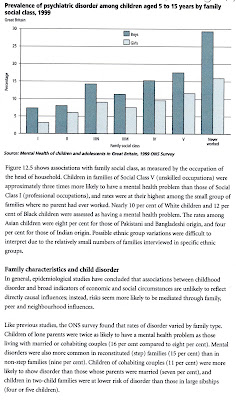
I am now prompted to speculate about how much this finding (which I have no reason to doubt wouldn't be replicated in NZ) might figure in the significant growth of invalid and sickness benefits for psychiatric and psychological conditions. Oh, the useful research that could be conducted.
In respect of Professor Gregg's report, the finding is used to build the case for getting sole parents into work. That the parent's unemployment is bad for the child.
I am less sure. The conditions may be hereditary. If the parent(s) also suffers from them, that may be why they have never worked and possibly will never work on a permanent basis. I see the finding as an argument for not financially incentivising people to have children in the first place (the current weekly payment to a lone parent is 210.47 UK pounds). Encouraging people to have children and then trying to get them into work is arse about face.
When will the people who are in a position to make or genuinely influence the rules start to acknowledge these realities?
Furthermore, the prevalence of psychiatric disorders among children aged 5 - 15 in families whose parents have never worked is almost double that of children whose parents are in low skilled jobs.
As it wasn't referenced the claim took some finding. It comes from an Office of National Statics (UK) report about the health of children over the period 1990 to 2001.

I am now prompted to speculate about how much this finding (which I have no reason to doubt wouldn't be replicated in NZ) might figure in the significant growth of invalid and sickness benefits for psychiatric and psychological conditions. Oh, the useful research that could be conducted.
In respect of Professor Gregg's report, the finding is used to build the case for getting sole parents into work. That the parent's unemployment is bad for the child.
I am less sure. The conditions may be hereditary. If the parent(s) also suffers from them, that may be why they have never worked and possibly will never work on a permanent basis. I see the finding as an argument for not financially incentivising people to have children in the first place (the current weekly payment to a lone parent is 210.47 UK pounds). Encouraging people to have children and then trying to get them into work is arse about face.
When will the people who are in a position to make or genuinely influence the rules start to acknowledge these realities?
Queen to talk welfare reform?
There is speculation that one of the items in the Queens Speech which is delivered at the state opening of Parliament, will contain news about further welfare reforms in the UK.
A Professor Gregg of Bristol University recently produced a paper on welfare and it is expected the government will adopt some suggestions. I cannot imagine any of our academies producing quite this sort of stuff. He believes everyone should be planning to return to work - sole mothers from the time their youngest is one. At the moment the age after which a mother is expected to work is 16. It is going to drop to 12 and to 7 by 2010.
As for the unemployed, which there are comparatively far more of than here;
Unemployed people who do not turn up to meetings [work focussed interviews] should get a written warning for the first one missed, and lose a week's Jobseeker's Allowance for every time after that they did not follow their conditions.
After a fourth offence, they would be told to carry out community-based work like street sweeping and digging gardens if they were "deemed to be playing the system" and lose four weeks' Jobseeker's Allowance if they refused.
Professor Gregg said they should do "work equal" activities, such as spending all day in an office looking for jobs: "It would involve doing an equivalent 9-to-5 job search with someone looking over your shoulder to make sure you were not just on Facebook."
And from the Secretary of State for Work and Pensions James Purnell,
...Mr Purnell welcomed them and said the "direction of travel" was right, although he said he would consult further on the issue of non-financial sanctions.
"The approach that virtually everyone should be doing something in return for benefits is the right one," he said.
But here's rub;
But his Conservative shadow Chris Grayling said: "I have lost count of the number of documents the government has published promising radical welfare reform in the past few years, but they never seem to get on with the job of delivering that reform."
A Professor Gregg of Bristol University recently produced a paper on welfare and it is expected the government will adopt some suggestions. I cannot imagine any of our academies producing quite this sort of stuff. He believes everyone should be planning to return to work - sole mothers from the time their youngest is one. At the moment the age after which a mother is expected to work is 16. It is going to drop to 12 and to 7 by 2010.
As for the unemployed, which there are comparatively far more of than here;
Unemployed people who do not turn up to meetings [work focussed interviews] should get a written warning for the first one missed, and lose a week's Jobseeker's Allowance for every time after that they did not follow their conditions.
After a fourth offence, they would be told to carry out community-based work like street sweeping and digging gardens if they were "deemed to be playing the system" and lose four weeks' Jobseeker's Allowance if they refused.
Professor Gregg said they should do "work equal" activities, such as spending all day in an office looking for jobs: "It would involve doing an equivalent 9-to-5 job search with someone looking over your shoulder to make sure you were not just on Facebook."
And from the Secretary of State for Work and Pensions James Purnell,
...Mr Purnell welcomed them and said the "direction of travel" was right, although he said he would consult further on the issue of non-financial sanctions.
"The approach that virtually everyone should be doing something in return for benefits is the right one," he said.
But here's rub;
But his Conservative shadow Chris Grayling said: "I have lost count of the number of documents the government has published promising radical welfare reform in the past few years, but they never seem to get on with the job of delivering that reform."
Tuesday, December 02, 2008
ACC account $1 billion short
Just revealed on the Radio Live news (no link yet) that ACC's non-earner account is almost $1 billion short and they do not have enough money to operate beyond March 2009. What was Maryan Street doing? John Key claims the government was aware of the situation. The non-earner's account is covered by direct funding from government and used for injuries to non-workers like teenagers, beneficiaries and others not in the paid workforce.
Update; NBR explains
Update; NBR explains
On resources and choice for mothers
Tapu Misa describes today what Minister of Social Development, Paula Bennett's priority should be;
The more important question for Bennett ought to be how public policy is contributing to a lack of choice for some mothers, and how it might support those who have neither the choice nor the resources.
This is code for Misa's desire to redistribute more resources from the 'rich' to the 'poor'.
Let's analyse what the current situation is.
There are essentially 4 types of mothers with dependent children. Partnered - working and not working - and single - working and not working.
Partnered women are heavily affected by public policies which apply to their other half. Those who don't work, to a large degree, and those who do, to a lesser degree. Taxation plays a big part in the resources they have and consequent choices. To service loans, a mortgage and raise children many women will find they have to return to work. But after paying for childcare, and the costs of going to work, often there isn't a lot left. Their future work prospects are however secured and enhanced. Low and flat tax would make a huge difference to the choices that were available to them. Indeed, with a partner's income increased, the mothers may not even have to work should they so choose.
Misa might argue that universal free childcare would have the same effect of increasing resources. But nothing is 'free'. That and other measures like extending Paid Parental Leave (and including fathers), has to be paid for through taxation which straight away prohibits moving to the low, flat tax that would actually do a lot more to increase choice.
Working For Families is a prime public policy intended to give mothers more choice. Instead it creates a ceiling. There is no incentive to work (or for the partner to increase his income) if the government is going to remove tax credits when that happens. Like benefits, WFF traps people, just at a higher rung on the income ladder.
Instead of taxing families only to hand it back, the money should be left in their bank accounts in the first place. This avoids all the dead-weight cost involved and removes disincentives to get ahead (which would also incidentally add to what NZ needs most - increased productivity.)
The above applies likewise to working single mums who, as part of the lowest income sector of society, would benefit from decent tax breaks more than any other group. A income free threshold would also serve this group well. That's another public policy that could be considered. Such a policy would boost their resources and choice dramatically.
Non-working single mums, reliant on welfare, while often having the least resources have, in some ways, the most choice. Their days are theirs to fill as they choose unimpeded by having to work. Unfortunately this short-term advantage too frequently translates into long-term disadvantage. Up to half of these mums find, as children become less dependent, their own lack of educational qualifications and work experience present real barriers to paid work. Their choice is then limited to staying on a benefit and staying relatively poor. There are currently 42,000 single parents reliant totally on welfare, whose youngest child is 5 or older.
The choices of the last group are paid for wholly by the taxpayer. They are choices - to leave a relationship or have children without a supportive partner - that often yield negative consequences. In general, these aren't choices that public policy should be encouraging.
The choices that public policy should be encouraging are those that see people making decisions about having and raising children when they are emotionally and financially ready and not before. Becoming mothers at the right time for themselves and their children. That kind of policy should be as neutral as possible eg low, flat tax enabling people to make their own decisions about how to combine family and work. Policy that simply redistributes resources from one sector to another will always come with both destructive incentives and disincentives.
As a broad prescription then government should be looking to removing the incentives to single parenthood (ensure welfare for mothers is strictly emergency assistance only) and reducing taxes on all working mothers (as part of universal low rates.) The first enables the second. This would maximise resources and choice for as many as possible.
Above all public policy should take account of the following; the choice to work or stay home is actually a personal one. It is for the parent(s) to make. It is not for society to make or fund.
The more important question for Bennett ought to be how public policy is contributing to a lack of choice for some mothers, and how it might support those who have neither the choice nor the resources.
This is code for Misa's desire to redistribute more resources from the 'rich' to the 'poor'.
Let's analyse what the current situation is.
There are essentially 4 types of mothers with dependent children. Partnered - working and not working - and single - working and not working.
Partnered women are heavily affected by public policies which apply to their other half. Those who don't work, to a large degree, and those who do, to a lesser degree. Taxation plays a big part in the resources they have and consequent choices. To service loans, a mortgage and raise children many women will find they have to return to work. But after paying for childcare, and the costs of going to work, often there isn't a lot left. Their future work prospects are however secured and enhanced. Low and flat tax would make a huge difference to the choices that were available to them. Indeed, with a partner's income increased, the mothers may not even have to work should they so choose.
Misa might argue that universal free childcare would have the same effect of increasing resources. But nothing is 'free'. That and other measures like extending Paid Parental Leave (and including fathers), has to be paid for through taxation which straight away prohibits moving to the low, flat tax that would actually do a lot more to increase choice.
Working For Families is a prime public policy intended to give mothers more choice. Instead it creates a ceiling. There is no incentive to work (or for the partner to increase his income) if the government is going to remove tax credits when that happens. Like benefits, WFF traps people, just at a higher rung on the income ladder.
Instead of taxing families only to hand it back, the money should be left in their bank accounts in the first place. This avoids all the dead-weight cost involved and removes disincentives to get ahead (which would also incidentally add to what NZ needs most - increased productivity.)
The above applies likewise to working single mums who, as part of the lowest income sector of society, would benefit from decent tax breaks more than any other group. A income free threshold would also serve this group well. That's another public policy that could be considered. Such a policy would boost their resources and choice dramatically.
Non-working single mums, reliant on welfare, while often having the least resources have, in some ways, the most choice. Their days are theirs to fill as they choose unimpeded by having to work. Unfortunately this short-term advantage too frequently translates into long-term disadvantage. Up to half of these mums find, as children become less dependent, their own lack of educational qualifications and work experience present real barriers to paid work. Their choice is then limited to staying on a benefit and staying relatively poor. There are currently 42,000 single parents reliant totally on welfare, whose youngest child is 5 or older.
The choices of the last group are paid for wholly by the taxpayer. They are choices - to leave a relationship or have children without a supportive partner - that often yield negative consequences. In general, these aren't choices that public policy should be encouraging.
The choices that public policy should be encouraging are those that see people making decisions about having and raising children when they are emotionally and financially ready and not before. Becoming mothers at the right time for themselves and their children. That kind of policy should be as neutral as possible eg low, flat tax enabling people to make their own decisions about how to combine family and work. Policy that simply redistributes resources from one sector to another will always come with both destructive incentives and disincentives.
As a broad prescription then government should be looking to removing the incentives to single parenthood (ensure welfare for mothers is strictly emergency assistance only) and reducing taxes on all working mothers (as part of universal low rates.) The first enables the second. This would maximise resources and choice for as many as possible.
Above all public policy should take account of the following; the choice to work or stay home is actually a personal one. It is for the parent(s) to make. It is not for society to make or fund.
Monday, December 01, 2008
Saving us from socio-economic harm
 Police operations to destroy cannabis production and distribution are being described as the most successful in 5 years. The police claim they have saved us, the community, $336 million in socio-economic harm.
But how do they arrive at that figure?
They destroyed 124,000 plants - or a yield of 992,000 oz - or 62,000 lbs - or 28,180 kg.
Then they multiply that figure (28,180) by the BERL Drug Harm Index figure of $11,800 per kilo.
Opioids and stimulants, such as P/methamphetamine and cocaine, were two of the most harmful illicit drug types causing $1.1 million and $403,000 harm per kilogram. Cannabis is estimated to cause harm of $11,800 per kilogram. LSD has the potential to cause over $1 billion of harm per kilogram, but it is used in very small amounts per occasion.
So the Police are not talking here about the selling value of the cannabis. They are basing their success on an estimate of the harm prevented.
Notice that the higher the estimate is (the more damage that is apparently done per kilo) the more success the cops can claim. That's handy.
Now I am wondering how many plants the police have failed to seize. Another ten for each destroyed? Another 20?
People keep on growing year on year so the chances of getting caught can't be very significant. Yet the total harm cost of cannabis use was put at $431 million just earlier this year. That would indicate the police are destroying 3 out of four cannabis plants.
Yes. I find that very hard to believe.
We have every reason to be skeptical about the sorts of numbers bandied about by the police and those contracted by them.
Australia doesn't want to 'lead the world' either
Delaying the ETS will damage New Zealand's image, I keep hearing. It will seriously threaten trade, I keep hearing. Today the NZ Herald carries an opinion piece urging to government to press on with the ETS. It claims;
This opinion piece reflects concurrence across business, the environment and forestry on the way ahead: Abandon the proposed legislative freeze.
I see 'consensus' has been rightly dropped in favour of "concurrence".
So what news from our largest trading partner, Australia?
Are they getting agitated with New Zealand's position?
As with most NZ mountains (Australian molehills) they have problems of their own consuming them. It appears the Australian government is also taking a cautious approach to the climate change response having just announced it will not set a carbon emissions reduction target until it sees where the rest of the world is going.
This opinion piece reflects concurrence across business, the environment and forestry on the way ahead: Abandon the proposed legislative freeze.
I see 'consensus' has been rightly dropped in favour of "concurrence".
So what news from our largest trading partner, Australia?
Are they getting agitated with New Zealand's position?
As with most NZ mountains (Australian molehills) they have problems of their own consuming them. It appears the Australian government is also taking a cautious approach to the climate change response having just announced it will not set a carbon emissions reduction target until it sees where the rest of the world is going.
Sunday, November 30, 2008
Wildly divergent results
Using two different approaches, the difference in literacy-testing scores for prisoners is astonishing. According to Radio New Zealand;
A new test shows the literacy and numeracy problems of prisoners to be much worse than previously thought.
The Burt Word Recognition Test found 2% of prisoners need literacy help and 17% need numeracy help.
A new screening tool, developed by the Ministry of Education, was also trialed recently on 197 new prisoners.
It found 90% needed literacy help and 80% were not functionally numerate.
I had to read this twice, myself, thinking perhaps there was a mistake in the first figures. The first test finds 2 in 100 prisoners need help and the second test finds 90 in 100 need help. A few people should be scratching their heads over this and asking themselves how much time and money is being wasted administering tests which produce such wildly divergent results.
(The Burt test is used to assess the needs of offenders on release or serving community sentences, so it isn't just 'nice-to-know' stuff.)
(And yes, Adolf, the copy-writer needs help.)
A new test shows the literacy and numeracy problems of prisoners to be much worse than previously thought.
The Burt Word Recognition Test found 2% of prisoners need literacy help and 17% need numeracy help.
A new screening tool, developed by the Ministry of Education, was also trialed recently on 197 new prisoners.
It found 90% needed literacy help and 80% were not functionally numerate.
I had to read this twice, myself, thinking perhaps there was a mistake in the first figures. The first test finds 2 in 100 prisoners need help and the second test finds 90 in 100 need help. A few people should be scratching their heads over this and asking themselves how much time and money is being wasted administering tests which produce such wildly divergent results.
(The Burt test is used to assess the needs of offenders on release or serving community sentences, so it isn't just 'nice-to-know' stuff.)
(And yes, Adolf, the copy-writer needs help.)
Friday, November 28, 2008
One in Three Maori Women on Welfare
Media Release
ONE IN THREE MAORI WOMEN ON WELFARE
Friday, November 28, 2008
Latest Ministry of Social Development figures show that one in three working-age Maori women receives a benefit.
According to welfare commentator, Lindsay Mitchell, "Maori females are now the most vulnerable group in New Zealand to benefit dependency. At the end of September 2008, 55, 255 - or 33 percent of Maori women aged 18-64 - relied on welfare as their prime (and usually only) source of income. This figure is more than three times higher than for the non-Maori population."
"New Zealand now has two working-age Maori women responsible for welfare policy, Paula Bennett and Tariana Turia, respectively the Minister and Associate Minister for Social Development. National's Paula Bennett is reported as supporting work-testing for single mothers when their youngest turns six. Unfortunately most Maori females begin on welfare very young, before acquiring any educational qualifications or work skills. They also tend to have larger families and it may be many years before they are faced with work-testing, at which point they face real barriers to employment. In any case, if unemployment continues to climb as forecast, there is a question mark over whether jobs will be available."
The problem of dependency stems from a large and steady inflow of young mothers and this is where the focus should lie. The Maori teenage birth rate is also much higher than the non-Maori rate.
"I don't believe anybody thinks babies being born onto a benefit is a good idea - except perhaps for the Associate Minister who is on record as saying,
I am intolerant of the excessive focus on controlling our fertility. When I used to sit around the Cabinet table with colleagues, one of the many hot topics I got into strife about was discussion around the 'problem' of teenage pregnancy. My objection was to the problemmatisation of conception.
So just what effective policies will the Ministers adopt to reduce this highly disproportionate rate of dependency?"
ONE IN THREE MAORI WOMEN ON WELFARE
Friday, November 28, 2008
Latest Ministry of Social Development figures show that one in three working-age Maori women receives a benefit.
According to welfare commentator, Lindsay Mitchell, "Maori females are now the most vulnerable group in New Zealand to benefit dependency. At the end of September 2008, 55, 255 - or 33 percent of Maori women aged 18-64 - relied on welfare as their prime (and usually only) source of income. This figure is more than three times higher than for the non-Maori population."
"New Zealand now has two working-age Maori women responsible for welfare policy, Paula Bennett and Tariana Turia, respectively the Minister and Associate Minister for Social Development. National's Paula Bennett is reported as supporting work-testing for single mothers when their youngest turns six. Unfortunately most Maori females begin on welfare very young, before acquiring any educational qualifications or work skills. They also tend to have larger families and it may be many years before they are faced with work-testing, at which point they face real barriers to employment. In any case, if unemployment continues to climb as forecast, there is a question mark over whether jobs will be available."
The problem of dependency stems from a large and steady inflow of young mothers and this is where the focus should lie. The Maori teenage birth rate is also much higher than the non-Maori rate.
"I don't believe anybody thinks babies being born onto a benefit is a good idea - except perhaps for the Associate Minister who is on record as saying,
I am intolerant of the excessive focus on controlling our fertility. When I used to sit around the Cabinet table with colleagues, one of the many hot topics I got into strife about was discussion around the 'problem' of teenage pregnancy. My objection was to the problemmatisation of conception.
So just what effective policies will the Ministers adopt to reduce this highly disproportionate rate of dependency?"
Thursday, November 27, 2008
Transitioning on and off welfare
Statistics NZ yesterday released data relating to people transitioning on and off benefit.
Two things stood out. Only transitions onto the unemployment benefit have dropped - all other benefits are 'business as usual', including a 45% increase in transitions to sickness since 2000. So much for Labour's reforms to DPB and incapacity benefits.

This is more interesting. Look at the pre-benefit employment history and observe the remarkable homogeneity of the data. Doesn't matter which benefit, the (average) individual transiting onto it has a patchy work history.

Two things stood out. Only transitions onto the unemployment benefit have dropped - all other benefits are 'business as usual', including a 45% increase in transitions to sickness since 2000. So much for Labour's reforms to DPB and incapacity benefits.

This is more interesting. Look at the pre-benefit employment history and observe the remarkable homogeneity of the data. Doesn't matter which benefit, the (average) individual transiting onto it has a patchy work history.

Wednesday, November 26, 2008
Desperately seeking justice or revenge?
 Thinking about the latest baby killing.
What motivates this relatively new trend whereby the family of victims sport tee shirts and wave banners emblazoned with their lost one's image?
Are they seeking sentencing justice and hope to influence the court, judge and jury? If so, is that legal?
Or are they seeking retribution through justice?
Are they assuaging their own guilt by 'honouring' and glorifying the victim? Or is it intended to induce guilt?
Is creating and displaying the image cathartic?
Is it a visual response to a gang patch or colours? A symbol of the side the wearer takes?
"... Jyniah's father Ike Te Awa, has also become estranged from his family, who have continued to support Kapea and not him."
The killer's family has their symbol in the flesh. The convicted one.
Am I struggling with this phenomenon because I'm Pakeha? Or is this development common to other cultures?
Does society in general respond to death in new ways which I am simply too sober to appreciate?
If I asked the person wearing this child's image on their chest, why, they may simply say, to remember her. Even then, I don't understand. You need to be reminded to remember??? For the sake of sanity I would be aching for a moment's relief from the memories.
I think there is a serious disconnect with reality going on here; in the courtroom fiascos we see, in the flashy funerals, in the utu-driven scrapping. Perhaps it's all for the media. One thing is for sure. Dysfunctional behaviour isn't just occurring between family members. It occurs between family groups.
Tuesday, November 25, 2008
2 in 3 think new govt a "disaster waiting to happen"
Interesting Stuff poll;
The Maori Party and ACT have joined National to form a new Government. How do you feel about the left-centre-right coalition?
It's great to see (446 votes, 27.1%)
It's a disaster waiting to happen (1115 votes, 67.8%)
I don't know (83 votes, 5.0%)
Stuff polls are not scientific and reflect the opinions of only those internet users who have chosen to participate
This prompted me to examine my own expectations. As usual, being brutally honest, I am in the minority. I don't know. I am not overly optimistic that a lot can be achieved in respect of what I personally want to see. So no surprises there.
But I am surprised at the number of people who aren't just 'not overly optimistic' but down-right pessimistic.
How would you vote? Perhaps a fourth option would have been prudent. "To soon to tell".
The Maori Party and ACT have joined National to form a new Government. How do you feel about the left-centre-right coalition?
It's great to see (446 votes, 27.1%)
It's a disaster waiting to happen (1115 votes, 67.8%)
I don't know (83 votes, 5.0%)
Stuff polls are not scientific and reflect the opinions of only those internet users who have chosen to participate
This prompted me to examine my own expectations. As usual, being brutally honest, I am in the minority. I don't know. I am not overly optimistic that a lot can be achieved in respect of what I personally want to see. So no surprises there.
But I am surprised at the number of people who aren't just 'not overly optimistic' but down-right pessimistic.
How would you vote? Perhaps a fourth option would have been prudent. "To soon to tell".
Monday, November 24, 2008
What about CYF?
"Ethical boundaries for people who work with youth," is the title of a media release from NZAAHD. Heard of them before? No. Neither had I. They are New Zealand Aotearoa Adolescent Health and Development.
This will be about the CYF worker who had sex with a minor he was working with and made the news recently, I think.
A Child Youth and Family worker faces jail after being convicted of having sex with a 15-year-old girl in his care.
Additionally, "He is one of four CYF workers who have lost their jobs in the past year after inappropriate relationships with young people."
But no. I'm wrong. It is a response to the possibility of the Waipareira Trust employing Clint Rickards to work with young Maori.
According to NZAAHD, "Mr Rickards has not been convicted of a crime. We must remember that he was found not guilty. However in his admission he had repeated sexual encounters with a young woman while he was in a professional position of power. He has yet to apologise for this, or admit that he made a mistake."
An employer of any practitioner who is being asked to work with youth should consider this concerning, and at the very least put some processes in place to ensure this wouldn't happen again.
Yet the same organisation failed to criticise and offer this advice to a government department which seems to have a proven track record of employing people who go on to 'exploit' their position. (Note to self. Any organisation with 'Aoteoroa' in its name can reasonably be expected to exhibit a left-wing government bias.)
I wouldn't go to bat for Rickards. He can look after himself. But there is something of a witch hunt developing here.
This will be about the CYF worker who had sex with a minor he was working with and made the news recently, I think.
A Child Youth and Family worker faces jail after being convicted of having sex with a 15-year-old girl in his care.
Additionally, "He is one of four CYF workers who have lost their jobs in the past year after inappropriate relationships with young people."
But no. I'm wrong. It is a response to the possibility of the Waipareira Trust employing Clint Rickards to work with young Maori.
According to NZAAHD, "Mr Rickards has not been convicted of a crime. We must remember that he was found not guilty. However in his admission he had repeated sexual encounters with a young woman while he was in a professional position of power. He has yet to apologise for this, or admit that he made a mistake."
An employer of any practitioner who is being asked to work with youth should consider this concerning, and at the very least put some processes in place to ensure this wouldn't happen again.
Yet the same organisation failed to criticise and offer this advice to a government department which seems to have a proven track record of employing people who go on to 'exploit' their position. (Note to self. Any organisation with 'Aoteoroa' in its name can reasonably be expected to exhibit a left-wing government bias.)
I wouldn't go to bat for Rickards. He can look after himself. But there is something of a witch hunt developing here.
Sunday, November 23, 2008
Creating a portrait
It's been some time since I have updated my artist blog so I thought I would do a post showing how I create a portrait. These were the progress shots I was sending to Rodney while painting his portrait for the Adams National Portrait Award in 2007.
For this painting I selected hardboard (about 1 x 1.5 metres) and coated it with gesso, which is a little like liquid chalk. This has two purposes. It acts as a receiver for the first coat of paint. But more importantly I use it to form a relief. So instead of having a canvas tooth, I have uniform waves of brushwork creating an under-surface. Canvas tends to grip paint whereas gesso on hardboard lets the paint flow and blend.

When the gesso is dry I coat the surface with, in this case, yellow ochre. This has a unifying effect. Wherever the overlaying image doesn't completely cover the board, yellow comes through. Some artists use this technique very skilfully in impressionist work, overlaying beautiful lilacs and violets over ochre which makes for wonderful skies. As undercoat colouring (thinned with turps) I nearly always use ochre or burnt sienna.
When the yellow ochre is dry I start work with a series of photos and sketch in the rough image in charcoal. Then using paint I block in the major colours and a rough likeness of the face.

Next time I start attacking the background. Particularly difficult in this portrait is the set of wooden steps which I wanted to give depth and interest to. And I need to make Rodney look like he is actually sitting on them rather than squatting.

Of course there are many other interims steps but by now I am starting to hone it. Now I am looking for what I want in the face, which is the expression I perceive.

Final submission in which I have polished the shoes, added the watch details, lightened the grass and whitened the shirt. It's hard to get a photograph that doesn't distort a work of this size (eg this looks foreshortened) but this is a fair representation of the final work which was one of those accepted for exhibition at the end of 2007.

For this painting I selected hardboard (about 1 x 1.5 metres) and coated it with gesso, which is a little like liquid chalk. This has two purposes. It acts as a receiver for the first coat of paint. But more importantly I use it to form a relief. So instead of having a canvas tooth, I have uniform waves of brushwork creating an under-surface. Canvas tends to grip paint whereas gesso on hardboard lets the paint flow and blend.

When the gesso is dry I coat the surface with, in this case, yellow ochre. This has a unifying effect. Wherever the overlaying image doesn't completely cover the board, yellow comes through. Some artists use this technique very skilfully in impressionist work, overlaying beautiful lilacs and violets over ochre which makes for wonderful skies. As undercoat colouring (thinned with turps) I nearly always use ochre or burnt sienna.
When the yellow ochre is dry I start work with a series of photos and sketch in the rough image in charcoal. Then using paint I block in the major colours and a rough likeness of the face.

Next time I start attacking the background. Particularly difficult in this portrait is the set of wooden steps which I wanted to give depth and interest to. And I need to make Rodney look like he is actually sitting on them rather than squatting.

Of course there are many other interims steps but by now I am starting to hone it. Now I am looking for what I want in the face, which is the expression I perceive.

Final submission in which I have polished the shoes, added the watch details, lightened the grass and whitened the shirt. It's hard to get a photograph that doesn't distort a work of this size (eg this looks foreshortened) but this is a fair representation of the final work which was one of those accepted for exhibition at the end of 2007.

Saturday, November 22, 2008
Not looking through rose coloured glasses
A letter to The Guardian posted at Samizdata
Dear Ms Featherstone
I think the people who should truly say sorry for such events are the opinion leaders of the Guardian. Please allow me to explain.
Last week I visited (as a doctor) a family in a council estate. The mother was concerned about her 12 year old son. She was very pleased that her older son was now on incapacity and would therefore do well for himself in terms of money. There is nothing wrong with this older boy that makes him incapacitated, but that is another story. She also had a 14 year old daughter, who while I was there, constantly argued with her mother demanding money for cigarettes. The three children had three different fathers, all absent. The kids, while I could see were still children, gleamed with malignant insolence. I can see them turning into damaged adults. I feel sorry for the trap they are in – the trap created directly by the welfare state whereby the family, and all those in the neighbourhood, see welfare as a lifestyle option. They live in squalor but have more wealth than most people I knew in India; they certainly have more material comforts than I ever had growing up in Delhi.
The Guardian describes such families as poor. The Labour party wants to throw money at the family. The Guardian readers blame Margaret Thatcher for this state of affairs, smug in their modern pieties, their intellectual laziness, and their stupidity masquerading as sanctimonious concern. I used to work with slum children in Delhi; they had very little, but even the most physically disabled amongst them made an effort.
There is no hope for Britian. Civilisations don't die, they commit suicide. And before they commit suicide, they read and believe the Guardian.
I truly and deeply feel sorry for all the children who are the victims of the welfare state. Things are much, much worse for the slum children in India, I saw more dignity among them and certainly greater hope.
I am not sure if you will understand this message. I am too tired to explain further. Either you will get or you wont. Either way, it will make no difference to anything.
Dear Ms Featherstone
I think the people who should truly say sorry for such events are the opinion leaders of the Guardian. Please allow me to explain.
Last week I visited (as a doctor) a family in a council estate. The mother was concerned about her 12 year old son. She was very pleased that her older son was now on incapacity and would therefore do well for himself in terms of money. There is nothing wrong with this older boy that makes him incapacitated, but that is another story. She also had a 14 year old daughter, who while I was there, constantly argued with her mother demanding money for cigarettes. The three children had three different fathers, all absent. The kids, while I could see were still children, gleamed with malignant insolence. I can see them turning into damaged adults. I feel sorry for the trap they are in – the trap created directly by the welfare state whereby the family, and all those in the neighbourhood, see welfare as a lifestyle option. They live in squalor but have more wealth than most people I knew in India; they certainly have more material comforts than I ever had growing up in Delhi.
The Guardian describes such families as poor. The Labour party wants to throw money at the family. The Guardian readers blame Margaret Thatcher for this state of affairs, smug in their modern pieties, their intellectual laziness, and their stupidity masquerading as sanctimonious concern. I used to work with slum children in Delhi; they had very little, but even the most physically disabled amongst them made an effort.
There is no hope for Britian. Civilisations don't die, they commit suicide. And before they commit suicide, they read and believe the Guardian.
I truly and deeply feel sorry for all the children who are the victims of the welfare state. Things are much, much worse for the slum children in India, I saw more dignity among them and certainly greater hope.
I am not sure if you will understand this message. I am too tired to explain further. Either you will get or you wont. Either way, it will make no difference to anything.
Wowsers wasting money hand over fist
At least the Aussie media asks the right questions. That is the most hopeful aspect of this report.
The Australian Federal government is embarking on a graphic 'nightmare' campaign aimed at curbingf binge-drinking among teenagers.
But the question for government, health groups and advertisers is how do you create campaigns aimed at an age group predisposed to risk taking actually work?
There have been similar multimillion-dollar campaigns by governments in the past 20 years, including the national "How will you feel tomorrow?" campaign of the 1990s, which, if statistics are anything to go by, made no difference to youth binge drinking.
Margaret Hamilton from the Australian National Council on Drugs headed the advisory board on the "nightmare" campaign.
Professor Hamilton accepts that there will be no discernible drop in drinking among teens as a direct result of the campaign.
Classic the-state-seen-to-be-doing-something syndrome.
The Australian Federal government is embarking on a graphic 'nightmare' campaign aimed at curbingf binge-drinking among teenagers.
But the question for government, health groups and advertisers is how do you create campaigns aimed at an age group predisposed to risk taking actually work?
There have been similar multimillion-dollar campaigns by governments in the past 20 years, including the national "How will you feel tomorrow?" campaign of the 1990s, which, if statistics are anything to go by, made no difference to youth binge drinking.
Margaret Hamilton from the Australian National Council on Drugs headed the advisory board on the "nightmare" campaign.
Professor Hamilton accepts that there will be no discernible drop in drinking among teens as a direct result of the campaign.
Classic the-state-seen-to-be-doing-something syndrome.
Friday, November 21, 2008
From Dysfunction to Death
Here's another unremarkable (an oxymoron as I am remarking) set-up.
A young, thought-to-be in her teens or early 20s, Maori mother of five, left dead, probably at the hands of a young Maori male, arrested by Police yesterday in Tokoroa.
Without a shadow of a doubt another family created and maintained with your money. With less certainty, but not much, 5 more screwed up lives to ensue. 5 more motherless meal-tickets.
When is this madness going to end?
A young, thought-to-be in her teens or early 20s, Maori mother of five, left dead, probably at the hands of a young Maori male, arrested by Police yesterday in Tokoroa.
Without a shadow of a doubt another family created and maintained with your money. With less certainty, but not much, 5 more screwed up lives to ensue. 5 more motherless meal-tickets.
When is this madness going to end?
Thursday, November 20, 2008

John's Key's " first crisis"
The DomPost describes the 200 jobs that Air NZ is shedding as John Key's first crisis.
Key says;
"It's quite clear that tourism as a whole will be at risk with the economic slowdown as we see less demand from overseas. My job over the next few months is to work with the tourism industry to do what we can to ensure we pick up a larger share of what is currently a declining international market."
Chief of Tourism New Zealand, George Hickton, has been quite vociferous of late however about Kiwis staying home. He says it would be better for the domestic market if New Zealanders spent their holidays and money in New Zealand. When I heard him expressing this view to Bill Ralston on Radio Live (can't listen to Susan Wood) I immediately thought, it'll be great if his counterparts overseas are doing the same and succeeding - not. I wonder if he and his new Minister can agree on a strategy that does not include tourist protectionism.
Key says;
"It's quite clear that tourism as a whole will be at risk with the economic slowdown as we see less demand from overseas. My job over the next few months is to work with the tourism industry to do what we can to ensure we pick up a larger share of what is currently a declining international market."
Chief of Tourism New Zealand, George Hickton, has been quite vociferous of late however about Kiwis staying home. He says it would be better for the domestic market if New Zealanders spent their holidays and money in New Zealand. When I heard him expressing this view to Bill Ralston on Radio Live (can't listen to Susan Wood) I immediately thought, it'll be great if his counterparts overseas are doing the same and succeeding - not. I wonder if he and his new Minister can agree on a strategy that does not include tourist protectionism.
Controlling what benefits can be spent on
I was rung by NewstalkZB at short notice yesterday to talk about welfare; the links to child abuse, Australia's plans to quarantine welfare payments and whether we could expect more from National.
Although I was reported in the following news bulletin as saying controlling what benefit payments could be spent on was a good idea, here is what I actually said;
I can understand why superficially it looks like a good idea but there are two problems I see
1/ Any sort of card or voucher system is open to abuse or fraud. Someone who wants cash badly enough could sell their entitlement for less than it is actually worth , which could leave the children in a worse situation. Or parents could turn to other dodgy means of raising cash like prostitution, or drug pushing.
2/ What we really need is for people to grow up. This paternalistic approach is only going to keep them immature and dependent.
On the upside women without cash do not have the appeal to deadbeats and hangers-on they currently attract and in some cases having no cash may be enough to make them decide to get a job.
What we really need to be saying to prospective newcomers , those young women who are currently contemplating or risking pregnancy, is, don't even think about it. Welfare is no longer an alternative lifestyle.
I should have added that the only support I would give the scheme is as a temporary measure seeing existing children through to independence.
Asked if I thought we could expect more from National I said no. Why? Because their only welfare policy is to work-test the DPB when the youngest child turns 6. The major problem with that policy is a failure to cap the number of children. Meantime, while the biggest percentage increase in births is among the 15-19 year-olds, there are no plans to prevent newcomers into the system. We should be making it very clear that welfare is no longer a lifestyle and that benefits should be time limited, perhaps to even less than the US allowance.
(On reflection I think Tariana Turia would go with a benefit control scheme as long as it was administered by a Maori organisation. Which opens another can of worms...)
Although I was reported in the following news bulletin as saying controlling what benefit payments could be spent on was a good idea, here is what I actually said;
I can understand why superficially it looks like a good idea but there are two problems I see
1/ Any sort of card or voucher system is open to abuse or fraud. Someone who wants cash badly enough could sell their entitlement for less than it is actually worth , which could leave the children in a worse situation. Or parents could turn to other dodgy means of raising cash like prostitution, or drug pushing.
2/ What we really need is for people to grow up. This paternalistic approach is only going to keep them immature and dependent.
On the upside women without cash do not have the appeal to deadbeats and hangers-on they currently attract and in some cases having no cash may be enough to make them decide to get a job.
What we really need to be saying to prospective newcomers , those young women who are currently contemplating or risking pregnancy, is, don't even think about it. Welfare is no longer an alternative lifestyle.
I should have added that the only support I would give the scheme is as a temporary measure seeing existing children through to independence.
Asked if I thought we could expect more from National I said no. Why? Because their only welfare policy is to work-test the DPB when the youngest child turns 6. The major problem with that policy is a failure to cap the number of children. Meantime, while the biggest percentage increase in births is among the 15-19 year-olds, there are no plans to prevent newcomers into the system. We should be making it very clear that welfare is no longer a lifestyle and that benefits should be time limited, perhaps to even less than the US allowance.
(On reflection I think Tariana Turia would go with a benefit control scheme as long as it was administered by a Maori organisation. Which opens another can of worms...)
Wednesday, November 19, 2008
The extreme authoritarianism of the SST
There are times when the Sensible Sentencing Trust appals me. My husband calls them fascists and I balk at that. But today's proclamations about drug and alcohol abusers having their children removed is just too fantastic.
Substance abusers must NOT be allowed to have unsupervised care of children until they have been PROVED to be drug/alcohol-free
1/ Who defines 'substance abuser'?
2/ Just where are the thousands of children whose parents fit the definition going?
3/ Are we going to persecute parents for hurting themselves or for hurting their children? Where will the line be drawn?
This sort of extreme authoritarianism gives the SST a bad name. This is exactly why I get very uncomfortable about ACT associating with them. Still, I no longer have any responsibility for the direction ACT goes in. Thank goodness.
Substance abusers must NOT be allowed to have unsupervised care of children until they have been PROVED to be drug/alcohol-free
1/ Who defines 'substance abuser'?
2/ Just where are the thousands of children whose parents fit the definition going?
3/ Are we going to persecute parents for hurting themselves or for hurting their children? Where will the line be drawn?
This sort of extreme authoritarianism gives the SST a bad name. This is exactly why I get very uncomfortable about ACT associating with them. Still, I no longer have any responsibility for the direction ACT goes in. Thank goodness.
Nia Glassie - Why?
First her father;
"I've got no feelings. I can't explain - at the end of the day my baby's gone and nothing will bring her back."
Shedding some big crocodile tears. And talking about 'shedding' isn't this the guy who was found by Kuka having an 'affair' with her niece in the garden shed?
Isn't this the guy that buggered off to Australia and left his kids behind?
Talk about there being no moral compass in these groupings of people called whanau.
And aren't we all getting sick to death of being commanded to take responsibility? Whether it be for 'narking' (I'll write more about that) or as a taxpayer, who should fork out more to alleviate the poverty that apparently lies at the heart of this dysfunction?
I knew a couple of kids living in a not dissimilar home and agonised over what to do. So did others. You are dealing with people for whom retribution is everything; that retribution could extend to the kids themselves, or the neighbours and their children. Their extended whanau, the first place CYF will look to remove the children to, may be no better. These families aren't just one bad apple surrounded by good. The neglect is measured not by its existence but by degrees of. Neglect doesn't kill but abuse can. They tend to be two sides of the same coin but not always. A lot of lies and cover-ups are par for the course as people guilty only of victimless crimes like smoking dope, or ripping off the benefit system, lie low. 'Narking' is no simple matter whether considering the best interests of the at-risk child, your child or yourself.
It is not black and white and the many moralisers who call talkback today agreeing that we will stop child abuse by looking out for it and not tolerating it, are simply feeding their own emotional need to do something. Then they will put down the phone and carry on in their middle class world where what to have for dinner is the most pressing issue.
What we are seeing in the Glassie case, and every other that does or doesn't hit the headlines, is supposed adults who have not grown up. Old enough to breed babies, do drugs and drink, get a menial job if it suits or not, but incapable of rationalising and controlling their fleeting, feckless, roller-coaster emotions. A child is perceived as weak or 'ugly'. It is targeted. This is grown-up bullying that has gone too far. The minds of these boy-men are further deranged by drink and the normalisation of violence through their daily cerebral activities. But they are just a cog in the generational wheel.
Here's the difference though. Forty years ago they wouldn't have been allowed to form the kind of groups loosely call families. There would have been no financial mechanism to create them. Babies were adopted out, sometimes to extended whanau, sometimes to strangers. But to people who WANTED them. It wasn't a perfect answer by any means, but what ever is?
So 40 years ago we weren't seeing the kind of mayhem we see now. Child abuse and neglect most certainly happened. But from everything I have read it was on a much smaller scale.
Expecting the solution to this problem to come from watchful dobbers-in is just avoiding the true problem and shifting blame. Tomorrows victims are being born right now and being sent home by CYF people who hold fast to the ideology that the child must always remain with its biological mother; being written onto a benefit by WINZ people who are not tasked to ask any questions.
Welcome to the compassionate and caring society.
"I've got no feelings. I can't explain - at the end of the day my baby's gone and nothing will bring her back."
Shedding some big crocodile tears. And talking about 'shedding' isn't this the guy who was found by Kuka having an 'affair' with her niece in the garden shed?
Isn't this the guy that buggered off to Australia and left his kids behind?
Talk about there being no moral compass in these groupings of people called whanau.
And aren't we all getting sick to death of being commanded to take responsibility? Whether it be for 'narking' (I'll write more about that) or as a taxpayer, who should fork out more to alleviate the poverty that apparently lies at the heart of this dysfunction?
I knew a couple of kids living in a not dissimilar home and agonised over what to do. So did others. You are dealing with people for whom retribution is everything; that retribution could extend to the kids themselves, or the neighbours and their children. Their extended whanau, the first place CYF will look to remove the children to, may be no better. These families aren't just one bad apple surrounded by good. The neglect is measured not by its existence but by degrees of. Neglect doesn't kill but abuse can. They tend to be two sides of the same coin but not always. A lot of lies and cover-ups are par for the course as people guilty only of victimless crimes like smoking dope, or ripping off the benefit system, lie low. 'Narking' is no simple matter whether considering the best interests of the at-risk child, your child or yourself.
It is not black and white and the many moralisers who call talkback today agreeing that we will stop child abuse by looking out for it and not tolerating it, are simply feeding their own emotional need to do something. Then they will put down the phone and carry on in their middle class world where what to have for dinner is the most pressing issue.
What we are seeing in the Glassie case, and every other that does or doesn't hit the headlines, is supposed adults who have not grown up. Old enough to breed babies, do drugs and drink, get a menial job if it suits or not, but incapable of rationalising and controlling their fleeting, feckless, roller-coaster emotions. A child is perceived as weak or 'ugly'. It is targeted. This is grown-up bullying that has gone too far. The minds of these boy-men are further deranged by drink and the normalisation of violence through their daily cerebral activities. But they are just a cog in the generational wheel.
Here's the difference though. Forty years ago they wouldn't have been allowed to form the kind of groups loosely call families. There would have been no financial mechanism to create them. Babies were adopted out, sometimes to extended whanau, sometimes to strangers. But to people who WANTED them. It wasn't a perfect answer by any means, but what ever is?
So 40 years ago we weren't seeing the kind of mayhem we see now. Child abuse and neglect most certainly happened. But from everything I have read it was on a much smaller scale.
Expecting the solution to this problem to come from watchful dobbers-in is just avoiding the true problem and shifting blame. Tomorrows victims are being born right now and being sent home by CYF people who hold fast to the ideology that the child must always remain with its biological mother; being written onto a benefit by WINZ people who are not tasked to ask any questions.
Welcome to the compassionate and caring society.
Tuesday, November 18, 2008
Running the Social Development show
I was going to take a wait-and-see approach to Paula Bennett. But then I read the following;
She [Paula Bennett] expects her associate minister, Maori Party co-leader Tariana Turia, to be instrumental.
"She and I share a belief that all children are our children. That means the good, the naughty, the broken and the cherished. We've talked about that many times, and I've got no doubt that's the understanding we will bring to the role. She will play a big role. She's got experience and some really firm views on what we need to do for Maori people."
How many times have you heard a collectivist say, it takes a village to raise a child?
I beg to differ.
It takes one committed individual. That commitment means wanting the child, being prepared to make sacrifices and lifestyle changes for that child, being able to support it financially, being able to provide stability and structure, and above all, being prepared to make it the centre of your world.
The very existence of the DPB diminishes the prospects all of these and I am deeply upset that we now have a Minister and Associate Minister of welfare who are going to defend it as a legitimate means to having and raising children, even if it is less than ideal.
National's work-testing policy for mothers whose youngest is 6 is a very weak policy, it's major pitfall being a failure to cap the number of children. But it wouldn't surprise me to see Turia oppose even that. She has a self-admitted conservative streak and would rather see mothers stay at home and she doesn't care who pays for it.
So I am very despondent about this development. Under this administration we are going to see greater entrenchment of the DPB. The numbers will go up. The number of teenagers taking it up will continue to increase. Having a Minister who was a teenager on the DPB but made good, romanticises and legitimises it.
Real life however repeatedly shows that the social problems running the gamut of inherited benefit dependence through to crime and tragedy are backgrounded by teenage birth (particularly adolescent) coupled with welfare upbringings. Maori are over-represented in the phenomenon.
And let's not forget what the new Associate Minister's attitude is to people who say the kinds of things I do.
"I am intolerant of the excessive focus on controlling our fertility."
What's wrong with individuals controlling their own fertility? Isn't that what personal responsibility is all about?
She [Paula Bennett] expects her associate minister, Maori Party co-leader Tariana Turia, to be instrumental.
"She and I share a belief that all children are our children. That means the good, the naughty, the broken and the cherished. We've talked about that many times, and I've got no doubt that's the understanding we will bring to the role. She will play a big role. She's got experience and some really firm views on what we need to do for Maori people."
How many times have you heard a collectivist say, it takes a village to raise a child?
I beg to differ.
It takes one committed individual. That commitment means wanting the child, being prepared to make sacrifices and lifestyle changes for that child, being able to support it financially, being able to provide stability and structure, and above all, being prepared to make it the centre of your world.
The very existence of the DPB diminishes the prospects all of these and I am deeply upset that we now have a Minister and Associate Minister of welfare who are going to defend it as a legitimate means to having and raising children, even if it is less than ideal.
National's work-testing policy for mothers whose youngest is 6 is a very weak policy, it's major pitfall being a failure to cap the number of children. But it wouldn't surprise me to see Turia oppose even that. She has a self-admitted conservative streak and would rather see mothers stay at home and she doesn't care who pays for it.
So I am very despondent about this development. Under this administration we are going to see greater entrenchment of the DPB. The numbers will go up. The number of teenagers taking it up will continue to increase. Having a Minister who was a teenager on the DPB but made good, romanticises and legitimises it.
Real life however repeatedly shows that the social problems running the gamut of inherited benefit dependence through to crime and tragedy are backgrounded by teenage birth (particularly adolescent) coupled with welfare upbringings. Maori are over-represented in the phenomenon.
And let's not forget what the new Associate Minister's attitude is to people who say the kinds of things I do.
"I am intolerant of the excessive focus on controlling our fertility."
What's wrong with individuals controlling their own fertility? Isn't that what personal responsibility is all about?
Monday, November 17, 2008
The CPAG will be delighted
Later today I will link to the media release the Child Poverty Action Group issues in reaction to Tariana Turia being made Associate Minister of Social Development. They will be delighted. Their first pick might have been Sue Bradford in a Labour-led government but given their major issue over the past few years has been opposing Labour's In Work payment going solely to working parents, a Labour government may not have been their choice.

The Maori Party and the Greens were the only parties to publicly back the CPAG's court action. Tariana's solution to the relative poverty that many Maori children experience is to increase benefits. John Key has given her a role in which she can promote that solution. (This is a perfect example of what Rodney Hide means when he says Key, on some issues, is to the left of Clark and there was no need for him to apologise).
The point of the In Work payment is in its name. It was introduced by Labour to encourage mainly sole mums to move into part-time work or increase their existing hours. That is because they believed that work was the best way out of poverty.
The Maori Party have fostered a strong impression that they agree with that. But when push comes to shove you will find they do not. Remember Tariana's words during the campaign. Working for welfare did not include Maori women.
Campbell: You’re saying welfare is bad for Maori, so we have to break the cycle by introducing a compulsory element -
Turia : We’re talking Maori unemployed. We’re not talking about Maori women on benefits.
Sharples has also insisted that single parents are to be supported.
Dr Sharples said he was not promoting a crackdown on the domestic purpose benefit, for "we have a culture of accepting solo parents, [and] we have to take care of them".
The Maori Party falls into the trap of putting the short term interests of children ahead of their long term. All the evidence points to raising benefits drawing more people onto them.
Will National do the same? Writing in The Press earlier this year John Minto commented;
Interestingly, the CPAG report launch was attended by the National Party's flinty social welfare spokeswoman, Judith Collins, who listened silently through the presentations. It could be that National, in its attempts to brand itself as compassionate and caring, will develop some policies to outflank Labour on the Left.
The 'flinty' Judith Collins isn't going to get welfare though because it seems Key considers her too 'hard line'. That in itself could signal a softening on this particular policy.
It will be a strange business when we have the Labour opposition calling for National not to make benefits more generous. But I think that is what we are in for.

The Maori Party and the Greens were the only parties to publicly back the CPAG's court action. Tariana's solution to the relative poverty that many Maori children experience is to increase benefits. John Key has given her a role in which she can promote that solution. (This is a perfect example of what Rodney Hide means when he says Key, on some issues, is to the left of Clark and there was no need for him to apologise).
The point of the In Work payment is in its name. It was introduced by Labour to encourage mainly sole mums to move into part-time work or increase their existing hours. That is because they believed that work was the best way out of poverty.
The Maori Party have fostered a strong impression that they agree with that. But when push comes to shove you will find they do not. Remember Tariana's words during the campaign. Working for welfare did not include Maori women.
Campbell: You’re saying welfare is bad for Maori, so we have to break the cycle by introducing a compulsory element -
Turia : We’re talking Maori unemployed. We’re not talking about Maori women on benefits.
Sharples has also insisted that single parents are to be supported.
Dr Sharples said he was not promoting a crackdown on the domestic purpose benefit, for "we have a culture of accepting solo parents, [and] we have to take care of them".
The Maori Party falls into the trap of putting the short term interests of children ahead of their long term. All the evidence points to raising benefits drawing more people onto them.
Will National do the same? Writing in The Press earlier this year John Minto commented;
Interestingly, the CPAG report launch was attended by the National Party's flinty social welfare spokeswoman, Judith Collins, who listened silently through the presentations. It could be that National, in its attempts to brand itself as compassionate and caring, will develop some policies to outflank Labour on the Left.
The 'flinty' Judith Collins isn't going to get welfare though because it seems Key considers her too 'hard line'. That in itself could signal a softening on this particular policy.
It will be a strange business when we have the Labour opposition calling for National not to make benefits more generous. But I think that is what we are in for.
Sunday, November 16, 2008
The Agreement
What I like about it is the clarity and the language. ACT has done very well in covering all of its identified priority policies and getting a commitment to action on each. Great result in that respect.
But there are a few of things ACT has signed up for which I do not like. That's compromise for you I guess. That's the difference being being in government or not.
From the Key Commitments;
Maintain and build New Zealand’s asset base by increasing investment in infrastructure such as roads, broadband and public transport, and by not selling Kiwibank or any other state-owned company.
I oppose state ownership of banks and disagreed with Key's broadband roll-out to every home. Huge expenditure for questionable gain.
Give families financial certainty by continuing all Working for Families payments at current levels...
WFF is a bad policy. It breaches not only ACT's but National's stated values. It should be abolished.
Give seniors financial certainty by keeping the age of eligibility of NZ Superannuation at 65.
The qualification age for Super should rise given ever-extending life expectancies. If the qualifying age for Super was set to match the average periods spent on the aged pension in 1900, the eligibility would now be well into the seventies for men and pushing 80 for women. Not that I am advocating a rise to those sorts of levels.
And from the Post Election Action Plan;
Introduce legislation to require DNA testing for every person arrested for an imprisonable offence.
This is wrong. The state has no right to take DNA samples before a person has been tried and convicted.
Introduce legislation to give police the power to issue on-the-spot protection orders to help them protect victims of domestic violence.
This will be abused by women who want the law to intervene in troublesome situations that do not warrant it. It will be used to achieve personal vendettas.
Instruct that a full 12-month course of Herceptin be publicly available.
I have reservations about overriding Pharmac on Herceptin funding as it sets a dubious precedent. We now have control of expenditure by political noise. But that could work in a negative fashion eg undoing funding of things like the morning-after pill. Of course, I would rather Pharmac ceased to exist but as it is not going anywhere, caution must be exercised in opening it up to less-than-expert lobbyists.
There is one error which results in ambiguity. The word 'eliminating' should replace 'elimination'.
National agrees to work with ACT to achieve better value for money in the public sector by:
• Involving the ACT Leader Rodney Hide as a member of the Cabinet Expenditure Control Committee process. A focus of this work should be on elimination programmes that do not deliver value for money.
It will be now most interesting to compare this agreement to that between National and the Maori Party.
But there are a few of things ACT has signed up for which I do not like. That's compromise for you I guess. That's the difference being being in government or not.
From the Key Commitments;
Maintain and build New Zealand’s asset base by increasing investment in infrastructure such as roads, broadband and public transport, and by not selling Kiwibank or any other state-owned company.
I oppose state ownership of banks and disagreed with Key's broadband roll-out to every home. Huge expenditure for questionable gain.
Give families financial certainty by continuing all Working for Families payments at current levels...
WFF is a bad policy. It breaches not only ACT's but National's stated values. It should be abolished.
Give seniors financial certainty by keeping the age of eligibility of NZ Superannuation at 65.
The qualification age for Super should rise given ever-extending life expectancies. If the qualifying age for Super was set to match the average periods spent on the aged pension in 1900, the eligibility would now be well into the seventies for men and pushing 80 for women. Not that I am advocating a rise to those sorts of levels.
And from the Post Election Action Plan;
Introduce legislation to require DNA testing for every person arrested for an imprisonable offence.
This is wrong. The state has no right to take DNA samples before a person has been tried and convicted.
Introduce legislation to give police the power to issue on-the-spot protection orders to help them protect victims of domestic violence.
This will be abused by women who want the law to intervene in troublesome situations that do not warrant it. It will be used to achieve personal vendettas.
Instruct that a full 12-month course of Herceptin be publicly available.
I have reservations about overriding Pharmac on Herceptin funding as it sets a dubious precedent. We now have control of expenditure by political noise. But that could work in a negative fashion eg undoing funding of things like the morning-after pill. Of course, I would rather Pharmac ceased to exist but as it is not going anywhere, caution must be exercised in opening it up to less-than-expert lobbyists.
There is one error which results in ambiguity. The word 'eliminating' should replace 'elimination'.
National agrees to work with ACT to achieve better value for money in the public sector by:
• Involving the ACT Leader Rodney Hide as a member of the Cabinet Expenditure Control Committee process. A focus of this work should be on elimination programmes that do not deliver value for money.
It will be now most interesting to compare this agreement to that between National and the Maori Party.
Acknowledging the politics that hinder welfare reform
David Cameron, UK leader of the Conservatives, gave this speech earlier in the year.
Today, there are almost five million people on benefits and out of work.... 2.6m people on incapacity benefit is not right.... the first reason reform hasn't happened before is that one vital step - reform of sickness benefits - could mean an increase in the unemployment figures and that's bad PR for any Government.
Just like here where the sickness and invalid benefits, now totalling in excess of 130,000 individuals, have been masking real unemployment. National's leadership needs to be as forthright as its UK counterpart and start by explaining the politics behind welfare reform resistance.
Try as I may, I just can't hear it in my head.
And that instinct is confirmed by this little tidbit regarding Key's new cabinet line up;
One likely surprise is that Judith Collins, the party's social welfare spokeswoman, is unlikely to get the social welfare portfolio - a sign, perhaps, that Key did not want a hardliner in that role.
No. Let's not go anywhere remotely near the truth. I do not always agree with Judith Collins but she would have a better handle on the problems than Paula Bennett. What a waste of 4 years getting to know the issues, only to be turfed out of playing any part in fixing them.
Today, there are almost five million people on benefits and out of work.... 2.6m people on incapacity benefit is not right.... the first reason reform hasn't happened before is that one vital step - reform of sickness benefits - could mean an increase in the unemployment figures and that's bad PR for any Government.
Just like here where the sickness and invalid benefits, now totalling in excess of 130,000 individuals, have been masking real unemployment. National's leadership needs to be as forthright as its UK counterpart and start by explaining the politics behind welfare reform resistance.
Try as I may, I just can't hear it in my head.
And that instinct is confirmed by this little tidbit regarding Key's new cabinet line up;
One likely surprise is that Judith Collins, the party's social welfare spokeswoman, is unlikely to get the social welfare portfolio - a sign, perhaps, that Key did not want a hardliner in that role.
No. Let's not go anywhere remotely near the truth. I do not always agree with Judith Collins but she would have a better handle on the problems than Paula Bennett. What a waste of 4 years getting to know the issues, only to be turfed out of playing any part in fixing them.
What about the ETS?
But what about the ETS?
Update;
Here is the relevant text from the agreement,
National agrees to a review by a special select committee of Parliament of the current Emissions Trading Scheme legislation and any amendments or alternatives to it, including carbon taxes, in the light of current economic circumstances and steps now being undertaken by similar nations.
National further agrees to pass forthwith an amendment to the ETS legislation delaying its implementation, repealing the thermal generation ban and making any other necessary interim adjustments until the select committee review is completed.
ACT is not opposed to New Zealand adopting responsible climate change policies. What it opposes is an ETS that was never adequately justified. If a rigorous select committee inquiry establishes a credible case that New Zealanders would benefit from action by New Zealand, in conjunction with other countries that are important to us, ACT would be prepared to support legislation giving effect to such action.
Good. Delaying its implementation is a good start.
Update;
Here is the relevant text from the agreement,
National agrees to a review by a special select committee of Parliament of the current Emissions Trading Scheme legislation and any amendments or alternatives to it, including carbon taxes, in the light of current economic circumstances and steps now being undertaken by similar nations.
National further agrees to pass forthwith an amendment to the ETS legislation delaying its implementation, repealing the thermal generation ban and making any other necessary interim adjustments until the select committee review is completed.
ACT is not opposed to New Zealand adopting responsible climate change policies. What it opposes is an ETS that was never adequately justified. If a rigorous select committee inquiry establishes a credible case that New Zealanders would benefit from action by New Zealand, in conjunction with other countries that are important to us, ACT would be prepared to support legislation giving effect to such action.
Good. Delaying its implementation is a good start.
Saturday, November 15, 2008
The public sector versus the public service
Earlier in the week some bloggers were somewhat triumphant about John Key's stated intent to cut the number of public servants as reported by Radio New Zealand.
Now he is promising NOT to cut any public service jobs. He is going to need to learn to communicate better than this;
Mr Key said the point of National's policy was to cap the number of public servants - whatever that was - at its current level.
"Whatever the starting point is, it's an apples for apples comparison," he told reporters.
"The point is it's not rising from the starting point."
Anyway (takes a deep breath) this whole business warrants further investigation given the additional remarks by the State Services Commissioner.
He said public sector growth between 2003 and 2008 was roughly in proportion to private sector growth.
So let's look at what yesterday's report actually tells us, because, like you, I was under the impression that the public service has blown out over the last few years.
Between 2003 and 2008, employment in the public sector as a whole increased by 36,452 to 335,012 (12.2%) compared with an increase of 232,000 to 2,163,800 (12.0%) in the employed labour force.
But wait...

The increase in public service headcount is 33 percent, with the largest increase among advisors and policy analysts.
So let's be clear about the difference between the public service and public sector.
The public service is made up of bureaucrats, pen pushers etc who manage the public sector.
If the rise in the public service is much higher than in the public sector as a whole then those vital frontline jobs (those which would have to be filled whether education, health, etc were private or public) must be proportionately diminishing. Which begs the question; why do we need more managers for fewer staff?
 So get a grip John and start asking the same questions instead of playing pals with the PSA. Right now the last thing New Zealand needs is a nice, (self-described) 'smiley', Prime Minister.
Now he is promising NOT to cut any public service jobs. He is going to need to learn to communicate better than this;
Mr Key said the point of National's policy was to cap the number of public servants - whatever that was - at its current level.
"Whatever the starting point is, it's an apples for apples comparison," he told reporters.
"The point is it's not rising from the starting point."
Anyway (takes a deep breath) this whole business warrants further investigation given the additional remarks by the State Services Commissioner.
He said public sector growth between 2003 and 2008 was roughly in proportion to private sector growth.
So let's look at what yesterday's report actually tells us, because, like you, I was under the impression that the public service has blown out over the last few years.
Between 2003 and 2008, employment in the public sector as a whole increased by 36,452 to 335,012 (12.2%) compared with an increase of 232,000 to 2,163,800 (12.0%) in the employed labour force.
But wait...

The increase in public service headcount is 33 percent, with the largest increase among advisors and policy analysts.
So let's be clear about the difference between the public service and public sector.
The public service is made up of bureaucrats, pen pushers etc who manage the public sector.
If the rise in the public service is much higher than in the public sector as a whole then those vital frontline jobs (those which would have to be filled whether education, health, etc were private or public) must be proportionately diminishing. Which begs the question; why do we need more managers for fewer staff?
 So get a grip John and start asking the same questions instead of playing pals with the PSA. Right now the last thing New Zealand needs is a nice, (self-described) 'smiley', Prime Minister.
Friday, November 14, 2008
That depends, Obama
New Zeal has a Penn and Teller video about Obama and his tax plans. Obama is featured telling a detractor facing higher taxes that he believes, "When you spread the wealth around it's good for everybody."
And guess what? I agree.
But spread the wealth through jobs and supportive relationships. NOT through taxation and handouts.
Because wealth spread through jobs and mutually dependent relationships between individuals is wealth spread voluntarily and for mutual gain. The incentives stay right. People have to work at their jobs and their relationships and they are rewarded.
But when the state takes it upon itself to direct money to people who do neither, it distorts incentives. It rewards the very actions that would be fruitless in a society reliant on goodwill, trust and mutual gain.
So it is with a sinking sense of disbelief that I hear Barack Obama making this sentimentalised statement when he fully intends to try and achieve the 'sharing of wealth' the wrong way.
Where's Ronnie Reagan when we need him most?
And guess what? I agree.
But spread the wealth through jobs and supportive relationships. NOT through taxation and handouts.
Because wealth spread through jobs and mutually dependent relationships between individuals is wealth spread voluntarily and for mutual gain. The incentives stay right. People have to work at their jobs and their relationships and they are rewarded.
But when the state takes it upon itself to direct money to people who do neither, it distorts incentives. It rewards the very actions that would be fruitless in a society reliant on goodwill, trust and mutual gain.
So it is with a sinking sense of disbelief that I hear Barack Obama making this sentimentalised statement when he fully intends to try and achieve the 'sharing of wealth' the wrong way.
Where's Ronnie Reagan when we need him most?
Treasury forecasts bode ill for welfare bill
Media Release
TREASURY FORECASTS BODE ILL FOR WELFARE BILL
Thursday, November 13, 2008
A Treasury report released today forecasts unemployment rising to 5.7 percent by 2010.
Commenting on this prediction, welfare commentator Lindsay Mitchell said, "To put that number into perspective, last time unemployment was at that level, in September 2000, 135,000 people were claiming the unemployment benefit - 112,000 more than today."
"Bear in mind too, that 5.7 percent of today's labour force represents more people than it did in 2000."
"Additionally, whenever unemployment rises so do numbers on other benefits, particularly the Domestic Purposes Benefit. During two previous periods of rapid unemployment growth - 1980 to 1983 and 1985 to 1988, DPB numbers climbed by 30 and 32 percent respectively."
"This is a time when it is crucial that government ensures that the numbers of people resorting to welfare for reasons other than unemployment are contained. For example, a stand-down period for the DPB would discourage families from splitting in order to claim two benefits instead of one."
TREASURY FORECASTS BODE ILL FOR WELFARE BILL
Thursday, November 13, 2008
A Treasury report released today forecasts unemployment rising to 5.7 percent by 2010.
Commenting on this prediction, welfare commentator Lindsay Mitchell said, "To put that number into perspective, last time unemployment was at that level, in September 2000, 135,000 people were claiming the unemployment benefit - 112,000 more than today."
"Bear in mind too, that 5.7 percent of today's labour force represents more people than it did in 2000."
"Additionally, whenever unemployment rises so do numbers on other benefits, particularly the Domestic Purposes Benefit. During two previous periods of rapid unemployment growth - 1980 to 1983 and 1985 to 1988, DPB numbers climbed by 30 and 32 percent respectively."
"This is a time when it is crucial that government ensures that the numbers of people resorting to welfare for reasons other than unemployment are contained. For example, a stand-down period for the DPB would discourage families from splitting in order to claim two benefits instead of one."
Thursday, November 13, 2008
Unbidden thoughts
Isn't it interesting that ACT was essentially formed out of Labour yet nobody ever entertains the idea that the party would do anything other than support National. Yes, ACT campaigned on changing the government. And a Labour government with a new Prime Minister, Deputy and Party President would be a changed government. A government that included the Maori Party (with Helen the Impediment gone) would be a changed government. A government that isn't beholden to the worst weasel, Winston Peters or that populist pretender, Peter Dunne, would be a changed government.
Holy hell. Get thee away such outlandish thoughts.
Holy hell. Get thee away such outlandish thoughts.
Subscribe to:
Posts (Atom)


