Statistics NZ has chosen to highlight Maori statistics in its presentation of final Census counts. Here is a summary;
Maori make up 14 percent of the population. The Maori population is much younger with a median age of 22.7 compared to 35.9 for the general population. Forty nine percent of the general population are married whereas only 29 percent of the Maori population are. 40 percent of Maori have no formal educational qualifications compared to 25 percent of the general population. The most common occupation for Maori is labourer and the most common over the general population is professional. The median income for Maori is $20,900 versus $24,400 across the total.
Linda reminded me earlier today about the business of doing things in the right order; finish your education, have your kids after marriage and stay married, to safeguard against poverty. (I think it may have been Newt Gingrich who originally said it). It would probably be good advice for Maori, in particular, to take on board. But I also take my hat off to all those hardworking Maori people who do vital manual and unskilled work for very little reward.
Wednesday, December 06, 2006

Don Brash responds to Hager book
I am pleased to see Don Brash responding to Nicky Hager's book. It appalls me that Hager is profiting from stolen property.
When I was considering whether to stand in the 2005 election it was suggested to me that entering and emerging from politics would be like going through a shower of shit. I thought the person who made this observation to me was exaggerating but perhaps not.
My experience of having half of our hoardings stolen was trifling by comparison but it leaves a sordid and seedy taste. I hope Don Brash has had plenty of personal support over the last few weeks because he certainly deserves it.
When I was considering whether to stand in the 2005 election it was suggested to me that entering and emerging from politics would be like going through a shower of shit. I thought the person who made this observation to me was exaggerating but perhaps not.
My experience of having half of our hoardings stolen was trifling by comparison but it leaves a sordid and seedy taste. I hope Don Brash has had plenty of personal support over the last few weeks because he certainly deserves it.
Income

According to this graph roughly 35 percent of people aged 15 and over have an income of $15,000 or less. You might be tempted to think a few people are telling porkies. But take into account;
500,000 superannuitants, 300,000 15-20 year-olds, 300,000 working age beneficiaries, some thousands of non-working partners/stay home parents and it begins to make sense.
So when commentators start talking about our low median income, especially Maori, remember how it is calculated. It is sometimes confused with median wages or salaries.
Census data
Interesting Census results just released;
*One in eleven New Zealanders/residents is Asian, one in seven is Maori and one in fifteen is a Pacific person
*Three quarter of households had access to cell phones and sixty percent have internet (Hello there)
*Auckland is the fastest growing region followed by Canterbury
*One in eleven New Zealanders/residents is Asian, one in seven is Maori and one in fifteen is a Pacific person
*Three quarter of households had access to cell phones and sixty percent have internet (Hello there)
*Auckland is the fastest growing region followed by Canterbury
A fat dog story
A very fat dog's owners are being prosecuted for animal cruelty and their dog has been taken from them. Won't be long before 'kids' can be substituted for 'dogs' I reckon.
An alternative form of birth control?
After some discussion yesterday about birth control I thought on reading this, if you lived in Christchurch, it just might be enough to put you off.
Radical plans to tackle overcrowding at Christchurch Women's Hospital may mean low-risk pregnant women are barred from giving birth there.
Under proposals yet to be put out for consultation, pregnant women who are deemed unlikely to have complications during labour would be directed to primary birthing units, such as Lincoln, Rangiora or Burwood, or advised to have a home birth.
An epidural for pain relief would not then be an option.
On the other hand they could turn up to the Canterbury Charity Hospital which exists for people who cannot get treatment from the public ones. I was going to give a bouquet to Pete Hodgson yesterday for finally sorting the bad blood fiasco but I've changed my mind.
Radical plans to tackle overcrowding at Christchurch Women's Hospital may mean low-risk pregnant women are barred from giving birth there.
Under proposals yet to be put out for consultation, pregnant women who are deemed unlikely to have complications during labour would be directed to primary birthing units, such as Lincoln, Rangiora or Burwood, or advised to have a home birth.
An epidural for pain relief would not then be an option.
On the other hand they could turn up to the Canterbury Charity Hospital which exists for people who cannot get treatment from the public ones. I was going to give a bouquet to Pete Hodgson yesterday for finally sorting the bad blood fiasco but I've changed my mind.
Tuesday, December 05, 2006
"Single mothers, many problems."
"Single mothers, many problems" is from the Wall St Journal and describes the new demographic - poor, working, single mothers. 37 percent of US births are to unmarried mothers. In NZ the percentage was 45 in 2004.
One answer
It is recognised that criminal victimisation surveys provide the best measure of violent crime. When they have been conducted in NZ they show much higher levels of crime than either court statistics or police records. The latest criminal victimisation survey in the US shows violent crime has DROPPED from 49.4 to 20.9 per 100,000 people over the age of 12 between 1980 and 2005. Why? Because they are locking more people up.
Putting aside the futility of the 'war on drugs' and incarceration of drug offenders pushing up numbers, it is obvious that keeping dangerous criminals away from the public is one way to reduce violent crime. It doesn't need to be forever either. Most criminals burn out in middle age.
Putting aside the futility of the 'war on drugs' and incarceration of drug offenders pushing up numbers, it is obvious that keeping dangerous criminals away from the public is one way to reduce violent crime. It doesn't need to be forever either. Most criminals burn out in middle age.
Give me a reason
A great song by Luther Vandross but not what I was thinking about.
At a lunch last week a fellow diner remarked on how violent Christchurch had become. There are so many murders, she said. There are "so many murders" in many places, I remarked which elicited a broad murmur of assent. A question arose, "Is it going to get better?". Yes, I replied, because everything is cyclical. I didn't add that I believe it'll get worse first and any improvement will probably be outside my life time. Pessimistic? Give me any half decent reason why it would improve.
I was reminded about this exchange by this morning's report in The Press that violent offending among youth is up 21 percent over the previous year (and that's just the ones the police have caught).
At a lunch last week a fellow diner remarked on how violent Christchurch had become. There are so many murders, she said. There are "so many murders" in many places, I remarked which elicited a broad murmur of assent. A question arose, "Is it going to get better?". Yes, I replied, because everything is cyclical. I didn't add that I believe it'll get worse first and any improvement will probably be outside my life time. Pessimistic? Give me any half decent reason why it would improve.
I was reminded about this exchange by this morning's report in The Press that violent offending among youth is up 21 percent over the previous year (and that's just the ones the police have caught).
Monday, December 04, 2006
Abstinence hailed as success?
Destiny's Abstinence Programme Proving Critics Wrong
150 young people, primarily from South Auckland and of Maori/Pacific Island descent, will formalize their commitment to Destiny's Absolute Abstinence programme in Mt Wellington this Friday night. The commitment comes off the back of a comprehensive education programme that educates young people on preferred choices when it comes to sex and drug/alcohol use.
Since the launch of Destiny's Absolute Abstinence model, over 700 young people have enrolled in the programme nationwide, with a 78% success rate for those remaining committed to their pledge of abstinence. The pregnancy rate within the programme presently sits at 1.6%.
Not a fan of the religous Right I nevertheless prefer to see people benefiting from some sort of eductaion than becoming welfare dependent, poor (in both senses of the word) parents.
On the basis of the general 15-19 year-old population the pregnancy rate is 2.5 and the birth rate 1.3 but among Maori and Pacific it rises to approximately 5 and 3 percent (the latter are rough calculations).
If on the other hand Destiny's sample is weighted towards younger teenagers (most teenage births are to 18 and 19 year-olds) they may not be making much difference. More detailed information would be useful.
150 young people, primarily from South Auckland and of Maori/Pacific Island descent, will formalize their commitment to Destiny's Absolute Abstinence programme in Mt Wellington this Friday night. The commitment comes off the back of a comprehensive education programme that educates young people on preferred choices when it comes to sex and drug/alcohol use.
Since the launch of Destiny's Absolute Abstinence model, over 700 young people have enrolled in the programme nationwide, with a 78% success rate for those remaining committed to their pledge of abstinence. The pregnancy rate within the programme presently sits at 1.6%.
Not a fan of the religous Right I nevertheless prefer to see people benefiting from some sort of eductaion than becoming welfare dependent, poor (in both senses of the word) parents.
On the basis of the general 15-19 year-old population the pregnancy rate is 2.5 and the birth rate 1.3 but among Maori and Pacific it rises to approximately 5 and 3 percent (the latter are rough calculations).
If on the other hand Destiny's sample is weighted towards younger teenagers (most teenage births are to 18 and 19 year-olds) they may not be making much difference. More detailed information would be useful.
Learning Maori
Came across this site which is very useful. You can click on words to hear their pronunciation, listen to passages, test yourself etc. Now all I need is some time.....
IQ gap persists; why and what to do.
Fascinating stuff from Reason. Charles Murray and James Flynn argue about whether the IQ gap between black and non-Hispanic white Americans has closed over the last thirty years. Murray is a libertarian and Flynn a socialist.
Flynn further observed that blacks generally do worse on vocabulary tests and he suggested that a cultural difference might explain it. The children of professionals hear about 2500 different words in a day whereas the children of welfare mothers hear about 600 different words every day. Finally, Flynn believes that the black adolescent subculture that devalues education is largely responsible for widening the IQ gap. “It is more probable than not that the black/white IQ gap results from environmental factors,” he declared.
Murray argued that general intelligence, so-called "g," a general factor that governs performance on all cognitive tasks, is highly heritable. He noted that g has a biological background in the brain. He cited differences in glucose metabolism, reaction times, and the volumes of specific grey matter in prefrontal cortices.
Flynn further observed that blacks generally do worse on vocabulary tests and he suggested that a cultural difference might explain it. The children of professionals hear about 2500 different words in a day whereas the children of welfare mothers hear about 600 different words every day. Finally, Flynn believes that the black adolescent subculture that devalues education is largely responsible for widening the IQ gap. “It is more probable than not that the black/white IQ gap results from environmental factors,” he declared.
Murray argued that general intelligence, so-called "g," a general factor that governs performance on all cognitive tasks, is highly heritable. He noted that g has a biological background in the brain. He cited differences in glucose metabolism, reaction times, and the volumes of specific grey matter in prefrontal cortices.
Sunday, December 03, 2006
'Extremists' not wanted
The following is just one sample of so many opinion pieces written about the change in National leadership. This is from The Press (with my comment below);
When former National leader Don Brash announced his resignation from Parliament this week, it marked more than the end of his personal political dream. Brash, it has become increasingly clear, was supported or advised by a small number of prominent new-Right zealots, says The Press in an editorial.
For them, the revolution that began two decades ago with Sir Roger Douglas's policies should never have ended, and Brash became their chosen champion. His exit from politics and his replacement by the team of John Key and Bill English mark the last gasp of Rogernomics and the end of an era.
Brash often talked the language of the mainstream but, as author Nicky Hager's book has confirmed, his supporters included those who were anything but this. Behind the scenes, he was encouraged or assisted by figures such as Ruth Richardson, Michael Bassett and the Business Roundtable's Diane Foreman and Roger Kerr.
These individuals are undoubtedly passionate about New Zealand and their own vision to promote economic growth and higher living standards.
Their vision and policies might sit well in their more natural home of ACT New Zealand, but they are out of step with the values of most New Zealanders and any political party which aspires to be seen as broad-based, centrist and electable.
New Zealanders are going to get what they vote for. They don't want 'extremist' politicians but are apparently happy to live in a country riddled with extremes. Extreme violence, extreme lawlessness, extreme division between living standards, extreme waiting lists, extreme illiteracy, extreme rates of imprisonment, extreme rates of stds and teenage abortion and birth.
Ironically in this age of choice nobody wants to make the hard ones. Sit on the fence, stay in the middle, don't rock the boat, sit in your comfort zone. Most people are just gutless. That's what National knows and ACT doesn't want to.
When former National leader Don Brash announced his resignation from Parliament this week, it marked more than the end of his personal political dream. Brash, it has become increasingly clear, was supported or advised by a small number of prominent new-Right zealots, says The Press in an editorial.
For them, the revolution that began two decades ago with Sir Roger Douglas's policies should never have ended, and Brash became their chosen champion. His exit from politics and his replacement by the team of John Key and Bill English mark the last gasp of Rogernomics and the end of an era.
Brash often talked the language of the mainstream but, as author Nicky Hager's book has confirmed, his supporters included those who were anything but this. Behind the scenes, he was encouraged or assisted by figures such as Ruth Richardson, Michael Bassett and the Business Roundtable's Diane Foreman and Roger Kerr.
These individuals are undoubtedly passionate about New Zealand and their own vision to promote economic growth and higher living standards.
Their vision and policies might sit well in their more natural home of ACT New Zealand, but they are out of step with the values of most New Zealanders and any political party which aspires to be seen as broad-based, centrist and electable.
New Zealanders are going to get what they vote for. They don't want 'extremist' politicians but are apparently happy to live in a country riddled with extremes. Extreme violence, extreme lawlessness, extreme division between living standards, extreme waiting lists, extreme illiteracy, extreme rates of imprisonment, extreme rates of stds and teenage abortion and birth.
Ironically in this age of choice nobody wants to make the hard ones. Sit on the fence, stay in the middle, don't rock the boat, sit in your comfort zone. Most people are just gutless. That's what National knows and ACT doesn't want to.
Still on Don Brash
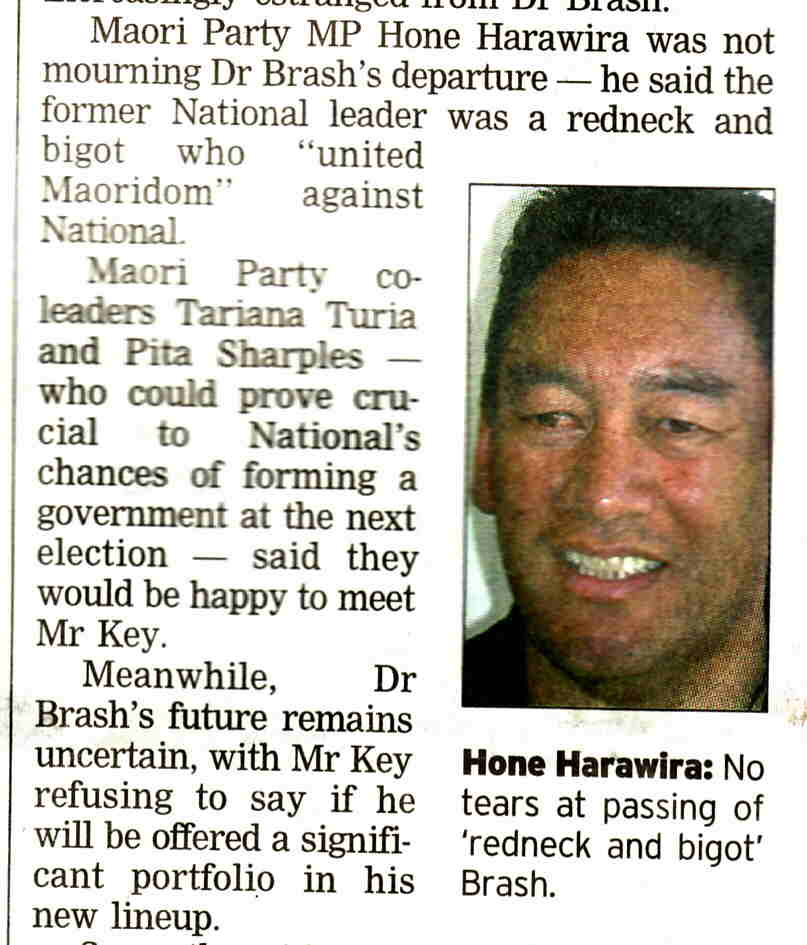
Tariana Turia says in her Beehive Comment; The Maori Party position didn’t even make the bulletin. Seems that nobody wants to hear a statement which says ‘we respect his right to make a decision’ or ‘we appreciate the impact such a difficult time can have upon the family’.
You see, nasty headlines, cutting insults are what sells papers – remarks which play on people’s fears and prejudices.
I can only conclude that Hone Harawira no longer officially represents the Maori Party.
Saturday, December 02, 2006
You get what you pay for?
Pay and display machines are being blown up by 'vigilantes'in East Sussex, UK, because they are so unpopular. Seems a bit over the top but when you consider that the authorities in Banbury go so far as to make parkers type in their registration number to prevent them handing an unused amount of time over to another motorist you begin to understand why there is such antipathy towards them.
Kiddy crisis in the 'Naki
Cinema: Parents parking kids, not cars
Children as young as eight are being dumped at the cinema by their parents
One of the lead stories in the Taranaki Daily News.
There are a couple of things I noticed. The use of the word 'dump' instead of 'drop off' inferring any parent who drops off their child is bad. I wouldn't let my eight year-old go to the cinema without an adult but I have dropped off my twelve year-old to meet friends. The reminder that the movie could be sold out is useful.
Good on the movie company for looking after the children that do get stranded.
But here's the line that really disgusts me; The New Plymouth District Council says it cannot review parking charges until next June because of the costs of retriggering the Local Government Act's need for consultation.
Isn't it pathetic? The stifling burden of rules and regulations. In fact, I'm sure if they look hard enough the council or OSH could find some reason why the cinema company shouldn't be taking care of kids in a separate area when they can't get into the movie.
Children as young as eight are being dumped at the cinema by their parents
One of the lead stories in the Taranaki Daily News.
There are a couple of things I noticed. The use of the word 'dump' instead of 'drop off' inferring any parent who drops off their child is bad. I wouldn't let my eight year-old go to the cinema without an adult but I have dropped off my twelve year-old to meet friends. The reminder that the movie could be sold out is useful.
Good on the movie company for looking after the children that do get stranded.
But here's the line that really disgusts me; The New Plymouth District Council says it cannot review parking charges until next June because of the costs of retriggering the Local Government Act's need for consultation.
Isn't it pathetic? The stifling burden of rules and regulations. In fact, I'm sure if they look hard enough the council or OSH could find some reason why the cinema company shouldn't be taking care of kids in a separate area when they can't get into the movie.
Friday, December 01, 2006
National morphing into Labour
Here we go. National morphing into Labour. Jackie Blue positioning herself to be the next Minister of Women's Affairs. ACT should be putting out a press release reminding New Zealand they would abolish this archaic, politics-of-privilege department.
Let woman then go on —not asking favors, but claiming as a right the removal of all hindrances to her elevation in the scale of being —let here receive encouragement for the proper cultivation of all her powers, so that she may enter profitably into the active business of life . . . Then in the marriage union, the independence of husband and wife will be equal, their dependence mutual, and their obligations reciprocal.
— Lucretia Coffin Mott, Discourse on Woman [December 17, 1849]
Let woman then go on —not asking favors, but claiming as a right the removal of all hindrances to her elevation in the scale of being —let here receive encouragement for the proper cultivation of all her powers, so that she may enter profitably into the active business of life . . . Then in the marriage union, the independence of husband and wife will be equal, their dependence mutual, and their obligations reciprocal.
— Lucretia Coffin Mott, Discourse on Woman [December 17, 1849]
Reforming Welfare
I had a flick through the UK report, Reforming Welfare, yesterday, looking for any comparative NZ data. This is all I found and it's from 2002 which devalues its usefulness.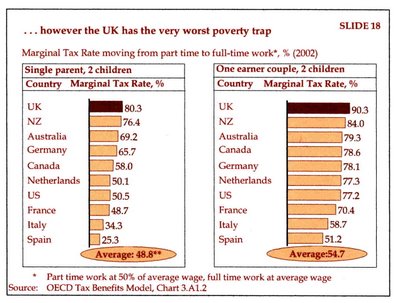
Anyway, Maxim have done a good job summarising the report as follows;
REPORT STRENGTHENS THE CASE FOR WELFARE REFORM IN UK
The already compelling case for welfare reform in the United Kingdom grew stronger recently, with the ballooning of government dependency continuing, and the release of a new report by the think tank Reform.
Reforming Welfare examines the current state of the British welfare system, showing that while spending on welfare is "colossal", the state of beneficiaries is getting worse, and the poverty trap only deeper. The British government spent £79 billion on welfare during 2005, supporting an estimated 14 percent of the working age population. At the same time, the number of government benefits has ballooned from seven in 1948 to 51 today.
The Times reported recently that under the British equivalent of New Zealand's "Working for Families" scheme, even those in the richest fifth of households are in receipt of government benefits. The paper reported that a third of the scheme's expenditure goes to the richest 50 percent of homes. It appears that more and more people are lining up for help they may not even need.
But although the welfare budget sucks more and more cash from the public purse, it delivers little in return. Reforming Welfare states that outcomes such as inequality and poverty are only getting worse, with many poorer regions worse off than 20 years ago. The report argues that the moral, social and economic consequences of welfare dependency are crippling, tracing the gradual historical shift from local structures aimed at preserving independence to the modern welfare state with its central bureaucracy and endless paperwork.
Setting the debate in much-needed context, the report lays down a tough and important challenge New Zealand cannot ignore. A welfare state which breeds a culture of entitlement is neither sustainable nor wise. As a country, we must do better when it comes to those left behind.
Anyway, Maxim have done a good job summarising the report as follows;
REPORT STRENGTHENS THE CASE FOR WELFARE REFORM IN UK
The already compelling case for welfare reform in the United Kingdom grew stronger recently, with the ballooning of government dependency continuing, and the release of a new report by the think tank Reform.
Reforming Welfare examines the current state of the British welfare system, showing that while spending on welfare is "colossal", the state of beneficiaries is getting worse, and the poverty trap only deeper. The British government spent £79 billion on welfare during 2005, supporting an estimated 14 percent of the working age population. At the same time, the number of government benefits has ballooned from seven in 1948 to 51 today.
The Times reported recently that under the British equivalent of New Zealand's "Working for Families" scheme, even those in the richest fifth of households are in receipt of government benefits. The paper reported that a third of the scheme's expenditure goes to the richest 50 percent of homes. It appears that more and more people are lining up for help they may not even need.
But although the welfare budget sucks more and more cash from the public purse, it delivers little in return. Reforming Welfare states that outcomes such as inequality and poverty are only getting worse, with many poorer regions worse off than 20 years ago. The report argues that the moral, social and economic consequences of welfare dependency are crippling, tracing the gradual historical shift from local structures aimed at preserving independence to the modern welfare state with its central bureaucracy and endless paperwork.
Setting the debate in much-needed context, the report lays down a tough and important challenge New Zealand cannot ignore. A welfare state which breeds a culture of entitlement is neither sustainable nor wise. As a country, we must do better when it comes to those left behind.
"Why won't NZ cut taxes?"
National Party associate finance spokesman, Craig Foss, has an article in the Wall St journal. Well done. NCPA summarises it.
Since the Labor Party took power in 1999, taxes have become quite burdensome:
* The top personal tax rate has been hiked to 39 percent from 33 percent.
* The corporate rate -- already a hefty 33 percent -- hasn't changed for over a quarter century.
* New Zealand's income and corporate tax-to-GDP ratio now ranks 16th among Organization for Economic Co-operation and Development (OECD) countries; seven years ago, the country placed 10th.
I take it then we can look forward to National cutting taxes.
Since the Labor Party took power in 1999, taxes have become quite burdensome:
* The top personal tax rate has been hiked to 39 percent from 33 percent.
* The corporate rate -- already a hefty 33 percent -- hasn't changed for over a quarter century.
* New Zealand's income and corporate tax-to-GDP ratio now ranks 16th among Organization for Economic Co-operation and Development (OECD) countries; seven years ago, the country placed 10th.
I take it then we can look forward to National cutting taxes.
Pregnant teenage heroin addict remanded
A pregnant teenage heroin addict was remanded in the Invercargill district court in order for CYF to arrange treatment for her and her unborn child. The story focuses on whether or not newborns of addicts are harmed by their mother's drug use, which is a bit laughable given the very strong possibility that if she uses heroin she also smokes and drinks (probably courtesy of a sickness benefit). But I am more interested in the fact she is in court. Had she committed some other crime? Or does CYF have the power to take her to court because of concerns over the unborn child?
Thursday, November 30, 2006
Good luck to the government
From Scoop;
Following yesterday's removal of this final legal obstacle, CPAG is looking forward to its chance to argue that the government's In Work Payment discriminates against some children, says Ms Wakim.
"The basis of our case is that children's needs are the same, whether or not parents are able to work. It is time to support all New Zealand's children including those whose parents may not be able to work," she says.
My argument against this is here.
Not often I find myself supporting the government.
Following yesterday's removal of this final legal obstacle, CPAG is looking forward to its chance to argue that the government's In Work Payment discriminates against some children, says Ms Wakim.
"The basis of our case is that children's needs are the same, whether or not parents are able to work. It is time to support all New Zealand's children including those whose parents may not be able to work," she says.
My argument against this is here.
Not often I find myself supporting the government.
Maori Party against Maori place names
The Maori Party would be amongst the strongest proponents of te reo. But now Tariana Turia is very angry about prisons having Maori names because of the negative connotations associated with these institutions.
"We know too, of the extreme objection that mana whenua took in the process of establishing a name for the Waikato based prison, at Spring Hill, early last year" said Mrs Turia. "Iwi had objected to the name, Puke Puna as they did not want Maori culture associated with the facility" recalled Mrs Turia.
"And yet still the Department persists with a whole new vocabulary of Maori names for their jails: Arohata (Tawa), Te Piriti, Te Wairere, Te Mahinga (Paremoremo), Kia Marama (Rolleston), Te Hikoinga, Rangipo (Tongariro), Kareo (Youth unit at Northland); and I'm sure there's plenty more where they come from" said Mrs Turia.
"Then we have all of the elaborately named programmes, such as 'Te Wairua o Nga Tangata (community probation programme) or even the expensive branding exercise to create a Maori sub-title for the Department".
"Is it meant to seduce us all into thinking these places are actually good for Maori, by virtue of having a Maori subtitle?" asked Mrs Turia.
Can anybody make any sense of her outrage?
"We know too, of the extreme objection that mana whenua took in the process of establishing a name for the Waikato based prison, at Spring Hill, early last year" said Mrs Turia. "Iwi had objected to the name, Puke Puna as they did not want Maori culture associated with the facility" recalled Mrs Turia.
"And yet still the Department persists with a whole new vocabulary of Maori names for their jails: Arohata (Tawa), Te Piriti, Te Wairere, Te Mahinga (Paremoremo), Kia Marama (Rolleston), Te Hikoinga, Rangipo (Tongariro), Kareo (Youth unit at Northland); and I'm sure there's plenty more where they come from" said Mrs Turia.
"Then we have all of the elaborately named programmes, such as 'Te Wairua o Nga Tangata (community probation programme) or even the expensive branding exercise to create a Maori sub-title for the Department".
"Is it meant to seduce us all into thinking these places are actually good for Maori, by virtue of having a Maori subtitle?" asked Mrs Turia.
Can anybody make any sense of her outrage?
Cheery thoughts for a dismal day
The lucky British have a 'welfare nation' that is bigger than ours! With spending of 79 billion pounds, on a per head of population basis that equates to 1,316 pounds or $3,777. Ours is only $3,601.

Gordon Brown is to thank for the wonderful expansion of welfare into the homes of "the rich". What a fantastic Prime Minister he is going to make.
Gordon Brown is to thank for the wonderful expansion of welfare into the homes of "the rich". What a fantastic Prime Minister he is going to make.
Wednesday, November 29, 2006
Come on, National
This post is an exercise in cheering myself up and finding something good to say about National. It's partly fiction. But it needn't be.
John Key will hand the welfare portfolio back to Katherine Rich who always presented a softer persona but actually did some real work in welfare when she produced her 2003 paper, Saving the next generation from welfare dependence. In it she laid out a plan which included working for the dole and work-testing, reciprocal obligations, time limits and reform of the child support system.
Rich will then front welfare reform policies using the Key approach of we will not turn our back on you but we have expectations - get off your bottom, be 'aspirational', grasp the opportunities for the sake of your children.
Key has already signalled this by insisting on adopting policies that work. There is all the evidence he needs they work in the United States.
Still, I had similar hopes for the Maori party and welfare but they were misplaced.....
John Key will hand the welfare portfolio back to Katherine Rich who always presented a softer persona but actually did some real work in welfare when she produced her 2003 paper, Saving the next generation from welfare dependence. In it she laid out a plan which included working for the dole and work-testing, reciprocal obligations, time limits and reform of the child support system.
Rich will then front welfare reform policies using the Key approach of we will not turn our back on you but we have expectations - get off your bottom, be 'aspirational', grasp the opportunities for the sake of your children.
Key has already signalled this by insisting on adopting policies that work. There is all the evidence he needs they work in the United States.
Still, I had similar hopes for the Maori party and welfare but they were misplaced.....
Tuesday, November 28, 2006
And the Nicky Hager award goes to....
Robson-on-Politics for;
Mr Bolger promised an end to Rogernomics and won a mandate but the moment votes had been counted after the 1990 election he put a Rogernome, Ms Ruth Richardson, into the finance portfolio and in came policies like Crown Health Enterprises (you had to pay a fee to go to a hospital), asset sales (NZ Railways was sold as were the last of the public shareholding in BNZ bank), unemployment soared to above 20% for Maori and toward 9% for non-Maori and welfare dependency and drug abuse and violence rose.
Unemployment was higher or similar in the UK and Australia and Canada and France and Italy.
Welfare dependency dropped between 1990 and 1996 by 22 percent.
Drug abuse and violence rose. Just as they continue to rise today under the Clark government.
Mr Bolger promised an end to Rogernomics and won a mandate but the moment votes had been counted after the 1990 election he put a Rogernome, Ms Ruth Richardson, into the finance portfolio and in came policies like Crown Health Enterprises (you had to pay a fee to go to a hospital), asset sales (NZ Railways was sold as were the last of the public shareholding in BNZ bank), unemployment soared to above 20% for Maori and toward 9% for non-Maori and welfare dependency and drug abuse and violence rose.
Unemployment was higher or similar in the UK and Australia and Canada and France and Italy.
Welfare dependency dropped between 1990 and 1996 by 22 percent.
Drug abuse and violence rose. Just as they continue to rise today under the Clark government.
The key from debut
Policies not personalities. That's what we should be looking very closely at. Here's what Key said in his debut today;
Personal freedom, individual responsibility, a competitive economy, and support for families and communities are the very principles under which the party was formed 70 years ago, and they are as relevant today as they were then.
What you can be assured of is that our policies will always be measured against our core principles.
We'll be watching.
Personal freedom, individual responsibility, a competitive economy, and support for families and communities are the very principles under which the party was formed 70 years ago, and they are as relevant today as they were then.
What you can be assured of is that our policies will always be measured against our core principles.
We'll be watching.
Early intervention in UK crime
When I read this headline I expected a story about intervening when potential criminals were still very young children. I was wrong.
Early intervention in UK crime
6.20am Tuesday November 28, 2006
British criminal psychologists are putting together a list of the 100 most dangerous murderers and rapists before they have committed any such crimes, The Times said.
Statements from previous partners, information from mental health workers, and details of past complaints are helping create the profiles.
Once an individual has been targeted, police can decide whether to plan an arrest.
Early intervention in UK crime
6.20am Tuesday November 28, 2006
British criminal psychologists are putting together a list of the 100 most dangerous murderers and rapists before they have committed any such crimes, The Times said.
Statements from previous partners, information from mental health workers, and details of past complaints are helping create the profiles.
Once an individual has been targeted, police can decide whether to plan an arrest.
Hone messes with Maori Party mana
Maori Party Statement on the resignation of Don Brash;
“As a party, we have stood firmly on our philosophy that we have practised in the House, of not belitting others. It is a practice we endeavour to uphold in all spheres of our activity. We will not compromise that practice now. E hara tenei i te wa, he whakaiti tangata” concluded Dr Sharples.
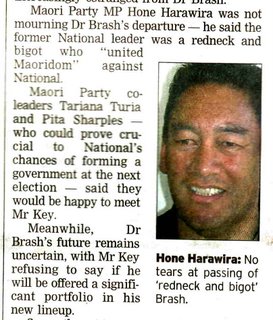
(Just goes to show all Maori do not think and act the same way. That's a bugger for the collectivists.)
“As a party, we have stood firmly on our philosophy that we have practised in the House, of not belitting others. It is a practice we endeavour to uphold in all spheres of our activity. We will not compromise that practice now. E hara tenei i te wa, he whakaiti tangata” concluded Dr Sharples.

(Just goes to show all Maori do not think and act the same way. That's a bugger for the collectivists.)
Monday, November 27, 2006
Our "great social progress"
 Another international conference is being held in Wellington today. It is about the FGC, or Family Group Conference, a process which was born in NZ in 1989. The Family Group Conference changed child and youth justice. It primarily kept offenders out of court. Today only 16-17 percent of offences go to court. 44 percent of offenders receive warnings only. Ruth Dyson opened the conference this morning with a typical ministerial speech which would have sent me to sleep in a nanosecond. Here she is winding up;
As any proud parent would, I'm going to finish by noting the international success of our baby – again. The FGC has been adopted and adapted around the world as a best practice model. As a country New Zealand can be justifiably proud of this and the great social progress we continue to make.
The great social progress we continue to make! Doesn't that take the cake. Talk about blinkered government.
"Que(e)rying Research"
Here's a conference many taxpayers will be ecstatic about paying for;
A conference looking at research into Lesbian Gay Bisexual Transgender (LGBT) issues will be held at AUT University next week.
In her address Professor Pringle will draw on a small local study of 'out' lesbian managers to argue that their lack of response to questions about gender issues in the workplace is because gender is actually heterogender - rooted in a dichotomous masculine and feminine relationship.
Identity issues for the women in this local study centred around the multi-layered process of coming out, making their sexual orientation visible within their managerial position. To some extent these lesbians were freed from gender issues, because managing gender is managing heterosexuality.
So what's the problem? What is it about academics creating problems where there are none. It's too clever for me.
A conference looking at research into Lesbian Gay Bisexual Transgender (LGBT) issues will be held at AUT University next week.
In her address Professor Pringle will draw on a small local study of 'out' lesbian managers to argue that their lack of response to questions about gender issues in the workplace is because gender is actually heterogender - rooted in a dichotomous masculine and feminine relationship.
Identity issues for the women in this local study centred around the multi-layered process of coming out, making their sexual orientation visible within their managerial position. To some extent these lesbians were freed from gender issues, because managing gender is managing heterosexuality.
So what's the problem? What is it about academics creating problems where there are none. It's too clever for me.
Sunday, November 26, 2006
Collin's views on welfare = ACT's?
The Herald on Sunday summarises the Hager book;
Hager says: "(Brash) gave the (welfare) job to an MP called Judith Collins, whose views on welfare would have fitted comfortably into (ACT)."
I suppose they do resemble Muriel Newman's. They are conservative views. The conservative wants welfare with obligations. It's expensive and paternalistic. It's interventionist. It may be an improvement on what we have.
Myself? I frequently disagree with the conservative approach.
Here's an example. Take the common occurrence of women giving birth outside of a permanent relationship. The conservative hankers after making all non-custodial fathers take financial responsibility for their children. Too many fathers are 'deadbeat Dads'.
I say make the person who decided to have the child take responsibility.
The conservative won't move on but we are living in different times. Women have rights, choice and independence hitherto unknown. They now need to accept liability as well.
Hager says: "(Brash) gave the (welfare) job to an MP called Judith Collins, whose views on welfare would have fitted comfortably into (ACT)."
I suppose they do resemble Muriel Newman's. They are conservative views. The conservative wants welfare with obligations. It's expensive and paternalistic. It's interventionist. It may be an improvement on what we have.
Myself? I frequently disagree with the conservative approach.
Here's an example. Take the common occurrence of women giving birth outside of a permanent relationship. The conservative hankers after making all non-custodial fathers take financial responsibility for their children. Too many fathers are 'deadbeat Dads'.
I say make the person who decided to have the child take responsibility.
The conservative won't move on but we are living in different times. Women have rights, choice and independence hitherto unknown. They now need to accept liability as well.
Saturday, November 25, 2006
Beaten by the Aussies again
Economist rates New Zealand 11th= in democracy index (left click to enlarge)
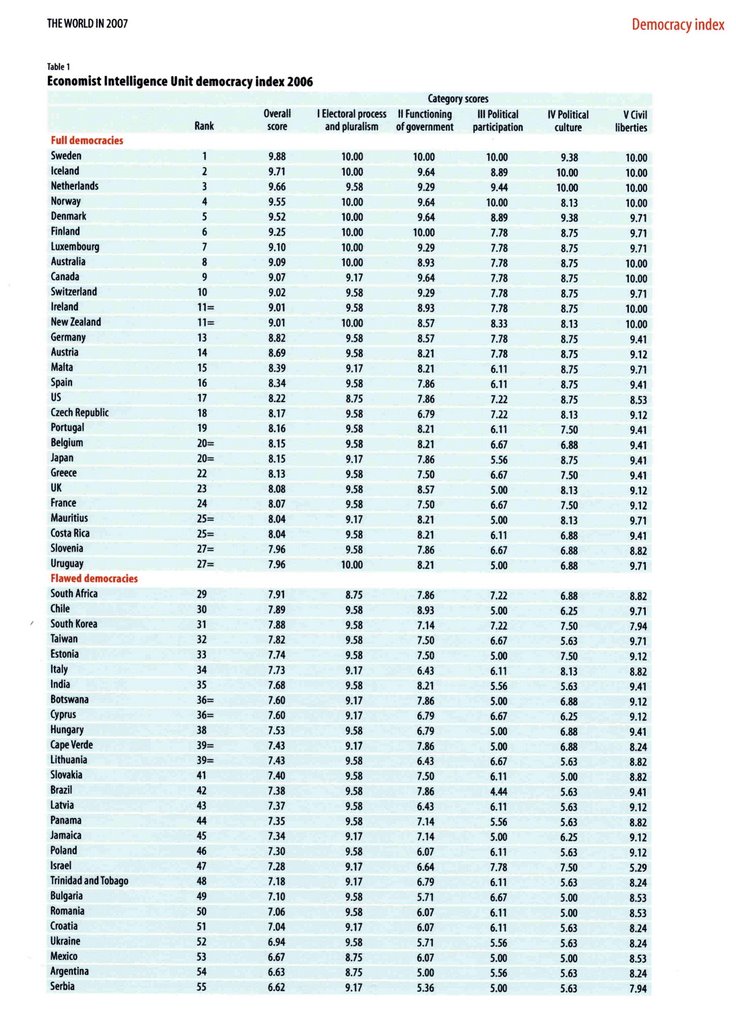 (left click to enlarge)
Objective academia
A research team led by the PM's husband Peter Davies has found that families are no better off financially than 20 years ago. The team includes a sociologist who says;
"What's scary in New Zealand is that it hasn't got better under Labour".
I suppose if National had been government he would have said, no wonder. Hardly an objective academic.
Professor Davis told a Sociological Association conference in Hamilton this week that each Census cost $25 million, but until now the Government had not got that value of data from it.
They cost a damn sight more than that. That little bit of 'research' wasn't quite up to the mark.
"What's scary in New Zealand is that it hasn't got better under Labour".
I suppose if National had been government he would have said, no wonder. Hardly an objective academic.
Professor Davis told a Sociological Association conference in Hamilton this week that each Census cost $25 million, but until now the Government had not got that value of data from it.
They cost a damn sight more than that. That little bit of 'research' wasn't quite up to the mark.
Friday, November 24, 2006
Will welfare reform go west?
Brash in a Spectator interview two weeks ago;
In the Spectator interview, he said that his overriding objective was to make New Zealand wealthy again. He also admitted that the party's education for the 2005 election was "in some respects" a quasi-voucher system. He said he wanted "real" welfare reform. "There has been a big exodus of people from unemployment benefit to non-work-tested sickness and invalid benefit. We were going to take a much firmer view to avoid people getting trapped in these demoralising dependency traps."
Brash always understood how big a problem welfare dependence is for this country. Google Don Brash and Welfare and you get oodles.
Google John Key and Welfare and there is almost nothing. Sure Key hasn't had the portfolio or been leader but Brash was talking about the need for reform when he was Reserve Bank Governor! It was always crystal clear what concerned Brash but I have no idea what John Key is passionate about changing.
In terms of acting on welfare, Bill English is the better bet.
In the Spectator interview, he said that his overriding objective was to make New Zealand wealthy again. He also admitted that the party's education for the 2005 election was "in some respects" a quasi-voucher system. He said he wanted "real" welfare reform. "There has been a big exodus of people from unemployment benefit to non-work-tested sickness and invalid benefit. We were going to take a much firmer view to avoid people getting trapped in these demoralising dependency traps."
Brash always understood how big a problem welfare dependence is for this country. Google Don Brash and Welfare and you get oodles.
Google John Key and Welfare and there is almost nothing. Sure Key hasn't had the portfolio or been leader but Brash was talking about the need for reform when he was Reserve Bank Governor! It was always crystal clear what concerned Brash but I have no idea what John Key is passionate about changing.
In terms of acting on welfare, Bill English is the better bet.
He's just not Don Brash
Not PC is looking for reasons to get excited about John Key but can't find any. I can't help him.
But I can give him a few which justify his lack of enthusiasm;
Mr Key
- supports Kiwibank buying into the home loan market under the guise of 'public-private partnerships'
- supports raising the minimum wage
- supports the extension of state owned enterprises
- urges a more "hands-on" approach to the economy
- bought into middle class welfare when he used a parliamentary perk to subsidise his Wellington mortgage
Just a few instances I've blogged about this year. I'm sure he's a nice bloke and all that; smart, witty, photogenic and mainstream. But it's the policies that matter.
But I can give him a few which justify his lack of enthusiasm;
Mr Key
- supports Kiwibank buying into the home loan market under the guise of 'public-private partnerships'
- supports raising the minimum wage
- supports the extension of state owned enterprises
- urges a more "hands-on" approach to the economy
- bought into middle class welfare when he used a parliamentary perk to subsidise his Wellington mortgage
Just a few instances I've blogged about this year. I'm sure he's a nice bloke and all that; smart, witty, photogenic and mainstream. But it's the policies that matter.
How much lower?
Broadmindedness is not a characteristic I can lay claim to. I was sent the Investigate article about David Benson-Pope due for publication today and was so repulsed by the images I had difficulty in reading it. I deleted it. If Wishart has fabricated any of this it is a truly evil action. If he didn't, and neither did his informant, then David Benson Pope is gone. I feel very, very sorry for his family. Can politics go much lower?
Thursday, November 23, 2006
Pro-legalisation movement strengthens
This has revived my spirits slightly;
More than 60 British officers, including two former chief constables, have joined Jack Cole's Law Enforcement Against Prohibition (Leap). He spent 26 years with the police in New Jersey. "Prohibition doesn't work, it's never worked," said Mr Cole, who will be addressing meetings of police officers and MPs during his visit. "Leap wants to end drug prohibition just as we ended alcohol prohibition in 1933. When we ended that nasty law, we put Al Capone out of business overnight - and we can do the same to the drug lords and terrorists who make over $500bn a year selling illegal drugs around the world."
More than 60 British officers, including two former chief constables, have joined Jack Cole's Law Enforcement Against Prohibition (Leap). He spent 26 years with the police in New Jersey. "Prohibition doesn't work, it's never worked," said Mr Cole, who will be addressing meetings of police officers and MPs during his visit. "Leap wants to end drug prohibition just as we ended alcohol prohibition in 1933. When we ended that nasty law, we put Al Capone out of business overnight - and we can do the same to the drug lords and terrorists who make over $500bn a year selling illegal drugs around the world."
Brash resigns
Don has resigned. I feel immensely sad and disappointed. It is one more nail in the coffin of politics for me.
Update; Gerry Brownlee is supporting John Key. Is Key a foregone conclusion?
My feeling is he will make National indistinguishable from Labour but capture the public imagination and take National to victory anyway. Then we will have another innings of National largely supporting the status quo. As they have, in general, always done. Labour govts have always been the doers.
Barry Soper has just described Don Brash as a most "unconventional politician" and not suited to "this place". Parliament=conformity? National=conformity.
Update; Gerry Brownlee is supporting John Key. Is Key a foregone conclusion?
My feeling is he will make National indistinguishable from Labour but capture the public imagination and take National to victory anyway. Then we will have another innings of National largely supporting the status quo. As they have, in general, always done. Labour govts have always been the doers.
Barry Soper has just described Don Brash as a most "unconventional politician" and not suited to "this place". Parliament=conformity? National=conformity.
A stunning display of stupidity

This is a stunner, isn't it? Why do we accord these imbeciles any degree of respectability? The police, that is.....
Culture, not booze, the problem
Auckland Mayoral candidate talking sense here.
And Stephen Berry's advocacy of legalisation of alternative drugs is not silly. I have worked with two people this year who have substantially improved their lives, and those of the people around them, by keeping away from booze and smoking cannabis instead. For these people keeping off alcohol is taking some degree of responsibility.
And Stephen Berry's advocacy of legalisation of alternative drugs is not silly. I have worked with two people this year who have substantially improved their lives, and those of the people around them, by keeping away from booze and smoking cannabis instead. For these people keeping off alcohol is taking some degree of responsibility.
Govt dept costs balloon
The Commerce Commission is costing the taxpayer 22 percent more than the year before with spending on staff increasing by 24 percent although consultancy costs quadrupled as well. There are around 160 staff and more than 30 earn over $100,000 - up from 12 the previous year. The chairwoman earns $411,000 - up 14 percent on the previous year.
Ironically, this outfit provides a fine example of what happens without competition.
The scrutiniser needs scrutinising.
(Source DomPost - no link)
Ironically, this outfit provides a fine example of what happens without competition.
The scrutiniser needs scrutinising.
(Source DomPost - no link)
Tuesday, November 21, 2006
White ribbon
See what my 12 year-old son brought home from school.

I asked him, "Where's the other one?"
"Which other one?" he replied.
"The one that shows you don't support women being violent towards men and children."
"Apparently that's on the increase too", he answered. Ah. At least he is getting some balance.

I asked him, "Where's the other one?"
"Which other one?" he replied.
"The one that shows you don't support women being violent towards men and children."
"Apparently that's on the increase too", he answered. Ah. At least he is getting some balance.
"Startling"?
Maori are twice as likely to have substance abuse problems.
The startling finding was revealed in statistical analysis of ‘Te Rau Hinengaro: The New Zealand Mental Health Survey’ and will be presented at the ATCA conference by Professor Doug Sellman, Director of the National Addiction Centre and the Christchurch School of Medicine.
“In the raw data, it appeared Maori were actually three times more likely to have substance abuse problems than other ethnicities, so the question was asked: how much of this result is due to ethnicity, and how much is due to other factors?” says Professor Sellman.
Multi-regression mathematical models were used to factor in variables that could explain the disparity such as age, gender, education, and household income.
“This analysis found that, independently of these other variables, Maori are twice as likely to have lifetime substance use disorders than other ethnic groups,” says Professor Sellman.
I don't find this startling. It's at the root of most of Maori disproportionately poor statistics. Alcoholism, binge drinking, cannabis and harder drug addiction lead to crime, inside and outside the home. Who are they kidding, startling?
The startling finding was revealed in statistical analysis of ‘Te Rau Hinengaro: The New Zealand Mental Health Survey’ and will be presented at the ATCA conference by Professor Doug Sellman, Director of the National Addiction Centre and the Christchurch School of Medicine.
“In the raw data, it appeared Maori were actually three times more likely to have substance abuse problems than other ethnicities, so the question was asked: how much of this result is due to ethnicity, and how much is due to other factors?” says Professor Sellman.
Multi-regression mathematical models were used to factor in variables that could explain the disparity such as age, gender, education, and household income.
“This analysis found that, independently of these other variables, Maori are twice as likely to have lifetime substance use disorders than other ethnic groups,” says Professor Sellman.
I don't find this startling. It's at the root of most of Maori disproportionately poor statistics. Alcoholism, binge drinking, cannabis and harder drug addiction lead to crime, inside and outside the home. Who are they kidding, startling?
Worse than a dog's breakfast
Labour will no doubt be watching this Stuff poll as it tries to decide whether to make supporting Bradford's Bill a conscience or party vote.
Do you support the anti-smacking bill?
Yes (18 votes, 20.5%)
No (66 votes, 75.0%)
I'm not sure (4 votes, 4.5%)
The proposed legislation is worse than a dog's breakfast - it's a dog's breakfast regurgitated.
Do you support the anti-smacking bill?
Yes (18 votes, 20.5%)
No (66 votes, 75.0%)
I'm not sure (4 votes, 4.5%)
The proposed legislation is worse than a dog's breakfast - it's a dog's breakfast regurgitated.
Monday, November 20, 2006
Xmas presents needed for children of inmates
Angel Tree is a fund set up by the Prison Fellowship to provide, among other things, xmas gifts for prisoner's children. They are particularly stretched this year due to 7,800 people being behind bars -"2,000 more than was predicted two years ago".
If you want to donate you can go to the Prison Fellowship website. To be honest I don't know whether I will or not but there may be more christian-spirited types than me reading this blog.
If you want to donate you can go to the Prison Fellowship website. To be honest I don't know whether I will or not but there may be more christian-spirited types than me reading this blog.
Birth statistics
The number of births is the highest since 1992. The September 2006 year has just been released and the ethnicity breakdown is interesting. Of the 59,120 births 29 percent were registered with Maori ethnicity, 15 percent Pacific, 10 percent Asian and 70 percent with NZ European and others, 1.5 percent. Obviously the percentages do not add up because around a quarter of births have more than one ethnicity registered.
But in 2004 28 percent of babies had Maori ancestry, 68 percent were non-Maori and 4 percent had no ancestry specified.
Since 1996 Asian births have grown by 61 percent from 3792 to 6100.
But in 2004 28 percent of babies had Maori ancestry, 68 percent were non-Maori and 4 percent had no ancestry specified.
Since 1996 Asian births have grown by 61 percent from 3792 to 6100.
The thoughts of Chairman Trotter
While not entirely agreeing with this column by Marc Alexander (Trotter does occasionally criticise Labour) I rather enjoyed it and you might too. I'm sure Trotter's dogged loyalty to Marxist rhetoric raises more eyebrows than just mine.
Sunday, November 19, 2006

Asian abortion
Further from Deborah Coddington's column;
Here's a disturbing fact: in 2003 four of every five pregnant Asian women aborted their babies. Do we keep abortion as a last-resort method of birth control, or accept it's a casual approach to contraception?
"Four of every five" where??
Not here. In 2003 there were 5285 births to Asian mothers and 3502 Asian abortions. So 40 percent of pregnancies ended in abortion. In 2004 this dropped to 36 percent. Neither figure is anywhere near 80 percent.
I got the distinct impression she was writing about Asians in New Zealand. Did you?
Here's a disturbing fact: in 2003 four of every five pregnant Asian women aborted their babies. Do we keep abortion as a last-resort method of birth control, or accept it's a casual approach to contraception?
"Four of every five" where??
Not here. In 2003 there were 5285 births to Asian mothers and 3502 Asian abortions. So 40 percent of pregnancies ended in abortion. In 2004 this dropped to 36 percent. Neither figure is anywhere near 80 percent.
I got the distinct impression she was writing about Asians in New Zealand. Did you?
Attitudes to Asians
Deborah Coddington is defending her North and South piece on Asian crime in today's Herald on Sunday. Here's an excerpt;
My sin was to write a feature about how New Zealand has gone from a country which once regarded Chinese immigrants as hard-working, law-abiding, good kiwis to today's situation, where each week brings news of yet another major crime involving Asians.
Contrast this to Margaret McClure's description of how NZ used to regard Asians;

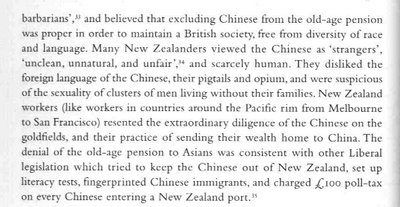
I realise Deborah is considering a different time frame but if anything New Zealander's attitude to and treatment of Asians has vastly improved.
My sin was to write a feature about how New Zealand has gone from a country which once regarded Chinese immigrants as hard-working, law-abiding, good kiwis to today's situation, where each week brings news of yet another major crime involving Asians.
Contrast this to Margaret McClure's description of how NZ used to regard Asians;

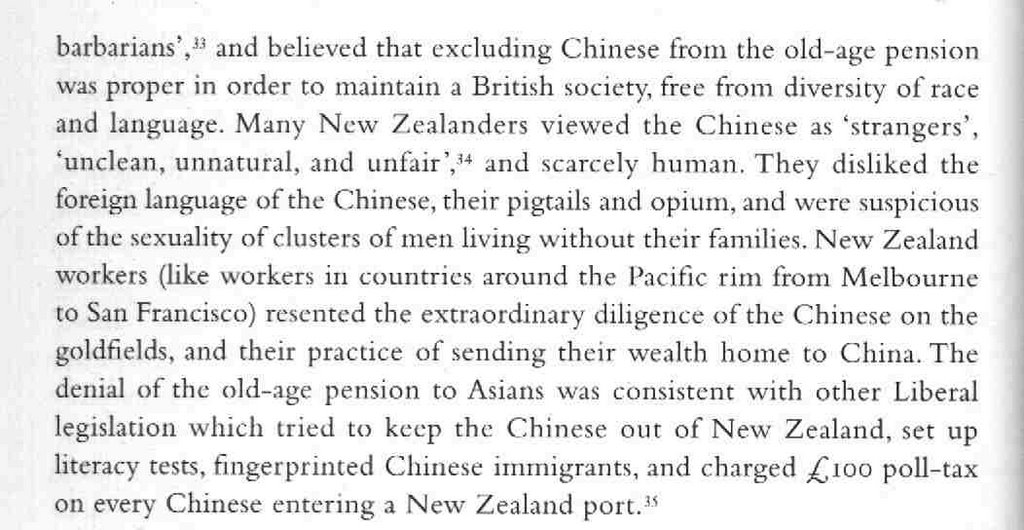
I realise Deborah is considering a different time frame but if anything New Zealander's attitude to and treatment of Asians has vastly improved.
Saturday, November 18, 2006
Children into care, Families into care...same thing really
Putting entire families into care is the next approach on the agenda for dealing with welfare and drug dependent parents with children. Apparently this is a common strategy used in Sweden so has Sue Bradford's backing. Hang on. I thought Sweden was some kind of promised land where families weren't dysfunctional, thanks to the state running their lives for them. Funnily enough Green co-leader, Russel Norman, apparently said, in a debate about Rodney Hide's Regulatory Responsibility Bill that the Greens share ACT's suspicion of the state. Has anybody told Sue?
Less Government = more wealth
 Socialists believe, when you claim the above, it's all about putting more money in your own pocket. Because that's the way they think. What's in it for me? And they assume everybody else does. After all it's always lefties trying to live off somebody else.
But more wealth benefits everybody and reduces poverty. And more wealth requires less government. A new Goldwater Institute report out of the US proves it. The great thing about the states is that each one does its own thing and the results can be compared.
The report, which can be downloaded from the NCPA link begins;
In modern politics, many believe that the government plays the role of Robin Hood. Through progressive taxation and spending, proponents believe that government reduces poverty while making everyone pay their fair share. The pages that follow will empirically evaluate the effectiveness of state government as Robin Hood.
NCPA summarises;
# The 10 states with the highest state spending per capita (Alaska, California, Delaware, Hawaii, Massachusetts, New Mexico, New York, Rhode Island, Vermont and Wyoming) saw an average increase of 7.3 percent of overall poverty rates and a 4.5 percent increase in childhood poverty.
# The 10 states with the lowest spending (Arizona, Colorado, Florida, Georgia, Missouri, Nebraska, Nevada, South Dakota, Tennessee and Texas) saw overall poverty decline by 11.2 percent and childhood poverty fall 12.2 percent.
The dramatic declines in poverty in the "small government" states strongly confirms the hypothesis that reduced taxes and state spending encourages the emigration of people and businesses to areas where private-sector job growth is able to flourish and become a powerful and effective antipoverty program, says Ladner. And while taxes and business climate alone are not the only factors in reducing poverty rates, they certainly go a long way in helping fight the war on poverty.
And from the report a couple of highlights; Colorado, the only state operating under a Taxpayer Bill of Rights reduced poverty more than any other state during the 90s. (It'll be interesting to see what impact suspending it will have.)
Wisconsin, which led the way in welfare reform, experienced strong drops in poverty rates.
Bear in mind this report pertains only to the 90s.
Rubbing their noses in it
 Film maker, Michael Moore is such a magnanimous guy. Read this - his pledge to the Republicans. Just to give you a taste here's number 5;
5) When we make America the last Western democracy to have universal health coverage, and all Americans are able to get help when they fall ill, we promise that you too will be able to see a doctor, regardless of your ability to pay.
Friday, November 17, 2006
Why do we need state telly?
Stuff poll asks, Which free-to-air television channel do you prefer?
TV One (863 votes, 16.3%)
TV2 (767 votes, 14.5%)
TV3 (2382 votes, 45.0%)
C4 (222 votes, 4.2%)
Prime (738 votes, 14.0%)
Triangle (36 votes, 0.7%)
Maori TV (191 votes, 3.6%)
Other (89 votes, 1.7%)
TV One (863 votes, 16.3%)
TV2 (767 votes, 14.5%)
TV3 (2382 votes, 45.0%)
C4 (222 votes, 4.2%)
Prime (738 votes, 14.0%)
Triangle (36 votes, 0.7%)
Maori TV (191 votes, 3.6%)
Other (89 votes, 1.7%)
The "Who do we adults think we are?" Forum
This is a report from a UNICEF forum held yesterday (I think). I wonder what you will make of it? I have interspersed some comments.
What emerged from the forum was a declaration that New Zealanders generally, and professionals in particular, need to start watching their language. People who care about the wellbeing of children and young people need to start following the feminist example of challenging disrespectful jokes and language that put women down, and start being strong about challenging ways of talking that are disrespectful of children as fellow human beings.
Has the 'feminist example' improved relations between the sexes or the level of violence adults are subjected to?
Too often children are talked about dismissively as if their value lay in the adults they will become rather than the human beings they are now. The forum challenges adult New Zealanders to listen to themselves and to not just demand respect, but to give it too.
I thoroughly respect my kids when they act in ways that deserve respect and I try to remember to remark on it to them. When they don't, I let them know.
'Children are often talked about and talked to in ways that are incredibly disrespectful’ says David Kenkel the UNICEF advocacy manager for New Zealand. He went on to add. ‘If you talked about any other group in society in the disparaging and dismissive way that children are so often talked about you’d face serious complaints.’
As well as silly complaints.
This is particularly true for teenagers, we demand respect from them but don’t always give respect in the ways we talk to them and about them. Think about what it must be like to be constantly described as a problem in media and conversation and to be viewed with suspicion when you and friends walk down the road just because of your age?’
I seem to remember not weeks ago many NZers fighting for the rights of young adults as largely responsible and respectable young individuals.
Dr Ian Hassall , New Zealand’s former commissioner for children described how children are loved and cherished in the private spheres of family life but that this attitude and way of talking doesn’t always cross over into the public sphere where too often children are described as if they were troublesome and burdensome. When a phrase like ‘they were no trouble’ is the best praise you can say in public about a child it says something about how the public sphere sees children as needing to be quiet deferential and obedient. Of course they can never conform to these expectations because they are human beings just like the rest of us.
Quiet, deferential and obedient? He's kidding. Very few parents harbour such old-fashioned expectations. It's rather nice if it happens but generally children make noise, think about themselves first and regularly test the boundaries.
These people are really trying too hard.
What emerged from the forum was a declaration that New Zealanders generally, and professionals in particular, need to start watching their language. People who care about the wellbeing of children and young people need to start following the feminist example of challenging disrespectful jokes and language that put women down, and start being strong about challenging ways of talking that are disrespectful of children as fellow human beings.
Has the 'feminist example' improved relations between the sexes or the level of violence adults are subjected to?
Too often children are talked about dismissively as if their value lay in the adults they will become rather than the human beings they are now. The forum challenges adult New Zealanders to listen to themselves and to not just demand respect, but to give it too.
I thoroughly respect my kids when they act in ways that deserve respect and I try to remember to remark on it to them. When they don't, I let them know.
'Children are often talked about and talked to in ways that are incredibly disrespectful’ says David Kenkel the UNICEF advocacy manager for New Zealand. He went on to add. ‘If you talked about any other group in society in the disparaging and dismissive way that children are so often talked about you’d face serious complaints.’
As well as silly complaints.
This is particularly true for teenagers, we demand respect from them but don’t always give respect in the ways we talk to them and about them. Think about what it must be like to be constantly described as a problem in media and conversation and to be viewed with suspicion when you and friends walk down the road just because of your age?’
I seem to remember not weeks ago many NZers fighting for the rights of young adults as largely responsible and respectable young individuals.
Dr Ian Hassall , New Zealand’s former commissioner for children described how children are loved and cherished in the private spheres of family life but that this attitude and way of talking doesn’t always cross over into the public sphere where too often children are described as if they were troublesome and burdensome. When a phrase like ‘they were no trouble’ is the best praise you can say in public about a child it says something about how the public sphere sees children as needing to be quiet deferential and obedient. Of course they can never conform to these expectations because they are human beings just like the rest of us.
Quiet, deferential and obedient? He's kidding. Very few parents harbour such old-fashioned expectations. It's rather nice if it happens but generally children make noise, think about themselves first and regularly test the boundaries.
These people are really trying too hard.
Milton Friedman dies
Classically Liberal reports on the very recent passing of Milton Friedman.
My thoughts turn to a live-link interview he and his wife Rose conducted with an ACT conference audience about 3-4 years ago. His mind was crystal sharp at over 90. This will be a great loss, especially for his wife with whom he co-authored much work.
My thoughts turn to a live-link interview he and his wife Rose conducted with an ACT conference audience about 3-4 years ago. His mind was crystal sharp at over 90. This will be a great loss, especially for his wife with whom he co-authored much work.
Benson-Pope - wrong again
Yesterday he told Parliament, 'People coming off a benefit in the last year outnumbered those going on to any benefit by a ratio of 4:1.'
If Mr Benson-Pope understood his portfolio he would immediately recognise that this is simply not possible.
Typically between 50 and 60 percent of the total caseload turns over each year. With a current caseload of around 280,000 at least 140,000 will have been new applications granted in the past year. In which case 560,000 people must have come off any benefit to satisfy a 4:1 ratio. That is impossible
The quality of the advice Benson-Pope is getting from the Ministry is very poor but his inability to recognise this is even more worrying.
If Mr Benson-Pope understood his portfolio he would immediately recognise that this is simply not possible.
Typically between 50 and 60 percent of the total caseload turns over each year. With a current caseload of around 280,000 at least 140,000 will have been new applications granted in the past year. In which case 560,000 people must have come off any benefit to satisfy a 4:1 ratio. That is impossible
The quality of the advice Benson-Pope is getting from the Ministry is very poor but his inability to recognise this is even more worrying.
Thursday, November 16, 2006
US Congressman Ron Paul's weekly column
Demographic Reality and the Entitlement State
November 13, 2006
The Government Accountability Office, or GAO, is an investigative arm of Congress charged with the thankless task of accounting for the money received and spent by the federal government. As you might imagine, people who spend all day examining the nitty-gritty realities of federal spending and deficits might not share the voters' enthusiasm for grand campaign promises.
David Walker, Comptroller General at GAO, has been on a speaking tour of the U.S recently-- and he pulls no punches when explaining just how precarious our nation's entitlement system really is.
He explains that Social Security and Medicare are headed for a train wreck because of demographic trends and rising health care costs. The number of younger taxpayers for each older retiree will continue to decline. The demand for "free" prescription drugs under Medicare will explode. If present trends continue, by 2040 the entire federal budget will be consumed by Social Security and Medicare. The only options for balancing the budget would be cutting total federal spending by about 60%, or doubling federal taxes.
Furthermore, Walker asserts, we cannot grow our way out of this problem. Faster economic growth can only delay the inevitable hard choices. To close the long-term entitlement gap, the U.S. economy would have to grow by double digits every year for the next 75 years.
In short, Mr. Walker is telling the political class that the status quo cannot be maintained. He is to be commended for his refreshing honesty and unwillingness to provide excuses for the two political parties, the administration, or the even the entitlement-minded American public.
I urge everyone interested to visit the GAO website at www.gao.gov, where you can view a report entitled: "Our Nation's Fiscal Outlook: The Federal Government's Long-Term Budget Imbalance." This report should be required reading for every politician in Washington.
Are ever growing entitlement and military expenditures really consistent with a free country? Do these expenditures, and the resulting deficits, make us more free or less free? Should the government or the marketplace provide medical care? Should younger taxpayers be expected to provide retirement security and health care even for affluent retirees? Should the U.S. military be used to remake whole nations? Are the programs, agencies, and departments funded by Congress each year constitutional? Are they effective? Could they operate with a smaller budget? Would the public even notice if certain programs were eliminated altogether? These are the kinds of questions the American people must ask, even though Congress lacks the courage to do so.
If we hope to avoid a calamitous financial future for our nation, we must address the hardest question of all: What is the proper role for government in our society? The answer to this question will determine how prosperous and free we remain in the decades to come.
November 13, 2006
The Government Accountability Office, or GAO, is an investigative arm of Congress charged with the thankless task of accounting for the money received and spent by the federal government. As you might imagine, people who spend all day examining the nitty-gritty realities of federal spending and deficits might not share the voters' enthusiasm for grand campaign promises.
David Walker, Comptroller General at GAO, has been on a speaking tour of the U.S recently-- and he pulls no punches when explaining just how precarious our nation's entitlement system really is.
He explains that Social Security and Medicare are headed for a train wreck because of demographic trends and rising health care costs. The number of younger taxpayers for each older retiree will continue to decline. The demand for "free" prescription drugs under Medicare will explode. If present trends continue, by 2040 the entire federal budget will be consumed by Social Security and Medicare. The only options for balancing the budget would be cutting total federal spending by about 60%, or doubling federal taxes.
Furthermore, Walker asserts, we cannot grow our way out of this problem. Faster economic growth can only delay the inevitable hard choices. To close the long-term entitlement gap, the U.S. economy would have to grow by double digits every year for the next 75 years.
In short, Mr. Walker is telling the political class that the status quo cannot be maintained. He is to be commended for his refreshing honesty and unwillingness to provide excuses for the two political parties, the administration, or the even the entitlement-minded American public.
I urge everyone interested to visit the GAO website at www.gao.gov, where you can view a report entitled: "Our Nation's Fiscal Outlook: The Federal Government's Long-Term Budget Imbalance." This report should be required reading for every politician in Washington.
Are ever growing entitlement and military expenditures really consistent with a free country? Do these expenditures, and the resulting deficits, make us more free or less free? Should the government or the marketplace provide medical care? Should younger taxpayers be expected to provide retirement security and health care even for affluent retirees? Should the U.S. military be used to remake whole nations? Are the programs, agencies, and departments funded by Congress each year constitutional? Are they effective? Could they operate with a smaller budget? Would the public even notice if certain programs were eliminated altogether? These are the kinds of questions the American people must ask, even though Congress lacks the courage to do so.
If we hope to avoid a calamitous financial future for our nation, we must address the hardest question of all: What is the proper role for government in our society? The answer to this question will determine how prosperous and free we remain in the decades to come.
Russell Fairbrother tells us how it works
"Often indirectly, you ask questions which suggest the girl is a bit of a sleazebag ... we're trying to put a stop to that kind of thing."
Read the full story here. Rather an injudicious choice of words. And isn't there a whiff of hypocrisy here.....what I used to do I now want stopped?
Read the full story here. Rather an injudicious choice of words. And isn't there a whiff of hypocrisy here.....what I used to do I now want stopped?
"Child abuse, 'It's your fault' "
Head of the Ministry of Social Development, Peter Hughes, came out swinging yesterday saying it is the responsibility of NZ adults to stop child abuse. Stop blaming government departments, he says. Of course he is right - to a point.
But look at what the Ministry does. In full knowledge that most abused or neglected children will come out of beneficiary homes where the parent is young, supposedly single, frequently Maori it continues to pay out cash no questions asked. It administers the very system that perpetuates the problem.
And if he looked at his own statistics he would see that there has been a steady rise in under-twenty single parents, a steady rise in the proportion of Maori on benefit, a steady rise in CYF notifications and substantiated findings of abuse or neglect, a steady rise in the number of people who are on a sickness or invalid benefit for drug, alcohol and substance addiction, some of whom have children. Yet his department continues to pay out more whenever a new child is added to a benefit, again, no questions asked.
The day Mr Hughes starts demanding policy change at a select committee is the day I will pay him some respect.
But look at what the Ministry does. In full knowledge that most abused or neglected children will come out of beneficiary homes where the parent is young, supposedly single, frequently Maori it continues to pay out cash no questions asked. It administers the very system that perpetuates the problem.
And if he looked at his own statistics he would see that there has been a steady rise in under-twenty single parents, a steady rise in the proportion of Maori on benefit, a steady rise in CYF notifications and substantiated findings of abuse or neglect, a steady rise in the number of people who are on a sickness or invalid benefit for drug, alcohol and substance addiction, some of whom have children. Yet his department continues to pay out more whenever a new child is added to a benefit, again, no questions asked.
The day Mr Hughes starts demanding policy change at a select committee is the day I will pay him some respect.
Wednesday, November 15, 2006
Compo for cold turkey (cont.)
750,000 pounds to 200. That should buy a few doses.
The hysterical thing about this development is that earlier in the year there was talk about quietly "retoxifying" reformed addicts coming up for release to prevent them over-dosing once out.
So addicts are committing crimes to get into prison for treatment. They don't get any so sue and win. But, unless they are retoxified after the cold turkey, they run the risk of killing themselves on release. With three or four thousand pounds in their pockets the prospect seems even more likely.
The hysterical thing about this development is that earlier in the year there was talk about quietly "retoxifying" reformed addicts coming up for release to prevent them over-dosing once out.
So addicts are committing crimes to get into prison for treatment. They don't get any so sue and win. But, unless they are retoxified after the cold turkey, they run the risk of killing themselves on release. With three or four thousand pounds in their pockets the prospect seems even more likely.
Doomsday predictions
Further reporting about the diabetes epidemic reveals, "There is a death due to diabetes every 10 seconds, and an amputation due to diabetes every 30 seconds. We are dealing with the biggest epidemic in world history."
Because indigenous peoples have higher rates they run the risk of becoming extinct.
There are 5 deaths due to cardiovascular heart disease every 10 seconds, 3 deaths due to smoking every 20 seconds, 1 death due to a road accident every 30 seconds. As Maori also feature disproportionately in all of these risks, presumably they are all threatening extinction as well.
Boy. I'm glad I'm not Maori.
Because indigenous peoples have higher rates they run the risk of becoming extinct.
There are 5 deaths due to cardiovascular heart disease every 10 seconds, 3 deaths due to smoking every 20 seconds, 1 death due to a road accident every 30 seconds. As Maori also feature disproportionately in all of these risks, presumably they are all threatening extinction as well.
Boy. I'm glad I'm not Maori.
Tuesday, November 14, 2006
'Cold turkey' compensation
A group of UK prisoners are sueing the Home Office for infringing their human rights for forcing them to go cold turkey while incarcerated. The case was due to go to the High Court yesterday but now it looks like the Home Office is going to settle out of court. Apparently the government doesn't want to suffer an embarrassing loss under its own human rights legislation. Around 198 prisoners may be compensated. What a terrible precedent. How long will it take to catch on here?
Vote on Stadium
Vote here
This also generates an e-mail to Trevor Mallard and Dick Hubbard
Update; Last night's TV3 Poll was split 68 % against, 32% for. This one is much closer....so far.
This also generates an e-mail to Trevor Mallard and Dick Hubbard
Update; Last night's TV3 Poll was split 68 % against, 32% for. This one is much closer....so far.
13 year-old on contraceptive pill without parental knowledge
I've been vaguely aware of the rules that allow this to happen but it's still something of a shocker. The debate has previously raged over abortions being procured for very young girls. When I last thought about it to any extent I think I came down on the side of the health authority based on the types of homes some of these girls come out of and the repercussions of having to tell their family (the pregnancy could be the result of incest). While I hate the idea of most parents not being involved or a girl not wanting them to be, sometimes it's in the child's best interests. But perhaps the legislation should allow exceptions as opposed to making proviso for all. That may be the way it is interpreted anyway. Certainly it would be my preference for the pill over an abortion. Sure, abstinence or protection from molestation would be preferable but in some cases it just isn't going to happen.
And sometimes contraceptive pills are prescribed for reasons other than preventing pregnancy - for example, reducing acne.
And sometimes contraceptive pills are prescribed for reasons other than preventing pregnancy - for example, reducing acne.
It might not happen overnight.....
.....but it did. What was a headline about Australian Aborigines yesterday is now a front page headline about Maori, Maori 'facing extinction' from diabetes.
Professor Zimmet labelled rising world diabetes rates – with the disease affecting one in four "indigenous" adults – a tragedy threatening to consume world economies and bankrupt health systems.
Self-induced diabetes is just another abuse of the socialist state. Another instance of Nanny killing people with 'kindness'. Make people responsible for their healthcare costs and they might develop an interest in staying healthy.
Professor Zimmet labelled rising world diabetes rates – with the disease affecting one in four "indigenous" adults – a tragedy threatening to consume world economies and bankrupt health systems.
Self-induced diabetes is just another abuse of the socialist state. Another instance of Nanny killing people with 'kindness'. Make people responsible for their healthcare costs and they might develop an interest in staying healthy.
Monday, November 13, 2006
Meningococcal death rate climbs

(Death rate should not be confused with number of deaths.)
This is a graph just released by anti-MeNZB vaccine campaigners Ron Lane and Barbara Sumner Burstyn.
1/ How do they get the data so quickly??
2/ The graph would be far more useful if it included the total number of cases. The fact it doesn't makes me slightly suspicious.
Percentages of smaller numbers are subject to greater fluctuation.
But I appreciate what they are giving us here and certainly the increase in fatality could be due to greater complacency. The, "My child is immunised so she can't be sick with meningitis" scenario. This result may have even been predictable.
"Cocacolonisation"
There's a word begging to catch on here. It is being used to describe the diabetes epidemic threatening the Australian Aborigine with extinction, if you believe this news report.
Maori were going to be wiped out by disease before the turn of the twentieth century too.
Coca Cola really is demonised beyond reason. It's a sugary drink for goodness sake. Come to think of it I haven't heard anyone talking about the 'alcholonisation' of Aboriginal Australians.
Maori were going to be wiped out by disease before the turn of the twentieth century too.
Coca Cola really is demonised beyond reason. It's a sugary drink for goodness sake. Come to think of it I haven't heard anyone talking about the 'alcholonisation' of Aboriginal Australians.
They don't want to know
Media Release
UNDER 1 IN 5 BENEFIT APPLICANTS NEW
Monday, November 13, 2006
Less than one in five people applying for a benefit is new to the system.
According to welfare commentator, Lindsay Mitchell, "In the year to June 2005 218,491 benefits were granted to working-age people. Of these 34 percent had previously been on a benefit within the past year, 15 percent had been on a benefit within 12 - 48 months previously. Only 23 percent had either never been dependent or the dependency was more than 4 years ago. The remaining 28 percent were transferring between benefits or regions."
"The significance of this 'repeat business' lies in the total time people are spending on benefits over their lifetimes. Currently the Ministry only tracks continuous time spent on benefit - not total time."
"While many politicians portray benefits as a stepping stone to a new life, the reality is they are a revolving door which most beneficiaries pass through many times. When the Australian government gave consultants access to beneficiary records their analysis revealed that the average time women spent on a benefit, commonly cited as 3 years, was actually closer to 12."
"The importance of understanding how long people are affected by benefit dependency was highlighted by the Ministry of Social Development Deputy Chief Executive Marcel Lauziere who said in the October issue of Research News, 'People on benefit were found to have lower living standards than working people with comparable incomes.' "
"Benefits, not low incomes, reduce living standards yet the Ministry appears to show no interest in understanding just how long people are dependent on benefits across their lives. They, and government politicians, prefer to talk about current durations of stay because this masks the horrendous level of benefit dependency they have allowed to develop."
UNDER 1 IN 5 BENEFIT APPLICANTS NEW
Monday, November 13, 2006
Less than one in five people applying for a benefit is new to the system.
According to welfare commentator, Lindsay Mitchell, "In the year to June 2005 218,491 benefits were granted to working-age people. Of these 34 percent had previously been on a benefit within the past year, 15 percent had been on a benefit within 12 - 48 months previously. Only 23 percent had either never been dependent or the dependency was more than 4 years ago. The remaining 28 percent were transferring between benefits or regions."
"The significance of this 'repeat business' lies in the total time people are spending on benefits over their lifetimes. Currently the Ministry only tracks continuous time spent on benefit - not total time."
"While many politicians portray benefits as a stepping stone to a new life, the reality is they are a revolving door which most beneficiaries pass through many times. When the Australian government gave consultants access to beneficiary records their analysis revealed that the average time women spent on a benefit, commonly cited as 3 years, was actually closer to 12."
"The importance of understanding how long people are affected by benefit dependency was highlighted by the Ministry of Social Development Deputy Chief Executive Marcel Lauziere who said in the October issue of Research News, 'People on benefit were found to have lower living standards than working people with comparable incomes.' "
"Benefits, not low incomes, reduce living standards yet the Ministry appears to show no interest in understanding just how long people are dependent on benefits across their lives. They, and government politicians, prefer to talk about current durations of stay because this masks the horrendous level of benefit dependency they have allowed to develop."
Fergusson criticises Families Commission
Excellent. Some substantiated criticism of the Families Commission. I understand the argument but ultimately David Fergusson is right. They can't have a bob each way and talk about the most severe forms of violence (which tends to come from the pathologically jealous male) and then brawling, which goes on in a much larger section of the community and flows both ways.
"...the commission is backing White Ribbon Day on November 25, which asks men to wear a white ribbon to show that they do not condone "men's violence towards women"....
But in an email to the Herald, Professor Fergusson said: "It is my frank view the commission's stance on domestic violence is not being guided by a dispassionate and balanced consideration of the evidence.
"Rather, it is being guided by an ideologically driven model that assumes on a priori grounds that domestic violence is a male problem and that female-initiated domestic violence does not exist or is so trivial that it can be ignored in the commission's policy focus."
(If I see a man wearing a white ribbon I'll punch him in the nose:-))
"...the commission is backing White Ribbon Day on November 25, which asks men to wear a white ribbon to show that they do not condone "men's violence towards women"....
But in an email to the Herald, Professor Fergusson said: "It is my frank view the commission's stance on domestic violence is not being guided by a dispassionate and balanced consideration of the evidence.
"Rather, it is being guided by an ideologically driven model that assumes on a priori grounds that domestic violence is a male problem and that female-initiated domestic violence does not exist or is so trivial that it can be ignored in the commission's policy focus."
(If I see a man wearing a white ribbon I'll punch him in the nose:-))
Sunday, November 12, 2006
"How Government destroys moral character"
An excellent short piece from the San Francisco Examiner by Robert Higgs. Well worth the read;
“Thou shalt not steal” is a rule as old as human society itself. We are taught early to respect what belongs to others, and by the time we are three years old, we understand the difference between mine and thine. Those who do not take the lesson to heart and persist in treating everybody’s property as something to take, so long as they can get away with it, are viewed as sociopaths.
Yet government as we know it rests entirely on this kind of sociopathy. Rulers take what does not belong to them and dispose of it to suit themselves.
“Thou shalt not steal” is a rule as old as human society itself. We are taught early to respect what belongs to others, and by the time we are three years old, we understand the difference between mine and thine. Those who do not take the lesson to heart and persist in treating everybody’s property as something to take, so long as they can get away with it, are viewed as sociopaths.
Yet government as we know it rests entirely on this kind of sociopathy. Rulers take what does not belong to them and dispose of it to suit themselves.
Dear Landlord
 This is a letter Russel Norman has drafted for tenants to send to their landlords. I hope he will be particularly encouraging those in the Green's beloved council and state houses which, in my experience, are in the worst state of disrepair. I was hanging curtains in one on Friday which had two panes of glass with holes in them. The tenant told me the council had inspected them and said they were safe as the remaining glass was firmly intact. Holes that let in cold air are obviously not a concern.
Date
Name
Company
Address
City
Suburb
Dear [Landlord]
I am writing this letter because of the report by the Parliamentary Commissioner for the Environment released on the 7th of November on building insulation and energy conservation. This report details the importance of ensuring that homes are well insulated not only to conserve energy use (and thus lower energy bills), but also because homes that are well insulated are more easily kept warm and dry, thus ensuring better health for their residents.
This report is intended to encourage homeowners to invest in better insulation for their homes. However, since I rent my home, I am not in a position to make the changes necessary to improve the quality of insulation.
However, these changes are important not only for conservation of energy, but also for my wellbeing and for your ability as landlord to keep your property viable in an increasingly competitive market. Thus, I am writing this letter to ask you to contribute to a more sustainable, healthier, and more economical home by considering the advantages of improving the insulation in this property. This could include insulation in the ceiling and floor and insulation around the hot water cylinder. Solar hot water would be great too!
With the release of this report, many New Zealanders will have the opportunity to act to improve their quality of living through better home insulation. I hope that you will consider aiding this effort by improving the quality of the insulation in your property and my home.
Thank you for your time and your consideration of this matter.
Sincerely
[Name]
That's Life
A man and his wife were sitting in the living room discussing a 'living will.'
"Just so you know, I never want to live in a vegetative state, dependent on some machine and fluids from a bottle. If that ever happens, just pull the plug."
Without a word his wife got up, unplugged the TV and threw out all the beer.
"Just so you know, I never want to live in a vegetative state, dependent on some machine and fluids from a bottle. If that ever happens, just pull the plug."
Without a word his wife got up, unplugged the TV and threw out all the beer.
Getting in on the act
New Zealand's very own Paul McCartney/Heather Mills celebrity muck-raking, mud-slinging, bust-up hits the news.
Saturday, November 11, 2006
Say What?!
MORE research. This was released yesterday by the Ministry of Social Development, from their Research News, Issue 5, October 2006;
The research, part of the Centre for Social Research and Evaluation's ongoing living standards programme, found that, while income is important, sustainable employment, education and assets are also key to achieving good living standards.
"One example of this," says Deputy Chief Executive of Social Development Policy and Knowledge, Marcel Lauzière, "is that people on benefit were found to have lower living standards than working people with comparable incomes. While income can certainly help improve our living standards, this research demonstrates the importance of sustained employment, as well as higher levels of education, home ownership and assets accumulation."
So? There are plenty of jobs. Get rid of the benefits.
The research, part of the Centre for Social Research and Evaluation's ongoing living standards programme, found that, while income is important, sustainable employment, education and assets are also key to achieving good living standards.
"One example of this," says Deputy Chief Executive of Social Development Policy and Knowledge, Marcel Lauzière, "is that people on benefit were found to have lower living standards than working people with comparable incomes. While income can certainly help improve our living standards, this research demonstrates the importance of sustained employment, as well as higher levels of education, home ownership and assets accumulation."
So? There are plenty of jobs. Get rid of the benefits.
More Families Commission research
More hand-wringing and naval-gazing here. And YOU paid for it. Well-educated, well-off women with too much time on their hands whining about how society views them. Where is their self-respect?
But it gets worse. Their solution is to demand even more of your money!
But it gets worse. Their solution is to demand even more of your money!
Friday, November 10, 2006
Unbelievable, literally.
Andrew Falloon has linked to a video which has Sue Bradford making this claim about the number of child deaths through physical abuse in Sweden. Apparently, "Between 1971 and 2000, in 21 of these years not a single child died from physical abuse and in each of the remaining 9 years one child died from abuse."
Below is the most recent UNICEF-produced Innocenti League Table for deaths from maltreatment. Sweden has 0.5 deaths per 100,000 children. If Sweden has around 2 million children (assuming a similar demographic spread to NZ) that means, on average, 10 children die from maltreatment per year (right click on image to enlarge).
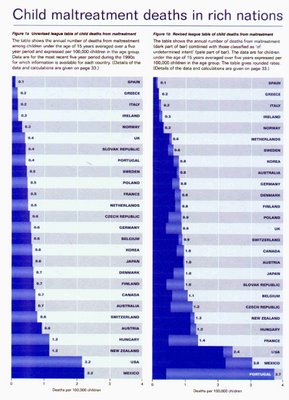
I am fairly sure Sue Bradford would be quite happy using this table to point out how poorly NZ is doing.
Below is the most recent UNICEF-produced Innocenti League Table for deaths from maltreatment. Sweden has 0.5 deaths per 100,000 children. If Sweden has around 2 million children (assuming a similar demographic spread to NZ) that means, on average, 10 children die from maltreatment per year (right click on image to enlarge).
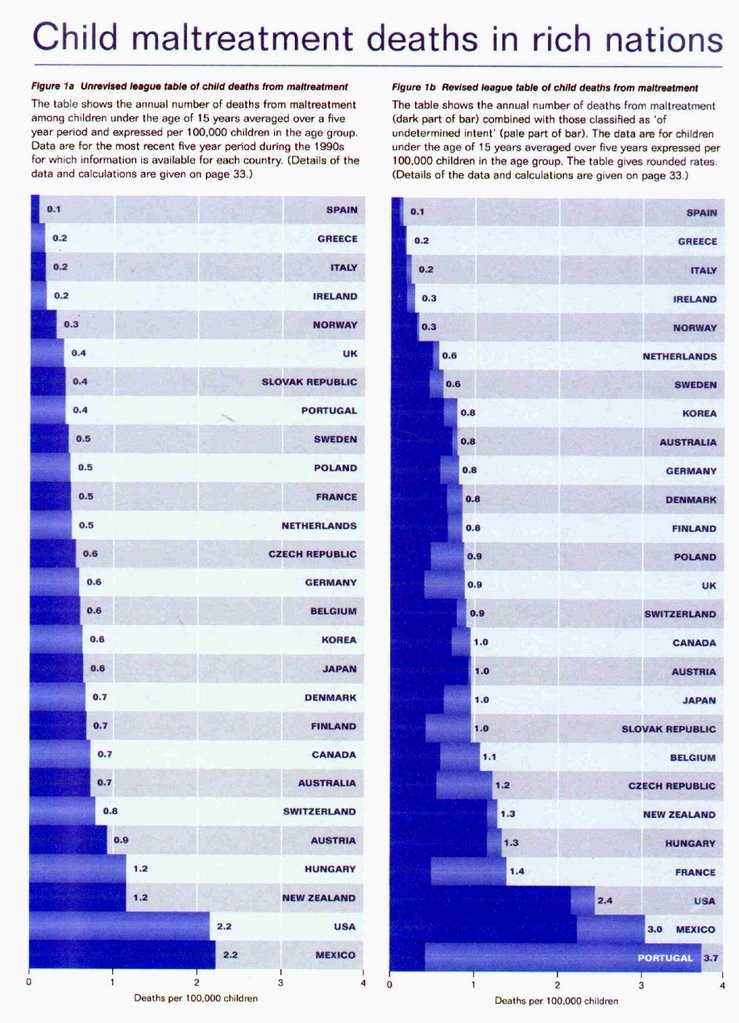
I am fairly sure Sue Bradford would be quite happy using this table to point out how poorly NZ is doing.
"Women bear brunt as job figures fall"
This headline in today's DomPost is highly questionable.
The article continues,"10,000 women lost their jobs in the last 3 months".
Yet the Statistics NZ release says, "The decrease (in employment) of 9,000 over the quarter was wholly due to falls in female full-time and female part-time employment.....Unemployment rose by 4,000 over the quarter....this movement was wholly driven by an increase in male unemployment."
So the women no longer working are not unemployed which rather suggests they have other means of support, probably a partner. They might have 'lost' their jobs or alternatively, they may have decided not to work. Why? Because as I suggested yesterday, the Working For Families assistance means they don't need to.
The DomPost article goes on to say,"Fewer jobs means overall spending is likely to slow down." Not necessarily, if my suggestion is correct.
What we need to know is the recent trend in WFF payments to see if there is a correlation with the drop in women employed. I'll see what I can find. But the WFF scheme is such a significant redistribution of wealth it has to be factored in to what is happening in the labour market.
The writer has overlooked the fact that women have a much greater degree of choice about work than men.
The article continues,"10,000 women lost their jobs in the last 3 months".
Yet the Statistics NZ release says, "The decrease (in employment) of 9,000 over the quarter was wholly due to falls in female full-time and female part-time employment.....Unemployment rose by 4,000 over the quarter....this movement was wholly driven by an increase in male unemployment."
So the women no longer working are not unemployed which rather suggests they have other means of support, probably a partner. They might have 'lost' their jobs or alternatively, they may have decided not to work. Why? Because as I suggested yesterday, the Working For Families assistance means they don't need to.
The DomPost article goes on to say,"Fewer jobs means overall spending is likely to slow down." Not necessarily, if my suggestion is correct.
What we need to know is the recent trend in WFF payments to see if there is a correlation with the drop in women employed. I'll see what I can find. But the WFF scheme is such a significant redistribution of wealth it has to be factored in to what is happening in the labour market.
The writer has overlooked the fact that women have a much greater degree of choice about work than men.
Thursday, November 09, 2006
False complaints
This case is disquieting, to put it mildly. The former policeman has been found not guilty of rape charges yet the person who made the false accusations gets name suppression? Will charges be laid against her? And now it is revealed that the case only went to court because it is one that the PM "personally" referred to a commission of inquiry into Police conduct, according to the man's lawyer, Gary Gottlieb.
Mr Gottlieb said there was a huge bill for private investigators and Ogle had to sell his house to met his costs.
"If we hadn't done what we did and had treated it like an ordinary trial, he would have been rolled.
"This is the trouble with anyone. If the state brings its forces against you, it is so bloody hard to stand up to it," Mr Gotlieb said.
And then, on a related subject, you have to wonder what motivates people to make false complaints. Coincidentally while pondering that I received this in the letterbox;

$100,000. And you pay nothing unless they get a result. Seems to me we are increasingly appealing to the worst aspects of human nature.
Mr Gottlieb said there was a huge bill for private investigators and Ogle had to sell his house to met his costs.
"If we hadn't done what we did and had treated it like an ordinary trial, he would have been rolled.
"This is the trouble with anyone. If the state brings its forces against you, it is so bloody hard to stand up to it," Mr Gotlieb said.
And then, on a related subject, you have to wonder what motivates people to make false complaints. Coincidentally while pondering that I received this in the letterbox;

$100,000. And you pay nothing unless they get a result. Seems to me we are increasingly appealing to the worst aspects of human nature.
Latest Employment Statistics
Unemployment rises slightly to 3.8 percent
NZ falls from 2nd in OECD to 4th=
But here's the interesting development; The decrease of 9,000 (0.4 percent) over the quarter was wholly due to falls in female full-time and female part-time employment.
That'll be the effect of Working For Families. Now the kids can have their Ipods and their mums. Doesn't it give you the warm fuzzies.
No? You're worried about productivity? So's Helen but let's face it - the votes are more important.
NZ falls from 2nd in OECD to 4th=
But here's the interesting development; The decrease of 9,000 (0.4 percent) over the quarter was wholly due to falls in female full-time and female part-time employment.
That'll be the effect of Working For Families. Now the kids can have their Ipods and their mums. Doesn't it give you the warm fuzzies.
No? You're worried about productivity? So's Helen but let's face it - the votes are more important.
The philosophical problem with the DPB
So ably described by David Green in Poverty and Benefit Dependency;


Try to remember this when next confronted with an indignant lifestyler belly-aching about society's obligation to support mothers and children. And if they try to argue they are raising future taxpayers tell them to take out a loan in anticipation.
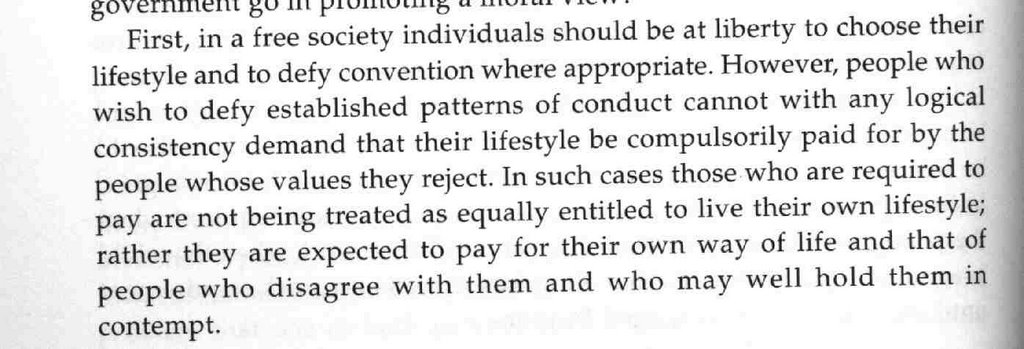


Try to remember this when next confronted with an indignant lifestyler belly-aching about society's obligation to support mothers and children. And if they try to argue they are raising future taxpayers tell them to take out a loan in anticipation.
On the same wave length
Last night I had the honour of stepping in for Rodney Hide and addressing the Waikanae Rotary members. No surprises what I talked about (after describing MY experience of Dancing with the Stars - a phone bill that grew at about the rate Rodney shrank) - welfare and the worst excesses of the welfare state.
But I also talked about my experiences as a volunteer and my conviction that people are far more resourceful and creative than government ever give them credit for. There was audible assent when I said the government should back off.
The President responded with a George Washington quote about government being like fire; a dangerous servant and a fearful master. We were on the same wave length.
But I also talked about my experiences as a volunteer and my conviction that people are far more resourceful and creative than government ever give them credit for. There was audible assent when I said the government should back off.
The President responded with a George Washington quote about government being like fire; a dangerous servant and a fearful master. We were on the same wave length.
Three killed in Gisborne
Yesterday there were radio reports about two domestic violence incidents in Gisborne but they have barely rated a mention in today's papers. Just small columns. Three killed, one woman is still fighting for her life in hospital.
I asked David if he knew about the killings in Gisborne and he responded, what killings in Gisborne? Life is becoming very cheap in some circles. Perhaps its lack of value is reflected in the media's lack of interest.
I asked David if he knew about the killings in Gisborne and he responded, what killings in Gisborne? Life is becoming very cheap in some circles. Perhaps its lack of value is reflected in the media's lack of interest.
Wednesday, November 08, 2006
Extreme Socialists vs Socialists
The Child Poverty Action Group has won the right to challenge the government through the Human Rights Tribunal. They want beneficiaries with children to be eligible for the $60 per week In-Work payment. Here is Tariana Turia egging them on. Around 70,000 of these children will be Maori.
I'll briefly reiterate my argument. If the CPAG win, essentially we will see an increase in benefit levels. An increase in benefit levels leads to an increase in the number of people going on or staying on benefits. CPAG want a short term gain and refuse to see the long term cost which cannot be in the best interests of children.
There is no guarantee the money reaches the children anyway.
And, most obviously, the incentive effect of the In-Work payment will be nullified if it is extended to non-working families.
I'll briefly reiterate my argument. If the CPAG win, essentially we will see an increase in benefit levels. An increase in benefit levels leads to an increase in the number of people going on or staying on benefits. CPAG want a short term gain and refuse to see the long term cost which cannot be in the best interests of children.
There is no guarantee the money reaches the children anyway.
And, most obviously, the incentive effect of the In-Work payment will be nullified if it is extended to non-working families.
Rugby stadium be damned
According to the NZ Herald, The Government says the stadium will cost about $500 million, although that is considered conservative.
Based on this government's record with large construction projects, prisons for example, the cost could easily escalate to $8-900 million.
That's half of what we spend on Law and Order. Three quarters of what we spend on Defence.
What a stark reminder of how wrong this government's priorities are.
Based on this government's record with large construction projects, prisons for example, the cost could easily escalate to $8-900 million.
That's half of what we spend on Law and Order. Three quarters of what we spend on Defence.
What a stark reminder of how wrong this government's priorities are.
Tuesday, November 07, 2006
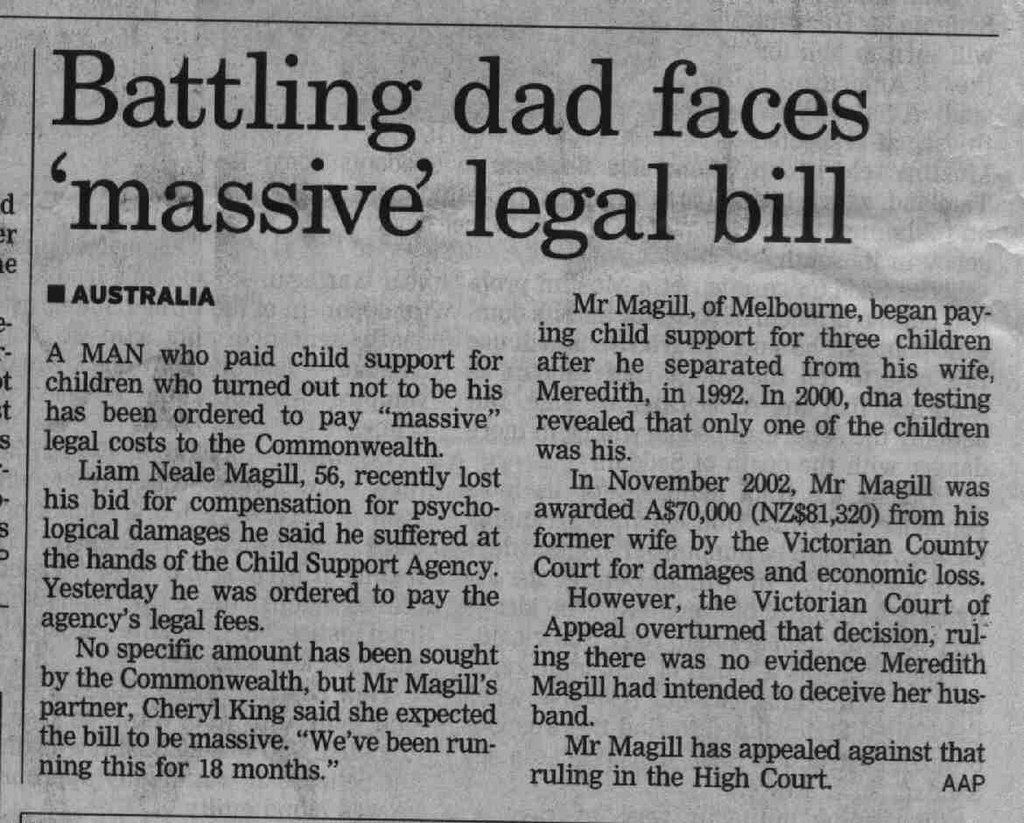
Scientists call 'climate frenzy' a diversion
Since the release of the Stern Report this is the first account I have seen (though I haven't exactly been looking very hard) in the NZ media describing a different viewpoint. Glad to see Tim Barnett has taken an interest. He is one Labour MP I have time for based on personal experience.
Monday, November 06, 2006

Thanks, United Future
As you know I like to keep track of what the Families Commission is spending the taxpayer's $7 million a year on.
"Researchers, funded by the Families Commission Blue Skies Fund, interviewed 40 Chinese, Korean, South African, UK, USA, Indian, Palestinian and Iraqi women about their experience of pregnancy and birth in New Zealand.
Migrant women who become new mothers in New Zealand say their cultural needs are often not met or understood by health professionals."
Looks like 'cultural insensitivity' is contagious. Perhaps it's caught in maternity wards.
"Researchers, funded by the Families Commission Blue Skies Fund, interviewed 40 Chinese, Korean, South African, UK, USA, Indian, Palestinian and Iraqi women about their experience of pregnancy and birth in New Zealand.
Migrant women who become new mothers in New Zealand say their cultural needs are often not met or understood by health professionals."
Looks like 'cultural insensitivity' is contagious. Perhaps it's caught in maternity wards.
Yeah right 4
In 2004 then Minister for Social Development Steve Maharey released the following;
New rules instituted within the Department of Work and Income (DWI) ensure that the benefit fraud is being properly detected and recovered, Social Services and Employment Minister Steve Maharey said today.
Mr Maharey dismissed claims by Act MP Muriel Newman that the Government had gone soft on benefit fraud. In fact the opposite is the case, Mr Maharey said.
New rules instituted within the Department of Work and Income (DWI) ensure that the benefit fraud is being properly detected and recovered, Social Services and Employment Minister Steve Maharey said today.
Mr Maharey dismissed claims by Act MP Muriel Newman that the Government had gone soft on benefit fraud. In fact the opposite is the case, Mr Maharey said.
It's a dog's life

Monday morning. Everybody off to work or school as the fifth household member prepares for another busy day.
100 million websites and growing - fast
Here's an interesting blog entry from the Adam Smith website detailing stats on the internet;
The big growth has been fueled by blogs and small business sites. The numbers going on line to set out their stall have increased more greatly and more rapidly than many people supposed. The world is becoming connected by invisible links, and those not able to grasp the simple technology of it will soon be like outsiders at the gates, watching the village feast take place within.
The big growth has been fueled by blogs and small business sites. The numbers going on line to set out their stall have increased more greatly and more rapidly than many people supposed. The world is becoming connected by invisible links, and those not able to grasp the simple technology of it will soon be like outsiders at the gates, watching the village feast take place within.
Getting the 'snip' on the social
Shock, horror. WINZ (naughty reporter) pays for vasectomies!
Great. Let's hope this publicity encourages a few more people down to their local office to apply for one.
Great. Let's hope this publicity encourages a few more people down to their local office to apply for one.
Sharing the blame

Sunday, November 05, 2006
Shonky Aussie advice
My BS detector has just gone off. I was reading Muriel Newman's weekly column in which she quotes Helen Hughes from the Australian Centre for Independent Studies;
Professor Helen Hughes, a senior fellow at the Australian based Centre for Independent Studies has looked at the question, “Should Australia and New Zealand open their doors to guest workers from the Pacific” and co-authored a report which is featured as our NZCPD guest commentary this week (click the sidebar link to view). Helen’s conclusion is that such a scheme is not only ill advised for Australia and New Zealand, but for the Pacific Islands as well. With 1.5 million people unemployed and underemployed in the region, a migrant worker scheme for 10,000 to 38,000 would be a ‘cruel deception’, which would shield Pacific governments from need to pursue economic reforms.
In her report she provides an interesting comparison between Australia and New Zealand’s approach to Pacific immigration, noting that while 24 percent of Australian residents were born overseas, only 2.4 percent were born in the Pacific, whereas of the 19 percent of New Zealand residents who were born overseas, 34 percent were born in the Pacific. She states that too great a reliance on immigration from the Pacific has given rise to serious social problems:
“Many Pacific islanders in New Zealand are less well integrated into the economy and society than Pacific islanders in Australia . In New Zealand, they remain geographically segregated into the second and third generations. Most live in highly concentrated communities in Auckland. Welfare dependence contributes to young Pacific Islander gangs, notably in Auckland. Compared with 16% of the total population, 26% of Pacific islanders receive some form of government benefit in New Zealand. The experience of Pacific migrants in New Zealand diverges from that in Australia because Australia has preserved selectivity of its migrant intake”.
The 2006 Census data is not yet available but official estimates for the Pacific people population for NZ in 2006 range from 7.1 to 7.4 percent. Across all main benefits Pacific Islanders make-up 7.5 percent of working-age beneficiaries, being under-represented in SB and IB and over-represented in DPB and dole.(By way of contrast Maori make-up 31.5 percent of working age beneficiaries.)
So in order to claim Pacific people are receiving significantly more government benefits than the general population she must have included children (Pacific families being larger). The creates an unfair impression.
Pacific people make a valuable contribution to the economy and it irks that an Aussie think-tank is trying to discourage New Zealand from allowing willing and able workers to come here.
Professor Helen Hughes, a senior fellow at the Australian based Centre for Independent Studies has looked at the question, “Should Australia and New Zealand open their doors to guest workers from the Pacific” and co-authored a report which is featured as our NZCPD guest commentary this week (click the sidebar link to view). Helen’s conclusion is that such a scheme is not only ill advised for Australia and New Zealand, but for the Pacific Islands as well. With 1.5 million people unemployed and underemployed in the region, a migrant worker scheme for 10,000 to 38,000 would be a ‘cruel deception’, which would shield Pacific governments from need to pursue economic reforms.
In her report she provides an interesting comparison between Australia and New Zealand’s approach to Pacific immigration, noting that while 24 percent of Australian residents were born overseas, only 2.4 percent were born in the Pacific, whereas of the 19 percent of New Zealand residents who were born overseas, 34 percent were born in the Pacific. She states that too great a reliance on immigration from the Pacific has given rise to serious social problems:
“Many Pacific islanders in New Zealand are less well integrated into the economy and society than Pacific islanders in Australia . In New Zealand, they remain geographically segregated into the second and third generations. Most live in highly concentrated communities in Auckland. Welfare dependence contributes to young Pacific Islander gangs, notably in Auckland. Compared with 16% of the total population, 26% of Pacific islanders receive some form of government benefit in New Zealand. The experience of Pacific migrants in New Zealand diverges from that in Australia because Australia has preserved selectivity of its migrant intake”.
The 2006 Census data is not yet available but official estimates for the Pacific people population for NZ in 2006 range from 7.1 to 7.4 percent. Across all main benefits Pacific Islanders make-up 7.5 percent of working-age beneficiaries, being under-represented in SB and IB and over-represented in DPB and dole.(By way of contrast Maori make-up 31.5 percent of working age beneficiaries.)
So in order to claim Pacific people are receiving significantly more government benefits than the general population she must have included children (Pacific families being larger). The creates an unfair impression.
Pacific people make a valuable contribution to the economy and it irks that an Aussie think-tank is trying to discourage New Zealand from allowing willing and able workers to come here.
Long term benefit dependence - the real picture
Yesterday David Farrar linked to a story about a man who has spent 21 years on the dole. Redrag comments that the number of people long term dependent on benefits is not very high. He says, Wow, is that all?
At the moment at least 124,000 working age people have been on a benefit continuously for four or more years. Almost 60,000 have been relying continuously on a benefit for more than ten years.
Note the word continuously. Many people cycle on and off benefits which breaks the continuity. When I took this into account in 2002 I found that the average stay on the DPB was not the publicised 3.7 years but at least 6.5 years. This is because almost half of the recipients had more than one stay on the benefit. There is a significant difference between continuous time spent on benefit and cumulative time.
Also remember that thousands of people who were on a benefit long-term are now on Super. It would be an interesting exercise to add those numbers into the mix.
At the moment at least 124,000 working age people have been on a benefit continuously for four or more years. Almost 60,000 have been relying continuously on a benefit for more than ten years.
Note the word continuously. Many people cycle on and off benefits which breaks the continuity. When I took this into account in 2002 I found that the average stay on the DPB was not the publicised 3.7 years but at least 6.5 years. This is because almost half of the recipients had more than one stay on the benefit. There is a significant difference between continuous time spent on benefit and cumulative time.
Also remember that thousands of people who were on a benefit long-term are now on Super. It would be an interesting exercise to add those numbers into the mix.
Another WINZ whoopsie
An Auckland electrician has perpetrated a massive fraud on WINZ.
According to sums done by Work & Income, which answers to the MSD, there were at least 120 linked false identities that were receiving cash. In total, those identities were receiving $54,000 a fortnight.
Looking on the bright side, I thought, now he is locked up at least the benefit numbers will come down. But alas, we will even be denied that silver lining. His inventions were collecting Super.
(If you are going to comment please feel free to use the contracted form of Work and Income - WINZ - because it saves time. Officially, and I have been given this instruction, they are to be referred to as Work and Income. Note the journalist obliged.)
According to sums done by Work & Income, which answers to the MSD, there were at least 120 linked false identities that were receiving cash. In total, those identities were receiving $54,000 a fortnight.
Looking on the bright side, I thought, now he is locked up at least the benefit numbers will come down. But alas, we will even be denied that silver lining. His inventions were collecting Super.
(If you are going to comment please feel free to use the contracted form of Work and Income - WINZ - because it saves time. Officially, and I have been given this instruction, they are to be referred to as Work and Income. Note the journalist obliged.)
Subscribe to:
Posts (Atom)


