Dying at the hands of a family member is becoming more common, although it is still a rare event. Of course the sort of activity which precedes a death is far more widespread than what the fatality statistics represent.
The Family Violence Death Review Committee released figures showing the number of deaths uncreased from 18 in 2008 to 41 last year. 16 were children. Typically these will be the deaths of very young children. The first two years is the most dangerous time for a child in a dysfunctional environment.
But 16. That is high.
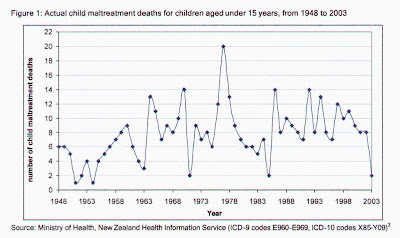
How long have New Zealanders been collectively wringing their hands over child abuse? About 50 years. During which time it has
probably worsened. One cannot say with absolute certainty that this is the case because of the hidden nature of abuse and the robustness of identifying and reporting over time.
There have been so many attempts to 'fix' this problem via the state and private initiatives, yet it persists. And I have nothing new to say. If a child is loved and wanted it will not be abused.
But I find myself agreeing less and less with the sentiment
expressed by John Sax of For The Sake Of Our Children Trust;
Mr Sax says questions need to be asked about what is happening with social policy. He believes there needs to be a holistic approach to family violence, with a big focus on trying to keep children with their immediate family where possible.That is exactly the philosophy CYF has been operating under for the last few decades.
Update; Having found the
source of the figures I should include a comment from their spokesperson;
"We are working with a broader definition to ensure we look as widely as possible at the problem, and this means we have come up with a higher figure than has been suggested from previous work in this area."The statistics come from the Police but the Death Review committee says it uses a different definition of a family violence death. As yet I haven't been able to work out the difference from reading their report.
Their definition;
Family violence death is defined in the Terms of Reference as:
The unnatural death of a person (adult or child) where the suspected perpetrator is a
family or extended family member, 4 caregiver, 5 intimate partner, previous partner of the victim, or previous partner of the victim’s current partner.They may have broadened the relationship status beyond that considered by the policy as 'family'.
The report contains this quote;
Family violence is a global problem affecting all cultural, religious and economic groups and is caused by a multitude of complex factors (Ma¯ ori Reference Group for the Taskforce for Action on Violence within Families 2009).And then this;
The over-representation this year of Ma¯ori as victims and perpetrators of family violence deaths signals an impact on the fabric of Ma¯ori society. Preliminary data indicates that three-quarters of family violence deaths involve Ma¯ori. While Ma¯ori have been involved in a large number of the identified cases this year, the issues are not for Ma¯ ori alone to address.
So the Review Committee is taking the politically correct line.
The Committee will work with the community as a whole, but will also engage with Ma¯ori in as many ways possible to ensure it is operating in a culturally appropriate, sensitive and responsive manner.The committee should be working primarily, and as a priority, with Maori. That would be the best use of its resources which they complain have been too few.


