From Colin James' NZ Herald column of January 24;
Labour spent much effort in 2004 on its "brand" to encapsulate its "values". But a brand has no value if voters don't value it. Waffle words like "fair and inclusive" are not likely to frame the way voters think. A "fair go" might. Getting voters to see tax as an investment, not a drain on good people's good times and a dole for wastrels, might.
I see tax as an investment - lost. It is money confiscated from the private sector and lost to private investment.
In the words of James Gwartney, Dwight Lee and Richard L.Stroup, authors of Commonsense Economics,
"There is every reason to believe that investors risking their own money will make better investment choices than central planners spending the money of taxpayers. Remember, an investor who is going to profit must discover and invest in a project that increases the value of resources. The investor who makes a mistake - that is, whose investment project turns out to be a loser - will bear the consequences directly. In contrast, the success or failure of government projects seldom exerts much impact on the personal wealth of government planners. Even if a project is productive, the planner's personal gain is likely to be modest. Similarly, if the project is wasteful - if it reduces the value of resources - this failure will exert little negative impact on the planners. They may even be able to reap personal gain from wasteful projects that channel subsidies and other benefits towards politically powerful groups who will then give the bureau added political support at budget time. Given this incentive structure, there is simply no reason to believe that central planners will be more likely than private investors to discover and act on projects that increase society's wealth."
Thursday, January 26, 2006

The Green Paper
The UK's welfare reform Green Paper has been released. It's a fizzer - what you would expect from a Labour, or, for that matter, a Conservative government. From the Scotsman comes this report which features an interesting comparison between the UK's approach to incapacity benefits and New York's;
How New York saw 86% drop in sickness payments
NEW York in the early 1990s was a very different place to the city which today boasts some of the highest employment and lowest crime in the world. Much of the credit for that change has gone to its then mayor, Rudy Giuliani.
His thinking was blunt: welfare fuelled poverty, and keeping people in penury was not compassionate. His attention turned to the 24,900 people then claiming the United States equivalent of incapacity benefit.
He had each rigorously assessed by an independent firm of medics. The old system was like the current British system: it sought to establish whether or not people could work.
But Mr Giuliani asked his firm of doctors to assess which type of work each person was physically and mentally capable of doing. He then hired a private company to help them find work.
Crucially, those assessed capable of even low-level employment were given jobs by the state - such as tending the parks or cleaning graffiti from the walls - if they refused to find them outside.
Staying at home and collecting benefit was not an option in New York. Faced with the alternative of low-paid and low-skilled work serving neighbourhoods, the incapacity benefit claimants dropped 86 per cent.
All this was achieved within three years. By 1999 - his fifth year as mayor - the sickness benefit rolls had shrunk to 3,423.
Many were re-categorised as unemployed and put on a level of welfare payments which were demonstrably inferior to the jobs then being created so quickly.
As president, Bill Clinton applied the same for states in what was called "workfare", as it demanded work.
But Britain looks set to remain in the "welfare" era.
How government plans to get people back to work
GOALS
• Reduce incapacity benefit claimants to 1.5 million within a decade.
• Return 300,000 lone parents into work.
• Encourage one million over-50s to return to work.
INCAPACITY BENEFIT (IB)
• To be renamed Employment and Support Allowance.
• New claimants to have "work-focused interviews" and engage in "work-related activity" to qualify.
• Those refusing to attend interviews will have payments cut, but not below level of jobseekers' allowance.
• Pathways to Work scheme, being piloted in Glasgow, to be rolled out nationwide.
• Those returning to work will qualify for extra benefits.
• Those with severest disabilities or health problems will have a higher benefit and be exempt from interviews.
• Doctors discouraged from signing people on to IB - and asked to support patients who want to return to work.
• Doctors' surgeries will have employment advisers to intercept those claiming IB.
LONE PARENTS
• Will be required to attend a job interview every three months once the youngest child turns 11.
• Will be offered benefits if they return to work, so no parent would be better off on benefits.
HOUSING BENEFIT
• Moves afoot to give benefit directly to claimant, thereby giving them an incentive to find a cheaper place to live.
Wednesday, January 25, 2006
Does Peter Dunne know what he thinks?

As read on Scoop;
Dunne cool on 'radical' child check-up proposal
Wednesday, 25 January 2006, 11:33 am
Press Release: United Future NZ Party
United Future leader Peter Dunne says the Children's Commissioner's call for the Government to test all children four times during childhood to keep tabs on their welfare looks remarkably like trying to re-invent the wheel.
"I'm all in favour of making sure all our kids get the best start in life ? in fact, that's been one of United Future's core messages ? but instead of setting up a whole new ? and invariably expensive ? system, why not use the community resources we already have?" he asked.
"For example, Plunket, to name just one New Zealand organization, has decades of experience in assessing the health and welfare needs of New Zealand children.
"There are many other locally-based and experienced organisations who can do the work the Commissioner is calling for ? let's make sure they're well-equipped to do the job.
"More well-meaning smothering by nanny state is not the answer," said Mr Dunne.
ENDS
Snap
Having just commented on the link between benefits and the rate of single parenthood, hot off the press comes this news from Scotland. Number of one-parent families up by 24%
"The government's critics say that it is the benefits system that has contributed to the increasing number of single parents. David Laws, the Lib Dem work and pensions spokesman, also blamed the benefits system for the rising number of lone parents. There is a financial "disincentive" for lone parents to take a new partner, Mr Laws said."
The Prime Minister, Tony Blair says that the long-awaited Green Paper on welfare reform, due for release today, "will put pressure on single parents to seek work".
Five most constipated people in the bible

1/ Cain who wasn't Abel
2/ Noah who sat on the ark for 40 days and 40 nights and passed nothing but water
3/ King Soloman who sat on the throne for 40 years
4/ Moses who took 2 tablets and went on the mountain
5/ King David whom neither Heaven nor Hell could move
State of our Welfare Nation (1)
This is a popular time of year for party leaders to deliver "state of the nation" speeches so I thought I might look at the state of our welfare nation.
Statistics aren't always reliable. Especially five years out from the last Census, the only time we actually count families and even then, we rely on people providing accurate and honest information.
The following, then, is based on 1/ Projected Families Containing Dependent Children by Family Type and Territorial Authority (published by Statistics New Zealand) and 2/ information provided by the Ministry of Social Development under the Official Information Act.
At August 2005 sixty nine percent (or 113,000 out of 164,500 ) of single parent families with dependent children relied on a benefit. The highest rates are in Northland (85 percent), Bay of Plenty (82 percent) and Gisborne/Hawkes Bay (80 percent).
In 1966 we didn't have the DPB. Only 7 percent of all families with dependent children had a single parent. Today that percentage has risen to about 32. I cannot prove the relationship between the DPB and the growth of one parent families is a causative one. You will have to draw your own conclusions.
(NB Some people on benefits also work part-time but the percentage isn't high. Less than one in four people on the DPB has participated in work some time in the past twelve months.)
Tuesday, January 24, 2006
Coming to a town near you......
This one is probably the sleeper story of the day. New regulations will mean that an estimated 1,000 Wellington buildings will require strengthening to guard against potential earthquake damage. Just heard Kerry Prendergast, Wellington Mayor, interviewed on the subject. "It's all about public safety," says she.
"Of the buildings identified, 300 are ours!". Yeah Kerry. But you won't be putting your hand in your pocket to pay up to '$100,000' to strengthen a structure. You'll be sticking it into the ratepayer's. Apparently this new requirement is yet another product of the extension in the powers of local government and will affect other centres in due course.
"Of the buildings identified, 300 are ours!". Yeah Kerry. But you won't be putting your hand in your pocket to pay up to '$100,000' to strengthen a structure. You'll be sticking it into the ratepayer's. Apparently this new requirement is yet another product of the extension in the powers of local government and will affect other centres in due course.
Thinking with no future

Sue Bradford: "It's time employers started to pay their fair share and accepted that wages should be high enough to live on. The taxpayer should not continue to be expected to subsidise business to the extent they are at present through top-up programmes like Working for Families and the Accommodation Supplement. These are just forms of unrecognised corporate welfare."
Employee taxpayers fund the WFF programme and are often also beneficiaries of it. Employer taxpayers also fund WFF but will generally not be a beneficiaries of it. Bradford wants the employer to pay higher wages, in which case his income and/or profits will fall and he will pay less tax. The employees, with increased income, will pay more tax and lose eligibility for WFF. Neither the employer nor the employee is better off. All that has been satisfied is the Green's ideological yearning to see employers punished.
If the Greens were genuine in their desire to see take-home wages rise they would back tax cuts and reduce or abolish these expensive "income -churning" govt-run programmes which do nothing but reduce productivity.
This happens in two ways; 1/ by giving people money to do nothing (why would a household's potential second worker take a part-time job if they are going to sacrifice their WFF entitlements?) and 2/ they use up valuable and scarce labour resources creating non-productive make-work jobs.
Many economists talk about New Zealand's urgent need to lift productivity. Expanding government redistributionist schemes is not the way to do it.
Footnote; I am reminded of an exchange I had with Trevor Mallard during the election camapign. We were seated together and during one candidate's presentation he quietly said, "When I started work the top tax rate was around 70 percent."
"Which is about what effective marginal tax rates will be under Working for Families," I answered. "Aaah. But at least you can work your way out of it," he replied. "Why would you want to?" I asked.
"Forget Them vs Us Attitude"
The following is an editorial from today's Gisborne Herald. The importance of Iain Gillies' message cannot be over-stated, but it doesn't appear in print nearly often enough. This should be COMPULSORY reading in school.
Employers and workers need to be on same wavelength
by Iain Gillies
Tuesday, 24 January, 2006
What is an employer? An employer is the person who gives us a chance to hold our head up high in society by earning our living.
An employer is also the person who gives us a chance to earn a fair wage, to show what we can do, and respond to an increasingly competitive environment.
At this time of the year we have many youngsters starting out on their careers. We wish them well and hope they fulfil their ambitions.
We have one bit of advice for them . . . disregard any suggestion that the workplace is a Them v Us world, with the workers on one side and the employers on the other.
Maybe that applied in the distant past but in today’s economic climate we’re all in the same leaky boat.
Perhaps that sounds a bit pessimistic because the country has plenty of successful businesses.
For a company to be viable it must produce a profit. This profit goes into many things, including plant maintenance, plant replacement, meeting rising costs and, most import of all, company growth.
Growth means more work and more jobs. The employer benefits from having the initiative to set up the business in the first place.
The employee benefits from having the initiative to acquire the skills necessary to do the work. And those looking for work benefit from the increased number of jobs available.
But weigh the business down with costs growing at a faster rate than the company’s ability to produce, sell and make a profit and the growth stops. The whole process can actually move into reverse.
The company, in order to keep from going to the wall, scrimps on plant maintenance, is less inclined to replace ageing plant and starts to cut back on the number of workers employed.
Let’s face it . . . people are in business for profit. If there is no profit, there is no business, no jobs, and no income tax for the state to distribute to the needy.
This is a basic economic fact and one ignored by too many people these days. So let’s cast aside that anachronistic Them v Us attitude and work together to make New Zealand a force to be reckoned with in the world.
Slow news day
A driver was stopped in Oregon under suspicion of drunken driving. The father of the driver, a passenger in the vehicle, proceeded to remove his prosthetic legs with which he assaulted the state trooper.
If the son wasn't legless, the father certainly was.
If the son wasn't legless, the father certainly was.
school holiday fever
We are into the last two weeks and the kid's time is starting to weigh a bit heavy. My seven year-old has just put her head around the door to tell me that she knows why you don't get square glasses. She says, if they were square and you tipped them up to drink out of, the drink would run out of the corners. I just looked at her.
Is that right? Now I am trying to envisage doing just that. Don't you put your mouth slightly into the glass in anticipation so in fact the drink wouldn't run out of the corners? I am intrigued enough to put "square glasses" into my search angine. Looky here;
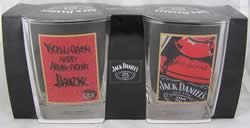
Genuine Jack Daniels square glasses. Is there something I am missing about whiskey and square glasses?
Is that right? Now I am trying to envisage doing just that. Don't you put your mouth slightly into the glass in anticipation so in fact the drink wouldn't run out of the corners? I am intrigued enough to put "square glasses" into my search angine. Looky here;

Genuine Jack Daniels square glasses. Is there something I am missing about whiskey and square glasses?
The topsy-turvy world we live in
The overnight talkback lines have been running hot over this one from Inglewood.
Paul Espiner grabbed a machete and confronted intruders who were threatening to kill a woman with a baseball bat one day last October.
For his bravery, he was charged by police and yesterday in the New Plymouth District Court was convicted – and discharged – of possessing an offensive weapon.
The intruder had been dealt with earlier, and was given a diversion, meaning he had to write a letter of apology, avoided a criminal conviction and had his name suppressed.
Fortunately Mr Espiner says he would do the same again.
Monday, January 23, 2006
Only half the story
 Some say Simon Power, National MP and spokesman for Crime and Justice, is really firing. Some take his press releases at face value. Here he says the parole system is failing.
While it is true that over 4,000 people failed to report while on parole over the past three years, the number has dropped steadily.
November 2002 165
December 147
January 2003 151
February 127
March 171
April 149
May 151
June 110
July 135
August 108
September 114
October 139
November 107
December 120
January 2004 95
February 95
March 131
April 125
May 89
June 85
July 101
August 114
September 107
October 114
November 164
December 107
January 2005 77
February 112
March 137
April 97
May 93
June 84
July 88
August 97
September 87
October 55
Total 4148
Breaches of parole are also trending down.
But Mr Simon says, “Parole is a failed experiment for serious offenders, but the Clark/Peters Government is not interested in doing anything about it, even when the evidence is staring them in the face,” .
I don't care for Labour but I do want the the full story. What surprises me is the government haven't bothered to issue a countering release. The wily or the lazy. Take your pick.

How to SuperSizeMySupport
Sometimes people use completely irrelevant statistics to bolster their dishonest campaigns. Here, speaking on behalf of UNITE and the SuperSizeMyPay.Com campaign, co-ordinator Simon Oosterman uses "poverty" statistics to build sympathy and support for his cause.
“Community groups are joining the fast food workers’ call for McDonald’s, Burger King and (Restaurant Brands restaurants) KFC, Starbucks and Pizza Hut, to take social responsibility for the welfare of their workers, their families and the wider community,” Oosterman said.
“In 2004, 19% of families had incomes below the poverty line and 43% of dependent children in sole parent families were living below the poverty line. [1] Over 22% of households reported that ‘food runs out because of lack of money’. [2]
“As the biggest brands, these companies set the wage standards for the entire industry and are in a key position to play a major role in making poverty wages history in New Zealand."
It is not the fault of the fast-food industry that so many people CHOOSE to raise their children single-handedly on a benefit. In all likelihood the 43 percent Oosterman refers won't have a working parent.
Note to Dr Cullen?
The UK Guardian reports today that a leaked document reveals the government is considering moving Benefit call centres offshore in order to save £1bn.
By some very rapid and rough calculations I reckon New Zealand could do the same and save around $65 million.
(Better still, if we could get a couple of hundred thousand working-age people off benefits we could save closer to $4 or 5 billion)
By some very rapid and rough calculations I reckon New Zealand could do the same and save around $65 million.
(Better still, if we could get a couple of hundred thousand working-age people off benefits we could save closer to $4 or 5 billion)
Mike Moore on the political landscape
 Mike Moore has a good column in today's DomPost, "Home seen through new eyes," in which he makes some observations about what has changed most since he's been away. Here are a couple;
"What's also very different in New Zealand is the number of tax-payer funded TV advertisements telling us to be better people. All good and worthy causes. Don't smoke, cover up food in hot weather, drive better, watch kids in pools, don't dive into rivers without checking, safe sex, exercise.
But does it work, or is it about showing that the government cares about us? The government must be the biggest ad buyer on TV and radio unlike in other democratic countries."
Well spotted. His list is a little light though. Let's not forget advice on alcohol consumption, gambling, avoiding the sun, avoiding accidents in the home, securing your home against criminals, avoiding domestic violence. What have I forgotten?
"Whatever happened to the stoic Kiwi who took it on the chin? And what's this about the new 'stress' industry where well-paid public executives need paid time off because they have a tough job? Hey, that's why they get the big bucks. Get another job if you're not up to it."
Absolutely. But Moore still thinks Labour can get it right.
"Labour now has a stronger Cabinet with the promotion of Southern Speights-drinking males David Parker, Clayton Cosgrove and Damien O'Connor. Hopefully they will fight the out-of-control bureaucrats who know best and want to social engineer us to be more like them."
Sounds like the real kiwi blokes vs the chardonnay socialists. But what is it the bloke says, "Shes a hard road finding the right woman mate."
It's an even harder road getting rid of her.(see Clark guns for another term as PM.)
Moore finishes with a rhetorical question, "Isn't it good the last two governments have not changed the fundamental reforms of the 80's?"
Totally.
Sunday, January 22, 2006
Wayne Again
I'm not on a witch-hunt but the news the PC Eradicator generates is silly.
Here he is having a go at the Ministry of Social Development for substituting "additional" needs for "special" needs.
Wayne Mapp - or PC Eradicator as he is sometimes called - is flabbergasted a ministry report seems to frown upon the term "special needs". The report replaces the term with "additional needs" throughout the lengthy document, stating it wants to break the convention of the term "special".
Wayne Mapp says it is hypersensitivity because there is little difference between the two terms. He is wondering whether a set of bureaucrats put a committee in place to come up with the new word.
Doesn't he remember that "special" needs was a descriptive "non-judgemental" replacement for conditions like epilepsy, cerebral palsy, autism, intellectual handicap etc. Yet "special" needs is now the standard he defends.
This man is really in a hole and digging...
The blame lies with the jackass who dreamt up the role.
Golf and GPS
Lots of people never listen to commercial radio because they detest the ads. But ads can educate and stimulate thought (and those that don't, I'll put up with because the alternative, state radio, is funded through forcing a majority of people, who never listen, to pay for it. Wrong.)
Anyway, I took the kids golfing yesterday. We all hacked our way around with the occasional good shots which can never be replicated by doing the same thing next time. The universal rule of golf.
So, there is this advertorial/interview I've just been listening to with a guy from Sharpies in Wellington. Apparently new golf rules came into force on January 1, 2006. Players can now use a GPS device (think its about $700) to work out the distance of the shot they want to make.
Now the device wouldn't make a blind bit of difference to my game. Getting the distance right isn't much use when the ball's trajectory is thirty or more degrees off course.
But I wonder how people feel about their use at a professional level? Surely part of a professional's skill is to be able to judge a distance? I'm a big fan of technology but is there a line to be drawn in sporting endeavours?
Postnote; I am now heavily dosed with voltaren thanks to a combination of golf and blogging. According to the Doctor I must have injured a shoulder/neck muscle without knowing it until four o'clock this morning when it when into excruciatingly painful spasm. Sitting in front of the computer too long and then going to bed caused the muscle to go into a gradual seizure. I better get off here now.
Gerry Fights On
Ex ACT MP, Gerry Eckhoff, continues the fight for property rights.
"Mr Eckhoff says DOC has told the farmers a botanical survey will have to be done on their land before they will ever get any form of resource consent."
So Gerry took out a trespass notice against them. 12 other farmers have signed it. His advice to landowners - if you have something special on your property, best get rid of it.
Once again, the state's use of force achieves the opposite of the intended result.
Subscribe to:
Posts (Atom)


