Fascinating, full and frank article here about Hispanic "family values". The Hispanic unmarried birth rate (per 1,000) has over taken that of blacks. This is an exploration of what that will mean for the future. There is still a "lingering work ethic" but more are turning to welfare.(California is one of the poorly performing states in the welfare reform league.)
Every 1,000 unmarried Hispanic women bore 92 children in 2003 (the latest year for which data exist), compared with 28 children for every 1,000 unmarried white women, 22 for every 1,000 unmarried Asian women, and 66 for every 1,000 unmarried black women.
Don't quote me on this but I reckon the 2003 Maori rate to be between 125 and 130 per 1,000 unmarried females aged 15 and over.
The fathers of these illegitimate children are often problematic in even more troubling ways. Social workers report that the impregnators of younger Hispanic women are with some regularity their uncles, not necessarily seen as a bad thing by the mother’s family. Alternatively, the father may be the boyfriend of the girl’s mother, who then continues to stay with the grandmother. Older men seek out young girls in the belief that a virgin cannot get pregnant during her first intercourse, and to avoid sexually transmitted diseases.
Thursday, December 07, 2006

I'm from the council and I'm here to help
 Like ----. Here's another council horror story. Risk assessment on mince pies ordered.
 I seriously considered (for all of two minutes) running for council to try and stem the bureaucracy but apparently the beast just churns away, much of the activity unbeknown to councillors until it hits the fan and they cop the flack.
Race-based funding persists
I was under the impression the government had moved away from race-based funding. The Otago DHB has awarded a contract for a Maori-focused health service in Central Otago.
Southlink Health Maori Health project manager Wayne Smith said cost, transport and a problem accessing doctors during work hours were all issues for Maori.
The new service would provide a necessary link between health services and Maori, many of whom were "uncomfortable" in that environment, he said.
The justification goes, this is needs-based funding, but is there anything in the above that isn't true of many low-income non-Maori?
Southlink Health Maori Health project manager Wayne Smith said cost, transport and a problem accessing doctors during work hours were all issues for Maori.
The new service would provide a necessary link between health services and Maori, many of whom were "uncomfortable" in that environment, he said.
The justification goes, this is needs-based funding, but is there anything in the above that isn't true of many low-income non-Maori?
Wednesday, December 06, 2006
Picture of disparity
Statistics NZ has chosen to highlight Maori statistics in its presentation of final Census counts. Here is a summary;
Maori make up 14 percent of the population. The Maori population is much younger with a median age of 22.7 compared to 35.9 for the general population. Forty nine percent of the general population are married whereas only 29 percent of the Maori population are. 40 percent of Maori have no formal educational qualifications compared to 25 percent of the general population. The most common occupation for Maori is labourer and the most common over the general population is professional. The median income for Maori is $20,900 versus $24,400 across the total.
Linda reminded me earlier today about the business of doing things in the right order; finish your education, have your kids after marriage and stay married, to safeguard against poverty. (I think it may have been Newt Gingrich who originally said it). It would probably be good advice for Maori, in particular, to take on board. But I also take my hat off to all those hardworking Maori people who do vital manual and unskilled work for very little reward.
Maori make up 14 percent of the population. The Maori population is much younger with a median age of 22.7 compared to 35.9 for the general population. Forty nine percent of the general population are married whereas only 29 percent of the Maori population are. 40 percent of Maori have no formal educational qualifications compared to 25 percent of the general population. The most common occupation for Maori is labourer and the most common over the general population is professional. The median income for Maori is $20,900 versus $24,400 across the total.
Linda reminded me earlier today about the business of doing things in the right order; finish your education, have your kids after marriage and stay married, to safeguard against poverty. (I think it may have been Newt Gingrich who originally said it). It would probably be good advice for Maori, in particular, to take on board. But I also take my hat off to all those hardworking Maori people who do vital manual and unskilled work for very little reward.
Don Brash responds to Hager book
I am pleased to see Don Brash responding to Nicky Hager's book. It appalls me that Hager is profiting from stolen property.
When I was considering whether to stand in the 2005 election it was suggested to me that entering and emerging from politics would be like going through a shower of shit. I thought the person who made this observation to me was exaggerating but perhaps not.
My experience of having half of our hoardings stolen was trifling by comparison but it leaves a sordid and seedy taste. I hope Don Brash has had plenty of personal support over the last few weeks because he certainly deserves it.
When I was considering whether to stand in the 2005 election it was suggested to me that entering and emerging from politics would be like going through a shower of shit. I thought the person who made this observation to me was exaggerating but perhaps not.
My experience of having half of our hoardings stolen was trifling by comparison but it leaves a sordid and seedy taste. I hope Don Brash has had plenty of personal support over the last few weeks because he certainly deserves it.
Income
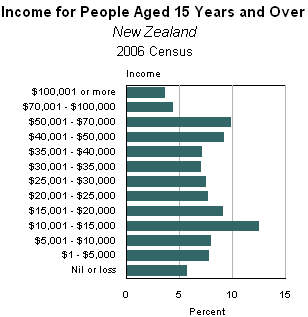
According to this graph roughly 35 percent of people aged 15 and over have an income of $15,000 or less. You might be tempted to think a few people are telling porkies. But take into account;
500,000 superannuitants, 300,000 15-20 year-olds, 300,000 working age beneficiaries, some thousands of non-working partners/stay home parents and it begins to make sense.
So when commentators start talking about our low median income, especially Maori, remember how it is calculated. It is sometimes confused with median wages or salaries.
Census data
Interesting Census results just released;
*One in eleven New Zealanders/residents is Asian, one in seven is Maori and one in fifteen is a Pacific person
*Three quarter of households had access to cell phones and sixty percent have internet (Hello there)
*Auckland is the fastest growing region followed by Canterbury
*One in eleven New Zealanders/residents is Asian, one in seven is Maori and one in fifteen is a Pacific person
*Three quarter of households had access to cell phones and sixty percent have internet (Hello there)
*Auckland is the fastest growing region followed by Canterbury
A fat dog story
A very fat dog's owners are being prosecuted for animal cruelty and their dog has been taken from them. Won't be long before 'kids' can be substituted for 'dogs' I reckon.
An alternative form of birth control?
After some discussion yesterday about birth control I thought on reading this, if you lived in Christchurch, it just might be enough to put you off.
Radical plans to tackle overcrowding at Christchurch Women's Hospital may mean low-risk pregnant women are barred from giving birth there.
Under proposals yet to be put out for consultation, pregnant women who are deemed unlikely to have complications during labour would be directed to primary birthing units, such as Lincoln, Rangiora or Burwood, or advised to have a home birth.
An epidural for pain relief would not then be an option.
On the other hand they could turn up to the Canterbury Charity Hospital which exists for people who cannot get treatment from the public ones. I was going to give a bouquet to Pete Hodgson yesterday for finally sorting the bad blood fiasco but I've changed my mind.
Radical plans to tackle overcrowding at Christchurch Women's Hospital may mean low-risk pregnant women are barred from giving birth there.
Under proposals yet to be put out for consultation, pregnant women who are deemed unlikely to have complications during labour would be directed to primary birthing units, such as Lincoln, Rangiora or Burwood, or advised to have a home birth.
An epidural for pain relief would not then be an option.
On the other hand they could turn up to the Canterbury Charity Hospital which exists for people who cannot get treatment from the public ones. I was going to give a bouquet to Pete Hodgson yesterday for finally sorting the bad blood fiasco but I've changed my mind.
Tuesday, December 05, 2006
"Single mothers, many problems."
"Single mothers, many problems" is from the Wall St Journal and describes the new demographic - poor, working, single mothers. 37 percent of US births are to unmarried mothers. In NZ the percentage was 45 in 2004.
One answer
It is recognised that criminal victimisation surveys provide the best measure of violent crime. When they have been conducted in NZ they show much higher levels of crime than either court statistics or police records. The latest criminal victimisation survey in the US shows violent crime has DROPPED from 49.4 to 20.9 per 100,000 people over the age of 12 between 1980 and 2005. Why? Because they are locking more people up.
Putting aside the futility of the 'war on drugs' and incarceration of drug offenders pushing up numbers, it is obvious that keeping dangerous criminals away from the public is one way to reduce violent crime. It doesn't need to be forever either. Most criminals burn out in middle age.
Putting aside the futility of the 'war on drugs' and incarceration of drug offenders pushing up numbers, it is obvious that keeping dangerous criminals away from the public is one way to reduce violent crime. It doesn't need to be forever either. Most criminals burn out in middle age.
Give me a reason
A great song by Luther Vandross but not what I was thinking about.
At a lunch last week a fellow diner remarked on how violent Christchurch had become. There are so many murders, she said. There are "so many murders" in many places, I remarked which elicited a broad murmur of assent. A question arose, "Is it going to get better?". Yes, I replied, because everything is cyclical. I didn't add that I believe it'll get worse first and any improvement will probably be outside my life time. Pessimistic? Give me any half decent reason why it would improve.
I was reminded about this exchange by this morning's report in The Press that violent offending among youth is up 21 percent over the previous year (and that's just the ones the police have caught).
At a lunch last week a fellow diner remarked on how violent Christchurch had become. There are so many murders, she said. There are "so many murders" in many places, I remarked which elicited a broad murmur of assent. A question arose, "Is it going to get better?". Yes, I replied, because everything is cyclical. I didn't add that I believe it'll get worse first and any improvement will probably be outside my life time. Pessimistic? Give me any half decent reason why it would improve.
I was reminded about this exchange by this morning's report in The Press that violent offending among youth is up 21 percent over the previous year (and that's just the ones the police have caught).
Monday, December 04, 2006
Abstinence hailed as success?
Destiny's Abstinence Programme Proving Critics Wrong
150 young people, primarily from South Auckland and of Maori/Pacific Island descent, will formalize their commitment to Destiny's Absolute Abstinence programme in Mt Wellington this Friday night. The commitment comes off the back of a comprehensive education programme that educates young people on preferred choices when it comes to sex and drug/alcohol use.
Since the launch of Destiny's Absolute Abstinence model, over 700 young people have enrolled in the programme nationwide, with a 78% success rate for those remaining committed to their pledge of abstinence. The pregnancy rate within the programme presently sits at 1.6%.
Not a fan of the religous Right I nevertheless prefer to see people benefiting from some sort of eductaion than becoming welfare dependent, poor (in both senses of the word) parents.
On the basis of the general 15-19 year-old population the pregnancy rate is 2.5 and the birth rate 1.3 but among Maori and Pacific it rises to approximately 5 and 3 percent (the latter are rough calculations).
If on the other hand Destiny's sample is weighted towards younger teenagers (most teenage births are to 18 and 19 year-olds) they may not be making much difference. More detailed information would be useful.
150 young people, primarily from South Auckland and of Maori/Pacific Island descent, will formalize their commitment to Destiny's Absolute Abstinence programme in Mt Wellington this Friday night. The commitment comes off the back of a comprehensive education programme that educates young people on preferred choices when it comes to sex and drug/alcohol use.
Since the launch of Destiny's Absolute Abstinence model, over 700 young people have enrolled in the programme nationwide, with a 78% success rate for those remaining committed to their pledge of abstinence. The pregnancy rate within the programme presently sits at 1.6%.
Not a fan of the religous Right I nevertheless prefer to see people benefiting from some sort of eductaion than becoming welfare dependent, poor (in both senses of the word) parents.
On the basis of the general 15-19 year-old population the pregnancy rate is 2.5 and the birth rate 1.3 but among Maori and Pacific it rises to approximately 5 and 3 percent (the latter are rough calculations).
If on the other hand Destiny's sample is weighted towards younger teenagers (most teenage births are to 18 and 19 year-olds) they may not be making much difference. More detailed information would be useful.
Learning Maori
Came across this site which is very useful. You can click on words to hear their pronunciation, listen to passages, test yourself etc. Now all I need is some time.....
IQ gap persists; why and what to do.
Fascinating stuff from Reason. Charles Murray and James Flynn argue about whether the IQ gap between black and non-Hispanic white Americans has closed over the last thirty years. Murray is a libertarian and Flynn a socialist.
Flynn further observed that blacks generally do worse on vocabulary tests and he suggested that a cultural difference might explain it. The children of professionals hear about 2500 different words in a day whereas the children of welfare mothers hear about 600 different words every day. Finally, Flynn believes that the black adolescent subculture that devalues education is largely responsible for widening the IQ gap. “It is more probable than not that the black/white IQ gap results from environmental factors,” he declared.
Murray argued that general intelligence, so-called "g," a general factor that governs performance on all cognitive tasks, is highly heritable. He noted that g has a biological background in the brain. He cited differences in glucose metabolism, reaction times, and the volumes of specific grey matter in prefrontal cortices.
Flynn further observed that blacks generally do worse on vocabulary tests and he suggested that a cultural difference might explain it. The children of professionals hear about 2500 different words in a day whereas the children of welfare mothers hear about 600 different words every day. Finally, Flynn believes that the black adolescent subculture that devalues education is largely responsible for widening the IQ gap. “It is more probable than not that the black/white IQ gap results from environmental factors,” he declared.
Murray argued that general intelligence, so-called "g," a general factor that governs performance on all cognitive tasks, is highly heritable. He noted that g has a biological background in the brain. He cited differences in glucose metabolism, reaction times, and the volumes of specific grey matter in prefrontal cortices.
Sunday, December 03, 2006
'Extremists' not wanted
The following is just one sample of so many opinion pieces written about the change in National leadership. This is from The Press (with my comment below);
When former National leader Don Brash announced his resignation from Parliament this week, it marked more than the end of his personal political dream. Brash, it has become increasingly clear, was supported or advised by a small number of prominent new-Right zealots, says The Press in an editorial.
For them, the revolution that began two decades ago with Sir Roger Douglas's policies should never have ended, and Brash became their chosen champion. His exit from politics and his replacement by the team of John Key and Bill English mark the last gasp of Rogernomics and the end of an era.
Brash often talked the language of the mainstream but, as author Nicky Hager's book has confirmed, his supporters included those who were anything but this. Behind the scenes, he was encouraged or assisted by figures such as Ruth Richardson, Michael Bassett and the Business Roundtable's Diane Foreman and Roger Kerr.
These individuals are undoubtedly passionate about New Zealand and their own vision to promote economic growth and higher living standards.
Their vision and policies might sit well in their more natural home of ACT New Zealand, but they are out of step with the values of most New Zealanders and any political party which aspires to be seen as broad-based, centrist and electable.
New Zealanders are going to get what they vote for. They don't want 'extremist' politicians but are apparently happy to live in a country riddled with extremes. Extreme violence, extreme lawlessness, extreme division between living standards, extreme waiting lists, extreme illiteracy, extreme rates of imprisonment, extreme rates of stds and teenage abortion and birth.
Ironically in this age of choice nobody wants to make the hard ones. Sit on the fence, stay in the middle, don't rock the boat, sit in your comfort zone. Most people are just gutless. That's what National knows and ACT doesn't want to.
When former National leader Don Brash announced his resignation from Parliament this week, it marked more than the end of his personal political dream. Brash, it has become increasingly clear, was supported or advised by a small number of prominent new-Right zealots, says The Press in an editorial.
For them, the revolution that began two decades ago with Sir Roger Douglas's policies should never have ended, and Brash became their chosen champion. His exit from politics and his replacement by the team of John Key and Bill English mark the last gasp of Rogernomics and the end of an era.
Brash often talked the language of the mainstream but, as author Nicky Hager's book has confirmed, his supporters included those who were anything but this. Behind the scenes, he was encouraged or assisted by figures such as Ruth Richardson, Michael Bassett and the Business Roundtable's Diane Foreman and Roger Kerr.
These individuals are undoubtedly passionate about New Zealand and their own vision to promote economic growth and higher living standards.
Their vision and policies might sit well in their more natural home of ACT New Zealand, but they are out of step with the values of most New Zealanders and any political party which aspires to be seen as broad-based, centrist and electable.
New Zealanders are going to get what they vote for. They don't want 'extremist' politicians but are apparently happy to live in a country riddled with extremes. Extreme violence, extreme lawlessness, extreme division between living standards, extreme waiting lists, extreme illiteracy, extreme rates of imprisonment, extreme rates of stds and teenage abortion and birth.
Ironically in this age of choice nobody wants to make the hard ones. Sit on the fence, stay in the middle, don't rock the boat, sit in your comfort zone. Most people are just gutless. That's what National knows and ACT doesn't want to.
Still on Don Brash
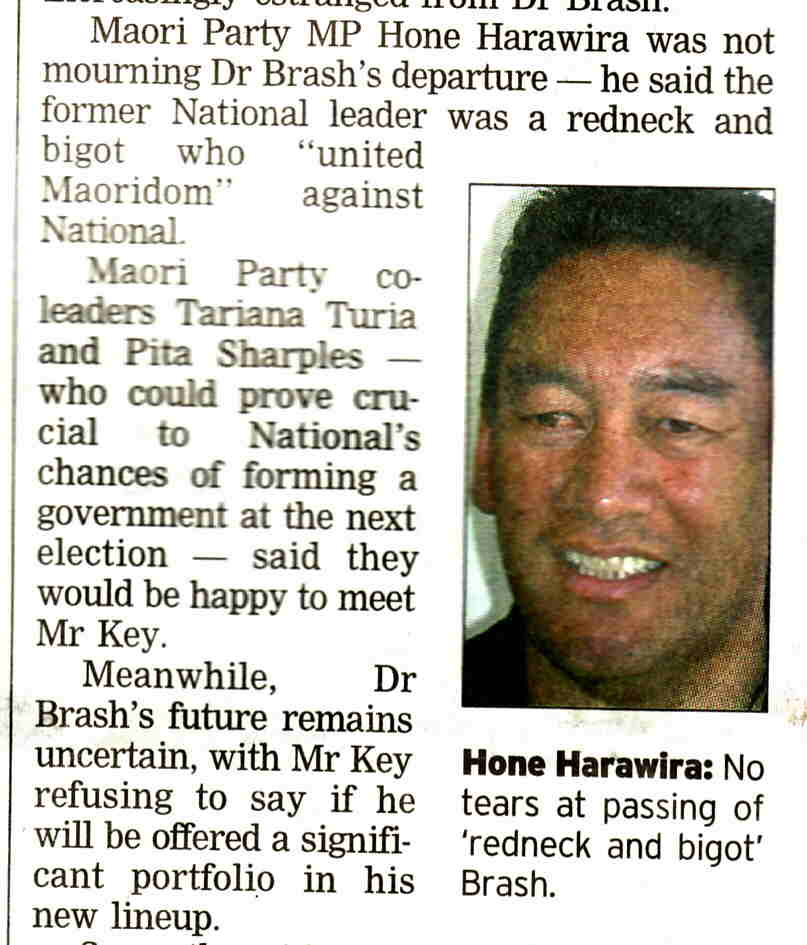
Tariana Turia says in her Beehive Comment; The Maori Party position didn’t even make the bulletin. Seems that nobody wants to hear a statement which says ‘we respect his right to make a decision’ or ‘we appreciate the impact such a difficult time can have upon the family’.
You see, nasty headlines, cutting insults are what sells papers – remarks which play on people’s fears and prejudices.
I can only conclude that Hone Harawira no longer officially represents the Maori Party.
Saturday, December 02, 2006
You get what you pay for?
Pay and display machines are being blown up by 'vigilantes'in East Sussex, UK, because they are so unpopular. Seems a bit over the top but when you consider that the authorities in Banbury go so far as to make parkers type in their registration number to prevent them handing an unused amount of time over to another motorist you begin to understand why there is such antipathy towards them.
Kiddy crisis in the 'Naki
Cinema: Parents parking kids, not cars
Children as young as eight are being dumped at the cinema by their parents
One of the lead stories in the Taranaki Daily News.
There are a couple of things I noticed. The use of the word 'dump' instead of 'drop off' inferring any parent who drops off their child is bad. I wouldn't let my eight year-old go to the cinema without an adult but I have dropped off my twelve year-old to meet friends. The reminder that the movie could be sold out is useful.
Good on the movie company for looking after the children that do get stranded.
But here's the line that really disgusts me; The New Plymouth District Council says it cannot review parking charges until next June because of the costs of retriggering the Local Government Act's need for consultation.
Isn't it pathetic? The stifling burden of rules and regulations. In fact, I'm sure if they look hard enough the council or OSH could find some reason why the cinema company shouldn't be taking care of kids in a separate area when they can't get into the movie.
Children as young as eight are being dumped at the cinema by their parents
One of the lead stories in the Taranaki Daily News.
There are a couple of things I noticed. The use of the word 'dump' instead of 'drop off' inferring any parent who drops off their child is bad. I wouldn't let my eight year-old go to the cinema without an adult but I have dropped off my twelve year-old to meet friends. The reminder that the movie could be sold out is useful.
Good on the movie company for looking after the children that do get stranded.
But here's the line that really disgusts me; The New Plymouth District Council says it cannot review parking charges until next June because of the costs of retriggering the Local Government Act's need for consultation.
Isn't it pathetic? The stifling burden of rules and regulations. In fact, I'm sure if they look hard enough the council or OSH could find some reason why the cinema company shouldn't be taking care of kids in a separate area when they can't get into the movie.
Friday, December 01, 2006
National morphing into Labour
Here we go. National morphing into Labour. Jackie Blue positioning herself to be the next Minister of Women's Affairs. ACT should be putting out a press release reminding New Zealand they would abolish this archaic, politics-of-privilege department.
Let woman then go on —not asking favors, but claiming as a right the removal of all hindrances to her elevation in the scale of being —let here receive encouragement for the proper cultivation of all her powers, so that she may enter profitably into the active business of life . . . Then in the marriage union, the independence of husband and wife will be equal, their dependence mutual, and their obligations reciprocal.
— Lucretia Coffin Mott, Discourse on Woman [December 17, 1849]
Let woman then go on —not asking favors, but claiming as a right the removal of all hindrances to her elevation in the scale of being —let here receive encouragement for the proper cultivation of all her powers, so that she may enter profitably into the active business of life . . . Then in the marriage union, the independence of husband and wife will be equal, their dependence mutual, and their obligations reciprocal.
— Lucretia Coffin Mott, Discourse on Woman [December 17, 1849]
Reforming Welfare
I had a flick through the UK report, Reforming Welfare, yesterday, looking for any comparative NZ data. This is all I found and it's from 2002 which devalues its usefulness.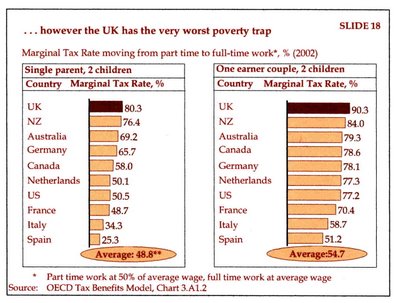
Anyway, Maxim have done a good job summarising the report as follows;
REPORT STRENGTHENS THE CASE FOR WELFARE REFORM IN UK
The already compelling case for welfare reform in the United Kingdom grew stronger recently, with the ballooning of government dependency continuing, and the release of a new report by the think tank Reform.
Reforming Welfare examines the current state of the British welfare system, showing that while spending on welfare is "colossal", the state of beneficiaries is getting worse, and the poverty trap only deeper. The British government spent £79 billion on welfare during 2005, supporting an estimated 14 percent of the working age population. At the same time, the number of government benefits has ballooned from seven in 1948 to 51 today.
The Times reported recently that under the British equivalent of New Zealand's "Working for Families" scheme, even those in the richest fifth of households are in receipt of government benefits. The paper reported that a third of the scheme's expenditure goes to the richest 50 percent of homes. It appears that more and more people are lining up for help they may not even need.
But although the welfare budget sucks more and more cash from the public purse, it delivers little in return. Reforming Welfare states that outcomes such as inequality and poverty are only getting worse, with many poorer regions worse off than 20 years ago. The report argues that the moral, social and economic consequences of welfare dependency are crippling, tracing the gradual historical shift from local structures aimed at preserving independence to the modern welfare state with its central bureaucracy and endless paperwork.
Setting the debate in much-needed context, the report lays down a tough and important challenge New Zealand cannot ignore. A welfare state which breeds a culture of entitlement is neither sustainable nor wise. As a country, we must do better when it comes to those left behind.
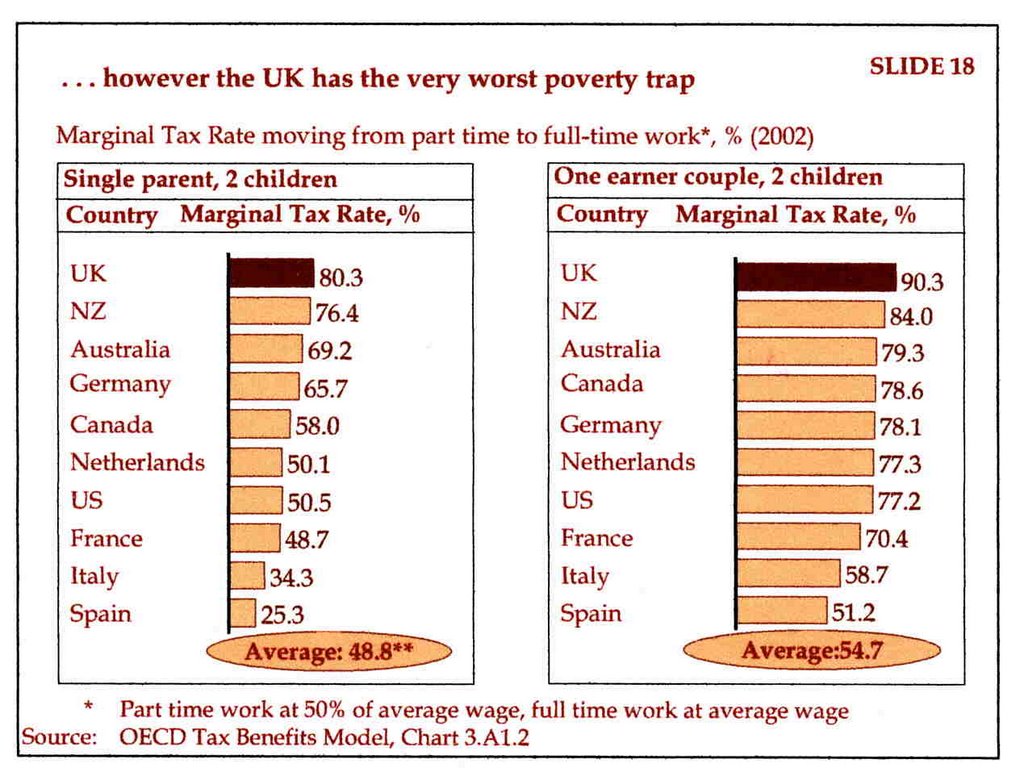
Anyway, Maxim have done a good job summarising the report as follows;
REPORT STRENGTHENS THE CASE FOR WELFARE REFORM IN UK
The already compelling case for welfare reform in the United Kingdom grew stronger recently, with the ballooning of government dependency continuing, and the release of a new report by the think tank Reform.
Reforming Welfare examines the current state of the British welfare system, showing that while spending on welfare is "colossal", the state of beneficiaries is getting worse, and the poverty trap only deeper. The British government spent £79 billion on welfare during 2005, supporting an estimated 14 percent of the working age population. At the same time, the number of government benefits has ballooned from seven in 1948 to 51 today.
The Times reported recently that under the British equivalent of New Zealand's "Working for Families" scheme, even those in the richest fifth of households are in receipt of government benefits. The paper reported that a third of the scheme's expenditure goes to the richest 50 percent of homes. It appears that more and more people are lining up for help they may not even need.
But although the welfare budget sucks more and more cash from the public purse, it delivers little in return. Reforming Welfare states that outcomes such as inequality and poverty are only getting worse, with many poorer regions worse off than 20 years ago. The report argues that the moral, social and economic consequences of welfare dependency are crippling, tracing the gradual historical shift from local structures aimed at preserving independence to the modern welfare state with its central bureaucracy and endless paperwork.
Setting the debate in much-needed context, the report lays down a tough and important challenge New Zealand cannot ignore. A welfare state which breeds a culture of entitlement is neither sustainable nor wise. As a country, we must do better when it comes to those left behind.
"Why won't NZ cut taxes?"
National Party associate finance spokesman, Craig Foss, has an article in the Wall St journal. Well done. NCPA summarises it.
Since the Labor Party took power in 1999, taxes have become quite burdensome:
* The top personal tax rate has been hiked to 39 percent from 33 percent.
* The corporate rate -- already a hefty 33 percent -- hasn't changed for over a quarter century.
* New Zealand's income and corporate tax-to-GDP ratio now ranks 16th among Organization for Economic Co-operation and Development (OECD) countries; seven years ago, the country placed 10th.
I take it then we can look forward to National cutting taxes.
Since the Labor Party took power in 1999, taxes have become quite burdensome:
* The top personal tax rate has been hiked to 39 percent from 33 percent.
* The corporate rate -- already a hefty 33 percent -- hasn't changed for over a quarter century.
* New Zealand's income and corporate tax-to-GDP ratio now ranks 16th among Organization for Economic Co-operation and Development (OECD) countries; seven years ago, the country placed 10th.
I take it then we can look forward to National cutting taxes.
Pregnant teenage heroin addict remanded
A pregnant teenage heroin addict was remanded in the Invercargill district court in order for CYF to arrange treatment for her and her unborn child. The story focuses on whether or not newborns of addicts are harmed by their mother's drug use, which is a bit laughable given the very strong possibility that if she uses heroin she also smokes and drinks (probably courtesy of a sickness benefit). But I am more interested in the fact she is in court. Had she committed some other crime? Or does CYF have the power to take her to court because of concerns over the unborn child?
Subscribe to:
Posts (Atom)


