Friday, March 27, 2020

US versus NZ unemployment benefits

According to RNZ:
The number of Americans filing claims for unemployment benefits surged to a record of more than 3 million last week as strict measures to contain the coronavirus pandemic brought the country to a sudden halt.
That's less than 1 percent of the US population.

Source

The total number of people claiming benefits in all programs for the week ending March 7 was 2,006,363, a decrease of 80,856 from the previous week. There were 2,039,322 persons claiming benefits in all programs in the comparable week in 2019. 

In New Zealand, before the pandemic, there were 147,000 jobseekers claiming benefits - 3% of our population.

Yes there are all sorts of barriers to even claiming an unemployment benefit in the US, and over 3 million new claims in a week is extraordinary but some context is always useful and interesting.

We won't know here until later in April how our numbers are faring (unless a non-normal announcement is made). And then the numbers on Jobseeker will have to be set alongside the numbers on wage subsidies to provide a real measure of compensated 'unemployment'.

What we do know is that MSD is struggling to deal with the level of inquiry and application from individuals. People are reporting wait times of over two hours which is impossible to accommodate for some mobile phone users.


Thursday, March 26, 2020

Arbitrary and unjustified closure of businesses

A small community.

A smallish supermarket, a dairy, a butcher, a green grocer and a bottle store.

Now only the first two have state permission to continue to trade.

The butcher and green grocer have existed under the same owners for a long time. They know their clients - many elderly - very well. They deliver to them. They chat, are on first name basis. They have occupied their premises long-term and serve a community function beyond their brief. They provide an essential service.

In the time they have traded, the supermarket has changed hands 3 or 4 times. The current owners do not know the community to the same extent.

Under Covid 19 Level 4 powers, all of the trading ability has been stolen from 3 and gifted to 2.

Why?

With two open, people will continue to come to the village and shop. The supermarket will require more staff  increasing potential exposure between staff and customer, thereby nullifying the decrease in potential exposure between butcher, greengrocer and customer. The supermarket presents far more opportunity to touch produce and surfaces than the butcher and greengrocer where you ask for what you want.

This is another authoritarian ruling that is ill-founded and illogical.

(And I can't find a link but it seemed that Katherine Rich from the Food and Grocery Council was today hinting that the supermarkets may soon be able to supply liquor for delivery. A full hand.)

Wednesday, March 25, 2020

Coronavirus edicts

1/ Don't 'panic' buy, or stock up.

Better to go frequently to the supermarket for what you need so as to ... minimise contact?

MORE CONTACT

2/ Don't take your families in people-carriers to one of the many New Zealand beaches or reserves where it is eminently possible to find a quiet spot to hang out with your 'bubble' humans and animals privately.

Please stay home within the confines of your compressed, crowded house.

MOST POLICE TIME IS SPENT ON FAMILY VIOLENCE CALL OUTS

3/ Do not indulge in any truly solitary pursuits like hunting or fishing from your dinghy because you may have a mishap and require emergency services like the police.

They won't be available because they will be employed at checkpoints making sure that you don't go on any solitary pursuits

... or distracted by family violence call outs.


Before you go off at me for not 'getting with the programme', I am following directions unfailingly. Most people are at this stage.

But as pressure builds, illogical and inconsistent edicts will bring this endeavour down very quickly.


Sunday, March 22, 2020

Australia doubles benefit rates

Australia will double benefit rates to deal with coronavirus:


People newly made redundant will have financial commitments well beyond the prior Newstart Allowance (but wasn't that always the case for individuals before this crisis?)

To meet these needs, and as a result, everybody on a benefit pre-March 20 has it doubled. 

It's only for 6 months ...

BUT what will the reaction be when benefits are halved??


Wednesday, March 18, 2020

Stuff from a small town in New Zealand

From the hinterland, the back blocks of rural heartland, one of my favourite commentators and artists Mark Wahlberg has started a blog Inside Pahiatua looking Out. We aren't overly blessed with views directly from and about small towns in New Zealand. Especially not of this nature. Linking to it in 'blogs I read'.

Tuesday, March 17, 2020

It is desirable to close the margin between benefit and employment income

Oh wait. Did I get that right?

Here's a quote I used recently when opposing the linking of benefits to wage inflation:

 "...it is desirable to create a margin between being dependent on a benefit and being in employment....
The Labour Party isn’t the party that says living on a benefit is a preferred lifestyle. Its position has always been that the benefit system is a safety net for those who are unavoidably unable to participate in employment. From its history, the Labour Party has always been about people in employment."
Michael Cullen, 2008
Yes NZ is facing an economic crisis. But I fear government response will make it worse.

Wage subsidies come with the proviso that the employer pays the employee a minimum of 80 percent of his existing wages. So the employee will be taking a 20 percent cut in income.

At the same time the beneficiary will be getting an 11-17 percent increase in the Jobseeker rate (plus any annual increase for wage inflation and the winter energy payment).

Lifting benefits when wages are heading south seems particularly foolhardy. I am seriously worried that we may see a repeat of the early nineties when benefit dependency reached 16 percent and large numbers of  unemployed never worked again with many migrating to sickness and invalid benefits.

God forbid.


Thursday, March 12, 2020

Greens: "It doesn't matter why you can't work..."

In the permissive tradition made famous by Metiria Turei, Greens co-leader Marama Davidson says: "It doesn't matter why you can't work - you should be able to immediately receive support." She wants stand-down periods permanently abolished and benefit rates increased substantially. This is in response to the coronavirus. But their desire for a sanction-free, no-questions-asked benefit system is well known.

It is staggering how pervasive welfare has become since its very first inception as the stringently policed old-age pension. A prospective recipient had to make application to a magistrate with proof of age, citizenship and good character. The names of those granted a pension were published in daily newspapers.

Until the 1960s clauses remained in benefit legislation to the effect that the applicant had to be sober and of good character and must not have caused their own incapacity to work. These disappeared as gate-keeping became increasingly difficult and society adopted a more 'progressive' attitude to need.

From then numbers exploded.


While Davidson is effectively saying it doesn't matter if you make yourself unemployable, actually she is only giving voice to the current state of affairs anyway. Thousands of  addicts, and criminals - past and present -  have their livelihoods paid for by the law-abiding. Thousands of parents chose to rely on the taxpayer instead of a partner to raise their children. Thousands of individuals have become inter-generational dependents as a result.

Are we a better country for the Green's (current political manifestation) brand of liberalism and non-judgementalism?

We may be. But if I was going to bat for children I'd say 'no'.

(It is one thing to extend kindness and care working one-on-one with beneficiaries and prisoners. A personal relationship includes personal knowledge about circumstances. But it does not follow that a society should apply a blanket approach of unquestioning and uncritical 'compassion'.)

Wednesday, March 11, 2020

Labour's lack of consistent philosophy

These are extremely unusual times. 'Stay calm and carry on' is my preferred mode of action.

A side effect of this flux is the exposure of Labour's lack of a core, consistent approach to assistance.

Under Finance Minister, Bill English, National was developing a highly targeted approach to need. Actuarial analysis was used to find who the most economically vulnerable and potentially costly were and efforts concentrated accordingly.

Along comes Labour and puts up election bribes like:

- Fees Free first year

- Best Start

- Energy Winter Payment

Each of these was cash assistance regardless of assets or income.Not once did they explain why they were prepared to give money to people who didn't need it.

Now Grant Robertson (who I rate in that party) is talking about the government's targeted response. He stresses how careful the government must be to meet only genuine and urgent need. Quite rightly.

But square it please.


Monday, March 09, 2020

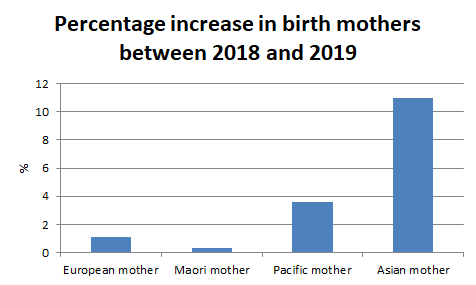
Increase in Asian mothers greater than all other groups combined

The matter of falling fertility caught my attention last year when I produced this paper for Family First.

NZ's fertility rate had dropped to an all-time low (like many other developed countries) in 2018. The 2019 data is now available and the birth rate has increased slightly to 1.75.

Predictably most of the increase is to mothers 30 and over. The increase in births by ethnicity is charted below. There were almost twice as many more Asian mothers than all the others combined. (1,203 versus 678)


Important note from data: "Each birth is included in every ethnic group specified. For this reason, some births are counted more than once and responses sum to more than the total number of births."

Birth data does not use a hierarchical system whereby Maori gets prioritised when there are multiple ethnicities. Here I have used 'mothers' as opposed to 'children' because mothers state fewer ethnicities than they do for their child, understandably. Mothers sum to 68,007 whereas children sum to 77,505. Total births for the year on the other hand is given as 59,637.

Tuesday, March 03, 2020

Parents on benefits continue having babies

Media Release: Parents on benefits continue having babies

March 3, 2020

Lindsay Mitchell, Welfare Commentator and researcher


In 2019 over 6,000 babies were added to an existing benefit.

"Information released to me under the OIA shows that 6,190 caregivers had added one or more 'subsequent children' aged less than 12 months to their benefit during 2019. That represents one in ten of all babies born last year.  For Maori the ratio doubles to one in five."

Having more babies when unable to independently provide for existing children entrenches long-term dependency. Children on a benefit from birth are more likely to experience abuse and neglect, material hardship, poorer health and educational outcomes, and contact with the justice system.

"To disincentivise adding children, in 2012 the National government introduced a policy whereby the requirement to return to part-time work when the youngest child turned five (later reduced to three) could not be delayed by having another baby. "

In the prior years 2006-2010 the annual average number of subsequent children born to parents on benefit was 4,800.* The situation appears to have worsened since.

"From July 2018 parents on benefits were paid an additional $60 weekly for new born children. 'Best Start' payments apply whether or not the baby is a 'subsequent child.' "

National disincentives and Labour incentives present a mixed and ultimately unsuccessful message as New Zealand fails to deal with the root of so many social problems.


*https://www.msd.govt.nz/documents/about-msd-and-our-work/publications-resources/regulatory-impact-statements/ris-welfare-reform-phase-one-social-security-amendment-bill-no1-.pdf

Indian migrants appearing in courts more often than Mongrel Mob members?

Shane Jones' adding- insult- to- injury comments are intriguing:

"I challenge anyone in New Zealand to disagree with me in terms of the sad regularity with which we are seeing egregious cases of abuse, in the media, coming from the Indian migrant community upon their own. In fact, they're appearing in courts with more regularity than the Mongrel Mob."
You would assume that "egregious" cases of abuse would earn at least a community sentence if not a term in prison. Yet Asian and other offenders make up just 4-5% of prisoners or offenders with a community sentence.


In 2015  nine percent of the prison population was Mongrel Mob. By 2018 the number had climbed to around 11 percent.

I suppose there could be some quirk such as all convicted Indian offenders are deported?? But even then they would serve their prison sentence first. Any other ideas that might back up Jones' claim?

Sunday, March 01, 2020

Growing failure of biological parents to care for their children

"Unsupported Child’s Benefit is a weekly payment which helps carers supporting a child or young person whose parents can't care for them because of a family breakdown."

"Orphan’s Benefit is a weekly payment which helps carers supporting a child or young person whose parents have died or can't be found, or can’t look after them because they have a long-term health condition or incapacity."

I included these when recently asking MSD how many more children were dependent on benefits.


Children on these benefits have risen by 18 percent from December 2017 to December 2019.

Yet again we see Maori children way over-represented. 

Many of these children will be in whangai, foster or grandparent care. Anecdotally (listening to grandparents raising grandchildren) drugs are a large part of the problem.

Apart from a small number of tragedies (Orphan's benefit only represents 2 percent of the total numbers) the growing columns largely reflect a failure of biological parents to provide care.

(The growth is not the result of the law change to allow dependent children to stay in foster care till an older age. In each and every single year age-band the numbers have increased. Babies under 1 year  increased by 44%)

Thursday, February 27, 2020

Just 7 percent of Jobseeker beneficiaries had part-time work at year end

One explanation for why Jobseeker numbers continue to climb despite the unemployment rate staying low might be part-time employment.

An individual can receive a Jobseeker benefit if they are working part-time. So under the OIA I asked MSD how many Jobseeker recipients had part-time jobs. I have graphed the data they supplied:


Only 7.3% of Jobseeker beneficiaries had a part-time job at December 31 - 5.2% of Maori and 9.4 percent of NZ European.

But this is point-in-time data and doesn't tell me about seasonal workers for example. MSD fact sheets once gave the percentage of beneficiaries who had earnings for the prior year.

Though obsolete it'd be useful to look at one of those fact sheets. The last to record this info was December 2012 - pre-welfare reforms. Of those on the old unemployment benefit:
12 percent had a current earnings declaration for their current spell on benefit. This indicates some participation in paid work (during the last 12 months) while receiving a main benefit.
Not a great deal higher.

Blog followers will know I have been particularly intrigued by the mismatch between low unemployed but high Jobseeker numbers for Maori.


Given all of the above I am still stumped as to why over 58,000 Maori are receiving a jobseeker benefit while fewer than 30,000 are unemployed.


(To be continued)

Wednesday, February 26, 2020

140% increase in housing wait list since 2017


Latest stats just released by MSD

Here's the longer term back story:

Tuesday, February 25, 2020

Almost 12,000 more children on benefits

Almost 12,000 more children on benefits

February 25, 2020

Lindsay Mitchell, Welfare commentator and researcher


Data released under the Official Information Act today reveals almost 12,000 more children are dependent on welfare benefits since December 2017.

"At 31 December 2019 there were 206,395 children aged 0-18 reliant on caregiver on a main benefit (185,930), Young Parent Payment (1,531) or Orphan/ Unsupported Child benefit (18,934). That's 6 percent higher than at December 31, 2017."

Of the 59,637 births during 2019 10,882 babies were welfare-dependent by year end. Nearly one in five. Over half - 57% - were added to an existing benefit.

New Zealand's child poverty problem cannot be solved when high numbers of children live in non-working homes. Raising benefits and reducing the income margin between work and welfare will only incentivise more people to opt for welfare. This normalises benefit dependency for their children and the habit becomes inter-generational.

In 2008 Finance Minister Michael Cullen said, "...it is desirable to create a margin between being dependent on a benefit and being in employment....
The Labour Party isn’t the party that says living on a benefit is a preferred lifestyle. Its position has always been that the benefit system is a safety net for those who are unavoidably unable to participate in employment. From its history, the Labour Party has always been about people in employment."

The more the current Labour government ignores this, the more intractable the child poverty problem will become.


Cullen wouldn't have linked benefits to wages

Indexing benefits to wages is setting a precedent. They've been indexed to inflation since 2001 but this move has always been resisted.


For many people the margin between income from a benefit and income from work is a cost they are prepared to pay. Fix that margin and they will always be prepared to pay it. Increase the margin and work becomes attractive.

The previous Labour government understood this.

 "...it is desirable to create a margin between being dependent on a benefit and being in employment....
The Labour Party isn’t the party that says living on a benefit is a preferred lifestyle. Its position has always been that the benefit system is a safety net for those who are unavoidably unable to participate in employment. From its history, the Labour Party has always been about people in employment."
Michael Cullen, 2008


Monday, February 24, 2020

Stop promising, Jacinda

Given child poverty reduction isn't playing well for Jacinda, she might reflect on this piece of realism and honesty from Don Brash as National opposition leader in 2005:
When asked to guarantee his policies would not lead to an increase in child poverty, Don Brash told Morning Report "look there's a cycle of these things, they go up and down. I can't promise anything in that area."
It's bat shit crazy to vow to reduce child poverty given  the many measures with relativity as the mainstay anyway.

Kids will do better when the adults and the country they live in does better.


Wednesday, February 19, 2020

Normalising methamphetamine

Reported in a soundbite during tonight's TV One News the italicised finding below.

The press release from which the soundbite arose:

Methamphetamine Use And Its Impact On Violence Laid Bare In World-first Study
Wednesday, 19 February 2020, 2:33 pm
Press Release: University of Otago
Almost a third of middle-aged New Zealanders have tried methamphetamine at least once, according to a new University of Otago, Christchurch study looking at the link between using the drug and violence in the general population.

"Almost a third" is 28%; "middle-aged" is 35 and  "New Zealanders" were 1,000 individuals born in Canterbury.

The other big market for meth is Australia. According to Flinders University in Adelaide:

In 2013, 7% of Australians reported that they had used methamphetamine in their lifetime, and 2% reported using in the past 12 months."

"In their lifetime" is a much larger window than by age 35 but read on.

Probably the most reliable NZ source for the prevalence of drug use is the Ministry of Health's  NZ Drug Survey which finds:

In 2015/16, 1.1 percent of adults (95% confidence interval, CI: 0.9–1.5) used amphetamines in the past year. This equates to about 34,000 New Zealanders.

1.1% is much lower than 2%, the Australian finding. Which calls into question the discrepancy between "middle-aged" and lifetime findings.

Back to the Christchurch Study press release:

"The findings show use of methamphetamine is common, as observed in the study’s cohort of middle-aged New Zealanders. According to Christchurch Health and Development data, methamphetamine is the third most common illicit drug after cannabis and ecstasy, Professor Boden says
...He cautions while methamphetamine use increases the risk of involvement in violence most people who used the drug did not engage in violence or experience violence in others.

I appreciate the study focuses on meth and associated violence and that is useful.

But what I heard - and subsequently read - was the message that methamphetamine usage is "common".

I've never used it. In my life I've used cannabis three times and wouldn't expect that to contribute to any claim about usage prevalence today.


Tuesday, February 18, 2020

Unemployment Rate versus Jobseeker Receipt by region

Here the official unemployment rate (from the HLFS) is charted against the receipt of Jobseeker benefit (from MSD fact sheets) by region at December 2019.

Only Auckland and Otago have a higher unemployment rate than % of the (local) working age population receiving a Jobseeker Benefit.

All of the areas with large discrepancies have high Maori populations. This is consistent with the discrepancy when charted on ethnicity alone.

My current conclusion is that many Maori in those regions are not unemployed but working part-time or seasonally so still entitled to the Jobseeker benefit.

Monday, February 17, 2020

Lowering the prison population: At what cost?

There are people in prison who shouldn't be there. And there are people who aren't in prison who should be there. 

According to Police, reported crime is up 7.1% in the year to November 2019 and "Serious Assault Resulting in Injury victimisations increased by 39.5% compared with the previous 12 months." There is some qualification about change in assault classifications but it isn't conclusive.

The most common reason for a prison sentence is violence. 

Yet the Ministry of Justice says, "Compared to 2017/2018 a smaller percentage of adults received prison sentences in 2018/2019, while the percentage receiving more serious community sentences continued to increase." (My emphasis)

Also, "The number of adults receiving a prison sentence increased between 2013/2014 and 2016/2017, however over the past year it has decreased from 8,130 people (13%) in 2017/2018 to 6,883 (12%) in 2018/2019. This has brought the number of adults receiving a prison sentence back to levels seen before the increase." 

It is to be hoped that the crimes not sending people to prison are of the 'lesser' variety. Though if you were a victim or theft or burglary (up respectively 7.6 and 6.3%) you may not agree.

I blogged recently that I agree with Andrew Little's goal to lower the prison population but not at any cost.