In the permissive tradition made famous by Metiria Turei, Greens co-leader Marama Davidson says: "It doesn't matter why you can't work - you should be able to immediately receive support." She wants stand-down periods permanently abolished and benefit rates increased substantially. This is in response to the coronavirus. But their desire for a sanction-free, no-questions-asked benefit system is well known.
It is staggering how pervasive welfare has become since its very first inception as the stringently policed old-age pension. A prospective recipient had to make application to a magistrate with proof of age, citizenship and good character. The names of those granted a pension were published in daily newspapers.
Until the 1960s clauses remained in benefit legislation to the effect that the applicant had to be sober and of good character and must not have caused their own incapacity to work. These disappeared as gate-keeping became increasingly difficult and society adopted a more 'progressive' attitude to need.
From then numbers exploded.
While Davidson is effectively saying it doesn't matter if you make yourself unemployable, actually she is only giving voice to the current state of affairs anyway. Thousands of addicts, and criminals - past and present - have their livelihoods paid for by the law-abiding. Thousands of parents chose to rely on the taxpayer instead of a partner to raise their children. Thousands of individuals have become inter-generational dependents as a result.
Are we a better country for the Green's (current political manifestation) brand of liberalism and non-judgementalism?
We may be. But if I was going to bat for children I'd say 'no'.
(It is one thing to extend kindness and care working one-on-one with beneficiaries and prisoners. A personal relationship includes personal knowledge about circumstances. But it does not follow that a society should apply a blanket approach of unquestioning and uncritical 'compassion'.)
Thursday, March 12, 2020
Wednesday, March 11, 2020
Labour's lack of consistent philosophy
These are extremely unusual times. 'Stay calm and carry on' is my preferred mode of action.
A side effect of this flux is the exposure of Labour's lack of a core, consistent approach to assistance.
Under Finance Minister, Bill English, National was developing a highly targeted approach to need. Actuarial analysis was used to find who the most economically vulnerable and potentially costly were and efforts concentrated accordingly.
Along comes Labour and puts up election bribes like:
- Fees Free first year
- Best Start
- Energy Winter Payment
Each of these was cash assistance regardless of assets or income.Not once did they explain why they were prepared to give money to people who didn't need it.
Now Grant Robertson (who I rate in that party) is talking about the government's targeted response. He stresses how careful the government must be to meet only genuine and urgent need. Quite rightly.
But square it please.
A side effect of this flux is the exposure of Labour's lack of a core, consistent approach to assistance.
Under Finance Minister, Bill English, National was developing a highly targeted approach to need. Actuarial analysis was used to find who the most economically vulnerable and potentially costly were and efforts concentrated accordingly.
Along comes Labour and puts up election bribes like:
- Fees Free first year
- Best Start
- Energy Winter Payment
Each of these was cash assistance regardless of assets or income.Not once did they explain why they were prepared to give money to people who didn't need it.
Now Grant Robertson (who I rate in that party) is talking about the government's targeted response. He stresses how careful the government must be to meet only genuine and urgent need. Quite rightly.
But square it please.
Monday, March 09, 2020
Increase in Asian mothers greater than all other groups combined
The matter of falling fertility caught my attention last year when I produced this paper for Family First.
NZ's fertility rate had dropped to an all-time low (like many other developed countries) in 2018. The 2019 data is now available and the birth rate has increased slightly to 1.75.
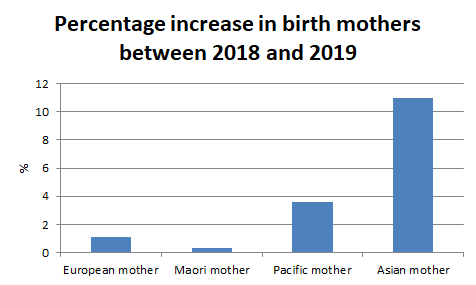
Predictably most of the increase is to mothers 30 and over. The increase in births by ethnicity is charted below. There were almost twice as many more Asian mothers than all the others combined. (1,203 versus 678)
Important note from data: "Each birth is included in every ethnic group specified. For this reason, some births are counted more than once and responses sum to more than the total number of births."
Birth data does not use a hierarchical system whereby Maori gets prioritised when there are multiple ethnicities. Here I have used 'mothers' as opposed to 'children' because mothers state fewer ethnicities than they do for their child, understandably. Mothers sum to 68,007 whereas children sum to 77,505. Total births for the year on the other hand is given as 59,637.
NZ's fertility rate had dropped to an all-time low (like many other developed countries) in 2018. The 2019 data is now available and the birth rate has increased slightly to 1.75.
Predictably most of the increase is to mothers 30 and over. The increase in births by ethnicity is charted below. There were almost twice as many more Asian mothers than all the others combined. (1,203 versus 678)
Important note from data: "Each birth is included in every ethnic group specified. For this reason, some births are counted more than once and responses sum to more than the total number of births."
Birth data does not use a hierarchical system whereby Maori gets prioritised when there are multiple ethnicities. Here I have used 'mothers' as opposed to 'children' because mothers state fewer ethnicities than they do for their child, understandably. Mothers sum to 68,007 whereas children sum to 77,505. Total births for the year on the other hand is given as 59,637.
Tuesday, March 03, 2020
Parents on benefits continue having babies
Media Release: Parents on benefits continue having babies
March 3, 2020
Lindsay Mitchell, Welfare Commentator and researcher
In 2019 over 6,000 babies were added to an existing benefit.
"Information released to me under the OIA shows that 6,190 caregivers had added one or more 'subsequent children' aged less than 12 months to their benefit during 2019. That represents one in ten of all babies born last year. For Maori the ratio doubles to one in five."
Having more babies when unable to independently provide for existing children entrenches long-term dependency. Children on a benefit from birth are more likely to experience abuse and neglect, material hardship, poorer health and educational outcomes, and contact with the justice system.
"To disincentivise adding children, in 2012 the National government introduced a policy whereby the requirement to return to part-time work when the youngest child turned five (later reduced to three) could not be delayed by having another baby. "
In the prior years 2006-2010 the annual average number of subsequent children born to parents on benefit was 4,800.* The situation appears to have worsened since.
"From July 2018 parents on benefits were paid an additional $60 weekly for new born children. 'Best Start' payments apply whether or not the baby is a 'subsequent child.' "
National disincentives and Labour incentives present a mixed and ultimately unsuccessful message as New Zealand fails to deal with the root of so many social problems.
*https://www.msd.govt.nz/documents/about-msd-and-our-work/publications-resources/regulatory-impact-statements/ris-welfare-reform-phase-one-social-security-amendment-bill-no1-.pdf
March 3, 2020
Lindsay Mitchell, Welfare Commentator and researcher
In 2019 over 6,000 babies were added to an existing benefit.
"Information released to me under the OIA shows that 6,190 caregivers had added one or more 'subsequent children' aged less than 12 months to their benefit during 2019. That represents one in ten of all babies born last year. For Maori the ratio doubles to one in five."
Having more babies when unable to independently provide for existing children entrenches long-term dependency. Children on a benefit from birth are more likely to experience abuse and neglect, material hardship, poorer health and educational outcomes, and contact with the justice system.
"To disincentivise adding children, in 2012 the National government introduced a policy whereby the requirement to return to part-time work when the youngest child turned five (later reduced to three) could not be delayed by having another baby. "
In the prior years 2006-2010 the annual average number of subsequent children born to parents on benefit was 4,800.* The situation appears to have worsened since.
"From July 2018 parents on benefits were paid an additional $60 weekly for new born children. 'Best Start' payments apply whether or not the baby is a 'subsequent child.' "
National disincentives and Labour incentives present a mixed and ultimately unsuccessful message as New Zealand fails to deal with the root of so many social problems.
*https://www.msd.govt.nz/documents/about-msd-and-our-work/publications-resources/regulatory-impact-statements/ris-welfare-reform-phase-one-social-security-amendment-bill-no1-.pdf
Indian migrants appearing in courts more often than Mongrel Mob members?
Shane Jones' adding- insult- to- injury comments are intriguing:
"I challenge anyone in New Zealand to disagree with me in terms of the sad regularity with which we are seeing egregious cases of abuse, in the media, coming from the Indian migrant community upon their own. In fact, they're appearing in courts with more regularity than the Mongrel Mob."
You would assume that "egregious" cases of abuse would earn at least a community sentence if not a term in prison. Yet Asian and other offenders make up just 4-5% of prisoners or offenders with a community sentence.
In 2015 nine percent of the prison population was Mongrel Mob. By 2018 the number had climbed to around 11 percent.
I suppose there could be some quirk such as all convicted Indian offenders are deported?? But even then they would serve their prison sentence first. Any other ideas that might back up Jones' claim?
Sunday, March 01, 2020
Growing failure of biological parents to care for their children
"Unsupported Child’s Benefit is a weekly payment which helps carers supporting a child or young person whose parents can't care for them because of a family breakdown."
"Orphan’s Benefit is a weekly payment which helps carers supporting a child or young person whose parents have died or can't be found, or can’t look after them because they have a long-term health condition or incapacity."
I included these when recently asking MSD how many more children were dependent on benefits.
"Orphan’s Benefit is a weekly payment which helps carers supporting a child or young person whose parents have died or can't be found, or can’t look after them because they have a long-term health condition or incapacity."
I included these when recently asking MSD how many more children were dependent on benefits.
Children on these benefits have risen by 18 percent from December 2017 to December 2019.
Yet again we see Maori children way over-represented.
Many of these children will be in whangai, foster or grandparent care. Anecdotally (listening to grandparents raising grandchildren) drugs are a large part of the problem.
Apart from a small number of tragedies (Orphan's benefit only represents 2 percent of the total numbers) the growing columns largely reflect a failure of biological parents to provide care.
(The growth is not the result of the law change to allow dependent children to stay in foster care till an older age. In each and every single year age-band the numbers have increased. Babies under 1 year increased by 44%)
Thursday, February 27, 2020
Just 7 percent of Jobseeker beneficiaries had part-time work at year end
One explanation for why Jobseeker numbers continue to climb despite the unemployment rate staying low might be part-time employment.
An individual can receive a Jobseeker benefit if they are working part-time. So under the OIA I asked MSD how many Jobseeker recipients had part-time jobs. I have graphed the data they supplied:
Given all of the above I am still stumped as to why over 58,000 Maori are receiving a jobseeker benefit while fewer than 30,000 are unemployed.
(To be continued)
An individual can receive a Jobseeker benefit if they are working part-time. So under the OIA I asked MSD how many Jobseeker recipients had part-time jobs. I have graphed the data they supplied:
Only 7.3% of Jobseeker beneficiaries had a part-time job at December 31 - 5.2% of Maori and 9.4 percent of NZ European.
But this is point-in-time data and doesn't tell me about seasonal workers for example. MSD fact sheets once gave the percentage of beneficiaries who had earnings for the prior year.
Though obsolete it'd be useful to look at one of those fact sheets. The last to record this info was December 2012 - pre-welfare reforms. Of those on the old unemployment benefit:
• 12 percent had a current earnings declaration for their current spell on benefit. This indicates some participation in paid work (during the last 12 months) while receiving a main benefit.Not a great deal higher.
Blog followers will know I have been particularly intrigued by the mismatch between low unemployed but high Jobseeker numbers for Maori.
(To be continued)
Wednesday, February 26, 2020
Tuesday, February 25, 2020
Almost 12,000 more children on benefits
February 25, 2020
Lindsay Mitchell, Welfare commentator and researcher
Data released under the Official Information Act today reveals almost 12,000 more children are dependent on welfare benefits since December 2017.
"At 31 December 2019 there were 206,395 children aged 0-18 reliant on caregiver on a main benefit (185,930), Young Parent Payment (1,531) or Orphan/ Unsupported Child benefit (18,934). That's 6 percent higher than at December 31, 2017."
Of the 59,637 births during 2019 10,882 babies were welfare-dependent by year end. Nearly one in five. Over half - 57% - were added to an existing benefit.
New Zealand's child poverty problem cannot be solved when high numbers of children live in non-working homes. Raising benefits and reducing the income margin between work and welfare will only incentivise more people to opt for welfare. This normalises benefit dependency for their children and the habit becomes inter-generational.
In 2008 Finance Minister Michael Cullen said, "...it is desirable to create a margin between being dependent on a benefit and being in employment....
The Labour Party isn’t the party that says living on a benefit is a preferred lifestyle. Its position has always been that the benefit system is a safety net for those who are unavoidably unable to participate in employment. From its history, the Labour Party has always been about people in employment."
The more the current Labour government ignores this, the more intractable the child poverty problem will become.
February 25, 2020
Lindsay Mitchell, Welfare commentator and researcher
Data released under the Official Information Act today reveals almost 12,000 more children are dependent on welfare benefits since December 2017.
"At 31 December 2019 there were 206,395 children aged 0-18 reliant on caregiver on a main benefit (185,930), Young Parent Payment (1,531) or Orphan/ Unsupported Child benefit (18,934). That's 6 percent higher than at December 31, 2017."
Of the 59,637 births during 2019 10,882 babies were welfare-dependent by year end. Nearly one in five. Over half - 57% - were added to an existing benefit.
New Zealand's child poverty problem cannot be solved when high numbers of children live in non-working homes. Raising benefits and reducing the income margin between work and welfare will only incentivise more people to opt for welfare. This normalises benefit dependency for their children and the habit becomes inter-generational.
In 2008 Finance Minister Michael Cullen said, "...it is desirable to create a margin between being dependent on a benefit and being in employment....
The Labour Party isn’t the party that says living on a benefit is a preferred lifestyle. Its position has always been that the benefit system is a safety net for those who are unavoidably unable to participate in employment. From its history, the Labour Party has always been about people in employment."
The more the current Labour government ignores this, the more intractable the child poverty problem will become.
Cullen wouldn't have linked benefits to wages
Indexing benefits to wages is setting a precedent. They've been indexed to inflation since 2001 but this move has always been resisted.
For many people the margin between income from a benefit and income from work is a cost they are prepared to pay. Fix that margin and they will always be prepared to pay it. Increase the margin and work becomes attractive.
The previous Labour government understood this.
For many people the margin between income from a benefit and income from work is a cost they are prepared to pay. Fix that margin and they will always be prepared to pay it. Increase the margin and work becomes attractive.
The previous Labour government understood this.
"...it is desirable to create a margin between being dependent on a benefit and being in employment....
The Labour Party isn’t the party that says living on a benefit is a preferred lifestyle. Its position has always been that the benefit system is a safety net for those who are unavoidably unable to participate in employment. From its history, the Labour Party has always been about people in employment."
Michael Cullen, 2008
Monday, February 24, 2020
Stop promising, Jacinda
Given child poverty reduction isn't playing well for Jacinda, she might reflect on this piece of realism and honesty from Don Brash as National opposition leader in 2005:
Kids will do better when the adults and the country they live in does better.
When asked to guarantee his policies would not lead to an increase in child poverty, Don Brash told Morning Report "look there's a cycle of these things, they go up and down. I can't promise anything in that area."It's bat shit crazy to vow to reduce child poverty given the many measures with relativity as the mainstay anyway.
Kids will do better when the adults and the country they live in does better.
Wednesday, February 19, 2020
Normalising methamphetamine
Reported in a soundbite during tonight's TV One News the italicised finding below.
The press release from which the soundbite arose:
"Almost a third" is 28%; "middle-aged" is 35 and "New Zealanders" were 1,000 individuals born in Canterbury.
The other big market for meth is Australia. According to Flinders University in Adelaide:
"In their lifetime" is a much larger window than by age 35 but read on.
Probably the most reliable NZ source for the prevalence of drug use is the Ministry of Health's NZ Drug Survey which finds:
1.1% is much lower than 2%, the Australian finding. Which calls into question the discrepancy between "middle-aged" and lifetime findings.
Back to the Christchurch Study press release:
I appreciate the study focuses on meth and associated violence and that is useful.
But what I heard - and subsequently read - was the message that methamphetamine usage is "common".
I've never used it. In my life I've used cannabis three times and wouldn't expect that to contribute to any claim about usage prevalence today.
The press release from which the soundbite arose:
Methamphetamine Use And Its Impact On Violence Laid Bare In World-first Study
Wednesday, 19 February 2020, 2:33 pm
Press Release: University of Otago
Almost a third of middle-aged New Zealanders have tried methamphetamine at least once, according to a new University of Otago, Christchurch study looking at the link between using the drug and violence in the general population.
"Almost a third" is 28%; "middle-aged" is 35 and "New Zealanders" were 1,000 individuals born in Canterbury.
The other big market for meth is Australia. According to Flinders University in Adelaide:
In 2013, 7% of Australians reported that they had used methamphetamine in their lifetime, and 2% reported using in the past 12 months."
"In their lifetime" is a much larger window than by age 35 but read on.
Probably the most reliable NZ source for the prevalence of drug use is the Ministry of Health's NZ Drug Survey which finds:
In 2015/16, 1.1 percent of adults (95% confidence interval, CI: 0.9–1.5) used amphetamines in the past year. This equates to about 34,000 New Zealanders.
1.1% is much lower than 2%, the Australian finding. Which calls into question the discrepancy between "middle-aged" and lifetime findings.
Back to the Christchurch Study press release:
"The findings show use of methamphetamine is common, as observed in the study’s cohort of middle-aged New Zealanders. According to Christchurch Health and Development data, methamphetamine is the third most common illicit drug after cannabis and ecstasy, Professor Boden says
...He cautions while methamphetamine use increases the risk of involvement in violence most people who used the drug did not engage in violence or experience violence in others.
I appreciate the study focuses on meth and associated violence and that is useful.
But what I heard - and subsequently read - was the message that methamphetamine usage is "common".
I've never used it. In my life I've used cannabis three times and wouldn't expect that to contribute to any claim about usage prevalence today.
Tuesday, February 18, 2020
Unemployment Rate versus Jobseeker Receipt by region
Here the official unemployment rate (from the HLFS) is charted against the receipt of Jobseeker benefit (from MSD fact sheets) by region at December 2019.
Only Auckland and Otago have a higher unemployment rate than % of the (local) working age population receiving a Jobseeker Benefit.
All of the areas with large discrepancies have high Maori populations. This is consistent with the discrepancy when charted on ethnicity alone.
My current conclusion is that many Maori in those regions are not unemployed but working part-time or seasonally so still entitled to the Jobseeker benefit.
Only Auckland and Otago have a higher unemployment rate than % of the (local) working age population receiving a Jobseeker Benefit.
All of the areas with large discrepancies have high Maori populations. This is consistent with the discrepancy when charted on ethnicity alone.
My current conclusion is that many Maori in those regions are not unemployed but working part-time or seasonally so still entitled to the Jobseeker benefit.
Monday, February 17, 2020
Lowering the prison population: At what cost?
There are people in prison who shouldn't be there. And there are people who aren't in prison who should be there.
According to Police, reported crime is up 7.1% in the year to November 2019 and "Serious Assault Resulting in Injury victimisations increased by 39.5% compared with the previous 12 months." There is some qualification about change in assault classifications but it isn't conclusive.
The most common reason for a prison sentence is violence.
Yet the Ministry of Justice says, "Compared to 2017/2018 a smaller percentage of adults received prison sentences in 2018/2019, while the percentage receiving more serious community sentences continued to increase." (My emphasis)
Also, "The number of adults receiving a prison sentence increased between 2013/2014 and 2016/2017, however over the past year it has decreased from 8,130 people (13%) in 2017/2018 to 6,883 (12%) in 2018/2019. This has brought the number of adults receiving a prison sentence back to levels seen before the increase."
It is to be hoped that the crimes not sending people to prison are of the 'lesser' variety. Though if you were a victim or theft or burglary (up respectively 7.6 and 6.3%) you may not agree.
I blogged recently that I agree with Andrew Little's goal to lower the prison population but not at any cost.
Friday, February 14, 2020
Butt covering or sheer incompetence?
Regarding the Flaxmere tragedy, earlier this week we were told:
Today the story changes:
I generally hold off critcising OT because of the 'damned if they do and damned if they don't' nature of their after-the-fact work.
But what the heck? Is this butt covering or sheer incompetence?
As for the "Not one more baby" politicised movement screaming about the uplift of Maori babies, it is glaringly obvious to who and where they should be directing that message. And it's not OT.
"Foster said no other government agencies, such as Oranga Tamariki, were involved with the family before the incident."
Today the story changes:
"A 4-year-old boy critically injured in a suspected case of child abuse had previously been admitted to hospital with broken bones and removed from his immediate family...Oranga Tamariki intervened and the boy was placed into the care of wider family. He was returned to his immediate family shortly before Christmas."
I generally hold off critcising OT because of the 'damned if they do and damned if they don't' nature of their after-the-fact work.
But what the heck? Is this butt covering or sheer incompetence?
As for the "Not one more baby" politicised movement screaming about the uplift of Maori babies, it is glaringly obvious to who and where they should be directing that message. And it's not OT.
Thursday, February 13, 2020
Labour's weird welfare world
A few weeks back I posted about burgeoning and massively expensive motel residence funded by Work and Income.
Just advised from MSD:
We help people pay for emergency housing, such as motels, with an emergency housing grant. This is called an Emergency Housing Special Needs Grant.What’s changing on 30 March
From 30 March 2020, if you've been in emergency housing for more than 7 nights, we'll ask you to pay 25% of your income towards your housing costs.I was taken aback that those being temporarily put up in motels weren't being charged anything!
This is similar to what people pay when they live in transitional housing or public housing.
We want to make housing costs as consistent and fair as possible for all our clients, no matter what type of housing you're in.
No wonder both individuals and moteliers were lining up.
Wednesday, February 12, 2020
Truth is rare
This evening, a gathering for a karakia for the nameless beaten Flaxmere four-year-old delivers an honest observation:
Hastings District Councillor Henare O'Keefe said good parenting began and ended in the home.
"If there is a solution, it cannot be legislated. If there is a solution you won't find it in Wellington. If there is a solution, you won't find it in council … we need to take a look in the mirror."
That is a demonstration of mana.
IRD's new approach: "This is Us"
Much has been mentioned by media lately regarding student debt. There's another kind of debt that hits the young too. Child support debt.The reasons for pursuing the debt are legitimate but penalties are outrageous.
I watched a video presentation from an IRD guy talking about efforts to reduce non-compliance among first time liable parents.
Here's a slide:
-New liable parents have a median age of 25.
-They have a relatively low income - median of $19k per year.
-Only a quarter of these pay their first three obligations on time
-Two thirds have over a 75% chance of getting into debt and remaining in debt.
1,000 new customers enter the system each month.
So how is IRD going to improve the situation? Rethink their penalty regime?
No. They have pioneered a new form of customer engagement calling it, "This is Us"
"To truly have our customers at the "heart" of our every interaction...."
Anyway, they piloted the new approach on 248 new liable parents and formed two other control groups from the remainder:
The measure of 'percent of assessment paid' is provided at 17 months.
I watched a video presentation from an IRD guy talking about efforts to reduce non-compliance among first time liable parents.
Here's a slide:
-New liable parents have a median age of 25.
-They have a relatively low income - median of $19k per year.
-Only a quarter of these pay their first three obligations on time
-Two thirds have over a 75% chance of getting into debt and remaining in debt.
1,000 new customers enter the system each month.
So how is IRD going to improve the situation? Rethink their penalty regime?
No. They have pioneered a new form of customer engagement calling it, "This is Us"
"To truly have our customers at the "heart" of our every interaction...."
"...one of the things in a behavioural interventions area is that we had a behavioural psychologist on our team and we used a variety of different things like soft skills training, empathy, active listening skills, things like using appeals, like, "Oh, by the way, I'm sure you want to do the right thing for your children", this sort of type of conversation, we reframe the conversations to make it easier to understand, use some negotiation techniques and the bottom one is really important because we emphasised the importance of paying Child Support for the benefit of his or her child, which we wanted to resonate that you're not just doing this because we're telling you to do this, you're doing this because you have an obligation to support your children even though you're not living with them."Patronising pap. There are irresponsible absconders (who Labour are going to help out later this year by allowing them to go unnamed and non-liable) but also many fathers who would very much like to be living with their children but have been denied the opportunity thanks in part to the benefit system and court bias.
Anyway, they piloted the new approach on 248 new liable parents and formed two other control groups from the remainder:
All new liable parents assessed on June 2017After 12 months the percentage of customers paying 'full and on time' was 62.6% for the pilot group; 61.6 for the registration initiative group and 61.2 for the standard group. The result wasn't cost effective on that measure. It wasn't provided at 17 months.
• 248 new liable parents from the pilot group
• 511 from the control group 1 = applications
received over the phone /in writing and educated
(called “Registration Initiative”)
• 311 from the control group 2 = all other
remaining customers and educated (called
“Standard Group”)
Pilot ran from July through December 2017
The measure of 'percent of assessment paid' is provided at 17 months.
These results have been sufficient to implement the new approach in the Families Section from July 2019.
They're all heart.
Tuesday, February 11, 2020
Changing our approach to teen parents?
By chance I happened upon a Teenage Parent Evidence Brief produced for Oranga Tamariki (OT) and published last August.
It is well known now that the teenage birthrate has been plummeting since 2008. This trend is happening across English-speaking countries. Oddly the paper rails against 'stigmatising' teen birth and recommends that adults 'normalise adolescent sex, contraception, and parenting'. I don't know why we should change the current approach which includes...
1/ financial support through the Young Parent Payment which the paper describes as:
...when the rate is falling so fast.
My only real point of interest in the brief was a couple of graphs on p15 which show teen parents with an OT 'statutory' or 'report of concern' history are also in decline, just not as rapidly. Unsurprising.
It is well known now that the teenage birthrate has been plummeting since 2008. This trend is happening across English-speaking countries. Oddly the paper rails against 'stigmatising' teen birth and recommends that adults 'normalise adolescent sex, contraception, and parenting'. I don't know why we should change the current approach which includes...
1/ financial support through the Young Parent Payment which the paper describes as:
obligations to participate in the service and in formal studyIt also involves money management - a payment card for necessity purchases with minimal cash provided.
financial incentives
sanctions for failing to meet obligations
access to childcare payments.
2/ teen parent units in secondary schools
3/ and good access to effective contraception
...when the rate is falling so fast.
And for those who will immediately (and understandably) ask what's happening to the teen abortion rate...
Prison population stalled
Statistics NZ last week reported that 'Prison building intentions triple in 2019'. Is that reflective of a rise in the prison population? The December prison stats were released yesterday and it would appear not.
The prison population declined during 2018 and was steady during 2019. The December number is always lower. The ethnic make up has remained almost exactly the same:
40 percent of prisoners have 'violence' listed as their worst offence.
In December 2017 Andrew Little said he would reduce the prison population. I agree with his aim.
The prison population declined during 2018 and was steady during 2019. The December number is always lower. The ethnic make up has remained almost exactly the same:
40 percent of prisoners have 'violence' listed as their worst offence.
In December 2017 Andrew Little said he would reduce the prison population. I agree with his aim.
Too many people with mental health problems and other issues weren't getting the help they needed while in prison, Little said, and so were unable to meet the conditions they had to[to] get parole...Speaking to Three's The Nation Andrew Little said he was going to approach the issue "very sensibly"."It's actually not that hard if we choose to resource it properly."So I hope that at least some of those new buildings will be mental health facilities.
Subscribe to:
Posts (Atom)


/arc-anglerfish-syd-prod-nzme.s3.amazonaws.com/public/CLVRIBDAFBGYDOMEHSBEXGSB4Q.jpg)