Wednesday, February 12, 2020

IRD's new approach: "This is Us"

Much has been mentioned by media lately regarding student debt. There's another kind of debt that hits the young too. Child support debt.The reasons for pursuing the debt are legitimate but penalties are outrageous.

I watched a video presentation from an IRD guy talking about efforts to reduce non-compliance among first time liable parents.

Here's a slide:


-New liable parents have a median age of 25.

-They have a relatively low income - median of $19k per year.

-Only a quarter of these pay their first three obligations on time

-Two thirds have over a 75% chance of getting into debt and remaining in debt.

1,000 new customers enter the system each month.


So how is IRD going to improve the situation?  Rethink their penalty regime?

No. They have pioneered a new form of customer engagement calling it, "This is Us"

"To truly have our customers at the "heart" of our every interaction...."


"...one of the things in a behavioural interventions area is that we had a behavioural psychologist on our team and we used a variety of different things like soft skills training, empathy, active listening skills, things like using appeals, like, "Oh, by the way, I'm sure you want to do the right thing for your children", this sort of type of conversation, we reframe the conversations to make it easier to understand, use some negotiation techniques and the bottom one is really important because we emphasised the importance of paying Child Support for the benefit of his or her child, which we wanted to resonate that you're not just doing this because we're telling you to do this, you're doing this because you have an obligation to support your children even though you're not living with them."
Patronising pap.  There are irresponsible absconders (who Labour are going to help out later this year by allowing them to go unnamed and non-liable) but also many fathers who would very much like to be living with their children but have been denied the opportunity thanks in part to the benefit system and court bias.

Anyway, they piloted the new approach on 248 new liable parents and formed two other control groups from the remainder:

All new liable parents assessed on June 2017
• 248 new liable parents from the pilot group
• 511 from the control group 1 = applications
received over the phone /in writing and educated
(called “Registration Initiative”)
• 311 from the control group 2 = all other
remaining customers and educated (called
“Standard Group”)
Pilot ran from July through December 2017

After 12 months the percentage of customers paying 'full and on time' was 62.6% for the pilot group; 61.6 for the registration initiative group and 61.2 for the standard group. The result wasn't cost effective on that measure. It wasn't provided at 17 months.

The measure of 'percent of assessment paid' is provided at 17 months.


These results have been sufficient to implement the new approach in the Families Section from July 2019.

They're all heart.

Tuesday, February 11, 2020

Changing our approach to teen parents?

By chance I happened upon a Teenage Parent Evidence Brief produced for Oranga Tamariki (OT) and published last August.

It is well known now that the teenage birthrate has been plummeting since 2008. This trend is happening across English-speaking countries. Oddly the paper rails against 'stigmatising' teen birth and recommends that adults 'normalise adolescent sex, contraception, and parenting'. I don't know why we should change the current approach which includes...

1/ financial support through the Young Parent Payment which the paper describes as:
obligations to participate in the service and in formal study
financial incentives
sanctions for failing to meet obligations
access to childcare payments.
It also involves money management - a payment card for necessity purchases with minimal cash provided.

2/ teen parent units in secondary schools

3/ and good access to effective contraception

...when the rate is falling so fast.


And for those who will immediately (and understandably) ask what's happening to the teen abortion rate...


My only real point of interest in the brief was a couple of graphs on p15 which show teen parents with an OT 'statutory' or 'report of concern' history are also in decline, just not as rapidly. Unsurprising.


Prison population stalled

Statistics NZ last week reported that 'Prison building intentions triple in 2019'. Is that reflective of a rise in the prison population? The December prison stats were released yesterday and it would appear not.


The prison population declined during 2018 and was steady during 2019. The December number is always lower. The ethnic make up has remained almost exactly the same:


40 percent of prisoners have 'violence' listed as their worst offence.

In December 2017 Andrew Little said he would reduce the prison population. I agree with his aim.
Too many people with mental health problems and other issues weren't getting the help they needed while in prison, Little said, and so were unable to meet the conditions they had to[to] get parole...Speaking to Three's The Nation Andrew Little said he was going to approach the issue "very sensibly"."It's actually not that hard if we choose to resource it properly."
 So I hope that at least some of those new buildings will be mental health facilities.

Friday, February 07, 2020

Unfashionable to expect much from husbands

A husband making a fleeting appearance at the very end of this story took me by surprise.

Latest unemployment rates

The December unemployment rate is down from 4.1 to 4 percent. But there underlying trends seen when graphed out ie the European and Maori rates have increased for the past two quarters while Pacific and Asian rates have been declining.


Source
(MELAA = Middle-eastern, Latin American, African)

In respect of the OECD New Zealand is in 14th lowest place:


(left click on images to enlarge)

Sunday, February 02, 2020

Police on bikes take note

As police are about to take to bikes....


...I recommend the following tutorial:


"...employers are freezing the over 50s out of the job market"

A Stuff headline reads:

How employers are freezing the over 50s out of the job market
The single and over-45 population is more likely to suffer poverty than any group other than single parents and the situation is worse if you're female, Māori or Pasifika. As Kiwis are less and less financially prepared for retirement there is an older generation desperate to work - but nobody will hire them.... Caroline Nola is one of dozens Stuff spoke to this week, after we sought stories from older people struggling to find work. 
The article provides lots of stats but none that support the headline. They missed these:


50-54 year-olds have the second highest rate employment.
55-59 year-olds have a reducing employment rate but the lowest unemployment rate.
60-64 year-olds have a similar employment rate to 20-24 year-olds (71.5 versus 72.1%)

Susan St John makes an appearance saying:
There was evidence that more seniors were accessing benefits and food grants, and the welfare system did nothing to help, she said. 
Yes there is evidence. But the increase in Jobseeker benefit is much higher among 25-39 year-olds:


I feel very sorry for anyone who attends multiple interviews and gets nowhere. It's demoralising and depressing. But that scenario isn't confined to older applicants.


Friday, January 31, 2020

Food grants 39% higher than at peak of GFC

In the financial year ending 2019, food grants exceeded the number granted during the GFC - when unemployment reached 6.7% - by 38.6 percent.

In the December 2019 quarter alone, over 3,300 grants were made daily.


But I notice (as remarked on recently) that the biggest increase is not identified as occurring in town and city service centres but in an 'other' region. According to MSD:

"The ‘other’ region includes the Ministry Contact Centres and Centralised Services that do not cover a part of New Zealand. Hardship assistance is reported by the Service Centre which granted the payment, so the increase in ‘other’ indicates more of these being granted in centralised offices."
So the majority of the increase isn't from grants made face-to-face at service centres but applied for on-line (using MyMSD) or over the phone. I gather money is loaded onto a payment card and the average grant is around $100.

It's a worry for the taxpayer but it's a bigger worry for the person becoming increasingly dependent on these grants.

Update: Jim Rose asked, "Have you asked for info on rates at which applications were declined?" Not me but someone else did. I've charted the data for the last four financial years.


Wednesday, January 29, 2020

Nash goes on the offensive but gets it wrong

Minister Stuart Nash does a weekly session with National MP, Mark Mitchell, on the Mike Hosking NewstalkZB show.

This morning, before Hosking had even asked an opening question Nash waded in:

NASH: "Hey Mike I haven't heard you comment on the December figures last year when 19,000  handed in their benefit and got back to work. Was that in one of your commentaries?"

HOSKING: "It was actually Stuart. You shouldn't come on this programme and say 'I haven't heard you' because all that indicates is you're tuned into the wrong radio station. You need to be where the number one radio show is and the audience is Stuart especially now that it's election year and you need some votes.

NASH: "Well when you think there are 19,000 more people in work than were on the benefit in the last quarter that's pretty good news . That shows a great economy and good economic management I would say. Wouldn't you Mike?"

HOSKING: "Well no because my great concern is the massive increase in the people on the benefit. How do you explain that?"

NASH: "It's still a lower percentage than it was when we took over [wrong - see below]."

HOSKING: "But it's still increasing though. There are more an more people on the Jobseeker benefit - there's another 15,000 on the Jobseeker benefit and these are work-ready people. Why aren't they working?"

NASH: "But the economy's growing, we've got record low unemployment. This is the third lowest unemployment in the last ten years.Wages are rising and the economy is booming."


18,818 benefit cancellations for work is not particularly spectacular when compared to the previous  December quarters and the trend-line is down.


More importantly there were 55,341 main benefit grants in the Dec 2019 quarter - the highest number since Dec 2015.

As well, in December 2017 - just after Labour took over - 9.8% of the working age population was on a benefit. By December 2019 it had grown to 10.5%. 

In respect of the Jobseeker benefit the number grew from 4.2% to 4.9%


An election campaign that is facts-based? Honest, robust, transparent?


Tuesday, January 28, 2020

P and poverty

Started the day by reading this headline:

Kids in poverty miss start of school year, as siblings share one uniform

This continuing poverty problem is baffling. OK. High rents is a undeniable issue. But then we have children apparently living in tents and garages. That's a terrible environment for kids but no rent problem. Still no money though? And state houses are affordable, but still no money? With all the extra emergency assistance WINZ is handing out? Food and clothing has never been more accessible. Food banks, markets, recycled clothing stores, charity shops. 

Then I spent 40 mins watching Fighting the Demon. If you can get past the overly dramatic treatment of the subject I recommend it.

Apparently meth is ravaging poor small towns. Police identified 600 P users in Kawerau (out of a population of 6,000). The kids are going without food. Debt is rife. Up to Whangarei, with the highest Jobseeker rate in NZ and an addiction counselor says the business man is using meth to be more 'productive' but the beneficiary is using it to escape his existence.

Therein lies a couple of clues.

But the media never puts the two issues together.


Monday, January 27, 2020

Case manager feeling "...just like an ATM machine"

Most of us have little choice but to rely on statistics to build a picture of what is happening at Work and Income. Accordingly, anecdotal evidence has some value, especially when it is from the normally gagged front line, and despite being secondhand. I can only trust that it is genuine. Transcribed from NewstalkZB's Week on Demand  (Jan 27, 8.30 am segment, starts at 7.15) it begins with Mike Yardley reading out a text or email from a listener and then refers to an Official Information Request of mine (I believe):

"Good morning Mike, My partner works for Work and Income and she says there has definitely been a culture change with respect to client obligations and the whole benefit system has ground to a halt hence why you are seeing the massive rises in the Jobseeker/Work-Ready benefit numbers. My partner says that if you are on a  benefit now you can basically stay there indefinitely because Work and Income case mangers are not tuning you up. My partner says that she feels her job is now just like an ATM paying out money willy-nilly. There is not the case management there used to be," says Dave.

Mike continues,

"Which is an interesting point because I know there was an Official Information request on this very matter in the last few weeks and apparently, according to Work and Income they are now only spending - these are case managers - about 20% of their time helping people on a benefit into work or ensuring they are work-ready or doing some training, looking at other options...just generally trying to get them onto a more independent and productive footing. And apparently this collapse in how much time they are spending with that sort of work-focused case management is because they are doling out so many hardship assistance grants and having to wade through so many applications. I think the figures out on Thursday from MSD say there were 537,000 [573,000] hardship assistance grants given out in the last year."

Mike Yardley has also penned an opinion piece,  Benefit numbers betray Labour's posturing on well-being.

Sunday, January 26, 2020

Why are 56,000 Maori claiming Jobseeker benefit when only 27,000 are unemployed?

Jacinda Ardern went to Ratana and told Maori she was working for their collective people and that the unemployment rate was dropping. Officially the latter is true.

But that's only half of the story.

Here is the Maori unemployment rate from Statistics NZ data:


However, in September 2017 Maori overtook NZ European on the Jobseeker numbers for the first time ever. Since they have been pulling away. Here are the Jobseeker numbers from MSD data:


It seems odd that the two trajectories are going in different directions.

According to the Stats NZ data at September 2019 there were 60,200 unemployed NZ Europeans and 27,500 unemployed Maori.

You would expect the number of  unemployed to be slightly higher than on Jobseeker - some people will be neither inclined to seek nor qualify for a Jobseeker benefit. This is the case for NZ Europeans.

But there is a large mismatch between 27,500 Maori unemployed and over 56,581 on Jobseeker benefit.

From Sep 17 to Sep 19 the Maori Labour Force Participation Rate (LFPR) fell from 70.4 to 67.8 percent - a drop of 2.6 points. NZ European LFPR fell from 71.7 to 70.7 - a drop of 0.3 points.

Looking at the 'not in the labour force' numbers, for NZ European they have climbed 9,000 - a 1.1% increase. The Maori increase is 17,800 - a massive 12 percent increase.

If an individual drops out of the labour force that means they are not looking or available for work. In which case they shouldn't be receiving a Jobseeker benefit. If they have dropped out due to health/disability reasons that preclude them from work permanently, they would go on the Supported Living Payment but there is no particular increase for Maori there.

On the other hand the Maori working age population has grown much more than the NZ European population probably due to the ageing NZ European pop versus the young Maori pop. (The stats are muddied by Stats NZ classifying the working age population as 15-64. Ridiculous when you can't even leave school till 16.)

But the same demographic characteristics apply to the Pacific population and their unemployment/ Jobseeker ratio is more like the NZ European with 13,400 unemployed and 11,552 on the Jobseeker benefit.


If Jacinda thinks this is a success for Maori she is probably in a very small minority.

And as she has pledged to run an election campaign free from fake news perhaps she could start by answering the question in the title of my post.

(There is one other remote possible explanation. Around 62,000 Jobseekers have a health condition or disability and are not 'work ready'. Could they all be Maori? I am going to rule it out on the basis that when the sickness benefit was rolled into the Jobseeker benefit in 2013 Maori only made up 28 percent or around 16,600 individuals. But I will OIA it.)

Update: A commentor points to part-time employment as a reason for many more Maori than just the 'unemployed' being on a Jobseeker benefit. But the 'underutilisation' (which includes underemployment) percentage for Maori is not much higher than for Pacific - 17.6 versus 14.1 percent. So I am skeptical about that answer.

Update 2: Further reflection - it is possible that the ranks of part-time Maori workers have been swollen by ex DPB ageing single parents. But that brings us back to arguing over whether these ladies are genuinely single. If they were partnered (as they very well may have been when claiming the DPB) they shouldn't qualify for the Jobseeker benefit (unless both partners are claiming the single rate - exactly half of the married/de facto rate). So many complications.

Bottom-line is the Maori unemployment/Jobseeker ratio is utterly different from the NZ European and Pacific. And I'd like to understand why.

Friday, January 24, 2020

Thursday, January 23, 2020

Terrible start to a "factual campaign free from misinformation"

This is quite desperate stuff. The number of people on Jobseeker benefits has gone up 10 percent since December 2018. Here's Sepuloni's take:

The December quarter benefit numbers released today show the Government’s plan to get people off the benefit and into work is starting to pay off,” Social Development Minister Carmel Sepuloni said.
“Nearly 19,000 people cancelled their benefit and went into work in the last few months of the year – that’s about the population of Levin – and is the second quarter in a row that the number of people coming off the benefit and into work has increased, year on year.
When a net figure goes up the only reason is that there have been more grants than cancellations.


“The number of people on a main benefit is 314,408, which is 10.5 per cent of the working age population, remaining lower than the 11.2 per cent on a main benefit under National five years ago.
In December 2014 the unemployment rate was 5.5 percent - not 4.2%. This is feeble stuff.

The picture is bad and she really cannot explain it away.


“The Government is committed to helping people to find meaningful and sustainable work while ensuring the welfare system is fairer and more accessible for all New Zealanders. While there’s more to do, we are on the right track,” Carmel Sepuloni said.
Unbelievable. I'd don't want to see what the 'wrong' track looks like.

And right now Jacinda Ardern is in Martinborough telling her MPs she wants a "factual election campaign free from misinformation".

Update: Getting worse. Sepuloni told Magic Talk midday news,"The trajectory for the rise started before we got in."

It did not.

Tuesday, January 21, 2020

'Hand-out' prioritised over 'hand-up'

Trite as they may sometimes sound there is a good deal of wisdom in ancient proverbs:

Give a Man a Fish, and You Feed Him for a Day. Teach a Man To Fish, and You Feed Him for a Lifetime

The following is a quote from the latest MSD Annual Report:

The increase in demand for financial assistance this year has impacted on the time our case managers can spend with clients on proactive employment-focused case management: only 20 percent of engagements with clients in June 2019 had an employment focus, the lowest proportion since 2014.

A significant element in extra financial assistance is Food Grants.


A 72% increase in 2 years.

Regionally, most of the food grant increase is classified as 'other' so one can only assume the applicant has no fixed address. The objection is commonly made that you can't get someone into a job if they have no fixed address. Yet MSD matches thousands of temporary visitors to jobs every year.

Ardern's government has prioritised a hand-out over a hand-up and the 'need' only grows.

Sunday, January 19, 2020

Fairness or Freedom?

The Daily Blog links to a column published in the Guardian by Bryce Edwards. It begins:

If New Zealand had a giant monument at the entrance to Auckland or Wellington harbour it would be a “Statue of Equality” not liberty, or so said visiting American political scientist Leslie Lipson who wrote a book about our politics in the 1940s.
New Zealanders have long held dear the notion of fairness, and Lipson’s reflection remains true today. 
And concludes:

 ...if Labour and its coalition partners can keep public debate around traditional egalitarian concerns about inequality, housing, health and education, the New Zealand notion of fairness will probably also ensure her government will get another chance.
Intrigued I had a look at the Lipson book. Some further context:


'Fairness' is of course a highly subjective notion. One man's fairness is the next man's injustice. That's why politicians should not be trusted to deal in it.

Freedom on the other hand restricts the use of force by politicians to impose their particular brand of 'fairness'. I know which I rate more highly.

Thursday, January 16, 2020

Dodgy stats

This table is taken from the statistical snapshot that informs the Children's Commissioner widely reported comments about inequity between the Oranga Tamariki's treatment of Maori and non Maori babies pre and post-birth:

Notice that the number of 'Ethinicity [sic] not specified' has climbed significantly since 2004 when they numbered just 3 - or 1.6% of all reports. Last year they numbered 336 - or 21.8% of all reports.

Now, the more babies that are removed from the non-Maori group the greater the gap grows between Maori and non-Maori.

Look at it this way. In 2004 Maori reports made up 53 percent of the total. And in 2019 Maori reports made up ... 53 percent of the total.

I don't think any conclusive claim can be made about Maori versus non-Maori with such a significant non-specified group. For instance, "There were eight times more concerns reported for unborn Māori babies in 2019, as compared with 2004. In that same time, reported concerns for non-Māori increased only 4.5 times."

And it leaves a question mark over the rest of the data pertaining to 0-3 month olds.

Is the removal of Maori babies "racism and bias"?


According to RNZ:
"Māori babies were five times more likely to end up in state care than non-Māori last year and their rate of urgent entries into state care has doubled since 2010, official figures show.
In that same period, 61 Māori babies were ordered into state care before they were born, compared to just 21 non-Māori.
Children's Commissioner Judge Andrew Becroft released the statistics this morning as part of a widescale inquiry into the removal of Māori babies, aged up to three months old, by the state.
That age group had been selected because that was where the statistics showed there were problems, and because it was a crucial bonding time for mother and child.
Judge Becroft said the figures raised clear questions about racism and bias within the state care sector.
"I've said previously that it's impossible to factor out the enduring legacy of colonisation... or modern day systemic bias," he said.
"Now that, to some extent, will obviously be at play here as it is across all decision-making and all government departments."
The inequities for Māori had grown over time and continued to worsen, Judge Becroft said."
 Is it not also possible that the high degree of risk-aversion rife through the public service is playing a role? After all the  rate of child abuse and neglect deaths has also been much higher among Maori children.

Previously I have posted the official stats as published by the Family Violence Death Review Committee. The most recent:


If the risk is greater based on factual evidence, and authorities act on that known risk, is that "racism and bias"?

But I also have sympathy for those who are decrying the high rate of removal. Personally nothing riles me more than laws, regulations and processes designed to tackle a small minority of offenders being over-zealously or even universally applied.


Wednesday, January 15, 2020

Children threatening to report parents

Looking at poll results commissioned by Family First regarding the anti-smacking law a couple of things stood out.
22% of parents with young children said their child had threatened to report them to the authorities if they were smacked
Coincidentally I overheard a conversation between a Maori and Pacific family in a hospital waiting room recently. Grandparents were comparing number of mokopuna. The Maori lady expressed a view that her mokopuna were scared of her because they knew she was tough, whereas they would manipulate their parents by threatening to call the cops if they were smacked.

That may be a good or bad thing. Maybe it serves the purpose of cooling the parent down momentarily. But maybe the better result is that the child stops whatever behaviour is heading for a smack. Whatever the case the children may fear the grandmother more but they also respect her more.

I wonder if children also threaten to call the authorities if they are under the age of 14 and left alone?

Somehow I doubt it.
50% of respondents said that despite the law they would smack their child to correct their behaviour if reasonable to do so.
A law that is so widely disregarded is not good law.

But we seem to have plenty of them.

Thursday, January 09, 2020

Fact or fib?

Working through more of MSD's published OIA responses, one topic caught my eye. This'll be interesting I thought. It was. It's one of mine!

It concerns a state-sponsored 'fact' which isn't.

Here's screenshot from a current on-line 'fact sheet' published under the auspices of the Welfare Expert Advisory Group, furnished by information provided by MSD:


If the claim had been,"Over 50% of  children growing up in households receiving a main benefit are Maori," I wouldn't have blinked. But as it stands I am deeply suspicious.

MSD has now published my OIA request for verification of source and their response:


Contained therein:


So where did it come from?

6 months on, no action has been taken to remove this unverified 'fact'.

What the hell. Under this government it will probably become true at some point.

Monday, January 06, 2020

Motel charges premium for emergency housing

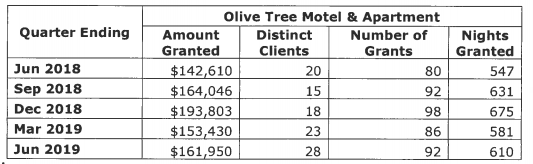
At long last MSD has updated OIA requests. Responses up to November 2019 are on-line and always make for interesting reading. For instance payments made to the Olive Tree Motel for emergency housing.

Clients are granted an amount which is paid directly to the motel.


In the June 2019 quarter the motel was receiving $265 per night.

But nightly charges per unit range from $145 to $165 according to their website. Charges reduce for longer stays.

Another request reveals that over 600 accommodation providers  received emergency grants in the June 2019 quarter. How many share a similar premium policy? It's certainly a booming 'industry' with a 49 percent increase in average grant between Sep 17 quarter and June 19 quarter:


I leave the comments to readers.

Saturday, January 04, 2020

My prediction Ardern would increase child poverty

New Year seems to be a time when predictions are checked. In September 2017 I predicted Jacinda Ardern would increase child poverty if she became Prime Minister.

On 7 of 9 measures introduced under the Child Poverty Reduction Act, to June 2018 poverty had increased. That's fairly out-dated data now and not a particularly useful measuring stick.

But also now known is that children in benefit dependent households rose between June 2018 and 2019. From Otago University's Child Poverty Monitor:


It's not a big rise but it's the first in 10 years.

I argued, and still do, that despite studying the child poverty problem as Labour spokesperson for six years, Ardern didn't understand the drivers.

Essentially the more a country chooses to decrease poverty through redistribution, the more joblessness grows.  It is well documented now that despite having low unemployment, numbers on the jobseeker benefit - and more recently the sole parent benefit - have increased. The kind of people who choose not to work when they could, aren't necessarily stupid. But they are quite probably not good money-managers.  For instance, they don't prioritise their children's needs. There is usually wisdom behind old adages. In this case, 'Easy come, easy go.'

I don't know if the Left will ever figure out that state-enforced redistribution to the poor doesn't solve their problems in a meaningful or sustained way. It won't under this leader anyway.

But here's an election year question for you to ponder. If Ardern claims this year that her Families Package has reduced child poverty (BUT more children are in non-working homes) is that a success?


Wednesday, January 01, 2020

Stuff and Inequality - only half the story

2020 just hours old and that hoary old chestnut is already rolled out. The rich are getting richer and the poor are getting poorer!

From Stuff where only half of the story is ever provided:
Rasbrooke said the data that was available suggested wealth inequality had worsened in the past decade or two..."There are very few demands on wealthy people in New Zealand, no meaningful taxes on their wealth."

From New Zealand's official source on household incomes (my emphasis):

New Zealand does not have a robust time series on wealth inequality, so we do not know if there are any changes in this aspect of household resources.

 Household income inequality in New Zealand is a little above average for OECD countries and wealth inequality is about average

New Zealand’s wealth inequality is about average for the OECD, with the top 10% of households holding around 50% of all household wealth.

As for other OECD countries, household wealth inequality in New Zealand is greater than income inequality. New Zealand ranks in the middle of the table, with around 50% of wealth held by the top 10%, similar to Canada, Norway and France. For the USA, 76% is held by the top 10%.

The Gini measure of inequality is a popular one but, because it uses information on all household incomes, it is susceptible to showing large fluctuations because of sampling issues for very high income households. The report therefore highlights the Gini trend for the lower 99%. There is no evidence of any sustained rising or falling trend in the last 25 years for the lower 99%, using the Gini. 

There is no evidence of any sustained rising or falling trend for BHC [before housing costs] income inequality, with New Zealand levels a little above the OECD average and similar to Australia. The share of total income received by the top 1% has been steady in the 8-9% range since 1990, similar to Finland and Norway, a little lower than Australia, and much lower than the UK (14% in 2015) and the US (20% in 2015).

Tuesday, December 31, 2019

Bush fire headlines

The idea that 'We live in apocalyptic times' might be misguided.

Questioning the idea might equally be challenged.

To satisfy my own curiosity I searched 'bush fires' in Papers Past.

1915

Read more

1936

Read more

1946

Read more


Wednesday, December 18, 2019

Just 'cause it's in the paper doesn't make it true

Not on-line but here is a quote from a Stuff journalist expressing opinion in today's Dominion Post:


My BS detector always goes off when I read claims about big economic differences between New Zealand and other first world English-speaking countries.

Here apples are not being compared with apples. Coughlan has compared NZ 'core' spending with UK 'total'.

The two following graphs show similar trajectories (as you would expect). In 2019 NZ spending 37.1% of GDP and the UK 39.4%

Total Crown Expenses

Public Spending as a percentage of GDP in the UK


Tuesday, December 17, 2019

"...continued creep of managerialism"

Opinion by Mark Blackham published in today's Dominion Post:

The response to the White Island tragedy is a stark insight into the continued creep of managerialism. It undermines the ability of state services to help citizens, but empowers it to infantilise us.
We're discouraged from acting on our own, and forced to bow to experts. Yet systems and fancy talk prevent experts taking substantive action for fear of career, safety, or arbitrary consequences for taking the "wrong" action. In these environments, there are no career prospects for heroes.    

Sunday, December 15, 2019

Advocates for a 'child pension' fail to mention WFF

Here's a supposed intelligent man being intentionally provocative on the subject of providing a "pension" for children:

"If I had my way you'd take it away from the decrepit old folk and give it to the young ones. Make super means-tested and a benefit for children unconditional. Older people don't need it, they have money."

Here's the thing. Not once in the entire article is Working For Families mentioned.

The author writes:
It would not be the first time such an initiative has been offered: New Zealand had a family benefit until April, 1991.
When it was scrapped it was worth $6 per week. 

$6 in wages in 1991 would be worth $13.55 today.

Even in 1946 when the universal family benefit was introduced at the rate of 1 pound a week that equated to only $76.87 today calculated under general CPI.

Here are the family tax credit rates from 2018. The IRD no longer publishes them (or I cannot find them).


I have included the Best Start payment which applies until 3 years-old for lower income families.

Clearly children are getting more cash assistance today than they were in 1991.

If you were a visitor from another country reading this claptrap though you'd think NZ gave no financial support to children at all. 


Monday, December 09, 2019

How the Church warnings about welfare came to pass

I don't know why MSD continues to surprise me. But they do. TVNZ had a piece about how beneficiaries are being provided with My Food Bag deliveries so I did a search of their site to find out more. No joy but this turned up under how MSD helps people live successful lives. Such utter tosh that I hardly know where to begin.

Perhaps I'll begin by remembering the warnings about welfare I posted a couple of days back, that the Methodist church foresaw the moral and spiritual disintegration benefits had the potential to create.

Sorry I cannot paraphrase what I just consumed. You'll have to read the whole thing:

Lea is a Samoan woman in her late 50s who lives alone, has never married, and has no children. She has lived in New Zealand off and on for about 30 years.

She has been employed most of her life but she lost her cleaning job after a miscommunication with her employer, and is now out of work. She is having difficulties in finding employment and she believes her age is the barrier for her getting a job. She is on a benefit and lives in a Housing New Zealand flat.

She met a man who has ‘befriended’ her and moved into her flat. He refuses to pay rent, won’t contribute to paying the power bill, and he eats her food. Lea says he uses all his benefit for gambling, alcohol and cigarettes. He often comes home drunk late at night. Lea is torn because she is active in her church and culturally, she knows it’s the right thing to do to help people. She has asked him to leave and he refuses. Lea doesn’t know what to do and she is worried that if it weren’t for her, he would be living on the streets. But having him there means she is sliding into debt and she has approached Work and Income for help. She is afraid to tell them what is really happening – she assumes they won’t understand.

Being Samoan means that questioning authority is a challenge for Lea. She is vulnerable to being taken advantage of and as English is her second language, she does not feel confident enough to stick up for herself.

In her words
"I got someone to help me, my friend… he never helped me, he just move in my place to live… he was working but he never pay anything to me. I think he’s using people."

"I didn’t want that thing, they [a jewellery store] force me to, they put it in the box, 'this is for you, you can take it home now’ but I don’t want because I can't afford. I said to her no I can't afford and she put it in my bag, she forced me to take home…"

"I always put $20 out from my benefit to put in the church every Sunday… even if I got no money I still put $20."

"My rent is $160, my benefit is $210. I always go and find a job but I think the hard thing for me to find a job because my age."

Her strengths
Lea has a generous spirit and supports those around her
She is resilient in the face of difficult situations and circumstances
She is self-sufficient
She is motivated to find employment even when she experiences constant set-backs.
How can we support Lea to thrive
Find an empathetic supporter who can understand her circumstances, preferably one who can communicate with her in her native tongue, empower her to have better boundaries and help her navigate around the NZ system.
Introduce her to other forms of resources e.g. use of Pacific Island radio station to access information in a language that is easy for her to grasp.
Support her in learning a non-judgemental approach to saying 'no'.
Acknowledge her need for boundaries and her desire to help others.
Focus on ways of protecting her from harm.
Locate a supportive job broker.
Link her to other Pacific entities to provide her with additional support.
Provide Lea with a Building Financial Capability programme that is grounded in her cultural context, e.g. MoneyMates programme run by her church community, using familiar Samoan concepts.

That's it.

The first thing I notice is the man - the predator - is working and on a benefit. Apparently Lea must be helped to say 'no' in a 'non-judgemental' way. What about Work and Income saying 'no' to this guy? He's a fraudster and a sot. Not satisfied with leeching on the taxpayer he's leeching on this hapless woman. But then the benefit system makes women hapless because they become isolated and lacking in self-esteem. Targets for scumbags.

Lea is neither resilient nor self-sufficient. But the MSD looking-glass view of the world portrays her as exactly that. Her church happily takes $20 off her every week yet she still apparently needs to be linked 'to other Pacific entities' for support.

MSD says they can help her 'locate a supportive job broker'. Hello???? She's on a benefit. Why doesn't she already have one? Oh I remember Work and Income have drastically reduced efforts to get people into jobs putting all of their resources into dishing out more money.

And yes I've bought into it but the whole tone of the 'story': man bad - woman good. Man criminal - woman victim. MSD is mostly staffed by women and I suspect that particularly ideology prevails.

I find this cameo and MSD's response to it immature, indulgent and childish.

Generations down the track, welfare has made too many people weak, helpless, stupid, and deceitful. Somehow MSD turns that into a good news story because - wait for it - they can wave a wand over Lea's life and she will live happily ever after. It is inconceivable that they are in fact the problem.

Sorry Lea. You are your own worst enemy and to be told otherwise isn't going to help.

Friday, December 06, 2019

Graph of the Day

Source

Update: Sharp-eyed reader points out that the part labelled "profit" isn't all profit either. It's the 'importer margin' - The importer margin is the gross margin available to fuel retailers to cover domestic transportation, distribution and retailing costs in New Zealand, as well as profit margins.

I could be wrong but I heard the CE of Z being interviewed and I think he said the profit was 7% or thereabouts. Not an area I'm very au fait with the point remains. If anyone is fleecing us its the government.

Warnings about welfare: Blast from the past

Some quiet time to enjoy surfing through old newspapers, the following snippets caught my fancy. The first is a letter to the editor regarding Michael Savage's promised social security:

Source

The second is a warning from the President of the Methodist Church regarding the same:

Source

And finally a response to Mr Copeland:

Source

How prescient was that remark?

Thursday, December 05, 2019

Kidscan: Are you sponsoring a child or a horse race?

I make no secret of my interest in horse-racing and that I have a very small share in a pacer. Yesterday I noticed this from the Pukekohe meeting:


If I was a sponsor to this organisation I'd probably be miffed.

I'm not because I disagree with the idea of sponsoring New Zealand children when the government already redistributes so much to their parents. We have a heavily-dependent parent population and Kidscan arguably makes them more reliant by assuming their responsibilities. For nearly three decades I've sponsored African children who are in rather more desperate communities where putting in irrigation, sanitation and schools is my idea of constructive charity.

Kidscan has been criticised in the past. I understand the arguments for charities getting involved in entertainment activities to lift profile and they may have had a marquee for supporters to thank them. It was probably a Xmas meeting where corporates traditionally lay on functions for clients, businesses host parties for staff etc. There may have even been an arrangement whereby some of the the day's prize money was donated back to the charity.

But if you are giving a dollar a day to support a New Zealand child through this charity are you happy to see it diverted in this way? Did you sponsor a child only to find you were sponsoring a horse-race?

Monday, December 02, 2019

Prisoners voting - letter to Leighton

Like the two commentors on my last post Leighton Smith is opposed to the reversal of National's blanket vote on prisoners voting. I sent him the following:

Hi Leighton

Prison serves three purposes: to protect the public, to punish the offender, and finally, to rehabilitate the offender.

Victims matter. We don't want more of them. Hence rehabilitation is vitally important. Those serving three or fewer years are amongst the most salvageable of prisoners and we expect them to leave prison, find jobs and contribute to society in the near future. It is therefore consistent and useful to reinforce that expectation by according them a say in that society.

And it will matter to some inmates. Prison is a very boring place where pecking orders are established and privileges sought. Those who get to vote will feel different from, perhaps a tad better than those who, by their worse crimes, have relinquished the opportunity. That too will enhance their potential for rehabilitation.

So based on successful reintegration into society being the most important function of prison for those serving three or fewer years, I am happy with the reversal of National's relatively short ban on all prisoners voting.

Best Wishes

Lindsay

He subsequently invited me onto his next podcast to argue my position. Which I did. Possibly not very well but I won't relinquish it. Will put up a link when the podcast goes public.

December 4 Podcast here

Monday, November 25, 2019

Ex-communicating National


National removed all prisoner voting rights on the back of one-term MP Paul Quinn's private member's bill in 2010. Andrew Little now says he will restore voting rights to those serving three years or less. Why? I haven't asked him but if a person is expected to contribute to society they should have a vote. If a prisoner will be released within the term of the next government they should have a say in how the country is run. They will be expected to work and pay taxes after all. But Bridges comes out crowing 'soft on crime.' National will rescind the change! A nonsensical call to the unrelentingly punitive element if ever I heard one. 

Then National's overwhelming opposition to the voluntary euthanasia bill revealed more about the party than I wanted to know. 

I've paid close attention to them for two decades and felt the odd flicker of excitement - when John Key called Working For Families 'communism by stealth', or Bill English said prisons were an 'economic and moral failure'. But the weak flame has now sputtered out.