Wednesday, January 15, 2020

Children threatening to report parents

Looking at poll results commissioned by Family First regarding the anti-smacking law a couple of things stood out.
22% of parents with young children said their child had threatened to report them to the authorities if they were smacked
Coincidentally I overheard a conversation between a Maori and Pacific family in a hospital waiting room recently. Grandparents were comparing number of mokopuna. The Maori lady expressed a view that her mokopuna were scared of her because they knew she was tough, whereas they would manipulate their parents by threatening to call the cops if they were smacked.

That may be a good or bad thing. Maybe it serves the purpose of cooling the parent down momentarily. But maybe the better result is that the child stops whatever behaviour is heading for a smack. Whatever the case the children may fear the grandmother more but they also respect her more.

I wonder if children also threaten to call the authorities if they are under the age of 14 and left alone?

Somehow I doubt it.
50% of respondents said that despite the law they would smack their child to correct their behaviour if reasonable to do so.
A law that is so widely disregarded is not good law.

But we seem to have plenty of them.

Thursday, January 09, 2020

Fact or fib?

Working through more of MSD's published OIA responses, one topic caught my eye. This'll be interesting I thought. It was. It's one of mine!

It concerns a state-sponsored 'fact' which isn't.

Here's screenshot from a current on-line 'fact sheet' published under the auspices of the Welfare Expert Advisory Group, furnished by information provided by MSD:


If the claim had been,"Over 50% of  children growing up in households receiving a main benefit are Maori," I wouldn't have blinked. But as it stands I am deeply suspicious.

MSD has now published my OIA request for verification of source and their response:


Contained therein:


So where did it come from?

6 months on, no action has been taken to remove this unverified 'fact'.

What the hell. Under this government it will probably become true at some point.

Monday, January 06, 2020

Motel charges premium for emergency housing

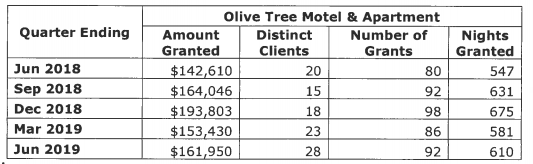
At long last MSD has updated OIA requests. Responses up to November 2019 are on-line and always make for interesting reading. For instance payments made to the Olive Tree Motel for emergency housing.

Clients are granted an amount which is paid directly to the motel.


In the June 2019 quarter the motel was receiving $265 per night.

But nightly charges per unit range from $145 to $165 according to their website. Charges reduce for longer stays.

Another request reveals that over 600 accommodation providers  received emergency grants in the June 2019 quarter. How many share a similar premium policy? It's certainly a booming 'industry' with a 49 percent increase in average grant between Sep 17 quarter and June 19 quarter:


I leave the comments to readers.

Saturday, January 04, 2020

My prediction Ardern would increase child poverty

New Year seems to be a time when predictions are checked. In September 2017 I predicted Jacinda Ardern would increase child poverty if she became Prime Minister.

On 7 of 9 measures introduced under the Child Poverty Reduction Act, to June 2018 poverty had increased. That's fairly out-dated data now and not a particularly useful measuring stick.

But also now known is that children in benefit dependent households rose between June 2018 and 2019. From Otago University's Child Poverty Monitor:


It's not a big rise but it's the first in 10 years.

I argued, and still do, that despite studying the child poverty problem as Labour spokesperson for six years, Ardern didn't understand the drivers.

Essentially the more a country chooses to decrease poverty through redistribution, the more joblessness grows.  It is well documented now that despite having low unemployment, numbers on the jobseeker benefit - and more recently the sole parent benefit - have increased. The kind of people who choose not to work when they could, aren't necessarily stupid. But they are quite probably not good money-managers.  For instance, they don't prioritise their children's needs. There is usually wisdom behind old adages. In this case, 'Easy come, easy go.'

I don't know if the Left will ever figure out that state-enforced redistribution to the poor doesn't solve their problems in a meaningful or sustained way. It won't under this leader anyway.

But here's an election year question for you to ponder. If Ardern claims this year that her Families Package has reduced child poverty (BUT more children are in non-working homes) is that a success?


Wednesday, January 01, 2020

Stuff and Inequality - only half the story

2020 just hours old and that hoary old chestnut is already rolled out. The rich are getting richer and the poor are getting poorer!

From Stuff where only half of the story is ever provided:
Rasbrooke said the data that was available suggested wealth inequality had worsened in the past decade or two..."There are very few demands on wealthy people in New Zealand, no meaningful taxes on their wealth."

From New Zealand's official source on household incomes (my emphasis):

New Zealand does not have a robust time series on wealth inequality, so we do not know if there are any changes in this aspect of household resources.

 Household income inequality in New Zealand is a little above average for OECD countries and wealth inequality is about average

New Zealand’s wealth inequality is about average for the OECD, with the top 10% of households holding around 50% of all household wealth.

As for other OECD countries, household wealth inequality in New Zealand is greater than income inequality. New Zealand ranks in the middle of the table, with around 50% of wealth held by the top 10%, similar to Canada, Norway and France. For the USA, 76% is held by the top 10%.

The Gini measure of inequality is a popular one but, because it uses information on all household incomes, it is susceptible to showing large fluctuations because of sampling issues for very high income households. The report therefore highlights the Gini trend for the lower 99%. There is no evidence of any sustained rising or falling trend in the last 25 years for the lower 99%, using the Gini. 

There is no evidence of any sustained rising or falling trend for BHC [before housing costs] income inequality, with New Zealand levels a little above the OECD average and similar to Australia. The share of total income received by the top 1% has been steady in the 8-9% range since 1990, similar to Finland and Norway, a little lower than Australia, and much lower than the UK (14% in 2015) and the US (20% in 2015).

Tuesday, December 31, 2019

Bush fire headlines

The idea that 'We live in apocalyptic times' might be misguided.

Questioning the idea might equally be challenged.

To satisfy my own curiosity I searched 'bush fires' in Papers Past.

1915

Read more

1936

Read more

1946

Read more


Wednesday, December 18, 2019

Just 'cause it's in the paper doesn't make it true

Not on-line but here is a quote from a Stuff journalist expressing opinion in today's Dominion Post:


My BS detector always goes off when I read claims about big economic differences between New Zealand and other first world English-speaking countries.

Here apples are not being compared with apples. Coughlan has compared NZ 'core' spending with UK 'total'.

The two following graphs show similar trajectories (as you would expect). In 2019 NZ spending 37.1% of GDP and the UK 39.4%

Total Crown Expenses

Public Spending as a percentage of GDP in the UK


Tuesday, December 17, 2019

"...continued creep of managerialism"

Opinion by Mark Blackham published in today's Dominion Post:

The response to the White Island tragedy is a stark insight into the continued creep of managerialism. It undermines the ability of state services to help citizens, but empowers it to infantilise us.
We're discouraged from acting on our own, and forced to bow to experts. Yet systems and fancy talk prevent experts taking substantive action for fear of career, safety, or arbitrary consequences for taking the "wrong" action. In these environments, there are no career prospects for heroes.    

Sunday, December 15, 2019

Advocates for a 'child pension' fail to mention WFF

Here's a supposed intelligent man being intentionally provocative on the subject of providing a "pension" for children:

"If I had my way you'd take it away from the decrepit old folk and give it to the young ones. Make super means-tested and a benefit for children unconditional. Older people don't need it, they have money."

Here's the thing. Not once in the entire article is Working For Families mentioned.

The author writes:
It would not be the first time such an initiative has been offered: New Zealand had a family benefit until April, 1991.
When it was scrapped it was worth $6 per week. 

$6 in wages in 1991 would be worth $13.55 today.

Even in 1946 when the universal family benefit was introduced at the rate of 1 pound a week that equated to only $76.87 today calculated under general CPI.

Here are the family tax credit rates from 2018. The IRD no longer publishes them (or I cannot find them).


I have included the Best Start payment which applies until 3 years-old for lower income families.

Clearly children are getting more cash assistance today than they were in 1991.

If you were a visitor from another country reading this claptrap though you'd think NZ gave no financial support to children at all. 


Monday, December 09, 2019

How the Church warnings about welfare came to pass

I don't know why MSD continues to surprise me. But they do. TVNZ had a piece about how beneficiaries are being provided with My Food Bag deliveries so I did a search of their site to find out more. No joy but this turned up under how MSD helps people live successful lives. Such utter tosh that I hardly know where to begin.

Perhaps I'll begin by remembering the warnings about welfare I posted a couple of days back, that the Methodist church foresaw the moral and spiritual disintegration benefits had the potential to create.

Sorry I cannot paraphrase what I just consumed. You'll have to read the whole thing:

Lea is a Samoan woman in her late 50s who lives alone, has never married, and has no children. She has lived in New Zealand off and on for about 30 years.

She has been employed most of her life but she lost her cleaning job after a miscommunication with her employer, and is now out of work. She is having difficulties in finding employment and she believes her age is the barrier for her getting a job. She is on a benefit and lives in a Housing New Zealand flat.

She met a man who has ‘befriended’ her and moved into her flat. He refuses to pay rent, won’t contribute to paying the power bill, and he eats her food. Lea says he uses all his benefit for gambling, alcohol and cigarettes. He often comes home drunk late at night. Lea is torn because she is active in her church and culturally, she knows it’s the right thing to do to help people. She has asked him to leave and he refuses. Lea doesn’t know what to do and she is worried that if it weren’t for her, he would be living on the streets. But having him there means she is sliding into debt and she has approached Work and Income for help. She is afraid to tell them what is really happening – she assumes they won’t understand.

Being Samoan means that questioning authority is a challenge for Lea. She is vulnerable to being taken advantage of and as English is her second language, she does not feel confident enough to stick up for herself.

In her words
"I got someone to help me, my friend… he never helped me, he just move in my place to live… he was working but he never pay anything to me. I think he’s using people."

"I didn’t want that thing, they [a jewellery store] force me to, they put it in the box, 'this is for you, you can take it home now’ but I don’t want because I can't afford. I said to her no I can't afford and she put it in my bag, she forced me to take home…"

"I always put $20 out from my benefit to put in the church every Sunday… even if I got no money I still put $20."

"My rent is $160, my benefit is $210. I always go and find a job but I think the hard thing for me to find a job because my age."

Her strengths
Lea has a generous spirit and supports those around her
She is resilient in the face of difficult situations and circumstances
She is self-sufficient
She is motivated to find employment even when she experiences constant set-backs.
How can we support Lea to thrive
Find an empathetic supporter who can understand her circumstances, preferably one who can communicate with her in her native tongue, empower her to have better boundaries and help her navigate around the NZ system.
Introduce her to other forms of resources e.g. use of Pacific Island radio station to access information in a language that is easy for her to grasp.
Support her in learning a non-judgemental approach to saying 'no'.
Acknowledge her need for boundaries and her desire to help others.
Focus on ways of protecting her from harm.
Locate a supportive job broker.
Link her to other Pacific entities to provide her with additional support.
Provide Lea with a Building Financial Capability programme that is grounded in her cultural context, e.g. MoneyMates programme run by her church community, using familiar Samoan concepts.

That's it.

The first thing I notice is the man - the predator - is working and on a benefit. Apparently Lea must be helped to say 'no' in a 'non-judgemental' way. What about Work and Income saying 'no' to this guy? He's a fraudster and a sot. Not satisfied with leeching on the taxpayer he's leeching on this hapless woman. But then the benefit system makes women hapless because they become isolated and lacking in self-esteem. Targets for scumbags.

Lea is neither resilient nor self-sufficient. But the MSD looking-glass view of the world portrays her as exactly that. Her church happily takes $20 off her every week yet she still apparently needs to be linked 'to other Pacific entities' for support.

MSD says they can help her 'locate a supportive job broker'. Hello???? She's on a benefit. Why doesn't she already have one? Oh I remember Work and Income have drastically reduced efforts to get people into jobs putting all of their resources into dishing out more money.

And yes I've bought into it but the whole tone of the 'story': man bad - woman good. Man criminal - woman victim. MSD is mostly staffed by women and I suspect that particularly ideology prevails.

I find this cameo and MSD's response to it immature, indulgent and childish.

Generations down the track, welfare has made too many people weak, helpless, stupid, and deceitful. Somehow MSD turns that into a good news story because - wait for it - they can wave a wand over Lea's life and she will live happily ever after. It is inconceivable that they are in fact the problem.

Sorry Lea. You are your own worst enemy and to be told otherwise isn't going to help.

Friday, December 06, 2019

Graph of the Day

Source

Update: Sharp-eyed reader points out that the part labelled "profit" isn't all profit either. It's the 'importer margin' - The importer margin is the gross margin available to fuel retailers to cover domestic transportation, distribution and retailing costs in New Zealand, as well as profit margins.

I could be wrong but I heard the CE of Z being interviewed and I think he said the profit was 7% or thereabouts. Not an area I'm very au fait with the point remains. If anyone is fleecing us its the government.

Warnings about welfare: Blast from the past

Some quiet time to enjoy surfing through old newspapers, the following snippets caught my fancy. The first is a letter to the editor regarding Michael Savage's promised social security:

Source

The second is a warning from the President of the Methodist Church regarding the same:

Source

And finally a response to Mr Copeland:

Source

How prescient was that remark?

Thursday, December 05, 2019

Kidscan: Are you sponsoring a child or a horse race?

I make no secret of my interest in horse-racing and that I have a very small share in a pacer. Yesterday I noticed this from the Pukekohe meeting:


If I was a sponsor to this organisation I'd probably be miffed.

I'm not because I disagree with the idea of sponsoring New Zealand children when the government already redistributes so much to their parents. We have a heavily-dependent parent population and Kidscan arguably makes them more reliant by assuming their responsibilities. For nearly three decades I've sponsored African children who are in rather more desperate communities where putting in irrigation, sanitation and schools is my idea of constructive charity.

Kidscan has been criticised in the past. I understand the arguments for charities getting involved in entertainment activities to lift profile and they may have had a marquee for supporters to thank them. It was probably a Xmas meeting where corporates traditionally lay on functions for clients, businesses host parties for staff etc. There may have even been an arrangement whereby some of the the day's prize money was donated back to the charity.

But if you are giving a dollar a day to support a New Zealand child through this charity are you happy to see it diverted in this way? Did you sponsor a child only to find you were sponsoring a horse-race?

Monday, December 02, 2019

Prisoners voting - letter to Leighton

Like the two commentors on my last post Leighton Smith is opposed to the reversal of National's blanket vote on prisoners voting. I sent him the following:

Hi Leighton

Prison serves three purposes: to protect the public, to punish the offender, and finally, to rehabilitate the offender.

Victims matter. We don't want more of them. Hence rehabilitation is vitally important. Those serving three or fewer years are amongst the most salvageable of prisoners and we expect them to leave prison, find jobs and contribute to society in the near future. It is therefore consistent and useful to reinforce that expectation by according them a say in that society.

And it will matter to some inmates. Prison is a very boring place where pecking orders are established and privileges sought. Those who get to vote will feel different from, perhaps a tad better than those who, by their worse crimes, have relinquished the opportunity. That too will enhance their potential for rehabilitation.

So based on successful reintegration into society being the most important function of prison for those serving three or fewer years, I am happy with the reversal of National's relatively short ban on all prisoners voting.

Best Wishes

Lindsay

He subsequently invited me onto his next podcast to argue my position. Which I did. Possibly not very well but I won't relinquish it. Will put up a link when the podcast goes public.

December 4 Podcast here

Monday, November 25, 2019

Ex-communicating National


National removed all prisoner voting rights on the back of one-term MP Paul Quinn's private member's bill in 2010. Andrew Little now says he will restore voting rights to those serving three years or less. Why? I haven't asked him but if a person is expected to contribute to society they should have a vote. If a prisoner will be released within the term of the next government they should have a say in how the country is run. They will be expected to work and pay taxes after all. But Bridges comes out crowing 'soft on crime.' National will rescind the change! A nonsensical call to the unrelentingly punitive element if ever I heard one. 

Then National's overwhelming opposition to the voluntary euthanasia bill revealed more about the party than I wanted to know. 

I've paid close attention to them for two decades and felt the odd flicker of excitement - when John Key called Working For Families 'communism by stealth', or Bill English said prisons were an 'economic and moral failure'. But the weak flame has now sputtered out.


Wednesday, November 20, 2019

It'll never be enough Carmel

Earlier this week the Child Poverty Action Group conference was giving stick to the Minister of MSD for not doing enough to ease poverty. She appeared, didn't take questions and has retaliated with a press release showing that:

1 million New Zealanders warmed by the Winter Energy Payment
36,000 families bank the Best Start Payment in first year
6,000 more families received the Family Tax Credit, 220,600 in total
They receive an increase too – from an average of $117 to $157 a week for Inland Revenue clients, and from an average of $147 to $188 a week for MSD clients
People receiving the Accommodation Supplement got an average increase from  $71 to $98 a week
13,500 carers receiving the new Clothing Allowance
We are on track to lift 50,000 to 74,000 children out of poverty

Ah but the Welfare Expert Advisory Group recommended increases to core benefit levels of up to 47%. When is that going to happen?

It must be a thankless task being a left-wing Minister and continuing to be criticised even when you do as you were asked.

I have an idea for Carmel. A little experiment.

Agree to give a beneficiary a meaningful % increase (up to 47%) if they opt to be paid in-kind, ie their benefit is loaded onto electronic card that can only be used for specified items. Otherwise the status quo remains.

It would be most interesting to observe the uptake.

But it'd fascinating to see the reaction of CPAG who would be severely conflicted over the civil liberties of beneficiaries to spend their money as they see fit versus the offer of a significant increase in income.

Friday, November 15, 2019

Is having to feed kids breakfast at school cause for celebration?

MSD thinks so:

The KickStart Breakfast programme will tomorrow celebrate 10-years as the only national breakfast programme of its kind in Aotearoa, serving more than 30 million breakfasts since 2009.


73% of Northland schools participate down to 26% in Canterbury.

Now this government 's goal is to replicate the dependency on lunches as well.

Truly aspirational.


Monday, November 11, 2019

If only Huntaways could vote

Switch on the computer this morning and  kick off with the really important stuff - an article  and short movie about my favourite dog - the Huntaway (mine waits impatiently as I write to get out and into it, despite the foul weather). Designed to run up to 20km a day, they relish their work, their freedom to work and purpose.


Feeling cheery I move on to an opinion piece by David Seymour at Magic Talk.

While encouraged to see him published for wider consumption, as I read it I am reminded about how bad this government - and National - really are. As well as last week's Zero Carbon abomination,

In ‘Red October’ last year, it was left to ACT to vote against the entire Parliament on three issues. Market studies legislation gives massive powers to bureaucrats at the Commerce Commission to demand sensitive commercial information from entire industries even if no allegation of uncompetitive behaviour has been made. The Prime Minister’s child poverty legislation focuses on inequality (and therefore ‘fixing’ it with income redistribution) rather than child poverty and neglect. ‘Equal pay’ legislation gives courts the power to decide how much workers in entire industries get paid.
Aside from a few brave academics and activists, we’ve been the only voice against new restrictions on what New Zealanders are legally allowed to say. Freedom of expression is important because it respects the fact that every one of us has a unique view of the world and because it allows us to make progress on difficult social issues.
Only ACT said ‘no’ to the first tranche of firearms legislation because it treated firearms owners with contempt and because rushed law is bad law. We are now seeing the consequences – just 32,000 of perhaps 240,000 firearms have been handed in to Police.

Matthew Hooton made mention of UMR polling last week finding ACT pushing 3 percent.It is probably premature to get excited about doubling (or more) their 2017 vote.

But as Seymour says, "...we believe in a free society..." They appear to be the only party in parliament that truly does right now. And they need support.

If only Huntaways could vote.


Sunday, November 10, 2019

Home ownership falls but barely

Over recent years the narrative amongst the media has been 'falling home ownership'. Today in Stuff Susan Edmonds writes:

"According to the 2018 census, only 64.5 per cent of New Zealanders own their own home, compared to nearly 74 per cent in the early 1990s."

Note the front page of Stuff  says an economist blames "greedy" boomers.

The rather more tempered headline reads, "Home ownership at lowest level in 70 years, economist says Baby Boomers to blame." I wonder if he actually used the word "greedy"?

In fact the rate is down by 0.3% since 2013 - a much smaller change then between previous census takes. From Stats NZ:

"By 2013, home ownership had fallen to 64.8 percent of households – the lowest rate since 1951 (when 61.5 percent of private dwellings were owned)."

It's possible the downward trend is arresting.


Wednesday, November 06, 2019

Single parents better off in work

Yesterday Statistics NZ released results from the General Social Survey which asks respondents whether they have enough money to meet everyday needs. Here is the result by family type for 'Not enough money'


The accompanying text reads:

"The proportion of single parents who felt they didn’t have enough money to meet everyday needs decreased from over one-third (36 percent) in 2008 to around one-quarter (24 percent) in 2018 – the biggest decrease of any family type."
There is a very strong correlation with the numbers on the DPB (which became Single Parent Support in 2013).


Obviously the strengthening economy after the GFC has provided more jobs. But also Bill English realised that is was just as important to focus on parents on benefits as it was the single unemployed. In fact probably more important as their well-being would effect the next generation.

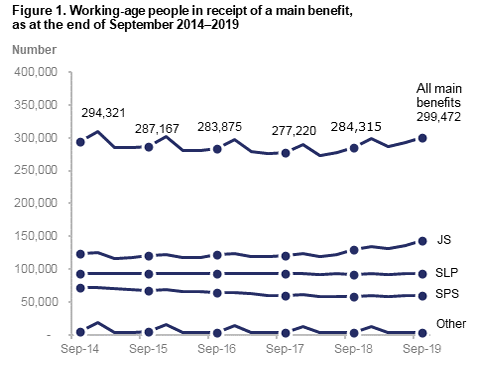
Unfortunately between September 2018 and 2019 the numbers rose for the first time since 2010. They went from 58,620 to 59,715 - a 1.9% increase.

I hope that we are not looking at a future where more single parents will be saying they don't have enough money to cover their costs because of the current government's attitude to welfare.

Tuesday, November 05, 2019

Housing waiting list increased 139% since September 2017


Just released 139 percent increase.


Update on child poverty statistics

The Child Poverty Action Group is holding a summit later this month. This statement is from the release about it:

Late into 2019, 174,000 children living in the most impoverished, desperate situations are yet to see any real gain.
It is quite incorrect to say "late into 2019" and put a number on it. But thanks anyway for prompting me to update myself on where the statistics are at.

Statistics NZ says:
"We have made improvements to the data source for measuring child poverty in the future, including increasing the sample size from between 3,000 and 5,500 to 20,000 households. These improvements were implemented in the 2018/19 HES, which is collected between July 2018 and June 2019. First child poverty results from this survey will be available early in 2020."
The figure of 174,000 is for the year ending June 2018. The definition for this group is:

 h) Percentage of children living in households in New Zealand in each financial year who fell in: Low income: less than 40% median equivalised disposable household income after housing costs (AHC) for the financial year
But there are multiple measures of poverty. Here's another:

i) Percentage of children living in households in
New Zealand in each financial year who fell in: Severe material hardship 

That number is 65,000

As that is the lowest number by any measure, these must be the "most impoverished".

You can find the various measures here.

They comprise a) through to j) 

The numbers range from  65,000 to 341,000

By 7 out of 9 measures (there is no d) table) child poverty grew between 2017 and 2018.

Friday, November 01, 2019

Are benefits protection money?

I heard Kim Workman expressing a view this morning that withholding benefits from gangs would result in more crime.

He may well be right.

But is that what Mickey Savage's grand and noble idea has come to? That benefits are now paid as protection money to some individuals or groups to ward off violence and lawbreaking?

Maybe a society could live with such an arrangement if it worked.

But it doesn't. The crime gets committed anyway.

If we want to reduce crime, by Mr Workman's logic, gang members should be paid more.

The tragic thing is that many current politicians actually believe and want that. If we just pay the unemployed and the unemployable more, Aotearoa will become some sort of nirvana. A shining beacon of social justice.

They are dangerous delusionists.

Thursday, October 31, 2019

"Welfare crackdown"

Couple of quick points.

Stuff is reporting that Labour abolished the sanction for not naming the father of a child on a benefit and that National would reverse this.

The removal of the sanction does not kick in till April 2020. Hasn't happened yet.

Also reported is National's plan to apply "money management " to beneficiaries under 20. This already happens. Introduced under the last National government.

The idea to withhold benefits from non-vaccinaters has been proposed repeatedly in the past. The problem seems to be if something untoward happens to a child post a vaccination received purely because the parent needed to retain their benefit, 'enforced' by the state, what responsibility does the state bear? This could be argued much further re what is and isn't a 'choice.'

But from a philosophical viewpoint, anti-vaxers rely on the herd immunity without contributing to it. Should they be allowed to rely on the herd's financial safety net without making that contribution?


Wednesday, October 30, 2019

Towards a Code of Social and Family Responsibility - Mark II

National is revisiting the past with its 'Social Services - Discussion Document.'

When Jenny Shipley was Prime Minister,

"...in February 1998 the Department [of Social Welfare] distributed copies of a discussion document to all 1.4 million households in the country. Towards a Code of Social and Family Responsibility described current laws and the role of government in relation to eleven issues, and posed questions that were intended to prompt discussion and stimulate feedback... John Angus and Maree Brown, the senior DSW officials responsible for analysing much of the public reaction to the Code, concluded that many of the negative responses were related less to the content of the proposal than to distrust of the government's motives. "
It is wearisome when you have followed political responses to social problems for so long.  The politicians come and go. The issues remain.

Can't help but conclude that working groups and public consultations are not much more than avoidance tactics.


Gangs are not good for children

If National comes out promising to attack gang welfare dependency you can bet your bottom dollar the Left will counter with, "But what about the children?"

The Left is as prone to manipulating children as pawns in their pro-welfare arguments as the gangs are in using them as meal tickets.

Just remember when you start hearing the objections:

The vast majority of adult gang members have received a main benefit. 62 percent for 5 or more years. Over half (59 percent or 2,337) of all gang members had benefit spells that included dependent children, either with or without a partner.

This will not include those children on a sole parent benefit whose mother is the main recipient.

Sixty percent of the 5,890 children of gang members have been abused or neglected. The alleged perpetrator of abuse or neglect was more often recorded as the children’s mother than the gang member.
How can anyone advance an argument that the taxpayer should continue to fund an environment that is so bad for children?

Statistical source

Monday, October 28, 2019

Why you can't trust RNZ

Last week I blogged about RNZ skewing benefit numbers.

Now they have just posted a report about National criticising the rise in Jobseeker numbers.

Spot the problem?


Thursday, October 24, 2019

MSD: no desired outcomes achieved

The MSD Annual Report has just been published.

No desired outcome achieved.


All against a backdrop of lowest unemployment in 11 years.

But wait. There's some good news. 

MSD has achieved greater gender diversity than the rest of the public service and NZ workforce:


Public too ignorant to own their own lives

Alex Penk from the Maxim Institute had an opinion piece regarding the proposed End of Life referendum, MPs are paid, and better equipped, to make these decisions,  published in Tuesday's DomPost.

My response:


I was surprised that 70 percent of the politicians who voted against a referendum were National MPs.

Wednesday, October 23, 2019

RNZ badly skews benefit numbers

According to Radio NZ:
There are still 109,000 people in New Zealand on a benefit, out of work. Fifty-two percent of those people have either a disability, health or mental health issue; or are caring for someone who does.
Here is the current situation:

I have tried to understand how the RNZ reporter came up with the 109,000 statistic. One possibility is the reporter referred only to Jobseeker beneficiaries and excluded those working part-time; that someone gave her unpublished data.

However she includes in her definition those 'caring for someone' with a disability. They receive the Supported Living Payment (SLP) which appears  missing from her statistic.

It is true that 44% of people receiving the Jobseeker benefit have an injury or health or disability condition but it is expected they will return to work. Those on SLP are not expected to work though some do want to, to the extent that they are able.

Those relying on the Sole Parent Support (SPS) have also been totally ignored in her statistic. Today it is the norm for mothers with children to work. When their youngest is three SPS beneficiaries have part-time work obligation which many do not meet. So surely many in this group are also "on a benefit, out of work".

RNZ is a strange outfit. Note they include in the broadcast soundbites of Mike Hosking railing against growing jobseeker numbers then run a piece dominated by Carmel Sepuloni. It's like pro-government propaganda.

Sunday, October 20, 2019

Duration on dole

Over at Kiwi Blog a commentor has posted on a discussion about the rising dole numbers:

MCos
I would suggest the problem is with the long term unemployed. According to this article 13.27% of our unemployed have been without work for a year or more. This puts us at the better end of the OECD spectrum and far ahead of a lot of European countries and the UK.
From what I’ve heard 90% of unemployed are reemployed within six months.
This would suggest that most people are out of work not because they want to slack around.
https://data.oecd.org/unemp/long-term-unemployment-rate.htm

I like this kind of comment because it is at least backed up by a source. Trouble is another source, MSD, provides a completely different statistic. My response:

63,977
78,954
The top number is those who have been on the dole (Jobseeker benefit) for a year or less and the bottom number is for more than a year.
55% long-term unemployed
https://www.msd.govt.nz/documents/about-msd-and-our-work/publications-resources/statistics/benefit/2019/quarterly-benefit-fact-sheets-national-benefit-tables-sep-2019.xlsx
For all main benefits 71% for been dependent for more than a year.

I checked the source of the OECD data. It is as I expected the HLFS:
The length of time (to reference week) since worked for pay or profit. Duration of "Less than one month" refers to the duration of unemployment during the previous four weeks, including the survey reference week.
This is a sample survey and relies on self-reporting. It is also the source of our official unemployment rate. The publicly available data does not include that which the OECD is using.

But the commentor indirectly raises an issue which I mentioned to Mike Hosking. There will be people on the Jobseeker benefit who are working a few hours but not enough to get off the benefit completely.  This might account at least in part for the discrepancy between the two long-term unemployed percentages presented by two different sources.

Saturday, October 19, 2019

The moral imperative to work

I had a discussion with Mike Hosking on NewstalkZB yesterday about why the numbers on Jobseeker continue to escalate. There are at least a couple of trends driving it but Mike was more interested in the political aspect.
Listen here


Host Kerre McIvor played a part of the interview and ran with it after 9. People were almost unanimously in her corner. That if you can work you have a moral imperative to do so.

It struck me later that National's welfare reforms have had one very interesting effect. Because so many more people are classified as  'Jobseekers' (those who used to be on a sickness benefit and those who would have been on the DPB even when their youngest was 14 or over), now that the unemployment rate is at only 3.9% the public is far less tolerant.

Remember that when Labour was last in govt and unemployment dropped to 3.8% in 2008, the same % of people were on welfare - just spread mainly over the other three benefits - DPB, Sickness and Invalid. So the argument about working and supporting oneself was muddied.

I don't know if this consequence was intended by National but it certainly makes the argument more black and white. The lack of workers in many industries and regions is holding back growth. An unjustifiable scenario with so many people receiving the dole.

Tuesday, October 15, 2019

Sean Plunket interviews Jim Flynn

Yesterday Sean Plunket interviewed Jim Flynn on Magic Talk and it was a fascinating 15 minutes. 

Flynn left the US to escape the persecution under McCarthyism so full well knows the experience of being shut down (or worse)  for beliefs. He talks here about that but also other scholars with whom he disagrees, the likes of Charles Murray, a "very nice man" who he regularly corresponds with. Another in danger of becoming a 'non-person' for his ideas.

He also talks about his specialist subject, 'intelligence' and what he thinks has happened to our collective intelligence that people have become less tolerant of alternative ideas. From memory described heightened sensitivity as a key driver.

And of course he discusses what his forthcoming book is about. Sounds like some Women's Studies departments on US campuses are fortresses of fundamentalist feminism. Otago's isn't he reassures.

This is really worth a listen:

"University of Otago emeritus professor Jim Flynn joins Sean Plunket on Magic Afternoons to discuss his book, ‘In Defense of Free Speech: The University as Censor’, being turned down by a UK publisher due partly to legal concerns around the inclusion of scholars with inflammatory views."

Monday, October 14, 2019

The road to hell is paved with good intentions

The Child Poverty Action Group has a list of goals it believes will improve outcomes for New Zealand children. They are:

Substantially improve core benefits;
Remove harsh sanctions that impact on children;
Ensure that all benefits and all part of Working for Families (WFF) are indexed annually to prices and wages;
Remove the hours of paid work criteria from the WFF In-Work Tax Credit and extend it to all low-income families;
Treat adults in the benefit system as individuals without penalising them for being in a partnership;
Focus on what will give children better outcomes and less on moving their carers into  paid work; and
Ensure that applicants receive all the assistance to which they are entitled.

I've addressed these below point-by-point:

SUBSTANTIALLY INCREASE CORE BENEFITS

Sole Parent Support basic weekly rate is $340 net. The rate is the same for a sole parent on Jobseeker support. A couple on Jobseeker support with children receive $195.50 each.

It is impossible to consider basic rates without taking into account accommodation subsidies:

And tax credits for children of beneficiaries:


(The new IRD site does not publicise rates but these were current in 2018.)

There's not a lot of point in tallying possible incomes but you can see that the components above and beyond the core rate are significant.

I do not doubt that life is tough on a benefit but - for the large majority - it is supposed to be  a temporary state of affairs. When the margin between working and welfare is reduced, the risk of dependency is increased. No study I am aware of has ever shown children  in long-term benefit dependent homes have better outcomes.

REMOVE HARSH SANCTIONS THAT IMPACT ON CHILDREN

Sanctions exist to ensure that beneficiaries meet their obligations. We all have obligations, whether to our partners, employers or employees. That's the real world.

We wouldn't adopt a general attitude that people with children should be exempt from obligations and it shouldn't be applied in the world of welfare.

ENSURE THAT ALL BENEFITS AND ALL PART OF WORKING FOR FAMILIES (WFF) ARE INDEXED ANNUALLY TO PRICES AND WAGES

The first part of this has already been implemented by the current government. If workers collectively get a annual wage increase so do beneficiaries.

REMOVE THE HOURS OF PAID WORK CRITERIA FROM THE WFF IN-WORK TAX CREDIT AND EXTEND IT TO ALL LOW-INCOME FAMILIES

The CPAG has fought for this through repeated court cases and lost. It was the 1999 - 2007 Labour government that created the in-work tax payment with the explicit purpose of getting beneficiaries - especially sole parents - into work. The Clark administration believed that the best way out of poverty is work. But working has other benefits too. It provides purpose, social contacts (not to mention romantic partners), and self-esteem. It also role models expectations to children.

TREAT ADULTS IN THE BENEFIT SYSTEM AS INDIVIDUALS WITHOUT PENALISING THEM FOR BEING IN A PARTNERSHIP

In 2018 economist and social policy advisor Michael Fletcher was commissioned by Superu to investigate individualising entitlements in New Zealand’s benefit system. He modelled changes that “… suggest the cost of individualising all entitlements would be in the order of $1.5 billion to $2 billion.” But he also cites forthcoming work from Anderson and Chapple that estimates
individualisation would cost several billion dollars per annum. A Universal Benefit Income would achieve the same end. In 2010, when Treasury modelled a UBI of $300 per week for all individuals aged 16 and over, it identified a $45-57b annual price tag (which would replace the current $27 billion cost.)

What did Churchill say, something about a society trying to tax itself into prosperity is like a man trying to lift himself up by the  handle of the bucket he is standing in? He might as well have a child in the bucket with him. The same would still be true.

FOCUS ON WHAT WILL GIVE CHILDREN BETTER OUTCOMES AND LESS ON MOVING THEIR CARERS INTO PAID WORK

So many studies on so many outcomes have shown children have better outcomes with two parents. Having two parents improves outcomes even when income is low. The two-parent family was the prevalent type before we began subsidising single parents.

Notwithstanding, some children are better off with just their mother or father, and a period of being supported by the taxpayer to stabilise a family situation doesn't present a problem. But again it should be temporary. Carers should be looking to work to provide for their children.


ENSURE THAT APPLICANTS RECEIVE ALL THE ASSISTANCE TO WHICH THEY ARE ENTITLED

Which should be the case, as should ensuring parents on a benefit are meeting all their obligations eg trying to find a job. Surely it's a two-way street? But CPAG disagree as per their prior goal calling for the abolition of sanctions.


It isn't at all clear to me what this brave new world of bigger benefits with no strings attached is going to do for children. Money can't buy love. In fact unconditional money finances lifestyles unconducive to happy and safe childhoods.

Thursday, October 10, 2019

Your kids won't need an inheritance

There's been discussion over the past two days about taxing wealthy pensioners more to claw back their Super. More and more 65+ year-olds are continuing to work. According to Age Concern in 2013, 22% of New Zealanders over the age of 65 years were in paid employment. This is up from 16.8% in 2006 and 11.4% in 2001. I'd imagine many are already paying enough tax to cover their Super. Personally, I prefer simple regimes and, to reduce the Super bill, think the age of entitlement should rise as is the case in US, UK and Australia. The PM is resisting it.

But one point made by a spokesperson from Infometrics irked me:
"... if people are worried about passing on money to their children when they die, people's increasing life expectancies mean that inheritances are often being received by children when they are themselves retired and don't really need the money..."
Apart from the obvious, that it is the individual's business what he or she does with his or her money, this statement, as a generalization, makes a false assumption.

Yes, people are living longer but they are having children later. Consider this graph depicting the age of mothers:


Teenage births now match those of the over 40s. The next two most divergent age groups (20-24 and 35-39 years) have also merged and 30-34 has grown from being the 4th (in 1974) to 1st most common age for child-bearing. 

And that doesn't take into consideration the age of fathers. There are 44 years between my youngest and my husband and that's not terribly unusual.

Increasingly parents will reach their life expectancy (and hopefully go beyond) while their offspring are a long way from retirement.

Friday, October 04, 2019

Preposterous idea from National

If this is true...

While Bridges wouldn't speak directly to the policies being considered, it's understood they include fines of up to $3000 for parents of children who leave high school and don't enter further education and training. 
... it's a preposterous policy.

If a 16 year-old wants to leave school and get a job what's that got to do with the government?

If the idea is about not having to support them with welfare payments, then stop the payments.

Plenty of people leave school with no further 'formal' education and do OK for themselves.

National risks the taint of authoritarianism when they come up with this kind of thinking.  It makes it much harder for them to rightly criticize the current government for over-regulating and over-taxing.

And Bridges just handed an opportunity to Ardern to look like the more sensible of the two when she responds that "reducing barriers" is a better option than fines.

Overall National's approach to welfare, especially under Bill English, was much more visionary and far-thinking than Labour's but this is a stupid idea and it will probably become the soundbite and what sticks.

Sunday, September 29, 2019

WINZ tougher on beneficiaries in regions with high Maori populations

A post at the Daily blog complaining that Carmel Sepuloni had only reduced sanctions by 20% led me to check because I thought it was higher.

In fact sanctions are on the rise again, up 34% between December 2018 and June 2019. What is fascinating is how unevenly they are applied however. The regions of East Coast, Northland, Bay of Plenty and Waikato have really ramped them up. All high Maori beneficiary populations. So has Wellington. 

As you can see from the chart below the application of sanctions is changing quite rapidly. In December 2018 Auckland applied more than double the sanctions that Waikato did. By June 2019 the two regions were almost on par - with vastly differing beneficiary population numbers.


I am not going to do the classic left thing and label this uneven application as 'racism'.
On my reading of WINZ history and Maori politics it is usually Maori who are tough on Maori. Many of the case managers are Maori. And you only have to reflect on Shane Jones attitude to his nephews...Sir Apirana Ngata even managed to get prohibition introduced on the East Coast when he was in parliament. Or a ban on sales of alcohol to Ngati Porou at least.

Anyway it is good to see that sense is prevailing in those regions when there is so much demand for labour (with a small 'l'). Carmel's corrupted concept of 'compassion' has not prevailed.

Saturday, September 28, 2019

Peak neuroticism

Are we there yet? I bloody hope so because I am sick and tired of it.

Is this what 'real' people do all day? Worry and blame.

I don't hear it when I am out walking the dogs which just about covers the extent of my daily comms with the outside world. I don't hear it in most talk back callers. If anything they reflect my 'get a grip' attitude. The odd one comes on to give the rest of us a smug lecture about how embarrassing and selfish we are, those of us who don't think the world is about to draw its dying gasp.

The sun comes up and the sun goes down. A human's time on earth is a mere blip. Make it mean something. Getting your kicks out of joining in the hype and  hysteria will work today.

But what about tomorrow? Your tomorrow.

I'm not taking it away from you.

Tuesday, September 24, 2019

Census 'highlights'

Thought I'd have a browse through the census tables released yesterday. My 'highlights':


273 census respondents said they worked 168 hours every week

84 people said they spoke 'Australian'

2,778 women had given birth to  ten or more children (that's working day and night)

15 people gave 'socialism' as their religious affiliation

363,819 people reported doing no housework, gardening, childminding or cooking

46,719 people didn't know whether their home was damp or not

156 people said they were an MP


Source

Tuesday, September 17, 2019

Labour's soft-on-welfare policies hurting South Auckland

According to RNZ gang problems are exacerbating in South Auckland leading to their question, What's behind south Auckland's recent crime spike?

Apparently deportees from Australia are now setting up new gangs resulting in turf wars.

But alongside Australia's relatively new hard-line deportee policy is New Zealand's soft-line welfare policy which includes a huge reduction in the application of sanctions, a suspension of the requirement to name fathers and a generally open slather philosophy.

So what effect is this having in South Auckland?

I chose three service centres (including Otara as it was mentioned in the article) and looked at Jobseeker numbers between June 2017 and June 2019.

In total the number of Jobseekers has increased from 3,749 to 5,054 - or 35 percent. The national increase is 15 percent.

Is the unemployment rate increasing?

Not nationally. I don't have data for South Auckland but I do have ethnic data and South Auckland has a very high Maori/Pacific population.


Down for every group.

Benefits are the staple of gangs. Sure the money isn't particularly lucrative but is it predictable and secure.

Here's Corrections official advice for deportees from Australia:

What if I have no money?
Work and Income in New Zealand is like Centrelink in Australia. They will talk to you about finding employment and can provide income support. They’ll sort out some immediate things to support you in the first few days and they’ll continue to work with you to support your relocation to New Zealand.
Of course all the extra beneficiaries in South Auckland aren't just gang members.

This area is a mere microcosm of what's happening nationally. On steroids.

Unemployment down from 4.7% in June 2017 to 3.9% in June 2019

Jobseeker numbers up from 118,776 to 136,233 over the same period.

Labour's soft-on-welfare policies are hurting South Auckland. It's par for the course. Labour always hurts those it pretends to care for the most.