Friday, June 10, 2016

Jacinda Ardern in the SST

Jacinda Ardern attacked my report in last week's Sunday Star Times.

Lobby group report ignores the realities.

--------------------

This week I opened the paper to find some astonishing "news" - a lack of marriage is to blame for child poverty.

I've spent the better part of six years reading and researching the issue of child poverty, and what we need to do to resolve this complex problem in New Zealand

And yet here it was, the silver bullet we have all been looking for. Marriage. Getting hitched. Tying the knot. It turns out that we didn't need an Expert Advisory Group on child poverty, or any OECD analysis for that matter - apparently all we really need is a pastor and a party.

At least, that's the world according to Family First, who commissioned a report this week which, they claim, provides "overwhelming and incontrovertible" evidence that when it comes to child poverty, a lack of marriage is our problem, and it's simply become "politically unfashionable" to talk about it.

I'm happy to talk about it; in fact all of Parliament is. We debated the ins and outs of the institution not that long ago - it was called the Marriage Equality debate. Oddly, I don't recall Family First supporting the idea of increasing access to marriage when it came to same-sex couples. But I digress.

The major piece of evidence Family First use to back up their claims? Child poverty has risen significantly since the 1960s, and more people were married back then. I am paraphrasing, but that's the general gist. And yes, those two pieces of information are true. But are they linked? You only have to look at where child poverty figures really jump around to figure that bit out. Back in the mid-1980s, child poverty numbers (after taking into account housing costs) were about half the levels they are now. What happened to cause the spike? De facto relationships and single parenting didn't all of a sudden become "on trend".

What happened was Ruth Richardson's Mother of all Budgets. Government support was slashed, unemployment rates were grim, and child poverty, as you would expect, went up significantly. Equally, you can also see a downward trend in child poverty numbers around the early 2000s when Working for Families was introduced.

So what about the other claims in the report? How about "51 per cent of children in poverty live in single-parent families". Stating the obvious, surely. Single parent equals single income.

So, Family First, here's my view for what it's worth. Families will take many forms. Some children will be raised by one parent, some will be raised by two, possibly with some distance in between, and some will be raised by four. But the other factors Family First was so quick to dismiss - low wages and staggering housing costs - mean we have 305,000 children in poverty. And this is the stuff that needs to change. It's time we faced reality.

I wrote a response below but have been told that only a 150 word letter-to-the-editor will be accepted. She gets nearly 500 words to attack and I get 150 to defend.

Here is my full rejected response.

Labour, not Family First, ignores realities

The Family First report Child Poverty and Family Structure: What is the evidence telling is?, attacked by Jacinda Ardern in last week's Sunday Star Times,  traced the change in family structure from 1961 - the year more babies were born than ever before, or ever since. Families were much bigger, mother's educational qualifications far fewer and their work force participation much lower. Yet child poverty was also very low. Under 5% of families with children lived in the two lowest household income bands.

Using the measure Labour/Greens favour (because it provides the highest estimate and greatest political impact) child poverty grew to around 16% by 1990 following 15 years of growing unemployment and numbers of sole parent families. Because so many children relied on welfare, it then shot up after the benefit cuts, peaked around 2001 and has fluctuated since. In 2014 it still sat at 29% despite unemployment falling to 5.7 percent.

Ardern says Family First ignores realities. Here is the reality she and Labour ignore. The strongest correlate for child poverty is the sole parent rate. Ardern is correct to say that de facto relationships and single parenting didn't, "...all of a sudden become 'on trend'." The growth in the rate of each is tracked in the report. Increasingly single parent families became the product of births to single females and this is now a well-established pattern.  In 2015, 5% of babies had no father details on their birth certificate; a further 15% had fathers with different residential addresses to the mothers. This is then reflected in the number of babies who will be benefit-dependent either immediately or shortly after their birth - 17.5 % of all babies born in 2015. It is somewhat fatalistic to bring a baby into the world with no means of supporting it and then start complaining about low wages, low benefits and high housing costs. That's after the fact.

Yes, two parent families also experience poverty but it tends to be short-term because their incomes are generally  derived from the market. Sole parent incomes are generally derived from benefits which create a trap for poorly educated and unskilled mothers and lead to long-term child poverty exposure. New Zealand's largest longitudinal study, SoFIE, showed that two parent families move out of poverty faster. Those most likely to stay poor over many years are Maori and sole parents.

Marriage comes into the income equation because marriages are far more stable than de facto relationships. By the time a child turns five, his parents are 4-6 times more likely to have separated if they were cohabiting rather than married. This high dissolution rate also drives sole parenting, leading to more child poverty. But even stable cohabiting relationships are often poorer because they are second or third partnerships struggling to support children from previous unions.

Ardern claims "low wages and staggering house costs" are the major reasons 305,000 children live in poverty.

Housing costs are contributing latterly, especially in Auckland. But the report details evidence from the New Zealand Institute for Economic Research that finds, with regard to the long-term picture, "...the cost of renting has remained broadly stable relative to income over many decades." Child poverty pre-dates the housing affordability problem by a long margin.

Perhaps relatively higher wages contributed to lower child poverty in the 1960s but does Ardern think voters want a return to state-mandated award rates? And while Working For Families - a Labour policy - goes some way to easing child poverty, it also subsidizes employers keeping wages artificially low. Similarly, rental subsidies go straight into landlord pockets. MSD recently published findings from a literature review that found, "... a proportion of demand-side housing subsidies is capitalised into higher rents in the private rental market."

A government cannot subsidize its way out of child poverty problems. Take another example. Subsidizing sole parents saw their portion of families with children almost triple between the 1976 and 2013 censuses.

The answer to solving the child poverty problem lies largely with individuals. Without a reverse in the trend away from stable, committed two-parent families, child poverty will remain high.

Thursday, June 09, 2016

"...abuse and neglect inflicted on young children is a product of staggering levels of poverty..."

The soft bigotry of extreme socialists rears its ugly head in the following report from the World Socialist Web Site. It refers to the death of Moko Rangitoheriri:

"Thirteen children died in New Zealand during 2015 in similar circumstances. Their average age was three. Over half the victims were Maori, one of the most exploited layers of the New Zealand working class. In the final analysis, the abuse and neglect inflicted on young children is a product of staggering levels of poverty, social breakdown and family dislocation."
So, there is no self-will available to this "most exploited class"; no access to feelings of humanity or compassion; no intellectual escape from the exploitative oppression.

Individuals are mere puppets.

So how is it that within this "most exploited class" a massive majority do not beat and kill their children? What makes them different?

The socialist explanation for the horrors that occur to some children is utterly deficient.

Apart from that, the paragraph's statistics hail from this report which also notes,

The most common cause of death for a child was a head injury, followed by asphyxia, which includes suffocation, strangulation and carbon monoxide poisoning.
The circumstances of Moko's death were extraordinary. Protracted and unspeakable.

Where are the fathers? Where is accountability?

Since Martin Van Beynan asked the question, Why doesn't anybody ask the questions? three more published writers have expressed very similar sentiments.

Ewen McQueen, in the NZ Herald, "The court has reached its verdict. The marchers have gone home. The politicians and media have done their usual hypocritical hand-wringing. But the question remains - where was Moko's dad?" He then generalised it to, where are the fathers?

David Seymour writing in the Sunday Star Times (opposite Jacinda Ardern who slated my child poverty and family structure report but more on that soon) asked, "Where the hell was his Dad?" referring also to Moko but broadening to a "fatherhood crisis".

And now, in this morning's DomPost, somewhat surprisingly, Rosemary McLeod has joined in,

I am sorry for women left alone and homeless with dependent children, but increasingly annoyed that nobody tracks the fathers of the children down to see how they are living, and ask why everyone else should pay for their offspring. While suffering mothers and children pose for the cameras, how come nobody ever asks such obvious questions?

It takes years, even decades for public opinion to reach tipping point but societal acceptance of fatherless families is on the wane.

Sunday, June 05, 2016

Andrew Becroft - good luck

I'd vote to abolish the Office of Children's Commissioner because it's just more state bureaucracy and to date, the lead role has only been occupied by seeming leftists.

But I've always had some time for Andrew Becroft because he was prepared to stand up and say the most common factor among the youth that came before him as Principal Youth Court judge was a lack of a father.

And he said it during the last Labour innings.

On the eve of his taking the reins from Russell Wills, the DomPost has written a piece about him. Again I warm to his attitude and conclusions (which mesh with mine when it comes to keeping on with dysfunctional families):

He says he's never written a young person off, though there is an air of "desperate inevitability" that comes with the family situations of some of them.
"I've always felt that with the right intervention, and with the right people in a young person's life, there is always hope.
"The reality is for some that is never going to be the case. But you never know, you see - you can't say for sure."
There is something about the job that "gives while its takes".
"There are enough stories of significant change to help you through the more distressing or despairing times when you wonder if change is possible."
So I wish him luck.

Saturday, June 04, 2016

Report summarized in NBR

The NBR has kindly run an op-ed summarizing my report as 'free' content over the long weekend:

"On the back of last week's budget, opposition politicians, academics and other advocates again expressed outrage at the incidence of child poverty. The culprits routinely blamed are unemployment, high housing costs and insufficient benefit payments.
But there is another factor – probably the most important – that is constantly overlooked. That is the rapid change in family structure.
In 1961, New Zealand experienced peak fertility. The average number of births per woman was 4.3. There were more babies born that year than ever before or ever since."

More

Thursday, June 02, 2016

The inconsistency of the Left - featured comment

From Jim Rose:

"One of the oddities of the 21st-century left is if you are gay, your life is incomplete unless you can marry and have children. If you suggest others, in particular parents, have an incomplete life if they do not marry, you are some sort of throwback."
I did not oppose same-sex marriage. I think marriage is a great institution. But it is odd how hard the left fought for gay inclusion and yet, when you put up data that shows de facto relationships are far less stable than marriages and therefore contribute more to child poverty, their defence of cohabiting as equal to marriage is strident.

Tuesday, May 31, 2016

Responding to criticism that goes beyond mere dismissal - there's not much of it

On the back of the release of Child Poverty and Family Structure on Monday, I had a busy day talking to media, dealing with e-mails, etc.

The attacks started around midday from the likes of Nigel Latta, Max Rashbrooke, Susan St John, Marama Davidson  and Janet Wilson. In a nutshell, after much uncomplimentary preamble, Latta said "... correlation does not equal causation". Rashbrooke said my stats were high school level. Green MP, Marama Davidson said I had misinterpreted  the statistics and NewstalkZB panelist Janet Wilson said Bob McCoskrie had made me write stuff I didn't believe.

Susan St John is the only one who has chosen to actually argue against elements of the report.

So I am going to respectfully address her objections.

"To say that parental breakup is the prime cause of child poverty is a bit like saying spots are the prime cause of measles."

The report says that sole parent families are the poorest in NZ (quoting MSD). It identifies the various pathways into sole parenthood, with especial attention given to those females who are single parents from the time of their child's birth (sole parents from the get-go as Larry Williams puts it). 2015 birth registration data showed 5% of babies had no father details recorded, and a further 15% had fathers with different residential addresses to the mothers. This is further reflected in 17.5% of babies born last year being reliant on welfare by the end of the year. At no point in the report did I say "parental breakup is the prime cause of child poverty."

"We can agree with her that sole parents and their children have higher rates of child poverty compared to married or defacto couples with children.  But around 50% of poor children come from two parent households."

Again I address this in the report saying,

While child poverty also occurs among two parent families, its severity and longevity tend to differ, primarily because two parent families generally derive their income from the market which is subject to fluctuations; single parents are more likely to derive their income from a benefit which is reasonably static and not subject to market fluctuations. Ironically, while benefit income is more secure, market income is more likely to improve over time. Sometimes a reported low annual income can mask a family’s financially stronger position when home ownership and savings are accounted for. But home ownership rates are also low among single parents. In 2001 only 9.7%
of single parent householders owned their own home. The largest group of homeowners was couple-with-children at 42%.
When debt ratios – dollars of debt versus every $100 dollars of assets – are measured, single parents have $56 for three or more children whereas couples have $18 for three or more children. 18
 St John continues:
It is deeply offensive to read this:
“It is not the intention of this paper to explore at length why marriage has fallen out of favour with most social science academics and policy-makers. The aim has been to show that marriage provides the best economic environment for raising children. The evidence is overwhelming and incontrovertible.“
Apart from the blanket statement that marriage is best when often it clearly is not, her snipe at left wing academics is misplaced.
Marriage does provide the best economic environment. I demonstrate it with the statistics extracted from customised Census 2013 data. I couldn't doctor that data. St John continues,
"Thinkers on the left favour strong, caring, mature relationships of equals. The left reject the limitations of traditional marriages where the woman is assumed to be dependent on the man. Parents who are respectful and caring of each other do provide a good environment for children- this can often be found in ‘unwed’ groups,  but is too often not found in those who are traditionally  ‘wed’. "

All the paper differentiates between is sole parent families, cohabiting families and legally married families; their incomes and, in the case of two parent relationships, propensity to separate over time (though I do briefly comment on the increasing incidence of dual earner families with children, adding to household income inequality - these are hardly 'woman dependent on man' families.)

"Lindsay Mitchell wants to claim child poverty is caused by marriage dissolution at the same time as she claims policy encourages that dissolution because separated couples are better off on welfare."

It took me a while to sort this one out. What the report says is that benefit settings incentivised separations if a mother preferred to get an income in her own name because 1/ it would match her partner's unemployment benefit and 2/ she won't have to share it. But it'll still be a low welfare income leaving her and the children around or below the poverty threshold.

"What exactly does Lindsay Mitchell want here? Less welfare? Policy implications of this report might be taken that she intends a reduction in the safety net yet further to limit ‘incentive to separate’ and to further stigmatize the unwed. These moves would be extremely dangerous. It is best to accept the world the way it is, rather than make policy for the world the way family values ideologues think it ought to be."

The report did not suggest any policy solutions. The only suggestions are St John's.

(On this post I won't publish any borderline comments.)


Monday, May 30, 2016

Family Structure and Child Poverty: What is the evidence telling us?

Very busy with media this morning.

Read the report, commissioned by Family First, here.

On with Leighton Smith at 9.30am.


Executive Summary

Despite families being much smaller, parents being older, mothers being better educated and having much higher employment rates, child poverty has risen significantly since the 1960s.

In 1961, 95 percent of children were born to married couples; by 2015 the proportion had fallen to 53 percent.

For Maori, 72 percent of births were to married parents in 1968; by 2015 the proportion had fallen to just 21 percent.

In 2015, 27 percent of registered births were to cohabiting parents. The risk of parental separation by the time the child is aged five is, however, 4-6 times greater than for married parents.

Cohabiting relationships are becoming less stable over time.

Cohabiting parents are financially poorer than married parents. They form an interim group between married and single parent families.

Single parent families make up 28 percent of all families with dependent children. These families are the poorest in New Zealand.

51% of children in poverty live in single parent families.

Single parents have the lowest home ownership rates and the highest debt ratios.

Children in sole parent families are often exposed to persistent poverty and constrained upward mobility.

Of registered births in 2015, 5% had no recorded father details and a further 15% had fathers living at a different home address to the mother.

Of all babies born in 2015, 17.5% (10,697) were reliant on a main benefit by the end of their birth year, over two thirds on a single parent benefit. Over half had Maori parents/caregivers.

The higher poverty rates for Maori and Pasifika children are reflected in the greater number of sole parent and cohabiting families.

Rapidly changing family structure has contributed significantly to increasing income inequality.

Child poverty is consistently blamed on unemployment, low wages, high housing costs and inadequate social security benefits. Little attention has been given to family structure.

Despite marriage being the best protector against child poverty it has become politically unfashionable – some argue insensitive – to express such a view.

But if there is to be any political will to solve child poverty the issue has to be confronted.


Saturday, May 28, 2016

Hitting the nail firmly on the head

Absolute must-read from Martin van Beynen published in today's Dom Post under the hard-copy headline, The dysfunctional are exasperating our patience:

"We have tried everything and all we have created is a culture of dependence, entitlement, helplessness and irresponsibility."


Bennett being a bully?

From today's DomPost:


This is an injudicious response from Bennett.

1/ It sounds threatening

2/ The question is entirely reasonable given the data now available about at risk children and long-term welfare dependence

3/ The government is doing quite a lot to reduce the incidence of "young, incapable and irresponsible" parents through various policies. Does Bennett stand behind those policies?

4/ In light of this, her taking aim at a particular question/er displays illogical defensiveness and  animosity


I have only ever had one direct piece of correspondence from Bennett when she objected to my pointing out that while many sole parents came off welfare, they also returned. She was offended on their behalf. At least they were trying. And she herself had tried to come off welfare and had to return.

It's a little like the Left's 'walk a mile in my shoes' deflection whenever someone questions the circumstances of a needy person. It doesn't wash with me.

An MP or  Minister's job is to deal with questions objectively. I am sure that the questioner knows what Paula's background is. It's been well-publicized.

(Disclaimer - My reaction is based purely on the DomPost snippet. I have no further context. But nether do the thousands of other readers.)


Friday, May 27, 2016

"No cost control mechanism and not under active review"

MSD has just released its Four Year Plan. The stats are only current to June 2015. Not much caught my attention bar this diagram:


(Left click to enlarge.)

The most worrying aspect of this is the note attached to Super:

"No cost control mechanism and not under active review".

Thursday, May 26, 2016

Benefit rise sucked up by Auckland landlords?

Yesterday the NZ Herald reported:

 Rents in Auckland jump $20 a week to record high

"...in April rents jumped up $20 a week to $520, a record high."

That's according to Trade Me anyway.

Is it a mere coincidence that benefits rose on April 1st by $25?

Rents didn't rise by $20 nationally because there isn't demand nationally.

The resistance to increasing the accommodation supplement is based on the theory that it will go straight into landlord pockets.

Subsidies. They always distort markets and often end up failing to achieve their goal.


Tuesday, May 24, 2016

Do we need to bring back orphanages?

A woman with eight children has been barred from Housing NZ because she was evicted from a meth contaminated home. WINZ is going to pay $100,000 to keep her in emergency accommodation until she can get back on the HNZ list.

This is madness. The threat of losing her home if it was abused obviously failed. WINZ can't turn her away because she has 8 children. Seems yet another instance of someone using their children as hostages to their lifestyle.

What's the answer? The children need to be cared for, housed and fed. Are we at a point in the welfare state cycle that we need to bring back orphanages that will care for children when their parent/s can't or won't?

But when you think about what it costs to keep one individual in prison the sums say it's cheaper to keep the children in their mother's care and pay out the $100,000.

Foster care? Probably best keeping the children together so a placement for 8 children would rule that out.

In any case, CYF must have deemed the mother the best care solution (if they are involved). So surely it would be better to find a house in a provincial centre, close to schools and other amenities, at around $300 a week and shift her there. She may not want to move out of Auckland but perhaps that's the price she will have to pay. Sorry, WE will have to pay. It's better than $100,000.

Sunday, May 22, 2016

Prisoner stats

Statistics NZ recently released prisoner stats some of which I have graphed below.

The Maori and European lines intrigue me. Why do they follow each other so closely in terms of trend? You would almost think there was a quote system in place. Obviously practice and policy plays an important role.


From Corrections here is the latest. At March 2016 there were 9,273 people in prison.


Just as an aside I was reading a paper on Maori over-representation in the justice system.

I searched the paper for the word 'father'. Not one mention.

This despite a number of relevant facts like Maori men under twenty are 6 times more likely to be fathers than NZ European. And children who grow up without fathers in their lives are much more likely to offend.

'Mothers' are mentioned 14 times. For example:

Māori children are more exposed to the risk of fatal child maltreatment associated with having a step-parent, as Māori children are twice as likely as New Zealand European to be raised in a family situation where unrelated persons - such as a new partner to the mother - are resident.
Isn't this what we always come back to? The disruption - even abandonment - of the nuclear family has so much to answer for.

I'll end with another quote:

"There is nothing fixed or immutable about these high rates of imprisonment. The over-representation of Māori in prison is a relatively recent phenomenon, dating from the period of increased urbanisation.  Changing values, family breakdown, lack of education and social competencies and social and economic inequality all feature as explanations of the current situation." 

Thursday, May 19, 2016

Unemployment rate under-estimated


Current unemployment levels could be underestimated by up the 0.5%

Why?

Because the source of the unemployment rate is a sample of around 15,000 households which are compulsorily surveyed.

Naturally enough some people refuse to disclose information, can't be contacted, move, etc.To adjust for this the surveyors weight households with similar characteristics to those not responding. To test how effective this is researchers matched March 2013 HLFS with Census 2013 data.

The results suggest that the calibration employed by the HLFS does a reasonable job of adjusting for non-response (once region is included as a benchmark), and that further non-response adjustments have minimal effect on reducing the bias introduced by non-response.
However,

 Using the linked dataset we discovered that bias from non-response exists in the estimates of labour force status from the HLFS. The unemployment rate in the responding sample is underestimated by around 0.3 percent to 0.5 percent, while the labour force participation rate is underestimated by around 0.2 percent. Unemployed people had both the highest non-contact rate and the highest refusal rate. This differs from other studies’ findings, where employed people were found to be harder to contact (Foster, 1998; Stoop, 2005).

So unemployment could be as high as 6.2%

This problem has always existed but appears to be worsening.

Response rates for the HLFS were around 86 percent on average over the four years to 2014, but there has been a downward trend in response rates in recent years that reached an all-time low in the June 2013 quarter (80.8 percent). 

Still, many countries use a form of the HLFS to assess labour force status and will no doubt have similar problems. Arguably comparability and tracking trends is more important than point-in-time accuracy.

Wednesday, May 18, 2016

Quote of the Day

This sentence leapt out at me from a piece entitled, "Don't be a sucker for socialism" by Glenn Reynolds:

Under capitalism, rich people become powerful. But under socialism, powerful people become rich. 

Tuesday, May 17, 2016

The Moko Rangitoheriri case

Alan Duff savages "Maori violence" and lack of leadership once again.

Back in NZ - and only Auckland - last week it seems as if I never left France.
Except for one major difference, the negative first: a young Maori couple from Taupo convicted of torturing then killing a child under their care. And not one Maori leader stood up and said anything.
Not so young.

As it turns out the male perpetrator - 43 - had been bailed to the address.

CYF has just released a lengthy statement responding to inquiries about the case of Moko Rangitoheriri:

Was CYFS aware David Haerewa was living with Tania Shailer?

No

Did Probations/Corrections inform CYFS that David Haerewa was being paroled to Tania Shailer's address?

You need to speak to Corrections about this.

If this did not happen - why not - as a result of the inquiries into James Whakaruru's death agencies were meant to share information?

See above

Was CYFS aware of David Haerewa's background?

We did not know David was living with Tania.

If not how could that be the case when Women's Refuge was aware of this?

You need to speak with Women’s Refuge.

So much for joined up government.

I don't blame CYF. I don't blame Corrections. There is so much dysfunction nobody can keep tabs on it all.

And I don't blame Maori leadership either.

But the single-most important point Duff makes is this, quoting Jason Witehira :

Mr Witehira said in his acceptance speech, "It's not about who you are, but what you are. It's about attitude and being an individual and having belief in yourself."
You can bet those hideous child-killer monsters were never exposed to any positive, can-do attitude. No. They grew up on a diet of abuse.
Being a self-believing individual is not particularly compatible with the essentially collective, conformist, Maori culture.


Monday, May 16, 2016

Green dogma disabused

Green MP Jan Logie has jumped on the man-bad/woman-good domestic violence band wagon.

Adding insult to injury, she extends her prejudice to the abuse of children.

At last report, 74,785 children and young people aged under 17 were present at domestic violence police call-out in one year. There is a lot at stake in terms of getting the Government’s response to this right.  Men who abuse their partners are also likely to assault their children.....Internationally the most up to date practice clearly states domestic violence best practice needs to be internalised by the child welfare system. It states there needs to be a specific commitment to partnering with adult survivors and to intervening with perpetrators to enhance child safety. If we don’t do that we put women, children and our society at further risk.
A simple graph will suffice to illustrate how ill-founded Logie's bias is:


The stats are slightly dated but that is because their promulgation is infrequent.

Woman abuse and neglect children too. And when they do, they are neither aberrant nor exceptional examples of female perpetration.

Sunday, May 15, 2016

Domestic violence - public attitude can't be railroaded by indoctrinists

In the interests of balance, having been both critical and skeptical earlier last week, I should report that the NZ Herald finally printed a column about family violence that took a differing view from the majority.

The NZ Herald is to be congratulated for its series highlighting NZ's atrocious record of family violence, but there is an inconvenient truth not being spoken, and reinforced by Kyle MacDonald's column Domestic violence is a male problem.
Kyle MacDonald is partly right - but based on the facts, he's also partly wrong. Family violence is not just a male problem. If we as a nation are really serious about reducing family violence, we need to talk about family violence in all its forms and all its causes. The last time I spoke up about this issue was in 2011 and the political response and condemnation was swift.
But I'm more interested in the facts and research and solving the problem than concerns around being politically incorrect.

And Bob McCoskrie goes on to details numerous statistics and research works that support the premise that domestic violence is not just a male issue.

He will be no doubt surprised at the degree of backing he gets from commenters. Almost unanimous.

Thursday, May 12, 2016

How do I trust thee NZ Herald? Let me count the ways

Yesterday, David left a comment that made me go and look at the latest NZ Herald editorial relating to domestic violence. It was titled:

Never any excuse for a man to hit a woman

The number of responses that took issue with the sentiment expressed was surprising.

Now, at the risk of sounding like a conspiracy theorist, I know for a fact that NZ Herald's current modus operandi is achieving website hits.  For example, they set up minimal word (for the attention deficit readers) contrasting views to provoke debates readers will repeatedly return to.

Regarding their anti-domestic violence campaign, I'd accepted their anti-male bias as sincere if misguided.

But I may be a muggins. Perhaps this entire campaign has been set up to antagonize and enrage, thus setting up a flurry of website hits.

Or maybe I am over-thinking it.

It's bad enough not trusting their so-called facts.

It's worse not trusting their motivation.

Flaxmere (updated)

Flaxmere is the 'benefit baby' capital of New Zealand.

The regional DHB does not breakdown births by centre. But if the numbers of babies born in 2015 who were benefit-dependent by year-end are calculated as a percentage of all beneficiaries at that Work and Income Centre, Flaxmere is the highest in the country.

In all of Hawkes Bay DHB region there were 2,215 babies born in 2015.

The region  encompasses  Work and Income Service Centres Flaxmere (96), Hastings East (155), Napier (170), Taradale (47), Waipukarau (26) and Wairoa (49).

A quarter of all babies born in the Hawkes Bay DHB region - 543 - were on welfare directly or shortly after their births.


Draw your own conclusions.

Update: Here is a man who has drawn his. He says (having fostered 200 children in Flaxmere) that the govt rewards children for having children, that govt has "legitimised" it.

Wednesday, May 11, 2016

NZ Herald's domestic violence campaign is not sound

The bias against males proliferating the NZ Herald's campaign against domestic violence was stated blankly by one contributor this morning:

"Domestic violence is a male problem, and women are the victims."
I disagree. Yes, men are more likely to resort to physical abuse but women either provoke or react with their own methods.

Here is data from the NZ Crime Survey . It doesn't understate the incidence of interpersonal crime in the way that reported crime statistics can. The graph shows the % of adults who were a victim of interpersonal violent offences in 2013:


(Right click to enlarge)

The commentary reads:

Overall, we find that women (6%) were more likely than the men (4%) to be the victim of a violent interpersonal offence by an intimate partner in 2013.

- The percentage of women experiencing 1 or more physical offences committed by an intimate partner was 3% in 2013 down from 5% in 2008.
- The percentage of men experiencing 1 or more threat and damage offences committed by an intimate partner was 3% in 2013 down from 4% in 2008.

There is a growing body of belief and advocacy that demands we accept women are beyond reproach.

I don't know what world these people live in.

Sunday, May 08, 2016

Foreigners are taking Kiwi jobs!!

According to Bernard Hickey, writing in today's HOS:
New Zealand created 120,000 new jobs in the past two years, but the number of unemployed and underemployed rose.
How did that happen?
Essentially New Zealand imported a net 123,900 people to do those jobs.
Really?

Hickey has added together the net migration gain for the two years to March 2016. From Stats NZ:
Unadjusted figures showed a record net gain of 67,600 migrants in the March 2016 year. 
The balance, 56,300 was the net figure for the previous year 

What he omits to add is that in the March 2016 year:

1/ New Zealand citizens returning to live in New Zealand accounted for one-quarter of all migrant arrivals

2/ 27,700 arrivals were on student visas

3/ 36,000 arrivals had New Zealand or Australian visas

This idea of foreigners taking Kiwi jobs is another gaining currency (with a good flogging from the they're-taking-our-houses NZ Herald.) There are certainly more immigrants coming to NZ to work and settle. But to talk about "importing" 123,900 workers when many of them are New Zealanders is misleading.

Hickey says that social, justice and educational policy settings are failing to turn out employable Kiwis, or that employers won't pay them enough to make it worth their while.

We all know that welfare is to blame for the situation whereby some New Zealanders have gotten "lazy" (the word a refugee recently used to me to describe people who sit on benefits when he had managed to get himself work with virtually no English and no help from WINZ).

Hickey concludes,

"Simply opening up the doors for more migrants is not the answer in the long run."

Actually it just might be. The kind of people who will make up NZ's population in the future will not tolerate the sort of welfarism which was never a feature of their birth countries. They know how damaging it can be.

Saturday, May 07, 2016

Unemployment rate - how NZ stacks up

The unemployment rate rose slightly from 5.4 to 5.7 in the march quarter. I have only just had chance to look at the tables. What interested me most was the global situation.

That wonderful semi-socialist paradise of Scandinavia  has only one country with a better unemployment rate than NZ - Norway. Denmark is just behind on 5.8; Sweden trails with 7.1 and Finland tails with 9.2 percent.

If you've listened to any of the US presidential campaign speeches - especially Bernie Sanders - you would think the country was utterly stagnant and that unemployment was raging. In reality, at 4.9% their rate is enviable by most other country's standards.

Of course, unemployment rates never tell a complete story.

It's a surprise to see Japan so high (ie lowest unemployment) on the table given their economic troubles. Much of the work is insecure and low paid:

"... the labor participation rate has risen during his three years in office, pushing the unemployment rate to a two-decade low. But the headline figures mask underlying weakness. During Mr. Abe’s tenure, the number of regular workers has fallen, while the percentage of nonregular workers has hit a record. The jump in labor participation has been fueled mostly by an increase in the number of married women and people aged over 60 taking part-time jobs as incomes of heads of households fall and the pension age rises, Goldman Sachs said in a January report."
And Iceland at number one? Not long ago it was bankrupt. Interesting summary of how that played out here:

Further, while Iceland’s recovery has far outpaced those of its peers, it hasn't been wholly without hardship. Employment is up, but credit remains hard to come by, and Icelandic pensions have taken a hit. Worse, the country is struggling to find new ways to diversify its economy; it’s currently promoting tourism and tech startups, but hasn’t exactly found a sector to replace the banks.
That sounds familiar.

At the other end of the spectrum comes the newly  unemployed  Greece, with 1 in 4 with no work, and the traditionally unemployed Spain, with 1 in 5 unemployed. Spain has spent almost 75% of the last 32 years with an unemployment rate in excess of 15 percent.

Out of 34 countries NZ is ranked 12th, just ahead of Australia and behind the US and the UK.

Locally, the key thing to understand is that,

New Zealand's labour force grows 1.5 percent
The labour force increased 1.5 percent in the March 2016 quarter, with 38,000 more people in the labour force. This was the largest quarterly growth since December 2004.
The labour force is those people seeking work. It is a subset of the working age population (currently standing at 69% and known as labour force participation rate).  Of those 38,000 newbies (who could young people entering the working age population, immigrants/ refugees or ex-pats returning, or someone returning to work after raising a family) 10,000 are unemployed.

So even though there were actually more people employed (up 0.2%) over the quarter, the unemployment rate still rose by 0.3%.

Thursday, May 05, 2016

Party donations per MP in 2015


Labour - $8,750
ACT - $162,000
National - $23,728
Greens - $28,571
Maori Party - $14,000
NZ First - $6,666
United Future - $0

Data sources here and here

Sorry about the slip in spelling.

Quote of the Day

"The only freedom which counts is the freedom to do what some other people think to be wrong. There is no point in demanding freedom to do that which all will applaud. All the so-called liberties or rights are things which have to be asserted against others who claim that if such things are to be allowed their own rights are infringed or their own liberties threatened. This is always true, even when we speak of the freedom to worship, of the right of free speech or association, or of public assembly. If we are to allow freedoms at all there will constantly be complaints that either the liberty itself or the way in which it is exercised is being abused, and, if it is a genuine freedom, these complaints will often be justified. There is no way of having a free society in which there is not abuse. Abuse is the very hallmark of liberty."    - Lord Chief Justice Halisham

End of Life Choice Bill still in ballot

A snippet in this morning's DomPost about David Seymour's disappointment that National vetoed a debate on his End of Life Choice Bill confused. Surely it can't be over as quickly and  simply as that?

However the bill is still in the ballot and if it is drawn will have to be debated. Or at least officially rejected by a majority of MPs.

I sincerely hope that it is drawn. Today.

Tuesday, May 03, 2016

Morgan Foundation attacks personal freedom ... again

The Morgan Foundation were at it again last week. Attacking personal freedoms to achieve the society they want. Whether its cats, climate or corpulence, regard for personal choice is utterly disregarded.

If you think I exaggerate read the latest here.

Instead of a facile debate over whether a sugar tax would work or not, we should be discussing which we value more – living in a free society where you can eat what you like and burden the state, or whether we value having a healthy, productive society. 

My response which was published yesterday (with editing):

 Geoff Simmons (Ideology behind the argument against sugar tax, DomPost, April 29) argues against the "freedom of choice" to eat what we like and wants taxes to curb consumption. These taxes will however apply to all consumers, most of whom do not have an over-eating problem. To control the behaviour of a minority, Simmons is completely comfortable with removing the majority's freedom of choice. In fact, he really dislikes freedom of choice, saying it will "clog our hospitals". That's just silly. Poor choice is what leads to obesity and ill-health. A seeming inability to deal with that issue should not lead to further punishment of the majority. Those who would so easily relinquish personal autonomy in favour of state dictates about what and how much should be eaten are frankly, scary.
And for good measure here is another from somebody called Amanda Purdy, published today:


Monday, May 02, 2016

A housing rental crisis?

The NZ Herald has a report  about the Salvation Army handing out increased numbers of food parcels  due to rising housing costs. In Auckland anyway.

Average rents for three-bedroom Otara houses rose from $382 a week in March 2014 to $466 this March
The article doesn't record the source so I am assuming it's from Barfoot and Thompson. Here's their March 2015 chart followed by March 2016.


The rise in the total South Auckland area, for 3 three-bedroom house, is a lot less than in Otara - 7  versus 22 percent.

But even then, Barfoot and Thompson say:
Over the last 12 months, Auckland saw an increase of $28 or 5.8% (for all property types). 
Whereas Stats NZ say, over the same period:

Rentals for housing increased 2.3 percent, with Auckland up 3.2 percent and Canterbury up 1.2 percent. 
3.2% is a much smaller increase than 5.8%

Auckland has always been one of the least affordable rental markets. But because it gets reported so much, people assume the same applies throughout NZ. It doesn't (though it suits the Sallies to fuel that perception when appearing on telly to promote their annual Red Shield Appeal.)

The following is from Statistics NZ  and shows rents as a percentage of equivalised household incomes for each NZ region:

(Left click for full table)

Those stats go to 2012. The average total rent payments in each of the following years has been:

2013  $273.50
2014  $288.90
2015  $301.00

But household incomes are also rising, even for beneficiaries (CPI adjustments yearly and recent $25 raise).

Just going back to Auckland, another aspect of the reported non-affordability is missed, at least when using official stats. Household incomes are equivalised according to number of members. So larger families will have their incomes reduced by the process. This means that the percentage that rent swallows is higher. That would certainly apply in South Auckland.

Sunday, May 01, 2016

Benefit babies at greatest risk

Following up from my previous post, "Intrigued" left a link at Whale Oil saying that the benefit baby statistics correlate strongly with geographic areas for the greatest child risk. He referred to Treasury work. (Follow the link for a further breakdown of the Auckland region.)

Compare my graph to the Treasury's below:


Here is the comment left at Whale Oil in full. Interesting:

"For anyone who has an interest in this area there is now access to useful data via the Integrated Data Infrastructure - a joint project between various departments - Corrections, Health, CYF, W&I and Stats NZ to map where the children at most risk are in NZ. It is no surprise that the areas with the highest welfare dependency (as per Lindsay Mitchell's analysis above) also show areas with the most at risk children. If anyone is interested in seeing the information that is now available and an interactive map of NZ, go to https://shinyapps.stats.govt.n...
And http://www.treasury.govt.nz/pu... A lot of the work being done by MSD on the overhaul of CYF integrates this information and it is a credit to this Government (in my opinion) that they are looking at the real cost to the State over the lifetime of a child born into a family with the identified risk factors (there are 4 key risk indicators) with the aim of investing in social welfare programmes that will (hopefully) mitigate against the perpetual cycle of welfare dependency, child abuse, crime etc and all the worst outcomes for children. It will be interesting to see how it all manifests in the next iteration of CYF but I sincerely hope it works as there are significant problems for tens of thousands of children in NZ. I think it's our best hope yet from what I have seen. After working in this field for nearly 2 decades I can assure you I've seen nothing from the left of the political spectrum or the CPAGs of this world to really come up with a solution for the real "child poverty" in NZ in all its ugly forms - other than use the term as a political club to try and score political points. I've been to the CPAG annual Budget Breakfast analyses in past years and yearned for a shred of common sense or practical and workable solutions from them and come away disillusioned and angry at their ideological grandstanding."

Thursday, April 28, 2016

Where the benefit babies are born


Every year I track how many benefit babies there are relative to the total births. Being a 'benefit baby' means relying on a parent or caregiver's benefit  by the the end of their birth year. Most will become reliant nearer to their birth date rather than first birthday. Many will go on to experience long-term deprivation.

This year I asked for a  breakdown by Work and Income Service Centre. That was provided. Then I asked the Ministry of Health for District Health Board birth data for 2015. They very quickly obliged without an OIA. Credit to them.

It was then straight forward to place each service centre in a DHB  and calculate the percentage of babies in each district that would be benefit-dependent before their first birthday.

TAIRAWHITI

Tairawhiti is Gisborne northwards. Almost one in three children born in 2015 would be on welfare either immediately or shortly thereafter.

This is more than three times the rate of the lowest DHB, Auckland.

AUCKLAND DISPARITY

The disparity, however, within  the greater Auckland region is highlighted by the difference between Counties Manukau at 21.4% and Auckland at less than half that rate at 9.7%. This disparity is far greater than the disparity in the Wellington region (compare Capital and Coast to Hutt.)

HIGH MAORI POPULATIONS

Not surprisingly Tairawhiti is followed by Northland. You will have noticed the tallest columns are those with high Maori populations.(Of all the benefit babies, 54 percent had a Maori parent or caregiver.)

Lakes covers the Rotorua and Taupo region south to Turangi and Whanganui takes in Marton and Taihape.

Hawkes Bay goes to Wairoa in the north and Waipukarau in the south. Counties Manukau is self-explanatory.

These then are the five DHB areas where from 21 to 32 percent of newborns have families unable to support them independently, usually from birth.

COSMOPOLITAN CENTRES DOMINATE THE LOWEST RATES

At the other end are the cosmopolitan centres. In ascending order, Auckland, Christchurch, Dunedin and Wellington.

Every South Island DHB - bar South Canterbury which is essentially Timaru and inland - is below the national average.

CONTRIBUTION TO CHILD POVERTY

Child poverty is largely (though not exclusively) a result of benefit babies.

But it isn't as if Gisborne and Northland have suddenly been plunged into a depression and unemployment crisis. In fact employment in these regions is far better than it's been in the past. It isn't as if these babies are on their parent's unemployment benefit.

Almost three quarters of benefit babies are on a single parent benefit.

There's the nub of the problem. A lack of two committed parents prepared to take financial responsibility for having a child.

(To end on a positive note, the national average is dropping. At long last.)


"Millennials Hate Capitalism Almost as Much as They Hate Socialism"

Experiencing this first-hand on a daily basis makes the content of the following piece from the Reason.com blog all the more relevant:

"When pollsters probe young people further about socialism and capitalism, they tend to find that respondents don't have clear concepts of these economic philosophies. To many millennials, "socialism" doesn't mean a government-managed economy but something like what we have now, only with more subsidized health care, student-loan forgiveness, and mandatory paid parental leave. Millennials were small children, if they were even born yet, when the Soviet Union dissolved. "Socialism" isn't Romania and Yugoslavia but Scandinavia, not Karl Marx and union halls but Bernie Sanders and Twitter."

Friday, April 22, 2016

Must-read from Karl du Fresne

This is a powerful reminder of the grim injustice (in the name of 'justice') ideologues can wreak.

Thursday, April 21, 2016

Latest total benefit numbers - back where we started from

Well, not quite where we started from. That'd be zero. But back where we started from when National took govt.


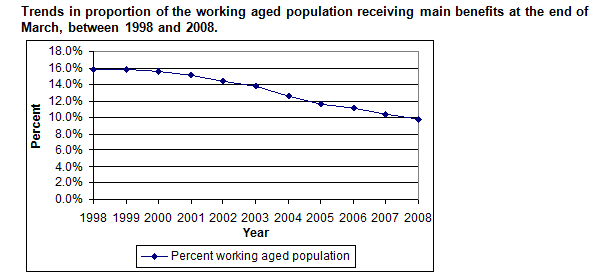
The slow total decline continues. Down to 9.9% of the working age population.

There's a blip with JobSeeker support but nothing dramatic or necessarily trendsetting. It may be saying something about the employment situation. It might just be ageing single parents being moved onto Jobseeker support. Little to be inferred by the reduction in YP/YPP for 18+. The teenage birth rate is dropping so perhaps unsurprising. The old invalid benefit - Supported Living Payment - remains stubbornly high though any reduction is unusual compared to the past few years. Reliance on welfare due to psychological conditions continues to grow. The Sole Parent Support reduction is the biggest and best news leading to fewer children on benefits.


I don't see any smoking gun in the data tables.

Total numbers are dropping. Just not fast enough for some readers. Or me.

As the drop is post GFC  it's worth looking where we were pre GFC.


At 9.9% of the working age population.

(The Super numbers are the big growth area and while most people don't think of it as a benefit, it's included in the tables.

Almost 700,000.

Up 23% since March 2011.)

Tuesday, April 19, 2016

Quote of the Day

From a piece in this morning's DomPost about junk science by Matt Ridley (British journalist and Conservative MP), prompted by Robert De Niro joining into the anti-vaccine brigade.

"Instead of evidence-based policy making, pseudo-science specialises in policy-based evidence making."


Wednesday, April 13, 2016

English tells truth and gets it in the neck

A Labour MP from Palmerston North is outraged that Bill English has told the truth.

English said that there are Kiwi men who are supposed to be available for work but don't turn up; that can't read and write and are virtually unemployable. That's why NZ imports immigrant farm workers.

The Labour MP says this is the government's fault after 8 years at the helm.

Really? If the individual and the individual's family do not value education, if they prefer to make money illicitly or from benefits, if they get their kicks from a variety of law-breaking  activities and spend much of their time cycling in and out of prison, is it really Bill English' fault?

The underclass, which we don't seem to talk about as much anymore, was just as bad after Labour's last 9 year innings.

This type of  petty, cheap-shot politics grinds my gears. What would the Labour MP do in English' shoes? Sweep illiteracy and unemployability under the carpet and only ever present a rose-tinted picture of a certain slice of society?

Because when that happens, problems never get solved. English has probably been the most innovative and daring Finance Minister when it comes to social policy. That willingness to try new approaches is born out of his recognition and acknowledgement of just how hopeless certain people have become.

And when Bill English said that prisons are a "moral and fiscal failure" did any Labour MPs jump up and down then?

Friday, April 08, 2016

CYF overhaul: crux of the matter overlooked again

Another voluminous  report into CYF; a long-winded ministerial response; multiple cabinet papers and a proposed radical overhaul promised

But when will the system that turns children into careless accidents or meal tickets be radically overhauled?

Because until then, none of these other investigations and re-inventions will matter a damn. There have been welfare reforms but the number of children being born into beneficiary families remains at the same level.


Of children born between 2005 and 2007 and known to CYF by age five:
 39 percent had mothers who had been receiving a benefit for more than four out of the last five years preceding their birth, and 60 percent had a primary carer who was receiving a benefit at the time of their birth,
 37 percent had a parent who had a criminal conviction in the five years prior to the child’s birth,
 69 percent had parents where there was a family violence incident attended by Police in the five years prior to the child’s birth, and
 36 percent had parents who were known to CYF as a child.

(Right-click on image to enlarge)

Thursday, April 07, 2016

Confusion in CYF report

This is from the Rebstock report into CYF released today:


 "In 2014, CYF received 152,000 family violence notifications from Police involving 97,000 children. The majority of these were not acted upon as the nature of the concerns did not reach CYFs threshold for response and there was a lack of alternative services to address the needs of these families in the community."

My initial reaction to this was utter surprise. A majority not acted on? That seems shocking.

But that's because it's not right.

Consider the CYF statistics:


In 2014 there were 57,889 family violence referrals from Police and 88,768 care and protection reports of concern.

According to CYF:

Notifications comprise “reports of concern” (which may require action by Child, Youth and Family) and “Police family violence referrals” (which do not require action by Child, Youth and Family). We receive reports of concern from Education, Health, Police, Courts, social service providers, family members, and members of the public. 

And:
Police family violence referrals are not assessed by Child, Youth and Family. Police family violence referrals are the result of Police attending a family violence incident where children are present or normally resident at the household concerned and where Police assess that Child, Youth and Family action is not required.
So it would appear the report stats are wrong and misleading. The report goes on to state however:

 These notifications represent a significant opportunity for early intervention to provide the support families need before concerns escalate into situations of harm to children.
Which and how many? Can sound recommendations be made based on unsound data?

The Third Way triumphed

It's only 10 to 15  years since many of us were fighting the introduction of Paid Parental Leave, Working for Families, interest-free student loans AND Kiwibank - Jim Anderton's pet project and National's latest pragmatic point-of-sameness.

The principles behind that opposition have not changed. But our current government has abandoned them.

My son, who is no intellectual slouch, has taken to ridiculing the free market.

I point out that libertarianism cannot be blamed for the last recession. That no libertarian would support government bailing out private financial institutions. YES he says but you would support deregulation of them.

I counter that deregulation can only succeed when consequences are real; when they cannot be avoided through bail-outs.

So, he says, you would support allowing financial collapse just to teach people consequences?

You get the circular nature of these exchanges.

The up and coming voters have been taught to blame greed and exploitation on the free market (which has not actually been free)  as if the free market is just a beast that governments tolerate; that governments can and should control in the pursuit of utilitarian goals.

The collective memory of a society functioning without (or at least with a smaller) welfare state - mass compulsory wealth redistribution - is fading.

Mass redistribution brings with it commandeering control of each major aspect of life - education, health and welfare. Once government assumes  the responsibility for financing provision of these, it must then gradually assume control of each and every personal action which imposes an associated cost.

The idea remains abhorrent to me.

Earlier dissenters seem lulled or numbed into submission. NZ may have a so-called right-of-centre government but Labour's 'Third Way' has triumphed.


Tuesday, April 05, 2016

3,999,999

Helen Clark may feel like she has a "stadium of 4 million people" behind her - and judging by overwhelming opinion expressed today she has -  but she can count me out.

I respected Clark as a PM for acknowledging the problems of chronic inter-generational despondency and dysfunction.

But even then she would not move against the prevailing feminist and socialist theory of (false) empowerment of women - the DPB.

Back on the DPB band wagon? Being petty when NZ could have the first woman heading the UN?

1/ The impoverishment of thousands of children is no small beer

2/  I do not care about nationalism or feminism. I do not get warm fuzzies about the connection Clark has to New Zealand or to my gender.

It has made me deeply uncomfortable today that so very many, John Key included, are prepared to forget not personal animosities (they are small beer)  but the ideological antipathy that freedom- embracing, small govt acolytes had for Clark.

Whoever the successful candidate is (notwithstanding the arguable impotence of the UN) I would prefer someone who has not made it their life's work to advance the responsibility and power of the state to enrich lives.


Monday, April 04, 2016

Inequality an excuse for theft

Yesterday I made a prediction about the response to Rodney Hide's account of chasing a shoplifter.

Quite bizarrely the type of reaction I predicted has come about, but not in the comments section after Rodney's column.

In this mornings DomPost Jane Bowron also writes about her experience in witnessing shop-lifting from her local supermarket. There must be a lot of it going on . Here is an excerpt from her column,

The gap between rich and poor is widening and with the long term stagnation of wages, theft for some is a desperate option while for organised habitual offenders, it's simply what they do for a job.

But Bowron isn't just an apologist for the victims of inequality. She even sympathizes with the second group.

The latter are relatively small-scale operators trying to make a buck, while corporate theft is allowed to go unchecked, is lauded and treated as a swaggering success story.

And earlier in her piece she refers to the "hugely profitable" status of the supermarket being ripped off, as though that also somehow balances the books.

But just as her defence of thieves is muddle-headed, so is the column in its entirety, the conclusion being citizens should arrest these offenders.

If we could just get over our apathy and take the global citizen's arrest principle wider, we might strike a blow against the empire of our own apathy.  

Why suggest that joe public should pursue and apprehend an individual who has just been painted as some sort of latter-day Robin Hood?

Sunday, April 03, 2016

Prediction


Rodney Hide writes a column about supermarkets' inability to defend their property from shoplifters because of asinine assault laws.

I will make a prediction about the comments that will ensue.

At least some will resemble the following:

It is a tragedy that a man has to steal to feed his family. And it's your politics, Rodney, that caused mass unemployment and poverty in this country.
After all, the left has been excusing theft for decades.

Never mind the small matter of job opportunities in Christchurch and the surrounding regions. The fact that Canterbury has the lowest unemployment rate in NZ is just inconvenient.

Friday, April 01, 2016

Govt closes gap between benefit and employment income

Today beneficiary parents receive a pay rise of $25 weekly or $1,300 yearly.

It is impossible without asking an OIA question to know exactly what that means in terms of percentage rise. That's because even though basic rates are known and constant, all the add-ons vary individually.

The last time the government published an average beneficiary payment was 2013:

An average sole parent with two children under thirteen, living in South Auckland would receive around $642 on benefit, including accommodation supplement and a minimal extra allowance for costs.
As benefits are inflation proofed (though add-ons aren't) that would increase to $647.95 in the last quarter of 2015.

With today's increase she  would be receiving $673 a week.

The best figure to compare that to is the average weekly incomes from wages and salaries:

Female $752
Female Maori $723
Female Pacific $698

Either sex aged:

15-19 $345
20-24 $698
25-29 $852

The table I am quoting doesn't provide gender breakdown with age but female rates are overall  consistently lower than male.

So, all in all, for a young  sole mother - particularly Maori or Pacific -  $673 is looking fairly attractive.

Yes, the work-testing has been extended to part-time (20 hours) for mothers with youngest child aged 3.

But the work obligations are only ever useful in places where there are jobs.

It'll be interesting to observe the behavioural changes over the coming 2-3 years.

Remember that the early work-testing policy implemented to stop people adding children to an existing benefit has already failed.


Thursday, March 31, 2016

Now that's a scary thought

There probably are as many persons coerced into acting, not as they want, but as others want, through majority rule as through totalitarian dictatorship.

– John C. Sparks, The Freeman [May 1971]

(hat-tip FFF)