Thursday, April 08, 2010

The "lucky" country thinks big

The Age is reporting that the Australian Treasury has predicted their population will grow to 36 million by 2050. The roughly matches what the Australian Bureau if Statistics are forecasting as well.

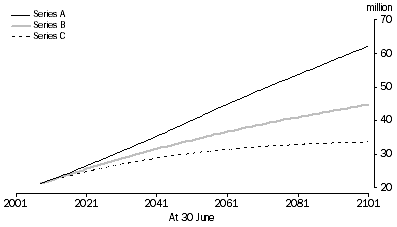
Australia's estimated resident population (ERP) at 30 June 2007 of 21.0 million people is projected to increase to between 30.9 and 42.5 million people by 2056, and to between 33.7 and 62.2 million people by 2101. Series A projects the highest growth, while Series C projects the lowest growth.


In contrast Statistics New Zealand is predicting the following for New Zealand;

Low fertility and the ageing of the large baby boom cohort have raised the prospect of slow or no growth in the future. Regardless of which projection is chosen, the general demographic outlook for New Zealand over the coming decades is for slowing growth, a narrowing gap between births and deaths, and an ageing population. This is a radical departure for a society accustomed to a growing population. Any innovative or expansionist planning or business programme must take account of structural shifts in progress.


This graph is from 2000, but even latest population projections - June 2009 - are only slightly higher:

The latest projections of New Zealand's population have the estimated resident population (provisional) at 30 June 2009 as a base. Projection series 5 presented here assumes that:

* New Zealand women will have 1.90 children each on average in the long-term (below the 2.1 children required for the population to replace itself without migration)
* life expectancy at birth will increase to 85.6 years for males and 88.7 years for females by 2061
* there will be a net migration gain of 10,000 people each year from 2013 onwards.

Given these assumptions, New Zealand's population is projected to grow from 4.32 million in 2009 to 5.15 million in 2031 and 5.75 million in 2061.


There are people who celebrate low or zero population growth. I am not one. The economic reality is that dependency ratios are growing and without an expanding working-age pool (what might be expected from net migration) NZ is facing massive problems.

Wednesday, April 07, 2010

The distortion of the DPB

Yesterday beneficiary advocate Paul Blair was back in the news claiming the Ministry of Social Development is acting illegally. He is trying to get people who have been relegated from an invalid's benefit to a sickness benefit to come forward and form a body that will take the department to court. Mr Blair describes himself as a qualified barrister. Listening to him interviewed by Sean Plunkett this morning he lacks the discipline and gravitas one might associate with that of a practitioner of the law.

Mr Blair has nevertheless succeeded in his past endeavours to bend MSD policy to his will. In 2004 he and two other fathers took a case against the department described by the NZ Herald as follows;


Three Rotorua beneficiaries have forced a law change for single parents with split custody of their children through an out-of-court settlement with the Social Development Ministry.

On October 1, 1991, a law was introduced to stop two parents living apart, but who had split custody of their children, from both getting the Domestic Purposes Benefit.

One was eligible for the sole-parent benefit and all the benefits that went with it, while the other was entitled to the unemployment benefit.

Rotorua beneficiaries advocate and sole parent Paul Blair argued that this was not fair as the parent receiving the DPB was entitled to earn more when working than the parent on the dole.

Parents on the DPB were also entitled to childcare subsidies, a non-recoverable training incentive allowance if attending a course, and did not have to be work-tested.

Rotorua sole parents Leon Broughton, Richard Amoroa and Mr Blair started legal proceedings in the High Court at Rotorua against the chief executive of the ministry more than a year ago.

In the out-of-court settlement, the ministry agreed the second parent in split-custody cases would be entitled to the emergency maintenance allowance, paid at the same rate as the DPB and with similar advantages.

Justice Alan McKenzie ordered the ministry to review the plaintiffs' benefits, pay any arrears, treat all similar cases in the same way and review cases as far back as December 12, 2000.


This is an utter distortion of how the DPB was intended to operate; the state paying for the mother (or father) to care for the dependent children while the liable parent contributes to this payment through earned income.

Another Court of Appeal case, the Ruka Case, also saw the original intention of the DPB distorted by a ruling that stated where a women was living in a relationship with a man who was abusive and not financially or emotionally supportive she could not be legally described as 'living in the nature of a marriage'. Therefore she could continue to receive the DPB. Thousands of past decisions were scrutinised under the new ruling, overturned and financially recompensed. Note now that as long as a man is violent and doesn't support his partner she can stay on welfare. A bitter irony given an original aim of the DPB was to enable women to leave abusive relationships.

Of course there are many other ways in which eligibility for the DPB has been distorted. These are just two of the more counter-productive examples.

Shattered myth

Some news for those of us who had to be forced to eat fruit and veges as kids, continue to force ourselves to eat fruit and veges as grown-ups and force our children to eat fruit and veges because THEY WILL MAKE YOU LIVE LONGER.

All that angst and resentful compliance may have been a complete waste of time.

However, having believed it for so long I am not about to relinquish my prejudice and share this revelation with the children. When they ask, "What's to eat?" my standard response will continue to be, "Get a piece of fruit."

(They only listen to me sometimes but this at least reduces the amount of junk food they might otherwise consume. And I need to indulge myself. I always feel like a better mother when I feed them fruit and veges.)

Once a lag, always a lag?

A friend once described to me how she and two others had gone to prison to visit a gang president to 'buy' her partner's freedom. She stayed in the car but was quite explicit about the intent of the visit and which gang was involved. And I have no reason to doubt the story.

I recalled this episode just now when reading about Jack Yorke, who similarly struck a deal to obtain his release. Looking at the region it may well be the same gang. Unfortunately for Mr Yorke, when the person with whom he had struck the deal died, new blood started demanding money to uphold the agreement. It's so despicable. Yorke, probably something of a wreck from hard living and on a sickness benefit, stole some property to pay the ransom. Then he confessed to the police. It was his first conviction in the 6 years since being released from jail.

Now he is being sent back to prison for 15 months with "special release conditions to assist in rehabilitation."

This raises a few questions in my mind.

1/ What, if anything, is being done about the blackmailing of Mr Yorke?

2/ What is 15 months in prison supposed to achieve? Would it be preferable to spend the $91,000 it costs to house a prisoner each year on buying Yorke a new identity and shipping him off somewhere? In prison it is going to cost 6 times what it currently costs to support him and the fact he stayed out of trouble after 2004 would suggest he is over his life of crime, worn-out most likely.

3/ If Mr Yorke is subject to threats and intimidation on the outside, what chance the authorities can keep him safe on the inside?

4/ And, of course, is Mr Yorke telling the truth, but I am prepared to give him the benefit of the doubt.

But perhaps the hard-liners would say, tough. He has to be punished and if he didn't want to do the time, he shouldn't have done the crime. Perhaps Mr Yorke is about to get his comeuppance for his previous life of offending.

And that is exactly where I part company from the hard-liners. Yes, I actually have some sympathy for this character because I imagine he is a burnt-out shell of a man who no longer poses a threat to society. There are plenty more like him hence very few old men are in prison. But more importantly the way the justice system is dealing with him seems to defy logic. There must be better outcomes available for both Yorke and the taxpayer. Surely.

Tuesday, April 06, 2010

11 percent of 16-24 year-olds on welfare

At December 2009 there were 62,580 16-24 year-olds on welfare,

View the benefit type, age and regional breakdown here.

Only 36 percent of them were on the dole. 35 percent were on the DPB.

(One 16 or 17 year-old was on a Widow's benefit.)

Just over 1 in 10 may not seem remarkable but in higher socio-economic areas the number will be negligible. And in the poorest areas the number will be around 4 or 5 in 10. That's where being on welfare is normalised behaviour.

Is Work and Income toughening up?

According to the NZ Herald people are being bumped off the invalid's benefit and onto a sickness benefit ahead of the new rule changes. The health advisers involved are not a new appointment though. It may be that after the release of last year's auditor general's report, which found a lack of progress in the application of Labour's changes, they have stepped up activity.

The story may also be the result of Rotorua beneficiary advocate and activist Paul Blair getting busy again. Paul Blair has previously taken the Ministry of Social Development to court in order to secure a rule change that allowed single parents to split the custody of their children, both go on the DPB and avoid work-testing.

So what do statistics show? The March quarter statistics are not out yet. But those up to December 2009 show an increase in both benefits. Within that picture it is entirely possible more people than usual are being transferred from IB to SB hence the steep rise on SB. But the inflow onto IB is still greater than the outflow.


These graphs show that around 55 working-age people out of 1,000 rely on a sickness or invalid's benefit. This compares to 24 in 1991. Something has to be done to reverse the growth trend. Putting someone on a shorter term, lower paying benefit might provide the encouragement they need to look for a different or supplemental source of income.

Monday, April 05, 2010

Methadone dispensing under increasing scrutiny in Scotland

In NZ there around 4,500 people on the methadone programme.

In Scotland, where the population is only 5 million, there are 22,000 on methadone.

As my husband noted, there must be long queues at the pharmacies in the morning.

It is no wonder that methadone has become a political football in Scotland but expense is a red herring. Methadone itself isn't expensive but the management of patients and dispensing adds up.


A coalition of world experts in drug abuse have defended the use of methadone to treat heroin addicts and warned that curtailing its prescription would bring about a spike in overdoses, crime and HIV.

In a letter to The Scotsman, the group, comprising dozens of international specialists, have condemned the "continuing misrepresentation" surrounding the effectiveness of the heroin substitute and rejected claims that is too expensive.

The defence of methadone by the coalition of GPs, psychiatrists, counsellors and epidemiologists comes in the wake of growing criticism of the treatment and accusations that the Scottish Government has become overly reliant on the drug.

Last week, Professor Neil McKeganey, the director of the Centre for Drug Misuse Research at the University of Glasgow, argued that more effort was required to get Scotland's addicts off drugs through abstinence.

Blog stats


Last month there were over 7,000 visits. A new milestone. Ta very much.

When less is more

An AUT survey shows that;

Feeling as though the Government is listening to them is one of the most important things to New Zealanders, but it is the area where the country scores the worst.

The best remedy for this is not more democracy, more participation, more consulting, more select committees, more representatives, more commissions of enquiry, etc.

It is LESS government. If government weren't so pervasive in all aspects of our lives its non-responsiveness would be less of a problem.

Sunday, April 04, 2010

Australia sucking money out of NZ

Why are there race meetings all over Australia today sucking money out of shut-down NZ?

Because NZ is a far more Christian nation? Or because NZ has more than its fair share of spoilsports? Or perhaps it is simply that Australia is a 'can do' country and NZ is a 'can't do'. Hence the growing economic gap.

And what is the reward for being a 'can't do' country? Russell Norman?

Maori smoke because they are poor - not because they are Maori

That's the latest finding in the Christchurch Health and Devlopment Study; Specifically;

OBJECTIVE: The present study examined the role of socioeconomic status and cultural identity in the association between ethnicity and nicotine dependence, in a birth cohort of >1000 methods young people studied to age 30. METHODS: Data were gathered on ethnicity, cultural identification, nicotine dependence, and socioeconomic factors, as part of a longitudinal study of a New Zealand birth cohort (the Christchurch Health and Development Study). RESULTS: Those reporting Māori identity had rates of nicotine dependence that were significantly higher (p < 0.05) than rates for non-Māori. Control for socioeconomic factors reduced the associations between ethnic identity and nicotine dependence to statistical non-significance. In addition, there was no evidence of a statistically significant association between Māori cultural identity and nicotine dependence, nor was there evidence of gender differences in the association between ethnic identity and nicotine dependence, after controlling for socioeconomic factors. CONCLUSIONS: The higher rates of nicotine dependence observed among Māori appear to be attributable to differences in socioeconomic status. Efforts to improve the socioeconomic standing of Māori should therefore help to reduce rates of nicotine dependence in this population.


Get your teeth into that.

I don't believe poverty makes people smoke (accept that it is an affordable 'pleasure').

Hypothetical question;

Why don't Pacific women, who have the same socio-economic status as Maori women, have a higher rate of nicotine dependence? Their smoking rate is the same as European women. And Asian women, the poorest, smoke the least.

In fact, the more I ponder this, the more inclined I am to think it is being Maori, something about an attitude (how many of us smoked when we were young as either an act of rebellion or to fit in with mates) that makes their tobacco use higher. Like welfare, they start young and it is difficult to kick the habit.

But that's just opinion. The science makes a nonsense of what I think.

"Ugly body language..."

John Armstrong writes about the tensions within ACT. A favourite of the media and left-wing blogs at the moment. He describes the apparently, "... ugly body language displayed by Hide and his deputy Heather Roy towards one another on TV3's The Nation last weekend." One assumes that the ugly body language occurs between two people who are in the same space at the same time. Body language is very hard to disguise. So I thought I would have a look.

I was under the distinct impression that the two had appeared on the programme, probably in the studio, together. I sat through 13 minutes waiting for something that never happened. In fact the whole thing is a story made up by TV3. Bits of it are true and bits of it are Stephen Parker overlaying his interpretation and asking questions he can then weave into the thread that says Heather wants the leadership. The stuff about Rodney - from an interview with Stephen Franks - not being a manager is twisted into 'Rodney is not managing'. What Rodney doesn't like managing is people. That's an entirely different thing.

Heather does like managing people. Organising and planning.

I think ACT was more successful when it was a group of individual MPs doing their own thing. But Heather likes team stuff. Unfortunately with people attracted to less government, strongly individualistic types, making them work together doesn't necessarily produce a synergistic effect. During my interview by the board pre 2008 election, when asked I replied that I am not a team player. Probably got me the chop. But it's true. And I don't think Rodney is. Muriel Newman certainly wasn't. Stephen didn't strike me as one either. They are ideas people who really don't enjoy the machinery of party politics.

Rodney may not be a people-manager, or a team player, but he is the only MP capable of being ACT leader. Heather doesn't come close to possessing Rodney's charisma; his intellect; his oratory skills and sheer bloody single-mindedness.

But there I go again buying the idea she even wants the job.

Saturday, April 03, 2010

Raise the Super Age

I have only now found time to go back now (prompted by a comment from yesterday - thanks) and have a look at the IMF recommendations to NZ.

In there is an utterly sane and inarguably sound idea. The age for Super eligibility must go up. The IMF ensconces that more neatly;

10. To address longer-term pressures on the budget, early steps should be taken to contain the projected growth in health care and pension costs. Measures could include improving the efficiency of health care spending and linking the pension eligibility age to life expectancy.

Super makes up the biggest single item of government expenditure ($7.7 billion) and it is going to rise significantly as the population ages. I would like to see a young group (supported by their parent's generation) pick up this recommendation and campaign on it.

It would be very provocative to use the moniker RSA. Some will say it is disrespectful to returned soldiers who have fought for their country, paid their txes etc but most returned soldiers will get a Vets pension anyway.

Grey Power are very strong politically and they are a pain-in-the-proverbial socialists (though not all of their members are). I imagine they would be the foremost opponents. What a bun fight that would be.

This issue needs a real push with Guy Smiley promising to do absolutely nothing about it. It would be a real polariser and sitting on the fence would get more and more uncomfortable.

Act-on-Campus?

Friday, April 02, 2010

History repeating

I have been reviewing older issues of the NZ Social Policy Journals this afternoon and realised that under the National government (of the 1990s) the contributors brought a far less 'government must' attitude. For instance there was a contribution by Gareth Morgan, and a number of people who wrote publications by the NZBR around that time. During the 2000s it was predominantly left-leaning academics contributing. But here is a statement, 17 years-old, that caught my eye.

Breaking the dependency cycle is one of the two top priority outcomes for the Department of Social Welfare in the 1993/94 year, and a number of new initiatives have recently been undertaken aimed at facilitating the “welfare-to-work” process.

During the 17 years another generation has become dependent. What is National's latest stated goal?

"...aiming to break the cycle of welfare dependency."

Previews and going off on a tangent

Well I've broken even before the exhibition officially opens. Sigh of relief. Can pay off credit card. Two paintings sold yesterday. I find the previews quite a trial. Everyone wants to talk to you and you are constantly aware of not being able to do that. So many friends come and go without my even being able to acknowledge them. This is one of the reasons I was never any good at politics because I not only let myself get monopolised by people, I enjoy it. I get easily engrossed in conversations. But frequently about stuff other than my paintings.

There are always people who will walk up and say, "Are you the Lindsay Mitchell that writes to the newspaper?" That's good. People who don't agree with my views never approach me. When I confess I am they launch forth on what they know and their perspective. Fascinating.

For instance a woman yesterday who had worked for social welfare in the early seventies said to me they never needed to introduce the DPB. "I could get a woman on the emergency benefit if she needed it," she said. But now , "the underbelly has got too big." Of course she is right about the emergency benefit. This idea that pre DPB women were forced to give up children, forced to live violent relationships is not wholly true. Help was available but not of right. That's what changed and that's what opened the floodgates.

Another person I know well who also worked in the department late 60s and early 70s, a sole parent herself at that time, has said the same thing. They didn't really need to do that. Quietly working within the existing rules help was there where it was warranted. Consequently when it was introduced there wasn't any big fanfare. Media coverage in the Evening Post was relegated to something like page 18 from memory.

Contrast that to the current climate - 'Future Focus' being a perfect example - whenever there is the slightest hint of eligibility rules for the DPB changing it dominates the media for days.

Thursday, April 01, 2010

Easter exhibitions


Solo 29 opens to the public tomorrow and there are 2 previews today. I have 12 new works on display and hope to spend quite a bit of time there pasteling. People very much enjoy watching an artist working. It's the school holidays so hopefully that will boost traffic. While I was down there laying out the work I took the opportunity to have a quick squizz at the National Portrait Competition showing nearby. Some great paintings on display (although I see the infamous Clayton Weatherston depiction has been removed.) So if you are in the city over Easter drop by and check out both exhibitions.

Wednesday, March 31, 2010

Sentences and orders being served soar


This graph appears to be telling me that the number of sentences and orders in place has jumped by roughly 50 percent since July 2007.

Corrections - currently one of the few growth industries in New Zealand.

You own your own life

Given the very sad passing of Margaret Page I thought this quote, from the Freedom Foundation's daily update was timely;

A man has the right to dispose of his life and his property in any way he chooses, without interference from anyone else. A man has no right to dispose of any other man's life or property, no matter what his personal rationalizations may be.

— Robert Ringer

MPs square off over welfare and child abuse

Over at Red Alert MP Carmel Sepuloni has taken enormous offence at National MP Todd McClay linking welfare to child abuse. It is a fine example of why it is impossible to have an objective conversation about this issue.

McClay's comments must have occurred during the debate on the Social Assistance (Future Focus) Bill,

Todd went down the wrong path when he disrespectfully brought Nia Glassie in to the debate. He went in to a rant abour how she was surrounded by people on benefits and therefore (in his mind) this led to her murder.

This was not only bad taste but it was offensive. Not only is the Govt trying to stigmatise beneficiaries as lazy; dole bludgers, ripping off the system BUT NOW they are adding – child abusers and even child murderers – to the stigma.


I have directed her to NZ research that shows children who are the subject of a care and protection notification are 4 times more likely to have a parent or caregiver on a benefit, adding;

You have to understand that ‘are more likely to’ can co-exist with ‘most don’t’. For argument’s sake;

8 out of 100 beneficiaries abuse their children.
2 out of 100 non-beneficiaries abuse their children.

Therefore beneficiaries are 4 times more likely to abuse their children BUT most don’t.

However, inasmuch as child murder usually occurs at the extreme end of abuse, it is more likely to happen when the parent or other caregiver is a beneficiary.

So stop taking offence and start asking whether there is a link between welfare and child abuse.

Tuesday, March 30, 2010

How ambitious is Heather Roy?

Is Heather Roy really angling for leadership of ACT or is she being cornered into appearing so by the media?

Having a female/male co-leadership situation is so PC. She is reported as saying that it has worked for the Maori Party and the Greens. But in what way?

In terms of actually achieving votes the single leadership of National and Labour has been far more effective.

Turia on the welfare reforms

Interviewed on Radio NZ this morning Associate Social Development Minister Tariana Turia made it clear she does not support National's DPB reforms but has to vote for them as minister. So does Sharples. But the rest of the caucus is another matter.

Initially she says she does support benefit reform (makes some interesting comments about people not understanding where benefit money comes from) but then makes it clear (as in the past) that she is only talking about the unemployment benefit. Her problems;

1/ The timing - where are the jobs?
2/ Single parents should be allowed to stay home until their children have "completed schooling."

Regarding the timing, I have blogged before about where the existing and looming shortages lie and demand will come as the baby boomers age. But as well manufacturing is picking up. Plus there is a lag in introducing reforms. If we put them off because of present circumstances, when circumstances change the new rules aren't in place.

Paying single parents to stay home until their children complete school - and if she had been asked to clarify that I am sure it would have been high school - is absurd, although, in law, what currently happens.

So how is this going to pan out? Tariana would not guarantee all her caucus will vote for the reforms. Have we heard anything from ACT about the reforms? Is their support guaranteed, bearing in mind the reforms (depending on which is under the spotlight) are a rehash, a continuation of current practice or could arguably make intergenerational dependency worse? What are the numbers needed?

If 3 Maori Party MPs and ACT didn't support the legislation, even with Peter Dunne's 'aye' the vote will be tied. Can legislation be passed under a tied vote? I don't know the answer to that.

Then again the ACT ministers of government may also be obliged to support the government in which case it is a done deal. But perhaps they should be holding out for change with more teeth - like limiting benefit eligibility to the number of children dependent when the benefit was granted. Or basing work-testing on a set period of time from when the benefit was granted, rather than on the age of the youngest child. In effect, time-limiting it. After all, ACT always claimed to be the campaigners for welfare reform and time-limits were very much part of their earlier policy.

The legislation has its first reading in parliament this afternoon.

Monday, March 29, 2010

There is none so blind...

Tapu Misa has written about National's welfare reforms in her Herald column today;

You'd think then that someone like Lindsay Mitchell, a "welfare commentator" and tireless critic of the DPB, would be celebrating.

Actually, no. The benefit changes, she blogs, "are a waste of time"; they've either been tried before (and failed) or are "a continuation of current practice dressed up as a new approach".

She points out that National introduced the same work test back in 1996, with little change in the number of DPB beneficiaries.

As for making people reapply for the dole after one year, Mitchell says 84 per cent of those on the dole don't even reach one year, and anyway, the unemployment benefit isn't the problem when it comes to inter-generational welfare dependency.

Mitchell's problem is with unwed teenage mothers who keep swelling the ranks of the DPB. She says they're the ones who find the idea of life on the DPB too seductive to pass up.

Who would choose this as a lifestyle option? Not the seventh form girls at the Auckland private school I spoke to recently. They'd never even heard of the DPB.


But that's hardly surprising. The teen birth rate of girls in the poorest decile, girls who don't attend private schools, is almost 10 times that of girls in the wealthiest. Girls attending private schools have families with high expectations of them and opportunities abound. Girls in the poorest decile will have much slimmer career prospects and motherhood rates alongside reasonably well. This doesn't necessarily mean they make an active decision to get pregnant and go on the DPB or EMA (which they can do from 16), but the availability of a benefit most certainly influences their choices.

In his book More Than Just Race (2009), Harvard professor William Julius Wilson disputes the widely-held assumption that underpinned many of the 1996 welfare reforms in the United States: that there is "a direct causal link between the level or generosity of welfare benefits and the likelihood that a young woman would bear a child outside of marriage".

Wilson writes that there is no evidence for the claims that welfare payments provide incentives for childbearing, or discourage marriage.


But there is. Research for the US department of Human and Health Services by Anne Hill and June O'Neill showed that a 50 percent increase in the value of welfare payments and foodstamps led to a 43 percent increase in unmarried births. Numerous other studies, and not just American, have identified a similar association.

Women don't need to be dragged kicking and screaming off the DPB, they need good childcare and secure, well-paying jobs.


If women want "secure, well-paying jobs" they need to plan for them. Nothing has more potential to interrupt an education or absolve the need to get an education better than the certainty of a welfare income that pays more than the minimum wage.


As Auckland University associate professor of economics Susan St John wrote last week: "New Zealand's figures show clearly that when the job conditions are favourable and unemployment is low, benefit numbers fall."


So what did we see with the DPB during the economic boom? A drop from a 1998 high of 113,000 to 97,000 in 2008. The core of long-termers, especially those who start young and stay longest, wasn't touched.


A 2002 analysis by Bob Gregory, an economics professor at the Australian National University, showed that most Australian women were constantly trying to get off welfare, but most ended up back on the benefit within a short time.


My comments on The Standard most probably led Misa to Bob Gregory's research, the most astounding aspect of which is he estimated, in Australia, women stayed on welfare for an average total of at least 12 years. This did not include benefits they might transfer to when they no longer had dependent children in their care. Which supports my assertion that welfare has transformed into far more than a last resort safety net.

I am not sure what Misa is trying to achieve with this column. Work and strong families are an integral part of Pacific culture. A denial that welfare can undermine both is self-defeating. But if she doesn't want to see the evidence then a private girls school is absolutely the best place to go looking for it.

Saturday, March 27, 2010

Deja vu

Which government, and in which year, said the following?

"This government will not support unemployment as a lifestyle option. We are making the benefit system simpler and fairer, but for those who do not accept their responsibilities, there will be sanctions. Those who fail to take up suitable jobs that are offered to them will not receive taxpayer support."

The truth will out - eventually

It has been an ongoing bone of contention between myself and the Ministry of Social Development that they are unable to accurately describe how long people stay on the DPB for cumulatively. This dates back 8 years.


For two reasons yesterday the issue arose again. Firstly because a commentor at The Standard was quoting statistics relating to each continuous spell and I pointed out the these couldn't tell us anything about total dependence (to which I got the usual name calling response from the usual sources).

But more importantly I see that the economics lecturer, Susan St John, did some calculations about National's proposed savings if they could cut the number of people on the DPB.

Sole parents come off the benefit either because they go back to paid work, or they re-partner. It appears that Key is assuming, heroically, the new policy will save an average of 6.5 extra years of DPB for each of the 2150 sole parents it moves into work. This would produce a net saving of around $200 million.


The only time I have ever seen that number before was when I produced it way back in 2002.

Friday, March 26, 2010

Angry America

Here's someone not holding back. Too good not to paste in its entirety;

American Exceptionalism, RIP

By Monica Crowley

Man is born free, but everywhere he is in chains.

-Jean-Jacques Rousseau

After Sunday night's health care spectacle dressed up as a "vote" in the House of Representatives, the American people have been shackled by a new set of chains. The United States of America - once great, grand and free - is on the path to becoming just another country. We were once the beacon of liberty, a nation that didn't just represent individual freedom but celebrated and protected it. The improbable defeat of the British that led to our dazzling founding made us exceptional from the outset. Our Constitution was quickly recognized, admired and loathed as an exceptional document of freedom. We survived intact a brutal Civil War that would have destroyed another country. And then, during two world wars, we crushed tyrannical enemies that wanted to snuff out our special liberty. We emerged stronger and, in turn, strengthened our exceptional status.

We have been the "shining city on a hill" that achieved superpower pre-eminence in a very short period of time because we were unique: The American people had a fierce passion for liberty, and our political system - based on limited government and individual freedom - was great because it was good. It allowed us to thrive, prosper and set ourselves apart from every run-of-the-mill nation.

No longer.

What the Democrats did last weekend was not just pass a horrendously expensive, corrupt and destructive health care bill.

They took a big chunk out of our exceptionalism.

They are turning us rather quickly into France. Or Great Britain. Or any other Western European nation that was once great but no longer enjoys that status.

And that's the point. President Obama said last year that he believed in "American exceptionalism, the way the British believe in British exceptionalism and the way the Greeks believe in Greek exceptionalism." Meaning: he doesn't believe in American exceptionalism. He believes we're an arrogant nation, which is why he has been obsessed with apologizing for America and bowing before foreign potentates. He believes that the United States, with its big guns and its big money, has thrown its weight around too much, been too aggressive, pushy and demanding and too insensitive to how our actions affected others. We need to atone for that, he believes, by being taken down a notch or two. He intends to do the takedown.

According to Mr. Obama, exceptionalism is so yesterday, an uncool, antiquated and ultimately destructive notion. Rather than be first among many, we should simply be one of many. Just another country on the United Nations' roll call. Nothing special. Equal to, say, Myanmar.

He is accomplishing this by expanding government in unprecedented ways. It's unprecedented for us, although it's certainly not unprecedented in the kinds of countries into which he's trying to turn us. By expanding government into every nook and cranny of your life - through health care, cap-and-trade, and education policy - he will exponentially grow the base of people dependent on the federal government. By doing that, he will create a permanent Democratic majority. (This is why he will take up amnesty for illegal immigrants as soon as the ink is dry on the health care bill this week.)

The objective: a massive welfare state, a la France and Greece - both of which, by the way, are sinking fast under their monstrous debts. One of the keys to unexceptionalism is a crippled currency. By transferring millions more Americans to the public dole through health care entitlements, he is growing our debt to levels that will bring about the end of the dollar as the exceptional cornerstone of the world's monetary structure. We'll soon be going hat in hand to the Chinese (the way the Greeks are going hat in hand to the European Union), begging for economic salvation. America as uniquely free? Not anymore.

This is why most Americans are not going to settle for anything less than the full monty: absolute and total repeal of Obamacare. Most if not all Republicans will run on repealing it. That's swell, but we have two conditions: (1) that they actually mean it and aren't just spewing "fiscal responsibility" rhetoric to get elected and then, once in office, backtrack from working for full repeal, and (2) there are to be no exceptions in any repeal. No exemptions for subsection this or that. No "well, that part isn't so bad" or "let's only throw out the bad parts." The entire thing is the bad part. The whole bill should be deemed an unconstitutional, criminal act. It must be repealed in toto.

Health care "reform" was never about health care. It was about expanding government into every part of your life as an excuse to confiscate more and more of your private property, strip you of your constitutionally guaranteed freedoms and remake America into a two-bit, second-rate, debt-laden European socialist backwater.

Sunday night, Mr. Obama said, "This is what change looks like." The change to which he refers is the change to unexceptionalism. Note to the president and congressional Democrats: We are exceptional Americans, and you are wholly unexceptional thieves of freedom. We want our liberty and exceptionalism back. We're throwing off the chains.

Monica Crowley is a nationally syndicated radio host, a panelist on "The McLaughlin Group" and a Fox News contributor.


(Hat tip The Freedom Foundation)

$4.8 billion?

The figure of $4.8 billion for welfare has taken hold over the last few days.

#New Zealand spends about $4.8 billion a year on welfare.

#The figures show 345,000 New Zealanders currently receive either independent youth, unemployment, sickness, invalid or domestic purposes benefit (DPB), and this costs taxpayers $4.8 billion a year.

#The changes, which include study loans for the DPB and additional funds for child care, will cost $88 million to implement in the first four years, but will save just $300m from the $4.8 billion benefit bill over the next decade.

#The Government says 345,000 New Zealanders currently receive a benefit, costing taxpayers $4.8 billion a year.

The total quoted of $4.8 billion covers only the basic benefit rate - not the supplementary assistance like family tax credits, accommodation allowance, disability allowance etc. The following shows that much more than $4.8 billion is spent on working age welfare.


Ball park figure - $6.2 billion

My estimates
$800 million accommodation supplement
$900 million family tax credit
$500 million incomer related rents

Add in student and disability allowances and the total climbs to over $7 billion.
That is the figure I would use for what working-age welfare costs.

(I expect that the lion share of 'other social assistance benefits' is WFF. If you want to label that welfare - and some do - then your'e looking of a welfare bill of approximately $9 billion. Considering the MSD vote is $20 billion that figure makes much more sense than $4.8 billion.)

Thursday, March 25, 2010

"Unwarranted"?

The NZ Herald's editorial is about the welfare reforms. It makes this observation;

Young women who regard the domestic purposes benefit as an open-ended career choice have long been a source of largely unwarranted anguish to the party.

Naturally my response is why "unwarranted"? Has the Herald some particular insight or information that the rest of us do not possess? As I have said before at least a third of single parents currently on welfare started there as teenagers. If record keeping extended beyond 1996 the percentage would be considerably higher. Perhaps the Herald looks at the point-in-time numbers and thinks, ah, only 3 percent of DPB beneficiaries are teenagers. That is not an uncommon mistake but leads to a complete misunderstanding of the size of problem of young women treating the DPB as "an open-ended career choice."

Children who are raised long-term on welfare are at much greater risk of experiencing poor health, transience, insecurity, poor educational achievement, abuse and neglect, getting into trouble with the law, developing substance abuse problems and becoming a beneficiary themselves. Anguish about this group can never be "unwarranted".

Wednesday, March 24, 2010

The Bill of Rights and senseless outcomes

The NZ Bill of Rights has its place but sometimes when the Attorney General reports on an abuse of it the practical ramifications are nonsensical.

Work testing sole parents on the domestic purposes benefit (DPB) is an unjustifiable breach of human rights, Attorney-General Chris Finlayson advised Parliament today.

It was against the Bill of Rights Act that a woman on the DPB with a child over six would face work testing, while women on the widow's benefit or the woman alone benefit would not, he said.


So go ahead and work test them all.

But most of the women on a widows benefit are nearing retirement age and it makes more sense to get younger women, who have years ahead of them to support themselves and their families, into the available work.

What work-testing the DPB will achieve

This is a direct quote from a letter I received from the Ministry of Social Development 13 May 2005;

Under the work test, 17.5 per 1,000 Domestic Purposes Benefit or Widows Benefit clients left benefit each month. This has risen to 18.8 per 1,000 clients in June 2004 following the introduction of enhanced case management and the personal development and employment planning process.

So the Ministry's own evidence shows that current policy is more successful than National's.

What a waste of time these reforms are going to be.

Tuesday, March 23, 2010

Welfare reforms a re-hash

WELFARE REFORMS A RE-HASH
Tuesday, 23 March, 2010

The National Government's welfare reforms aimed at reducing the cycle of welfare dependency and branded as Future Focus, have either been tried before or are a continuation of current practice dressed up as a new approach, according to welfare commentator Lindsay Mitchell.

"For instance, the Minister is promising a redesigned medical certificate for sickness and invalid beneficiaries but the current certificate was only redesigned in September 2007 as part of the Working New Zealand: Work-Focused Support Programme. Additionally we are told that applicants for the invalid's benefit who are expected to be able to work part-time in the next two years will instead receive a sickness benefit. That is the existing criteria for eligibility."

"Work-testing the DPB when the youngest child turns 6 has been tried before and resulted in a mere 2.7 percent drop in numbers on the DPB over the period it was in force. According to the Ministry a single parent with two children living in Auckland receives 14 percent more per week than someone on the minimum wage working full-time. That provides a significant incentive to avoid work-testing by ensuring the youngest child is never older than 5. So if the birth rate of welfare dependent mothers increases this policy is more likely to increase the cycle of welfare dependence. That is because children raised on a benefit are more likely to become beneficiaries themselves."

"Finally making people reapply for the dole after 1 year is not a bad idea by any means. But 84 percent of unemployment beneficiaries don't even reach a year. The unemployment benefit is not the problem when it comes to intergenerational welfare dependence."

"Where people are capable of working - and a majority are - the government should be making welfare strictly temporary assistance. That was what the original architects of welfare intended."

Benefit reforms - arguably worse than the status quo

Paula Bennett has just announced Future Focus, National's much vaunted welfare reforms designed to "break the cycle of welfare dependency".

Summarised;

Unemployment benefit

Continues to be work-tested but instead of 100 percent loss of benefit for non-compliance with work requirements, only 50 percent of the benefit will be lost at first failure.

All UB beneficiaries will have to re-apply after one year and undergo a comprehensive work assessment.

Invalid's benefit

The medical certificate is being re-designed to provide case managers with more information about the beneficiary's capacity to work.

Anyone deemed able to work in the next two years will be sent to the sickness benefit instead.

Sickness benefit

Again, redesigned medical certificate and a new requirement that a second certificate is issued at 8 instead of 13 weeks.

Like UB, a compulsory review after 1 year.

From May next year, where assessed capable of working part-time, will be work-tested like unemployed beneficiaries. Sanctions for non- compliance same as UB.

DPB

From September beneficiaries with youngest child aged 6 will be part-time work-tested. Some exemptions for parents of special needs children or those studying at level 4 or above. Same sanctions as unemployment benefit.

Sanctions

Staggered instead of 100 percent at first failure. Single beneficiaries more likely to be sanctioned than couples with children.

Hardship payments

Easier to get a small number over a year - harder to get large number

Abatement

The $80 threshold (how much a beneficiary can earn before their benefit income is reduced by 30 cents in the dollar) is raised to $100.

My response;

The Unemployment benefit.

Why reduce the sanction for failure to comply with a work-test? This weakens the effectiveness of sanctions. It seems that National wants one sanction regime so eased it in advance of extending the scheme to the sickness and domestic purpose's benefit. I note they explicitly state, "single beneficiaries with no children are more likely to be sanctioned than couples with children." There is a incentive here to make sure you have a child dependent on you.

Invalid's and sickness benefits.

MSD had already introduced a redesigned medical certificate in 2007 and the effectiveness was called into question in a recent Auditor General's report. In any event, numbers on IB and SB continued to grow.

The reforms to sickness benefits will emulate what Australia did with their disability support pensions in 2006 by introducing part-time work obligations on those assessed as able to work.

The result there?

The Sydney Morning Herald reports earlier this month;

The reforms introduced a much tougher social security regime that aimed to end long-term welfare dependency and cut the growth in welfare rolls.

But the evaluation shows the changes failed to put a brake on the high numbers joining disability pension rolls, made little progress in moving people with disabilities off benefits and into work, and made only ''modest'' gains in the work participation of the very long-term unemployed and mature-age job-seekers...

The evaluation shows that in the year after the reforms the same numbers were added to the disability pension rolls as in previous years. These rose from 712,000 in July 2006 to 757,118 three years later.

However, there was also progress with 10 per cent of new disability pension applicants on Newstart leaving income support after six months. In previous years, only 4 per cent of a similar group moved off the pension.

Clare Martin, the chief executive of the Australian Council of Social Service, said: ''Although the figures show there was a small rise in people with disabilities moving into work, the policy actually left thousands of people worse off because they were diverted onto lower levels of payments. It was simply problem-shifting.''


DPB

The introduction of a work-test when the youngest child turns 6 will encourage the beneficiary to make sure their youngest child is never older than six. National says that when they previously introduced a work test on the DPB (1997-2003) the full-time employment rates of sole mothers climbed rapidly. But the number on the DPB dropped by only 3,000 or 2.7% percent. This policy could be significantly strengthened by adding a cap on the number of children allowed while on a benefit. Currently about 5,000 children are added to an existing benefit every year.

The figure the Ministry has provided for a typical DPB parent renting in Auckland is $580 per week or $30,160 per annum after tax. A full-time job on the minimum wage would pay $26,520 before tax.

That's another big incentive to keep growing a family and stay on the benefit.

Lifting earning capacity for people who are part employed and part benefit dependent seems like a good idea but may simply lead to more people staying in that position than moving into full-time work.

The reforms will enhance the motivation of those people who want to work. But are they the problem?

The Minister says they are aimed at reducing the cycle of dependency but they may well do the very opposite by increasing the benefit-dependent birthrate. Children born onto a benefit are far more likely to become adult beneficiaries.

The most pressing problem inherent in the welfare system - making children guarantors of a no-obligation benefit income - just got worse.
Monday, March 22, 2010

Forced wealth redistribution losing popularity

A new instalment of the Social Inequality Survey conducted by Massey University has just been published with some interesting shifts in respect of welfare and wealth redistribution;

The Government’s Responsibility

Forty percent of respondents agreed that it is the government’s responsibility to reduce the differences in income between people with higher incomes and those with lower incomes. However, 34% disagreed and 26% neither agreed nor disagreed.

Responses to the question of whether the government should provide a decent standard of living for the unemployed showed a similar pattern: 43% agreed, 30% disagreed and 27% were neutral.

Only 22% of those surveyed agreed that the government should spend less on benefits for the poor; 48% disagreed and 30% neither agreed nor disagreed. This is consistent with the notion that the government has a responsibility for reducing income differences.

However, while there is support for the government to play an active role in protecting those on low incomes and reducing income disparity, this support is by no means universal. Furthermore, the proportion of New Zealanders who believe that the government should reduce income differences has fallen by 10% since 1992. This mirrors a similar decline in the proportion who believe income differences in New Zealand are too large. In both cases, most of this decline has occurred in the last decade.


Following the current trend those who do not think it's the government's job to reduce income differences will be in a majority within 15-20 years. Whether that will translate into government action is quite another matter.

An appalling miscarriage of justice

False accusations of rape. How common are they? This question runs through my mind whenever I read a story like this one, a particularly shocking case given the accused spent 17 weeks in Waikeria Prison prior to a trial at which the jury then found him 'not guilty' after 7 minutes deliberation.

Perhaps if the police kept statistics on the incidence of false rape complaints they might take a more cautious approach to investigating and prosecuting. But they don't.

They keep statistics on "False statement/Declaration Etc" but do not distinguish the nature of the false complaint. And they keep statistics on sexual offences.

I know I have blogged about this subject before but it keeps resurfacing. 1990s US data shows that 1 in 4 men suspected of rape can be excluded through DNA testing. That is not to say the other 3 were guilty. In 20 percent of cases the DNA evidence was inconclusive. A match was established in the remainder but then the matter of whether or not an assault or consensual sex took place has to be determined.

On a reading of just the media coverage, this man has suffered a gross miscarriage of justice. It doesn't do much for my faith in police procedures. Note his barrister's comment;

"What happens in these cases is everyone is risk-averse. No-one wants to exercise any discretion as to whether the case will proceed or not."

Sunday, March 21, 2010

MSD misrepresenting statistics and misleading the public

A report just published by the Ministry of Social Development examines efforts in Counties Manukau to reduce youth offending.

Under key findings the following appears;

Homicides in Counties Manukau reduced from an unprecedented peak of 34 in 2005 to 7 in 2008.

The figure of 34 looks too high. For further verification I went to the actual report;

Homicides
The number of homicides tends to vary considerably from year to year. However, the 2005 figure (34) in Counties Manukau for young offenders was the highest recorded in the last decade. The numbers of homicides in 2007 and 2008 were considerably lower at 6 and 7 respectively. Nationally, excluding Counties Manukau, homicides by young offenders remained fairly stable between 2004 and 2008 at approximately 20 a year.


Here are the police statistics for Counties Manukau;


There were 19 homicides in 2005. How can there have been 34 homicides by youth offenders in the same year?

Of course there may have been more youth apprehended for homicide but that isn't what the report says.

The media would simply cut and paste the statement under key findings which is an error of significant magnitude.

Saturday, March 20, 2010

Moderation turned on

Sorry folks but I have turned on the moderation function. Fortunately I am never far away from the keyboard so when you comment it should appear fairly quickly.

Unfortunately my deep reluctance to curb freedom of speech is increasingly being interpreted as some sort of tacit approval of the quite absurd comments I leave up.

Friday, March 19, 2010

Remember Wayne Patterson?

Do you recall the exploits of one Wayne Patterson?

He invented superannuitant identities and successfully defrauded Work and Income of 3.4 million dollars. A TV doco aired about this quiet and unassuming character who lived modestly, invested the money wisely, including in gold bars which he hid in his ceiling. Ultimately he made a profit for the taxpayer of $467,000.

Contrast this to the sleazebag ASB finance investor who stole $17.8 million from unsuspecting and trusting clients. Blew it on sex and lavish living. Poured it down the toilet pretty much.

Who should have got the longer sentence?

Patterson got 8 years and sleazebag got 6.

Astonishing claim

In Australia "health and welfare " jobs have just overtaken the retail sector in terms of employment. Currently 1 in 9 jobs is in health and social assistance.

According to The Age;

"It will keep getting bigger," says labour market specialist Mark Wooden, of the Melbourne Institute.

The entire sector will one day account for one in every two workers ".


Good lord. How can that be sustainable?

In NZ one in 10 workers is employed in health and social assistance (it rises to closer to 2 for females). But 1.5 works in retail trade and accommodation.

The same upward trend is occurring though. In September 2004 the sector accounted for 8.9 percent of the workforce. Five years later it stood at 10.2 percent.

Returning to the claim I guess what he is saying is that society will become so efficient at creating wealth without labour input that it will be able to afford for every second worker to be a health or care worker. Can't see it myself.

Thursday, March 18, 2010

The criminal class has society over a barrel

The criminal class has society over a barrel. Look at the news coverage.

On Tuesday night in Hamilton two young women attempted to rob a family a home. The father acted to prevent them and eventually neighbours became involved. The police say:

"Here we have neighbours looking out for each other resulting in the arrest of the woman, which is to be commended, but we also have a homeowner suffering a stab wound trying to defend his property in what could have been very tragic circumstances.

"We would prefer people capture details and descriptions rather than place themselves at risk. If at all possible, call 111 and let us respond to the problem."


In other words, let them rob you.

Then up the road in Huntly business owners are sick and tired of increasing property crime and theft. They met with their local MP to express their understandable unhappiness;

But Huntly Community Board chairman Frank McInally, who is a strong advocate for the installation of security cameras, yesterday told the Times that most retailers were "their own worst enemies".

"They won't put their hand in their own pockets to contribute towards the cameras," he said.

"You hit them up for $1000 each for cameras and they don't want to know about. But they're happy to talk about increased insurance premiums. "They talk a lot, but will do absolutely nothing off their own bat."


So again the message sent to thieves is, do your worst. Why the hell should small business owners be coughing up for street security when they already pay their rates and taxes for a reasonable level of law enforcement?

But worse than any of this is the fact that we are forced to support the criminal class through a benefit system that has gone haywire; is bereft of a moral compass.

BIG RISE IN BENEFICIARIES GOING TO PRISON

Thursday, March 18, 2010

Figures released under the Official Information Act show there has been a sharp increase in the number of people who have had their benefits cancelled because they went to prison.

"In 2009 4,192 people had their benefit cancelled because they were going to prison. That is 37 percent up on the 2008 figure, and 47 percent up on the 2007 figure," according to welfare commentator Lindsay Mitchell.

"58 percent were Maori, 89 percent male and 47 percent came off a sickness or invalid's benefit."

"468 parents or caregivers also left the DPB to go to prison. "

"Most criminals break the law many times before they are incarcerated. No doubt there are thousands more people who are serving community sentences or home detention while continuing to receive welfare. Additionally 3,496 people were granted a benefit last year on release from prison."

"This situation rather puts paid to the idea that benefits discourage crime by providing people with a living income."

"The Prime Minister was correct when earlier this year he described New Zealand's welfare rolls as out of control. Welfare was not designed to aid and abet thousands of criminals. "


So we are damned if we do, and damned if we don't. I am rather starting to prefer the idea of damned if we don't.

Wednesday, March 17, 2010

In the home stretch

Winding down to the exhibition now. With oils you have to have the work finished well before installation and this week I have been able to embark on a new project - soon to be announced. Here is some of the work of other artists involved. Mine is the top right portrait. And below is a publicity shot Sam took yesterday for local papers. Fingers crossed I sell as well as at the last show.


Creeping separatism

It is rumoured that whanau ora is going to be administered by Te Puni Kokiri.

Inasmuch as the DPB is a social policy which benefits (?) mainly women, shouldn't it be handed over to the Ministry of Women's Affairs?

And if there is going to be a Minister of Whanau Ora what about a Minister of DPB?

And why not hand the administration of Super over to the Retirement Commissioner and have a Minister of Super?

National tell us that they want trim down public services and bureaucracy and go in exactly the opposite direction with Maori. Pure politics.

Politics aside, the real question is, can Maori providers sort out Maori social problems? How will we know whether the new approach is working? (That question pops into my head because I was reading the other day about the continuing creation of marae courts. In nearly two years since the first began hearing cases no formal evaluation has been conducted.)

My suspicion is that families under the whanau ora scheme will be treated differently to families who are not. That could manifest in avoidance of work-testing for example. It is no secret that the soon-to-be Minister of whanau ora is absolutely against work-testing mothers on the DPB. Whanau ora may provide the political solution to that conflict.

A very close watch needs to be kept on what develops under whanau ora. But my guess is that scrutiny will be impeded by the fact of it being run by the Ministry of Maori Development.

Timid welfare reforms

Some years back I was approached by a parent of children that went to school with mine, who had read my letters, knew my politics etc. She was from the US and very sympathetic to my views about welfare. What she wanted to convey to me was that when she lived in the US she considered herself to be left-leaning. But without changing her own political views, in this country she felt decidedly to the right of the spectrum. In particular she felt NZers were too politically correct and had an over developed sense of being owed. Whereas in the States she would vote Democrat here she would be more likely to vote Act.

It doesn't matter which main party is in power (except for the aberrations of the late 80s/early 90s) New Zealand is essentially very collectivist and socialist. Where once that mentality saw NZ innovating and leading in social policy (eg social insurance paid by the state rather than the employer/employee) it is now creating paralysis.

Tuesday, March 16, 2010

WHY?

Mistakes happen. Yesterday for instance I had a letter published in the DomPost and after my name it said "Point Howard". I have been writing to the DomPost for years. Why would someone suddenly take it into their heads that I live in Point Howard? Apart from the fact that people are going to keep asking me if I have moved (which happened when the Dompost temporarily started using the identifier Muritai instead of Eastbourne) it's no big deal. But why?

Anyway, here is a really big "why?"

A Boston cat has been called for jury service. But that's not the why. He was entered on the last census forms as a pet, Sal Esposito. Someone in officialdom has their wires crossed and Sal has transformed into a human. One old enough to do jury service mind you.

No, the why is WHY won't the jury commissioner relieve the cat of his civic duty?

(Hat tip Reason.com)

Monday, March 15, 2010

Ripping off charity

The mentality of someone who rips off the taxpayer is comprehensible. The taxpayer is invisible, indeed the individual himself is one and just getting back some of what he put in.

But ripping off a charity? I suppose donors are also invisible. But the recipients of the charity, especially children, certainly aren't.

I began volunteering in 2004 and up until last year, when I had a client that involved more travel than previous clients, I didn't claim for mileage. I had made a reasonably sized donation to the charity and it seemed illogical to then take money out. But last year I wasn't as flush and when I was asked to take on a client some distance away said yes, but that I would have to claim for mileage.

So if Roger McClay has been ripping off various charities, has he fallen on hard times or is it simply a matter of greed? Perhaps he really rates himself and mentally justifies his actions because they are damn lucky to have his services. Maybe he has a gambling addiction or some other expensive hobby.

Whatever has happened in his head, it is sad to see someone throw away their reputation and future prospects because he will get little sympathy and probably no second chances. And now that I look for a link to the story I discover one of the charities he is accused of ripping off is World Vision, who we have supported for nearly twenty years. Thanks Roger. I wasn't faceless after all.

Sunday, March 14, 2010

Am I getting anywhere with this?

Regular readers will know that when I think a comment or a criticism or a revelation is important I will distribute it as a media release. Sometimes I get feedback along the lines of, why isn't it getting picked up?

Actually they do get picked up. But someone who listens only to National Radio for example can be forgiven for thinking they do not.Increasingly I get calls from NewstalkZB, Radio Live and, less so, Rhema. I have been on Radio NZ but only a couple of times. My local paper gives me a bit of coverage as per below which ran in the Hutt News and The Leader and the readership of local papers is quite high because they are distributed free to all homes. Over the years the NZ Herald has published a number of articles but there prime social issues reporter is not sympathetic to my views. Breakfast TV is also calling me if there is a relevant issue.

Courting the media is very difficult. I hate seeing my name in print. I get an immediate but irrational sinking-stomach feeling. The thought of a TV appearance or speech sends my stress levels into the troposphere. But I cope. If I want to advance welfare reform I have to. And advancing welfare reform isn't about beating a political drum for the sake of it. It's about changing how we think about need, how we meet it without creating more; without causing so much unnecessary and additional hurt and waste along the way.

Saturday, March 13, 2010

Maori adoption and parallel worlds

The following is from a letter to me from the Ministry of Social Development. It clarifies the difference between adoption in the Maori and non-Maori world. I suspect that quite a number of Maori babies are 'adopted' out (whangai) but there are no statistics available. I suspect that most Maori babies born to unpartnered or young Maori are supported by welfare but cannot confirm this because MSD says it does not record the relationship status between the person receiving the benefit and the dependent child who provides eligibility. And the ethnicity of the child is not recorded, only the ethnicity of the caregiver. I have written previously about the potential for the exploitation of children in this respect.

Anyway, another brick wall hit, but some of you may nevertheless be interested in the different processes.

Friday, March 12, 2010

Do people on the DPB want jobs?

In 2002 research was commissioned into whether people on the DPB were interested in looking for work. An external research company phoned 1,233 people on the DPB and asked about their level of interest and found;

Very interested 32%
Fairly interested 29%
Not that interested 19%
Not interested at all 17%
Unsure 3%

I had just come across this again and was musing about how honest the responses were. Perhaps it would be like my GP saying to me, how interested in cutting down your alcohol intake are you Lindsay? (She thinks I drink too much wine but in my defence my intake, apart from periods of total abstinence, doesn't go up and it doesn't go down).

The answer she wants is very interested. What she wants to hear is certainly being mentally processed. So is the honest answer, not interested at all. Should I plum for somewhere in between? Or isn't it true that I am fairly interested, so long as it doesn't actually happen? If an alcohol free wine was invented that tasted great and gave a nice buzz, I would certainly be fairly interested.

So how indicative is that research? I recall at the time Mr Maharey making a big deal about how most people on the DPB wanted to work. Actually, the veracity of the results notwithstanding, they were interested in 'looking for work'. That's a different thing. Being interested in looking for a job doesn't translate into accepting it if it pays only slightly more than a benefit.

And as much as those who said they weren't even interested in looking can make a taxpayer feel rather testy, at least they were honest.

Admitting a mistake

You will find this post dry and boring but it is necessary.

I have been getting it in the neck from a patronising commenter for making a statistical error.

I divided an average figure into a median figure. Wrong.

The corrected figure is;

Government transfers account for 8 percent of the average male income and 19 percent of the average female income (not 8 percent of the median male income and 24 percent of the median female income, which I originally posted.)

The commenter goes on the tell me what I should have done;

Taking the median (if you want to use medians) weekly govt transfers by gender from Table 12 and putting them against median aggregate income in table 1, you'd be horrified to know that the median male weekly govt transfer income is 40% of the median male income from all sources, but the ratio for females is 64%.


So why the huge difference between the two sets of figures? My erroneous figures looked far more likely than these, which is why I didn't spot the mistake.

Because Table 12 is Median Weekly Income by Income Source for those receiving that source of income.

Hence it is an error to divide those figures into the figures at Table 1 which is Average and Median weekly Income for all people aged 15 and over.

So the anonymous commenter, who demands I admit my mistake or lose my credibility, might like to join me. Especially as he or she says "what really irritates me is the abuse of statistics."

Thursday, March 11, 2010

Recent painting puzzles

This photo has fascinated me since I first saw it at the Alexander Turnball Library. It is of a district nurse visiting a family in Northland (1950s?). The man next to her is holding a clipboard one imagines on which to record the baby's weight. Is he a doctor? I doubt he is the man of the family. If he was the father and a farmer, he would be dressed differently.

I very rarely paint landscape matter but really wanted to preserve this scene.

What I love is the look on the various children's faces and the way the baby is focussed on the photographer. The way the mother has the two young ones in her grasp as though to keep them under control or just near. The juxtaposition between the families bare feet and the visitor's shiny shoes. I didn't struggle too much with likenesses but more on expressions. It is hard painting tiny little faces and making them read right. My eyesight isn't what it was but reading glasses don't work as I am constantly standing back to check the distance impression. Also I have put space around the group but wonder if it adds anything. Perhaps I should cut it differently.


And here I have reworked "Reona". No I didn't change the face colour. It's just the photograph. I had a problem with the clothing because I had added/invented it and it wasn't sitting comfortably. She looked like a cardboard cut out but taking the image to the edge of the canvas made it worse. The re-work is an improvement I think. More harmony. What I should have done in the first place.


Why did US unemployment go so high?

It appears that the US suffered much higher unemployment during the recession than NZ. And this has surprised me because the US, in previous recessions, has fared better than other countries in terms of unemployment.

But there is something different about their current rate of 9.7 percent.

Because the number of parents (mainly mothers and single) receiving welfare was enormously reduced due to the 1996 (and earlier) reforms and far more now have an attachment to the work place, they qualify for unemployment insurance and are officially counted as unemployed.

Just a couple of rough calculations shows what a difference that has made.

US population = 309,000,000
NZ population = 4,360,000

In the US 11.4 million are receiving unemployment benefits (insurance) or 3.6 percent of the population.

In NZ 66,300 are receiving an unemployment benefit, only 1.5 percent of the population. But if you added in 70 percent of the DPB population ( roughly the percentage the US reduced their numbers by) the proportion would rise to 3.3 percent.

I have left sickness and invalid benefits out because they equate to US Supplemental Social Security assistance - another programme. However we do have greater comparative numbers in that area.

So I am now thinking that the US isn't in quite as bad shape as their numbers would indicate.

(It goes without saying that my workings are very sketchy eg I have used total population instead of working age. This is just a blog post, not a thesis.)

Voluntary sterilisation is "self-mutilation"

Garth George makes some fairly astonishing statements in his column today. Bearing in mind many men and women choose either to have a vasectomy or tubal ligation (myself included) theses pronouncements are just weird;

It [voluntary sterilisation] would be accepted by only a handful of men and women, if that, since even the mentally challenged - as child abusers invariably are - would shrink at being reduced to sterility, robbed of the inalienable human right to reproduce.

...I have a dear friend here in Rotorua, a man rich in years, in experience and wisdom, strong and enduring in his Christian faith, who has spent a lifetime serving his God, his family and his church.

We talk often and at great length of the things of God and the things of the world. He contends, and I agree, that voluntary sterilisation amounts to self-mutilation and renounces the natural law of self-preservation.


Thanks for sharing such an enlightened view Mr George.