Friday, September 15, 2006

More for moderate Mr Key

Tut tut. Here I go "citing partisan reports" again. I can't resist Thomas Sowell. (Make this relevant by substituting Maori teenagers for Black teenagers);

It was a common political move when Chicago’s city council voted recently to impose a $10 an hour minimum wage on big-box retailers. There is nothing that politicians like better than handing out benefits to be paid for by someone else.

What was uncommon was the reaction. Chicago’s Mayor Richard M. Daley denounced the bill as “redlining,” since it would have the net effect of keeping much-needed stores and jobs out of black neighborhoods. Both Chicago newspapers also denounced the bill. The crowning touch came when Andrew Young, former civil rights leader and former mayor of Atlanta, went to Chicago to criticize local black leaders who supported this bill. While the $10 an hour minimum wage was politics as usual, the unusual backlash against it provides at least a glimmer of hope that more people are beginning to consider the economic consequences of such feel-good legislation.

A survey has shown that 85 percent of the economists in Canada and 90 percent of the economists in the United States say that minimum wage laws reduce employment. But you don’t need a Ph.D.in economics to know that jacking up prices leads fewer people to buy. Those people include employers, who hire less labor when labor is made artificially more expensive.

It happens in France, it happens in South Africa, it happens in New Zealand. How surprised should we be when it happens in Chicago? The economic consequence of political largess -– whether in the form of minimum wage laws or medical or other benefits mandated to be paid for by employers -– is to make labor artificially
more expensive.

Countries with generous employee benefits mandated by law -– Germany and France, for example -– have chronically higher unemployment rates than unemployment rates in the United States, where jobs are created at a far higher rate than in Europe. There is no free lunch. Higher labor costs mean fewer jobs.

Since all workers do not have the same skill or experience, minimum wage laws have more impact on some than on others. Young, inexperienced and unskilled workers are especially likely to find it harder to get a job when wage rates have been set higher than the value of their productivity.

In France, where the national unemployment rate is 10 percent, the unemployment rate among workers less than 26 years old is 23 percent. Among young people from the Muslim minority, the unemployment rate is even higher.

In the United States, the group hardest hit by minimum wage laws are black male teenagers. Those who refuse to admit that the minimum wage is the reason for high unemployment rates among young blacks blame racism, lack of education and whatever else occurs to them.

The hard facts say otherwise. Back in the 1940s, there was no less racism than today and black teenagers had no more education than today, but their unemployment rate was a fraction of what it is now -– and was no different from that of white teenagers.

What was different back then? Although there was a minimum wage law on the books, the inflation of that era had raised wage rates well above the specified minimum, which had remained unchanged for years. For all practical purposes, there was no minimum wage law. Only after the minimum wage began to be raised, beginning in 1950, and escalating repeatedly in the years thereafter, did black teenage unemployment skyrocket.

Most studies show unemployment resulting from minimum wages. But a few studies that reach different conclusions are hailed as having “refuted” the “myth” that minimum wages cause unemployment. Some of these latter studies involve surveying employers before and after a minimum wage increase.

But you can only survey employers who are still in business. By surveying people who played Russian roulette and are still around, you could “refute” the “myth” that Russian roulette is dangerous.

Minimum wage laws play Russian roulette with people who need jobs and the work experience that will enable them to rise to higher pay levels. There is now a glimmer of hope that more people are beginning to understand this, despite political demagoguery
.

S word out and other stuff

I didn't know that the S word couldn't be broadcast in the US. Apparently the Federal Communications Commission has banned it;

This spring, the FCC declared s-words, like f-words before them, to be a step beyond merely “indecent.” Now they are “profane.” That means that these “most offensive words in the English language” will “provoke violent resentment,” and that uttering them on the public airwaves is as good as guaranteed to be punished.

But the President uses it.

And so the FCC now censors and chills political speech—even that of the president, for most broadcast outlets did choose to bleep him for fear of fines. Mind you, the commission does recognize some constitutionally protected speech. That is why it has not ruled racial or religious epithets to be profane: because those words can be political. In the FCC’s skewed logic, then, the n-word is political speech but BS is not.

It took me a while to figure out what the N word is.

So whose community standards is the FCC upholding? The FCC says all America is provoked to “violent resentment” over bullshit. Well, bullshit. Show me the man, woman, or, yes, child in a schoolyard who has not uttered the word. Search Google, and you will find 32 million bullshits. Bullshit is part of our language, culture, and politics. The FCC is not enforcing the nation’s community standards. It is enforcing the taboos of a few religious pressure groups.

I'm pretty sure the S word is allowable here. In fact I think have used the long form of BS on radio....then again, I am more likely to use the word 'bollocks'. In relating what another person had said, I was hesitating over using the P word the other day, but the host said it for me. Here are the published guidelines for radio broadcasters;

1a Broadcasters will take into consideration current norms of decency and good taste in language and behaviour bearing in mind the context in which any language or behaviour occurs and the wider context of the broadcast eg time of day, target audience.

Which reminds me. Lindsay Perigo is standing in for John Tamihere on the Tamihere/Jackson Radio Live show. Jackson, left-wing, unionist, ex-Alliance MP described Perigo yesterday as a "right-wing, fascist."

Doubtless together they will be pushing the boundaries of decency and good taste. Generally I prefer NewstalkZB because of professionals like Justin du Fresne and Larry Williams. On Radio Live some hosts are never happier than when they are slagging each other off. Bad taste.

Thursday, September 14, 2006

Minimum wages hurt the people they are supposed to help

There is plenty of analysis showing the effects of raising the minimum wage to be detrimental. People who advocate for raising minimum wages are cynical populists. John Key has a big future as a politician.

Daily Policy Digest

ECONOMIC ISSUES

Wednesday, March 08, 2006

MINIMUM WAGE, MINIMUM SENSE

After humiliation at the polls in November, California Gov. Arnold Schwarzenegger now advocates raising the state minimum wage from its current $6.75 an hour to $7.75 by July 2007, says David Henderson of the Hoover Institution. While Democrats support the idea of helping poorer families, researchers claim artificial wage rates adversely affect lower income people.

Consider the findings of various economists:

* Only 20 percent of the workers potentially affected by an earlier one dollar increase in California's minimum wage were supporting a family on a single minimum-wage income. The other 80 percent were teenagers or adult children living with their parents, adults living alone or dual earners in a married couple.

* Increases in minimum wages actually redistribute income among poor families by giving wage increases to some and putting others out of work. They estimate the 1996 and 1997 federal minimum-wage increase amplified the proportion of poor families by one-half to one percentage point.

* People in their late 20s worked less and earned less the longer they
were exposed to a high minimum wage, presumably because the minimum wage destroyed job opportunities early in their work life.

Also:

* A comprehensive survey of studies of the minimum-wage increase found that a 10 percent increase in the minimum wage reduces employment of young workers by one percent to two percent.

* If this estimate holds for California, Gov. Schwarzenegger's proposed 15 percent increase would destroy 1.5 to 3 percent of young Californians' jobs -- about 35,000 to 70,000 jobs.

Me and the EBs


It's a Big night in our house tonight. Supernova final. Haven't missed a show. I'll be glued to the set and heaven help anyone who makes a noise or tries to distract me. I can't stand Lucas Rossi and love Dilana to death. But now I know just how frustrated the Exclusive Brethren feel.

I don't vote.

I can't vote.

I don't know how to text.

Wednesday, September 13, 2006

Key disappoints again

John Key should be on the Labour benches. If he assumes the leadership of National I will at least cease to be conflicted over my support for Don Brash but distrust of National.
This is very sad. I hope they can find a happy outcome.

Statement from Don Brash re request for privacy
Wednesday, 13 September 2006, 1:41 pm
Press Release: New Zealand National Party
13 September 2006
Don Brash MP
National Party Leader

Statement from Don Brash

National Party Leader Don Brash advised today that he and Mrs Brash have been having some difficulties in their marriage and as a result he has taken leave for a couple of days to spend time with his family.

"Je Lan and I are working through these difficulties, and we are both committed to making our marriage work.

"As people will understand, this is a very difficult time for me and my family. I ask that the media respect our need for privacy."

Social engineering not working 2

This time from Scotland, A £100 million, ten-year government health drive has failed to improve Scotland's diet, according to a damning report, which reveals many of the country's eating habits are worse than they were a decade ago.

But look at the picture that accompanies the story;

The results were blamed on a reliance on junk food and lack of co-ordination in government, agriculture and industry. Picture: PA

That burger doesn't look too bad. Occasionally I either buy Angel Bay burgers or make my own, put them on fresh rolls with fresh lettuce, tomato, and cheese. Everybody likes them. What's the big deal?

Social engineering not working

More on life expectancies. Researchers have found a more than thirty-year difference in life expectancies amongst Americans;

At one end of the scale are Asian-American women living in New Jersey, who have an average life expectancy of 91 years, according to a Harvard University report.

At the other extreme are American Indians in South Dakota, whose average life expectancy is only 58 years.


The life spans of the healthiest Americans are more than 30 years longer than those of the least healthy, despite more than two decades of efforts to reduce the disparities.

"There are millions of Americans that have lifespans the same as in developing countries," Dr Murray said. "That alone is pretty remarkable, considering we spend $US5000 ($A6600) a year per person on health care."

The gaps between groups had if anything grown in the past two decades, he said.

"In simple terms, there has been a lot of discussion and effort, but no progress."


Since hearing Gareth Morgan describe the Indian reservations he recently travelled through I've been meaning to have a closer look at the subject. This article pretty well says it all.

Quick succession babies shorten mother 's life

New research based on data from the UK and US shows that women who have less than an 18 month interval between babies have a higher mortality rate.

Mothers who have babies in rapid succession could be putting their physical and emotional health at risk, experts said.

The study also provided further evidence of the link between teenage motherhood and poorer health in later life.


This may be why, in part, Maori women have a shorter life expectancy.

Tuesday, September 12, 2006

Attack on Exclusive Brethren continues

Well, I guess they asked for it when they went after Labour and the Greens but I find myself marvelling at Labour's hypocrisy whereby they feign deep concern about the Exclusive Brethren but put Muslims on a pedestal.

Sue Moroney manouvered this primary question with a further supplementary to give Dalziel a chance to have a go.

SUE MORONEY to the Minister of Women's Affairs: What reports, if any, has she received encouraging women to enter non-traditional apprenticeships and trades?

Supplementary; What barriers exist to women taking up non-traditional roles in society?

Lianne Dalziel; Unfortunately there are some groups in New Zealand whose beliefs dictate that men make all the decisions and women are treated as second class citizens, unable to participate in any areas of New Zealand life. One of the groups is the Exclusive Brethren, whose beliefs limit choices for women, which is why their alignment to a major political party presents such a threat to the advancement of women here in New Zealand if their policies were ever to be implemented.

"Sunday's Babies"

It's still a buzz when the mainstream media publish one of my pieces. This one, Sunday's Babies, was picked up by the Hawkes Bay Today and the Wellingtonian. That they get published tells me that public opinion is shifting, if at a snail's pace.

Govt complicit, govt gutless

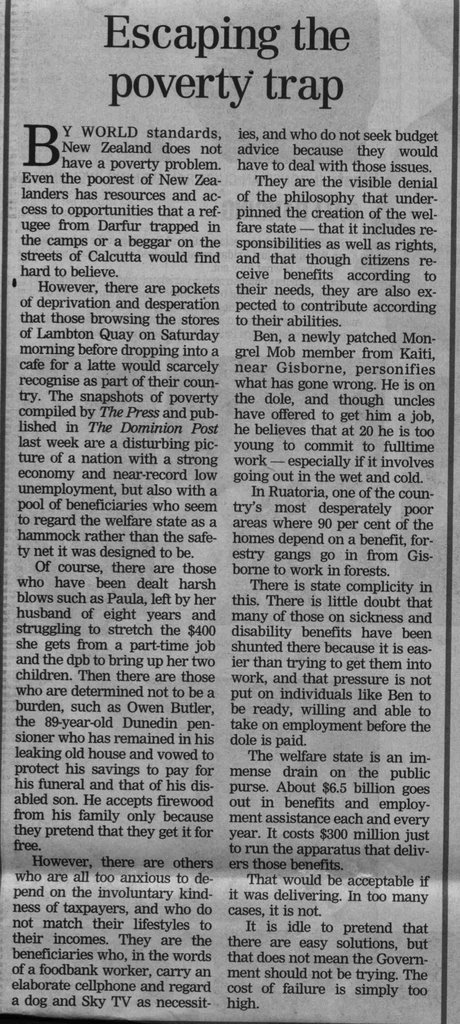
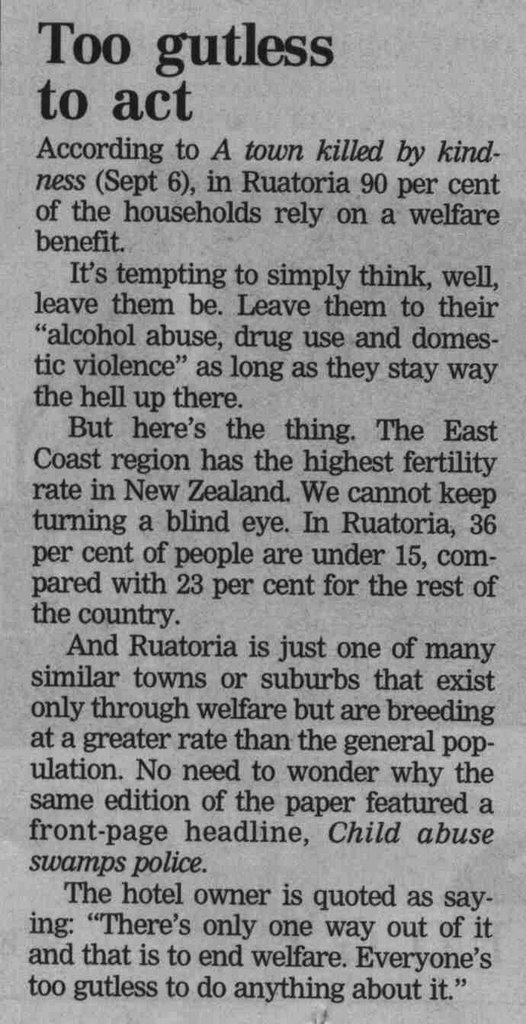
The writer of the DomPost editorial and myself are on the same wave-length. These appear together today. (Left click on the editorial to enlarge)

Monday, September 11, 2006

Begging letter

Dear Wellington City Council

While I was visiting your library this morning a parking attendant placed a $40 fine under my windscreen wiper. Imagine my surprise when I returned to my vehicle, having put ample money in the pay and display machine to take me through to 11 am. Of course, it does pay to actually extract the ticket from said machine and display it on the dashboard. I am afraid I missed this important step.

As with a similar recent incident when having asked the ATM for $100 dollars I either a/ confused the receipt with the cash and put the latter in a conveniently located trash can or B/ I simply walked away from the machine without removing the five twenty dollar bills.

I am also reminded of another recent episode when my husband and I arrived at Wellington airport ready to board the 7 am flight to Auckland only to find I had booked us on the 7 pm flight. This necessitated a further expenditure of $700 in order to meet an important engagement.

Either I have entered the first stages of Alzheimer's disease or I am living proof that women cannot multi-task - that is, use their brains and their hands simultaneously. Whichever is the case, as you can see it is a very expensive business.

Would you consider waiving the charge on compassionate grounds? I cannot vouch for my safety if my husband discovers I have yet again treated his hard-earned cash as if it had no more value than Zimbabwean currency.

Your Sincerely

PM - It's a conspiracy

In her regular interview with Paul Holmes this morning the Prime Minister decided to turn the Libertarianz' pledge-card court-case into another secret funding conspiracy. Describing the Libertarianz as a "small right-wing outfit" she asked, "Who thinks the Libertarianz can afford this?"

And again, just to make sure you get the message, "The question is, who is paying for this?"

My question is, will PC be sending HC a sermon on why the Libertarianz are not right-wing?

Update; Latest NewstalkZB headlines reporting that the PM is now suggesting National is behind the "plot".

Oh, sod it

Inadvertently Sue Kedgley can be very funny. She was talking about her train trip up country to collect petition signatures and how there was a barrow-full awaiting her in Otorohanga. It's quite exciting apparently. That same wheel barrow, she said, was used to overturn the first sod on the Overlander!

This was followed by a very pregnant pause from the newsreader....

(This is what she meant, I think.)

Where to next?


1) What has our country achieved on employment and poverty issues over the last 12 years?

2) What have we learned?

3) What do you think will be the main issues that we will need to focus on in the next 12 years?


These are the three questions asked by the final issue of the Jobs Letter which has been published since 1994 and provides a valuable source for anybody interested in such matters. There are answers from a range of politicians, academics, economists, mayors, councillors, trade unionists...and me. You may have your own.

Sunday, September 10, 2006

"The pregnancy police are watching you"

I have suggested before that women on the methadone programme should also receive a contraception injection as a condition of participating. I even agree with the idea of paying "crack" mothers to voluntarily have their tubes tied, but the following moves into another realm entirely (it's an excerpt from a Guardian piece which appeared in today's SST);

In the US, women of child-bearing age are being advised to consider themselves 'pre-pregnant' at all times, by giving up smoking, drinking and drugs. What are the implications of treating people as glorified incubators, asks Diane Taylor

Two-faced troublemakers

I am assuming that the Progressive Enterprise workers are striking because of low pay (and some regional parity issues). Here's what I don't understand. Many would qualify for Working For Families assistance. Others, especially young singles, could qualify for an accommodation allowance.

These income support payments are means-tested. If their wages go up they stand to lose assistance $1 for $1. This is a simplistic but valid supposition.

But the likes of Laila Harre have a passion for sticking it to the employer first and failing that, the taxpayer second. It isn't really about the employee, who gains nothing. I will never forget her comment when it was pointed out some people were ripping off Paid Parental Leave by taking it and not returning to work. So what. It's paid for by the state, she said.

And Sue Bradford says she doesn't want the taxpayer subsidising the employer but have you ever heard her calling for less income support? No. Her answer would be to raise the thresholds for qualifying. That way she can hit up the employer and the taxpayer.

Without these infernal interferers, wealth-sapping bureaucracies, dole for deadbeats, witless politicians, the meddling masses of non-producing parasites, we would ALL be better off.

Saturday, September 09, 2006

Generous welfare does not prevent crime

This is a comment from a reader on Krimsonlake's blog;

The problem with trying to deal with the problem of people taking advantage of a welfare system is that for every ten people that you motivate to go out and get a job, one will be motivated to go out and commit crime.

If you look at other countries, like Canada and the US, tougher welfare system equals more crime and cases of child neglect, and the economy doesn't really suffer any ill effects of a relaxed welfare system because there are less criminals to take care of.


This is an erroneous but not unusually held belief that somehow welfare provision prevents crime. Canada's crime rate over its provinces is highly variable but, interestingly, lowest in Ontario, which has undergone vigorous welfare reforms, reducing their welfare numbers by more than 50 percent since 1994.

Wikipedia ;Canada's crime rate is close to the average of Western Europe, lower than some nations (United Kingdom, Sweden) but higher than others (Spain, France). Canada has several times more crime per capita than Japan.

UK and Sweden have very generous welfare - France, and particularly Spain, much less so.

And of course one would have to question why crime sky-rocketed in NZ from the sixties in tandem with the explosion of the benefit system. Don't go blaming it purely on unemployment. Look at what's going on right now with the "lowest" unemployment rate in the OECD. I would suggest crime has more to do with family structure, stability and ability to provide.

Japan's welfare state

You don't read much about the Japanese welfare state. But this article describes the problem they are running into with low fertility - 1.32 - and high longevity. They don't want immigration given the islands are already densely populated but they don't want to give up their welfare state which is very much geared to care and provision for the elderly. Something has to give and it looks like they are going to accept "temporary" losers. Workers will have to live with less job security and fewer benefits.

Friday, September 08, 2006

Maharey muck-up?

Just watching an interview with Steve Maharey and Wayne Mapp. Maharey has caused a stink by giving a $200 donation to a fund which was set up to assist the locked out/ striking Progressive Enterprise workers. Mapp says he is taking sides. Maharey says he is helping to feed his constituent's kids. And he really should have given more and he would do it again.

It's Maharey's money. He's given it voluntarily. Seems to me it's a better solution than having his constituents down at the WINZ office looking for handouts. For once I think I might be in sympathy with Mr Maharey.

Hostels for single mums

The Welfare State We're In discusses a recommendation from UK Labour MP David Blunkett (ex Minister for Work and Pensions) that young single mothers should go into hostels instead of being provided a council house or flat.

Thursday, September 07, 2006

Criminal families

Just wondering if Nathan Fenton, accused of murdering 17 year-old Mairina Dunn is related to these two.

Caesareans increase risk of newborn death

The Scotsman reports, Newborn babies are more than twice as likely to die when their mothers choose to have a Caesarean section, compared with natural births, according to new research.

Although the reasons remain uncertain, the scientists said the gap between the figures could be that labour helped babies to breathe better and adapt to the outside world.

They said understanding the causes of the differences was important because of the rapid growth in the number of women choosing to have Caesareans.


In 1999 Caesareans made up 20 percent of NZ births. As well as increasing risk to the baby, other hot-off-the-press research has shown Caesareans triple the risk of the mother dying during the birth.

Karaoke crack down

Reason reports, The Chinese government is concerned about people singing risqué songs in karaoke bars. So it is rolling out a program in test cities in which karaoke bars can choose songs from a central database. The approved songs will exclude those with sexual content, political themes and foreign slang.

Umm. What does that leave?
The perfect job for a man who can only count to five? Put him in charge of a newly created billion-dollar Super Ministry.

The Lazy Left

The following is an excerpt from a piece by Jane Kelsey. It's about child poverty and the government's refusal to pay the In Work payment to beneficiary families;

First, as the Child Poverty Action group repeatedly points out, this condemns New Zealand’s already disadvantaged children to begin life of poverty from which they may never recover. Some 230,000 children pay that price simply because their parents are beneficiaries. New Zealand (and Labour) once believed in equality of opportunity. Indeed, Labour’s own 2002 Agenda for Children aims ‘to make life better for children’ and its social policy published in 2004 recognises that ‘poor child health is linked to poor adult health and also to broader poor outcomes including unemployment and crime’. No more.

The differential impact on Maori compounds the structural inequalities of colonisation. Maori and Pasifika families are often the poorest, largest and most benefit-dependent. Ministry for Social Development figures released in April 2006 showed 93,423 Maori children and 137,857 non-Maori children would be excluded from the benefits of the package. This represents 45.9 percent of all Maori children, 29.6 percent of Pasifika children and 12.3 percent of Pakeha children. Such discrimination negates the possibilities for these children to participate, belong and achieve within New Zealand society and constitutes another violation of the Crown’s obligations under te Tiriti o Waitangi. In economic terms, abandoning so many today’s children will deprive the country of the healthy, educated and socially stable adult generation we will need tomorrow.

My comment; The left is fundamentally lazy. Social problems are intrinsically linked to a lack of money. The lack of money is the fault of government policy. If government policy is changed and South Auckland or Ruatoria or Aranui families receive more money the lives of their children will be vastly improved.

Does anybody really believe that (apart from diehard socialists)? We've spent nearly seventy years trying this approach to little avail it would seem.

Kelsey's attitude is patronising (the poor have no responsibility for their own circumstances) dishonest (it is society's fault that brown children are disproportionately poor) and, above all, lazy (forcing government to pay more is all we need to do.)

Wednesday, September 06, 2006

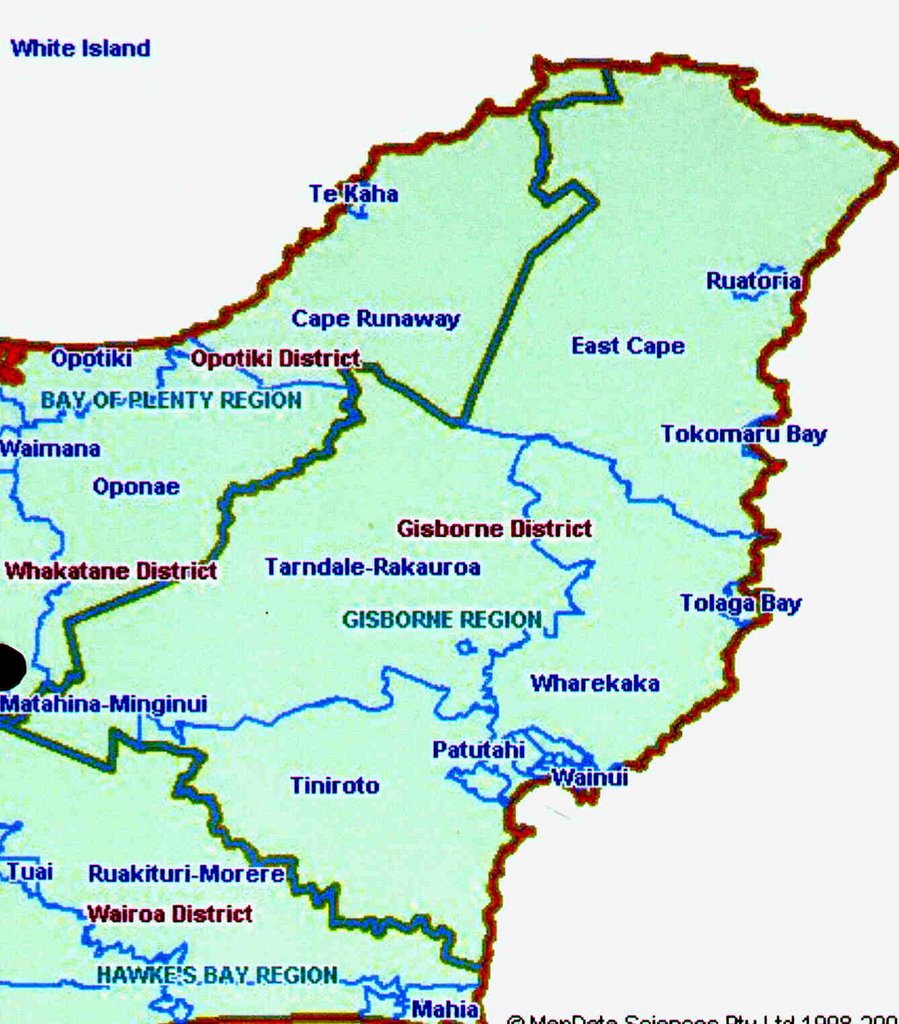
Ruatoria etc

Ruatoria. I tried to do some research about Ruatoria a couple of years ago but I couldn't reach a conclusion based on the information I had. The continuation of the DomPost series, "Of poverty and priorities" has the answer I was looking for. Apparently in Ruatoria ninety percent of the households rely on a benefit. So why was I particularly interested in this little East Coast town?

Looking at the 2001 Census Ruatoria has one of the highest ratios of one parent families. There were exactly the same number as two-parent families. Apparently there were 87, yet DPB claimants registered at the Ruatoria WINZ office at 2004 were 216. The population was trending down so the discrepancy is probably explained by a large number of claimants living in the sticks.

Reading this morning's piece it is tempting to just think well, leave them be. Leave them to their alcohol abuse, violence, fighting and criminality just so long as they stay way the hell up in Ruatoria. But here's the thing. The East Coast has the highest fertility rate in New Zealand. We cannot keep on turning a blind eye. Thirty six percent of the people are under 15 compared with 23 for the rest of NZ. And Ruatoria is just one of many similar towns or suburbs which exist only through welfare and are outbreeding the general population. No need to wonder why today's frontpage headline reads, "Child abuse swamps police".

Here's a couple of quotes from another in Martin van Beyen's excellent series;

Ron Hedley, owner of the local sawmill, confirms he has vacancies....The work ethic and pride in independence have been lost, he says. "A culture has been established with the Government keeping everyone afloat with handout money, and why work if you've got someone who is going to support you?"

Joe Parata, who runs the Ruatoria Hotel, echoes Mr Hedley."There's only one way out of it and that is to end welfare. Everyone's too gutless to do anything about it."

Tuesday, September 05, 2006

Spend, spend, spend!

Having made an oral submission opposing the establishment of the Families Commission, every so often I have a look at their website to see what they are up to. Not a lot. Here is their latest piece of earth-shattering research. Remind me again how much they cost us? $7 million a year. What a waste of money.

"Maori unemployment still a serious problem"

I referred yesterday to an article by Rob Mcleod about Maori unemployment. Here is a link.

Today the general unemployment rate is down to 3.6 percent yet the Maori unemployment rate remains over 8 percent, the same as the general rate in 1994. Worse, the Maori youth unemployment rate is a tragic 18 percent. Yet how rarely do we hear politicians and commentators saying this is unacceptably high?

Benefit rises lead to more single mothers

The Greens and the Maori Party should heed new research which estimates that an increase in yearly benefits of 1,000 euros $NZ 1,976) will increase the incidence of single mother families by about 2 percent.

These two parties are supporting the Child Poverty Action Group's legal challenge to force the government to increase payments to beneficiary families with children. If they succeed we are likely to see more young women becoming single mothers.

The research analysed 14 European countries and found that Britain had by far the highest proportion of single mothers in the European Union. The report says that eight percent of British households were headed by a single mother aged 18-35. Britain also has one of the highest benefit rates. The lowest numbers of single mothers were in Spain, Greece, Portugal and Italy.

The researcher, Libertad Gonzalez, a Barcelona academic, said, 'The correlation across countries is quite striking. The countries with the highest incidence of single mothers are also the countries with more generous benefit, and vice versa....Spain, Greece and Portugal with small numbers of single mothers also have lower benefit levels. The UK and Ireland are both generous with benefits and have a higher incidence of these families.'

According to the British Sunday Times, latest figures from the Office for National Statistics show single-mother families in Britain have steadily risen from 1% of all households with children in 1971 to 11% in 2004.

By contrast New Zealand's 2001 Census showed 24 percent of all families with dependent children were headed by a single mother, with a further five percent headed by a single father. The numbers are projected to rise.

In the past the OECD has criticised New Zealand's single parent benefits as being too generous. This new research, and other research from the US, would suggest that there is a strong correlation between the level of our benefits and the high number of single mothers.

If the proponents of increasing benefit rates are still not convinced, they may care to have a look at the Dominion Post, page A8 today, where even a single mum on welfare says giving more money to beneficiaries is not a good idea. She is quite clear about where the money will end up, "They'll just spend it on more piss".

Monday, September 04, 2006

One in four Maori on benefit

An article in the DomPost business section today, by Rob McLeod, reminds us that when general unemployment was over eight percent there was much hand-wringing. Yet Maori unemployment is still that high despite having dropped considerably.

Which prompted me to check how high their overall benefit dependency rate is.

I am relying here on estimates from 2005 (roll on the Census releases). In the 18-64 age group there are around 347,000 Maori (a slight over-estimation due to relying on five-year age bands balances a slight under-estimation due to being a year old).

At the moment 86,893 18-64 year-old Maori are on a benefit or 25 percent. The Pacific rate is about half that and the non-Maori or Pacific rate around 8 percent.

I suppose we should adopt the glass half full approach and celebrate 3 in 4 Maori not being on a benefit!

Where is he indeed

I once had a run-in with Phillip Field over the Social Services Select Committee table.

He became highly agitated about my wanting to abolish the DPB and launched into a tirade about women and children living on the streets of india. Had I been there? Had I seen it? Is that what I wanted for New Zealand? Despite the barrage of questions I couldn't get a word in edgeways. Eventually the chairwoman Georgina Beyer intervened and told him to let me respond. At which point I simply pointed out that India does not have the lowest unemployment rate in the developed world. Well, that didn't help matters. He then appeared to be speechless.

But the impression left with me was of a man barely under control. I'd met him before at select committee, previously he had been chairman, and he was always very calm and civil. But last year he was a different man.

Anyway, I was reminded about this because I came across the TransTasman ratings for MPs in 2003. About Mr Field, who at 3 out of ten only had one Labour MP rated lower (Ashraf Choudary) they wrote;

Another behind the scenes man. Lovely voice but not much else. Faded after a promising start. Where is he?

Sunday, September 03, 2006

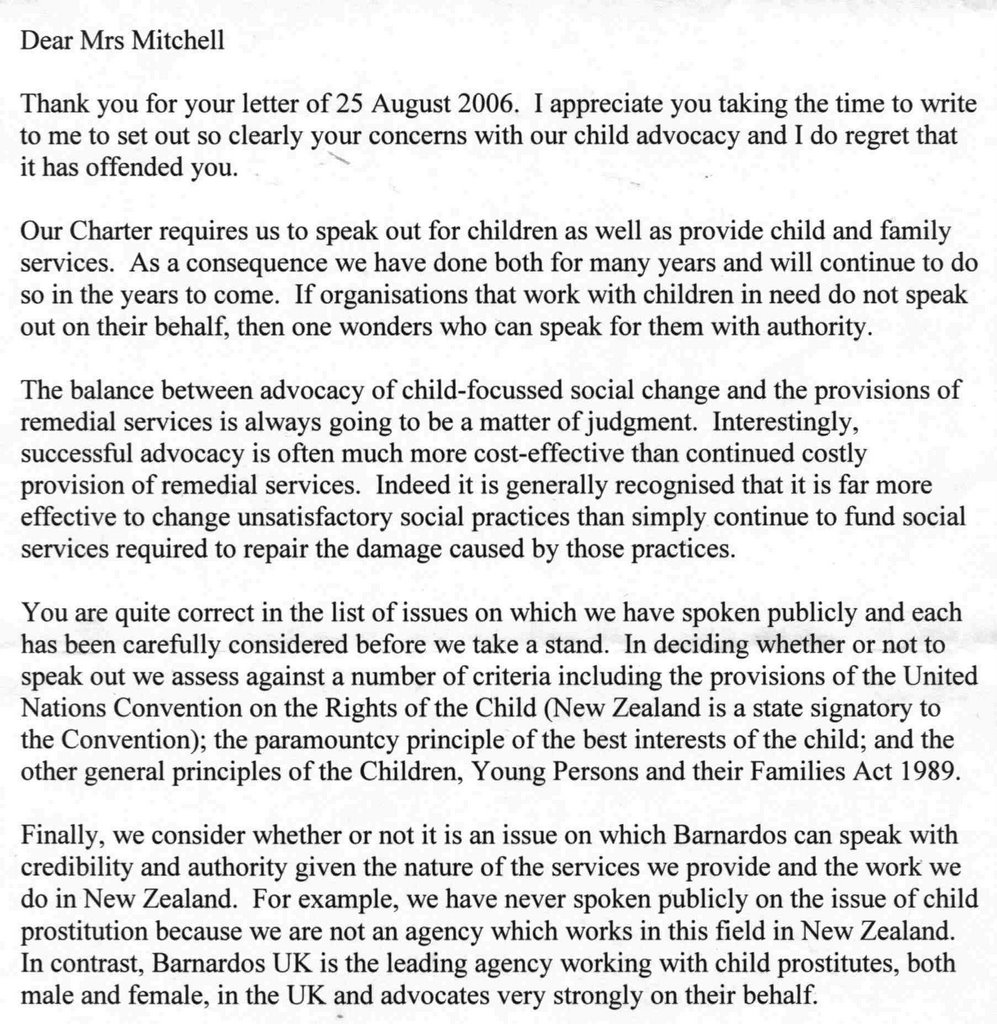
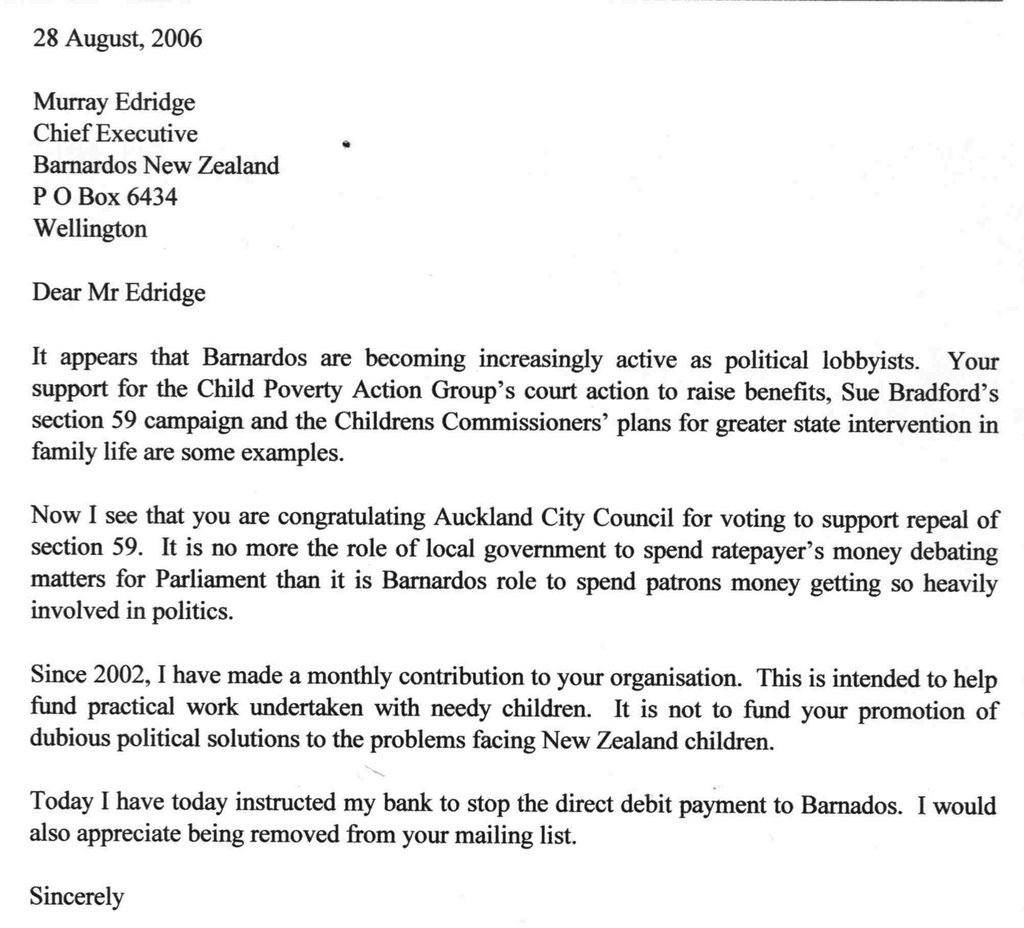
A few of you were interested in my letter to Barnardos CE Murray Edridge. Here is the reponse;

Saturday, September 02, 2006

He had his finger on the button

Following on from the last post, in 1888 another character toured the country having a look at the poor. He was Duncan McGregor, the Inspector of Hospitals and Charitable Aid. He opposed 'outdoor relief' (any form of charity that was provided outside an institution). He spoke against central government's role in providing assistance to the poor because it taught men and women to rely on government and 'disbelieve the scripture, "He that will not work, neither shall eat" '. He also claimed that, 'we mortals have the capacity to consume the solar system on such terms....Society attempts to cheat both God and the Devil by giving money out of...taxes, and soothes its conscience by thinking it is providing for the poor; whereas in sober fact it is merely drugging itself and poisoning them.'

(Source; A Civilised Community, Margaret McClure)

"Of poverty and priorities"

That's the title of an extraordinary article in today's DomPost. It makes for compelling reading. The writer, Martin van Beynen and photographer, Kirk Hargreaves, toured the country looking for the worst poverty and talking to people about their circumstances. His experience is very much what I've found volunteering. And the volunteers and social workers he spoke to are also fairly cynical but keep on going. You cannot not want to help some people but it's damn near impossible to get them to change their priorities. Here are some passages (with the odd comment from me in italics);

(But) in most areas, benefit dependence, criminality, drug and alcohol addiction are not the norm. In the areas we visited, they are.

We find the poor. The worthy poor, and plenty who are poor through their own fault.

A long-time South Island foodbank worker says, "If I was cynical, you would say they all carry a cellphone, they all have a dog, and the majority of them have Sky TV and they smoke. Where are their priorities?"

"They won't go to budget advice because budget advice will address those issues. And it's not just a plain phone - it's got to be an eleborate telephone."

We can vouch for the fact that the stereotypical beneficiary, shy of work and yet driving a good car, drinking, smoking and watching SKY TV, exists in good number. It is a hard heart, however, that doesn't sympathise when the circumstances are known. Even if the head shakes in disbelief. (I know that feeling well).

Ben, 20, of Gisborne, an agreeable Mongrel Mob member recently patched, has a one-year-old, a partner and is on the dole. His dog, a faint-hearted mongrel, tucks into a fish head as his partner hangs out the washing. He agrees work is plentiful in the area but he's not yet ready to "commit" to fulltime work, especially in the wet and cold. The work he is talking about is often temporary and his benefit is guaranteed every week, he says. As we leave a carload of his friends arrive. Big men, none working.

In Waitangirua, near Porirua, Meagan Darwin, 27 - mother of five aged 12 to 5 - still spends $35 a week on smokes. Her power is often turned off and she regularly runs low on food. Twenty dollars a week goes to repay a benefit she fraudulently claimed.

"Smoking is my only luxury. Take it away and what have I got?" she says.

Ms Darwin's children are challenging but happy and well-cared for. She has just about given up drinking because "I'm putting my kids first."

(In Dunedin) Mrs Mehau has three children and another on the way. Mr Mehau works as a security guard for 30 hours a week, earning $11-50 an hour. Mrs Mehau, who had her first baby at 16, has never been off the benefit. "It does feel good not having to answer to anyone, but I get worried how we will make ends meet, " she says."I can see why people do benefit fraud. It's so much easier." (She should know.)

They have a huge new TV, a dog and an old six-cylinder Ford Fairlane. The TV and the new washing machine and dryer are on hire purchase. Recently they had to use the foodbank. In some ways they are the classic beneficiary family, their own worst enemy. (I've said this directly to one girl but you aren't telling them anything they don't know.)

We see many beneficiaries eking out a meagre and strained living. Those living honestly will always struggle unless they budget tightly and live frugally.

Several beneficiaries admitted outright fraud to me. One had a boyfriend living with her, but not officially. He had his own state house (his own?)which he rented out to illegal immigrants.

Many times we are reminded how small NZ is...... no one is that far from a medical centre or a major town. Nowhere is so remote that services cannot be accessed. Ruatoria has a courthouse, a police station with four fulltime staff, its own Work and Income office anda health centre.

We expect to find worse. It seems as if some areas have had a clean up just for us.... We go to Clendon, which is the new Otara of South Auckland. The area is rent with gang violence, domestic assaults and dependence. Yet the house are only ten years old and still in good condition.

South Auckland social worker Emelio Estaban, who has worked in the slums of Chile says, "The outside look all nice and new. The hidden part of the picture is indoors. The problem lies not so much with the buildings but the families inside them."

In Kaiti, Gisborne, a (shop) attendant explains Mates beer - $5-90 for two litres - is bought only by the "alkies". The tipple of choice for the area, one of the poorest in New Zealand with a huge domestic violence problem, is Steinlager and Purple Goannas, she says.

In some areas, people,often young mothers with big families, appear to lead lives of utter grimness. In a state house ghetto in Gisborne, I approach a Maori holding a child on her hip. When she speaks I see her teeth are mostly black stumps (probably thumped out of her). She is 25 with six children. She says she can't talk to us about her life. So bad you can't talk to us? "Yes" she says.

Most tragically we find the mentally ill and the lonely living rough without the support of friends or family.

In Kaikohe on a bitter Sunday we go to Purdy St and find Katrina Witehira, 41 and Philip Robinson, 44, paying $130 a week for a ramshackle house with warped plywood covering many windows.

Both on invalids benefit because of mental health problems, they have run out of money. The power is off and there is no food. The floor lets in a cold draught through a hole in a cupboard and you can see the sky through the roof. The toilet is blocked and they sleep on a thin mattress on the floor. (Hey, but at least they are out in the community aye).

In the end, the poor defy description or generalisation. In the end, there is much to be hopeful about. (I wish I was so optimistic. The recurring theme through the piece is the presence of so many children living in awful situations. The next generation of poor, dependent and often dysfunctional people is growing up now.)

Friday, September 01, 2006

Bridget Saunder's HighLife

I didn't know my husband read gossip columns. He telling me something passably interesting about Rodney Hide being spotted craning his neck at the Boobs-on-Bikes parade. But this was better;


Update; According to Rodney Hide's blog he has an alibi. Umm. Now I remember why I don't read gossip columns.

Quizz

One of these is Goldie Hawn. Who are the other two?

Thursday, August 31, 2006


Oswald's been fantasizing about Father's Day. But by the sound of things it's about as far-fetched as this one.

Who was he kidding

When writer Charles Murray last visited NZ talking about the incentives inherent in any state welfare system and the problems with benefits for single mothers, then Social Development Minister, Steve Maharey said this;

I do not support the view that the dpb is a lifestyle choice for many young women. Nor is there any research that supports it.

Reasearch? The fact that thousands of women continue to grow their families courtesy of the taxpayer is all the evidence I need. Here are the latest figures;

27,219 DPB 'clients' had added one or more children to their benefit at June 2006.

At October 1, 2004 the number was 23,160. The habit is catching.

Don't tell me that's not about lifestyle choice.

Don't believe the telly

Leo Leitch will be familiar to people who read letters-to-the-editor. His opposition to abortion is a recurring theme. He reluctantly supported my DPB petition letting me know by fax - sent at about 2 in the morning. That must be part and parcel of his "sense of humour". Now it has got him into trouble with the law and cost him $750. TV ads had mistakenly led him to believe police officers also have a sense of humour.

We don't know how lucky we are

One could be forgiven for feeling like we live in an increasingly violent, crime-ridden country based on the events of the past few weeks. The newspapers are full of disturbing stories and murders don't even make the front page anymore. But take heart. These statistics will reassure you that we are in fact living in a relatively safe country.

South African crime statistics for last year showed:

# 18,793 murders, an average of 51 a day in a nation of 47 million

# 55,114 reported rapes

# 249,369 assaults with grievous injury

# A South African is 50 times more likely to be murdered than the average person living in Western Europe

The Minister of Safety and Security (there's a misnomer if ever I saw one) has instructed under-resourced officers to get to a crime scene by donkey or bike if they have to. Let's hope NZ never descends to this terrible state of affairs.

Wednesday, August 30, 2006

Hypocrisy of the right and the left

On the tenth anniversary of the US welfare reforms Cathy Young writes in Reason;

Paradoxically, antiwelfare-reform feminists, most of whom had assailed the idea of full-time motherhood as a noble female vocation, found themselves defending a system that paid women to stay home with children. They mocked — rightly, in some cases — the hypocrisy of right-wingers who attacked poor single mothers for not holding jobs, yet lamented the rise in middle-class married mothers working outside the home. But surely it was at least as inconsistent for those on the left to hail the movement of married women into the workforce, and then treat full-time motherhood as an entitlement for poor single women. No, single women did not have babies to collect welfare checks; but for those who were trapped in lifelong dependency, the welfare system functioned as an enabler.

Facts about Fathers

Statistics New Zealand usually put out a "Facts about Fathers" release for Father's Day. This year, 2006, they are saying, This Sunday 135 New Zealand men will get the ultimate Father's Day present: a baby.

Two years ago they said, A baby will be a Father's Day present for an estimated 170 men this year, according to latest figures from Statistics New Zealand.

In 2004 I asked why they hadn't adjusted the figure for all the babies who were born into single parent homes, some who would never know who their father is or even have his name on their birth certificate? Thousands of babies would be presents for the taxpayer, not fathers.

Now, I do not know exactly how they make this calculation. Given that babies rarely arrive on the due date, Father's Day is always on the same day in the week and time in the season, I can't think of any better way than to simply divide the September quarterly births by 91 days. Given the quarterly birth rates have consistently numbered around between 13,500 and 14,500 since at least 1992 I can see no reason for the variation from 2004 to 2006. Thirty five fewer fathers on Father's Day this year?

Perhaps Statistics New Zealand have decided to factor in what they missed in 2004.

Or perhaps there is simply some special calculation they use of which I am unaware. More babies are now being scheduled for caesarians and Father's Day is not a 'working' day but I doubt the calculation is been based on asking every maternity ward how many deliveries they are expecting this Sunday.

Tuesday, August 29, 2006

Kids comments

A number of Primary Schools were doing a project on "The Sea". Kids were asked to draw pictures, or write about their experiences. Teachers got together to compare the results, and put together some of the comments that were funny, and some that were sad. Here are some of them. The kids were all aged between 5 and 8 years.

This is a picture of an octopus. It has eight testicles. (Kelly age 6)

Whales are animals, not fish. If they don't get air they can drown, like my brother did last summer. (David age 7)

Oysters balls are called pearls. (James age 6)

I don't like the sea. It makes me sick on the ferry. (Peter age 6)

My goldfish died. Why? (Katie age 5)

If you are surrounded by sea you are an Island. If you don't have sea all round you, you are in continent. (Wayne age 7)

I think sharks are ugly and mean, and have big teeth, just like Emily Richardson. She's not my friend no more. (Kylie age 6)

A dolphin breaths through an arsehole on the top of it's head.(Billy age 8)

My uncle Billy goes out in his boat with pots, and comes back with crabs.(Millie age 6)

When ships had sails, they used to use the trade winds to cross the ocean. Sometimes, when the wind didn't blow, the sailors would whistle to make the wind come. My brother said they would be better off eating beans. (William age 7)

I like mermaids. They are beautiful, and I like their shiny tails. How do mermaids get pregnant? (Helen age 6)

I'm not going to write about the sea. My baby brother is always screaming and being sick, my Dad keeps shouting at my Mum, and my big sister has just got pregnant, so I can't think what to write. (Amy age 6)


Some fish are dangerous. Jelly fish can sting. Electric eels can give you a shock. They have to live in caves under the sea where I think they have to plug themselves into chargers. (Christopher age 7)

My mum has fish nets, but doesn't catch any fish. (Laura age 5)

When you go swimming in the sea, it is very cold, and it makes my willy small. ( Bob age 6)

When me and Sarah went to the sea side in the summer holidays, we hid in the sand dunes and watched my big sister doing it with her boyfriend. It was fun. (Lauren age 7)

A submarine goes under the water like a fish, but it has lots of seamen inside. (Emma age 5)

When I grow up,I want to be captain of a big ship, and have lots of sailors (Valerie age 6)

Divers have to be safe when they go under the water. Two divers can't go down alone, so they have to go down on each other. (Becky age 8)

On holiday my Mum went water ski-ing. She fell off when she was going very fast. She says she won't do it again because water shot up her fanny.(Julie age 7)

Massey research on stay-at-home-mums

Apparently new research shows most New Zealanders approve of stay-at-home mums.

That's all well and good but what do they think about unpartnered mothers, who make up almost a third of all mums? Would their attitude change if the mother had to be on a benefit in order to stay home? Unfortunately the survey doesn't ask, which I think is something of a weakness.

It is worth bearing in mind if more mothers had financially supportive partners and we didn't have to pay so much tax to support them, fewer partnered mothers would need to work.

We cannot have our cake and eat it too. Somebody has to pay for the welfare state.

This claim is rubbish

The Dominion Post reports Social Development Minister David Benson-Pope saying, The Government was paying out $1.2 million a year less in benefits than in 1999. I was wondering why he would be crowing about such a paltry amount until I checked his press release which actually gives a figure of $1.2 billion. Slight typo on the DomPost's part.

Nevertheless I am very surprised at this claim.

The Crown Accounts Analysis for June 2006 isn't due for release until November but last year's showed the following;

1999 $12,429 (million)
2000 $12,483
2001 $12,681
2002 $12,838
2003 $13,110
2004 $13,352
2005 $13,448

If Benson-Pope is right the next figure should be $11,229.

There is no way that could happen. Even if all unemployment benefits were removed the total would only drop to $12,596.

I suspect the DomPost reporter's typo is closer to the mark.

Women's "workplace revolution"

A new plan drawn up by UK Minister for Constitutional Affairs, Harriet Harman is grossly intrusive. There and here Labour is slipping back into control mode;

Under reforms introduced by Labour, employees have the right to ask their boss if they can work part-time but there is no obligation on them to agree. In the next stage of reforms being proposed, employers would have to prove the job cannot be done part-time to refuse the request.

What employer in their right mind would be trying to make a full-time job out of a part-time one? (Apart from one in the civil service)

Monday, August 28, 2006

Overdue letter

It's always a risky business for charities to get involved in politics. Of course they are free to, just as I am free to withdraw my support.

Feminism to blame

A few weeks back I posted about the increase in female violence in Timaru. Now it seems their female drink-driving rate is rising pushing the overall rate up again after years of decline. This editorial puts some of the blame on feminism;

From women never being able to wrest the driving wheel from their partners to only getting the privilege when driving him home from the pub, now Timaru police find half their drink drive offenders are women. And they come from all walks of life. What's going on? The feminist movement has something to do with it.

........The message has to be the same to everyone. Drunk drivers maim and kill. It doesn't matter what gender they are.


That's an interesting observation. Whereas a drunk female assaulting someone has less chance of causing serious damage than a male, behind a wheel she has exactly the same potential.

Who's to blame?

This awful case of the 17 year-old killed in the security van throws up a number of culprits;

The killer and any accomplices obviously, the seventeen year-old whose own actions landed him in the situation, the security guards for his placement, and last but not least, the youth justice system.

Parents Ian and Lorraine said they had no confidence in New Zealand's youth offender system and wanted him to experience prison after a series of "minor misdemeanours".

"In an attempt to stem any escalation of a more serious nature, they officially charged Liam with the theft of their vehicle," the family said.


These are not the first parents to find they have no effective back up from the police or court system. The approach to youth offending is to keep them out of court until it cannot be avoided - hence only 17 percent of offenders end up there.

Now one could argue if this kid had been kept out of court he wouldn't be dead. Fair enough. But his offending would have escalated. At least that's what his parents believed and they knew him better than I do.

Unfortunately his age also killed him. At seventeen he was too old for the youth court, although I seem to remember reading somewhere a district court case could be referred to the youth court for a seventeen year-old.

The problem is kids know the law is soft. Parents struggling to control them get no assistance.

Just check out a NZ Yearbook. Youth offending is categorised under social services. Adult offending under crime and the justice system.

My heart goes out to his parents who were doing what they believed was the best by their son. What a tragedy. What a travesty.

Sunday, August 27, 2006

Teen pregnancy rate

Oswald asks how our high school preganacy rate compares to the one at Canton High, Ohio. Unless individual high schools or colleges keep data I don't think we know.

What is known - of the 15-19 year-old female population (est 151,050) there were 3,718 abortions and 4,138 births in 2005. This means the pregnancy rate per 1000 is 52. Factoring in miscarriage, which affects 15 - 20% of all pregnancies, the rate climbs to 59-62 per 1,000.

So at the upper range 6.2 percent of 15-19 year-olds will become pregnant each year.

The US high school pregnancy rate is 8.4 percent - the Canton School was double the national average. There is every chance that in our lowest decile schools the average rate is also double. So it isn't beyond the realms of reasonability to suggest that one in eight high school pupils might get pregnant in a given year at a given school.

(There were 115 births and abortions in the 11-14 year age band but they are not statistically significant. Also it is possible that some of the births and abortions in the 15-19 year age band were to the same individual but again I don't think these will make a significant statistical difference.)

Saturday, August 26, 2006

Again - bans do not work

Here's a story from an Ohio High School where one in seven girls is pregnant. The school has preached abstinence-only. Like any other type of ban, it hasn't worked. Bans do not work. More likely, they have an opposite effect to the desired.

Election Spending - get over it National

On the subject of the 2005 election spending Bill English writes;

What About The Three Blind Mice?

The next episode of this drama will test the character and principles of Rodney Hide, Peter Dunne and Winston Peters. Labour want to pass legislation to validate everything they have done and bring in State funding of political parties. Act, NZ First and United Future all face hefty bills to repay the public money they spent on electioneering, and so far they look like they will support Labour's legislation. So, along with Helen Clark, they will all have their finger in the wind for the next few weeks testing public opinion to oblige Helen Clark and let her get away with it, or will they all have to pay the money back? You decide.


OK. By my calculation, with the backing of NZ First and the Greens alone, UF and ACT can vote against any retrospective legislation and it will still pass. Having voted against it, will their principles demand they repay sums as have National and Maori?

They will not be obliged to. And personally, as an ACT donor I wouldn't want my money being handed back to Parliamentary Services while Labour and the Greens sit on theirs. But, there is another way to look at this whole thing.

If ACT spent my tax on their yellow bus I have no complaints. Just as Labour- supporting taxpayers probably won't be too concerned about public spending on the pledgecard and Green taxpayers won't be opposed to public spending on energy pamphlets, etc. And as the funding and spending is on a pro rata basis it all works out quite neatly. The only taxpayers who are really upset are National supporters and Libertarianz voters. If National had dipped into Parliamentary office funding too then their supporters would have also got some value for their tax dollars. Libertarianz, with no parliamentary representation, never got the option.

Apart from which Bill English is hardly in a position to be questioning the principles of Hide, Dunne and Peters;

According to the Herald;

FROM THE PUBLIC PURSE

* Bill English's campaign against the Government's foreshore legislation.

* Green Party energy pamphlet.

* NZ First's foreshore poster used last election.

* Act's yellow bus.

Friday, August 25, 2006

Welfare reforms; UK light-years behind US

Socialists write such drivel.

Here's the headline,"Britain: Labour government proposes punitive welfare reforms"

An example of a 'punitive' reform is;

* Mandatory interviews every six months for lone parents on income support with children under 11 years of age and every three months for those whose youngest child is more than 11, in an effort to get them back to work.

Oh, that's really harsh now.

Of course, the reforms are all about "serving the needs of big business". It couldn't possibly be a matter of no longer tolerating some people living off the efforts and honesty of other people. Or that kids need an example of a working parent. Or that people are happier when they participate and have some control over their lives. No. The socialists, the great friends of the downtrodden, wouldn't see that.

Not adding up

A report about how primary school children are performing is a mixed bag. It's not all bad but here's what stood out for me.

It says, Girls and boys performed equally on most maths questions, and disparities between the performance of children in high and low-decile schools had reduced in the four years.

That's good I thought. But is it? It could be that the performers in the higher decile schools aren't doing as well. There isn't enough information in the article to ascertain whether this is the case but;

Otago University's latest National Education Monitoring Project reveals a marked decline in pupils' knowledge of basic number facts and their ability to correctly answer simple maths problems, particularly at Year 4 (eight and nine-year-olds).

So, at least in the basic maths area, if the disparities have reduced, it stands to reason the declining performance must be more prevalent in the higher decile schools. If that isn't reassuring enough for a parent the following quote is;

Annis Hew, whose nine-year-old daughter, Tiffany Ang, receives extra maths tutoring in Christchurch once a week, said she wanted her daughter to excel beyond New Zealand's average standards.

"We have come from Malaysia and we found the system here had a lower standard," Hew said.

"She was above average when she got here, but we wanted her to be at the same standard as she would be in Malaysia, so we have sent her to tutoring to help with that."


The lesson is don't just rely on the school to do the job. Make sure you know what your kids don't know.

Thursday, August 24, 2006

Warning

This makes a lot of sense and the conditions he describes apply here;

Outgoing Reserve Bank governor Ian Macfarlane has warned that Australia likely faces a recession within the next seven years — one that could be made far worse by the heavy debts of Australian households.

Mr Macfarlane said that the biggest risk was that if an outside shock made the economy slow down or start to contract, the debt-heavy household sector, instead of continuing to spend and stabilising the economy as in the past, would cut its spending, making the downturn worse.

In the 1990-91 recession, he said, "the boom and bust was in the corporate sector. Companies were going broke, banks failing, people selling stuff at distress prices. The household sector was a stabilising force.

"What I fear is that next time there's a negative shock to the economy, the household sector won't be the same source of stability. It might be the source of instability."

Exporting the problem

It's rather disturbing that the judge is ready to inflict this time-bomb on our cross-Tasman cuzzies;

A teenager appearing in court yesterday on his fourth drink-driving charge in six months got nothing more than a heavy fine.....

On one occasion, he was so drunk, police were called to the intersection of Carrington and Huatoki streets at 7.30am by concerned members of the public who had reported a man asleep in his car.

Police arrived to find Brunning asleep in the driver's seat with his keys in the ignition.

In the front of the car's grille was a large section of hedge, the front driver's wheel had been worn to the rim and the car was covered in dents.....

(The judge's) decision followed an appeal by defence counsel Turitea Bolstad for a fine to be imposed, so Brunning could go with his mother to live in Australia.

Brunning's family embraced with cheers of congratulations after he left the court.

Wednesday, August 23, 2006

Back to bailing-out loss-makers


So now the government is considering bailing out the Overlander. 51 percent of poll respondents to Stuff say they wouldn't use the service to keep it going. That should be good enough for a Minister spending somebody else's money.

The Overlander was constantly unreliable. Not a proposition that any self-respecting tourist agent would want to promote. And unfortunately that's where the service's viable market lies.

Barking


Britney wants to be buried with her dog

Does she know anything about the life span of dogs?

Fudging the issue

The Children's Commissioner organised another meeting yesterday to discuss youth crime. Same old, same old. Our current approach is fundamentally sound (despite it not actually working) and potential criminals almost always come from a "high risk" group who are easy to identify.

So, why not identify them?

Nine times out of ten they will be registered at WINZ within days. There's the first flag. If we are going to pay people to hold onto babies they can't raise well or even adequately, at least use the system to some advantage.

Lesley Max, chief executive of the youth lobby group Great Potentials, agreed with Judge Becroft.

She said a major factor in early intervention was parenting, and funding was needed so more help could be given to teach good parenting skills.

The steps to stop children becoming the victims of abuse were the same as the steps to stop them becoming perpetrators of crime.

New Zealand had a shameful record of child abuse, she said.

A baby crying around a young male could spark a crime with fatal repercussions.


International research indicates that most babies are killed before they reach 12 months and most newborns are killed by their mothers. But let's not mention that.

And see what else she said? MORE funding is needed. We pay the wrong people to become parents and then have to pay more to teach them how to become half-decent parents? Oh, save me. Adrift in a ship of fools.

Tuesday, August 22, 2006

How cynical is that?

Just off Newsroom;

Rates Probe? - The Prime Minister says it may be time for MPs to hold an inquiry into local government rates.

Isn't that the most cynical move? Of course the PM wants to shut down Rodney Hide's bill so is giving NZ First the nod.

Why? Because it's central government's aim to shove as much onto local government as it can over the next few years. They call it devolution. I'd call it passing the buck big time except.....they will hold on to the taxpayer's buck while the council takes ever more of the ratepayer's.

Laurie O'Reilly

The role should be scrapped but as Children's Commissioners go, Laurie O'Reilly was one of the better;

LAURIE O'RIELLY

The Children's Commissioner Laurie O'Reilly, who is terminally ill, has made his last planned public appearance at the Family Violence Symposium in Palmerston North. He used the occasion to urge more support for the Commission's Fathers Who Care: Partners in parenting programme.

O'Reilly: " The most urgent thing now facing NZ is the issue of fatherless families we have to address and develop a new attitude to parenting, it is a shared responsibility. We have been so liberal and brave and modern in meeting our own needs as adults that we have overlooked our children and everyone has an obligation to see that changed..."

Source Sunday Star-Times 31 August 1997 "O'Reilly still has his eye on the future" by Miriyana Alexander


He would be disappointed in our complete lack of action and progress in the following years. Just more huis and programmes and worsening statistics. Pay for fatherless families and that's what you get.

The world doesn't owe me a living

This is from a fairly balanced article in yesterday's Washington Post. It demonstrates how people now view welfare in the States. My feeling is there is a good chunk of New Zealanders who believe welfare (for people able to work) should be temporary;

Miss Britt, 35 and the mother of three, entered the District's welfare system in 2002 after leaving an abusive relationship. She has finished classes in medical administration at the So Others Might Eat's Center for Employment Training and expects to be employed soon and off welfare within the year.
Miss Britt never experienced the "unlimited" welfare of the old system, but says she doesn't mind that the Temporary Assistance for Needy Families (TANF) benefits are limited. "Temporary is just that," she said. "I know that it's going to end."
She is grateful for the many efforts aimed at helping her leave welfare and get a good job. "Nothing is more gratifying than to walk into a grocery story with my own money, rather than a TANF card," she said.

Where do they find them?

This is a stomach-turning story but the circumstances in which the alleged abuse took place aren't uncommon. What caught my attention was the headline, "Mother's lover denies abuse".

I am looking forward to the day when I read, "Mother's love denies abuse."

Monday, August 21, 2006

Child Support 2

Total child support debt at October 31, 2005 was over $1 billion.

The amount of debt belonging to non-custodial parents living in Australia is actually down slightly (6.4%) from $301,182,023 at October 31, 2005.

Comparing sets of figures at points in time sometimes disguises a downward trend. That's not Judith Collin's problem but, if he is planning to make one, Revenue Minister, Peter Dunne is a bit slow. Probably busy swotting up his Oxford.

Child Support debt

According to Judith Collins, In 2003, $73,207,549 was owed by liable parents known to be living in Australia. Today that figure has ballooned to $281,913,850.

It's quadrupled.

To put that into context, in 2004 the total collections for Child Support were $294,966,857!

The huge Australian figures are in part the result of interest accruing. Any amount not paid by the due date has 10 percent interest added and a further 2 percent of the total amount is added each month.

I know some readers are better informed on the subject of child support than I am and would be interested to know how much of the increase Collin's is reporting is due to more renegers fleeing to Oz and how much to accrual interest and penalties on existing debt.

Culture of "respect" - not what you think

Andrei wondered what point I was trying to make by posting a Spectator letter about heroin and New York. None in particular. Occasionally I read something which makes me stop and think and figure it might make other people do the same. The 'crack epidemic' did contribute to US crime across many cities. But New York City's approach to crime has been especially successful where others have failed. That can't be denied.

Crime is associated with many factors; relative poverty, race, family breakdown, welfare dependence, unemployment, drugs - their use and status, alcohol abuse, illiteracy, mental health problems, feminism etc. A claim that the resolution of any one factor has led to its reduction is extremely difficult to prove.

Here is another article which I post not to make a point but because it is fascinating, bearing in mind what happened in South Auckland over the weekend;

Not long ago, the United States was declaring "mission accomplished" on crime: Homicide rates were plunging, the crack epidemic was over, the broken windows were fixed. Now, preliminary FBI statistics show that homicides rose nearly 5 percent in 2005, and news from around the country suggests that 2006 is looking worse. Our many Iraqs at home are making it clear that the self-congratulation was premature. In reality, Americans were lulled into complacency about violent crime. And two new factors have emerged: Some of the law enforcement tactics used to fight crime in recent years damaged the social fabric in many communities and contributed to increased crime. More important has been the spread of a virulent thug ethos -- an obsession with "respect" that has made killing a legitimate response to the most minor snubs and slights. In parts of the District's Anacostia neighborhood today, a young man knows that the wrong kind of eye contact with the wrong person -- a "hard look" -- can cost him his life.

IDOL picks

Having watched every episode of this series there is something whiffy about NZ Idol. This is a talent show, surely. But each week the producers delve into the lives of each contestant looking for pathos - the more tragedy they can find the better. If the warbler isn't singing for a recently dearly-beloved-departed then they are singing for a recently dearly-beloved-arrived. Hell, is nobody allowed to sing for themselves?

Of course, contestants have seen how surprise-selection Ashley cruised in on the public vote after revealing her endeavours were soully for her best-mate-recently-departed. Now they are all looking for some tear-jerker tale to get the soppys pressing buttons.

Oh well. I pressed buttons for two based on the fact that they had decent voices.

Matt, a brave Bee Gee be-alike sang To Love Somebody with passable earnestness and musicality (singing for his baby son).


And Aroha, singing I'll Be There described as a Mariah Carey song, whereas comparisons to the adolescent Michael Jackson would have been more apt. She's like a Maori version of Bambi (singing for her koro after two years of silence since his passing).

Got your hankies out yet?

Sunday, August 20, 2006

A different take on NY crime drop

This letter appeared in the July 2006 Spectator;


(left click on image to enlarge)

"Tip of the iceberg"

According to this NZ Herald report;

In the 12 months to July, Starship - New Zealand's largest paediatric hospital - admitted 48 children who were victims of "suspected or definite" child abuse.

Most cases involved children under a year old. Seven of those children did not survive, a figure Starship said was unusually high compared with previous years.

Overall, this equated to almost one hospital admission a week - with many of the cases "as horrific as the Kahuis", said Patrick Kelly, clinical director of the hospital's child abuse team.


The writer refers to the Kahui abuse as "just the tip of the iceberg" but it could just as easily be the 48 cases are the tip of the iceberg. For instance, how many admissions occur at other hospitals?

Saturday, August 19, 2006

It's pathetic

If you are ever tempted to think governments have made progress in social welfare over the past decade (other than employment which is actually attributable to the private sector), forget it.

Here's a piece from the Jobsletter June 1995;

PROGRAMME TO TRIM DPB
The Compass programme run by the Income Support Service is also hoping to reduce the numbers of single parents on the DPB by getting them back to work. The Christchurch pilot programme was last week featured on TV3 news and showed that of the 300 beneficiaries on the programme, a third are now off the benefit, and 25% of these have gone into employment. Budget night funding announcements will mean that every office of Income Support around the country will soon have a Compass co-ordinator. Programme organisers are predicting that Compass may help cull the DPB rolls by 30,000 people.


That year there were 102,000 people on the DPB. Today there are 102,000 people on the DPB.

But wait...there's more...

In spite of a drop in unemployment benefits, the government faces a constant and dramatic growth in other benefits, particularly with people on sickness and invalid benefits and the domestic purposes benefit.

Peter Gresham has announced that from September, beneficiaries will be given regular medical check-ups (paid for by the State), in an effort to reduce the numbers on the long-term benefits and encourage them back to work. Social Welfare says that applicants for the sickness benefit would have their initial test done by their GP. A second check would be required four weeks after the benefit was granted, then after three months the beneficiary would be required to be examined by an accredited doctor. The checks would be carried out yearly from then on. On Budget night, the Government estimated that tougher screening would save 5% of the current cost, or $60m, over the next three years by moving people from the sickness and invalid benefits on to the dole.


At that time there were 74,000 people on the sickness and invalid benefits. Today there are 122,000.

The government should STOP doing whatever it is they do. They just manage to make matters worse.

Friday, August 18, 2006

Two in three say no

A Waikato Times Stuff poll today asks;

Work on a new Ibis Hotel started in central Hamilton this week, with the Hamilton City Council one of three partners in the venture. Is this a role you like seeing the council in, property development?

67.4 percent say NO

Local government is a law unto itself.

Nanny's "great little cookbook"

Gardening and cooking skills are not being passed down. That's what WINZ staff have noticed. It's true but let's not kid ourselves the loss is confined to beneficiaries.

People grew their own veges because they needed to make their small incomes go further and/or they enjoyed the process and liked eating homegrown produce. People cooked because they had to. Some did it well, some did it adequately and others badly. Some enjoy it, some don't.

Times have changed. Ready to eat food is cheap. Go to the right places and veges are cheap (if you are interested in eating them).

But cooking and growing veges takes time which many people don't have (notice the gorgeous gardens of retired folk). Beneficiaries ironically do have the time but why should we expect them to behave differently from the rest of society? Especially those who have chosen not to work for a living.

Skills and a love for doing things are passed down through families. Stuff the family and you stuff that process. Make people reliant and they will lose their iniative. This is just another example of government screwing things up and then trying to fix it.

Of course the "great little cookbook" will be touted a raging success because everybody will take one home. Why not? After all, it's "free".

UPDATE; Shameless. I said it would happen but with such unseemly haste??? David Benson-Pope says Great Little Cookbook going like hotcakes.

UPDATE 2; The demand for the "beneficiary cookbook" (as described in the DomPost) is so overwhelming it is going to be put on a website. Seems to me there is a slight problem there. Can you spot it?

Thursday, August 17, 2006

media release

NZ FAILS WHERE US SUCCEEDS
Thursday, August 17, 2006

This month the US celebrates ten years of welfare reform.

Lindsay Mitchell, welfare commentator said, "They are celebrating because each of the aims of reform has been realised. Child poverty has fallen, employment has increased and the rate of out-of-wedlock child-bearing has been arrested."

"In particular the decline in dependence has been strong in the group with the greatest tendency to stay on benefits the longest - young uneducated single mothers."

"The Heritage Foundation has shown that during the late 1990s employment of never-married mothers increased by nearly 50 percent, of single mothers who are high school drop-outs by 66 percent, and of young single mothers (ages 18 to 24) by nearly 100 percent."

"Meanwhile New Zealand has had very little success in persuading women off the DPB. In the five years to June 2006 the total number dropped by only 5 percent. At this rate it will take another 93 years to get back to where we were when the DPB emergency benefit was transformed into a statutory entitlement in 1973."

"Sadly the percentage of 18 and 19 year-olds has risen which indicates that the overall number will not continue to drop as these teenagers typically stay on welfare the longest."

"The percentage of recipients who have a current earnings certificate has also dropped indicating fewer are working part-time."

"It is terribly depressing that New Zealand has neither the political will nor energy to emulate the US reforms. The government can see what needs to be done but simply refuses to act. I hope that this isn't merely anti-Americanism at work. The cost of Labour's failure to deal with the social disintegration that so often comes with long-term reliance on welfare is not worth paying."

Shocker

This is a shocker, really. It distresses me to read about a good man going to prison for four years for breaking an illogical law.

It's too late

This is Wiremu's story. He's 16, already has 60 charges for theft and assault against him and thinks he will probably go to prison after he turns 17. Two things stand out.

There is no mention of any family (unless you count the relative that taught him how to break into cars).

He says he has too much time on his hands.

I've met kids like this. They say what you want to hear, like, they want to do a building apprenticeship, and then in the next breath they have to remind you how wicked they are. They are basically amoral.

The odds are it's too late for this kid. He is telling us there will be more victims and we are letting him run free and probably even paying him a benefit to boot. How sick is that?

Wednesday, August 16, 2006

Who is this?


Don't cheat.


Update; The DomPost's Last Word has also noticed Sue's transformation. Asked to comment Ms Bradford said it's the result of having a good hairdresser and valuable make-up advice from her daughter. I thought I'd try out my seven year-old daughter for make-up advice. "Don't wear any," she said, taking another bite of toast and marmite.

You learn something every day...

....some of it totally useless.

I didn't know Billy Joel (not a human rights activist) wrote "Big shot" about Bianca Jagger and nor did I know that Bianca Jagger is a human rights activist. Here she is writing in the Scotsman. She should get it together with Bob Geldof. Or Bono. Bob, Bono and Bianca (but not Billy).

Tuesday, August 15, 2006

"Love thy criminal"

The justice system reforms announced today are purportedly about keeping more criminals out of jail.

Back in 2002 the government decided to lock criminals up for longer, which is what has happened. Now, Clark says, recorded crime is at its lowest level in 20 years (true).

So why stop doing what is working? Unless, in fact, it isn't.

Actual prosecuted charges have risen by 5 percent over the past ten years so locking people up for longer doesn't appear to be deterring criminals. The idea of building more prisons isn't publicly popular so, what the hell. Labour says, let's take our chances keeping them in the community or at home.

It's the public I'm worried about. Garth McVicar doesn't mince his words;

But in a scathing attack the Sensible Sentencing Trust has accused the Government as being heartless and cruel to victims. Trust spokesman Garth McVicar said. "This is more of the same old, "love thy criminal and screw the victim", policies we have had for the last thirty years".

Katrina baby boom

What to make of this. According to the LA Times a Baby Boom Adds Life to Rebirth of New Orleans. A surge in Katrina babies is especially noticeable with fewer hospitals open. Medical staff and parents see the children as signs of hope.

This is conveyed as a feel-good story about close couples.

But as I understand it New Orleans has an out-of-wedlock birthrate of 60 percent, and amongst teenagers, 96 percent. It is one of the poorest cities with forty percent of adults functionally illiterate and a very high school drop-out rate.

According to Michael Tanner, Cato's welfare specialist, Louisianna is also one of the few states that still has a generous welfare system with no cap on benefits for additional children born out-of-wedlock.

Welfare state makes us less happy

James Bartholomew writes on his blog about how the welfare state has made us less happy;

We live now in a society where the government controls more and more of our lives. It robs us of a sense that we are the ones who run our own lives. It takes away a certain dignity and, through that, it takes away some of our contentment.

The psychological impact (not to mention the cultural impact) of the welfare state has been enormous. It deserves far more study than the academic world has yet given it.

You don't say

Doctors are being urged to take a tougher approach in signing accident victims off work.

The Accident Compensation Corporation wants to reduce the amount of time some injured claimants have off work - for their own benefit and to save money.

"It's well recognised that work is something that keeps people healthy," said ACC's interim manager of health purchasing, Anne O'Connell.


That's rich. Tell it to WINZ. The number of people on a sickness or invalid benefit is 299 per 10,000 of population.

40 years ago the rate was 39 per 10,000.

Monday, August 14, 2006

"The enemy within"

The subject is obvious in this excerpt from a Times editorial, The enemy within;

Why is Britain such a breeding ground for these young men, for that is what most of them are? Much can be ascribed to timidity on behalf of the authorities, wedded as they are to a multiculturalism that isolates many young men in ghettos and a reluctance to espouse British values through our schools and institutions. That appeasement was epitomised by the sanctuary offered to extremist Islamic groups in Britain — “Londonistan” — in the pathetic hope that it might offer some form of immunity from violence. The United States, with its intolerant attitude to those preaching hate, has been far more successful in integrating its Muslim citizens, offering them the ideals of patriotism and progress. Even France, which has a bigger Muslim population than Britain and has had its share of troubles with disaffected youth, has not seen the scale of Islamist treachery that we are experiencing here. MI5 believes up to 400,000 people in Britain are sympathetic to violent “jihad” around the world and that as many as 1,200 are involved in terrorist networks.

Gay intolerance

intolerance has many faces. There are apparently gay people who criticise their gay friends, who enter into a civil union, for "selling out" to "heteronormativity". I'm struggling to understand this. Does that mean some gays really want to be different - it's the being different that's most important? But being in a de facto relationship gay or straight is hardly remarkable any more.

I supported civil unions because I couldn't see why people who want to make a formal committment to each other should be excluded. It comes as something of a disappointment to learn that their existence has created a new problem. Why can't people live and let live? That's what gays have always asked society for. But it seems some can't accord the same to each other. Double standards.

Sunday, August 13, 2006

Idol picks 2

As in past years NZ Idol went north and improved. I got a minor buzz then a major one.

Victor is a bright kid and a fast learner. He will go through.

Indira is something else. Her version of Taylor Dayne's Love Will Lead You Back was just gorgeous. As soon as she finished I wanted to hear it again. Shades of Randy Crawford's trueness, Vanessa William's tonality and Gladys Knight's warmth.

Hailing from a reportedly highly disciplined Tongan family, her mum and dad looked on, beamed and hooted, and cried just a tad. This former Miss Tonga competitor is much better suited to a real talent show.

What is Libertarian?

There's as good brief piece at the Institute for Humane Studies about what is Libertarian? It may have been there a while but I have only become aware of it since the Freedom Foundation put up a link. One definition given, and I like for its simplicity, is this;

Liberals favor government action to promote equality, whereas conservatives favor government action to promote order. Libertarians favor freedom and oppose government action to promote either equality or order.