Saturday, March 25, 2023

The disconnect between unemployment and welfare dependency

The disconnect between the unemployment rate (3.4% or 99,000) and the number of people on a benefit (11.3% or 353,904) has many scratching their heads. I get asked about it a lot. There are some differences in concepts, parameters and other nuances but keeping it simple...

At December 2022 the Jobseeker Work Ready (JS-WR) total was 98,766. Pretty well on the mark.

But this leaves a quarter of a million working-age people over and above the officially unemployed count and receiving an income from the state.

They are either too sick to work or have child-minding responsibilities.


Now to put that into long-term perspective consider the following graph:


In 2010, when the effect of the GFC was evident, just over 12% were on a benefit. Now it's 11.3% but the proportion made up by the underlying layers remains roughly the same (albeit with different labels.)

Most working-age welfare benefits were introduced in the late 1930s and for the next thirty years recipients comprised just 2 percent of the population and were overwhelmingly widows and invalids. The explosion in welfare began from the mid-seventies.

Getting to my point, while unemployment fluctuates the underlying core of sick people or sole parents is entrenched. The economy has to carry this population whether times are good or bad, whether there are jobs or not.

WHY this situation has developed - or been allowed to develop - could fill a thesis. But many of you will have lived through the entire period and can probably share some valuable observations. Feel free.


Thursday, March 23, 2023

Gloomy outlook for young people on benefits

Yesterday MSD issued some insights into how young people (16-24 years-old) are faring in the benefit system. Searching for some good news, their first key finding described how young people "have recovered much faster from the economic effects of the pandemic compared to the Global Financial Crisis."

The government response to covid drove a very steep increase in young people going on a benefit so naturally enough you would expect a fairly steep corresponding decrease. By contrast the GFC presented a gradual increase and decrease in numbers.


Note that by June 2022  54,900 young people on benefits is still well above their lowest level in late 2017 which coincides with the change in government and Ministers. Numbers on Sole Parent Support and Supported Living Payment are on an upward trend.

Next the report waxes lyrical about supporting young people to engage in education and gaining skills. Shame about the polytechnic reforms fiasco described by Otago Polytech chief executive as a "national disgrace."

But that's where any 'positivity' ends.

Apparently "longer-term trends" suggest young people will need more help with their mental health. This is where the truly eye-opening news begins.

"In the March 2010 quarter, 5.2 percent of young people had accessed mental health and addiction services, and this more than doubled to 13.3 percent by the June 2019 quarter."

By 2019 almost 40 percent of youth benefit clients had used these services. This immediately raises chicken and egg questions. While it is likely that the poor mental health precedes the benefit dependence, languishing on welfare is also not conducive to good mental wellbeing. Undoubtedly a two-way mechanism operates.


Notice too that this upward trend preceded any sign of the covid pandemic.

The next piece of information is even more appalling.

"When looking specifically at young people currently receiving a benefit, the 2019 Social Outcomes Model estimated that they would spend an average of 16.5 years receiving a main benefit over their future working lives; this increased to 19.1 years in 2021." 

An almost three-year increase in over just two years. 

This growing propensity to fail to achieve independence is because of "complexity" apparently. The greater the number of risks - eg. police, justice or Oranga Tamariki involvement, NCEA failure, school suspension or inter-generational welfare dependence - the longer the duration of stay on welfare will be. It is easy to understand that with youth crime and educational failure in the ascendancy these numbers can only spiral upwards.

The report culminates with a down-playing dose of self-deception which sadly seems all too familiar amongst today’s public service employees:

"While there have been rapid decreases in main benefit numbers for young people who receive a main benefit, some vulnerabilities remain."

The only "rapid decreases" to occur were after the ‘end’ of the pandemic and among youngsters who would probably never have been in the benefit system if it hadn't been for government's covid response.

Otherwise, the underlying trend is of growing reliance and greater dysfunction among young people living through crucial scene-setting years which may determine the rest of their lives.

What a sorry mess.


Wednesday, March 22, 2023

"Welfare commenter claims the Govt shouldn't be taking credit for declining Jobseeker levels"

 Mike Hosking Breakfast Show, NewstalkZB:


"A welfare commenter claims the government shouldn't be taking credit for declining Jobseeker levels.


Data from Social Development, comparing June 2020 to June 2022, shows almost 25,000 fewer people are relying on Jobseeker.


But researcher Lindsay Mitchell says benefit levels spiked during the pandemic, and the numbers reflect a move away from COVID restrictions.


She told Mike Hosking other benefit numbers aren't declining.


Mitchell says there's growth in the sole parent support benefit, which she claims is a problem as it drives intergenerational dependency."


Listen here

Saturday, March 04, 2023

Racial discrimination in the public service

In a publication called "Engaging All New Zealanders survey report: Children in New Zealand Communities 2022" commissioned by Oranga Tamariki and administered by NielsenIQ, the results are presented in a fashion that makes Asian and New Zealand European participants almost invisible.

Just under 1,600 people aged 18 and over answered the survey. The results were then weighted to roughly represent the population. NZ European 71%; Maori 13%; Pacific 6%; Asian 15% and other <1 (The percentages do not tally to 100 percent as some respondents have more than one ethnicity.)

The participants were asked a range of questions relating to their attitudes towards the care and well-being of children. For instance, "Do people think Aotearoa New Zealand is getting better or worse at caring for children?" The group that answered 'worse/much worse' had increased from 28% in 2019 to 36% in 2022.

The data for Maori is provided and says, "37% of Māori feel we are getting worse/much worse, compared with 30% in 2019" but no other ethnicity's individual response is available.

There are two sections in the report dedicated respectively to Maori and Pacific responses which both include further analysis regarding gender and age.  There is none provided for Asian or NZ European. In fact, the word 'Asian' appears just twice in the entire report, and both instances are contained in a table detailing ethnicity of the respondents.

In a page of "What was said about the factors which contribute to a lack of thriving by children" there are seven quotes. Five are from Maori females. Only one quote was from a male and he was described as of "other ethnicity".

The methodology used to make comparisons between groups is, "When subgroup differences are mentioned, the results discussed are always in comparison with the overall/total result." That results in Maori being compared to everyone (including themselves!) rather than the more useful, Maori compared to non-Maori.  Further analysis of a more useful nature is not possible because the necessary desegregated data isn't provided.

An argument might be advanced that, as the majority of children who come to the attention of Oranga Tamariki are Maori then most interest should centre on Maori attitudes. But attitudes of those whose children are under-represented should be of equal importance. Comparison of attitudes could shed light on differing outcomes.

The surveyors claim to have engaged "All New Zealanders" but report on only some. The dismissive attitude taken to Asian interests is an affront. But it is typical.

Across the board, the almost exclusive focus of the public service on Maori and Pacific needs is increasingly evident (whether or not it is welcomed by the groups themselves). The diminishing goodwill and gathering resentment of the majority risks loss of participation and co-operation. Bureaucrats and politicians may not want to know what that looks like in practice, but they are going to find out. Disengagement with the forthcoming census might be about to deliver a nasty shock.

If people are to be asked what they think - or how they live - their responses must matter and must count regardless of their skin colour.


Tuesday, February 28, 2023

Writing off beneficiary debt

There is a call from anti-poverty activists for the government to write off beneficiary debt which has grown to over 2.3 billion dollars.

Acquiescing to this demand would create an ever-growing snowball.

Next for consideration would be student debt; debt to the Ministry of Justice for unpaid fines; debt to IRD for unpaid child support payments; debt to Kaianga Ora for overdue rents and more.

After all, many of the people with forgiven Work and Income debt fall into these other categories also. For the sake of consistency, the write-offs should be all encompassing.

In which case, what about debt to the state-owned Kiwibank? Surely it is within the government's grasp to exercise some clemency there as well.

But it isn't fair for only those with debt to Kiwibank to enjoy this relief.

Parliament has the power to make private companies write off debt via legislation.

Highly profitable banks could be forced to write off mortgage debt; finance companies forced to write off car loan debt.

And if Kaianga Ora is writing off tenant debt shouldn't private landlords be made to do the same?

The list goes on because the rationale for the original demand - that beneficiary debt be written-off - is a constant across all debt.

Debt and its repayment causes hardship; it causes stress sometimes culminating in domestic violence. It can ruin lives, drive people to suicide even.

If the first roll of the snowball is the right and fair thing to do, then so are the subsequent rotations.

While the media is very happy to run with these sorts of demands and soak them in sympathy rather than calm analysis, some of us beg to differ.

Beneficiary debt (other than debt created by state error) has been voluntarily assumed and must be repaid.

Writing off beneficiary debt would simply be another nail in the coffin of personal responsibility and create an extremely dangerous precedent.

Unfortunately, it could just be the life-saving policy the Labour, Maori and Green parties are looking for.

Monday, January 23, 2023

Sepuloni

Hot on the heels of media nonsense about Ardern's departure - for instance, it was driven by misogyny despite many of her harshest critics being females - comes the fawning over Sepuloni.

In the NZ Herald Thomas Coughlan writes:

Sepuloni’s elevation to the top may challenge this. She’s Social Development Minister and may keep this role after the reshuffle (she’s excelled, so far).

And at RNZ Jane Patterson says:

The MP for Kelston, Sepuloni has been a steady pair of hands in the social development portfolio and makes history as the first Pasifika deputy prime minister.

For starters emergency housing is in the social development portfolio. The take-over of motels leading to social mayhem (think Rotorua) has been a tragedy for those housed in them and those in their surrounds. The waiting list for public housing has sky-rocketed since Sepuloni has been Minister.

EVERY main benefit has seen increased numbers since 2017. Covid played a part, but the upward trend was established before 2020.

Never before has New Zealand seen demand for both skilled and unskilled labour at current levels yet 11.3 percent (up from 9.7 in 2017) of the working age population is benefit-dependent.

Compounding this, the average length of time people are spending dependent has gone up.

Sepuloni has driven some extraordinary changes that defeat what the last Labour government was trying to achieve. No longer requiring mothers on the benefit to name fathers of their children is a prime example.

The increases to benefit rates and other financial supports have eaten away the incentive to work as the difference between income from work and income from a benefit dwindles. Previous Labour governments resisted linking benefits to wage inflation but Sepuloni did exactly that in 2020. 

In fact, this Labour government has implemented many of the Green Party's welfare policies including diminished use of sanctions to enforce work obligations.

Her own ministry's annual reports acknowledge the department is not moving in the right direction in a number of areas.

Worst of all Sepuloni has overseen a rise in children living in unemployed homes. The damage to their outcomes is well researched and documented. But unheeded by this government whose sole focus has been to lift incomes with their fingers firmly in their ears over the unintended consequences of paying people to do nothing ... except have children.

If all of the above is "excelling" I hate to envisage what failing looks like.

Sepuloni has not been a great Minister. That the media are painting her as such demonstrates ignorance and bias. The only thing that has kept the social development portfolio largely away from the headlines is the comparatively worse performance of police, education and health.


Thursday, January 19, 2023

December benefit stats give cause for concern

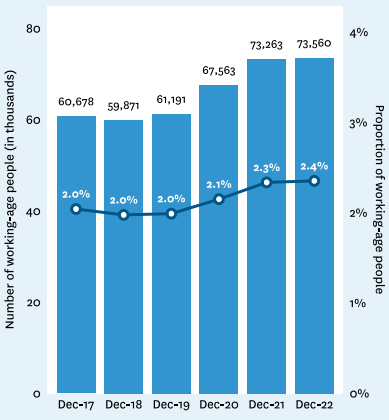
The latest benefit stats have just been released and while the Jobseeker numbers have declined, not so numbers for the other two main benefits - Sole Parent Support and Supported Living Payment:


Number and proportion of people receiving Sole Parent Support at the end of the last six December quarters.


Number and proportion of people receiving Supported Living Payment at the end of the last six
December quarters.

The rise in what used to be called the Invalid benefit (now Supported Living Payment above) is not insignificant. There are around 6,000 more people permanently unable to work due to illness. Almost half of the increase is due to psychological or psychiatric illness.

Given what we know about the level of mental illness within corrections facilities, I wonder how many of them are ex-prisoners? Recall that the prison population is down around thirty percent or 3,000.

There will almost certainly be a contribution from the under-performing health system as waiting lists continue to be a major problem.

As for the increase in sole parent reliance, it shouldn't be happening. Not with the amount of work that is currently available. The last Labour government leaders - Clark and Cullen - were very keen to lift the workforce participation of sole parents to the same level as partnered parents.  Clark was a particular type of feminist. She was interested in women empowering themselves through independence.

Ardern's Labour is different. Ideologically they are closer to the Greens. Remember Metiria Turei's championing of benefit fraud justified by motherhood and need? Labour has since implemented many of the Green's welfare policies as they relate to sole parents. The impetus to improve the lot of sole parents and their children through employment has dissipated. Which is a great shame.

Overall the total number of benefits in place is down from December 2020 but still up 22 percent on December 2017:

Number and proportion of people receiving a main benefit at the end of the last six December quarters.


Importantly, the benefit which people tend to stay on the shortest time (Jobseeker) has lost numbers whereas the benefits where people tend to stay the longest time (Sole Parent and Supported Living) have gained numbers.

Not a good result.


Thursday, January 12, 2023

PM more self-delusional by the day

Prime Minister Jacinda Ardern is heading into the 2023 election campaign stating:


“Our record is growing Māori housing. Our record is growing Māori employment opportunities. Now our record is growing the Māori economy. I will happily campaign on our record.”


I really don't have a lot of stomach for this. Most Māori are working and law-abiding like most non-Māori and the constant racial identification of people only feeds resentment and division.

BUT if the Prime Minister wants to crow about what she has achieved for Māori let's look at what she hasn't achieved for Māori.

Since 2017, the Māori percentage of all people on main benefits has risen from 35.9 to 37.2% - in raw numbers from 99,351 to 128,502

Māori now make up 38.6 percent of those on a Jobseeker benefit - up from 37.6 %. Again, in raw numbers (despite the drop in the unemployment rate) there are over twenty thousand more Māori on the Jobseeker benefit than there were in 2017 (45,357 to 65,706).

The percentage Māori make up of the Sole Parent Support benefit has risen from 47.8 to 48.2% or 28,413 to 35,151.

Possibly the worst statistic in terms of Māori children's future prospects, absenteeism - as defined by attending school less than 70 percent of the time - has risen from 10.5 in 2017 to 23.8 percent in 2022 (term 2).

The Māori share of the prison population continues to climb - 50.7 to 53 percent (although the actual prisoner numbers have dropped due to Labour's policy to drive down the prison population by admitting fewer criminals and releasing earlier).

Finally, in a by no means exhaustive list, the Māori share of the public housing waiting list has grown from 44 to 49.6 percent or 3,389 to 14,130. A massive increase in raw numbers.

The data is summarized below:


If this is the Prime Minister's idea of achieving for Māori, then she is even more self-delusional than I'd previously entertained.

And if she is returned on this record then we are all deeply in trouble. All of us together.

Sources

https://www.msd.govt.nz/about-msd-and-our-work/publications-resources/statistics/benefit/index.html

https://www.educationcounts.govt.nz/statistics/attendance

https://www.corrections.govt.nz/resources/statistics/quarterly_prison_statistics

https://www.msd.govt.nz/documents/about-msd-and-our-work/publications-resources/statistics/housing/datafiles/2022/oct/ph-national-monthly-timeseries-datafile-october-2022.xlsx
https://www.msd.govt.nz/documents/about-msd-and-our-work/work-programmes/social-housing/housing-quarterly-report-dec2017.pdf


Thursday, January 05, 2023

The price of reducing poverty

The benefit system was originally about providing secure income for those genuinely unable to work. That inability to work did not include causing one's own incapacity or having dependent children.

It has since evolved to become a government tool for equalizing incomes between the employed and unemployed and advancing other ideological goals like the financial emancipation of the female parent from the male parent.

To some degree benefits have become an alternative source of income for those uninterested in the obligations and constrictions involved with being employed. Those who disagree with that statement argue nobody would willingly choose to live on a meagre benefit income. 

That may hold water for single people. But the latest incomes monitoring report from MSD shows a couple on a benefit with two or more children receives over $800 weekly after housing costs. Additionally,

In real terms, total incomes after housing costs of people supported by main benefits were, on average, 43% higher in 2022 than in 2018.

Which brings us to the gap between income from benefits and income from work.


Until 2016 wage growth outstripped inflation hence the growing gap. Since 2019 benefits have been indexed to wages. Previously they were only indexed to inflation. Accordingly, the report notes the 2022 "main benefit increases reduced the gap". That is, income from work became less attractive.

As well,

...there are still reasonably poor financial incentives to increase the level of hours worked for many low-income families. This is because when earnings increase, their income support payments are withdrawn relatively quickly. High childcare costs and low take-up of in-work assistance can also have a negative impact on financial incentives to increase hours of work.

Little wonder worker shortages are endemic.

So, the income support/benefit system is contributing negatively to the economy in that regard.

But worse, it is being used by the Prime Minister to achieve her primary goal of reducing child poverty. 

According to the report, using Labour's chosen measures which show percentage drops since 2017, she has been successful in this endeavour.

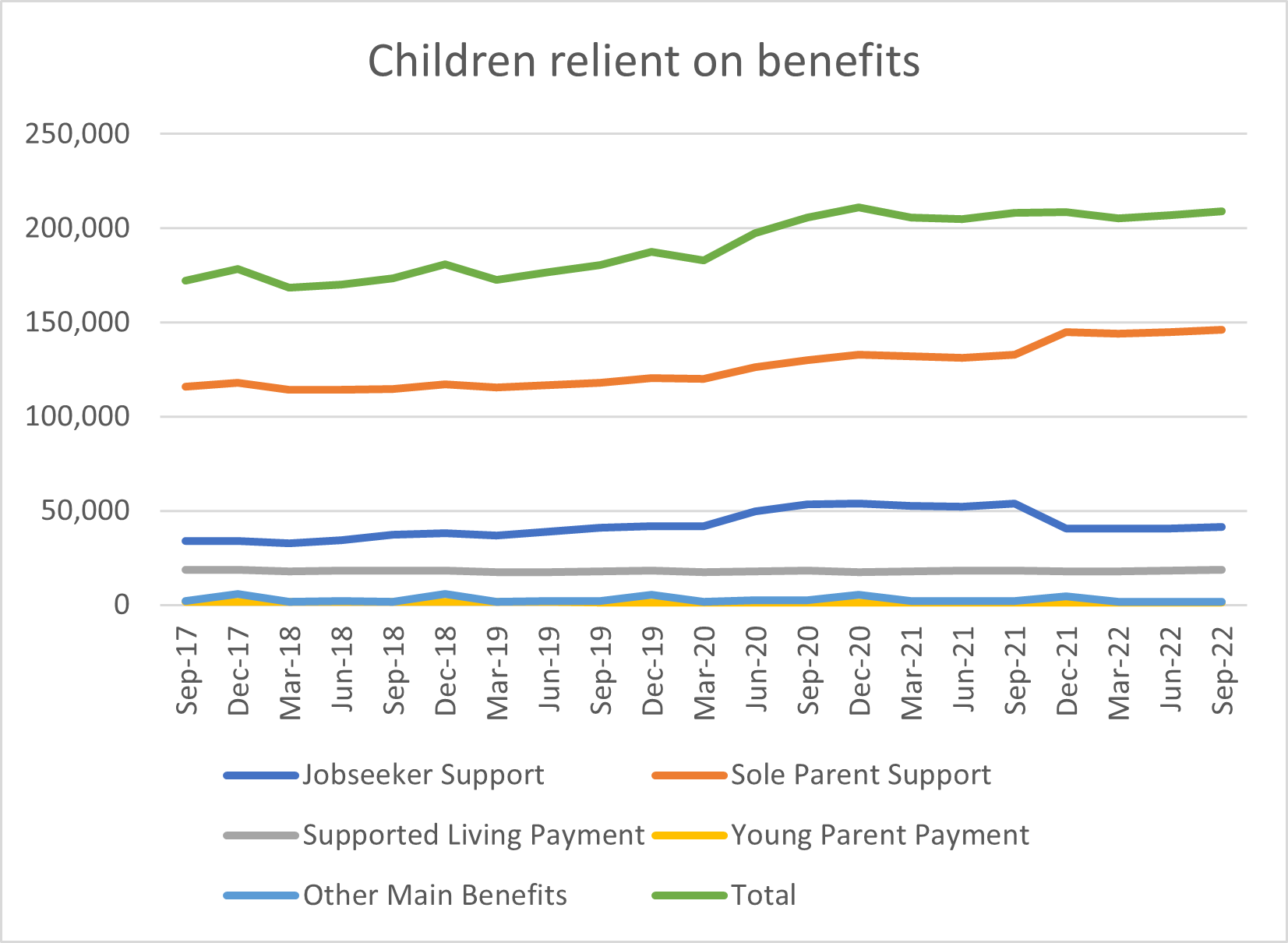
What is omitted from this report is the increasing number of children reliant on benefits. 


Is this increase a reasonable trade-off for reducing child poverty? If the higher incidence of neglect and abuse for children growing up on a benefit is acceptable, then the answer is yes.

I disagree. The increase may even be described as the exploitation of children to make the Prime Minister look good. There is no reason why the welcome downward trend for state-dependent sole parents would have reversed bar financial encouragement.

Another finding from the report throws a further spanner into the works for redistributionists.

Asian households feature the lowest percentage of children experiencing material hardship - around 4% compared to the Pacific rate of around 24%

And yet when it comes to income support:

Eligible families with Asian parents had low estimated take-up in recent years. The late 2010s was a period of rapid growth in the Asian population of Aotearoa New Zealand. Low awareness, uncertainty about entitlements, administrative, personal and cultural barriers to claiming, or reluctance to claim payments among recent migrants may be factors explaining the trends. 

So the benefit system cannot be credited with low Asian hardship. Something else is protecting their children. Probably the self-reliance and work ethic of their parents.

The government can fiddle all it wants robbing Peter to pay Paul under the guise of 'fairness and equity'. But the downsides to this interference are corrupting incentives which will continue to blight New Zealand's future.


Sunday, December 18, 2022

NZ's rarely-reported plummeting prison population

Appalling crime story after appalling crime story gets reported.

But media rarely report on the big decline in New Zealand's prison population.


There are various possible explanations for the reduction including demographic change, policy changes in police and justice procedures, and/or less imprisonable crime being committed. Government politicians claim less crime is being committed, especially by youth, "according to the statistics". But the statistics they use - apprehension, prosecution and conviction - rely on those activities actually occurring. If the police are instructed not to pursue a fleeing vehicle, then the ensuing apprehension etc. is less likely to happen.

When Labour became government Kelvin Davis stated a goal of reducing the prison population and set about doing so. This is one policy goal they've actually achieved. But at what cost?

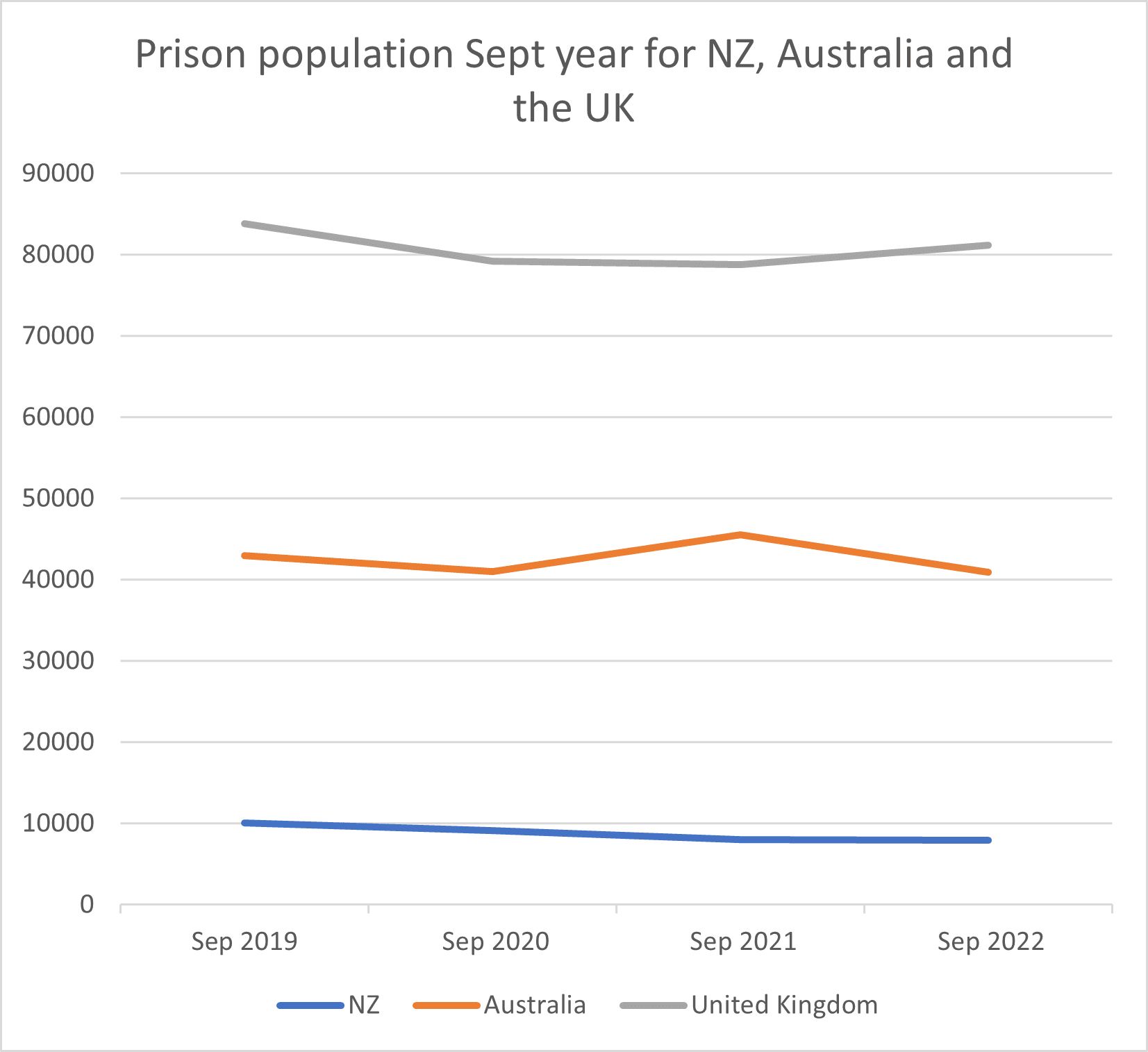
The prison population reduced by over twenty percent between September 2019 and 2022. It could be said that one in five people who should be in prison are not so it's hardly surprising the country is experiencing a "crime wave". But that proposition is barely provable.

What we can usefully look at is how New Zealand compares to two very similar countries - Australia and the United Kingdom.

The first chart shows the change in numbers:


The large difference in prison population numbers disguises the degree of change so I've plotted percentage-change separately:


The last grouping shows that between 2019 and 2022 Australia (-4.8%) and the UK (-3%) also saw prison population falls but they are much smaller than NZ's (-20.7%)

The deviation implies NZ's decline is very much a matter of policy and not the social and demographic factors that affect prison populations.

You will note from the first chart that the NZ prison population is starting to climb again. A campaign to attract more staff to Corrections has been high profile. The government may now be abandoning their experiment.

Tragically it is too late for some though.

Bill English may have been right when he described prisons as a fiscal and moral failure. They certainly don't rehabilitate every inmate. They don't even come close. Far more needs to be done within prisons in that regard.

But prisons serve another purpose. They protect the public from dangerous people. That aspect of their place in society seems to have been overlooked in recent years.

Thursday, December 01, 2022

New Zealand - No longer a secular state

 An ODT opinion piece recently parodied the rapid adoption of Māori names for government departments. It drew attention to the renaming of the Earthquake Commission as Toka Tū Ake EQC which apparently "reflects the whakapapa of our nation." The name-change decision was made by the Minister and cabinet.

The Commission site contains a section about their new Māori name.
In the beginning, Ranginui (sky father) and Papatūānuku (earth mother) were joined in such a strong embrace it created darkness. When their sons separated them to create light, Ranginui grieved so much for Papatūānuku that his tears flooded the land. Their sons turned Papatūānuku over so their parents would not face each other and see each other’s sorrow.
Rūaumoko is the youngest, unborn son of Ranginui and Papatūānuku. He was turned toward the earth in his mother’s womb. His brothers gave him fire so he could warm himself in the darkness. Being so closely tied with his mother, Rūaumoko felt her pain at the separation. When he stirs, he expresses his anger through geothermal currents, earthquakes, and volcanic eruptions. As we live alongside Rūaumoko’s rumblings and Ranginui’s tears, EQC’s role is to help make our homes stronger, ensure new homes are built on better land, and provide support when damage occurs.
Are these characters any different to Adam and Eve? Creation myths sit at the basis of religious belief. Imagine then Christian biblical stories and imagery appearing on Ministry websites to explain their reason for being and values. It would not happen.
In a 2013 Otago University lecture Andrew Bradstock said:
"...there is a shared perception here that religion is principally for the private not the public domain. This was given a degree of official endorsement in July 2010 when a draft report on “Human Rights in New Zealand Today” was released by the Human Rights Commission. This carried a statement that “Matters of religion and belief are deemed to be a matter for the private, rather than the public, sphere.” The wording was subsequently changed following complaints (though the text is still on the HRC website), but it would be hard to dispute the claim that we generally feel more comfortable if individuals or organisations, when speaking publicly, refrain from parading openly any religious convictions they may have."
Doesn't the promotion of Māori mythology fall into the domain of parading religious convictions?

And it isn't just the Earthquake Commission.

The Reserve Bank postulates,
"How Tāne Mahuta can explain our financial system. Māori oral traditions tell us that Tāne Mahuta dug his shoulders into Papatuanuku (earth mother) and used his legs to push against Ranginui (sky father), separating them and letting the light into the world. With that light, Tāne Mahuta, guardian of the forest and birds, enabled life to thrive."
The Climate Change Commission explains its Māori name, He Pou a Rangi: Ingoa Māori:
"The simplest translation of He Pou a Rangi is 'a pillar of the sky'. The concept considers our role as upholders of the sky. We are honouring the sky and in turn, have a duty to care for it. Using 'He' Pou ('a' pillar) rather than 'Te' Pou ('the' pillar) recognises that we are one of many pou or organisations working together to address climate change. Pou can uphold, provide a point of connection, protect, and provide stability. In a te ao Māori view, pou provide a two-way connection, both upholding and uplifting what is above, but also connecting and grounding with what is below. Pou connect Ranginui, the sky father, to Papatūānuku, the earth mother."
There are many more examples occurring across various government websites and in the documents they generate. Law lecturer David Griffiths refers to, "...state concessions to indigenous Māori spirituality that are now commonplace in legislation and other governmental actions." That was sixteen years ago.
Ironically, and somewhat inexplicably, the developments have been accommodated by people who have no truck with Christianity - liberal atheists. The pace of change has accelerated under the woke left.
Back in 1996 Justice Heron argued 'the courts were “secular” institutions and he declared that “involving any person in a karakia against their personal wishes” was “insensitive and unacceptable” '.
Yet a recent meeting of state-employed health professionals with no Māori people in attendance still featured the obligatory karakia delivered by a non-Māori female. When asked why, the answer received was, "Their belief in equity." Was a Christian or any other prayer offered? No. So much for equity.

Just as people balk at the imposition of mythology to explain matters of science, there will be those discomfited by the routine practise of karakia (especially given the diversity of cultures and beliefs of those working within the New Zealand health system, which is almost entirely publicly run).
The solution is not to start offering sops to every other religious belief that exists in New Zealand. To put it crudely - two wrongs do not make a right.
The answer is to re-establish the traditional and necessary secularism of the state. In the United Kingdom where awareness and objection to the problem is more acute, an organisation has formed which maintains,
"Public services that are intended for the whole community, especially those funded by public money, should be provided in a secular context, open to all, without discriminating against anyone on grounds of religion/belief – either the people who are served or employed."
Amen to that - or whatever the secular equivalent is.

Monday, November 21, 2022

Am I the only person who reads MSD's annual reports?

Am I the only person who has read MSD's latest annual report?

It's a tedious business but surely a few checkers cast their eyes over it prior to publication.

I was casting my own over the benefit statistics by region when I stopped in my tracks.


According to the above table 77.3% of people on benefits in June 2022 in the Southern region (which encompasses Dunedin, Central Otago and Invercargill) were Māori.

That's extraordinary. 

I checked the other two South Island regions - Canterbury and Nelson-Marlborough-West Coast - to find similar proportions at respectively 71.2 and 77.7 %

This is astounding news to me. Māori make up 17 percent of the population nationally but lower percentages in the South Island. For instance, at the last census only 9.4% of the Canterbury population identified as Māori.

When a statistic is so out of whack the obvious recourse is to check it against another source.

MSD  regional data for Canterbury June 2022 shows Māori made up just 21.1% of all people on benefits whereas NZ European accounted for 71.2 percent.

The data has been inverted.

But the error isn't even consistent.

There are eleven regions and tables contained in the annual report.

The data is correct for just three - Northland, Auckland and Waikato.

What surprises me is that even faint familiarity with MSD data would set off alarm bells. It is simply implausible that 77 percent of beneficiaries in the Southern region are Māori.

If that's wrong what else might be?

I returned to the table above and took another look. Apparently, 26.9 percent of beneficiaries in the Southern region have been on a benefit for one year or less; 45.8 percent for more than one year. That sums to 72.7 percent.

What about the rest?

Of course this could all be dismissed as trivial errors.

But if funding is to be race-based in any manner then accurate numbers are extremely important. 

The idea is bad enough. Poor execution of it is salt in the wound.


Sunday, November 06, 2022

PM's big idea is bad

My first reaction to today's following NZ Herald headline was incredulity:

One big idea - what PM Jacinda Ardern would do if money was not a factor

Why pose such a redundant proposition when governments are scrambling to spend less? Well, most governments.

But then I thought the answer might shed light on just how naive and ineffective the PM is.

Her big idea? Free early childhood education. 

“I’d make it completely free. Completely free. And when I say completely free, I’d also give choice to families about at what point and stage their child accesses it. Because for some we know it provides stability to kids that they might not have in their home life.”

Hang on. Back up. Isn't this putting the cart before the horse?

Perhaps you need to address why 'some' kids don't have stability in their home life.

You've already thrown a whole lot more money at the problem due to the first wrong diagnosis and now there are thousands more children in unemployed homes. Dare I say it, unstable homes.

But let's look at the evidence the PM might be inclined to take heed of. Evidence produced under her own administration.

Whether or not early childhood education improves outcomes for children is at best controversial.

In 2019 the Auckland University of Technology (AUT) prepared a paper for MSD which asked, ‘Is participation in Early Childhood Education related to child health and development?’ 

It reported numerous studies (including American, British, Australian) which found the larger the quantity of time spent in non-maternal care, the greater negative effects were. For instance, “A Swiss study has also found that the accumulation of time in group-based childcare specifically was associated with greater externalising (aggression, ADHD symptoms, non-aggressive externalizing behaviours) and internalising (depression, anxiety) behaviours at 7 years.”

AUT noted however, “The Christchurch Health and Development Study found that ECE participation over time was not significantly associated with behavioural outcomes in childhood and adolescence once sociodemographic factors, child-rearing practices and child characteristics were accounted for.”

Analysing recent Growing Up in New Zealand data AUT then concluded, “…more time in ECE per week was inversely associated with the development of emotional difficulties and peer problems.”

This finding, however, is not particularly robust.

Social, emotional and behavioural difficulties (via SDQ) were measured at 24 months. Children in full-time maternal care rated the highest level of ‘abnormal’ difficulties at 21.2 percent. Children in centre-based care recorded only 13.9 percent.

But the highest levels of abnormal difficulties also occurred with unemployed mothers (22.8%) and benefit recipient mothers (36.9%) – the group most likely to be parenting full-time.

The paper’s authors acknowledge, “parents who are employed are more likely to need, afford, and use ECE; this tendency will ‘select’ a particular group of children, many of whom may have different behavioural and health profiles to the converse group.”

Furthermore, in describing the limitations of the paper:

“It is possible that the positive association between child behaviour and ECE is in part due to children with behavioural difficulties being excluded from ECE (reverse causation). Unlike primary school, there is no requirement for early childhood education services to take children who have conduct or peer problems. It is also possible that parents with full time childcare responsibilities of two-year children may rate their behaviour as worse than the parents of children in childcare, because they see them all the time (so may be more aware of their behaviour) and also due to the increased stress of parenting fulltime… Given limitations in the data collection noted elsewhere, it is not possible to determine why attendance appears to protect against emotional difficulties and peer problems, and hence why this finding contrasts with previous research.” (my emphasis)

This inconclusive research could nevertheless be used as an argument to get more children from 'unstable' homes into ECE.

But, and it's a massive 'but', primary school is free (and compulsory) and attendance amongst children from transient (geographical and maternal relationship-wise), dysfunctional families can range from non-existent to patchy. Why would ECE attendance be different?

Probably some level of ECE for children from well-adjusted families is fine (though I still regret buying the 'socialization' idea with my first.)

The problem of children suffering 'abnormal' difficulties often associated with a benefit-dependent parent(s) will not be solved by ever greater removal of responsibility from the parent.  Broken families can't be healed by herding their children into daycare. An ECE teacher cannot be the mother who needs to bond physically and emotionally with her child through constant and positive touch and talk from day one. Free ECE cannot possibly fill the void that comes with not being a wanted child.

We should be glad there is no money for the Prime Minister to indulge in yet another distracting, poorly thought-out, bad idea.


Monday, October 31, 2022

New Report Measures Father Absence in NZ

 New Report Measures Father Absence in NZ


Thousands of New Zealand children struggle with having no father in their lives, and a new report from Family First - WHERE DOES HE LIVE? Measuring Father Absence in New Zealand - finds little change since Children's Commissioner Laurie O'Reilly described fatherless families as the 'greatest social challenge facing New Zealanders' in 1998.


Report author Lindsay Mitchell says, "Last year one in twenty births had no father registered; one in six did not have a father living at the same address as the mother and almost one in five had parents with no stated legal relationship.”


“For the past fifty years married and unmarried births have broadly trended in opposite directions and are steadily converging. In the year to June 2022, 49.8% of all births were unmarried. In the June quarter alone births to unmarried parents surpassed the halfway mark for the first time reaching 50.7%. Children are also increasingly being born to de facto relationships (30% of all births) which do not have the same stability as marriages.”


“Maori children are the most likely to experience father absence. The proportion of Maori babies born to married parents has fallen from a relatively high level of 72% in 1968 to just 20% in the June 2022 quarter. Maori children are the most likely to experience living with a sole parent.”


For children, father absence is associated with poverty, material hardship, abuse and neglect, lower cognitive capacity, substance use, poorer physical and mental health and criminal offending. But estranged fathers can also suffer materially and emotionally. The mortality rate of fathers paying child support is significantly higher than the norm.


Mitchell says, “There are some positive trends for the prospects of father absence reducing. The teenage birth rate is plummeting, and men are first-time fathering when they are older and more stable. But official projections show sole parent families maintaining their current level through to 2043.”


“So there is good and bad news. Actual trends hold some promise - predictions, less so. Perhaps those children who grew up without parental stability are successfully seeking it in their own relationships? Let’s hope so."


Monday, October 24, 2022

Our leaders need to join the right dots

The Minister of Finance and Deputy Prime Minister says:

"We've lifted about 66,000 kids out of poverty in the past few years ..."

What he neglects to add is they have also consigned about 37,000 more to life on a benefit bringing the total to over 209,000.

Robertson continues:

"If we don't have a population that's feeling well, healthy and happy, then they're going to be less productive."

It's a shame he doesn't link the two. New Zealand has long struggled with low productivity. Perhaps that's because there is so much intergenerational welfare dependence?

Early entry into the benefit system is strongly co-related with intergenerational benefit receipt.

MSD's own commissioned analysis found:

The correlation is striking enough to believe that early entry may be a proxy for intergenerational benefit receipt (with the notable exception of teen-aged SLP entrants).

·         The evaluation looked specifically at the share of beneficiaries up to age 25 that can be matched to a record of parental benefit receipt - a “benefit match”. We also looked at the extent of their family’s exposure to benefits, during each matched beneficiary’s teenage years (13-18).

·         These figures show that inter-generational correlations are very strong – most young clients in the benefit system had some exposure to the benefit system through a parent or guardian.

·         Nearly three quarters (74%) of all beneficiaries up to age 25 had a parent on benefit while they were a child, and just over a third (35%) had a parent on benefit throughout their teenage years.

·         The greater the family benefit history the longer the client tended to stay on a benefit, particularly for the Jobseeker benefit.

But that was 2015. When National, thanks to Bill English, was serious about understanding and tackling this long-standing problem. A goal of reducing the number of children in benefit-dependent households was set as part of the Better Public Service goals. Real progress had been made seeing a reduction of 61,000 between 2011 and 2017, yet Labour scrapped the goals.

The gains made have been undone. For instance, noting the final item on the above list, the time people stay on a benefit is getting longer again.

And let's not forget the Prime Minister who said:

 "...if you ask me why I’m in politics, my answer will be simple: children ...” 

But she never ever talks about children on benefits (except when boasting about paying their parents more.) She never acknowledges the evidence that outcomes for poor children on benefits are worse than for poor children with working parents. She certainly steers well away from the subject of intergenerational dependence.

Either she doesn't understand the implications of more children entering the benefit system, or it just doesn't fit with her world view.

If she honestly wanted to make New Zealand the best place in the world to raise children tackling benefit reliance should be her number one priority.


Friday, October 21, 2022

Average future years on a benefit increases again

MSD's Annual Report was released yesterday.

From the CEO's forward:

There is a lot we can reflect on and be proud of over the last year, including:

Getting more people into jobs than ever before

A relentless focus on getting people jobs has seen 226,836 clients move off benefit into work in the last two years – our highest recorded result.

Great. But how many benefits were granted in the same two years?

415,266 

In the past two years there have been more benefit grants than cancellations.

With all the covid disruption to labour markets, movement on and off benefits has been volatile and not the best gauge of success.

Here is, perhaps, the most important indicator:

"The number of years, on average, for which people receiving a benefit at 30 June in the respective year are expected to be supported by a benefit over the remainder of their working lives."


There has been a 20 percent increase in average future years on a benefit over the last five years.

Again, I put this down to expectations built by Labour. Through various policies they have made it easier to get on a benefit and stay on a benefit. Add to this a health system that isn't fixing people ...

Here's a sobering thought.

Right now, that expectancy totals 4.43 million years.