Thursday, October 20, 2022

September benefit stats released - big jump in Supported Living Payment

The Supported Living Payment (SLP) replaced the Invalid's benefit. Officially:

Supported Living Payment is for people who have, or care for someone with, a health condition, injury or disability that limits their ability to work. 

Please note the graph's Y axis is not zeroed in order to show the increase more clearly.


In one year, the number climbed by 4,659 or almost 5 percent. Half of the increase is down to psychological and psychiatric conditions; the gender bias is female and most of the increase is among 55–64-year-olds (though no age group has shown a decrease). NZ Europeans have the largest increase (though it looks proportionate to their share of the population). There is no increase in carers receiving the payment. I would hazard a guess the increases in cardiac, musculoskeletal and cancer conditions reflect delays in diagnosis/treatment - in other words, a failure of the health system.


Sole parent support is on the way back up again though some of the increase is because mothers were transferred back from Jobseeker Support when the subsequent child policy was removed.


Perhaps the most important statistic - the number of children reliant on benefits - climbed through the year to September and now sits at 209,127. Remember that whenever you hear the PM maintaining a success in child poverty reduction.


And finally, there are:


That's 11.1 percent of the 18–64-year-old population and not far off the population of Christchurch.

All of this against record low unemployment.


Friday, October 14, 2022

Relationship between poverty and foodbank use

MSD's annual tome of poverty statistics was released last week.

The NZ Initiative provides a good summary here. Eric Crampton wryly notes:

"Spin machines revved up quickly, trying to find the least indefensible ways of using the data to support whatever position they had before they’d opened the report."

For mine, of interest, was a new section on foodbank use. I have graphed the data below interested in the relationship between foodbank use and child poverty. 

The data features children aged 0-17 in primarily the Auckland region. Foodbank use is at least once in the last 12 months. AHC 50 relates to the percentage of children in households below fifty percent of the median income After Housing Costs and MH 9+ relates to the percentage of children experiencing 9 or more items of material hardship eg going without fresh fruit or doctor visits.


Unsurprisingly in every area the relationship is similar.  But it is certainly not uniform. The shapes of each area cluster differ.

The ratio of AHC50 to foodbank-use shortens moving left to right. In Albert etc. 14 percent are at AHC 50 and 3 percent used foodbanks. In Southern wards the numbers are respectively 25 and 19 percent. The gap is much narrower.

Without knowing how many times beyond once a foodbank was used, the dependency appears disproportionately greater moving left to right.

This might reflect a greater density of foodbanks in poorer areas.

But I also notice the marginal relationship between AHC50 (financial hardship) and MH9+ (material hardship) is not constant. It too tends to close but Western and Howick etc. have the biggest margins. This says to me that low incomes in those areas go further. Perhaps caregivers budget better. Perhaps they carry less debt. There could be a myriad of reasons.

Theories about how to measure poverty have been multiple and varied through the ages. The study of poverty has historic roots. But some have argued it might be better identified and understood by measuring not what goes into a house but what goes out. Expenditure counts as much as income.

This particular report arises from income and says, "The use of expenditure is not generally accepted as an alternative, in part because it also is not a good proxy for reporting consumption possibilities, but also because the quality of the expenditure data is often patchy."

Fair enough but not enough is known about expenditure (bar housing) to properly understand what might make a positive difference. And that is the point of these reports.

(The report does not, by the way, capture recent data or people living in emergency housing.)


Wednesday, October 12, 2022

The unprecedented rush to emergency housing

 The following graph shows the number of MSD clients living in emergency housing up to 2021:


Typically, around 92 percent of clients are housed in hotels/motels with the remainder in hostels/holiday parks.

Then next chart shows a breakdown by area:


I am not convinced that the demand grew solely from "a shortage of affordable housing" - the reason provided by MSD. Neither is population growth a convincing reason with 2016 providing a mid-point - not a beginning.


I think demand was driven largely by expectation.

When people begin to hear about others in their circles being provided with motel accommodation for free they will start to respond. When people see modern state housing being built with attractive income-related rents they will want to get into one even if that means waiting in emergency housing for free for a period.

Belatedly, in October 2021, MSD started to charge emergency housing clients 25% of their income (in line with the income-related rent subsidy) because apparently, "Anecdotal evidence from our front-line staff suggests there may be small numbers of clients in [emergency housing] that are incentivised to access and remain in [emergency housing] when they have an alternative housing option because they face no accommodation costs."

There is some reduction in that year's numbers. But 2022 is shaping up to look more like 2020 based on stats to July 31 (12,465 clients).

No doubt there are rental accommodation shortages (driven by Labour's hostile policies towards landlords) but behavioural economics probably explains a good part of this unprecedented rush to emergency providers.

Purely my opinion of course.

(BTW Rotorua has established a database of accommodation providers classified by whether they provide emergency housing or not. Many do not. I link to it in the interests of helping Rotorua restore its tourism industry. I have many fond family memories of happy holidays spent there.)


Sunday, October 02, 2022

Stoush between collectivist and individualist Māori

A stoush between collectivist and individualist Māori is long overdue. It has simmered for a long time but this week boiled over when Kelvin Davis exposed his thinking for all and sundry to examine. He confirmed that a Māori world with its own set of values exists, and that anyone with even a smidgen of Māori heritage should get themselves into it. It wasn't a kindly suggestion. It was a command. The cost of not complying? Derision and ostracism. It's reminiscent of the treatment handed out to those who don't want to be part of the Gloriavale commune.

The tribe is a communistic unit. The tribe takes precedence. It owns you. Its culture is all-encompassing. It provides strength in numbers, security and identity. But it is also stultifying and limiting depending on which lens it is viewed through. Ultimately, inevitably, whether at the micro or macro level, the question must be answered. Is your allegiance to the tribe, or is it to yourself and your chosen group of family and friends.

If the two overlap, all well and good.

But in New Zealand (and Australia), for tens, maybe hundreds of thousands of Māori, they don't. Mixed partnerships are more common than those with the same ethnicity. And each of these partnerships - many producing children - will face issues of concurrent cultures.

Increasingly, through media and public services, through health, justice and education, the Māori culture is being prioritised. To the point of being romanticized and lionized. Long-standing rules about the state being secular are broken to accommodate Māori spiritualism. Te reo - or knowledge of te ao - is de facto compulsory inasmuch as, if you don't have it there are now careers that are barred to you. The Māori 'team' propelling this are on a roll. They are in ascendancy. They have gathered non-Māori into their tribe with astonishing success and seeming ease, though reflecting on the creeping compulsion maybe 'ease' is the wrong word. As far back as the nineties you wouldn't progress through a public service job interview if unable to demonstrate an understanding and appreciation of the Treaty.

Prior to this compulsory cultural renaissance people managed their own conflicts. Where they had a foot in both camps - the tribe and the alternative - they made their own decisions. Some stayed, some divided their time, some rejected. In the middle of last century sociologists observed Pakeha men who married Māori women tended to move into the tribe; Māori men who married non-Māori moved into the non-tribal society. Tension would have existed always but so did the freedom to choose.

What kind of society wants to remove that freedom? One in which the collective trumps the individual.

Forget all the hoo-ha about culture, values and Māori mysticism. Colonisation, oppression and racism. They are only trinkets to tempt followers of fashion.

What is happening is a clash between philosophies. Politics is the practical expression of philosophy.

So it isn't surprising that the strong-arming to get with the Māori worldview programme is coming from the left (the Labour Māori caucus, Green and Māori Party MPs). And those resisting are coming from the right (National and ACT). What played out in parliament this week, and is still reverberating with non-politicians now entering the fray, is the age-old stoush between collectivism and individualism. It's New Zealand's cold war.

If we are going to be forced to take a side, and mounting evidence points to this eventuality no matter your ethnicity, think of the conflict in these terms.

Do you want to own your own life?


Saturday, October 01, 2022

Pumping up those polls

Stephen Joyce opines in the NZ Herald today about the PM's "performative policy-making":

"I thought we'd reached peak performative decision-making when Jacinda Ardern took offence at Jack Tame pointing out how many of her performative policy announcements hadn't resulted in anything."

Turn the page to witness the PM at WOW last night - peak performative poll-pumping:


The previous post described how Jacinda Ardern has spent 14 hours on her Child Poverty Reduction portfolio in 20 months.  

I wonder what she spent on fittings, rehearsal and performance at WOW?


Monday, September 26, 2022

PM spends 0.2 percent of her time on Child Poverty Reduction?

 A reader sent me the following quote from a Bryce Edward's article at the BFD:

The Prime Minister took on the portfolio of Child Poverty Reduction, as a way of signalling her ambitions to fix the problem. But clearly she has had other priorities.

This was exposed in the release of ministerial diaries last month, which give an indication of how much time ministers spend on any particular portfolio. Between October 2020 and June 2022 Ardern was recorded as spending only 14 hours on this portfolio – an average of only 40 minutes per month. One calculation put this at a meagre 0.2 per cent of her working time on what she said was her most important portfolio.

Yes, I did check the calculations which would have her working eleven-hour days, seven days a week.

Thursday, September 22, 2022

On child poverty, racism and colonisation


A just-published Listener article asks, "Why doesn't middle-class NZ care about child poverty?" It gathers views from half a dozen people including a principal, a teacher, an advocate against child poverty, a charity head, a Māori provider chair and Pasifika social worker. Apparently, they told the Listener that the middle-class has become indifferent to child poverty. Yet a careful reading of the piece finds it is primarily the Child Poverty Action Group advancing the idea that, "For middle white New Zealand, poverty is equated with being brown. This is where the indifference comes from." The Chief Executive of the Auckland City Mission goes further claiming active hostility to solo mothers, especially Māori: "As a society, the narrative is 'how dare you raise a child alone? We are going to make it as hard for you as we can - we will punish you.' And secondly, in our country, poverty has a colour. It is about racism and colonization."

In fact, there are more NZ European children in material hardship than all other ethnicities put together. The table below shows there are 53,000 NZ European compared to a total of 47,000 combined other ethnicities (these are the most recent data reported in June 2021):


Click to view

So poverty doesn’t have a colour. Saying poverty has a colour is a convenience for those who want to blame racism and colonisation.

The next thing of note from the above chart is that Asian children have relatively low rates of material hardship. Is this due to higher incomes? No.

The following chart shows that the percentage of Asian children in the poorest households is on par with Māori at 15%:


Click to view

So low household income does not have a direct relationship with material hardship. How money is budgeted and what it is spent on matters. Asian families are also more likely to derive their income from work. The Ministry of Social Development long ago established that, “Standard of living data show that poor children reliant on government transfers are more likely to be subject to restrictions in key items of consumption than are poor children in families with market income.”

And yet both the head of the Auckland City Mission and convenor for the Child Poverty Action Group call for more government transfers. The former wants anyone raising children to receive in-work tax credits and the latter wants more tax from the “richest ten percent” to fund a universal child benefit (oddly missing that a universal child benefit would go to the children of the richest ten percent.)

The social worker from South Auckland would like to see the recommendations of the Welfare Expert Advisory Group established four years ago implemented. Either he or the writer of the piece claims a review “found that the Government had made no progress on implementing the report’s 42 key objectives.”

That is totally incorrect. For instance, sanctions for not naming the other parent were removed; the ‘subsequent child work obligation’ was abolished: the child support pass-on is implemented; benefits and abatement thresholds were increased; benefits were indexed to wage inflation and accommodation supplements were raised. (This is not an exhaustive list.)

The social worker who wants the recommendations implemented then goes on to argue that “Accommodation supplements hide the fact that rents are too high, so essentially the government is pouring money into private rentals.” High rents are at least partially a result of the government imposing unrealistic housing standards and scrapping tax deductibility, policies he would doubtless approve of.

This disconnect with economic reality characterises suggestions made when those “who see deprivation up close on a daily basis” are asked for their solutions to child poverty. Despite decades of redistributing wealth, the problem persists. Perhaps the prescription is wrong.

If the diagnosis is wrong, it probably is.

If the Chief Executive of the Auckland City Mission stopped for a moment blaming “society” for the poverty of sole parent children and instead reflected on where their fathers are, and why they are absent, a real remedy might reveal itself. Perhaps replacing fathers with the DPB all those years ago wasn’t such a good idea after all?

If the Māori provider chair stopped insisting that child poverty is the “product of colonisation” and reflected on why the children of low-income Asian parents do not suffer disproportionate material deprivation, a real remedy might reveal itself. Perhaps the strong work ethic that typifies immigrants to this country could be celebrated and emulated?

And if indeed the middle-class has become “indifferent to child poverty” perhaps it is because they can see through the many excuses for why it exists.


Monday, September 19, 2022

Likelihood of getting off a benefit decreasing

The longer people are on a benefit, the harder it is to get off it.

The following graph illustrates that. Someone who has been benefit-dependent for 1-6 months has a much higher likelihood of leaving for employment than someone with a duration of a year or more. Although the graph was released this month (September 2022) it only contains data to June 2020 unfortunately:


Two concerns.

In each of the years shown, the likelihood of leaving a benefit for employment has decreased.

Compounding that, in June 2017, 74% of all beneficiaries (203,772) had been on a benefit for more than a year. This grew to 75% in June 2022 (257,490).

For Jobseeker beneficiaries the respective percentages climbed from 57% (67,479) to 61% (104,985).

Most disturbing is this growing dependency is happening against a backdrop of employers across the board crying out for workers.

This scenario seals it. The welfare system has morphed well beyond a last-resort, safety net.


Sunday, September 18, 2022

Self-responsibility surcharges?

 As it is now common practice to accord sentencing discounts to criminals with childhood experiences beyond their control, what about surcharges for not exercising self-responsibility?

Every individual has the ability to exercise personal agency. It might be argued for some it is reduced to a choice between the devil and the deep blue sea but it is usually evident that arriving at that impasse could have been avoided.

Compassion is one thing. But excuse-making is another. It is the latter habit that now defines this country and the wrong-headedness holding sway. 

Effort and persistence go unremarked while failure and indifference mark out the victims among us. And don't we love victims.

So long as, of course, the culprits are fashionable - colonization, capitalism, racism and patriarchal oppression.

In reality people have never been more able to control their lives than right now. There is more prosperity and choice than has ever existed.

If it were my call, there would be no discounts. They make a mockery of the free will that defines us. They are in direct conflict with the very reason laws exist. Worse, they send an ambiguous and confused message to offenders and society.

If they are going to be handed out, they should be delivered with a surcharge and explanation. 

"Yes, you had a terrible childhood, but so did many others who managed to avoid criminality. You knowingly chose the wrong path so here's a matching surcharge for not exercising the self-responsibility that others with similar backgrounds managed to."

Sunday, September 11, 2022

Enough now

Our time, the Queen died very early Friday morning. Mike Hosking, a proud royalist and huge fan of Her Majesty ran an excellent show dedicated to her passing. I shed a tear listening to her longtime friend and lady-in-waiting Lady Ann Glenconner describing how they had known each other as young as eight. Listening to personal loss always moves me.

But what the heck? It's now Sunday and still NZ papers are dripping with dross dominated largely by royal gossip. I can't be more specific than the headlines allow because I'm not reading it. 

Her passing should have been treated with the dignity and restraint that personified the exceptional woman the Queen was.

The longer this garish 'grieving' goes on, the less sincere it all appears.

Thursday, September 08, 2022

Propaganda writ large

An advert plays incessantly on the radio telling me that "Wearing a mask is an act of intentional kindness."

An intention cannot be ascribed to an action by a third party. How does the creator of this advert know why I am wearing a mask?

If I go into the supermarket maskless I will be asked to don one or leave. So I take my own. It is an act of resentful compliance. I resent the rule, the enforcer of the rule and worse, myself for complying.

Every time I hear the ad these angry feelings are reinforced.

My strategy for dealing with unwanted emotion is to rationalize. What if the ad said, "Be kind, wear a mask" which at least eliminates the absurd idea that someone else can live in my head and know my thoughts. But what is kind about wearing a mask? I'm not a surgeon. I have no illness and even if I did, isn't sharing germs part of how we have existed together for eons?

Perhaps the rational response is to understand the message in its inversion, "If you don't wear a mask people will think you are cruel and uncaring."

That I think is what's really going on.

We've had five f------g years of this 'be kind' guilt-tripping propaganda shoved down our throats and everywhere you look the results are crippled systems and crippled people.

Now I'm getting confused over what it is to be genuinely kind.  Maskless, I gave a girl some money the other day. Broke my own rule. She said she wanted to get a feed. I checked she had a roof over her head at night and some sort of support system and then gave her $20. Maybe she'll go and buy a bottle of wine or whatever it takes to get off her face but why shouldn't she enjoy a few hours escapism? I'd like a few myself but my meagre daily alcohol ration makes that an impossible option.

Perhaps I should have walked up to this kid and said, "Excuse me. Where is your mask? You do know that it's an act of intentional kindness to wear one, don't you?"


Monday, August 29, 2022

Why Do Our Young Lead Developed World In Poor Mental Health?

MEDIA RELEASE

28 August 2022

Report - Why Do Our Young Lead Developed World In Poor Mental Health?

In 2020, UNICEF ranked New Zealand last of 38 developed countries in child mental well-being. In a new report for Family First, “Child and Youth Mental Health: Why New Zealand's young lead the developed world in poor mental health”, researcher Lindsay Mitchell explores the UNICEF claim.

"What I found was NZ has the worst youth suicide, self-harm and bullying statistics. Mental disorders have risen significantly, as has consumption of antidepressants and anti-psychotics. These increases are above what is occurring in the general population,” says Lindsay Mitchell.

The report gathers data from the New Zealand Health Survey, Mental Health and Addiction Services monitoring reports, Pharmac, DHBs, various longitudinal studies, Oranga Tamariki, MSD and Youth 2000 surveys.

"On the available evidence, New Zealand undoubtedly faces a mental health crisis among the young. But this may be just part of the picture. For instance, the Growing Up in New Zealand study has lost touch with hundreds of children who are the most likely to be suffering poor mental health due to exposure to accumulating adverse experiences associated with transience; multiple parental relationship transitions; young, deprived, and poorly educated mothers who disproportionately experience hardship and depression.”

“According to Oranga Tamariki, '…the alcohol and drug issue is prolific / increasing' among Family Start clients, and various data suggests thousands of babies are exposed to alcohol and other substances in utero."

"This first scenario describes an environment that elevates the risk of children developing poor mental health,” says Lindsay.

"A second scenario is of a more pervasive depression and anxiety problem exacerbated less by mayhem and material deprivation, and more by recent developments such as social media-driven poor self-image, heightened sensitivity to parental and/or peer pressure, fear of failure, climate change anxiety and confusion over sexual and gender identity. The second group may also be dealing with separated parents, torn loyalties, school and home-life upheaval and adapting to stepsiblings."

“Based on the extensive data presented, both of these groups - which no doubt overlap - are growing, along with unmet need and wait times for treatment. New questions are arising regarding the effectiveness of medication and lack of alternative therapies. There are suggestions that over-reliance on medication is reducing capacity for self-help.”

"But most importantly, a reversal of this upward surge demands a wider appraisal and acknowledgement of societal changes that have lessened the likelihood that children will experience material and emotional security and stability throughout their formative years. If children were genuinely placed at the centre of the family, given time, given unconditional love, given space to explore but surety to return to, there may still be no guarantees. But the odds of that child developing good mental health will massively increase."


Sunday, August 28, 2022

More children unsafe under Ardern's watch

Jacinda Ardern in 2017:

“...we are small enough that we can absolutely introduce child wellbeing policies so that New Zealand is once again a great place to bring up children and be a child.”

Since then, more children are being investigated for family harm incidents:


More children are victims of intentional injury and sexual assault:


Yes, I am being selective but so is the Prime Minister when she announces:


Wednesday, August 24, 2022

MSM and poor reporting

 A TV1 news item says about the inquiry into abuse-in-care:


"A report from the Inquiry shows one in three young people placed in residential care by the state between 1950 and 1999 went on to serve a prison sentence. The research shows Māori were even more likely to end up in prison, with 42% serving a custodial sentence as an adult. For the general population during the same period less than one in 10 ended up in prison." (My emphasis)


I got stuck on the last part of that. 'Less than' is indeterminate but suggests not much less than. Which seems way too high. From the actual report:


"Although there are caveats and limitations to consider, the principal results are nevertheless clear. The incarceration rate of people who were in State residential care is high. It is much higher than that of a cohort matched in age, sex/gender, and ethnicity."


So the denominator was not the "general population". It was a matched cohort which by necessity would have been disproportionately Māori.


But the 'fact' will be repeated frequently - Heather du Plessis has just done so. And this evening's One News did the same.  I will wince every time.


Nevertheless, the data is valuable and proves NZ is no different from the countries highlighted in the 2018 report I wrote for Family First, Imprisonment and Family Structure, which stated in the Executive Summary:

"The strongest predictor for imprisonment is growing up in state care."

Saturday, August 13, 2022

Increased benefit rates drive increased deprivation

Increased benefit rates drive increased deprivation.

This is no surprise to logical thinkers. Simply upping benefits doesn't mean the extra money will be well spent. Benefit increases have the effect of drawing more people onto benefits, away from work and the structure work brings to people's lives.

But the following admission from the Rotorua Lakes District Council nevertheless surprised me:

"Millions of dollars in welfare has to deliver the desired impact of hope and positive change, instead, Rotorua has seen a steady increase in deprivation since the onset of Covid-19, largely driven by increased benefit rates."

It's an odd sentence though and I wonder if 'has' in the first line was meant to be 'was'?

If local body bureaucrats really believe that simply pouring more money into workless households will create "positive change" they are naive in the extreme. 

The report authors note also that Rotorua is second to bottom of 67 councils for crime. Yet isn't it a tenet of the left that decreasing benefits causes crime? Seems the opposite is happening.

Let's hope a few more officials start to cotton on.

Update

In this Bay of Plenty report Rotorua MP Todd McClay uses the term benefit rate to mean the number of people on benefits whereas 'benefit rates' normally mean payment rate.

Either way my contention holds up. Benefit payment rates AND benefit numbers have risen under Labour.

Tuesday, August 09, 2022

Prison population levels off

Labour's policy was to drive down the prison population. And they have.

But since March 2022 the population has levelled off. 2022 looks different to 2020 and 2021.

A change in policy? Time for a cup of tea?  Something has changed.


Source

Wednesday, August 03, 2022

Unemployment drops by a third - benefit numbers rise by a quarter

Unemployment drops by a third - benefit numbers rise by a quarter.

That's what's happened during (almost) five years under a Labour government.

The June 2022 unemployment rate has just been released. It's 3.3 percent. In June 2017 the rate was 4.8 percent so has fallen by nearly a third.

But in that same five-year period the total number on benefits increased by 25 percent - or 276,333 to 344,642.

Graphed:


If you have the constitution for it you can read Statistics NZ's technical and long-winded explanation for why the unemployment rate and benefit data are two different things. 

The point to be made is that Labour constantly, tediously, talks about the low unemployment rate (3.3%) but never the high benefit dependence rate (11.7%)

Labour affect to represent 'the workers' while quietly indulging the many thousands who are not interested in a paid job. 

Low wage workers are struggling in under-staffed workplaces because of closed borders and covid absenteeism but also because Labour has made life on a benefit increasingly easy and unpressured. 

The only rational reason people in low paid jobs continue to turn up is their work ethic and commitment to workmates and employers. 

I don't know how they tolerate a government prepared to pay their slack-arse neighbour to do nothing - let alone vote for them.


Saturday, July 30, 2022

Benefit incomes - why it's not worth working

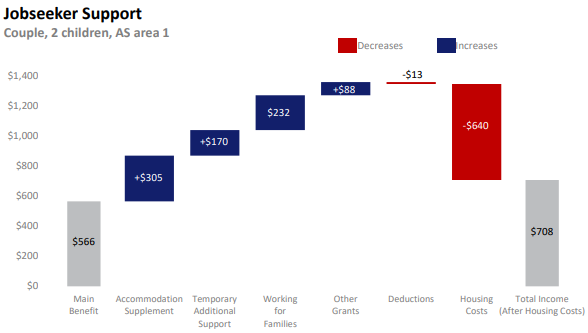
MSD have released a report on benefit incomes. I have long held that beneficiary advocates base their poverty pleading on the basic benefit rate, but those numbers are well under total incomes once the additional top-ups are included. Here is a selection of the graphs from the report:


(Left click on image to enlarge)

In this calculation $450 is nominated for a single person's accommodation costs in a high rental area. This reflects a one-bedroom apartment in Auckland perhaps but even then, the sum is quite generous. All of the young people I know share flats and houses. And they have jobs. Most try and keep their accommodation costs below $200 per week. The example is very odd.

The next example shows a couple with two children. The nominated rent in this one seems reasonable:


Note that their total income is $1,348 per week or $70,096. This is though just an example. 

Below are actual average incomes by family type before and after housing costs:


Averages reflect a range of living costs around the country.

The couple with two children receives $59,644 annually net.

It is immediately obvious that one working parent - let's say the father earning around $60,000 - can only support his family as well as income from a benefit.

For example a father working in construction, education, and automotive on the median salary. 

If he worked in customer services, transport and logistics, or hospitality and tourism he'd be worse off.

And we wonder why there is a labour shortage.

I am out of time but go look at the report, especially the section on inflation. (Don't be tripped up by the 'equivalisation' process.)

Afterthought: It occurs to me that the government is going to start pushing this line hard - that they've looked after families with children on benefits but now single people are falling behind. The report nominates an unrealistically large rent in the single person example to leave a small after-housing costs income. Why?

Because they are gearing up to push the unemployment insurance scheme on New Zealand whether it is warranted or wanted.


Thursday, July 28, 2022

Graph of the Day


Heard any alarm bells ringing yet?

Friday, July 22, 2022

Carmel Sepuloni talks half of the story

 Carmel Sepuloni announces: 

Benefit numbers continue to fall

“The statistics show our investment into front line case management has worked, and while we are not out of the woods by any means, we are tracking in the right direction."

Not for children. Their numbers are going up.


Something else I would be worried about is that the "3,717 fewer people on a Main Benefit compared to March 2022" represents a 1% drop. 

Over the same period last year, the reduction was 3 percent.

Tuesday, June 21, 2022

MSD: More fraud investigators than prosecutions

The following pieces of information come from a published OIA response (the images are skewwhiff because that's how they appear at MSD's site):


But wait...there's more:


Read the response and draw your own conclusions.


Wednesday, June 15, 2022

Irreconcilable stats for April 2022

SEEK EMPLOYMENT REPORTS

SEEK Employment Report - Job ads soar to new highs in April


MSD REPORTS

Jobseeker Work Ready recipients increase by 345 in April

Main benefits cancels into work decrease by 3,678 in April

The Flaw in PM's Plan

In April this year the Prime Minister laid out the progress she has made towards child poverty reduction since taking office. She said her government has "lifted tens of thousands of children from poverty and improved the lives of many others."

She makes one specific comparison over the time frame since becoming Prime Minister - a "30% reduction in children aged 0-17 who live in low-income households after housing costs, over three years (from 2017/18)."

This was achieved primarily by lifting benefits and family tax credits - and in particular introducing a $60 weekly child payment called Best Start.

She failed to mention she has also overseen thousands more children becoming dependent on benefits.

Between March 2018 and March 2022 the number of children in benefit-dependent households grew by 22 percent or almost 37,000. To picture this increase, imagine about one hundred good-sized schools.

I spent a number of years as a volunteer working with dependent families and came to know the tragic circumstances of a typical child on a benefit. But my sample is small so let me construct a profile based on New Zealand statistics.

Let's call the child Sam. She's five and lives in Northland (which has the highest % of its working-age population on welfare). She is Maori and lives with her sole mother (more dependent sole parents are Maori than any other ethnicity). Sam's mum has debt to MSD of $4,000 (the average mean debt to MSD at June 2021) and receives hardship assistance for food (as one of  364,000 food grants issued in the March quarter). Sam lives in a private rental which is subsidised with a $160 weekly accommodation supplement. Sam has one older sibling, and her mum has been on thebenefit since leaving school (those entering the benefit system under twenty stay the longest). Sam's mum is 25 and will probably remain on a benefit well into her thirties (average future years expected on a benefit is 12.4 at 2021 - up from 10.6 in 2017).7 There is also a high chance Sam will herself become a beneficiary (looking at a group of 83,000 children born in benefit households between 1993 and 1995, 47% had entered the benefit system themselves by age 23.)

This then is a typical profile of a child in a benefit dependent household.

Less typical but still not statistically uncommon would be for Sam to have moved homes more than once since her birth; to be known to Oranga Tamariki; to have a mother with a substance use problem and/or suffering mental ill-health, and to have a father serving a community or prison sentence.

Benefit dependency is a known risk for children. The likelihood of children suffering abuse or neglect increases in proportion to time spent on a benefit. The correlation is probably due to the inherent dysfunction of non-working households. There is no need for a routine, no need to get to a job and no need for kids to get to school (Covid has only exacerbated the malaise.)

This mirrors what I saw as a volunteer called into help families in crisis (some on benefits cope admirably well but they are the exception).


   - A sixteen year-old heavily pregnant Maori girl with a controlling and menacing Pakeha boyfriend twice her age and fresh out of prison. She is living in the house of her alcoholic and criminal mother whom the Sallie Army has finally given up on.

    -A young Samoan man struggling to raise daughters (one not even his biological child) by a Maori mother who had abandoned them for gang life.

    -A self-absorbed immature European girl whose child was always exhibiting the latest Dr Phil acting-out syndrome eg pulling at her hair was apparently 'self-harming'.

    -Another older New Zealand European single mother deeply depressed and traumatised by a dark past she would hint at but never divulge. Not a fun game to participate in.

    -And yet another young, chaotic Pakeha female who'd lost custody of her child to her mother. She fantasized about being a human rights lawyer - also watching too much Oprah - but was only ever getting around to it. When I ferried her to the local polytech to be interviewed for a course in nail-care she insisted on wearing her pyjamas and dressing gown. Any excuse to stay on a benefit and watch daytime telly I expect.


None had any real incentive to change as long as the money came in.

These are the lifestyles of unemployed parents. They themselves have often not grown to adulthood but we pretend they can provide consistent and caring parenting ... if only the government just pays them more.

That's the major thrust behind the Prime Minister's mission to reduce child poverty. Paying everybody more whether or not they earn it.

That's the flaw in her plan. More money does not guarantee better child outcomes. In fact it does the very opposite when all it achieves is more children on benefits.

She is never challenged on the flaw in her plan.

Who asks the hard questions about where all the extra money goes? Who asks why New Zealand has apparently record low unemployment but over 200,000 children relying on a parent on a benefit? Who asks about appalling and worsening school absenteeism? Who asks why New Zealand ranked last in child mental well-being in the most recent UNICEF report card? Who asks why only one in five Maori babies has married parents?

Who cares so long as the PM can pat herself on the back and claim to have achieved what she came to parliament for.


Saturday, June 11, 2022

Why Luxon can't win the war on gangs

 According to the Ministry of Social Development, “The harm inflicted by gangs is a serious issue in New Zealand. We have a complex gang problem that spans social, economic and justice issues." 

That was 2014 when there were 3,960 adult gang members known to police.

Last year, in 2021, it was reported: “As of June 30, there were 8,061 gang members on the list curated by police, up from 5,343 at the end of 2017.”  

Over an examined twenty-one year period 92 percent of gang members received a benefit at some point with the average duration of receipt at 8.9 years. 

Their rents are often paid through the accommodation supplement if not through income-related rents and emergency housing in motels etc. And their food is often paid for through hardship grants. 

Gang partners are also paid single parent benefits and child tax credits. Their weekly ‘package’ can amass more than $1,000.

In 2014:

There are in the order of 6,000 to 7,000 children known to be associated with gang members who are growing up in welfare recipient families, and are subject to high rates of abuse and neglect.

A total of 3,516 children of gang members were recorded as being the victims of abuse or neglect that had been substantiated on investigation by Child, Youth and Family. This is 60 percent of the total 5,890 known children of gang members.

The alleged perpetrator of abuse or neglect of gang member’s children was more often recorded as the child’s mother than the gang member father.

Gang members do not itch to attach themselves to clever, educated, and independent females. Gang women are often the female offspring of gang parents who taught them how to care for children.

But it is important to gang members to father children, and they do it more frequently than non-gang members - 2,337 gang members had benefit spells that included 7,075 dependent children. 

Lately there’s a lot of noise over the deported 501s and their contribution to escalating gang and gun violence.

But New Zealand does very well in amplifying its homegrown problem through strong welfare incentives and weak child protection services. 

Today National leader Chris Luxon released his getting-tough-on-gangs policy. To be honest I haven't even read it.

Because a couple of days ago Chris Luxon told Guyon Espiner that National would raise benefits under his government.

Now National leader, he rules out welfare cuts and says the party will raise benefits if it wins power (without specifying when and by how much).

"I can tell you right now, I'm not dreaming up a policy to reform welfare ..."

Then you aren't serious about gangs - this generation and the next ...and the next ...

Saturday, May 21, 2022

So many elephants in the room they are becoming unremarkable

In the NZ Herald this morning ex Labour leader sort of congratulates Grant Robertson on his budget spending. Or rather, damns with faint praise really. He writes,

Housing ... not just the supply but also the quality of existing stock — continues to be the elephant in the room to addressing the growing inequity in our society.

Housing is an issue. It is some people's major issue. But...

Set me to thinking. What is mine?

It's twofold. It's stubborn and ignorant repetition of past policies that have never worked. 

And simultaneously charting dangerous territory with the assertions that democracy can't work for minorities (with flavour of the day, Maori). To that end frantically throwing out bedrock democratic principles.

Democracy doesn't work for minorities. I know. I am in one. The 5-10 percent that genuinely crave small government, free markets and personal responsibility. It doesn't follow I advocate for an overthrow of 'one person, one vote'. It means my minority has to persuade the majority their way.

But back to the point of my post. 

What is your elephant in the room?

Prove my point. There are so many elephants in the room that they are now unremarkable.


Thursday, May 19, 2022

Budget baloney

Unbelievable bullshit.

The great spin machine has it that for too long mothers on the DPB - called Sole Parent Support since 2013 - have been robbed, yes robbed, of their rightful child support payments made by the non-custodial father. Jacinda says mothers have been "denied money that is rightfully theirs."

Reality check. The state has generously paid a livable statutory entitlement to any sole parent - regardless of the reason for their single state - since 1973. If the non-custodial parent was paying child support (known as 'maintenance' at that time) the state kept it to offset the cost of the benefit to the taxpayer.

Today's announcement puts an end to that.

Some sole parents are in for a pay rise. 

Not because the father is going to pay more. But because the taxpayer is.


Wednesday, May 18, 2022

Female prison population shrinks nearly twice as fast as male


Between March 2017 and March 2022 the female prison population decreased by 39.3 percent whereas the male prison population shrank by just 22.4 percent.

A win for the ever-aggrieved feminists?

Wednesday, May 11, 2022

New Zealand today: Where facts are described as "nonsense"

 RNZ reports:

Shane Reti: Life expectancy for Māori was 30 years in the 1840s but today it is around 73.4 years.

Willie Jackson: Shane is talking nonsense.

There have been enormous health (and other) gains for Māori over the past 100 or so years. I gathered them together in one document here.

Progress is being made but constant polemic-driven politicking and redundant reforms will not hasten it.

If Andrew Little's goal is to reduce bureaucracy to improve efficiency, why develop two separate health authorities? He too is flying in the face of reality.

Ultimately, the personal decisions individuals make about their own health will have the greatest impact on their longevity.

That should be the message to Māori and every other person of every other ethnicity.


Saturday, April 30, 2022

Behind the headline

An RNZ headline reads:

High rate of suicide in pregnant and post-natal women

"Suicide is the leading cause of death during pregnancy and the postnatal period, and Māori women are three times more likely to die this way, a new report has found."

That's an alarming fact and one that somewhat surprised me.

Any suicide is a terrible tragedy but perhaps even more so when it involves an unborn child.

After a moment's reflection, my analytical mind immediately wants to know, how many?

The report is from the Helen Clark Foundation and while the assertion is made and referred to several times in the paper, no statistics are provided. The claim is referenced though and takes us to this source - the maternal section of Perinatal Mortality Review report.

In the thirteen years that span 2006 to 2018 there were 30 suicides or two annually on average.


There were 809,831 maternities in the same period. Maternal suicides are in fact very rare.

But rarity doesn't make for headlines.

Furthermore, there were 27 in the period 2006 to 2016, leaving three in 2017/ 2018.

Maternal suicides are reducing.

For context 65 young people under twenty took their lives in the year to June 2020.


Update: On TV One the maternal suicide number has grown to 10 every year. 


Thursday, April 28, 2022

Labour actually achieves something

The data for the following chart comes from StatsNZ. 

Looks like New Zealand is becoming a safer place. Fewer crimes are being committed - of every type - that warrant imprisonment.

There has been a 39.3% decrease in sentenced prisoners since 2016 from 8,958 to 5,433 total offences.

'Unlawful entry with intent/burglary, break and enter' has seen a 44.5 percent decrease. Wow.

What a great result by the Labour government.

Mr Sharma will be delighted.


Tuesday, April 26, 2022

On Māori inter-marriage and future implications

The rates of partnering between Māori and non-Māori are high and always have been. 

Historically:

 “Intermarriage with non-Maori contributed to the rapid growth of the Maori population in the post-war period. As at 2003, almost one-quarter of Maori children were born to non-Maori mothers, (Statistics New Zealand 2005).” 

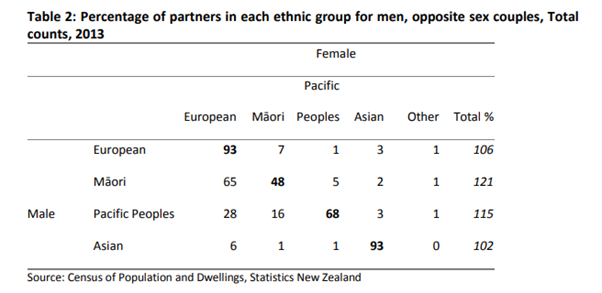
In 2013 fewer than half of Māori men had a Māori partner:

Source

The corresponding figure for Māori females is 52 percent.

Furthermore, trend-wise:

“There has been a small but important decline in the proportion of partnered Māori who have a Māori partner. In 2001, 53% of partnered Māori men had a Māori partner. In 2013 this declined to 48%. For Māori women the decline was from 52% to 47%.”

These realities pose vital questions:

1/ Is there a pervasive appetite for separatism among people who have long been attracted to those outside their own race and culture?

2/ With institutions and services increasingly split along racial lines, where will individuals of mixed ethnicity fall? This is particularly pertinent in the case of Oranga Tamariki which is pursuing a policy of keeping ‘Maori’ children with ‘Maori’ relatives as a priority. When all aspects of the child’s well-being are considered, this may be the best course of action; equally, it might not.

John Tamihere famously said New Zealand’s future, “… is being decided in our bedrooms, not our boardrooms.” He also identifies as Māori more strongly than any other ethnicity, as is his right.

Since making that proclamation as Māori Affairs Minister in 2004, Tamihere has become a strong advocate for separate systems. As Māori Party president he appears more radical in his views than when a Labour MP.

Is he now in danger of forcing those of mixed ethnicity – even children – to make difficult, possibly unbearable decisions to meet the demands for tino rangitiratanga – ‘by Māori, for Māori?’

At the risk of sounding overly dramatic the phrase ‘Let no man put asunder’ might be a reminder to those who want to divide New Zealand that ultimately, individuals make their own life choices, and those choices are sacrosanct.


Sunday, April 24, 2022

"What women want from Labour, National"

I strongly object to writers who refer to groups of people and profess to speak for them. It happens all the time with Maori, and now Paula Bennett presumes on behalf of women. 

But once a politician always a politician so it's hardly surprising. 

Political parties run 'focus groups' to find out who to woo and what to say. They put their political pinkies in the wind and blow with it. And blow is a good word.

This piece is a lot of 'blow'.

'We' this, 'we' that. Heavy on stereotypical female roles. A shout out to the sisterhood? A signal about how to behave if you want to belong? 

Identity politics, to be blunt about it. 

BUT Bennett knows more about women than I do. She has lost none of her political smarts. Her cloaked advice is for National (not Labour): "You must capture our heads and our hearts." Currently common corporate parlance.

I must have been mistaken when I thought identity politics was the domain of the left.

It squeezes out the individual who doesn't identify with any group - who gets a shiver down their spine when told WHAT THEY THINK AND WANT. Exactly what Bennett has done.

This whole device (former minister speaks for her gender to her former party) leaves me cold.

Then again, my cynicism regarding politicians has never been as deep as it is right now. 

The manipulative game they play, and which voters willingly participate in, is ruinous.


Saturday, April 16, 2022

PM: "Come to New Zealand, we're kind."

 The Prime Minister is off overseas tomorrow. RNZ reports:

Ardern will be making local media appearances and leveraging off New Zealand's Covid-19 response. She noted research suggesting those abroad now see the country in a more favourable light.

"They see us as people who look after others, and that's a really important message to send," Ardern said.

"Come to New Zealand, we're kind."

Kind of what? Kind of authoritarian? Kind of conformist? Kind of pathetic?

Jacinda said there would be no vaccine mandates. Thousands breathed.

Then she said there would. Thousands lost their livelihoods.

With nothing left to lose they went to parliament to appeal to her.

Not only did she steadfastly ignore them. She sneered and then smeared them. 

But let's shove aside the mental images still raw from the end of the protest. 

And all the hardship the government response to covid wreaked on the economy.

Covid aside, under Ardern, New Zealanders have experienced so much additional stress.

She has actively made life less tolerable for:

Farmers (unworkable regulations, new taxes, SNAs and encouraged division between rural and urban interests)

Landlords (often unnecessary onerous regulations and loss of tax exemption on mortgage interest)

Employers (more sick leave, higher legislated wages, extra public holiday and family violence leave)

The customers of farmers (all of us) are no better off. Farm produce gets more unaffordable.

Tenants are paying higher rents and now the pool of rental properties appears to be shrinking.

Employees are struggling with inflation that has both international and domestic drivers (not least the hyper spending by government on a burgeoning bureaucracy.) In a high inflation environment the poorest - and their children - hurt the most. They have the least disposable dollar.

The ratio of income to house prices - and newly legislated LVR lending restrictions - means many young people believe it is impossible to buy a home here.

The next migration outflow is imminent and unavoidable.

But... back to the PM's trip. She said, "Now is the time to get out and about, to support our exporters, and so we're willing to take on board the risks."

RNZ originally headlined their article PM says "Now is the time to get out"

An editor guarding their funding source has since changed it.

But I say it to my adult children all the time.

Wednesday, April 13, 2022

Sepuloni stonewalls serious questions

This morning SEEK, the foremost advertiser of jobs in New Zealand, advised that March listings were up 27% on March last year and 2 percent up on last month. Job ad levels are at a record number.

Applications per job had, however, fallen significantly.

Last week in parliament ACT MP Karen Chhour put the following questions to the Minister for Social Development and Employment, Carmel Sepuloni:


8. KAREN CHHOUR (ACT) to the Minister for Social Development and Employment: Does she believe that jobseeker beneficiaries who fail to meet their work obligations should have their benefits reduced; if so, why were work-related benefit sanctions in the last quarter of the last year less than half what they were in 2019?


Hon CARMEL SEPULONI (Minister for Social Development and Employment): Only if it is appropriate to do so, and as a last resort. The Ministry of Social Development (MSD) has changed its way of working during COVID-19. Staff are more proactive with clients and offer more phone engagements, in line with the alert and traffic light settings. The member will notice the number of people sanctioned for failing to prepare for work has remained steady over this time period, and almost all the drop-off in sanctions is for failing to turn up to an appointment. This reflects the changed environment due to COVID-19, as well as increased Government investment in front-line work-focused case management. I'd also like to point out the big drop in the number of parents with dependent children who are sanctioned. This fell from 1,980 in December 2019 to 579 in December 2021. MSD are working more closely with clients to understand the reason for their non-compliance and make it easier to re-comply if they have children. Our new ways of working have been successful. Last year more people moved off a main benefit and into work than any time since electronic records were kept, a trend which is continuing in 2022. 


Sepuloni claims sanctions for failing to prepare for work are "steady" but sanctions for those failing to participate in work dropped 62.5 percent from 1,200 to 450. For context the denominator is 368,172 so the fraction is, in any case, tiny.

 But let's deal with the last part of the answer.

The number cancelling a main benefit to move into work is a somewhat meaningless figure without accompanying grants: 


Graphing the Ministry's data shows that in March 2022 there were still more grants of a Jobseeker benefit than cancellations of a main benefit to move into work. In March 2021 the reverse was true. So the situation has actually deteriorated. Additionally, more Jobseeker benefits were granted in March 2022 than either of the two prior months.


Karen Chhour: If someone on jobseeker support does not have an exemption for health reasons and refuses to fulfil a suitable job vacancy, should they be able to stay on their full benefit with no consequences?


Hon CARMEL SEPULONI: Every person's situation on the benefit is different, and it's important that the Ministry of Social Development and the case managers recognise that. We also need to begin from the starting point of assuming that the vast majority of people who are on benefit do want to work. MSD's job is to support them into the job opportunities that are available, that are best suited to them, and work to ensure that the work they take up is sustainable and meaningful for them and good for them and their whānau.

Working is actually about 'earning a living.' A lot of work is not sustainable simply because that is the nature of jobs today. Not everyone can find a long-term secure job that fulfils them in every way. Thousands of people do work that they'd prefer not to. That's the reality of life. They do find reward though in having workmates, in supporting themselves and being occupied.


Karen Chhour: Is it fair to use hard-working Kiwis' taxes to pay for 106,000 work-ready jobseeker beneficiaries when many industries are crying out for labour, with some having to shut their doors due to understaffing?


Hon CARMEL SEPULONI: What is not fair is to use the politics of divide and rule by trying to pit those "hard-working" New Zealanders against people that are on benefit. Many of us in this House would have had a stint on benefit at some point in time. We're no longer on it. We didn't have the intention to stay on it. We always had aspirations to get out and work for ourselves and our whānau, and that is what the vast majority of beneficiaries also have. There's also a cohort of New Zealanders who struggle to get into work for a range of other reasons, including health conditions and disabilities, and for far too long they have been under-invested in. It's not just about expecting the person on benefit to get off benefit and go and work. It's about a Government being committed to breaking down the barriers to them being able to take up employment.

I surely won't be alone in seeing the irony in a Minister from the current government accusing a member of the opposition of using the "politics of divide and rule." Labour and the Greens are steeped in identity politics which pits the interests of one group against another. New Zealand is being increasingly divided along race, gender and age lines. And the Prime Minister's notorious response to a question about whether the vaccine passes were intended to create two different classes of people - "yip yip" - is, unfortunately for her, unforgettable.


Karen Chhour: Why, when so many businesses need staff, have the average future years on a benefit risen from 10.6 years in 2017 to 12.4 years in 2021?


Hon CARMEL SEPULONI: I saw some recent information that came through to my office yesterday that actually saw there's been a reasonably significant increase in the number of New Zealanders who were exiting benefit and still in employment six months later. This is what we've been focused on since day one in Government—is not just seeing getting people off benefit as the win, which the previous Government saw as a win, regardless of where they went, but actually supporting them into sustainable, meaningful employment so that they are able to continue to work for them and their whānau and, hopefully, with the right support, not return to benefit.


"...some recent information"? That's hardly a rigorous response. If the information isn't referenced, it isn't subject to scrutiny.

According to the latest MSD Annual Report, the "percentage of clients who remain off main benefit having secured sustainable work" (for 26 weeks) decreased from 70.6 in 2016/17 to 68.7 in 2020/21. 

If Labour had successfully focused on a goal of "exiting benefit and still in employment six months later" benefit numbers would be well down. They are not. They grew in every year of the government's first term and eased only slightly between 2020 and 21.

Incidentally Chhour's data comes from the same source. It is damning.

If the "vast majority" of people on a benefit want to work, have aspirations to support their whanau, why, in a job rich situation, has the expected time they will spend dependent grown by seventeen percent?

That remained unanswered.

Parliament is a difficult listen these days. Ministers do not answer questions - particularly supplementaries - and when the opposition MPs complain to the speaker their objections are brushed aside with mealy-mouthed assertions that the question has been addressed.

The only positive comment I can make is that Sepuloni isn't the worst offender.

How bad is that?