Tuesday, February 16, 2016

Pacific Islands Family Study: Fathers also victims of partner violence

There are a number of longitudinal studies underway in NZ.

The well-known Christchurch Health and Development Study (birth cohort 1977); the Dunedin Multi-disciplinary Study (birth cohort 1973); and Growing Up in New Zealand Study (birth cohort 2009-10) are those that jump to mind.

But today I learned of the Pacific Island Family Study (birth cohort 2000) reported here.

Readers might be interested in some of the findings to date.

Participants: the PIF Study recruited 1,376 mothers of a cohort of 1,398 Pacific infants (22 pairs of twins) born at Middlemore Hospital (a large tertiary hospital) in South Auckland between 15 March and 19 December 2000. An infant was deemed eligible for the study if at least one of their parents identified themselves as being of a Pacific ethnicity and was a permanent resident of New Zealand

Data collection: the PIF Study primarily collects self-reported data through structured interviews with mothers and fathers in their homes and with children in their schools. Children and their families have been visited when the children were aged six weeks, and 1, 2, 4, 6, 9 and 11 years

This one intrigues me  because fathers were less likely to smoke over time but mothers more.

This caught my eye because it shows (as often argued on this blog) that men are also victims of partner violence. At Year 11 of the survey 10% of fathers and 16% of mothers reported being victims of minor physical partner violence; 4% of fathers and 8% of mothers reported being victims of severe partner violence.

Noteworthy is this commentary:

"The PIF findings are consistent with those reported in other New Zealand groups (Magdol et al, 1977), and revealed that mothers were just as likely as fathers to perpetrate and be victims of severe IPV."


Overcrowding is not unusual in PI households but this puts some dimensions on the extent. This prompted me to speculate about the apparent poverty of PI children using the official child poverty measurements which are based on equivalised household incomes. Equivalising means adjusting for numbers of household members. So the more members, the lower the equivalised income will be.

While it is quite true that more members will require more financial resources I am nevertheless reminded that child poverty measurement is based on a constructed household income - not actual household income.

Here's a final observation I also found interesting:

The high percentage of traditional gift giving among Pacific families, and the level of financial stress associated with such practices, may play a role in reducing the financial security for some of these Pacific families. There is growing evidence that younger, New Zealand-born, Pacific people are becoming less committed to traditional gift giving to churches and other cultural obligations. 
That may be a good or bad thing depending on which side of the transfer one stands.

Monday, February 15, 2016

PM says something useful

In Parliament last week, after a great deal of belly-aching and nagging by Metiria Turei about taxing people more, the Prime Minister responded:

"...our whole system relies on people getting out of bed in the morning, working hard, and paying taxes. In my experience, there are literally millions of New Zealanders who get up every morning, who do not want the Government to give them a handout, and certainly just want to have a fair system in which to operate."

Then, with some prompting from David Seymour

"As we know, when we have a broad-based, low rate that is fairly applied, actually what you see is that New Zealanders get on and they pay their tax bills. They do not spend time trying to avoid taxes. What we know, actually, with the Green Party and, to be frank, with the Labour Party, is that all they know how to do is spend other people’s money, when the rest of the country is actually focused on how to make money."

Just thought I'd put that up this morning because we don't hear the PM nailing his colours to the mast (other than the flag mast) often enough.

Many of us don't see  a great deal of difference between National and Labour when it comes to spending. But it is also inescapable that to stay in power National has to play a pragmatic game balancing taxing and spending for the greatest political gain. It must frustrate the PM and a number of MPs equally. But in a democracy, is there a choice other than slowly,slowly, catch a monkey?


Sunday, February 14, 2016

Some religion on Sunday

My sentiments exactly, but expressed by Rodney Hide in today's Herald on Sunday. On the govt's attempt to tax smokers out of existence

"Taylor's proposal would see a packet of cigarettes priced at a $100 by 2025.
I suspect that would achieve the Government's target. New Zealand would be smoke free. Taylor would not be seeing any smokers. The job would be done.
That would be because we smokers would be holed-up, out of sight, hidden in the hills, puffing furiously on our home-grown weed - bandits and outlaws, but free.
I hope I would be with them. I would prefer the fun and the freedom compared to the prissy lot we have become."

Risk-free living is a relatively new most unwelcome religion.

After the tragic recent spate of drownings we are being told

"Never swim alone and only ever swim at patrolled beaches."

How realistic or desirable is that?

Alcohol causes cancer. Take the law into your own hands and refuse to serve a pregnant women.

Meat causes cancer. Don't barbecue.

Speed kills.  Fine the bejesus out of minor offenders. And again wrest keys of suspect drivers if you like.

Gambling is an insidious addiction further encouraged by alcohol sponsorship. Ban it like we banned tobacco sponsorship.

And while you are at it ban it from all sports. Young minds are too impressionable.

Facebook is a fiendish scourge on young minds too. It drives people to suicide.

Quad bikes. More dangerous than a loaded gun. Guns!! A horrible symbol of animal exploitation and male dominance. Ban them.

I could go on and on. But in the interests of my own safety and sanity ...well it's just too risky or  I'll end up in Them Thar Hills too, swinging off the branches of some nasty non-native tree. Or holed up in my non-consented tree house.


Saturday, February 13, 2016

"...their problems are therefore those of the Maori people..."

It has been clear for a long time that a disproportionate number of children who are reported to CYF, have a substantiated finding of abuse or neglect against their parent or caregiver, or end up in state care are Maori. But I haven't seen the statistics put in these terms before (or if I have I've forgotten):


 "...35 per cent of all Maori children are notified to CYF before age 5, compared with 11 per cent of non-Maori children."
This is from the 'interim' report by the group led by Paula Rebstock tasked with examining CYF.

Statistics relating to ethnicity are increasingly redundant as more and more New Zealand-born children report (or their parents report) more than 1, 2, or even 3 ethnicities.

The above finding is particularly intriguing because many Maori children who  also have Pacific Island, NZ European, Asian, etc parentage will be counted as Maori because of the hierarchical system government uses.


From a Families Commission report 2004:


"...if a person reports more than one ethnic identity they will be counted only once, in the following priority order: Māori, Pacific peoples, Asian, other, European." 

(Yes, some reporting  systems take account of multiple ethnicities leading to annoying and meaningless totals for the purposes of research, and  reliance on self-identification produces Maori as the overriding ethnicity anyway.) 

I came across a passage (not on-line) the other day that crystallizes the problem.


The children of a mixed marriage are also usually very readily accepted by their grandparents, both Maori and Pakeha. In the wider community such children are nearly always looked on as Maori if their ancestry is at all obvious (the term ‘half-caste’ seems to be used less now than formerly), and their problems are therefore those of the Maori people… Harre 1968

I have been reading up on mixed marriages/partnerships and the rate of partnering between Maori and non-Maori is very high especially when compared to other races in other countries.

Personally I think it's a good thing but when it comes to problems with offspring it has to be said the contributing ethnicity who is not Maori gets of scot free when it comes to the reporting of ethnic contribution.

Thursday, February 11, 2016

Anti-smacking law is bad law


The anti-smacking law has failed to reduce the abuse and neglect of children. It was never going to make a difference because lawless people don't give a damn. In fact normally law-abiding people don't give a fig for it either. On a recent plane trip, the row in front of me contained a mother and two youngsters one of whom was being stroppy. I didn't see what the child did (to her sibling I think) but what I did hear was the mother, having handled the situation saying to the daughter, "I'm sorry if I tapped you too hard but...." She followed the law by changing the language.

Many people think we should just get over it and get on with it. But this report highlights that the anti-smacking law, which is being policed, may actually be making the situation worse.

It's bad law. I've listened to people speak who have been criminalised by it and their experiences have been harrowing.

Read the  report summary here.

Tuesday, February 09, 2016

US politics - contrasting views

I noticed two editorials that related this morning. First the DomPost lamenting the bizarrenness of US politics but citing Republican candidates only. Not a  Democrat in sight. (Oh, and typically the writer manages to have a crack at ACT in the process).

 American politics may seem grotesque to New Zealanders. We have reckless demagogue politicians; but we don't have anyone as bizarrely irrational as Donald Trump.
We have narrow and fanatical politicians, but no-one as bigoted or as nasty as Ted Cruz. We have ignorant and foolish politicians, but none as breathtakingly weird as Ben Carson. 

Then a piece by a very angry American taking extreme umbrage at front-running Democrat candidate Hillary Clinton.

Hillary Rodham Clinton is not qualified to be president of the United States of America, because she doesn’t know what the United States of America are. Terry Shumaker, former U.S. ambassador to Trinidad (I wonder what that gig cost him) and current abject minion in the service of Mrs. Clinton, quotes Herself telling an audience in New Hampshire: “Service is the rent we pay for living in this great country.” There is a very old English word for people who are required to perform service as a rent for their existence, and that word is serf. Serfdom is a form of bondage.
Agree or not, at least the second writer has zest for his topic. And note he identifies himself thereby owning his thoughts unlike the DomPost editorialist.

I wonder if the US political process is considered "grotesque" simply because too many commentators in this country have become overwhelmed by political correctness allowing it too censor and comfortably numb their intellects?

Monday, February 08, 2016

Quite different pictures

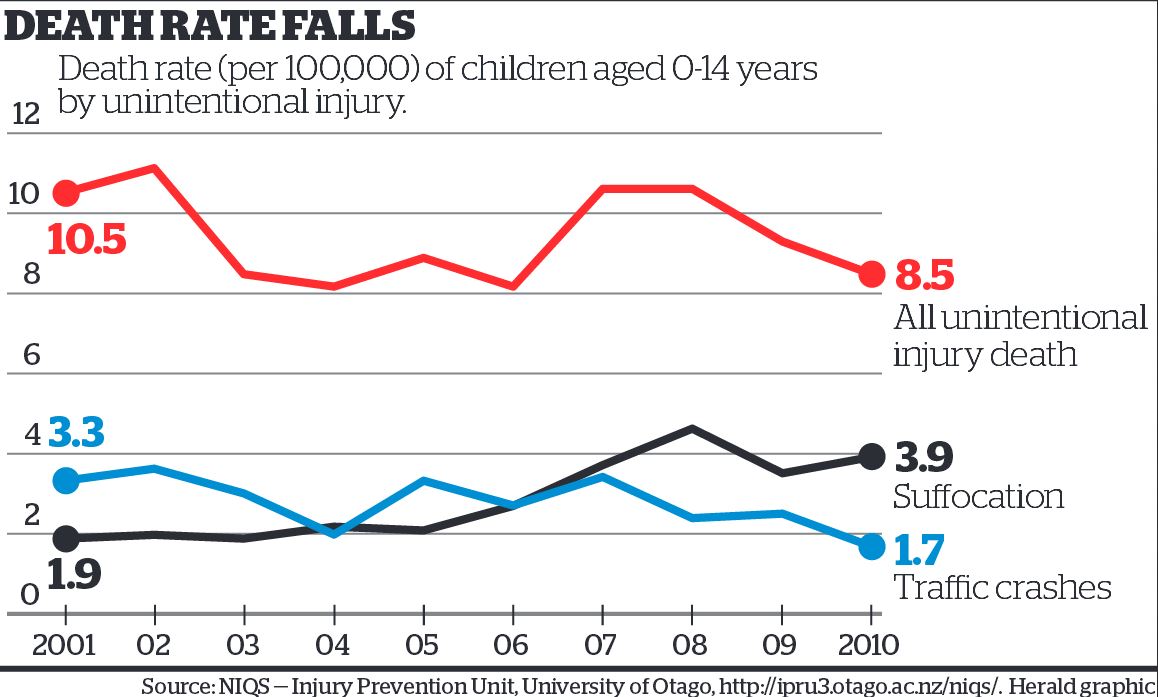
The NZ Hearld has a headline, New Zealand now much safer for children as injury cases plunge.

There must have been data availability restraints for the black and blue lines on the graph below because the writer could have taken the red line to 2012 showing even greater overall improvement.

Below the NZ Herald graph is the result of querying the NZ Injury Query System. The death rate per 100,000 children from 'unintentional injury' dropped to 6.5 by 2012. I went on to query fatalities from 'all intents'  and have graphed the difference. That produces a slightly different picture.


Sunday, February 07, 2016

Seymour vs Ardern is going to be entertaining

At the supermarket checkout this afternoon I spotted the header on the Sunday Star Times heralding two new columnists - David Seymour and Jacinda Ardern. Very nice. I expect they'll be given (or agree together) a subject each week.

Then I got an e-mail alert that Ardern had tweeted the link so took a look.

Interesting. It appears David has taken  on the subject and Jacinda has responded. I assume next week it'll reverse.

This format will make for much more entertainment.

Here's the first installment .


OPINION: Like almost all Kiwis I have always avoided Waitangi on the big day. Images of protesters, crying prime ministers, and actual mud-slinging are enough to put most people off.  If you've ever been in Sydney for Australia Day, you'll know how much better our national day could be.

But Parliament obliges me to be here, so I'm writing this from an old Paihia motel (my parliamentary colleagues had booked out the Waitangi Copthorne, but that's another story).

The trouble this time is the Trans-Pacific Partnership Agreement, or TPPA. People oppose it for the same reason people used to have mullets – fashion, not logic. Being of Ngāpuhi descent myself, it's been a real struggle to understand why local Maori are protesting a trade agreement. 

If an iwi is going to host representatives of the Crown to symbolise this 176-year-old relationship, why not rotate the host iwi and location?

The fact is, many colonial-era Maori were very entrepreneurial, and took ready advantage of the more secure property rights provided by the Treaty – more secure than being invaded by nearby tribes as happened through the musket war period around 1820 to 1840. One of the many important rights the Treaty gave was access to sea lanes protected by the most powerful navy on the planet.

I've been reading Hazel Petrie's Chiefs of Industry. It tells the story of colonial-era Maori such as Te Hemara Tauhia. In the 1850s he built a sawmill in the north and charged Pakeha to mill their timber.

Then he realised they were making money off the shipping so he commissioned a 20-tonne ship to move it, too. That guy would have favoured signing the TPPA.

He was not unusual. As another author summed up, colonial Maori "were able to leverage European technologies to build remarkable trading relationships around the world as well as forcing the world's most powerful empire into a stalemate."

Back up here at Waitangi Day 2016 the usual suspects (about 0.01 per cent of the population) have made the elected prime minister of New Zealand stay away and denied all of us a national day we can enjoy because they don't like the TPPA. It got me thinking.

The Treaty was not signed just at Waitangi. It went on tour and was signed by Chiefs all over the country.  Waitangi is just the place it was signed first.

It's never been clear why one iwi gets to monopolise the celebrations, but this year's circus has made it especially unclear. The disruptors don't know much about trade or even their own history of trade.

Even the device that one protester threw at Steven Joyce probably entered the country under the China FTA.

If an iwi is going to host representatives of the Crown to symbolise this 176-year-old relationship, why not rotate the host iwi and location? It could be in a different place each year, following the actual path that the Treaty took during 1840.

Ngāpuhi have denied the whole country a proud national day just one time too many. It is time to take this show on the road. There were 20-odd signing locations so it'll come back around in 2036. Estimates are that the TPPA will be adding an extra $3 billion to our economy every year by then.

And a bit of competition among locations might also help to lift standards of behaviour, bringing some dignity and joy back to this historic occasion.

Jacinda Ardern responds

Australia Day? Are you kidding? That is the last place we should be looking for a model of race relations, let alone a national day of celebration – unless you're into drunken, casual racism. 

I am sorry you felt a sense of duty rather than any desire to be at Waitangi, David. Or that your auto lodge didn't meet your expectations.

But your interpretation of what the pilgrimage to this place symbolises is just plain wrong. It's not about the dominance of any one iwi as you claim, it's about recognising the place where the treaty - and the relationship between Maori and the crown, all began, and what that relationship means now.  
And that's what makes your argument so ironic. You believe that moving around the country every year, presumably having the talks and debate we have at Waitangi, would be a better way to mark our national day. And yet this is the very thing that caused the difficulties this year - the fact the government didn't talk, didn't debate, an agreement that they signed on behalf of New Zealand, and Maori - the TPPA. 

I hand on heart believe in free trade, and so does my party. But we also know that this agreement was about more than trade, and it was these elements of the agreement that the government should have discussed openly- they didn't. 

There is no denying that there have been ups and downs over the years at Waitangi, but it remains a place for open debate and dialogue. That's worth celebrating.

Gang children - growing the problem

"The proportion of gang members and affiliates in New Zealand’s prison population has grown. The 2003 Department of Corrections census of prison inmates showed that gang members and affiliates accounted for 11.5 percent of the sentenced inmates. Over two thirds of those inmates belonged to either the Mongrel Mob or Black Power gangs. As of April 2013, gang members and affiliates comprised over 30 percent of inmates, with over 10 percent of the prison population belonging to the Mongrel Mob. Forty-six percent of prisoners under the age of 19 have gang affiliations."


"The literature suggests that single-faceted approaches are unlikely to be effective in dealing with gang issues. Suppression in particular has been criticised as largely ineffective in reducing involvement in gangs and offending.

In 2008, the Ministry of Social Development noted that:

A sole suppression strategy is costly…and gains are short term. Suppression has proven the least successful of all interventions and can have a negative impact as members convert stigmatisation into a symbol of status. Further … a reliance on the Police as public commentators on gang issues can be problematic, as many have narrow views of gangs and criminality, which may then be perpetuated
through the media leading to simplified notions about how best to respond.

Black Power member Denis O’Reilly similarly notes: “You have got to have an integrated response. But if the only weapon you have is a hammer then everything looks like a nail”.
Moreover, suppressing and imprisoning gang members can exacerbate the problem by providing gangs the opportunity to recruit new members in prisons, dominate prison culture and run criminal activities within prisons such as contraband trading. Prisons are a major recruiting ground for the largest ethnic gang in New Zealand – the Mongrel Mob – and a Mob chapter was formed in Auckland Maximum Security Prison in the late 1970s."

Source

Saturday, February 06, 2016

ACT Conference 2016


I've agreed to speak at the next ACT Party conference three weeks today. I'll cover what's been happening in welfare - the good and the bad - and  what further reform could look like.

Here's a list of speakers, all of whom I am keen to hear.


Further details

Friday, February 05, 2016

Growth in psych conditions in the welfare system

Here's a tidy illustration of a phenomenon I occasionally blog about; the growing incidence of benefit dependence due to psychiatric or psychological conditions.


The blue line is the old sickness benefit; the green line, the invalid benefit.

The total number at June 2015 was 53,611.

At March 1999 the total was 24,194.

A 121% increase compared to a total population increase of around 21%.

More sickness? More diagnosis? Whatever the driver, it's actually a problem for the Ministry of Health to address yet its MSD that bears the budgetary implications.

Thursday, February 04, 2016

The sky is falling ... not

Just reflecting on the back of yesterday's post, it must cause just a little bit of discomfit for politicians when they get it so wrong. No? I guess that if it did, they wouldn't be in the game.

November 2015

"New Zealand’s unemployment rate is now worse than Australia’s – an economy described as ‘fast becoming a basket case’, Labour Finance spokesperson Grant Robertson says.

“Last night Australia’s new figures put unemployment at 5.9 per cent. New Zealand’s is 6 per cent.

“Australia’s economy has been going through extremely difficult times of late. It has been a rapid downturn for a once-thriving economy.

“New Zealand has experienced a sustained period of economic growth that is now falling away. We should be doing much better than Australia. There is no way our unemployment rate should be higher than the across the Tasman.

“John Key and Bill English always blame overseas economic factors and turbulent times. But the GFC is over and other countries are doing much better. Britain, Australia and the US all have unemployment levels below 6 per cent and falling. New Zealand’s is forecast to top 7 per cent.share on twitter

“The stark truth is National hasn’t been able to turn growth into jobs. Now the economy is going downhill opportunities will be even harder to come by, even for those with jobs.

“This isn’t the Kiwi dream. It’s getting harder and harder to get into work or find a better job. Behind these figures are real people with families to support and ambitions to fulfil.

“National is failing them,” Grant Robertson said.

And just for good measure here he is talking to the Labour Party conference:


"151,000 New Zealanders are out of work, and the rate of unemployment is six per cent, with projections that it will head towards seven per cent next year. 151,000 people.  Think about that.  It is nearly twice the population of this city out of work.  It is nearly 50,000 more than when National took office.  In Gisborne one in every ten people is out of work. It is clear that John Key and Bill English see levels of unemployment like this as collateral damage in their blinkered economic vision."

Wednesday, February 03, 2016

Good fall in unemployment rate

Statistics NZ is reporting the unemployment rate has dropped to 5.3%.

It was 6 percent in the September 2015 quarter.

This is the lowest unemployment rate since March 2009.

A quick round-up from tables:


Female unemployment dropped more than male

Big fall for the 20-24 age group but small rise for 15-19

Drops for all ethnicities especially Pacific falling from 13.1 to 9.7%

Big fall in Northland from 8.2 to 6.2%

Only region showing an increase - 4.2 to 4.5% - is Otago

Ag, forestry and fishing recorded biggest employment increase in terms of numbers, followed very closely by construction

Internationally NZ moves from ranking 15th to 10th= in OECD


Bad news for Labour.

Unemployment has been considered one of National's few points of vulnerability.


Inter generational benefit receipt

These pie graphs show the percentage of beneficiaries aged 16-17 who had a parent(s) who were also on welfare.

For instance 56% of Maori beneficiaries aged 16-17 had been reliant on their parent's benefit for more than 80 percent of their teenage years.

For the large majority of all clients they had a parent  who had spent time receiving welfare.

Conversely only 7% had no match to parental receipt.

I suppose the left would call this the transmission of disadvantage.  It is also the transmission of values and expectations.

(Caution: I expect that in among this group will be young people with physical and intellectual disabilities whose parent has been receiving a benefit to provide care for them. These young people make up 23% of the total.)

Source

Tuesday, February 02, 2016

Ex Aussie prisoners emulate NZ criminals

Front page headline in DomPost reads,

Third of crims sent home now reoffending

30 percent to be precise. That's entirely predictable.

Pretty much on the rate for those released from NZ prisons. Australian prisons do no better at rehabilitation it would seem.


Additionally, the police say they expect the re-offending rates to "soar".


That, unfortunately, is what recidivism rates do.

It's not until the last sentence of the report that we learn,

"[Amy] Adams said the latest police figures were in line with New Zealand prisoner's general offending rates."

I guess it is easier to get people outraged about the ex-Aussies than our homegrown variety.

(If you wonder why I not infrequently blog about the prison population it's because of the strong correlation with welfare. As described in the latest Taylor Fry report:

"Offenders who have been convicted of a crime and served some type of criminal sentence are heavily over-represented in the welfare population.
· About a quarter of the 2014/15 beneficiary population have had a criminal conviction in their past; for males it is 4 in 10.
One in ten welfare clients has been to prison and one in ten has been convicted of a violence-related crime.
· There is a strong statistical relationship between clients who have been convicted and served a
sentence and long-term benefit receipt.")

Sunday, January 31, 2016

Stark example of forced minimum wage hikes

The closure of many Wal-mart stores (with the re-establishment of new ones simultaneously) seems to provide very practical evidence of what happens when minimum wages are legislated too high.

Where the minimum wage was raised to $12.55 in Oakland, California the store closed. In the nearby city of San Leandro the minimum wage is $10 and the stores stayed open.

The difference between these three locations is the Oakland Wal-Mart has over a 25 percent difference in labor costs for entry-level employees than the San Leandro locations, says Mark Perry, an American Enterprise Institute scholar and professor of economics and finance at the University of Michigan’s Flint campus.
“Given the reality that Wal-Mart operates on razor-thin profit margins (only 2.8 percent last quarter), a 25 percent difference in labor costs for entry-level workers can be the difference between a store that turns a profit and a store that barely breaks even, or loses money,” Perry wrote.
A research fellow from the Heritage Foundation observes:

 “The true minimum wage is $0.00 an hour, Companies do not have to hire workers, and they will not pay them more than the value they create.”
That's the reality of the private sector.

Hence the movement for higher minimum or  living wages has now focused on the public sector where  economic facts take a back seat to forced wealth redistribution ideology.

Wednesday, January 27, 2016

Why is NZ more corrupt?

Radio NZ is reporting:

New Zealand has slipped again, to fourth, in the latest anti-corruption global rankings.

NZ was 1st in 2012 and 2013; 2nd 2014 and now fourth. But no explanation of why is provided.

Maybe NZ stayed the same and Denmark, Sweden and Finland improved?

Here's the site that rates the countries for corruption.

NZ's conglomerate score suffers from a lower ranking in "Rule of Law" measured by another organisation. Here NZ is only 6th of 68 countries.

Additionally, a poorer score from "Sustainable Government Indicators", arising largely from a low ranking on environmental policy it would appear, has added to NZ's drop.

Water management and use and greenhouse-gas emissions have been a focus of policies in recent years. Deforestation has been addressed with an effective permit system. Critics say the government has failed to resist agricultural-industry pressure, but all recent governments have been active in protecting biodiversity.
While New Zealand withdrew from its original commitments under the Kyoto protocol, it is working toward its own independent emissions-reduction goal.
There you go. That's what has contributed to us becoming more corrupt.


Tuesday, January 26, 2016

Work vs Benefit - Time for a reality check

The NZ Herald asked for a brief op-ed (200 words) responding to the suggestion that going off welfare isn't providing better incomes. I abridged and added to yesterday's post:

A Blenheim single mother of three finds she is only $34 better off working. She says, "When you weigh it up, is it worth going to work? The Government is trying to get everyone off the benefit but there is no incentive to work."

The incentive lies in being self-supporting, in joining the workforce that creates the productivity and taxes to pay for, among other things, benefits for those who genuinely can't support themselves.


"There is that stigma attached to being on the benefit and many believe that you are just a bludger," she adds. Only if you can work and refuse to.


In any case, she goes on to answer her own question: "I love my job. It makes me feel rewarded."


Time for a reality check. Because of the accommodation supplement and family tax credits, the gap between benefit income and income from work is very small (and will get smaller from April this year when parents with dependent children get a $25 benefit rise).


Moving into work may provide little financial gain initially. But the individual's sense of well-being and future prospects are improved.


In this instance the ex-beneficiary has already identified that. Good for her.


Here is the opposing view from a beneficiary advocate :

There is a large percentage of my clients who approach our service and ask us to look at the viability of returning to work -- single parents who are committed to getting off benefit and excited about the prospect of returning to work.

When we break down the in-work tax credit, the childcare subsidy, accommodation supplement and temporary additional support, it is not uncommon that the working single parent ends up with under $50 a week more in their hand.


We then look at transport, parking, appropriate clothing etc. for work. Work and Income will assist with a percentage of this cost, however, not the total cost, which then gets taken off the $50.


Then, school holiday programmes need to be paid for along with childcare, which is subsidised, and the $50 in hand is reduced further.


Given this, most of our clients still opt to return to paid work because we can see the benefits of work experience which may lead to better work opportunities. However, this does not provide a living wage and the extra expense of working does not often make this a sound financial choice.


What can be done? The in-work tax credit for low-income earners needs to be increased, childcare needs to be free for low-income earners, including after-school care and holiday programmes, the living wage needs to be adopted by employers and the Government.


The benefit is not a lifestyle choice, but when the income paid to working families is equivalent, we need to have a close look at incomes, rather than increasing subsidies.


I notice the second op-ed well exceeds 200 words.There is something symbolic about that but I can't quite put my finger on what it is.

Monday, January 25, 2016

"...no incentive to work"

A Blenheim single mother of three has found she is only $34 better off working.

"When you weigh it up, is it worth going to work? The Government is trying to get everyone off the benefit but there is no incentive to work."

This line bugs me. The incentive to work lies in being self-supporting, in joining the community that provides the productivity and taxes to run the benefit system. In being a giver instead of a taker - especially after having been a taker for an unspecified time.

But then she hits on the real incentive to work herself:

"I love my job. It makes me feel rewarded."

So what is the point of this piece?

It's headed up "Blenheim mother of three struggling to survive after coming off the benefit."

Her main problem is that 57% of her income is going on a mortgage. Lucky her. She 'owns' her own home. Most people are moaning because they can't get on the first rung of the property ladder. But perhaps she could reduce the repayments?

"We struggle but we survive.
In Marlborough the gap between the low income and the high income is horrendous.
The rich get richer and the poor get poorer."
The journalist tries to give this some supporting data.

 According to the 2013 census data the median income in Marlborough was $27,900, compared with $28,500 for all of New Zealand.
Nearly 23 per cent of Marlburians aged 15 years and over had an annual income of more than $50,000, while 36 per cent earned $20,000 or less.

Proving what? In among the 36 percent are dependent children, students and a disproportionate number of elderly. It's Marlborough. But a comparison to earlier census would be needed to prove a growing gap.

And the struggling mother of three is actually earning over the median income. (It's a possibility she is intentionally limiting her hours to keep her student loan under the threshold for repayment.)

Ministry of Social Development figures showed those on main benefits in Marlborough had gone up slightly from 2237 in December 2014 to 2265 in December 2015.
But down 14% from 2,638 in December 2011. That's inconvenient.

I am not without sympathy for the family. It is tough on kids having very little disposable income. But they live in a great part of the country, they eat well, have housing security and most importantly, prospects. That doesn't happen when you stay on a benefit.

"There is that stigma attached to being on the benefit and many believe that you are just a bludger," she said

Only if you can work and won't.

As I said I don't get why this is newsworthy. It's just more resentment fuel for the inequality insurgents.

Sunday, January 24, 2016

What has National done for Maori?

With Ratana celebrations looming some are saying the church's loyalty to Labour is still strong and National needs to show what it has done for Maori.

All govt should be 'doing' for people is creating economic conditions and freedoms that allow them to 'do' for themselves. Nevertheless, that doesn't preclude looking at social indicators under National. I'll aim for 2002 to 2014. The first half under Labour - the second under National.

Benefit  Dependency


Bad start

Prison Population

Better

Smoking rate


Continuing to decline

Teenage birthrate


Astonishing improvement

Abortion rate


Also positive

Life expectancy

No cessation of steady rise between 2006 and 2013.

Suicide


Very mixed.

Maori aged 15-24 Not in Employment, Education or Training


This data is is only available from 2008 but the trend is at least positive. In fact a lot of the Infoshare data now appears to only date back 7 or 8 years. Frustrating.

There are far more social indicators but the data isn't particularly easy to access and graph quickly.

Based on the above snapshot there isn't a lot that Ratana followers could gripe about that they wouldn't have griped about under Labour.


Friday, January 22, 2016

Carmel Sepuloni is woefully weak in opposition

National is publicising a drop in benefit numbers over 2015.

But Labour MP, Carmel Sepuloni is bitching about National not knowing where people who leave a benefit go:

 Carmel Sepuloni said the government was only telling part of the story by ignoring how many people had actually gone onto work.
"The Minister is not being transparent about the numbers of people coming off he benefit, particularly the number of people going into jobs because they're not keeping proper track of how many people are going into work," she said...
"There's some information to show a few of them go off because of study, marital status or death. But there's a much higher proportion where the government has no information about where they're going on to."

Here's the most recent publicly available data under National:


Shall we see what it looked like under Labour?


Under National, proportionately more people are leaving an unemployment benefit for work. And more is known, or shown or made public - take your pick -  about the other reasons for leaving welfare.

Note: The National numbers are quarterly; the Labour numbers are annual.

Thursday, January 21, 2016

News more important than truth

The quote I referred to earlier this week sounded like something Margaret Thatcher would say but was actually contained in a response from MSD to media regarding a news item that claimed there were no benefits for 16-17 year-olds and that was why teenagers were living in the bush.

That's an utter nonsense and the media shouldn't just repeat assertions without establishing their veracity. But news is now more important than truth.

Any youth or young parent can walk into Work and Income and begin a process of assistance if they can't live at home and have no other means of support. No, they won't simply get cash thrown at them as per the old Independent Youth Benefit. They will be assigned to a Youth Service Provider who will work out what they need to do in terms of training towards their future, parenting courses perhaps, enrolling any child with a GP, etc. The money they receive from Work and Income will be managed to ensure rent, board, power and other debts get paid. It's not a cushy number any more. But to say they have no option but live in the bush is wrong.

Hence the response from MSD which contained the quote I alluded to:


Assistance for Young People
14 January 2016.
Following enquiries regarding the assistance available to young people living rough in Auckland, MSD wants to assure the public that there is support for young people who find themselves in vulnerable situations.

Any young people with serious housing or other social services needs should get in touch with us as soon as possible. We would also encourage people in the community to alert us to groups that might need our help.

We’ll then get a good understanding of their individual needs so we can talk about the various types of support available, determine what will make a difference for them, and put plans in place to help.

There are benefits available to young people aged 16 or 17 who are unable to live at home. For this group the Youth Service provides wrap-around support. This includes mentoring, budget assistance, and help to continue school and training, so they can gain the skills to find a job and have an independent future.

In addition, if there is a care and protection concern, we’ll assess the young person’s needs and determine, along with other agencies, what needs to happen to support them.

Young people often want to make their own decisions about where they live and we work with them to make sure they’re in a safe and appropriate living situation. We don’t do this alone - a range of agencies and community organisations work together to support vulnerable young people. But at all times we must remember that State support cannot and does not replace the love and care of a supportive family. (My emphasis).

Wednesday, January 20, 2016

$1b is a big number

The Dompost has the biggest, boldest $1b on their front page I have ever seen. You couldn't cover it with a mobile phone. Not mine anyway.

The price of a free school education will soar to record heights this year.
Official figures show "voluntary donations" from parents and others will this year have collectively provided more than $1 billion to bankroll schools since 2000.
Commentators have described that as a watershed figure with some arguing New Zealand's "free education" system is broken. 
I just did some back-of-a-matchbox calculations.

Would it be reasonable to ask parents to pay say $96 a year towards their child's schooling? That's on average so obviously some would pay a lot less, possibly even nothing because the fee is voluntary.

There are 13 years across a child's education.(Year one to Year Thirteen).

So there are roughly 780,000 children in the school system (13 years x 60,000 in each age-band). Let's drop of the 4% that attend private schools which leaves 748,800.

That would amount to $72 million annually.
Over 14 years that would be just over $1b

Shock, horror.

$96 is $24 a term or $2.40 a school week.  It's just downright outrageous.

Monday, January 18, 2016

"... State support cannot and does not replace the love and care of a supportive family."

Who said this?

"... State support cannot and does not replace the love and care of a supportive family."

No doubt you will google it.

Surprised?


Doubling the unemployment benefit rate?

Grant Robertson is talking up the Danish 'Flexicurity' model intimating Labour policy in 2017 might look like something similar:

The Danish system has three parts. It has flexible rules for hiring and firing workers, to make it easier to cut staff in downturns and easier to hire new staff when an economy rebounds. It has a generous unemployment benefit of up to 90 per cent for low-paid workers. And it has an "active labour market" policy, which means unemployed are helped into work, given guidance or re-trained.
Mr Robertson said New Zealand already had a flexible labour market, but it needed to be balanced with greater security and income support.
"Obviously you can't take a model and replicate it from one country to another. It's the principles of it that we are looking at and how something similar could be put in place in New Zealand."
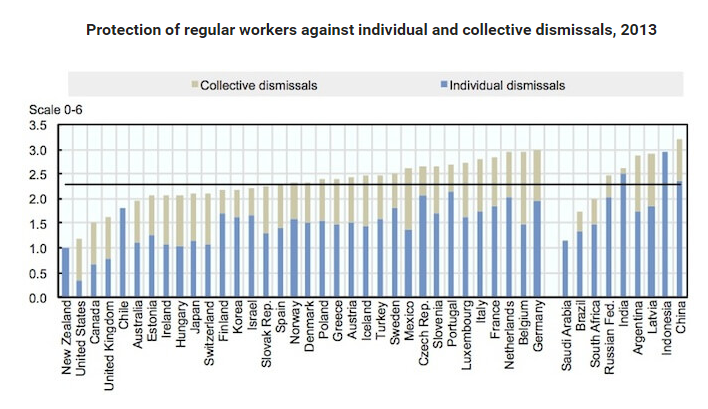
 The following graph is apparently based on data extracted from the OECD database. I am assuming it is accurate:


NZ has the most "flexible labour market" already.

But what would "a generous unemployment benefit of up to 90 per cent for low-paid workers" entail?

40 hours at minimum wage taxed at 20% = $472.  90% of that is $425.

The current Job Seeker benefit for a single person aged 25+ is $210.13. Of course that ignores any accommodation supplement but on the face of it Robertson is talking about doubling unemployment benefits.

That would mean other benefits would have to rise relative to the Job Seeker benefit. You couldn't have a single person getting a basic benefit higher than a sole parent with dependent children.

I'm actually for an unemployment benefit that pays more on the proviso that:

It is funded via employee/employer contributions and is time-limited.

I wonder if Labour would go for that?


Saturday, January 16, 2016

I got breathalyzed at 1pm on Friday

I got breathalyzed at 1pm on Friday, January 15. The result was "no alcohol".

But a couple of things gave me pause for thought.

In the Lower Hutt  area, a very busy bridge has been temporarily closed for maintenance, and a major diversion is in place. This afforded the perfect place to launch a drink/drive operation. I said to my daughter after we passed, "There are 20 cops there, yes?" She agreed. Some are placed pre- and post testing area (presumably to prevent people u-turning last minute). There are 3 directly testing, with others milling behind, and others around the place any 'positives' are taken to. There were probably 4 police cars stationed alongside  other support vehicles in a large grassy roadside area.

Firstly, the traffic diversion was not working well. One intersection, unused to so much traffic, was backing up badly and begging for a set of lights or a points-man. I thought that would have been  useful job for the traffic police. But no.

Second, I've been thinking about Article 21 and 22 of the NZ Bill of Rights. Why am I and others being subjected to arbitrary detention by the agents of the state that we pay to keep us safe from crime? To monitor and deal with people who would actively abuse personal or property rights? Who would maim and kill and leave innocent people scarred for life?

Third, I am not convinced that the new lower alcohol limit is making any difference at the sharp end. But it has allowed for more tax extortion  and more criminalization.

Crime isn't low enough for me to be happy for  law and order resources to be used this way. I doubt it ever would be. The exercise smacks of picking low-hanging fruit to squeeze revenue from, and general persecution of other road users who aren't fully compliant with state requisites.

Safety appears somewhere  on the list of objectives but not at the top.

Friday, January 15, 2016

Returning the compliment

Today's DomPost reports that Australia is watching New Zealand's welfare reforms (p2). Their government is apparently looking to NZ "for inspiration."

We should return the compliment and look to Australia for inspiration also.


(It seems there are moves afoot to push it even higher.)


Thursday, January 14, 2016

Quote of the Day

As relevant as ever:

It is the highest impertinence and presumption, therefore, in kings and ministers to pretend to watch over the economy of private people, and to restrain their expense.…They are themselves always, and without any exception, the greatest spendthrifts in society. Let them look well after their own expense, and they may safely trust private people with theirs.

– Adam Smith,
An Inquiry into the Nature and Causes of the Wealth of Nations [1776]

Hat tip FFF

Misery index low in US

This is a new concept to me. I suspect a NZ version may be quite similar. While our current unemployment rate is higher than the US (Sept - 6% vs 5.2%) our labour force participation rate is quite a bit higher. And both countries have low inflation which, according to Brookings, voters don't worry about like they used to.

Maybe people aren't that miserable. Not as miserable as New Zealand's opposition politicians would like them to be anyway.

Wednesday, January 13, 2016

'Don't blame child poverty on tobacco and alcohol'

Embedded image permalink


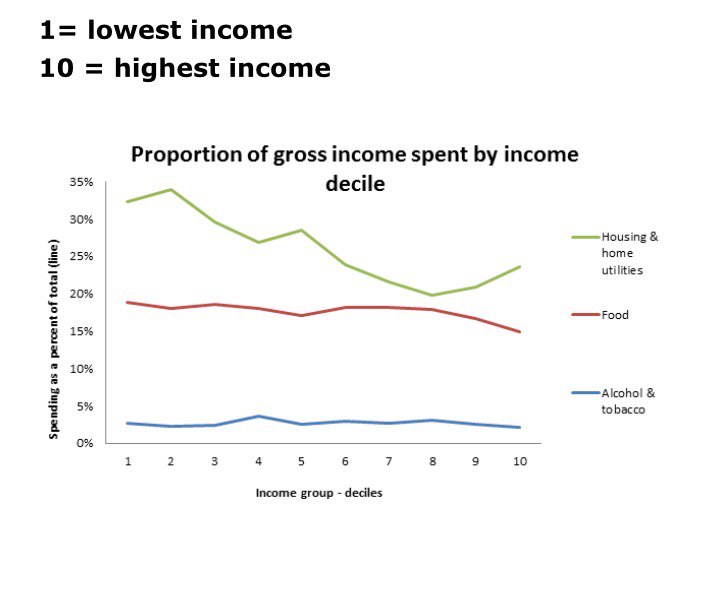
The child poverty activists are especially busy at the moment. They are using the above graph to show that the poor are not spending more money on alcohol and tobacco than the rich. It follows then that expenditure on alcohol and tobacco is not a 'blame' factor in child poverty.

It is my experience that the 'poor' often prefer cannabis to alcohol but is there any evidence to back this?

Yes. Ministry of Health data shows that in the poorest quintile, 7 percent of adults use cannabis "at least weekly" compared to 1.6 percent in the wealthiest quintile.

But back to alcohol and tobacco. The low income groups relevant to child poverty are parents, sole mothers especially.   But the elderly living on Super alone will feature heavily in the lowest income deciles in the above graph quite possibly lowering the average alcohol and tobacco spend. If you look at tobacco usage among one group particularly pertinent to child poverty ie Maori mothers, their smoking rates and tobacco spending are much higher (albeit trending down).

Take the latest smoking during pregnancy data for the Hutt DHB:

From Counties-Manukau DHB the picture is similar:

And referring back to the data about cannabis use, "Māori women were 2.3 times more likely than non-Māori women to have used cannabis in the last 12 months".

If the activists consider alcohol and tobacco expenditure relevant to the issue, so is spending on cannabis. Also a more detailed analysis of expenditure on alcohol and tobacco by families with dependent children is necessary to draw any sound conclusion about its contribution or otherwise to child poverty.

New pastel

Updating my artist blog with a pre-Christmas pastel commission, Danny and Katie. Here's how it evolves:


Tuesday, January 12, 2016

Why suppress evidence of welfare abuse?

Bear with me while I go back in time. The relevance will become apparent.

In 2011 work was undertaken on behalf of the Department of Labour (now the Ministry of Business, Innovation and Employment or MBIE) which involved matching data from the Household Labour Force Survey or HLFS (the official source of our unemployment rate) and Ministry of Social Development benefit data.

If individuals on the HLFS also receiving a benefit were providing accurate information to both departments - Statistics New Zealand and MSD - the data should provide no surprises, right?

Wrong.

The major finding of the paper was that, "About 40% of people on work-tested benefits may not be meeting their labour market obligations, as they appear to be either working too much or searching too little."

Despite being expected to maintain an "unrelenting focus" on getting work - as prescribed by law -  1 in 3 unemployment beneficiaries reported to the HLFS no job search activity in the past 4 weeks; 1 in 5 reported no job search activity and no intention to seek work in the next year.

At the other end of the spectrum, "1 in 10 people being paid an unemployment benefit report to the HLFS that they are working more than 30 hours per week."


"The inter-temporal pattern suggests that as the unemployment benefit numbers decline in good times, the overall stock of unemployment beneficiaries contains a larger proportion of people who are not really seeking work. When unemployment numbers rise in bad times, there are a higher proportion of genuine job seekers among the stock of unemployment beneficiaries."

So 10 percent of people claiming an unemployment benefit were working full-time (a further check against PAYE records showed 4% earned in excess of $2,000 in the reference month); a third hadn't fulfilled their obligations to look for a job in the past month; and a fifth had no intention of looking for a job. That's what the beneficiaries told the interviewer from Statistics New Zealand anyway. What motivation would they have to lie? None that occurs to me. Though they could be motivated to lie to MSD in order to continue to receive benefit money.

Now here's the odd thing. The findings were never released.

The existence of the research only became known to me when the author referenced* it in a later publication. He did so because he believed the paper had been published. He left the Department of Labour after completion understanding that the paper merely required a ministerial briefing then would be made public. For that reason (and because the taxpayer had funded the work, he said)  the author supported my application to the Ombudsman to compel MBIE to release the paper after their initial refusal to do so. That process took over one year.

So why weren't the findings made public, and why the resistance to release the paper to me? I can only speculate as to why.

But here goes.

The findings were politically sensitive. They would be a bad look for a National government claiming to have tightened up on welfare, and powerful ammunition in the hands of the opposition. Possibly. But the data matching exercise extended back into the Labour years and the abuse levels then were, proportionately, even higher!

It is more likely that the government didn't want media broadcasting their data matching exercises far and wide. No, law-abiding Joe Public wouldn't particularly object. The 'nothing to hide, nothing to fear' attitude is rife in this relatively corruption-free country (rightly or wrongly).

But imagine a beneficiary reads or hears about how a survey they are being forced to participate in is being checked against their Work and Income records. For the welfare abuser, that would merely tip them off to lie more consistently to government departments.

Data-matching is being used increasingly but its effectiveness lies in keeping the public in the dark. There's an irony at work. Non-transparency is required to improve integrity of systems.

So ultimately that's where I find the most convincing rationale. But that leaves me with a dilemma.

As a long-time critic of the welfare system, the findings vindicate or illustrate my concerns about the rampant misuse of the system (which hurts  genuine beneficiaries and the taxpayers funding it). Do I want to make a song and dance about these findings though, if the information acts to assist those with the worst motivations?

Because of the time lapse is the issue even newsworthy? I ran it past a couple of wiser heads than mine and they thought it was, but the two parliamentary journalists I ran it past didn't.

You will form your own opinion.

There is no doubt that the National government has been more vigorous about detecting and stopping fraud but against the above revelations the numbers still look inadequate. From parliamentary oral questions in March last year ( note Jo Goodhew's description of the numbers as "a small minority"):

Benefits—Savings 6. Hon JUDITH COLLINS (National—Papakura) to the Associate Minister for Social Development: How much has the Government saved as a result of its benefit fraud initiative?
Hon JO GOODHEW (Associate Minister for Social Development): Since benefit fraud reform initiatives began 2 years ago we have saved the taxpayer over $60 million in future benefit payments. Only a small minority of beneficiaries take money they are not entitled to, but those who do cost tens of millions of dollars each year. These changes make it difficult to defraud the welfare system and hold people accountable for their actions.
Hon Judith Collins: How is the Government encouraging beneficiaries to comply with the welfare system?
Hon JO GOODHEW: Over the past 2½ years around 9,500 benefits have been cancelled after fraud was discovered. We expect to see fewer cases of benefit fraud as our case officers continue working closely with clients to ensure they declare their income and any changes to their relationship status. We have also identified 3,000 clients who have previously committed fraud. By managing these clients more closely, we can help to ensure that they do not reoffend. 


If the 2011 findings held true for current Jobseeker beneficiaries, as many as 48,000 people may be either failing to meet work-search obligations, or already working full-time and continuing to claim a benefit.


*The reference also stated, "... about 10 per cent of people whose welfare records showed that they were receiving a DPB reported being partnered or living as married." That data, however, was not included in the paper released to me.

Friday, January 01, 2016

Morgan Foundation can't be trusted

An article appeared in this morning's DomPost from one Dr Jess Berentson-Shaw of the Morgan Foundation. Apparently the first of three.

My response by way of a letter-to-the-editor:


Dear Editor

Dr Jess Berentson-Shaw of the Morgan Foundation (DomPost, Jan 1) argues that giving families cash with "no strings attached" is the best way of reducing child poverty. To support her argument she quotes from The Economist, "Unconditional Cash Transfers work better than almost anyone would have expected. They dent the stereotype of poor people as inherently feckless and ignorant".

This is only part of the quote. The next sentence is, "But Conditional Cash Transfers are usually better still, especially when dealing with the root causes of poverty and, rather than just alleviating it, helping families escape it altogether."

That immediately conflicts with the idea of "no strings attached."

Additionally, The Economist feature was about aid in the developing world. Not alleviating family poverty in the first world where employment, social housing, highly effective contraception, low-cost health services, 'free' education and  access to credit, etc are all available.

Lindsay Mitchell


There is far more that could be said but why credit any validity to the rest of the piece when it starts with a deception.

Thursday, December 31, 2015

Income support by age


The graph above depicts incomes support by age.

I had to make it double axis or it would have been very tall.

The left-hand axis and grey columns show numbers of Super and Veteran pension recipients.

The right-hand axis and coloured lines show numbers of working-age benefit recipients.

Obviously the growth in Super is large at 49% between 2005 and 2015. In behind the 64+ is a steady but small rise of 55-64 year-olds. Interesting that that age band did not change with the recession. Probably because most are not working due to some form of physical incapacity. Their numbers are not affected by changes in the labour market.

The 18-24 and 40-54 are more-or-less back to where the number lay in 2005 (though the rates would be lower as the relevant populations are higher).

The biggest drop in any age group is among 25-39. This is probably partly due to the growth rate in sole parent employment.

It's great that working age benefit numbers are declining albeit slowly. Currently 10.2% of the 18-64 population relies on a benefit. In 2005 it was 12%; in 2000 it was near to 17%

But we need those numbers to keep falling because government expenditure on income support for 64+ will continue to climb quite steeply over the coming years.

Wednesday, December 30, 2015

'Investment' if you want more of it

In today's NZ Herald Child Poverty Group spokeswoman Susan St John writes,

"A shameful disparity between the treatment of children in families who can work enough paid hours, and those children whose families cannot, means in practice New Zealand has two classes of low-income children. The "in work" worthy can be supported to the full extent of the social security legislation, and the children of the unworthy, the outcasts: beneficiaries, disproportionately the disabled, Maori or Pasifika, many with chronic illness, are consigned to remain in poverty.

The parents of the "undeserving children" may struggle in a casualised labour market, on low wages or with redundancies, or in the aftermath of disasters. Irrespective of the cause of low income, regardless of circumstance, all children could and should be afforded the same tax-funded child payments to ensure an adequate standard of living."

You cannot isolate a child from its parent. So in effect she wants all parents to be treated the same whether or not they work. This involves far more than the $25 benefit rise for parents scheduled for next year.

St John wants to increase  "....child assistance by $72.50 a week for the very poorest families" and add "...$100 a week to the newborn's Family Tax Credit for one year for those who don't get paid parental leave."

"...spending of an extra $1 billion per annum is required immediately. This is what an "investment approach" to child poverty should look like."

An investment if more child poverty is what's wanted. How so?

With massive increases like these, having children becomes the way to (initially secure and) increase income. Because these children are being produced by people who have only a thought for the present, their life chances will be compromised. For example the parent who cares more for money than for their child's future will stay out of work and fail to set any example of industry and sacrifice. Or they will live in areas where there are no economic opportunities or prospects for offspring to do anything else but become the next generation of individuals who parent- for- an- income.

And who needs a husband or partner when the state is a better provider? So more sole parents....and more poverty. And more calls from CPAG to raise benefits...

It's time to stop throwing good money after bad and accept that strong family structure and work ethic are the two most important safeguards against poverty.


Sunday, December 27, 2015

Historical 'rape'

Pertinent, and I'll make no comment other than I subscribe to The Scotsman because Scotland and New Zealand have surprisingly similar social dysfunction 'statistics':
THERE has been a five-fold increase in the number of rape and attempted rape cases in the High Court linked to domestic abuse over the last four years, figures show.
According to the Crown Office, there were 435 rape or attempted rape cases in the High Court in 2014/15 where domestic abuse was an aggravating factor, compared with 88 in 2010/11.
Prosecutors said the steep rise was due to changes in legislation and an increase in the number of historical crimes being reported.
But charities said Police Scotland’s pro-active approach to tackling domestic abuse was also having an impact.
The number of domestic abuse charges marked for the sheriff court was 31,373 in 2014/15, compared to 20,673 in 2011/12 – an increase of over 50 per cent.
Sandy Brindley, national coordinator for Rape Crisis Scotland, said police had adopted a new tactic of speaking to ex-partners of men being investigated in domestic abuse cases.
Oh bugger it. I will make one more comment. When the policing and justice system operates with a bias, the benefactor can be expected to exploit it.

And that is doubly worrying in view of the last piece of the article above.

Hell hath no fury etc.