Sunday, January 24, 2016

What has National done for Maori?

With Ratana celebrations looming some are saying the church's loyalty to Labour is still strong and National needs to show what it has done for Maori.

All govt should be 'doing' for people is creating economic conditions and freedoms that allow them to 'do' for themselves. Nevertheless, that doesn't preclude looking at social indicators under National. I'll aim for 2002 to 2014. The first half under Labour - the second under National.

Benefit  Dependency


Bad start

Prison Population

Better

Smoking rate


Continuing to decline

Teenage birthrate


Astonishing improvement

Abortion rate


Also positive

Life expectancy

No cessation of steady rise between 2006 and 2013.

Suicide


Very mixed.

Maori aged 15-24 Not in Employment, Education or Training


This data is is only available from 2008 but the trend is at least positive. In fact a lot of the Infoshare data now appears to only date back 7 or 8 years. Frustrating.

There are far more social indicators but the data isn't particularly easy to access and graph quickly.

Based on the above snapshot there isn't a lot that Ratana followers could gripe about that they wouldn't have griped about under Labour.


Friday, January 22, 2016

Carmel Sepuloni is woefully weak in opposition

National is publicising a drop in benefit numbers over 2015.

But Labour MP, Carmel Sepuloni is bitching about National not knowing where people who leave a benefit go:

 Carmel Sepuloni said the government was only telling part of the story by ignoring how many people had actually gone onto work.
"The Minister is not being transparent about the numbers of people coming off he benefit, particularly the number of people going into jobs because they're not keeping proper track of how many people are going into work," she said...
"There's some information to show a few of them go off because of study, marital status or death. But there's a much higher proportion where the government has no information about where they're going on to."

Here's the most recent publicly available data under National:


Shall we see what it looked like under Labour?


Under National, proportionately more people are leaving an unemployment benefit for work. And more is known, or shown or made public - take your pick -  about the other reasons for leaving welfare.

Note: The National numbers are quarterly; the Labour numbers are annual.

Thursday, January 21, 2016

News more important than truth

The quote I referred to earlier this week sounded like something Margaret Thatcher would say but was actually contained in a response from MSD to media regarding a news item that claimed there were no benefits for 16-17 year-olds and that was why teenagers were living in the bush.

That's an utter nonsense and the media shouldn't just repeat assertions without establishing their veracity. But news is now more important than truth.

Any youth or young parent can walk into Work and Income and begin a process of assistance if they can't live at home and have no other means of support. No, they won't simply get cash thrown at them as per the old Independent Youth Benefit. They will be assigned to a Youth Service Provider who will work out what they need to do in terms of training towards their future, parenting courses perhaps, enrolling any child with a GP, etc. The money they receive from Work and Income will be managed to ensure rent, board, power and other debts get paid. It's not a cushy number any more. But to say they have no option but live in the bush is wrong.

Hence the response from MSD which contained the quote I alluded to:


Assistance for Young People
14 January 2016.
Following enquiries regarding the assistance available to young people living rough in Auckland, MSD wants to assure the public that there is support for young people who find themselves in vulnerable situations.

Any young people with serious housing or other social services needs should get in touch with us as soon as possible. We would also encourage people in the community to alert us to groups that might need our help.

We’ll then get a good understanding of their individual needs so we can talk about the various types of support available, determine what will make a difference for them, and put plans in place to help.

There are benefits available to young people aged 16 or 17 who are unable to live at home. For this group the Youth Service provides wrap-around support. This includes mentoring, budget assistance, and help to continue school and training, so they can gain the skills to find a job and have an independent future.

In addition, if there is a care and protection concern, we’ll assess the young person’s needs and determine, along with other agencies, what needs to happen to support them.

Young people often want to make their own decisions about where they live and we work with them to make sure they’re in a safe and appropriate living situation. We don’t do this alone - a range of agencies and community organisations work together to support vulnerable young people. But at all times we must remember that State support cannot and does not replace the love and care of a supportive family. (My emphasis).

Wednesday, January 20, 2016

$1b is a big number

The Dompost has the biggest, boldest $1b on their front page I have ever seen. You couldn't cover it with a mobile phone. Not mine anyway.

The price of a free school education will soar to record heights this year.
Official figures show "voluntary donations" from parents and others will this year have collectively provided more than $1 billion to bankroll schools since 2000.
Commentators have described that as a watershed figure with some arguing New Zealand's "free education" system is broken. 
I just did some back-of-a-matchbox calculations.

Would it be reasonable to ask parents to pay say $96 a year towards their child's schooling? That's on average so obviously some would pay a lot less, possibly even nothing because the fee is voluntary.

There are 13 years across a child's education.(Year one to Year Thirteen).

So there are roughly 780,000 children in the school system (13 years x 60,000 in each age-band). Let's drop of the 4% that attend private schools which leaves 748,800.

That would amount to $72 million annually.
Over 14 years that would be just over $1b

Shock, horror.

$96 is $24 a term or $2.40 a school week.  It's just downright outrageous.

Monday, January 18, 2016

"... State support cannot and does not replace the love and care of a supportive family."

Who said this?

"... State support cannot and does not replace the love and care of a supportive family."

No doubt you will google it.

Surprised?


Doubling the unemployment benefit rate?

Grant Robertson is talking up the Danish 'Flexicurity' model intimating Labour policy in 2017 might look like something similar:

The Danish system has three parts. It has flexible rules for hiring and firing workers, to make it easier to cut staff in downturns and easier to hire new staff when an economy rebounds. It has a generous unemployment benefit of up to 90 per cent for low-paid workers. And it has an "active labour market" policy, which means unemployed are helped into work, given guidance or re-trained.
Mr Robertson said New Zealand already had a flexible labour market, but it needed to be balanced with greater security and income support.
"Obviously you can't take a model and replicate it from one country to another. It's the principles of it that we are looking at and how something similar could be put in place in New Zealand."
 The following graph is apparently based on data extracted from the OECD database. I am assuming it is accurate:


NZ has the most "flexible labour market" already.

But what would "a generous unemployment benefit of up to 90 per cent for low-paid workers" entail?

40 hours at minimum wage taxed at 20% = $472.  90% of that is $425.

The current Job Seeker benefit for a single person aged 25+ is $210.13. Of course that ignores any accommodation supplement but on the face of it Robertson is talking about doubling unemployment benefits.

That would mean other benefits would have to rise relative to the Job Seeker benefit. You couldn't have a single person getting a basic benefit higher than a sole parent with dependent children.

I'm actually for an unemployment benefit that pays more on the proviso that:

It is funded via employee/employer contributions and is time-limited.

I wonder if Labour would go for that?


Saturday, January 16, 2016

I got breathalyzed at 1pm on Friday

I got breathalyzed at 1pm on Friday, January 15. The result was "no alcohol".

But a couple of things gave me pause for thought.

In the Lower Hutt  area, a very busy bridge has been temporarily closed for maintenance, and a major diversion is in place. This afforded the perfect place to launch a drink/drive operation. I said to my daughter after we passed, "There are 20 cops there, yes?" She agreed. Some are placed pre- and post testing area (presumably to prevent people u-turning last minute). There are 3 directly testing, with others milling behind, and others around the place any 'positives' are taken to. There were probably 4 police cars stationed alongside  other support vehicles in a large grassy roadside area.

Firstly, the traffic diversion was not working well. One intersection, unused to so much traffic, was backing up badly and begging for a set of lights or a points-man. I thought that would have been  useful job for the traffic police. But no.

Second, I've been thinking about Article 21 and 22 of the NZ Bill of Rights. Why am I and others being subjected to arbitrary detention by the agents of the state that we pay to keep us safe from crime? To monitor and deal with people who would actively abuse personal or property rights? Who would maim and kill and leave innocent people scarred for life?

Third, I am not convinced that the new lower alcohol limit is making any difference at the sharp end. But it has allowed for more tax extortion  and more criminalization.

Crime isn't low enough for me to be happy for  law and order resources to be used this way. I doubt it ever would be. The exercise smacks of picking low-hanging fruit to squeeze revenue from, and general persecution of other road users who aren't fully compliant with state requisites.

Safety appears somewhere  on the list of objectives but not at the top.

Friday, January 15, 2016

Returning the compliment

Today's DomPost reports that Australia is watching New Zealand's welfare reforms (p2). Their government is apparently looking to NZ "for inspiration."

We should return the compliment and look to Australia for inspiration also.


(It seems there are moves afoot to push it even higher.)


Thursday, January 14, 2016

Quote of the Day

As relevant as ever:

It is the highest impertinence and presumption, therefore, in kings and ministers to pretend to watch over the economy of private people, and to restrain their expense.…They are themselves always, and without any exception, the greatest spendthrifts in society. Let them look well after their own expense, and they may safely trust private people with theirs.

– Adam Smith,
An Inquiry into the Nature and Causes of the Wealth of Nations [1776]

Hat tip FFF

Misery index low in US

This is a new concept to me. I suspect a NZ version may be quite similar. While our current unemployment rate is higher than the US (Sept - 6% vs 5.2%) our labour force participation rate is quite a bit higher. And both countries have low inflation which, according to Brookings, voters don't worry about like they used to.

Maybe people aren't that miserable. Not as miserable as New Zealand's opposition politicians would like them to be anyway.

Wednesday, January 13, 2016

'Don't blame child poverty on tobacco and alcohol'

Embedded image permalink


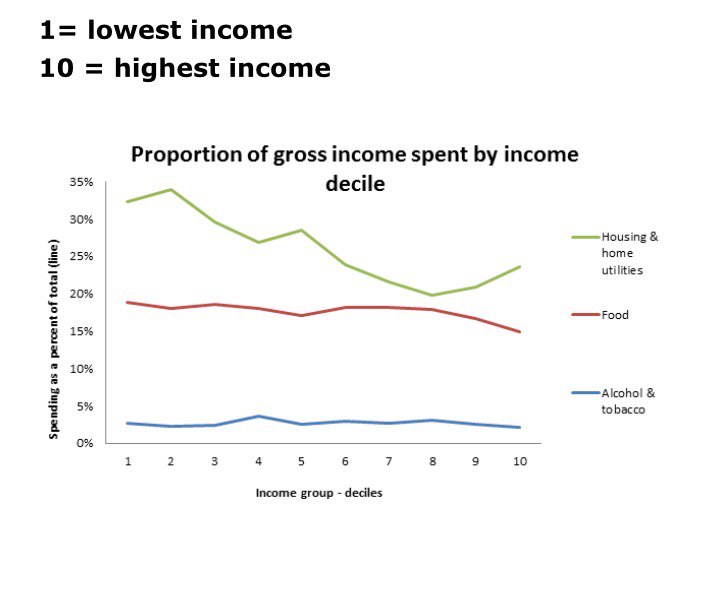
The child poverty activists are especially busy at the moment. They are using the above graph to show that the poor are not spending more money on alcohol and tobacco than the rich. It follows then that expenditure on alcohol and tobacco is not a 'blame' factor in child poverty.

It is my experience that the 'poor' often prefer cannabis to alcohol but is there any evidence to back this?

Yes. Ministry of Health data shows that in the poorest quintile, 7 percent of adults use cannabis "at least weekly" compared to 1.6 percent in the wealthiest quintile.

But back to alcohol and tobacco. The low income groups relevant to child poverty are parents, sole mothers especially.   But the elderly living on Super alone will feature heavily in the lowest income deciles in the above graph quite possibly lowering the average alcohol and tobacco spend. If you look at tobacco usage among one group particularly pertinent to child poverty ie Maori mothers, their smoking rates and tobacco spending are much higher (albeit trending down).

Take the latest smoking during pregnancy data for the Hutt DHB:

From Counties-Manukau DHB the picture is similar:

And referring back to the data about cannabis use, "Māori women were 2.3 times more likely than non-Māori women to have used cannabis in the last 12 months".

If the activists consider alcohol and tobacco expenditure relevant to the issue, so is spending on cannabis. Also a more detailed analysis of expenditure on alcohol and tobacco by families with dependent children is necessary to draw any sound conclusion about its contribution or otherwise to child poverty.

New pastel

Updating my artist blog with a pre-Christmas pastel commission, Danny and Katie. Here's how it evolves:


Tuesday, January 12, 2016

Why suppress evidence of welfare abuse?

Bear with me while I go back in time. The relevance will become apparent.

In 2011 work was undertaken on behalf of the Department of Labour (now the Ministry of Business, Innovation and Employment or MBIE) which involved matching data from the Household Labour Force Survey or HLFS (the official source of our unemployment rate) and Ministry of Social Development benefit data.

If individuals on the HLFS also receiving a benefit were providing accurate information to both departments - Statistics New Zealand and MSD - the data should provide no surprises, right?

Wrong.

The major finding of the paper was that, "About 40% of people on work-tested benefits may not be meeting their labour market obligations, as they appear to be either working too much or searching too little."

Despite being expected to maintain an "unrelenting focus" on getting work - as prescribed by law -  1 in 3 unemployment beneficiaries reported to the HLFS no job search activity in the past 4 weeks; 1 in 5 reported no job search activity and no intention to seek work in the next year.

At the other end of the spectrum, "1 in 10 people being paid an unemployment benefit report to the HLFS that they are working more than 30 hours per week."


"The inter-temporal pattern suggests that as the unemployment benefit numbers decline in good times, the overall stock of unemployment beneficiaries contains a larger proportion of people who are not really seeking work. When unemployment numbers rise in bad times, there are a higher proportion of genuine job seekers among the stock of unemployment beneficiaries."

So 10 percent of people claiming an unemployment benefit were working full-time (a further check against PAYE records showed 4% earned in excess of $2,000 in the reference month); a third hadn't fulfilled their obligations to look for a job in the past month; and a fifth had no intention of looking for a job. That's what the beneficiaries told the interviewer from Statistics New Zealand anyway. What motivation would they have to lie? None that occurs to me. Though they could be motivated to lie to MSD in order to continue to receive benefit money.

Now here's the odd thing. The findings were never released.

The existence of the research only became known to me when the author referenced* it in a later publication. He did so because he believed the paper had been published. He left the Department of Labour after completion understanding that the paper merely required a ministerial briefing then would be made public. For that reason (and because the taxpayer had funded the work, he said)  the author supported my application to the Ombudsman to compel MBIE to release the paper after their initial refusal to do so. That process took over one year.

So why weren't the findings made public, and why the resistance to release the paper to me? I can only speculate as to why.

But here goes.

The findings were politically sensitive. They would be a bad look for a National government claiming to have tightened up on welfare, and powerful ammunition in the hands of the opposition. Possibly. But the data matching exercise extended back into the Labour years and the abuse levels then were, proportionately, even higher!

It is more likely that the government didn't want media broadcasting their data matching exercises far and wide. No, law-abiding Joe Public wouldn't particularly object. The 'nothing to hide, nothing to fear' attitude is rife in this relatively corruption-free country (rightly or wrongly).

But imagine a beneficiary reads or hears about how a survey they are being forced to participate in is being checked against their Work and Income records. For the welfare abuser, that would merely tip them off to lie more consistently to government departments.

Data-matching is being used increasingly but its effectiveness lies in keeping the public in the dark. There's an irony at work. Non-transparency is required to improve integrity of systems.

So ultimately that's where I find the most convincing rationale. But that leaves me with a dilemma.

As a long-time critic of the welfare system, the findings vindicate or illustrate my concerns about the rampant misuse of the system (which hurts  genuine beneficiaries and the taxpayers funding it). Do I want to make a song and dance about these findings though, if the information acts to assist those with the worst motivations?

Because of the time lapse is the issue even newsworthy? I ran it past a couple of wiser heads than mine and they thought it was, but the two parliamentary journalists I ran it past didn't.

You will form your own opinion.

There is no doubt that the National government has been more vigorous about detecting and stopping fraud but against the above revelations the numbers still look inadequate. From parliamentary oral questions in March last year ( note Jo Goodhew's description of the numbers as "a small minority"):

Benefits—Savings 6. Hon JUDITH COLLINS (National—Papakura) to the Associate Minister for Social Development: How much has the Government saved as a result of its benefit fraud initiative?
Hon JO GOODHEW (Associate Minister for Social Development): Since benefit fraud reform initiatives began 2 years ago we have saved the taxpayer over $60 million in future benefit payments. Only a small minority of beneficiaries take money they are not entitled to, but those who do cost tens of millions of dollars each year. These changes make it difficult to defraud the welfare system and hold people accountable for their actions.
Hon Judith Collins: How is the Government encouraging beneficiaries to comply with the welfare system?
Hon JO GOODHEW: Over the past 2½ years around 9,500 benefits have been cancelled after fraud was discovered. We expect to see fewer cases of benefit fraud as our case officers continue working closely with clients to ensure they declare their income and any changes to their relationship status. We have also identified 3,000 clients who have previously committed fraud. By managing these clients more closely, we can help to ensure that they do not reoffend. 


If the 2011 findings held true for current Jobseeker beneficiaries, as many as 48,000 people may be either failing to meet work-search obligations, or already working full-time and continuing to claim a benefit.


*The reference also stated, "... about 10 per cent of people whose welfare records showed that they were receiving a DPB reported being partnered or living as married." That data, however, was not included in the paper released to me.

Friday, January 01, 2016

Morgan Foundation can't be trusted

An article appeared in this morning's DomPost from one Dr Jess Berentson-Shaw of the Morgan Foundation. Apparently the first of three.

My response by way of a letter-to-the-editor:


Dear Editor

Dr Jess Berentson-Shaw of the Morgan Foundation (DomPost, Jan 1) argues that giving families cash with "no strings attached" is the best way of reducing child poverty. To support her argument she quotes from The Economist, "Unconditional Cash Transfers work better than almost anyone would have expected. They dent the stereotype of poor people as inherently feckless and ignorant".

This is only part of the quote. The next sentence is, "But Conditional Cash Transfers are usually better still, especially when dealing with the root causes of poverty and, rather than just alleviating it, helping families escape it altogether."

That immediately conflicts with the idea of "no strings attached."

Additionally, The Economist feature was about aid in the developing world. Not alleviating family poverty in the first world where employment, social housing, highly effective contraception, low-cost health services, 'free' education and  access to credit, etc are all available.

Lindsay Mitchell


There is far more that could be said but why credit any validity to the rest of the piece when it starts with a deception.

Thursday, December 31, 2015

Income support by age


The graph above depicts incomes support by age.

I had to make it double axis or it would have been very tall.

The left-hand axis and grey columns show numbers of Super and Veteran pension recipients.

The right-hand axis and coloured lines show numbers of working-age benefit recipients.

Obviously the growth in Super is large at 49% between 2005 and 2015. In behind the 64+ is a steady but small rise of 55-64 year-olds. Interesting that that age band did not change with the recession. Probably because most are not working due to some form of physical incapacity. Their numbers are not affected by changes in the labour market.

The 18-24 and 40-54 are more-or-less back to where the number lay in 2005 (though the rates would be lower as the relevant populations are higher).

The biggest drop in any age group is among 25-39. This is probably partly due to the growth rate in sole parent employment.

It's great that working age benefit numbers are declining albeit slowly. Currently 10.2% of the 18-64 population relies on a benefit. In 2005 it was 12%; in 2000 it was near to 17%

But we need those numbers to keep falling because government expenditure on income support for 64+ will continue to climb quite steeply over the coming years.

Wednesday, December 30, 2015

'Investment' if you want more of it

In today's NZ Herald Child Poverty Group spokeswoman Susan St John writes,

"A shameful disparity between the treatment of children in families who can work enough paid hours, and those children whose families cannot, means in practice New Zealand has two classes of low-income children. The "in work" worthy can be supported to the full extent of the social security legislation, and the children of the unworthy, the outcasts: beneficiaries, disproportionately the disabled, Maori or Pasifika, many with chronic illness, are consigned to remain in poverty.

The parents of the "undeserving children" may struggle in a casualised labour market, on low wages or with redundancies, or in the aftermath of disasters. Irrespective of the cause of low income, regardless of circumstance, all children could and should be afforded the same tax-funded child payments to ensure an adequate standard of living."

You cannot isolate a child from its parent. So in effect she wants all parents to be treated the same whether or not they work. This involves far more than the $25 benefit rise for parents scheduled for next year.

St John wants to increase  "....child assistance by $72.50 a week for the very poorest families" and add "...$100 a week to the newborn's Family Tax Credit for one year for those who don't get paid parental leave."

"...spending of an extra $1 billion per annum is required immediately. This is what an "investment approach" to child poverty should look like."

An investment if more child poverty is what's wanted. How so?

With massive increases like these, having children becomes the way to (initially secure and) increase income. Because these children are being produced by people who have only a thought for the present, their life chances will be compromised. For example the parent who cares more for money than for their child's future will stay out of work and fail to set any example of industry and sacrifice. Or they will live in areas where there are no economic opportunities or prospects for offspring to do anything else but become the next generation of individuals who parent- for- an- income.

And who needs a husband or partner when the state is a better provider? So more sole parents....and more poverty. And more calls from CPAG to raise benefits...

It's time to stop throwing good money after bad and accept that strong family structure and work ethic are the two most important safeguards against poverty.


Sunday, December 27, 2015

Historical 'rape'

Pertinent, and I'll make no comment other than I subscribe to The Scotsman because Scotland and New Zealand have surprisingly similar social dysfunction 'statistics':
THERE has been a five-fold increase in the number of rape and attempted rape cases in the High Court linked to domestic abuse over the last four years, figures show.
According to the Crown Office, there were 435 rape or attempted rape cases in the High Court in 2014/15 where domestic abuse was an aggravating factor, compared with 88 in 2010/11.
Prosecutors said the steep rise was due to changes in legislation and an increase in the number of historical crimes being reported.
But charities said Police Scotland’s pro-active approach to tackling domestic abuse was also having an impact.
The number of domestic abuse charges marked for the sheriff court was 31,373 in 2014/15, compared to 20,673 in 2011/12 – an increase of over 50 per cent.
Sandy Brindley, national coordinator for Rape Crisis Scotland, said police had adopted a new tactic of speaking to ex-partners of men being investigated in domestic abuse cases.
Oh bugger it. I will make one more comment. When the policing and justice system operates with a bias, the benefactor can be expected to exploit it.

And that is doubly worrying in view of the last piece of the article above.

Hell hath no fury etc.

Saturday, December 26, 2015

The answer is 197 or 5.7%


Sorry for the delay in providing the answer to my previous post question. I received a new lap top for Christmas (the old one was repeatedly over-heating and shutting down) and the transfer of data has taken time.

The Hutt Valley DHB screening process found 197 of the 3, 458 woman questioned disclosed physical abuse at home. That's 5.7%. S Beast guessed 5-15%.

This result is remarkably similar to that found by the 2014 NZCSS, which found 6% of women and 4% of men "to be the victim of a violent interpersonal offence by an intimate partner in 2013".

"The New Zealand Crime and Safety Survey (NZCASS) is a face-to-face survey of almost 7000 randomly chosen people living in New Zealand who are aged 15 or over.

The NZCASS has been carried out three times: 2014, 2009 and 2006."


The good news is the 5% of people who were victimised by an intimate partner in 2013 was down from 7% in 2008.

Thursday, December 24, 2015

Have a guess

A couple of days back I was questioning Jan Logie's claim that 70 percent of sole parents on income support were leaving or had come from violent relationships.

Just yesterday a relevant piece appeared in the Hutt News which highlighted local levels of family violence by screening women presenting at Hutt Hospital.

"During the year ending June 30, 2015, 3,458 women were asked if they had been subjected to physical abuse in their home.
Every woman presenting at one of the hospital's key high risk areas - emergency department, child health, special care baby unit, medical assessment and planning unit and maternity - was screened unless it was inappropriate to do so because children or a controlling partner were present....every mother was asked at least three times during her pregnancy, again if she gave birth at the hospital, and a Plunket nurse might ask later."

So how many do you think disclosed being subjected to physical violence?

(Yes there are too many unknown factors to make an educated guess but have a crack at it anyway.)

Wednesday, December 23, 2015

Govt moves on Sole Parent Support again

The legislation required to increase benefits by $25 next April to families with children is currently passing through parliament. The bill is called the Support for Children in Hardship Bill.

Naturally the opposition will have to support the government bill. But they aren't happy.

That's because National is taking the opportunity to make another change.

At the moment sole parents are required to work (or look for work) averaging at least 15 hours per week when their youngest starts school.

The bill changes that requirement to an average of 20 hours per week when the youngest child turns 3.

That was what the Welfare Working Group recommended in 2011.

In fact Anne Tolley makes mention of it during the debate:

"The Opposition often talks about Norway, and how they do things in Norway. It was interesting to see that France, Germany, Norway, and Switzerland have a work expectation for people receiving a benefit when their youngest child is 3 years of age. A range of other countries have work expectations at an earlier age, including Sweden, Japan, and Denmark, which is another country that is often quoted to us as one that we should take notice of. In Belgium, Denmark, Finland, Japan, and Sweden all sole parents are subject to a work test, regardless of the child’s age. So, actually, what we are doing here in New Zealand is consistent with international practice.

Finally, I refer to the Welfare Working Group from 2011, which recommended that sole parent beneficiaries should be required to seek part-time paid work of at least 20 hours per week once their youngest child is 3 years of age. Of course, we did not implement that—we did not go as far as that. But having seen, then, the success and the number of sole parents with children younger than 5 going into part-time work, we are very confident that the obligations we are placing in this bill will have a great long-term effect for those families—for both the mothers and for their children, long term. So I think the evidence has been well presented. It is very clear. It is well supported.

I refer the Opposition to the comments of Dr Lance O’Sullivan, who was last year’s New Zealander of the Year, who supported the proposals from the Government at the time they were announced. He stated—and, again, we have good evidence that shows it—that children from vulnerable families at risk, which we know many of those children in sole parent, benefit-dependent homes are, will benefit the most from having access to early childhood education. So the 20 hours’ early childhood education will provide those children with learning opportunities and with socialisation, and we think that that has good long-term benefits for those children."

Of course it still won't make any difference to those sole parents who choose to live where work opportunities are scarce.

Tuesday, December 22, 2015

Typically dodgy claim from Green MP

A report in the DomPost this morning:

"...Green Party social development spokeswoman Jan Logie said international evidence shows about 70 per cent of people seeking income support are in a violent relationship so many more people should be receiving an exemption."

That was news to me.

She also recently said in Parliament:

"I really have to remind this Committee, again, of the fact that there is international research, which indicative research in New Zealand backs up, that 70 percent of these sole parents are likely to be leaving violent relationships."

So a did a bit of googling.

Here is the Australian research:

"This paper summarises the findings from a study investigating aspects of single mothers’ experiences of transition and adaptation to living as a single parent in South Australia in the 1990s.  The qualitative research traced 36 respondents’ decision making, and the events surrounding their entry into sole parent status and subsequent adaptation.....The women in this study were drawn from the group at highest risk of violence - single women who had previously had a partner.  Just over half the sample (55 percent) had ever experienced physical or sexual assault by a former partner and/or other family member.  Of the twenty survivors of violent assaults, ten had first been abused in childhood, and eight of these had also experienced violent adult relationships.  Of the 29 separated mothers, seventy-two percent nominated violence as the reason their relationship ended....
All respondents had claimed income support at the time they became single mothers.
The research sample was drawn from a range of sources in South Australia including 8 women from a parent community of a primary school in a low socio-economic region of metropolitan Adelaide, 6 clients from a sole parent resource centre, 2 students from Flinders University, 10 referrals from respondents and 10 mothers from Whyalla.  Recruitment of respondents was undertaken by a combination of notices at venues which mothers attended, invitation by the researcher and referrals from respondents.  Thirty percent of the respondents were aged between 25 and 34, whilst 60 percent were aged between 35 and 45.  Just over half the sample had been a single parent for less than five years and 70 percent had one or two children.
The sample was grouped for analysis into mothers who gave birth alone (n=7), mothers who separated from non-violent relationships (n=11) and mothers who separated from violent relationships (n=18).....
The findings from the study  highlight the compounding ways in which violence against women and children is a critical factor impacting on the population of single parents in Australia.  The National Council of Single Mothers and their Children’s (NCSMC) member organisation in South Australia, Spark Resource Centre, has consistently identified that between seventy and eighty percent of clients presenting at the Centre are survivors of violence.  Their presenting problems include poverty, homelessness, being unable to protect themselves or  their children from abuse during contact, children’s behavioural problems arising from violence and feelings of rejection and stigma from wider society."

The research is biased. 10 respondents were referrals. The consistent identification of violence survivors comes from those who turn up at resource centres. It'd be like doing a survey at Women's Refuge.

Qualitative research does not allow conclusions to be drawn across the whole population.

Getting back to the reason Jan Logie was making this claim - to ensure certain sole parents aren't work-tested - why is it the Greens think that discouraging women from developing a new support network of friends and co-workers and leaving the isolation of being benefit-dependent and easy prey for a ne'er-do-well, is such a bad thing?


Monday, December 21, 2015

Govt predicts higher child assault numbers in 2016

It's a mystery to me how the projections are made but it's pretty grim.

 "...we are working to reduce the number of assaults on children. By
2017, we aim to halt the 10-year rise in the number of children experiencing physical
abuse, and reduce the current numbers (2011) by five percent. This is a complicated
area of work and the answers are not simple. Long-term success and sustainability will
be challenging."


To be fair at least the govt has been prepared to try new approaches in this area. They want to give more autonomy to the people who live and work in the communities with these children and enable each agent to communicate with the other:

"Children’s Teams are one of the tangible ways in which we are integrating our
support for children at risk. They bring together professionals from iwi/Mäori,
health, education, welfare and social service agencies to work with children and
their families.....The Children’s Action Plan Directorate is currently developing the Vulnerable Kids
Information System (ViKI). ViKI will be an essential tool to enable Children’s Teams to
identify, respond to, and reduce child vulnerability. ViKI will be implemented in phases,
with the first phase supporting the Hamilton Children’s Team....There are currently four Children’s Teams which were established in 2013 and 2014.
These are in Rotorua, Whangarei, Horowhenua/Ōtaki and Marlborough. The remaining
sites yet to go live are in Hamilton, Tairawhiti (Gisborne), Eastern Bay of Plenty,
Christchurch, Whanganui and Clendon/Manurewa/Papakura."

Some of those teams might be up and running since the publication of the report.

But whether the new ways of working can be supported is a further question:

"It is not a simple task to manage transformational business change while also managing
the rise in demand for services in the face of rising prices. To add to the complication of
cost pressures, two large programmes of work (Children’s Action Plan (CAP) and Child,
Youth and Family service delivery changes) were funded on a one-off basis." 
Step back for a moment though.

It has to be asked why New Zealand has come to this.

Pumping money into poor communities through benefits that are supposed to improve the lives of children, only to have to pump in more and more for (sometimes futile) efforts to keep those children safe. 


 The number of children who experienced substantiated physical abuse in the 12 months to 30 June 2015.

Sunday, December 20, 2015

10 years blogging

Image result for birthday cake with 10 candlesYesterday marked ten years of blogging. Over 5,000 posts and I still don't necessarily know what I think about any given subject; or have the answers; or understand the sum of the facts. But on one matter I am consistently provoked enough to keep going. And it's not welfare. I am having difficulty encapsulating what it is. Perhaps it's just low-grade thinking, of which there is no shortage proliferating politics, academia and the media. Rarely a day passes without someone or something setting off my bull-shit detector. Very occasionally they are false alarms highlighting my own prejudices. Sometimes the energy and/or time isn't available to address the offence. And they will most certainly run out before the transgressions do.....

No matter. I celebrated with a good dose of Billy Connolly. May I recommend him next time you are feeling overwhelmed by mush and mediocrity, and desperate to shut out the 'stupid' world.

Saturday, December 19, 2015

Latest OECD data on pension qualification and affordability

Summarised by the US Social Security department:

"The report presents a number of aging-related statistics for the OECD member countries, which include the following:

In 32 of the 34 OECD member countries, the fertility rate is below the replacement level.

Average life expectancy at age 65 in the 2010–2015 period is 21.8 additional years for women and 17.4 additional years for men and is expected to reach 25.8 years and 21.9 years, respectively, in the 2060–2065 period.

The average number of expected years in retirement has increased from 11 for men and 15 for women in 1970 to 18 and 22, respectively, in 2014.

The old-age dependency ratio (the population aged 65 or older divided by the population aged 20–64) is projected to nearly double from the current 28 older persons for every 100 working-age persons to 35 older persons by 2025 and to 55 older persons by 2075.

The share of older workers aged 55–64 has risen from 48 percent in 2004 to 56 percent in 2014.
The average effective age for leaving the labor market is 64.4 for men and 63.1 for women.

To counter these trends and the financial strain they put on public pension systems, the report notes that many countries have raised the statutory retirement age and introduced measures that discourage early retirement. By 2054, according to current legislation, 15 of the 34 OECD member countries will have retirement ages older than 65 (compared with 8 member countries in 2015)."

I wonder if New Zealand will be one by 2054?

Martin van Beynen nails it with a MUST-READ

Some years ago Martin van Beynen took off on a tour of New Zealand to find poverty. He didn't stand in a university lecture theatre or go to some church in a wealthy suburb to preach statistics.

What he did do was produce a series of articles and photographs from the most run-down and often dysfunctional environments. He talked to the people who live in them who it must be said were often rather cheerful and stoic. Or sometimes angry and disaffected. But he took us to the places we know exist yet will probably never see for ourselves.

Today he has delivered again with a brilliant expose of the meaninglessness of child poverty reports.
Absolute must-read. Reproduced in full here so I can be assured of access to it in the future:

OPINION:  If you lived next door to children living in severe poverty, you would probably do something to help out.
You might, for instance, slip the family a few hundred bucks around Christmas, have them over for dinner occasionally or pay the odd household bill for them.
But living cheek by jowl with the poor doesn't happen to middle NZ very much any more.
The gap has widened and the poor congregate in their enclaves and middle NZ goes some place else.
Street life doesn't bring the classes together.
But we hear about poverty quite a bit because, as an advanced society, we have measures and statistics to monitor how we are treating the most vulnerable.
We have reports like the Child Poverty Monitor which was released this week.
It said 305,000 dependent New Zealanders aged 0-17 were living in income poverty. Using another measure, it reported 220,500 of the same age group were living in "severe poverty".
It generated the usual response of Government bashing, capitalist blaming and gnashing of teeth. John Key scandalised Labour's children's spokeswoman Jacinda Ardern by linking poverty to drug use.
Green Party co-leader Metiria Turei said the Government's refusal to end child poverty was putting children's lives at risk.
Ad Feedback
And then, as is becoming usual, nothing.
Shouldn't we be shocked and appalled? Why aren't we doing something? What is wrong with us?
The answers are many and various. As a political or even social advocacy tool reports like the Child Poverty Monitor are pretty hopeless.
They cast the net too wide so truly serious poverty is trivialised. They suggest the answers all relate to handing out more money, that easy fix solutions exist. They tell us what we already know. Maori and Polynesian children are over-represented. Really?
They imply children are somehow divorced from their family or community environment.
In addition the numbers don't sound quite right.
Let's take a city in NZ which has a population of say 400,000. About 100,000 will be under 18. Of those, about 29,000, according to the report, are living in "income poverty" and about 21,000 will be in "severe poverty".
That's a lot of kindergartens, primary schools and high schools in a city like Christchurch or Wellington.
And what is income or severe poverty anyway?
Poverty is an emotive term, at least for my generation (I am a youthful 57).
It brings to mind an income on which it is impossible to afford the basic necessities of life. It conjures up images of ragged children, dust bowls, rundown houses, beaten down workers and bleak streets. But being poor is different from living in poverty.
In modern sociological terms poverty has become to mean the inability to participate fully in society or to reach one's full potential.
And don't forget we are not just talking about poverty. It is child poverty.
A child is a small innocent person in my book. When you include 16 and 17 year-olds, you bring young adults into the mix. They are still children, of course, but their childhoods have gone.
We all know why these reports use the word child. A child is blameless and  innocent. This gets around the problem of the undeserving poor. These  child poverty victims have, by a cruel quirk of fate, ended up being born in the wrong families.
Child poverty is more worthy of a sympathetic ear than old people poverty or single parent poverty. It is innocent poverty.
Then we have those fascinating definitions. Income poverty is defined as 60 per cent of the median income after housing costs are taken into account. Severe poverty is 50 per cent of the median income.
Median income is the point at which half the people receive more and half receive less than the stated amount.
The child monitor report does not say what the median NZ income is but a bit of detective work shows the median NZ income is $621 a week.
It's more complicated however. The median income from wages and salaries is $882 a week ($45,864 pa).
Then we have income from "Government transfers" which is income provided by the state for things like benefits, Working for Families, ACC payments and NZ Superannuation.
The median weekly transfer is $315 a week.
Another reason to be a little wary of the Child Monitor report is that it reports a big change in income poverty from 2013 ( 24 per cent of dependent 0-17 year olds) to 2014 (29 per cent).
What could have happened in just 12 months to plunge another 45,000 children and young adults into income poverty?
We need to be reminded about children living in true hardship. But not everything that reminds us is worthwhile.
Reports like the Child Poverty Monitor are not working.
Everyone knows a low income is only one of a host of factors which make people poor and increasing benefits or allowances will make little difference to the poverty which stems from human frailties, failures or vices.
We need robust measures to give us an accurate picture of who needs help but the figures are starting to seem meaningless.
We have come to doubt them. They don't seem to reflect reality. They lump the poor into one amorphous caste. They make no allowance for the black market economy or the ability to harvest free food.
A lot is already being done to help families in hardship and a lot more needs to be done but these reports don't help at all.


Friday, December 18, 2015

Who will sing for the male victims?


From the NZ Herald:
Kiwi singer Tina Cross has teamed up with a police choir for a powerful message against domestic violence.
Joining forces with the Counties Manukau District Commander's Police Choir and teenagers from Otahuhu Blue Light Choir, Cross re-recorded her 2014 song Walk Away as a message of support for women in abusive relationships.

According to TV3 last night


So far this year, 33 people have died from family violence - 16 children, 10 women and 7 men.

And recently from the DomPost:

A  Stuff data investigation has found at least 204 children, aged 0-14, have died as a result of neglect, abuse, or maltreatment in New Zealand since 1992.
 Most commonly, they died at the hands of men. Almost three quarters of the killers were family members.
The killers were almost equally likely to be mothers or fathers, accounting for 31 per cent and 29 per cent of cases respectively, where the victim's relationship with the killer was known. 

So who will sing for the male victims of  domestic abuse?

And who will sing for the children killed by their mothers?

Personally, I view singing for a cause as a wankfest.

But it does continue to highlight a biased and unjust refusal to acknowledge the active and aggressive part women can and do play in family violence.


Tuesday, December 15, 2015

Genuine about reducing child poverty? Here's an original idea

So the misdiagnosers had their day in the sun as the media went potty with the headline buster, Third of children in poverty - report (DomPost front page).

The  implicit answer is more state-mandated wealth transfer.

That won't work though, because that is the policy that creates poverty; not the policy that reduces it.

So it is something of a relief, on the same day, to read a different idea.

Problem 1: Children who lose contact with their fathers do worse in life.
Problem 2: Single mothers who want to work often struggle with the cost of childcare.
Problem 3: Many non-resident fathers are without meaningful work.
All three of these problems are fairly well established in the research literature. Each also motivates a battery of policy responses, with varying degrees of efficacy. In a recent report on poverty and opportunity from a working group convened by Brookings and the American Enterprise Institute, non-resident fathers received some special attention....So, let’s see…Lots of non-resident fathers are not gainfully employed; single mothers are struggling with childcare cost; and children, especially boys, are suffering from the distance or absence of their father. Here’s an idea: have the fathers look after their children, allowing mothers to get into and stay in work. The savings for the mother would far outweigh child support payments, which could be suspended when the father is providing childcare. What if, rather than squeezing these men for every last nickel, we were to ask them to do childcare instead?

With single mothers increasingly participating in the workforce, this idea has merit - social and economic.

Ironically, it suggests a partial reverse of times gone by, when fathers dominated the workplace and mothers almost always provided the childcare. Like then, two parents should be able to manage their families financial and childcare requirements without welfare - separated or not.