Friday, June 08, 2012

"The Empty Playground and the Welfare State"

This is a fascinating piece distributed by the NCPA. Apparently people who don't have children are 'free-riders' and socialised retirement has created more and more of them. I have a couple of problems with this. Many childless people pay disproportionate amounts of tax over their lifetimes. And thanks to other forms of working-age welfare some parents produce children that are not contributors. And the reasons behind falling fertility rates are multiple. But it's nevertheless an interesting theory.

The Empty Playground and the Welfare State

In centuries past, the traditional method for workers to prepare for retirement and ensure that their needs would be met was to have children.  Ideally, parents would invest time and resources into raising their children, who would then care for their elderly parents in their retirement, says Ramesh Ponnuru, a senior editor for the National Review.
This process has changed, but less than one might think.  The relationship between the younger and older generation remains the same (the prior financially provides for the latter) -- the primary difference is that the system is socialized.  All younger citizens pay in, and all older citizens receive.
Interestingly, the hidden effect of the socialization of this relationship is that it has created a widespread free rider problem, pitting those with children against those without them.

  • Parents must invest in their children in order to turn them into productive workers, capable of caring for themselves and contributing to government programs for the elderly.
  • Parents will then receive outlays from these programs later in life, which are presumably the fruits of their children's labor.
  • However, non-parents will have the same retirement security provided by Social Security without having to raise their own children.
  • In short, non-parents are given a free ride off of the efforts and sacrifices of parents.
This is not to say that there are no other reasons for having children than retirement security; of course, many parents gain joy from raising children while others see it as an expression of gratitude for the life they have been given.  Nevertheless, the presence of this free rider problem should, theoretically, result in people having fewer children in countries with developed Social Security programs.
  • In a 2005 paper by economists at the National Bureau of Economic Research, they found that fertility rates dropped rapidly just after World War II, just when socialized retirement security programs were expanded.
  • Additionally, fertility rates fell further in Europe, where entitlements were expanded more than they were in the United States.
  • In their model, entitlements account for roughly half of the decline in fertility.
  • They found that when a pension system expands by 10 percent of gross domestic product, the average number of children per woman drops by 0.7 to 1.6.

Wednesday, June 06, 2012

Bradford berates Bennett

At the weekend it was Metiria Turei bollocking Paula Bennett for "plunging the knife" into solo mums. Today it's Sue Bradford's turn. But first, consider the incongruity of her position.

Sue Bradford wants the state to step in when a child is smacked. She didn't want any parent to be able claim the use of 'reasonable force' when disciplining a child and get away with it.

But she wants the state to keep right out of influencing whether or not a parent previously convicted of serious child abuse or murder has a further child.  

[Paula Bennett] said the Cabinet was considering a range of options to deal with the issue of known child abusers or killers having further children - including allowing the Court to direct someone convicted of serious child abuse or neglect or murder not to have more children.

Bradford responds:

Government moves towards judicial control of some womens’ reproductive rights are another insidious step on the slippery road to State eugenics says Auckland Action Against Poverty spokesperson Sue Bradford. ‘It is abhorrent that on top of encouraging long acting contraception for all women beneficiaries and worktesting them from the time their baby is one year old, Paula Bennett now intends to find a way to stop some mothers from having children at all. ‘While the protection of children should always be paramount, our group recognises that the courts and CYFS already have the right to step in and remove babies and children if they are in danger.’

But this is after the fact and frequently these children will be damaged in utero because of their mother's (and father's) habits.

I am the last person to defend the state's desire to interfere in personal matters. But the first to concede it has a role in protecting children and adults from real harm inflicted by another individual. What I want to see is known perpetrator's paying for crimes. Not the vast majority taking the weight of interventionist legislation which attempts to find the needle in the haystack.

Truth Column Friday June 1


Last week's Truth column about TV7 and others here.

I see Bob Jones is now writing a weekly column for the NZ Herald and Rodney Hide's Herald on Sunday offering was superb.

And I am confused because I thought Deborah Coddington had finished writing for the same paper but maybe she is doing an occasional column.

Monday, June 04, 2012

NZ no longer tied to the Monarchy's apron strings

I'm not particularly interested in the Monarchy but I am in social change. Statistics New Zealand put together this pictorial for the Queen's Jubilee:


New Zealand’s population – both humans and cows – has more than doubled in the 60 years that Queen Elizabeth II has been on the throne, but it seems the price of an electric kettle is a fraction of what it once was.

Statistics New Zealand has been delving into historical data from 1952 and comparing it with the latest information available. 

Deputy Government Statistician Dallas Welch says New Zealand’s population has changed markedly. 

“Back in 1952, New Zealand broke through the 2 million population barrier and 60 years on, that’s more than doubled to 4.4 million. Coincidentally, the number of dairy cows has also more than doubled from less than 3 million, to over 6 million.” 

Mrs Welch said immigration patterns have also changed. 

“When the Queen first took the throne, more than half of our immigrants came from the United Kingdom. Today that’s more like 17 percent, although in the past year, more people still moved here from the UK than from any other place. 

“In trade, the Old Country used to contribute about two-thirds of our export earnings. Last year, 3 percent of our export earnings came from the UK.” 

And as for making a nice cup of tea, in 1952 an electric kettle cost 59 shillings and 6 pence (about $164 in today’s terms) and a 1lb (500g) pack of tea was 6 shillings and 4 pence (about $16.60). Today a kettle costs about $44 on average, and a box of 100 teabags (about 200g of tea) costs about $4.46.

Sunday, June 03, 2012

More on welfare reform and teenage birth/abortion

More discussion with Mr Puddleglum which you can ignore if you are not interested:
"Second, I see your graphs (on your blog) confirm, or don’t contradict, the claim that rates of African American ‘out of wedlock’ births were pretty constant between 1920 and 1990. So I take it you accept that point?"
I have scanned what Murray actually wrote about illegimate births in Losing Ground. He didn't dispute it either.


You say (or cite someone else saying)  black, employed and married women decreased the number of children they were having so the illegitimate percentage rose. But surely the problem is that the illegitimate babies were the ones being raised on welfare, being poor and being disadvantaged and their numbers, in absolute terms, were growing. (By the way, Charles Murray's latest idea about solving poverty and welfare reliance is a basic minimum income from the state for every adult individual. Something like Gareth Morgan's proposition.)
"Since 1990, the graphs you posted indicate significant reductions in that rate, especially amongst African Americans but also, to a much smaller degree in other groups. You think – or at least I assume you do – that that decline is associated with ‘welfare reforms’ initiated prior to and during that period? These ‘reforms’ being removal of access to cash benefits, etc. I’m interested in why you are interested in that particular possibility rather than others such as (a) the economic up-turn in the 1990s (If I recall from the link in my last response, that was the explanation for the increase in the proportion of African American ‘out of wedlock’ births prior to 1990 – more employment and therefore fewer births overall, therefore unmarried births formed a greater proportion of the birth rate) and (b) the increased funding for Medicaid and related contraception and abortion services (here and here), especially for low income groups. I’m particularly interested in the latter as I also take it that you support the current proposal to provide free, long-acting contraception to young women beneficiaries (suggesting that you think it will be an effective measure)? Given that African Americans are disproportionately represented amongst the low income groups, the effect would be particularly significant for that group."
What I said was, "In which case you would have to conclude that reforms have nothing to do with the tumbling rates after 1990. I don't accept that. Neither do I rule out other factors at play." If it were the economy alone a turn-around would have occurred during the later 2000s. It hasn't. I'd guess that the extra contraception funding was effective as part of the reforms because the abortion rate also decreased. So unless sexual behaviour has changed, falling birthrate and falling abortion rate equals more prevention.

Abortion rates

Do I think offering free long-acting contraception to women beneficiaries will help? To a degree. When female beneficiaries know that they will be work-tested when any additional child is one year-old they will be more motivated to avoid that outcome. But young women who want babies - for whatever reason - or who are disinclined to use contraception for other reasons - eg weight gain - aren't going to be persuaded.
"There’s a third possible cause for this decline in rates of unmarried births – marriage may have become popular again, especially for young teenagers (I seem to recall something about the ‘resurgence’ of marriage?). There’s also the artefactual effect stated in the footnote to the table underpinning the graphs (in the original source): “Trends in non-marital births may be affected by changes in the reporting of marital status on birth certificates and in procedures for inferring non-marital births when marital status is not reported.” (Interestingly, the rates of unmarried births reduced far less significantly for African Americans aged 18 and 19 years (about 15% between 1995-2002) than it did for 16-17 year olds (33%) – why would that be the case given that, presumably, any ‘welfare reforms’ would have affected those groups equally?)"
I wouldn't assume they were affected equally by the welfare reforms. Part of the reform process was focussed on keeping younger girls in school and living with a 'responsible adult' as a prerequisite for receiving cash assistance. Similar to what National is going to attempt. Marriage resurgence? In general marriage rates across races are down. That doesn't mean a sub-group (by age) wouldn't be following a different trend but I can't find any evidence of it among African American teenagers. Increasing co-habitation is another muddying factor but co-habitations tend to be far less stable than marriages. In fact their brevity often leads to reliance on welfare assistance with a young child.
"Given these other possible explanations why focus on an explanation that, if incorrect, could result in significant further hardship (i.e., no effect on birth rates but more instability of income for the mother)? Isn’t that quite a risk to take?"
Can I take a broad approach now because arguing individual points is interesting but very time-consuming.

Here's my position (and it encompasses your further remarks about time spent on welfare not being a problem.) In all of your discussion you haven't mentioned fathers and the role they used to play in 'poor' families. I think fathers are very important. I think men's evolved role - in western societies - has been significantly damaged by welfare in as much as low-income earners were made redundant as bread-winners. The curtailment of welfare - or at least the restoration of welfare as a genuine last resort - carries with it risks. But the greater risk in my mind is to continue to allow or encourage the demise of the two-parent family (see, I am also old-fashioned:-))

Your viewpoint appears to accept the high level of single parents and works on how best the  state should ensure their children, who are disproportionately reliant on welfare,  do well. Hence the DPB isn't a problem to you.

Whereas I believe the strongest society is built on enduring, mutually supporting, voluntarily co-dependent relationships between individuals. There will always be relative poverty but strong families compensate for this (in NZ this is illustrated by Pacific and Asian families.) I have no doubt that we both want the same end but we are going to disagree on means.

I reflect momentarily, wouldn't it be great to see the US downward trends in teenage birth and abortion happening here.

 
There is some very recent improvement but there isn't a long-term established trend.

 By the way I found a more recent table (2010) for the US:

Saturday, June 02, 2012

African American teenage birthrate and reliance on welfare

The following is posted to support a discussion I am having elsewhere. The Political Scientist is arguing, or seems to be, that teenage birth and recourse to welfare shouldn't be characterised as a problem or 'poor choice' and offering long-acting contraception is the wrong approach.

I have already responded to one claim he cites - "there was likely no correlation between the level of welfare ben­efits and the incidence of out- of-wedlock births" -  at his blog.

Below I address two more:


Claim:

 "An examination of the rate of babies born to unwed African American teenagers remains virtually unchanged from 1920 through 1990.[39]"

The "rate of babies born" means the number of births per 1,000 15-19 year-old African Americans.

The graphs below show plummeting unwed teenage births to African Americans since the early 1990s. Many individual states had their own reforms well before 1996 - the year when federal reform occurred.

The claim implies welfare benefits had nothing to do with the rate of African American illegitimacy 1920 to 1990 because of its constancy (ignores the steep rise during the 80s).

In which case you would have to conclude that reforms have nothing to do with the tumbling rates after 1990. I don't accept that. Neither do I rule out other factors at play.

The rate has continued to fall by the way with a slight blip somewhere around 2007-08 (from memory).


Source

Claim:

"...the myth of widespread permanent welfare status proved equally impossible to correct. Numerous reports and studies demonstrated that welfare was a transient state for most recipients and that it served primarily as a temporary safety net during financial crisis caused by job loss or family crisis.[42]

 The Political Scientist reiterates this in a comment to me:

"I’m also aware that you have spent much time and energy arguing for ‘welfare reform’ on the assumption that it creates something that you, and many others, refer to as ‘welfare dependency’.

It is, of course, mistaken but, given the correlational nature of much of the research that is perhaps understandable. We are all prone to confirmation bias."

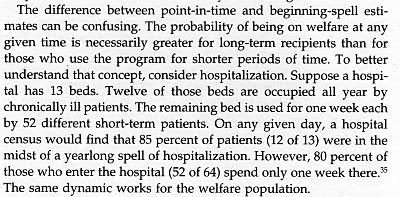
The statistical phenomenon of short-term reliance hiding long-term is explained below via NZ research into how long people rely on the DPB:

On average, sole parents receiving main benefits had more disadvantaged backgrounds than might have been expected:

·          just over half had spent at least 80% of the history period observed (the previous 10 years in most cases) supported by main benefits
·          a third appeared to have become parents in their teenage years.

This reflects the over-representation of sole parents with long stays on benefit among those in receipt at any point in time, and the longer than average stays on benefit for those who become parents as teenagers.

Had the research considered all people granted benefit as a sole parent, or all people who received benefit as a sole parent over a window of time rather than at a point in time, the overall profile of the group would have appeared less disadvantaged.


 And another explanation I have used before from The Poverty of Welfare:

8 out of 10 years reliant on the DPB is a good enough definition of 'welfare dependency' for me.

Friday, June 01, 2012

Social messaging promoted over basic safety

When you toot a horn you startle and momentarily distract every other driver or pedestrian in the vicinity. Hence Officially:

Using the horn

The horn should only be used as a reasonable traffic warning. It should not make an unnecessary or unreasonably loud, harsh or shrill noise.

 Maori Party co-leader Tariana Turia has suggested drivers should show their disapproval of others smoking in cars carrying children by tooting at them and wagging their finger like Supernanny scolding a child.

Some are so obsessed with the long-terms dangers smoking can cause that they have left their common-sense parked up somewhere.

Thursday, May 31, 2012

I've had it


This poor bastard has had enough.

 (Hat tip Sean Fitzpatrick)

Wednesday, May 30, 2012

5 kids, 2 dead, 2 years jail

None of this raises eyebrows any more. There are loads more culprits just getting away with it. Just having the luck scales tip their way. Just avoiding criminality. But the impact on their surviving children is the same. Born to incapable parents, sent to questionable second carers, set on a life of utter insecurity and incomprehension of why. This is New Zealand.

(No need to point out to me that is was probably 6 kids. It is de-humanising to squabble over the adequate and accurate  quantification of humanity.)

Crowding

For the 'sky is falling' types a paper released by Statistics NZ today describes 'crowding ' since 1921.

"The 1921 Census identified 9 percent of dwellings as crowded. These were dwellings with more than 1.5 people per room (now considered severe crowding)......According to the 1921 people per room measure, less than 1 percent of households were severely crowded in 2006."

Just under 1 in 10  down to under 1 in 100.

The world is a better place in very, many ways.

Tuesday, May 29, 2012

Families Commission - effectively gone

I didn't really want to think very hard about the implications of the Families Commission 're-structuring' but was prompted to when asked to go on Jim Mora's panel this afternoon (contact from RNZ 2 days running - did a taped interview yesterday's about the 22 percent of babies being on welfare by year-end).

I have concluded that its a de facto abolition. The money from their budget is going into projects that will support the welfare reforms. Parenting programmes for instance. And the new SuPERU unit (Social Policy Evaluation and Research Unit) will support, in particular, all the extra 'wrap-around' privately-provided youth services dovetailing with the new Youth Payment.

In 2008, prior to the election, Key told Family First he would get rid of the Families Commission and then hastily retracted his statement when it was published in the DomPost. This is the next best move. Christian conservative Peter Dunne has never been happy with his 2002 confidence and supply trophy which couldn't even define what a family is. The Commission was subsequently hijacked by Labour under Rajen Prasad, now a Labour MP and constant apologist for welfare dependence. For instance, it strongly advocated for the anti-smacking legislation which United Future vehemently opposed. And Dunne won't feel any regret about losing Christine Rankin, a current commissioner.

The Families Commission was largely a waste of time and resources though I will say that recently, some sharper,  more NZ-relevant research emerged.

But we are past talking now. We were past talking in 2003 when I submitted my opposition to select committee overseeing the formative legislation. More government isn't the answer.

Growing up in New Zealand

According to the NZ Herald, the restructured Families Commission is to take responsibility for the Growing Up in NZ study which has a sample of just under 7,000 babies born in Counties Manukau and Waikato in a period between 2009-2010.

Coincidentally I was looking at that study just yesterday. Regarding 'family resources',  at nine months of age it found 18 percent of babies had parents who received income from a main benefit in their first year. This number is too low, especially in those regions. The reason for the undercount is probably considerable drop-out from the study - 7 percent by nine months. And quite probably the very people we need to take more notice of, those families that are least able to provide good care for their children, are the ones most likely to drop out. So as long-term studies go it is already carrying a frustrating deficiency.

Nevertheless the first report is chocker full of interesting information about the babies and their parents. Things that stand out for me include the high reported use of marijuana, especially by partners; one in ten mothers smoked tobacco through pregnancy; reported relationship status doesn't match  DPB use when the baby is young - that is a fair number of people receiving the DPB actually have a partner. 457 mothers had no partner when the baby was 9 months yet 723 received income from the DPB.  And 8-9 percent slept in their parent's bed.

Monday, May 28, 2012

"Awaiting moderation" on Frogblog

Green MP Holly Walker wants to end child poverty in two terms by arriving at a parliamentary accord about the matter. As my subject today was the number of babies born last year relying on welfare by year-end contributing substantially to the child poverty problem, this afternoon I posted the following comment. It has been "awaiting moderation" ever since (now 9:10pm). I don't know why both Frogblog and Red Alert do this to my comments. I am never rude or abusive.
 
I released statistics today that show that 22 percent of babies born last year were dependent on a benefit by year-end. This isn’t an aberrant stat. Through good times and bad between one in four and one in five children is added to a new or existing benefit at or shortly after their birth. You won’t solve ‘child poverty’ without reducing this pattern of behaviour.

(BTW, who is Photonz1 who consistently puts up arguments against Green positions? Be nice to know.)

Smokers save the taxpayer money

So the latest taxes are no more than imposing state ideals and revenue gathering....

Radio NZ reports on Treasury officially acknowledging the truth.

A report by the Treasury has admitted smoking actually saves the Government money in the long run.
The fiscal benefits of smoking have long been suspected but rarely acknowledged and a report by Treasury now puts this on the record.
In its report, Treasury says smokers often die earlier than non-smokers and save the state in superannuation costs.
Treasury says smokers pay $1.3 billion a year in excise which may already exceed the direct health costs they impose.
The report then goes on to consider broader economic questions. It says smokers' shorter life expectancy reduces superannuation and aged care costs, meaning they are already "paying their way in narrowly fiscal terms"
The report was prepared for last week's Budget decision to raise the tax on cigarettes to discourage smoking.
Research by the New Zealand Institute of Economic Research has suggested that people should be able to pay increased prices into a special fund and get the money back later if they can prove they have quit.
The economic consultancy says that would be more effective than giving the money to the Government in higher taxes.

22 percent of babies born 2011 on welfare by year-end

Media Release

22 PERCENT OF BABIES BORN IN 2011 ON WELFARE BY YEAR-END

Monday, 28 May, 2012

Welfare commentator Lindsay Mitchell said that data released to her under the official Information Act  show that 22.2 percent of babies born in 2011  were dependent on a caregiver receiving a benefit by the end of the same year.

"Over one in five babies reliant on welfare by year-end is a sobering statistic. Almost half of the caregivers were Maori and half were aged 24 or younger."

"There is an established pattern of childbearing followed by reasonably rapid, if not immediate, recourse to welfare in New Zealand.  This occurs during good and bad economic periods."

"The implications for this high percentage lie in the likelihood of these children remaining on a benefit for many years. Ministry of Social Development research found, 'The older the child when they first have contact with the benefit system, the greater their likelihood of leaving benefit. Compared to those in contact at birth, those who first have contact between birth and six months have a 15% increase in the probability of leaving benefit. Between six months and one year there is a 33% increase, between one and two years there is a 41% increase, and first contact between two and three years is associated with a 56% increase in the probability of leaving benefit.' "

"These are the circumstances which are overwhelmingly contributing to New Zealand's child poverty problem."

Truth column Friday May 25

 Last Friday's Truth column:


The alcohol reform debate is boring. New Zealand has been agonising over alcohol since Adam was a boy. Parliament has tried to control its sale and consumption  since the 1800s. Then, lobby groups like the Salvation Army pushed abstinence; today, an alcohol tax hike. Dealing with lives ravaged by alcohol they forget most drinkers do not have a problem. To the contrary. People are now able to enjoy New Zealand-made boutique beers of international quality, visits to vineyards, wine and food festivals and economic benefits - like jobs - that vintners and brewers provide.


Yet all we hear is bad news about 'booze'. Particularly young drinkers. Which is somewhat forgetful of those doing much of the moaning - the middle-aged. Look back to their heyday to find a far worse culture of drink-driving for instance. In 1990, 139 15-24 year-olds affected by alcohol/drugs were involved in fatal crashes. Twenty years later the number had fallen to 54. After-match drinking was chronic and flat 'parties' were frequent. Drunken youth weren't as obvious because the 'Courtenay Places' didn't buzz all night. But young people using and abusing alcohol is no new thing.


Ironically, it is much harder for teenagers to purchase alcohol now than it was in the seventies and eighties yet  lobbyists and legislators still aren't satisfied. Some want the purchase-age put back to twenty, sales from convenience stores banned, trading hours cut and excise lifted.


As parents we want our kids to learn from our mistakes. Unfortunately human nature is such that they need to learn from their own. We hope and pray they survive those mistakes - the vast majority do. And they grow up in the process. But as a country, are we growing up?


Next month parliament will probably raise the purchase-age and impose further restrictions. Yet another exercise in punishing the responsible for the behaviour of the irresponsible. Par for the course in New Zealand I'm afraid. 


Saturday, May 26, 2012

Paula Bennett deserves recognition for breaking the mold

Yesterday MSD posted their Statement of Intent for 2012-2015 on-line. The following extract is from the Minister's forward. Now I don't expect readers of this blog to get over-excited. Some of you want no state welfare system at all. But that's not going to happen any time soon. The reason I am copying this is Bennett's willingness to put the facts on the table. This isn't typical Ministerial waffle that, at best, says we must do better. It says the system is a failure and it has to change. And amazingly even the taxpayer gets a mention:

New Zealanders want a welfare system we can be proud of. The system must support people who genuinely can’t support themselves, but those who can work should be available for work and actively looking. Better resources and support to help more people off welfare dependency and into work is a clear priority. The system has failed too many New Zealanders by creating dependence and the Ministry of Social Development is moving towards a more active approach that will see greater support in helping more people off welfare and into work.

Young people are a clear priority within welfare reform. We know that those who go on welfare young tend to stay longer than others and have poorer opportunities as a result. Of real concern are the 16 and 17 year olds who become disengaged from education, employment and training and who are on a collision course with the adult welfare system.

Teen parents also stay longer on benefits than those who become parents at an older age. On average, a teen mother will spend more than seven of the next 10 years on the Domestic Purposes Benefit.

The welfare system has allowed very young people and teen parents to gain access to a benefit, with very little support. We will not continue to fail these young people by handing them a welfare cheque and leaving them to their own devices.

The Ministry of Social Development is engaging with youth service providers who will work with these vulnerable young people in a very new way. Whether or not they receive a benefit, those 16 and 17 year olds and 16–18 year old teen parents at risk of going on or remaining on welfare long term will receive wrap-around support.

Sole parents will also receive much greater support to move into work, as previously this was a group that attracted little work expectation or assistance.

The integrity of the welfare system must be protected and the Ministry of Social Development will continue to improve systems to prevent fraud and abuse of the benefit system. This includes better, faster data matching and getting tougher on those who do abuse the welfare system which is there to support those in genuine need.

These changes are about greater expectations to ensure more New Zealanders participate fully in our economy and society. We are rebalancing the incentives and obligations and ensuring the welfare system is fair to those who use it and those who pay for it.

Friday, May 25, 2012

NZ's comparative risk rating

This morning Don Brash delivered a speech to the Institute of Chartered Accountants on the effects of yesterday's budget. This table appeared in the notes. NZ has the same risk rating as the US.

(I received the speech via e-mail so if anyone wants a copy let me know. It's not up at his website yet.)

Treasury's lack of faith in welfare reforms

Actual and forecast welfare spending:


Wednesday, May 23, 2012

"Public not fooled by media"

Here's an opinion piece that merits wider reading. From Michael Cox published in the Waikato Times;  

I think the correct word is dichotomy, but I had to look it up in the dictionary. It means when two parts are sharply opposed. So it would be fair to say that a dichotomy exists between what I read, hear and see in our media and the regularly published political polls. "Key has blown it" read one headline. "National self-destructing" said another. The guts of the comments made under these strident headlines go along the lines of, "since the November elections John Key and his National Party seem to have gone down a path of sheer political madness". "Their proposed partial asset sales, the deal-making with SkyCity, the ACC problems and the sale of the Crafar farms to a Chinese group, all spell political doom for this hapless Government." Not so, say the polls. In fact, they have shown an increase in support for Mr Key and his merry band of politicians. This hapless Government now has more support than on election night. Obviously, the public likes strong and positive leadership and doesn't believe the media's interpretation of events. So how can the press get it so wrong? Here I begin to tread carefully, for it is a writing sin to overgeneralise, but could it be that our reporters are hoping that Mr Key and his government have a serious pratfall? My many years of experience with the media have taught me that, in general, most of them lean to the Left in their personal political persuasions. The job attracts that type of thinking, with a strong emphasis on social justice and a dismissal of capitalist necessities of day-to-day economics. Those who are professional put these leanings aside and publish what they consider is true and correct and do a fair job. Some just let all their prejudices hang out. The relationship between politicians and journalists is a very delicate one. They both need each other to do their jobs properly. Both tread warily in each other's presence. I always felt journalists didn't like politicians and were envious of them. I am aware of only two journalists who have become MPs: Fred Doidge in 1936 and Brendon Burns, who lost his Labour seat in the last general election. Interestingly, in my time in that establishment, the members of the Press Gallery formed the strongest journalists' union in the country. So I think it would be fair to say that the re-election of Mr Key's Government was not greeted with overwhelming joy and elation at the bar in the Press Galleries lounge. The reporting since that time has been continuously against the Government. It's as if the professional reins have been loosened. There is a feeling that the proper Opposition has not fired under its new leadership, leaving a void that some journalists have felt they should fill. Our Fifth Estate is very powerful. While at present there is a dichotomy between what is reported and the polls, if the media are of a mind to attack Mr Key's Government over the next year or so, they will play a part in eroding its public support – they are that powerful. Someone like Kim Hill with her three hours of interviewing Left-wing international personnel every Saturday morning has an ongoing effect on people's political views. It's a bit like Chinese torture: drip, drip, drip. She is the only woman I know who can consistently get me out of bed at 8am on Saturday. Then on Sunday morning on National Radio we are gently badgered by former Labour MP Chris Laidlaw. He never pulls punches when the political Right gets in his way. Together, these two articulate and persuasive presenters are a concerted voice for the Left. I've said it is dangerous to generalise and I should acknowledge some of the editorials that have been positive about the actions taken by Mr Key particularly over events such as the SkyCity deal, which has so much of an upside for New Zealanders. Mr Key is a deal maker to the core and has been since I worked with him when he was a young foreign exchange dealer in a merchant bank in Wellington. That can only be a positive for this country and I suspect that the public appreciate that and reflect their views in the polls. 

(Sorry about the formatting. Blogger drives me nuts)

Budget 2012 - small mercies to anticipate

There may be more recent data but this will do:

Across the entire sample, 52 percent of offenders released from New Zealand prisons in 2002/03 were convicted of a new offence and were returned to prison at least once during the 60-months follow-up period. 

Yesterday in Parliament:

Hon ANNE TOLLEY (Minister of Corrections): Yesterday the Associate Minister of Corrections and I announced that Budget 2012 will contribute to a 25 percent reduction in reoffending by 2017, and 18,500 fewer victims of crime every year from 2017.

In other terms, in five years time, instead of 5 in 10 prisoners re-offending, New Zealand can look forward to 4 in 10 re-offending. I can hardly wait.

Tuesday, May 22, 2012

Welfare state not living up to expectations

In the budget run-up Every Child Counts is warning the government they must invest in children.

“As we head into Budget 2012, it is time for the government to publicly acknowledge the significant return on effective investment in children and assure the public that their policies will improve life for our most vulnerable children,” says Jenny Prince, Every Child Counts Steering Group member and CE of Plunket.
At the same time, a new study from the US  casts doubt on whether the welfare state can make up for a lack of two parent families. The study compares US and UK cohorts.

“WASHINGTON, DC, May 16, 2012 — Children in the United States and Great Britain share a number of common risk factors that increase the likelihood that they will have behavioral problems—and Britain’s broader social welfare programs don’t appear to mitigate those risks, according to a new study in the June issue of the Journal of Health and Social Behavior (JHSB)....

"We wanted to see whether the role of parents was equally important in both societies because the argument has been made that more developed welfare states—such as Great Britain—can make the role of parents less important, by providing additional supports that can help compensate for situations where households have more limited resources. This study tells us that parents are important in households, regardless of the strength of the welfare state.”
The UK Daily Mail has coverage here. They headlined coverage of the study from the Journal of Health and social Behaviour with:

Research found children from broken homes did worse regardless of how much state support is given
(Hat-tip Bob McCoskrie)

Social security wasn't unaminously welcomed - 1938

Response to Savage's Social Security proposals publicised via a radio broadcast earlier the same week;

(Source - The Evening Post, April 4, 1938)

Monday, May 21, 2012

Truth Column May 18

The following is my column published in The Truth, Friday, May 18:
When the first Old Age Pension was introduced in 1898 - over one hundred years ago - the qualifying age was 65. Fast forward to 2012 and the qualifying age is still 65. Given male life expectancy has risen from around 62 to 79 this seems astonishing.
Like so many government assistant schemes, pensions for the aged began as a tightly controlled, rather stringent programme but gradually ballooned, becoming a political football in the process. That's exactly what Super is right now with John Key staking his Prime Ministership on retaining the status quo.
Personally, I have never understood this intransigence. I asked him directly via a talk show question and answer session - why? He responded, during the 2008 election it became apparent that Labour was going to embark on a whispering campaign about his party's intention to raise the age. Thus he decided to put the mockers on it quick smart.
But it wasn't smart. Super is a huge cost with the youngest recipients accounting for a disproportionate share. The yearly bill for 65 and 66 year-olds alone is around $1.3 billion Looking ahead, as the baby-boomers age, the size of the workforce is going to shrink relative to the size of the 65 plus group. As one of them, I am uncomfortably aware of this. My kids will be (increasingly?) taxed to keep me.
So what, you may say? Hasn't that always been the way? Yes, but we haven't faced this kind of demographic change in the past. As are many European countries and the US. That's why they are lifting their entitlement ages.
Uncharacteristically Key has read this one wrong. When Phil Goff made lifting the age Labour policy in 2011 many people sensibly approved. Politicians are renowned for flip-flopping and generally we denigrate them for it. But this is one instance when a change of mind might reap kudos rather than derision.
Link not up yet but the editor's column is here.


Sunday, May 20, 2012

McCarten missing the point

More mangled logic from Matt McCarten today. About the extended free contraception to the teenagers of women on the DPB:

"If we really want to reduce teenage pregnancy and abortion it would be more principled, and just as cost-effective, to offer it to all young women."

Stupid. But I have heard this sentiment over and over. Who can believe it comes from the mouths of lefties who in the very next breath are demanding all sorts of targeted assistance for the poor.

But if we treat contraception as purely a health matter anyway, it is the poorest teenagers that become teenage mothers. DHB statistics illustrate this fact. So prevention is targeted at that group.

I wonder what McCarten thinks of the targeted funding for the reduction of rheumatic fever?

Tariana Turia:

"Today we announced that as part of Budget 2012 we are doubling the spending, from $12 million to $24 million, over the next 4 years to reduce rheumatic fever in vulnerable communities. We currently have 101 schools engaged in the rheumatic fever campaign, targeting 35,000 children in seven regions. This new funding will allow more schools and more children to be targeted in this preventive programme. Around 70 percent of children who get this Third World disease will suffer some heart damage, but with proper treatment that risk is dramatically reduced.
McCarten's idea of  "principled" policy would require the programmes to be run in all communities whether or not rheumatic fever is a problem.


Saturday, May 19, 2012

ACT's biggest backer a bigot

It sickens me reading the views of one Louis Crimp, who I have never heard of before today, although his face looks vaguely familiar. He is a bigot and apparently ACT's biggest backer.

Unfortunately, because I stood for ACT twice, I still get associated with  stuff that goes on in and around the party. And so I am compelled to publicly disassociate myself from this guy.

According to The Herald Mr Crimp said in an interview:

"All the white New Zealanders I've spoken to don't like the Maoris, the way they are full of crime and welfare."

Asked if his political views could be labelled racist, he said: "I don't give a stuff what I'm called. You have to look at the facts and figures. This is the problem with New Zealanders. Most of them dislike the Maoris intensely - I won't say hate - but they don't like to say so."
But here's the kicker:

Act's president, Chris Simmons, said he disagreed with Mr Crimp on some areas but respected his right to have a view....Mr Simmons said the party would take Mr Crimp's money again.

ACT has utterly lost its way. It was the champion of individual rights and arch critic of collectivism, and should be the party speaking out most vehemently against racism - not tolerating and tacitly condoning it through allowing a bigot to buy influence. I am appalled.

Thursday, May 17, 2012

Teenage birthrate hits new low

The March quarter teenage birthrate has dropped to 25.3 per 1,000 15-19 year-olds.

This is the lowest rate since  1972 when the number was 69 per 1,000.

This is good news because most babies born to teenage parents end up on welfare.


Currently there are 3,051 18-19 year olds on the DPB (some might not be parents but caregivers to someone sick).

In March 2009 when the teenage birth rate was 32.2, there were 3,570 on DPB, so the drop in the birthrate is reflected in numbers dependent.

It may be that the messages about the DPB no longer being a long-term option are getting through. But the number of babies being born is dropping across the spectrum from 64,159 (year ended March 2009) to 60,860 March 2012.

The depressed economy? More potential dads leaving the country? (The abortion rate is also trending down so fewer women are getting pregnant in the first place.) Motherhood less fashionable? The moral climate?

I think that people are beginning to appreciate that the road ahead might not be so easy and are starting to adjust their behaviour accordingly. Whatever their circumstances are.

What do you think is changing?


Wednesday, May 16, 2012

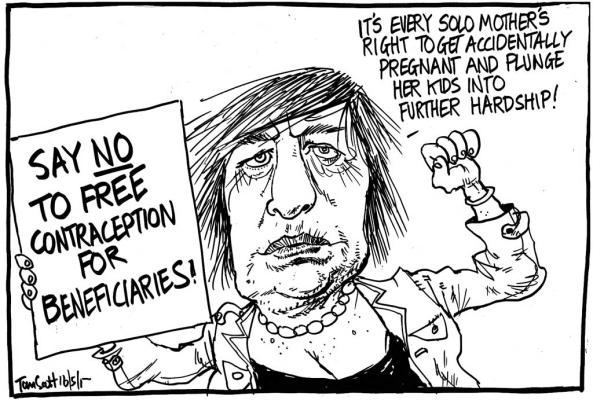
Tom Scott gets it

There are times when a cartoon really nails it.


PPL- time to take a step back

A column for the NZCPD, May 13:

Paid Parental Leave - time to take a step back The NZ Herald recently ran a poll asking whether National was right to use its veto to override Labour MP Sue Moroney's private member's bill to extend Paid Parental Leave (PPL) from 14 weeks to 6 months. After 16,000 votes were submitted, sixty percent of respondents had answered yes.

Frustratingly, this doesn't tell us whether people were against the extension in the context of the current economic climate, against an extension full-stop, or against the entire scheme. I fall in the last category.

More

Tuesday, May 15, 2012

Another redundant objection to extended free contraception

S Beast commented on an earlier post,

"I also find the idea of a government agency prying into the sex life of 16 year olds more than a little creepy."

You will no doubt also find the idea of the education and health departments doing the same "creepy"? 12 and 13 year-olds given the immunisation against cervical cancer are asked if there was any chance they could be pregnant. School counsellors get intimately involved in situations surrounding the sex lives of adolescents. CYF, another "government agency" would also be closely involved with the sex lives of young people, and unfortunately, even children.

More generally, because I have seen other objections about case managers being involved in the 'new' policy,WINZ staff already deal with special grants for:


They also have to deal with difficult areas such as rape and incest when enquiring  after the father of a dependent child, the naming of whom is a requirement for receipt of the DPB. They use their discretion over whether or not to impose a penalty for not complying if the aforementioned scenarios are involved.

I imagine then they are quite capable of exercising discretion over offering a referral to a family planning clinic or GP for the purposes of receiving free long-acting contraception.


Monday, May 14, 2012

"NZ has a problem"

Friday's Right On  column in The Truth:

New Zealand has a problem

Working-age welfare accounts for around 13% of government’s total expenditure – that’s up from 2% 40 years ago. Many people – by no means all – end up on a benefit due to the choices they make, especially around partnering and parenting.

By the end of 2010, 23% of babies born that year had a caregiver on welfare. The pattern is fairly well established, so a lack of jobs is only part of the problem.

New Zealand has the second highest rate of sole parent families in the OECD at 30%. Most people don’t want to be sole parents, and most children want mum and dad in their lives.
These are statements of fact, not finger-pointing, blame or vote-buying.

By financially replacing fathers, government policy inadvertently caused substantial child poverty. The left wants this poverty reduced with higher benefits but this approach is only more of what created the problem in the first place. At least a third of mothers on the DPB started on welfare as teenagers. Without qualifications or work-skills, a benefit income can match or even surpass any working wage they might expect.

Welfare reforms being passed by Parliament have two goals. The first is preventing these young people from coming into and remaining in the system for many years, through more intensive and practical management from outside organisations, and restricting how benefit money can be spent. The second is passing the financial responsibility for their children back to parents through greater work expectations. For example, a single parent must be available for part-time work when their youngest child starts school.

The reforms are hardly radical. But they reflect a change in the way politicians and voters view welfare. They want a safety net, not a trap that damages families and children. The current set-up is not representative of a society that cares.


 Bomber's and and other Truth editorials here

Sunday, May 13, 2012

Nasty and offensive journalism

There's been some hysterical responses to National's plan to extend the type of free contraception available to beneficiaries. Some of them serious, some laughable. But the following is offensive:

"The really noxious component of the whole proposal is its extension to the teenage daughters of beneficiaries who are over the age of consent.

It would be comforting to believe that this plan was not meant to be a slur on women on the DPB. Yet the inference is unavoidable.

As is the implication that being a trollop is hereditary. There's a slut gene that gets transmitted from solo mothers to their daughters. If your mother was a slut, you'll probably be one, too. Maybe not, but let's not take any chances. These second-generation sluts can't help themselves. Only long-term invasive contraception can counter the effects of the gene."
Who is Paul Little? Someone who makes stuff up for a living?

It was Colin Craig who raised the idea of promiscuity, who implied that NZ women are sluts. Little has developed this further into the idea that women on the DPB are sluts because they are the ones being offered the  extended free contraception.

It wasn't Paula Bennett, who was herself a teenage parent on the DPB. I stopped short of being one due to a miscarriage. I was very glad of the contraceptive pill but it wasn't foolproof. And over time I probably had more partners than was wise. Plenty of willing men around. And go ahead Paul Little. Call me a slut. It doesn't bother me.

But don't go calling anyone on the DPB a slut simply by reason of being a beneficiary.

The reason that the teenage daughters of mothers on the DPB are being offered extra free contraception is because girls raised in single parent homes have a significantly greater likelihood of becoming teenage mothers. If they are already dependent on a mother who is reliant on a benefit they will almost certainly follow in her footsteps. The science shows that these girls will stay on a benefit a long time and their children, along with those who are added to a benefit, will experience the poorest educational and health outcomes. It is an EXCELLENT idea to do everything possible to delay parenthood in these circumstances.

I have written about this method before. Opposition (in any form) describe an idea in nasty and offensive terms and then attribute those nasty and offensive terms to the originator of the idea. Very shallow and inadequate thinking.


(And for the Herald to drop a photo of Paula Bennett with her daughter next to this crap is also nasty and offensive. )

Friday, May 11, 2012

Hard to get excited about more Mob misuse of money

As a 'welfare commentator' I suppose I should have something to say about the alleged Mongrel Mob's misuse of whanau ora funding. But it is hard to get even mildly warm under the collar about it, not least because it is Winston Peters poking the stick.

When you line it up against all the other tax money gangs absorb, the DPB that finances their women and children, the $100,000 annual upkeep when inside, the law and order funds for policing and processing them, etc. $20,000 is small beer. Within or without the rules, it's all the same to me.


Two snippets

Two snippets noticed today:

Stories of children scavenging through pig slops and downing entire bottles of antibiotics out of hunger are an "embarrassment to the country" says a Kaitaia GP.
Doctor Lance O'Sullivan said he had been doing what he could to fight the effects of child-poverty in his region but it sometimes felt like an uphill battle.

It is a human right's violation to tell poor people they can't have children.”
- Susan Fraser (Crofton Downs)

Thursday, May 10, 2012

Strange report

The latest report about a Russian aircraft 'test-flight' that ended in tragedy is odd:

Twenty-one minutes after takeoff, the crew asked for permission to decline from 3000 metres to 1800 metres, said Daryatmo.

Aviation expresses altitude in feet. And permission to 'descend' is requested; not 'decline'.

Probably just journalistic bumbling.

Wednesday, May 09, 2012

Sallies interfering again

The Salvation Army gets up my nose and they may as well stop sending me begging letters because they are off my list of worthy causes. I abhor their stance on welfare and now I can add their lobbying on alcohol reform to my reasons for disaffection:

The Salvation Army recommends the Government immediately increase excise on alcohol by 25 per cent. This would have little effect on moderate drinkers but would reduce alcohol consumption by teenagers and heavy drinkers – the most price-sensitive consumers – by as much as 10 per cent.
Stop promoting punishment of the responsible for the actions of the irresponsible, not to mention the economic damage threatened to the many industries associated with alcohol production and sale. I'm sick of it.

I would gladly fund their practical work but cannot separate it from their ignorant and annoying advocacy.

Depressing picture

What a (largely) depressing picture Alistair Bone paints of young people in Huntly. I am copying it in its entirety to keep on the record. Think about it next time you read or hear some do-gooder saying there is no evidence that females have kids to get on the DPB. Go into the right neighbourhood and homes (like I have and this writer has) and you will see it for yourself. I just hope that Paula Bennett is choosing the people who are going to be in charge of changing this mindset, culture, whatever you want to call it, very carefully. (Hat-tip Clint Heine and Friends)

'Cracking it' on welfare in Huntly


Mike Watane had plans and savings when he was a kid. He wanted to go around the world.
"There were places I had planned in my head. I saw the Gold Coast on TV and thought that was a lot better than Rainbows End had to offer". Then the unexpected happened.
"I saw her stomach getting bigger and bigger and thought 'aw yeah, I'm trapped now'. That was pretty much my money gone, getting her stretchy waist clothes."
He was 21 and she was 22.
He's still with his girlfriend. Baby is three. He's just come off a welding course and goes down to Hamilton every couple of days looking for something.
There's been no luck yet, so he's on his bike, literally, and talking to mate Poro Kingi on a street in Huntly West.
On paper it's a terrible place. Dead bottom and 10 out of 10 on the deprivation scale, worse than Meremere, worse than Ngaruawahia, worse even than living across the river in Huntly East.
It's hard to find actually abandoned houses in New Zealand, but there's heaps here, their windows boarded with graffitied plywood.
The rail line runs straight through Huntly West and the twin towers of the power station don't go anywhere. There are so many gangs locals need more than a hand to count them off and subset them into senior and junior.
Kingi's hefting baby Cali on his shoulder.
He and his partner are struggling, but Cali was planned and wanted. He says a lot around here are not even 18 when they have their first. He's lived here all his life and can't think of a time when that's not been true.
They like the Government's new plan. Watane thinks long-term contraception would help the younger generation, make it a place where you just see girlfriends and boyfriends together and not with a kid in tow.
The heat of the moment can do funny things to your plans, he says.
Down the road a bit and Te Aroha Kirkwood and Shanelle Herewini hear that.
"You tell them to wrap it, but sometimes they don't listen or they are too drunk." Te Aroha giggles, she's on a benefit, 19 years old, eight months gone.
Shanelle says she wouldn't take the contraceptive, even free – "put the money in the bucket".
Get the kid and take the money. She's laughing, maybe playing up. But Te Aroha whispers, just about to herself, "I would like to have that."
The Police Ten Seven crew were at the dairy earlier. Someone knocked it over looking for smokes, the girls say. Three young guys turn up on bikes. They're intense, they give names, probably not real.
Walter is 16, his girlfriend is 17 and pregnant. He doesn't have a job, just a mystery magic formula.
"Money is all around me. Why do I need a job when money just gets given to me?"
Despite that, he's going to hold off. He'll see how "hard case" the first one turns out before getting another.
Most of the girls won't go for the Government offer, he reckons. They want babies.
"I heard you crack it on the benefit if you have babies." he says.
One of his lieutenants has a different take. He learns the Government doesn't actually want to pay people on a benefit to have babies.
"They should move that thing – the minimum wage, yeah – up from $13.50 and they might get a job. Even if they moved it to $15, that would make a big difference," he says.
Farther down the same street lives Fay Love. She's been bowled by a purse snatcher, but still takes a stick to the hoods in her yard.
The voluntary contraception offered to the teen girls of beneficiaries is never going to work: "Half the parents round here are going to say 'it's my child, they can do what they like'."
As she talks, more and more women appear on her steps. They agree. Take their benefit away or it's a joke.
Abby Martens flats with Desiree Maddern. They're both on the benefit. Desiree was pregnant five times before she was 20, twice by accident. She works with the cops in the Blue Light programme, trying to put kids back on track. She's dead against it being compulsory.
She poses a question. "Are girls just having babies for the money, or because they want a baby, or to keep a guy?"
At 19, Abby would be the bullseye for the programme. But she wouldn't do it. She doesn't believe in unnatural contraception; her parents were very into homeopathy.
She's brave, honest. When she's with a partner, she uses a condom she says, but sometimes ...

Tuesday, May 08, 2012

82% say "YES"

A Campbell Live poll just announced the following result:

"Is it a good idea for beneficiaries to be given free long-acting contraceptives?"

YES - 82 percent

Paula Bennett was more genuine and convincing than Meteria Turei who was undone by opposing for the sake of it.


"...state should not play a role in women's reproductive lives"?

Sue Bradford says, about the just-announced extra funding for long-term contraception for beneficiaries and their teenage daughters, "There are many in the church and community groups who believe that the state should not play a role in women's reproductive lives."

So the state should discontinue current funding of contraception, family planning services, abortion, tubal ligations, maternity services, Paid Parental Leave, Plunket, fertility treatments, etc ? Is that really what Bradford is saying? It is a highly troublesome argument for her to advance.


In fact it is one you would be more likely to hear from me. Yet she is against this subsidy and I am for it. My reasoning?

I will go along with the latest funding because it is an attempt to reduce the social and economic cost that generally follows the birth of a child onto a benefit.

Monday, May 07, 2012

Why I get put in the right-wing box

Published in last Friday's Truth:

Describing political beliefs as 'left' or 'right' is convenient but problematic. An old friend recently asked, "When did you become a right-winger?"  I didn't, I replied. A right-winger is conservative on social issues like alcohol laws, gay marriage and voluntary euthanasia. I'm not, because I believe in individual choice and freedom. From very young the maxim 'live and let live' resonated for me.  So when government  tells me what I can and can't do, I chafe.

Local government is, in some respects, a worse offender than central, with vast powers to dictate what can and can't be done with private property. To demolish my garage and build a new one, I am told I have to push it back; or turn it adjacent to the street; have a roller-door rather than an angle-opening one despite there being no footpath outside. The process drags on and to rub salt into the wound,  my rates fund those putting unfathomable obstacles in my way.


Central government is a less obvious but more pervasive force with the power to
take my property (compulsory taxes) to use in ways not just wasteful, but actively destructive. Paying people to have babies is a good example. Children produced as meal-tickets are highly vulnerable.

When government robs Peter to pay Paul, it limits Peter's choices to promote Paul's. Peter has no say in the matter except perhaps once every three years, but even then, there isn't a lot to differentiate National and Labour, both big spenders.


What I want from a government is less benefit spending, less productivity-stifling regulation, less corporate and middle-class welfare and lower, flatter taxes. And that's why I get put in the right-wing box.

Sunday, May 06, 2012

Roger Kerr's successor

The NZ Business Roundtable has merged with the NZ Institute to form what is now called The NZ Initiative.

The new head of this group is Oliver Hartwich. Here are some excerpts from an interview on The Nation.

Rachel When our next guest left the UK to take up a new job in Australia, then Conservative MP David Cameron remarked, the sooner he gets on the ship the better. Economist Dr Oliver Hartwich has critics and fans who've closely watched his work at Britain's leading think tank, the Policy Exchange, and more recently at the Centre of Independent Studies in Sydney. He's now in New Zealand to head up the New Zealand Initiative, a merger of the Business Round Table and the New Zealand Institute. And after his first week on the job he joins us now in the studio. Welcome to the programme Dr Hartwich. It's quite an interesting merger, two very different beasts. Why do you think they’ve brought you in, is it because for example you may have a blank slate when it comes to New Zealand?

 Oliver Hartwich – New Zealand Initiative Executive Director
I think they were looking for someone with a sense of humour so they couldn’t go past a German of course. But seriously the organisation, I mean it's built on the legacy of two existing organisations, the Business Round Table and the New Zealand Institute, but the idea was really to form a new initiative, and that’s why it's called the New Zealand Initiative, and it's built to really promote policies that promote good policies for all New Zealand, for all New Zealanders. We're basically showing the same visions whether we're standing on the left or on the right, it doesn’t really matter too much, we all believe in sound economic management. Nobody wants to see high inflation, no one wants to see high unemployment. We basically believe in the same things, and we're trying to actually promote policies that work for the whole of the country...

I think the whole political spectrum is basically converging towards the centre, it's not just a thing that you will see on the right, you actually see it on the left as well. I think we have seen quite a bit of a conversion in the last 20 years globally. So you’ve got the traditional left wing parties moving closer to the centre, traditional right wing parties moving closer to the centre, because in the end they're driven often by opinion polls, by focus groups, by short termism, and they're really trying to just grab the issues of the day and politics I think has become much less ideological after the end of the Cold War, and I think that’s probably seen in many countries around the world including of course most European countries..

I'm an old Liberal, I'm not a Neoliberal, I really believe in individual freedom, I believe in policies that work, I believe in empirical research driving policy making.

....Maybe we should see a first light return of ideology in political debates anywhere, because what I actually miss from political debates is some clear divisions. We have this convergence to what is centre. What's really missing are debates, real passionate debates really based on principles not just on opinion polls, not just based on some focus group polling. I think the times when we actually had debates between people who believed in a more planned economy and other people who believed in a more free economy, I think that they're quite healthy for democracy. When democracies converge on the centre ground, political debates become quite stale, they become personality driven. I would actually like to have real debates upon policy."

More.

Some good stuff.

Big discrepancy in reported funeral grant figures

According to Stuff "Department of Work and Income statistics show in the 12 months to the end of March, 5473 funeral grants were made, totalling $9.8 million.....In 2011, Work and Income issued 5412 grants totalling $9.3m, and in 2010, 5562 grants cost $9.3m. "

Check out this MSD table which shows that in the financial year 2009/10 only 26 funeral grants were made.

I have searched 'funeral' in the latest MSD Statistical report and no other results are found.

I am intrigued because the Stuff figure sounds far more plausible.

What this highlights is the difference between statistical information gained under the OIA (where I think it was sourced) and what is in the public domain.

Saturday, May 05, 2012

Clash of cultures

This is an odd story described as "an ugly encounter with aggression, racism and abuse". All it really highlights are cultural differences between Germans and Kiwis. Germans are very rules-bound and quite obedient. I discovered that after a few visits there, both working and for leisure.

The story goes, after a collision at a roundabout "We said, 'OK, we want to leave everything like this until the cops come," Ms Kirn said. "In Germany, what we learn is if you have a car accident just leave everything like it is."

I can appreciate the consternation and frustration these two women caused by refusing to move their vehicle which was presumably holding up other traffic. Imagine for a moment if I behaved the same way. I'd get called a stupid woman doubtless. Then I could run to the papers about misogyny being rife in NZ?

Or imagine if I was in Germany, caused a collision at a roundabout and proceeded to drive my car into a position where it was no longer impeding the flow of traffic. The Germans would get very angry with me for interfering with the 'crime' scene  most probably. And they would phlegmatically bar me. I've encountered this sort of unbending slavery to unreasonable rules first-hand. And it isn't pleasant.

Now, I am sure all Germans are not like that. And neither are all Kiwis aggressive, abusive, racists .

"I felt I never want to come back to NZ. It's very nice nature but we didn't know people were racist." 

Get it into perspective. An unfortunate accident and ensuing misunderstanding which brought out the worst in some individuals.

Thursday, May 03, 2012

Work-testing the DPB having effect?

The following are the quarterly 'all employed' percentages for households with 'One parent with dependent child(ren) only' (first row) and 'One parent with dependent and adult children' (second row). They span each quarter since March 2010 ending with March 2012.

Work-testing the DPB for care-givers with children aged 6 or older started in September 2010. 

The sole parent employment rates are picking up.

 
51.6
51.4
50.0
48.3
51.4
52.0
53.1
53.8
54.5
34.4
34.2
32.8
34.6
38.6
27.8
29.9
37.6
39.2

But the overall unemployment rate is up. Which group is reducing their employment?

 
Couple with one dependent child (first row)
Couple with two dependent children (second row)

 
66.5
66.2
67.8
68.3
66.1
67.6
67.6
69.4
64.9
65.3
67.0
67.7
66.1
65.8
64.8
65.2
67.9
66.8

When I find time I will graph these interesting developments.

The law of unintended consequences

A fine example of the law of unintended consequences has recently come to my notice.

Where I live the council recently erected pooh-bag dispensers. These bags are easier to use than plastic shopping bags, which often have holes and are bulkier in the pocket, so people are making use of them and not carrying their own bags.  BUT the dispensers keep running out. Result - less dog pooh is  picked up. The consequence of the policy is the exact opposite of its intent - more dog pooh.

I have reverted to carrying my own bags but  can imagine some people now blaming their failure to pick up after their dog on the council for not ensuring the dispensers are full at all times!

Moral of the story. The more you do for people, the less they will do for themselves. The more responsibility you assume for them, the less they will assume for themselves.


(I was reminded of this by a story on 3 News this morning about a set-up whereby people can exchange dog pooh for free wifi. Great incentive to get people busy collecting as much of it as they can find.)