Stephen Franks is musing about the proposed property tax and its effect on the rental market/ housing availability. Which prompted this comment from me (I risk broadcasting the idea to deter National, not to encourage the statists);
I have also pondered this in a vague sort of way. A great deal of rent is currently paid for with the accommodation supplement ( $1 billion annually). If rents rise as a result of a property tax, under this government's approach of compensating the 'poor' for any rise in their living costs, the accommodation supplement will also have to go up. How much of the extra revenue raised will be offset by the extra expenditure?
The Left puts up two irreconcilable demands. As you put it "soak the rich", and subsidise the poor. But while the landlord has freedom of pricing, nothing has been achieved except more cash transfer. The same happens with employment. While on one hand the Left wants workers topped up by the state, they also rail against subsidising the employer. Hence a minimum wage is legislated.
So don't be surprised if the Left start talking about a maximum rent. If National go down this road they will have to contend with this demand, and as Mr Key has already fiercely asserted that the 'poor' will be compensated for any rise in GST, he will be in a very weak defensive position.
Saturday, January 30, 2010

Friday, January 29, 2010
More is broken than just the tax system
Writing in today's NZ Herald, Susan St John succeeds in showing how complex and counter-productive the state's attempts to redistribute wealth have become. But because the writer believes in the notion of state responsibility for income equality she is merely hoping that the government can come up with a better design on the back of "an adequate and comprehensive review."
Perhaps, instead, it is time to examine the beliefs behind government-mandated redistribution - or put more crudely, robbing Peter to pay Paul.
There are two broad ways that wealth gets redistributed. Through taxation and transfers, or through work and shared profit. Over the past 40 years the trend has been towards the first method. State cash transfers have grown steadily. That growth has brought with it more and more complexity as more and more people want a piece of the pie. It is undeniable that whenever a new 'benefit' is introduced it isn't long before there are calls to extend it, either by generosity or by eligibility. A recent example is Paid Parental Leave. Not happy with the current status, lobbyists want 52 weeks instead of 14 and fathers to be paid as well. (Notice here that the prime lobbyist, the Families Commission, is also, after a fashion, a recipient of cash transfers.)
So why is it that government continues to increase the rate of transfer - from the frugal 19th century beginnings of welfare through to the recent Working For Families - yet inequality, according to St John, keeps growing? It is now apparently at an unacceptable level.
The problem lies in the method. When people work for their income there is a return to both employer and employee. The sum of wealth is added to. When people do not work but receive income from the state, the sum of wealth is diminished. This means there is a very obvious limit on how much the state can transfer.
Add to this the disincentive factor. It is reflected in the vast number of people now receiving some form of welfare. If the state is offering cash, the need and desire to work is reduced.
Which is how we have arrived at the current "mess", to use Ms St Johns description. But the only question being asked is, how can the state keep giving people money and keep them working? Trying to solve that conundrum has resulted in the very complicated interface between the cash transfer and taxation system.
Somehow NZ has to pull back from the current pathway and fiddling with the tax system isn't the answer. Taking money off people just to give it back (and more) is patently silly and inefficient. Paying people benefits from a very young age thus locking them into the cash transfer system for years is socially and economically counter-productive.
There are better ways to organise a society. Better economic brains than mine have put up ideas worth exploring. Flat tax, tax-free income thresholds, negative income tax, private social security provision, individualised social security accounts, etc.
But underlying all of these ideas is a philosophy of minimal government intervention. If simplicity and equity are paramount we need less taxation, less taxation machinery, less churning and less transfer - not more.
Perhaps, instead, it is time to examine the beliefs behind government-mandated redistribution - or put more crudely, robbing Peter to pay Paul.
There are two broad ways that wealth gets redistributed. Through taxation and transfers, or through work and shared profit. Over the past 40 years the trend has been towards the first method. State cash transfers have grown steadily. That growth has brought with it more and more complexity as more and more people want a piece of the pie. It is undeniable that whenever a new 'benefit' is introduced it isn't long before there are calls to extend it, either by generosity or by eligibility. A recent example is Paid Parental Leave. Not happy with the current status, lobbyists want 52 weeks instead of 14 and fathers to be paid as well. (Notice here that the prime lobbyist, the Families Commission, is also, after a fashion, a recipient of cash transfers.)
So why is it that government continues to increase the rate of transfer - from the frugal 19th century beginnings of welfare through to the recent Working For Families - yet inequality, according to St John, keeps growing? It is now apparently at an unacceptable level.
The problem lies in the method. When people work for their income there is a return to both employer and employee. The sum of wealth is added to. When people do not work but receive income from the state, the sum of wealth is diminished. This means there is a very obvious limit on how much the state can transfer.
Add to this the disincentive factor. It is reflected in the vast number of people now receiving some form of welfare. If the state is offering cash, the need and desire to work is reduced.
Which is how we have arrived at the current "mess", to use Ms St Johns description. But the only question being asked is, how can the state keep giving people money and keep them working? Trying to solve that conundrum has resulted in the very complicated interface between the cash transfer and taxation system.
Somehow NZ has to pull back from the current pathway and fiddling with the tax system isn't the answer. Taking money off people just to give it back (and more) is patently silly and inefficient. Paying people benefits from a very young age thus locking them into the cash transfer system for years is socially and economically counter-productive.
There are better ways to organise a society. Better economic brains than mine have put up ideas worth exploring. Flat tax, tax-free income thresholds, negative income tax, private social security provision, individualised social security accounts, etc.
But underlying all of these ideas is a philosophy of minimal government intervention. If simplicity and equity are paramount we need less taxation, less taxation machinery, less churning and less transfer - not more.
Thursday, January 28, 2010
Goff's speech - warning
Don't waste your time reading it.
Spun to be something it wasn't.
In a nutshell;
The recovery. All should share in it. Every NZer wants to work and should be paid at least $15 an hour. State sector chiefs shouldn't be paid more than $400,000 though. Rich bankers and CEOs of finance companies should be dealt with. The rich should pay their way and benefit fraudsters should be cracked down on (so National can't use them to cut social services.) No child should be left behind because all parents want the best for their children. But the community is responsible for stepping in where parents fail. Three strikes sucks and a promise to address Maori and Pacific educational failure. Tax reform must be fair. Beat the R&D funding drum.
Stephen Franks was wrong. More's the pity.
Grassroots Labour's Kaine Thompson says Labour lost the last election because voters became bored with them. Nothing in this speech is going to change that. If this is his best, Phil Goff should pursue a new direction in life.
Lord, I am tired of vapid politicians.
Spun to be something it wasn't.
In a nutshell;
The recovery. All should share in it. Every NZer wants to work and should be paid at least $15 an hour. State sector chiefs shouldn't be paid more than $400,000 though. Rich bankers and CEOs of finance companies should be dealt with. The rich should pay their way and benefit fraudsters should be cracked down on (so National can't use them to cut social services.) No child should be left behind because all parents want the best for their children. But the community is responsible for stepping in where parents fail. Three strikes sucks and a promise to address Maori and Pacific educational failure. Tax reform must be fair. Beat the R&D funding drum.
Stephen Franks was wrong. More's the pity.
Grassroots Labour's Kaine Thompson says Labour lost the last election because voters became bored with them. Nothing in this speech is going to change that. If this is his best, Phil Goff should pursue a new direction in life.
Lord, I am tired of vapid politicians.
Goff to define a 'welfare rort'
It is very hard to read this and remain composed;
It will be fascinating to hear how Goff defines a "welfare rort". He can hardly use the high profile examples National has been parading, when the whole point of this 'state of the nation' speech is to differentiate the party he leads.
Make no mistake. It is Labour that has time and time again given society programmes that are open to exploitation. They are warned of the unintended consequences but always press ahead in the interests of 'social justice' and vote-buying. They gave us Working For Families and now he is going to rail at the matter of it being ripped off.
And "personal responsibility"? It is a long, long time since Labour philosophy and policy has been synonymous with personal responsibility. Personal responsibility is only for the suckers who keep the show on the road in spite of extensive government efforts to demoralise and disincentivise the lot of us.
Labour leader Phil Goff is expected to ramp up his rhetoric against welfare rorts and vested interests in a speech in which he needs to put Labour back on the front foot after a year in the poll doldrums.
....He is expected to return to his theme of personal responsibility – taking aim at those who "rip off" the system, rich or poor. Among those in his sights will be wealthy Kiwis exposed by a tax working group last week to be hiding income to qualify for benefits.
It will be fascinating to hear how Goff defines a "welfare rort". He can hardly use the high profile examples National has been parading, when the whole point of this 'state of the nation' speech is to differentiate the party he leads.
Make no mistake. It is Labour that has time and time again given society programmes that are open to exploitation. They are warned of the unintended consequences but always press ahead in the interests of 'social justice' and vote-buying. They gave us Working For Families and now he is going to rail at the matter of it being ripped off.
And "personal responsibility"? It is a long, long time since Labour philosophy and policy has been synonymous with personal responsibility. Personal responsibility is only for the suckers who keep the show on the road in spite of extensive government efforts to demoralise and disincentivise the lot of us.
Another sickening animal story
An aggrieved neighbour takes the law into his own hands and slaughters 33 dogs. This is exactly the reason why the idea of vigilantism sparks deep reservations within me.
If there was a problem with these dogs (as yet unproven) they should have been destroyed humanely.
The whole story is utterly sickening and sad. The owner is clearly something of an eccentric man who has chosen a lifestyle most people wouldn't understand. But apart from not registering his dogs, which would have been financially beyond him, what harm was he doing anybody else?
The guy that committed this atrocity is the headcase. He may well have been heartbroken over the loss of his pet but as such should have understood something of the way Mr Hargraves might have felt about his own animals.
If there was a problem with these dogs (as yet unproven) they should have been destroyed humanely.
The whole story is utterly sickening and sad. The owner is clearly something of an eccentric man who has chosen a lifestyle most people wouldn't understand. But apart from not registering his dogs, which would have been financially beyond him, what harm was he doing anybody else?
The guy that committed this atrocity is the headcase. He may well have been heartbroken over the loss of his pet but as such should have understood something of the way Mr Hargraves might have felt about his own animals.
Wednesday, January 27, 2010
Benefits by region
My analysis of the latest benefit data;


Things to note;
1/ The DPB has the highest numbers in all bar two regions.
2/ The Canterbury and Southern regions have disproportionately high numbers on invalid benefits (and high ratios due to psychological and psychiatric reasons). These are the only regions where there are more people on IB than DPB.
3/ Auckland is the only region that has more sickness beneficiaries than invalid beneficiaries.
4/ The growth in sickness benefits has been very high over the past year averaging 16 percent nationally, compared to 4 percent in the previous year. It is highest in the Waikato which also features the highest DPB growth.
5/ Wellington, home of government, has the lowest unemployment benefit growth; Canterbury the highest.
You may notice and want to comment on other aspects of the data. But the graphs do not paint a very bright picture.


Things to note;
1/ The DPB has the highest numbers in all bar two regions.
2/ The Canterbury and Southern regions have disproportionately high numbers on invalid benefits (and high ratios due to psychological and psychiatric reasons). These are the only regions where there are more people on IB than DPB.
3/ Auckland is the only region that has more sickness beneficiaries than invalid beneficiaries.
4/ The growth in sickness benefits has been very high over the past year averaging 16 percent nationally, compared to 4 percent in the previous year. It is highest in the Waikato which also features the highest DPB growth.
5/ Wellington, home of government, has the lowest unemployment benefit growth; Canterbury the highest.
You may notice and want to comment on other aspects of the data. But the graphs do not paint a very bright picture.
Tuesday, January 26, 2010
Abdominal abomination
The call for publicly-funded stomach stapling is just abominable. Not that it doesn't already go on to a degree but talking it up as an 'entitlement' is just a green light to get fat and then take the easy way out. And 2 National MPs have backed up the call. Obviously individual responsibility doesn't apply to what you choose to put away on a daily basis. But then it doesn't apply to much else with this particular version of a National government.
Yesterday I blogged about just how tight the health budget is. There are many people who are going to be living in pain because they have degenerative unavoidable conditions. MacDoctor told us last week that he is having a devil of a time getting patients in to see a hospital specialist.
But that is the economic ethics of publicly funded health. If you are old you are a burden. If you are young you are an investment. No matter if you failed to control the behaviour that caused the need for a $28,000 operation.
Turia says;
"We already pay billions of dollars for the care of diabetics ... All of that is huge money that the state has to pay."
Here's a radical idea. Avoid the frigging diabetes in the first place or pay for the op yourself.
Yesterday I blogged about just how tight the health budget is. There are many people who are going to be living in pain because they have degenerative unavoidable conditions. MacDoctor told us last week that he is having a devil of a time getting patients in to see a hospital specialist.
But that is the economic ethics of publicly funded health. If you are old you are a burden. If you are young you are an investment. No matter if you failed to control the behaviour that caused the need for a $28,000 operation.
Turia says;
"We already pay billions of dollars for the care of diabetics ... All of that is huge money that the state has to pay."
Here's a radical idea. Avoid the frigging diabetes in the first place or pay for the op yourself.
Monday, January 25, 2010
Unspeakably horrible stories of cruelty
The story of the man feeding kittens to his pitbull has been widely canvassed but I only just came across this one. It's chilling.
I saw and heard the sister of the man who fed kittens to his pitbull saying he was just being stupid. She valued their lives just about as much as he did. A certain type of people don't care about themselves (except in the most base way) and don't care about others - human or otherwise. Quite commonly, they are parents.
I saw and heard the sister of the man who fed kittens to his pitbull saying he was just being stupid. She valued their lives just about as much as he did. A certain type of people don't care about themselves (except in the most base way) and don't care about others - human or otherwise. Quite commonly, they are parents.
Health spending - the rationing can only increase
It would be possible to embark on a similar exercise using NZ statistics but let's just rely on the work the Australian Treasury has already done. According to the Age;
Our government spending is currently $2876 per person. This cannot be compared directly because in Australia the states spend individually on top of the federal government. But it is the projected increase that is important.
In the mix are new technology, price inflation and, most importantly, the ageing population. If a much bigger chunk of the population is 'old' the average spend increases. This is progressively happening against a backdrop of recession or the lag from it.
I understand that our DHBs have been told that they are only getting a little over 1 percent of increased funding this year. It is already very tight. And it's going to get much tighter.
So it is no surprise that the government is going to fight the Human Right's ruling regarding payment for the care of disabled adult children by their parents or that some DHBs are looking for other sources of revenue.
Just as an aside looking at the health spending projections there is no allowance for an increase ($13.4 billion in 2010 to ...$13.4 billion in 2015). On the other hand social security and welfare spending equivalent figures are $21.1 billion to 24.6. Why the big difference? Yes some of the welfare increase is Super but that means the country is forecasting for old-age pensions but not the healthcare needs of the pensioners. That's a worry. I would prefer to see budget limitations being put on Work and Income. When is that going to happen?
FEDERAL Government spending per person on health will rise in real terms from $2290 today to $7210 in 2050, with state governments at risk of being overwhelmed by rising costs, Prime Minister Kevin Rudd has said.
Treasury projects that, on present trends, the total health spending of all states will exceed all of their tax revenues, excluding the GST, by 2045-46, and possibly earlier in some states.
Our government spending is currently $2876 per person. This cannot be compared directly because in Australia the states spend individually on top of the federal government. But it is the projected increase that is important.
In the mix are new technology, price inflation and, most importantly, the ageing population. If a much bigger chunk of the population is 'old' the average spend increases. This is progressively happening against a backdrop of recession or the lag from it.
I understand that our DHBs have been told that they are only getting a little over 1 percent of increased funding this year. It is already very tight. And it's going to get much tighter.
So it is no surprise that the government is going to fight the Human Right's ruling regarding payment for the care of disabled adult children by their parents or that some DHBs are looking for other sources of revenue.
Just as an aside looking at the health spending projections there is no allowance for an increase ($13.4 billion in 2010 to ...$13.4 billion in 2015). On the other hand social security and welfare spending equivalent figures are $21.1 billion to 24.6. Why the big difference? Yes some of the welfare increase is Super but that means the country is forecasting for old-age pensions but not the healthcare needs of the pensioners. That's a worry. I would prefer to see budget limitations being put on Work and Income. When is that going to happen?
Sunday, January 24, 2010
Well said Muriel
Beautifully put;
From Muriel Newman's weekly column.
There are around 340,000 private rental dwellings in New Zealand, many owned by mum and dad investors who have put their savings into rental property as part of their retirement plan. Any decision by John Key and National to punitively punish these people – because the government can’t get its own spending under control – is contemptible. As is any further attempt to politically portray them as pariahs.
From Muriel Newman's weekly column.
Marriage makes a difference
What is it about marriage? Social liberals don't much care for the state-sanctioned traditional custom. Modernists wanted to dispense with 'the piece of paper'. Helen Clark apparently loathed the idea of marriage.
Marriage is a very public promise. You hear folk say it means nothing these days. People don't expect it to last. But on an individual basis, I am certain many do. De facto relationships have their place, especially for the young, but they aren't really about commitment (I generalise).
I am a big fan of the institution of marriage but stop short of saying the government should get involved in promoting it. It is government involvement in the private lives of people that has played a significant part in undermining marriage.
Crusader Rabbit drew my attention to this news out of the UK, a similar society to NZ. Only 3 percent of unmarried couples stayed together until their child was 16.
The only similar NZ information I have ever come across is;
The divergence of percentages may be explained by a lack of age specification.
So why does any of this matter?
When starchy phrases like out-of-wedlock birth or illegitimacy rates or even unmarried parenthood are used, lots of folk get up in arms. They claim that the terms are irrelevant because many children are born to unmarried parents who are nevertheless in stable and committed relationships. This research turns that on its head.
NZ is approaching an unmarried birth percentage of 50. It isn't uncommon for parents to marry after the birth of their children but neither is it uncommon for them to split when the going gets tough. That is a sad development. It is an emotionally and financially costly business. And the costs are socialised.
Sure, married parents split up to, but less frequently. So marriage makes a difference.
Marriage is a very public promise. You hear folk say it means nothing these days. People don't expect it to last. But on an individual basis, I am certain many do. De facto relationships have their place, especially for the young, but they aren't really about commitment (I generalise).
I am a big fan of the institution of marriage but stop short of saying the government should get involved in promoting it. It is government involvement in the private lives of people that has played a significant part in undermining marriage.
Crusader Rabbit drew my attention to this news out of the UK, a similar society to NZ. Only 3 percent of unmarried couples stayed together until their child was 16.
The only similar NZ information I have ever come across is;
According to Jan Pryor, director of the Roy McKenzie Centre for the Study of Families (and now Chief Families Commissioner) only about 12 to 13 percent of kids’ parents live together but aren’t married.
Mr and Mrs Average, Dominion Post, July 26, 2008
The divergence of percentages may be explained by a lack of age specification.
So why does any of this matter?
When starchy phrases like out-of-wedlock birth or illegitimacy rates or even unmarried parenthood are used, lots of folk get up in arms. They claim that the terms are irrelevant because many children are born to unmarried parents who are nevertheless in stable and committed relationships. This research turns that on its head.
NZ is approaching an unmarried birth percentage of 50. It isn't uncommon for parents to marry after the birth of their children but neither is it uncommon for them to split when the going gets tough. That is a sad development. It is an emotionally and financially costly business. And the costs are socialised.
Sure, married parents split up to, but less frequently. So marriage makes a difference.
Saturday, January 23, 2010
Proof that most people are politically ignorant
A very funny piece of satire posted by Adolf at No Minister reminded me of a few thoughts I had had regarding the Massachusetts victory (isn't it great how you can put in a few letters vaguely resembling the state name and the spell checker obliges?)
Was there ever a more glaring illustration of how politically ignorant most people are?
Barack Obama was voted in on a wave of feel-good romanticism. No doubt many felt bighearted and broad-minded simply by voting in the first black President. Did they care or know what Obama's politics were? I don't think so. It was symbolism and idealism all the way to the polls.
But how quickly his popularity has waned as his plans have actually permeated the almost-impenetrable political conciousness of many, thanks to a huge effort on behalf of those individuals and groups who have relentlessly written about, lobbied and rallied against Obamacare, which would represent a huge step towards what America has rejected since its constitution was written.
There is a lot wrong with the US but there is still an understanding of individual freedom simmering away. They have been through, and are still going through, very tough times. But out of adversity, good will often result. A reawakening of what their founding fathers believed in may be that good. I hope so.
Was there ever a more glaring illustration of how politically ignorant most people are?
Barack Obama was voted in on a wave of feel-good romanticism. No doubt many felt bighearted and broad-minded simply by voting in the first black President. Did they care or know what Obama's politics were? I don't think so. It was symbolism and idealism all the way to the polls.
But how quickly his popularity has waned as his plans have actually permeated the almost-impenetrable political conciousness of many, thanks to a huge effort on behalf of those individuals and groups who have relentlessly written about, lobbied and rallied against Obamacare, which would represent a huge step towards what America has rejected since its constitution was written.
There is a lot wrong with the US but there is still an understanding of individual freedom simmering away. They have been through, and are still going through, very tough times. But out of adversity, good will often result. A reawakening of what their founding fathers believed in may be that good. I hope so.
Friday, January 22, 2010
Record rise in sickness benefit numbers
Media Release
RECORD RISE IN SICKNESS BENEFIT NUMBERS
Friday, January 22, 2010
Statistics released today by the Ministry of Social Development show that numbers on the sickness benefit have jumped by 8,000 or 16 percent in the past year. That is the largest yearly increase recorded since the sickness benefit became available in the 1930s.
Welfare commentator Lindsay Mitchell believes this is as much a reflection of the recession as an increasing incidence of sickness or accidents.
"Looking at the profile of people on the sickness benefit, compared to five years ago they are younger, fewer have worked in the past year and more have a psychological or psychiatric incapacity. Often depression and stress can relate to being unemployed."
"The government needs to take great care at this time not to let people who should be on an unemployment benefit migrate to one of the longer term benefits like sickness, invalid or domestic purposes benefits. As the economy recovers numbers on the unemployment benefit can be expected to fall. But people on other benefits have a much greater likelihood of becoming entrenched."
RECORD RISE IN SICKNESS BENEFIT NUMBERS
Friday, January 22, 2010
Statistics released today by the Ministry of Social Development show that numbers on the sickness benefit have jumped by 8,000 or 16 percent in the past year. That is the largest yearly increase recorded since the sickness benefit became available in the 1930s.
Welfare commentator Lindsay Mitchell believes this is as much a reflection of the recession as an increasing incidence of sickness or accidents.
"Looking at the profile of people on the sickness benefit, compared to five years ago they are younger, fewer have worked in the past year and more have a psychological or psychiatric incapacity. Often depression and stress can relate to being unemployed."
"The government needs to take great care at this time not to let people who should be on an unemployment benefit migrate to one of the longer term benefits like sickness, invalid or domestic purposes benefits. As the economy recovers numbers on the unemployment benefit can be expected to fall. But people on other benefits have a much greater likelihood of becoming entrenched."
Increasing benefits to compensate for GST rise - stupid
Another day of reading the news and shaking the head. Keys says if GST rises, so will benefits. That's only fair.
A wealth of research shows behavioural changes according to benefit payment rates. For example, the rate of single parenthood rises with an increase in the relevant benefit payment.
Do those people reacting to a higher benefit spend time analysing why the benefit payment has been increased? And if they did they would figure that benefits have increased relative to low wages. There is no mechanism for lifting low wages to compensate for increased GST (unless the government lifts the minimum wage but that hasn't been suggested - yet).
By the time the behavioural change is factored in, the extra revenue from increased GST (only $200 million after adjusting benefits, Working For Families and pensions) could disappear. If there was just a 3 percent rise in working age people claiming a benefit, the advantage would vanish. Any higher percentage growth and the government's position worsens.
This really is a pathetic government. Face facts Mr Key. We got by before WFF and all the other increased spending Labour introduced. We got by before the feminist, minority and human rights lobbies started using the benefit system to further their causes resulting in an explosion in welfare receipt. We need real tax reform and that can only happen with real spending reform. But you are not the man for that job.
Moreover, if you are talking about increasing WFF then you are, by your own previous definition, talking about increasing "communism by stealth."
A wealth of research shows behavioural changes according to benefit payment rates. For example, the rate of single parenthood rises with an increase in the relevant benefit payment.
Do those people reacting to a higher benefit spend time analysing why the benefit payment has been increased? And if they did they would figure that benefits have increased relative to low wages. There is no mechanism for lifting low wages to compensate for increased GST (unless the government lifts the minimum wage but that hasn't been suggested - yet).
By the time the behavioural change is factored in, the extra revenue from increased GST (only $200 million after adjusting benefits, Working For Families and pensions) could disappear. If there was just a 3 percent rise in working age people claiming a benefit, the advantage would vanish. Any higher percentage growth and the government's position worsens.
This really is a pathetic government. Face facts Mr Key. We got by before WFF and all the other increased spending Labour introduced. We got by before the feminist, minority and human rights lobbies started using the benefit system to further their causes resulting in an explosion in welfare receipt. We need real tax reform and that can only happen with real spending reform. But you are not the man for that job.
Moreover, if you are talking about increasing WFF then you are, by your own previous definition, talking about increasing "communism by stealth."
Thursday, January 21, 2010
A cruel example of the "limitations of law"
The state of Victoria has a higher population than NZ but fewer road fatalities. Last year they had a record low in road deaths.
But a terrible accident at the weekend killed five young people. Typical aspects all present. Young, male driver. Limited licence requirements flouted. High speed. Alcohol.
This is followed by a discussion of the limitations of the law, what has been tried so far and what direction the police may go in next.
(Cars can be impounded for up to 48 hours for a first speeding offence.)
The highly readable piece goes on to describe how there is a risk-taking type who shouldn't be behind the wheel and efforts to identify them are being stepped up. Academics are talking about brain scans. The police are talking about working more closely with health professionals and educationalists. The police have apparently "veered into the realm of psychology".
The thing is, even when you identify the 'type', how do you stop him from getting behind the wheel of a car, whether he owns it or not?
You would have more success trying to persuade other people not to get in a car with him. Ultimately, you cannot save people from themselves.
But a terrible accident at the weekend killed five young people. Typical aspects all present. Young, male driver. Limited licence requirements flouted. High speed. Alcohol.
STEVEN Johnstone, the 19-year-old driver in Sunday's horror crash that claimed five young lives in Mill Park, makes a chilling case study on the limits of the law. The apprentice roof tiler had a speeding conviction in the past year and was only allowed to carry one passenger, according to police.
Instead, his car was crammed with six people as it slammed into an oak tree at 140 km/h after hurtling through the intersection of Childs and Plenty roads.
This is followed by a discussion of the limitations of the law, what has been tried so far and what direction the police may go in next.
The Deputy Police Commissioner was similarly unmoved by the call to destroy cars.
"I intuitively understand why people want to crush cars, but again I go back to the evidence that 99 per cent of people that lose their cars in the first instance don't reoffend."
(Cars can be impounded for up to 48 hours for a first speeding offence.)
The highly readable piece goes on to describe how there is a risk-taking type who shouldn't be behind the wheel and efforts to identify them are being stepped up. Academics are talking about brain scans. The police are talking about working more closely with health professionals and educationalists. The police have apparently "veered into the realm of psychology".
The thing is, even when you identify the 'type', how do you stop him from getting behind the wheel of a car, whether he owns it or not?
You would have more success trying to persuade other people not to get in a car with him. Ultimately, you cannot save people from themselves.
Wednesday, January 20, 2010
The Supreme Court
What a great analogy for well-intentioned policy gone awry; the hallmark of big government.
The plan ...

The outcome ....
(Outcome pinched from Kiwiblog.)
The plan ...


The outcome ....
(Outcome pinched from Kiwiblog.)
Airfares for fatties inflate
Air France-KLM is going to begin charging obese people 75 percent of the cost of buying a ticket for the adjacent seat. But I wonder how they are going to define obese? I think KLM is missing a more creative opportunity and solution. I am quite small and wouldn't mind doing a deal with a fattie. They can encroach on half of my seat if they pay half of my fare. It's a win-win. And I'd rather sit next to a fatty than someone who never shuts up.
9 on dole for 20 years - so what?
So, Stuff tells us, 9 people have been on the unemployment benefit for more than 20 years. This unimpressive piece of trivia hides more than it reveals about the general degree of dependence on benefits. I believe the Ministry does not want that known because they have never conducted the research or supplied data in a form that would reveal its extent. But US and Australian research would indicate the level is likely to be high.
Looking at just the DPB for example 10,700 people have received that benefit continuously for 10 or more years; 15,800 have received that benefit or any other continuously for 10 or more years.
But many people have breaks off a benefit where they might work a period or form a relationship temporarily. They then drop out of the numbers that have been continuously on benefit. That doesn't mean their level of dependence is significantly less over a long period or over a lifetime. At June 2007 43,866 people on the DPB were reliant for a second (third, fourth etc) time. Many of them would not be featuring in the continuously dependent for 10 years or more despite having been cumulatively dependent for 10 or more years.
Bearing this significant short-coming in mind, across all benefits 37,300 people have been reliant continuously on their current benefit for 10 years or more; 62,000 have been reliant on their current or any other benefit for 10 years or more.
The highest rate of long-term dependence naturally features among invalid beneficiaries, but it is followed by the DPB. As partnered women with dependent children have higher employment rates than unpartnered, it is safe to conclude that single mothers are dependent on the state for longer than partnered women depend on their spouses or de factos.
It should be the other way around. But I see Paula Bennett is stalling again about introducing work-testing - the government is "still working on its welfare manifestos" - the very least National should be doing.
Looking at just the DPB for example 10,700 people have received that benefit continuously for 10 or more years; 15,800 have received that benefit or any other continuously for 10 or more years.
But many people have breaks off a benefit where they might work a period or form a relationship temporarily. They then drop out of the numbers that have been continuously on benefit. That doesn't mean their level of dependence is significantly less over a long period or over a lifetime. At June 2007 43,866 people on the DPB were reliant for a second (third, fourth etc) time. Many of them would not be featuring in the continuously dependent for 10 years or more despite having been cumulatively dependent for 10 or more years.
Bearing this significant short-coming in mind, across all benefits 37,300 people have been reliant continuously on their current benefit for 10 years or more; 62,000 have been reliant on their current or any other benefit for 10 years or more.
The highest rate of long-term dependence naturally features among invalid beneficiaries, but it is followed by the DPB. As partnered women with dependent children have higher employment rates than unpartnered, it is safe to conclude that single mothers are dependent on the state for longer than partnered women depend on their spouses or de factos.
It should be the other way around. But I see Paula Bennett is stalling again about introducing work-testing - the government is "still working on its welfare manifestos" - the very least National should be doing.
Tuesday, January 19, 2010
Three strikes - an anti-climax
ACT has just issued a press release entitled; 'Three strikes' to become law.
The deal that is acceptable to National seems well short of what ACT wanted.
David Garrett says;
As the release reads, the sentence settled on to qualify the conviction as a 'strike' is 7 years.
And as far as I can ascertain the third strike simply delivers the maximum sentence without parole.
(You can make the comments).
ACT Leader Rodney Hide was today pleased to announce that ACT's 'Three Strikes' policy is to be incorporated into the Government's Sentencing and Parole Reform Bill for passing into law.
The deal that is acceptable to National seems well short of what ACT wanted.
David Garrett says;
"The key issues were the list of 'strike' offences, whether there should be a three or five year sentence to qualify for a 'strike' or just a conviction, and whether the 'Third Strike' would mean 'life' or the 'max',"
As the release reads, the sentence settled on to qualify the conviction as a 'strike' is 7 years.
And as far as I can ascertain the third strike simply delivers the maximum sentence without parole.
(You can make the comments).
Early education - is it really all it's cracked up to be?
Apparently a new evaluation of the long-standing early education programme for low income children in the US has shown that there is very little difference in outcomes between those that are enrolled and those who were not. Rather than rely on the report about the report I had a very quick look at the actual evaluation;
Importantly this is an evaluation through to 1st grade only. A further report is pending into outcomes by 3rd grade.
Head Start has been going since 1965 and was instituted as part of Lyndon Johnson's War on Poverty.
It costs nearly $US7 billion and 60 percent of enrolled children are non-white.
I guess what interests me is other countries have modelled educational/social policies after Head Start. In NZ there has been increasing focus on and professionalisation of early education across the board. No doubt there will be many studies that show a positive effect. But when it comes to low income children in particular, I would think that the home environment and the parental input are more influential. Perhaps there is only so much intervention can (generally) achieve - and if this study is anything to go by - the difference may be disappointingly modest.
(Of course, it could also be argued that the quality of education and environment of Head Start needs to be extended through to later grades or that there is something wrong with US schools or that children are less malleable as they get older. I am beginning to wonder if I should even hit the publish button....but there isn't anything else that caught my interest today.)
In sum, this report finds that providing access to Head Start has benefits for both 3-year-olds and 4-year-olds in the cognitive, health, and parenting domains, and for 3-year-olds in the social-emotional domain. However, the benefits of access to Head Start at age four are largely absent by 1st grade for the program population as a whole. For 3-year-olds, there are few sustained benefits, although access to the program may lead to improved parent-child relationships through 1st grade, a potentially important finding for children’s longer term development.
Importantly this is an evaluation through to 1st grade only. A further report is pending into outcomes by 3rd grade.
Head Start has been going since 1965 and was instituted as part of Lyndon Johnson's War on Poverty.
It costs nearly $US7 billion and 60 percent of enrolled children are non-white.
I guess what interests me is other countries have modelled educational/social policies after Head Start. In NZ there has been increasing focus on and professionalisation of early education across the board. No doubt there will be many studies that show a positive effect. But when it comes to low income children in particular, I would think that the home environment and the parental input are more influential. Perhaps there is only so much intervention can (generally) achieve - and if this study is anything to go by - the difference may be disappointingly modest.
(Of course, it could also be argued that the quality of education and environment of Head Start needs to be extended through to later grades or that there is something wrong with US schools or that children are less malleable as they get older. I am beginning to wonder if I should even hit the publish button....but there isn't anything else that caught my interest today.)
Monday, January 18, 2010
The Methadone Programme
Last year I wrote to each of the 21 DHBs and the Ministry of Health asking questions about the Methadone Programme under the Official Information Act. Over the years I have sent requests to various Ministries but none that I can recall to the Ministry of Health. The nature of the response itself was interesting.
A number of DHBs rang me obviously curious to know why I was curious to know. One woman was quite hostile, demanding indignantly, "Who are you?". An interested individual I answered. Another Doctor had a long conversation with me because, I think, he thought I was an ACT MP (this didn't become apparent until the end of our conversation or I would have put him right.) He was very forthcoming and told me how, for example, before they had been able to resolve waiting lists in his region, he believed women had deliberately become pregnant to get on the scheme. But the waiting lists were no longer a problem. Some areas however were still struggling because there was a shortage of or no pharmacies prepared to dispense to methadone patients.
Anyway it was quite clear that my request was provoking a mixed reaction. It must have been raised at a general MOH/DHB meeting and it was decided that the MOH would make a response on behalf of all DHBs. However, by this stage some of the DHBs had been good enough to compile an individual response. The variation between them, and the fact that the DHBs had no protocol for dealing with a request of this nature, is, as I said, interesting of itself.
For instance I asked how many patients had dependent children. All bar one response declined an answer citing either a lack of information or privacy. The DHB that did provide an answer said 85 percent of their methadone patients had dependent children.
I asked about the duration of stay on the methadone programme. The umbrella response from the MOH said that the information wasn't readily available "..but of those clients seen by methadone services in 2007/08, 3244 (81%) were seen for at least a year."
But I received more fulsome information from individual DHBs including;
The MOH said they could not provide average duration. However when I asked how many people had used the programme since inception they answered that in the period 1 July 2001 to December 31 2008 the number was 8,887 nationally. As the number was 4,437 in 2007/08 a high turnover is not indicated. In fact in the calendar year 2008 517 people started on the programme and 300 left.
2 DHBs would only respond to certain questions if I paid. One estimated 40 hours at $76 per hour to answer 7 out of the 10 questions I asked. The other, 34 hours at $76 per hour. One said it would take 4 hours to calculate the cost of treating patients whereas all the other respondents, including the MOH, were able to provide an answer at no cost.
3 DHBs provided answers to 7-8 questions but they weren't necessarily the same ones. None of these mentioned charging.
All up there wasn't a single question that either one of the individual DHBs or the MOH didn't answer.
Which begs some questions; Why such a patchy response? Is information in certain areas only available to the wealthy? Isn't the OIA supposed guard against this very thing?
Some DHBs made a real attempt to supply the information. Others did not.
What did I learn?
*That, as I expected, the methadone programme is more about maintenance than rehabilitation. Of those who left the programme (300) 3 overdosed, 39 died, 39 left involuntarily and 219 left voluntarily. If we assumed that anyone who managed to wean themselves off methadone is in the 'voluntarily left' group, then the success rate in terms of rehabilitation is not high. 5% percent at the most.
*That if the one response I got regarding patients having dependent children is representative, the percentage is high.
*That the costs of administering the programme are climbing inexplicably. It rose by 52 percent between 2007/08 and 2001/02 whereas the numbers were relatively stable.
*That there is nothing remarkable about the ethnic make-up of patients which roughly matches the general population.
*That very few patients (1 percent) are under 20. Amazingly 17 are over 65.
If it was my call I would not dispense with the programme. It gives heroin addicts a chance to normalise (eg avoid crime, hold down a job, parent) or even recover. But the actual cost of methadone is next to nothing and some scrutiny into why it is costing $14 million to primarily maintain rather than cure addicts wouldn't go amiss. It's not unlike the welfare system really. Best of intentions gone awry. More dependence instead of less.
But I will conclude with my own bottom line in this area. If women are on the programme they should also have to use long-acting contraception as a condition of their admission. It could easily be administered as part of the clinic treatment. Babies being born addicts courtesy of the taxpayer weighs very heavily on my mind. There is an opportunity to discourage this from happening and strongly incentivise female addicts to get clean. It may be that some clinics already unofficially encourage female patients in this direction. I don't know.
A number of DHBs rang me obviously curious to know why I was curious to know. One woman was quite hostile, demanding indignantly, "Who are you?". An interested individual I answered. Another Doctor had a long conversation with me because, I think, he thought I was an ACT MP (this didn't become apparent until the end of our conversation or I would have put him right.) He was very forthcoming and told me how, for example, before they had been able to resolve waiting lists in his region, he believed women had deliberately become pregnant to get on the scheme. But the waiting lists were no longer a problem. Some areas however were still struggling because there was a shortage of or no pharmacies prepared to dispense to methadone patients.
Anyway it was quite clear that my request was provoking a mixed reaction. It must have been raised at a general MOH/DHB meeting and it was decided that the MOH would make a response on behalf of all DHBs. However, by this stage some of the DHBs had been good enough to compile an individual response. The variation between them, and the fact that the DHBs had no protocol for dealing with a request of this nature, is, as I said, interesting of itself.
For instance I asked how many patients had dependent children. All bar one response declined an answer citing either a lack of information or privacy. The DHB that did provide an answer said 85 percent of their methadone patients had dependent children.
I asked about the duration of stay on the methadone programme. The umbrella response from the MOH said that the information wasn't readily available "..but of those clients seen by methadone services in 2007/08, 3244 (81%) were seen for at least a year."
But I received more fulsome information from individual DHBs including;
The current average duration on the programme is 6 years which is the same as five years ago.
49.9 months currently and 28.5 months five years ago.
The average duration of patients on the programme is estimated at 5 years.
There are still some patients receiving the methadone since the programme started in ___ in 1995.
The MOH said they could not provide average duration. However when I asked how many people had used the programme since inception they answered that in the period 1 July 2001 to December 31 2008 the number was 8,887 nationally. As the number was 4,437 in 2007/08 a high turnover is not indicated. In fact in the calendar year 2008 517 people started on the programme and 300 left.
2 DHBs would only respond to certain questions if I paid. One estimated 40 hours at $76 per hour to answer 7 out of the 10 questions I asked. The other, 34 hours at $76 per hour. One said it would take 4 hours to calculate the cost of treating patients whereas all the other respondents, including the MOH, were able to provide an answer at no cost.
3 DHBs provided answers to 7-8 questions but they weren't necessarily the same ones. None of these mentioned charging.
All up there wasn't a single question that either one of the individual DHBs or the MOH didn't answer.
Which begs some questions; Why such a patchy response? Is information in certain areas only available to the wealthy? Isn't the OIA supposed guard against this very thing?
Some DHBs made a real attempt to supply the information. Others did not.
What did I learn?
*That, as I expected, the methadone programme is more about maintenance than rehabilitation. Of those who left the programme (300) 3 overdosed, 39 died, 39 left involuntarily and 219 left voluntarily. If we assumed that anyone who managed to wean themselves off methadone is in the 'voluntarily left' group, then the success rate in terms of rehabilitation is not high. 5% percent at the most.
*That if the one response I got regarding patients having dependent children is representative, the percentage is high.
*That the costs of administering the programme are climbing inexplicably. It rose by 52 percent between 2007/08 and 2001/02 whereas the numbers were relatively stable.
*That there is nothing remarkable about the ethnic make-up of patients which roughly matches the general population.
*That very few patients (1 percent) are under 20. Amazingly 17 are over 65.
If it was my call I would not dispense with the programme. It gives heroin addicts a chance to normalise (eg avoid crime, hold down a job, parent) or even recover. But the actual cost of methadone is next to nothing and some scrutiny into why it is costing $14 million to primarily maintain rather than cure addicts wouldn't go amiss. It's not unlike the welfare system really. Best of intentions gone awry. More dependence instead of less.
But I will conclude with my own bottom line in this area. If women are on the programme they should also have to use long-acting contraception as a condition of their admission. It could easily be administered as part of the clinic treatment. Babies being born addicts courtesy of the taxpayer weighs very heavily on my mind. There is an opportunity to discourage this from happening and strongly incentivise female addicts to get clean. It may be that some clinics already unofficially encourage female patients in this direction. I don't know.
Saturday, January 16, 2010
Growing up

Kittens are born...and the next minute they are ready to leave home, or their drawer. One is still looking for a someone who will love and care for it. We simply cannot keep another. Four cats is absolutely enough. Anyway, I can't get any more food in the shopping trolley. An old Geordie gent tapped me on the arm this morning, pushing my piled high trundler out of Woolies, "Back agin t'morrow, will 'e?"
Haiti fund-raising effort
Is $500,000 'generous'? It's only around 30 cents a household. Perhaps 'generous' needs to be prefixed with 'relatively'(as compared to previous appeals, not countries).
In terms of government aid the following countries have pledged;
NZ $1 million
UK 6 million pounds (NZ$13 million)
Australia $10 million (NZ$12.5 million)
US $100 million (NZ$135 million)
The Australian government has pledged 13 times the amount that NZ's has.
Some people have a problem with the government sending 'their' money - I don't. This is a valid area for collective action. In any case, our government can and does waste $1,000,000 at the drop of a hat at home.
In terms of government aid the following countries have pledged;
NZ $1 million
UK 6 million pounds (NZ$13 million)
Australia $10 million (NZ$12.5 million)
US $100 million (NZ$135 million)
The Australian government has pledged 13 times the amount that NZ's has.
Some people have a problem with the government sending 'their' money - I don't. This is a valid area for collective action. In any case, our government can and does waste $1,000,000 at the drop of a hat at home.
Friday, January 15, 2010
Disagreements between Turia and Bennett
The NZ Herald reports on the associate Minister of Social Development strongly disagreeing with the Minister of Social Development over the proposal to require the unemployed to re-apply for the dole after one year.
Except "malingerers" do not want help.
This is going to be a year of sparks flying between these two. Despite The Herald saying they have worked closely together so far, at least two other deep divisions between the two come readily to mind. Work-testing the DPB and putting at-risk Maori children in placements away from whanau.
I don't know how the decision-making hierarchy pans out. You may. An Associate Minister has responsibility for specific areas but I imagine ultimate authority still rests with the Minister. Is that correct?
Apart from which any Bennett/National legislative policy will get the numbers anyway.
"This is a vulnerable group ... Surely if you are saying people are unemployed for too long and malingerers, then you have to be really clear about taking steps to help them back into work. "
Except "malingerers" do not want help.
This is going to be a year of sparks flying between these two. Despite The Herald saying they have worked closely together so far, at least two other deep divisions between the two come readily to mind. Work-testing the DPB and putting at-risk Maori children in placements away from whanau.
I don't know how the decision-making hierarchy pans out. You may. An Associate Minister has responsibility for specific areas but I imagine ultimate authority still rests with the Minister. Is that correct?
Apart from which any Bennett/National legislative policy will get the numbers anyway.
Is there a problem with GPs?
I am hoping to attract MacDoctor's attention and expert input. Health is not a sector I have studied in any depth. So I stand to be corrected on the following conclusion.
Waiting in the surgery with my poorly (that's an old-fashioned term for sick) daughter days back I overheard the receptionist telling someone via phone that the practice could not see them because they weren't registered there. She gave a number to ring where someone would tell them which Hutt Valley practices were taking on patients or the caller could go on the waiting list to be taken on at that particular practice.
Another incident was recently recounted to me about a young woman who turned up with shingles or chicken pox at a pharmacy. The virus was getting near her eyes and the pharmacist was very worried about her and tried ringing several practices in an effort to get her in front of a GP.
As I understand it, Labour poured an extra couple of billion into primary health. They changed GP funding. GPs are now paid per capita. That is they are paid for each enrolled patient whether they see them or not. I have heard that the DHBs are now becoming quite frustrated with some GPs because they are taking time off. And they are not enrolling new patients. Apparently GPs describe the problematic situation as an economic one. But it has been suggested to me it is an ethical one.
Not long ago we needed a plumber urgently. It was a Saturday morning and we had a burst main flooding the garden. I deal with a fantastic outfit, and a plumber was there within a couple of hours. He worked all day to fix the problem. He was able to go and get the supplies he needed because hardware stores open all weekend because they are staffed by people prepared to work all weekend.
But if you need to see your doctor urgently, even when he has been paid to see you, frequently it's an impossibility. GP practices work very limited hours. So the alternative is hospital emergency services or after hours - neither of whom has been paid to see you. (It could be argued that the hospital has, indirectly, but you will pay through the nose at the after hours.)
Outcome; Labour upped the spend on primary health substantially for no increase in productivity.
Waiting in the surgery with my poorly (that's an old-fashioned term for sick) daughter days back I overheard the receptionist telling someone via phone that the practice could not see them because they weren't registered there. She gave a number to ring where someone would tell them which Hutt Valley practices were taking on patients or the caller could go on the waiting list to be taken on at that particular practice.
Another incident was recently recounted to me about a young woman who turned up with shingles or chicken pox at a pharmacy. The virus was getting near her eyes and the pharmacist was very worried about her and tried ringing several practices in an effort to get her in front of a GP.
As I understand it, Labour poured an extra couple of billion into primary health. They changed GP funding. GPs are now paid per capita. That is they are paid for each enrolled patient whether they see them or not. I have heard that the DHBs are now becoming quite frustrated with some GPs because they are taking time off. And they are not enrolling new patients. Apparently GPs describe the problematic situation as an economic one. But it has been suggested to me it is an ethical one.
Not long ago we needed a plumber urgently. It was a Saturday morning and we had a burst main flooding the garden. I deal with a fantastic outfit, and a plumber was there within a couple of hours. He worked all day to fix the problem. He was able to go and get the supplies he needed because hardware stores open all weekend because they are staffed by people prepared to work all weekend.
But if you need to see your doctor urgently, even when he has been paid to see you, frequently it's an impossibility. GP practices work very limited hours. So the alternative is hospital emergency services or after hours - neither of whom has been paid to see you. (It could be argued that the hospital has, indirectly, but you will pay through the nose at the after hours.)
Outcome; Labour upped the spend on primary health substantially for no increase in productivity.
Thursday, January 14, 2010
Maori women and smoking 2
A few days back I did a post about Maori women and smoking. A belated comment came in and I am going to highlight it because it rings true and appears to have a credible author. I especially liked the comment about do-gooders;
I did several years in social work and 'early intervention' and my pet hate is health promotion forced on this area. Lets not get real with people and say ' he/she is a looser and you can do better', 'this is how to hang out washing', 'you need to get up at seven to get your kids to school, 'lets sit down and take a look at the list of groceries you need this week', how about we take a family trip to the park/beach/pool and make some sandwiches for lunch', 'how about we look into jobs, or courses'.... instead lets take them to expo's and more agencies to address smoking??? Lets do more assessments, lets keep ticking the boxes and insisting that the babies get all their vaccinations and tick all those boxes and if they dont do it' report them to CYFS, lets give grass roots workers impossible caseloads so they end up unintentionally colluding, so the experts with more impossible caseloads can in turn, miss the warning signs of yet another otrocity and blame it on the grass roots workers blah blah. You said it well Lindsay in your blog , and until people can tackle the everyday monotonous living that they probably never experienced consistently, why would they give up what seems their only pleasure at all. Especially with all the do gooders around to bore them and stress them out more!
I'm Maori, single ma, smoke and drink, have great friends and whanau, have a great job and look after us and I enjoy life. I dont see the health promoters knocking on my door :-) GET REAL PEOPLE!!!
Wednesday, January 13, 2010
Unemployment and crime according to The Standard
Over at The Standard they are talking about unemployment causing crime again.
When I challenged this theory I was directed to the following graph;

This is a really interesting representation. First let me show you what the crime line looks like when fully depicted;
+1999+to+2009.jpg)
Now, if you can imagine the unemployment measure on a right axis also starting from zero, the line depicting the unemployment rate would deviate a long way from the crime line. It would drop well below it. Here is a crude sketch;

Or let's put it another way. A forty five percent drop in unemployment, which delivered maybe a 10 percent drop in crime, does not show a strong association.
Return to their graph and consider something else. Using their scale, when the right-hand axis reaches zero - or full employment - the left-hand axis will still be showing about 78,000 crimes.
This "conversation" came out of a post they did today which was actually about violent crime and how it has risen under National. But it had been rising under Labour too. The following is violent recorded offences;

Now, one last thing. Imagine if the same treatment was given to this graph as occurred to the first. There would be no correlation whatsoever.
A Government that really wanted to reduce crime, rather than one that was simply pandering to populism to get elected, would concerntrate on the well-known and understood causes of crime – the biggest of which are unemployment-induced poverty and deprivation.
When I challenged this theory I was directed to the following graph;

This is a really interesting representation. First let me show you what the crime line looks like when fully depicted;
+1999+to+2009.jpg)
Now, if you can imagine the unemployment measure on a right axis also starting from zero, the line depicting the unemployment rate would deviate a long way from the crime line. It would drop well below it. Here is a crude sketch;

Or let's put it another way. A forty five percent drop in unemployment, which delivered maybe a 10 percent drop in crime, does not show a strong association.
Return to their graph and consider something else. Using their scale, when the right-hand axis reaches zero - or full employment - the left-hand axis will still be showing about 78,000 crimes.
This "conversation" came out of a post they did today which was actually about violent crime and how it has risen under National. But it had been rising under Labour too. The following is violent recorded offences;

Now, one last thing. Imagine if the same treatment was given to this graph as occurred to the first. There would be no correlation whatsoever.
Are we, or are we not, highly taxed in NZ?
Crusader Rabbit drew my attention to the last of these graphs. I am including the two others. The first (or a statistical variation of) is the one that social democrats always use to show that New Zealanders are not highly taxed in the scheme of things. It shows total tax revenue as a percentage of GDP and NZ is just over the OECD average;

But look at tax on goods and services....

And finally, look at tax on income and profit ....

For historical interest, the statistical tables attached to the final graph show that in 1955 (when our per capita income was relatively high) the OECD average tax on income and profits was 9 percent of GDP. NZ's was 9.1 percent.
By 2007 (when our per capita income is relatively low) the OECD average was 13.5 percent and NZ's was 22.3 percent.
And note also that in Canada, Sweden, Finland and the US the percentage has fallen in the past few years. Ours has risen.

But look at tax on goods and services....

And finally, look at tax on income and profit ....

For historical interest, the statistical tables attached to the final graph show that in 1955 (when our per capita income was relatively high) the OECD average tax on income and profits was 9 percent of GDP. NZ's was 9.1 percent.
By 2007 (when our per capita income is relatively low) the OECD average was 13.5 percent and NZ's was 22.3 percent.
And note also that in Canada, Sweden, Finland and the US the percentage has fallen in the past few years. Ours has risen.
Socialist soap
 When I read this headline, Socialist soaps wanted, I thought it was about cleaning agents. And for the life of me I couldn't imagine what a socialist soap would look like. How would it differ from any other soap? Perhaps you are told that you can all share it, use it every day, and it will never run out? Or perhaps that you can all share it, use it everyday and the state will give you more when it runs out? Perhaps, and this would make sense of the headline, it is rationed and acquired only by using soap stamps? Maybe socialist soap cleanses the spirit of nasty self-interest? Any other ideas?
Tuesday, January 12, 2010
How generous are New Zealanders?
Apparently, based on tax files;
Americans gave 1.60 percent of their aggregate personal income to charity, more than double the 0.73 percent that Canadians donated to charity.
This tweaked my interest. Canada has a bigger public sector than the US and my assumption is that where government does more, taxpayers give less to private charity.
So how would NZ compare on this basis?
It is estimated that NZ individuals, as reported on tax returns, give $356 million annually (c 2004).
In 2004 there were approximately 1.494 million households with an average income of $63,384.
So New Zealanders give an average of 0.38 percent of their aggregate income.
On this basis (tax receipts kept) in 2004 our household gave approximately 0.5 to charity but with economic uncertainty I have cut back to around 0.43 percent.
I am now feeling rather stingy.
(Notwithstanding there are lots of ways people express generosity beyond giving cash.)
Americans gave 1.60 percent of their aggregate personal income to charity, more than double the 0.73 percent that Canadians donated to charity.
This tweaked my interest. Canada has a bigger public sector than the US and my assumption is that where government does more, taxpayers give less to private charity.
So how would NZ compare on this basis?
It is estimated that NZ individuals, as reported on tax returns, give $356 million annually (c 2004).
In 2004 there were approximately 1.494 million households with an average income of $63,384.
So New Zealanders give an average of 0.38 percent of their aggregate income.
On this basis (tax receipts kept) in 2004 our household gave approximately 0.5 to charity but with economic uncertainty I have cut back to around 0.43 percent.
I am now feeling rather stingy.
(Notwithstanding there are lots of ways people express generosity beyond giving cash.)
Monday, January 11, 2010
Labour and risk aversion
This post could get me banned from Red Alert because people do get banned from there, quite frequently.
Yesterday Trevor Mallard posted a brief reaction to Kerre Woodham's column in the Sunday Herald. In full;
That was it. Plus 38 comments including a number which were deleted because they were offensive or off thread. The last comment is from Trevor;
I couldn't post my reaction to this at the site because my comment would be "thread-jacking" as was expat's. But do you see the delightful irony in Trevor's closing remarks?
(While I am on the subject (I think???:-)), a commentor on this blog was upset about comments directed towards them and emailed me about it. There is very little I will delete in the way of comments. Many that are offensive are directed towards me anyway. Eventually I did remove the entire post because one commentor had gone too far. Otherwise I cannot and will not take responsibility for people upsetting one another in the comments section. They have to do that. There isn't a skerrick of authoritarianism in me.)
Yesterday Trevor Mallard posted a brief reaction to Kerre Woodham's column in the Sunday Herald. In full;
Kerre Woodham’s column in the HoS today promotes letting or even encouraging kids to take some risks.
Too often risk averse parents and schools wrap kids in cotton wool to the point where they don’t develop the power to judge risk and make their own decisions.
That was it. Plus 38 comments including a number which were deleted because they were offensive or off thread. The last comment is from Trevor;
expat – every now and again we do a more general post to test reaction to Red Alert and the style people want. What comes through very clearly is that users want a much tighter moderation policy here than at Kiwiblog or The Standard. That includes staying on thread, language and tone. It means that lots of individuals who don’t feel safe on other blogs feel ok commenting here.
That is the end of the debate on moderation on this thread. All further off thread comments will be deleted.
I couldn't post my reaction to this at the site because my comment would be "thread-jacking" as was expat's. But do you see the delightful irony in Trevor's closing remarks?
(While I am on the subject (I think???:-)), a commentor on this blog was upset about comments directed towards them and emailed me about it. There is very little I will delete in the way of comments. Many that are offensive are directed towards me anyway. Eventually I did remove the entire post because one commentor had gone too far. Otherwise I cannot and will not take responsibility for people upsetting one another in the comments section. They have to do that. There isn't a skerrick of authoritarianism in me.)
Crime theory "demolished"
According to the Wall St Journal the theory that crime is caused by "income inequality" and "social injustice" has been "demolished" by continuing falling crime rates coupled with rocketing unemployment.
Over seven million lost jobs later, crime has plummeted to its lowest level since the early 1960s.
The response to the theory is described;
Of course, it wasn't only the US that went down this path.
The writer concludes that policing and incarceration have kept the trend moving in the right direction and looks specifically at Los Angeles and New York;
That may be right. But I think there is more to it. There has been a sea-change in US thinking over the past 30 years. Americans were focussing on welfare and its role in society long before Clinton's federal legislation was enacted. For instance from the 1970s people receiving social security because they were drug or alcohol addicted had to attend rehab courses, have a benefit payee and there was a 36 month time limit. I am not saying this was particularly successful but use it as an example of their keenness to prevent long term worklessness. More importantly, various states were trying out different approaches to prevent welfare undermining the institution of family, particularly black families, recognising that strong and enduring families are one of the greatest deterrents to crime.
All of this culminated in the famous 1996 Clinton welfare reform act - PRWORA - the Personal Responsibility and Work Opportunity Reconciliation Act. It's a mouthful but when you break it down and think about it, the words embody the opposite of what leads to crime. Irresponsibility and idleness.
The state can and does influence moral thinking. Americans do not wince about using the words "personal responsibility". They use them to name laws.
In NZ too many people do wince. For them it means "individual responsibility", which translates to "individualism", which translates to "selfishness and greed" (see a comment from Friday that directed me to "stop thinking only of yourself").
So what do we have as a result. Our crime rate, specifically violent crime, continues to grow. And it would appear we are going to go down the unavoidably hard line of locking up more and more people but without any accompanying move towards instilling in society a different attitude towards responsibility. It has to start with the individual.
Over seven million lost jobs later, crime has plummeted to its lowest level since the early 1960s.
The response to the theory is described;
If crime was a rational response to income inequality, the thinking went, government can best fight it through social services and wealth redistribution, not through arrests and incarceration. Even law enforcement officials came to embrace the root causes theory, which let them off the hook for rising lawlessness. Through the late 1980s, the FBI's annual national crime report included the disclaimer that "criminal homicide is largely a societal problem which is beyond the control of the police." Policing, it was understood, can only respond to crime after the fact; preventing it is the domain of government welfare programs.
Of course, it wasn't only the US that went down this path.
The writer concludes that policing and incarceration have kept the trend moving in the right direction and looks specifically at Los Angeles and New York;
At the start of the recession, the two police chiefs who confidently announced that their cities' crime rates would remain recession-proof were Los Angeles Police Chief William Bratton and New York Police Commissioner Ray Kelly. As New York Police Commissioner in the mid-1990s, Mr. Bratton pioneered the intensive use of crime data to determine policing strategies and to hold precinct commanders accountable—a process known as Compstat. Commissioner Kelly has continued Mr. Bratton's revolutionary policies, leading to New York's stunning 16-year 77% crime drop. The two police leaders were true to their word. In 2009, the city of L.A. saw a 17% drop in homicides, an 8% drop in property crimes, and a 10% drop in violent crimes. In New York, homicides fell 19%, to their lowest level since reliable records were first kept in 1963.
The Compstat mentality is the opposite of root causes excuse-making; it holds that policing can and must control crime for the sake of urban economic viability. More and more police chiefs have adopted the Compstat philosophy of crime-fighting and the information-based policing techniques that it spawned. Their success in lowering crime shows that the government can control antisocial behavior and provide public safety through enforcing the rule of law. Moreover, the state has the moral right and obligation to do so, regardless of economic conditions or income inequality.
That may be right. But I think there is more to it. There has been a sea-change in US thinking over the past 30 years. Americans were focussing on welfare and its role in society long before Clinton's federal legislation was enacted. For instance from the 1970s people receiving social security because they were drug or alcohol addicted had to attend rehab courses, have a benefit payee and there was a 36 month time limit. I am not saying this was particularly successful but use it as an example of their keenness to prevent long term worklessness. More importantly, various states were trying out different approaches to prevent welfare undermining the institution of family, particularly black families, recognising that strong and enduring families are one of the greatest deterrents to crime.
All of this culminated in the famous 1996 Clinton welfare reform act - PRWORA - the Personal Responsibility and Work Opportunity Reconciliation Act. It's a mouthful but when you break it down and think about it, the words embody the opposite of what leads to crime. Irresponsibility and idleness.
The state can and does influence moral thinking. Americans do not wince about using the words "personal responsibility". They use them to name laws.
In NZ too many people do wince. For them it means "individual responsibility", which translates to "individualism", which translates to "selfishness and greed" (see a comment from Friday that directed me to "stop thinking only of yourself").
So what do we have as a result. Our crime rate, specifically violent crime, continues to grow. And it would appear we are going to go down the unavoidably hard line of locking up more and more people but without any accompanying move towards instilling in society a different attitude towards responsibility. It has to start with the individual.
Friday, January 08, 2010
ACT and taxpayer-funded privilege
I have been mulling over ACT's scholarship policy which was under attack yesterday. This isn't the vouchers policy but a scheme Heather Roy pushed through as part of the National/ACT agreement. It wasn't campaigned on. She acquired $2.6 million for 150 scholarships for low socio-economic children to attend private schools.
The question I have been asking myself is what part of a classical liberal philosophy does the policy satisfy? And if ACT isn't a classical liberal party which other principles does this policy fulfil? Isn't it simply an example of taxpayer money being spent on privilege or special interest? There is certainly an argument that it is a better use of taxpayer than many others but is this the track ACT should be going down? Isn't that what leftists are all the time doing? Harnessing taxpayer money for what they believe in?
Personally I would have expected ACT to be encouraging private or charitable enterprises to fund scholarships.
The question I have been asking myself is what part of a classical liberal philosophy does the policy satisfy? And if ACT isn't a classical liberal party which other principles does this policy fulfil? Isn't it simply an example of taxpayer money being spent on privilege or special interest? There is certainly an argument that it is a better use of taxpayer than many others but is this the track ACT should be going down? Isn't that what leftists are all the time doing? Harnessing taxpayer money for what they believe in?
Personally I would have expected ACT to be encouraging private or charitable enterprises to fund scholarships.
Thursday, January 07, 2010
Humour in unexpected places
If you want a laugh you wouldn't ordinarily go looking for it at The Standard but this is passably funny.
Garth George should leave child abuse alone
Garth George has chosen to write about child abuse in today's column. He has struck on this theory;
Rogernomics has been blamed before for New Zealand's seemingly high rate of child abuse. But not because of fast economic growth. Tariana Turia for instance;
Poor old rogernomics. Damned if it did; damned if it didn't.
The statistics alone do not support either theory anyway because the death numbers are so low very small differences can substantially change the rate. And any debate about the rate of abuse gets incredibly muddied by changing definitions, changing attitudes and reporting rates, and changing laws and their application.
According to George;
Eight children aged between five weeks and three years died from abuse in the year just ended, which is the average for any year in this country.
Yet deaths from child maltreatment have averaged around 8 a year for a long time.
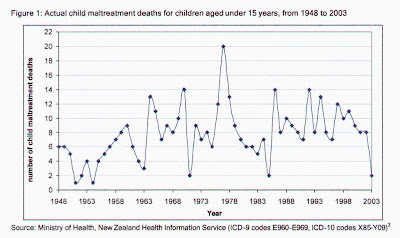
In 2004,05 and 06 the yearly average was 8.6
Then the statist in George goes looking for a quick fix. The Do something, Anything approach.
Unfortunately, to some people, money is everything. Let's strip this thing down.
Children are abused, very occasionally to the point of death, because they are not wanted. They are brought into this world oh so casually by people who do not have the maturity to look after a puppy. Why, when avoiding unwanted pregnancy is easier than it has ever been, does it keep happening? Because 'dropping sprogs' is part of a lifestyle. The same lifestyle that involves the drug and alcohol abuse George refers to.
It's a mean lifestyle that has always existed. But without a doubt, paying people to not only live it, but add children to it, has exacerbated the incidence.
Forget all the crap about slow economy/ fast economy. Like other developed countries, in our 20th century crusade to redistribute wealth - to obliterate need and inequality - we grew this group of disaffected and dysfunctional individuals.
And Garth George is calling for more of the same.
Rodger McDaniel, a lawyer, church pastor and former state legislator who is deputy director of the Wyoming Department of Health, reckons that whenever there is fast growth in an economy it brings with it a variety of social problems, including drug use, alcohol abuse and child abuse.
That makes sense, for all of those have soared with a vengeance since the economic revolution of the mid-1980s.
Rogernomics has been blamed before for New Zealand's seemingly high rate of child abuse. But not because of fast economic growth. Tariana Turia for instance;
“This latest report makes it quite clear - the peak in child deaths was from late 1980s and 1990s - the so-called experimental years in New Zealand’s economy - when unemployment was highest and when benefits were cut” says Mrs Turia.
Poor old rogernomics. Damned if it did; damned if it didn't.
The statistics alone do not support either theory anyway because the death numbers are so low very small differences can substantially change the rate. And any debate about the rate of abuse gets incredibly muddied by changing definitions, changing attitudes and reporting rates, and changing laws and their application.
According to George;
Eight children aged between five weeks and three years died from abuse in the year just ended, which is the average for any year in this country.
Yet deaths from child maltreatment have averaged around 8 a year for a long time.

In 2004,05 and 06 the yearly average was 8.6
Then the statist in George goes looking for a quick fix. The Do something, Anything approach.
And, perhaps, undo the shocking discrimination instituted by the Clark Government that denies the child-related supplement called the in-work tax credit to the poorest children and has left them further behind and well below the poverty line.
Says Susan St John, of the Campaign Against Child Poverty: "It would cost about $450 million a year to extend the in-work tax credit to all low-income children. They would then be treated the same as others regardless of the source of their parents' income - as they do in Australia.
"Money is not everything but it is a very important basic foundation. Society deliberately denies the poorest children adequate financial support and then blames them when their children become social costs."
Certainly money isn't everything, but for God's sake let us start somewhere - and soon.
Unfortunately, to some people, money is everything. Let's strip this thing down.
Children are abused, very occasionally to the point of death, because they are not wanted. They are brought into this world oh so casually by people who do not have the maturity to look after a puppy. Why, when avoiding unwanted pregnancy is easier than it has ever been, does it keep happening? Because 'dropping sprogs' is part of a lifestyle. The same lifestyle that involves the drug and alcohol abuse George refers to.
It's a mean lifestyle that has always existed. But without a doubt, paying people to not only live it, but add children to it, has exacerbated the incidence.
Forget all the crap about slow economy/ fast economy. Like other developed countries, in our 20th century crusade to redistribute wealth - to obliterate need and inequality - we grew this group of disaffected and dysfunctional individuals.
And Garth George is calling for more of the same.
Wednesday, January 06, 2010
Halfdone blog ratings for December 2009
I like Halfdone's blog ratings because so far I have only climbed the table:-)
Half Done rated 683 blogs in December 2009.
What I can't figure out is what the little yellow icon denotes.

Half Done rated 683 blogs in December 2009.
What I can't figure out is what the little yellow icon denotes.

Welfare UK-style
The following is from James Bartholemew, author of The Welfare State We Are In. Which NZ government does the opening paragraph remind you of? Hint. National hasn't even talked big - yet.
Housing benefit provides the biggest discouragement to work
In the great roll call of this government’s failures and blunders, its record on housing benefit deserves to have a prominent place. This was the government that was going to “think the unthinkable” on welfare benefits. Instead it “did the predictable”. Instead of embarking on radical reform like the administration of President Clinton in America, it opted to muddle along. It talked big and acted small.
Housing benefit is arguably the worst of all the benefit failures. Why? For two important reasons. One, it costs an amazing amount of money after nearly doubling since Labour came to power to £20 billion. That – for those who can bear the idea – amounts to £692 for every working person in Britain. Most people imagine that Jobseekers’ Allowance is the big, key welfare benefit. Not at all. Housing benefit costs more than three times as much.
The second and even more important reason why this failure matters is that housing benefit is probably the biggest single discouragement to the low-skilled unemployed to getting a job. Get a job and you lose housing benefit at a rapid rate. So housing benefit is one of the most important reason why more one in four people of working age are not working.
The official cost of £20 billion is just the beginning. Nearly all the people who are discouraged from working are also getting other benefits including Jobseekers’ Allowance and – in many cases - Incapacity Benefit or Income Support. But worse even than that is the effect on the morale and culture of those at the lower end of society who get accustomed to welfare dependency. It causes depression and alienation and contributes to uncivil and even criminal behaviour.
There is a simple rule for creating sound welfare benefits. It was described 175 years ago in the report of a Royal Commission into the operation of the poor laws. The commissioners decided that benefits should not be more advantageous than the income that would be obtained by the individual taking on low-paid work. It is as simple as that. Work must always pay. .
On radio phone-ins I have often heard people exclaim: “Do you realise how little you get on Jobseekers’ Allowance? You can’t live on that!” Unfortunately interviewers – being part of the upper middle class - rarely understand that the Jobseekers’ Allowance and other benefits are normally accompanied by other benefits such as a free school meals and, very likely, the big one: housing benefit. Only when they are all added together do they amount to a meaty discouragement to work for the low-paid.
It will come as a surprise to many people to know that not all countries pay housing benefit – or at least not to as many classes of people as Britain does. In Italy, for example, an unmarried teenage mother does not climb up the council housing queue, get income support and housing benefit. She is expected to live with her parents or other relatives or perhaps the father of the child. The result is that there is far less unmarried parenting in Italy than here. They make their decisions and live with them. That means they make better decisions.
If there were prizes for tinkering with the welfare benefit system, this government would certainly win the gold trophy. I used to get press releases from the old Department of Social Security as it was called. If I had had a strange notion of interior decoration, I could have wall-papered my bedroom with them within a few weeks.
To be fair, some reforms have gone in the right direction. James Purnell, when he was in charge, decided that people should only get benefit to pay for a maximum of five bedrooms. Yet you can see from this example just how cautious the reform has been. For people who struggling to afford accommodation with two bedrooms, it will seem outrageous that others can going on having babies and getting more and more bedrooms at the expense of taxpayers. And people sometimes get benefit at a level based on expensive housing. Hence the scandalous case recently of one family getting £2,875 a week.
America was far more radical in its reforms. President Clinton agreed to a limit to the total number of years in a lifetime during which people could claim unemployment benefit. America was determined to do something about the benefits culture. Britain under Labour has merely strutted on the stage – posing, pontificating and making precious little difference.
What could be done? One idea – from the Centre for Social Justice - is to subsume housing benefit with many benefits into just a couple of major benefits. The benefits could be withdrawn at a slower rate than now when someone gets work, thus reducing the discouragement to getting a job. The trouble is that, other things being equal, this would cost a lot more.
The truly radical idea would be do something like that but significantly reduce the amount paid and leave it to the recipient entirely what accommodation is rented – if any. That would provide a powerful incentive to lodge with relatives or to go to a different area with lower rents.
But has Britain got the guts to do this sort of thing? I would like to think so but there is every reason to doubt it. The upper middle class elite does not get the seriousness of the problem. The BBC, the readers of Guardian and the Independent believe that their support for generous benefits makes them into generous, good people. Unfortunately it does not. It results instead in the continuance of a welfare dependant lower class with tremendously damaging social effects both to the poor themselves and everyone else.
(This is the unedited version of an article that appeared in the Daily Express today.)
Housing benefit provides the biggest discouragement to work
In the great roll call of this government’s failures and blunders, its record on housing benefit deserves to have a prominent place. This was the government that was going to “think the unthinkable” on welfare benefits. Instead it “did the predictable”. Instead of embarking on radical reform like the administration of President Clinton in America, it opted to muddle along. It talked big and acted small.
Housing benefit is arguably the worst of all the benefit failures. Why? For two important reasons. One, it costs an amazing amount of money after nearly doubling since Labour came to power to £20 billion. That – for those who can bear the idea – amounts to £692 for every working person in Britain. Most people imagine that Jobseekers’ Allowance is the big, key welfare benefit. Not at all. Housing benefit costs more than three times as much.
The second and even more important reason why this failure matters is that housing benefit is probably the biggest single discouragement to the low-skilled unemployed to getting a job. Get a job and you lose housing benefit at a rapid rate. So housing benefit is one of the most important reason why more one in four people of working age are not working.
The official cost of £20 billion is just the beginning. Nearly all the people who are discouraged from working are also getting other benefits including Jobseekers’ Allowance and – in many cases - Incapacity Benefit or Income Support. But worse even than that is the effect on the morale and culture of those at the lower end of society who get accustomed to welfare dependency. It causes depression and alienation and contributes to uncivil and even criminal behaviour.
There is a simple rule for creating sound welfare benefits. It was described 175 years ago in the report of a Royal Commission into the operation of the poor laws. The commissioners decided that benefits should not be more advantageous than the income that would be obtained by the individual taking on low-paid work. It is as simple as that. Work must always pay. .
On radio phone-ins I have often heard people exclaim: “Do you realise how little you get on Jobseekers’ Allowance? You can’t live on that!” Unfortunately interviewers – being part of the upper middle class - rarely understand that the Jobseekers’ Allowance and other benefits are normally accompanied by other benefits such as a free school meals and, very likely, the big one: housing benefit. Only when they are all added together do they amount to a meaty discouragement to work for the low-paid.
It will come as a surprise to many people to know that not all countries pay housing benefit – or at least not to as many classes of people as Britain does. In Italy, for example, an unmarried teenage mother does not climb up the council housing queue, get income support and housing benefit. She is expected to live with her parents or other relatives or perhaps the father of the child. The result is that there is far less unmarried parenting in Italy than here. They make their decisions and live with them. That means they make better decisions.
If there were prizes for tinkering with the welfare benefit system, this government would certainly win the gold trophy. I used to get press releases from the old Department of Social Security as it was called. If I had had a strange notion of interior decoration, I could have wall-papered my bedroom with them within a few weeks.
To be fair, some reforms have gone in the right direction. James Purnell, when he was in charge, decided that people should only get benefit to pay for a maximum of five bedrooms. Yet you can see from this example just how cautious the reform has been. For people who struggling to afford accommodation with two bedrooms, it will seem outrageous that others can going on having babies and getting more and more bedrooms at the expense of taxpayers. And people sometimes get benefit at a level based on expensive housing. Hence the scandalous case recently of one family getting £2,875 a week.
America was far more radical in its reforms. President Clinton agreed to a limit to the total number of years in a lifetime during which people could claim unemployment benefit. America was determined to do something about the benefits culture. Britain under Labour has merely strutted on the stage – posing, pontificating and making precious little difference.
What could be done? One idea – from the Centre for Social Justice - is to subsume housing benefit with many benefits into just a couple of major benefits. The benefits could be withdrawn at a slower rate than now when someone gets work, thus reducing the discouragement to getting a job. The trouble is that, other things being equal, this would cost a lot more.
The truly radical idea would be do something like that but significantly reduce the amount paid and leave it to the recipient entirely what accommodation is rented – if any. That would provide a powerful incentive to lodge with relatives or to go to a different area with lower rents.
But has Britain got the guts to do this sort of thing? I would like to think so but there is every reason to doubt it. The upper middle class elite does not get the seriousness of the problem. The BBC, the readers of Guardian and the Independent believe that their support for generous benefits makes them into generous, good people. Unfortunately it does not. It results instead in the continuance of a welfare dependant lower class with tremendously damaging social effects both to the poor themselves and everyone else.
(This is the unedited version of an article that appeared in the Daily Express today.)
Tuesday, January 05, 2010
Maori women and smoking
If one in three Maori women is on a benefit, one in two Maori women smoke, and smoking rates are highest among low income groups, the chances are the taxpayer is paying for their cigarettes or rollies. The taxpayer is also paying for their cessation attempts, on average numbering 14 before successful.
So we pay for Maori women to smoke, and we pay for them not to. There seems a more obvious solution, although there is little political will to explore it.
Quitting smoking is tough. It is doubly tough if you are depressed, bored, idle, with nothing to look forward to and nothing else in your life that gives you pleasure - albeit fleeting pleasure. And when in such a rut the prospect of foreshortening life doesn't hold much sway either.
Kiwiblog recently ran a story about a no-smoking prison that was deterring people from committing crime. They would rather give up crime than quit smoking. Given a choice I am sure some people would rather get a job than quit smoking. Such is their desire to smoke.
While people have multiple problems in their lives, quitting smoking will never be a priority. There are more fundamental issues that need sorting first.
So we pay for Maori women to smoke, and we pay for them not to. There seems a more obvious solution, although there is little political will to explore it.
Quitting smoking is tough. It is doubly tough if you are depressed, bored, idle, with nothing to look forward to and nothing else in your life that gives you pleasure - albeit fleeting pleasure. And when in such a rut the prospect of foreshortening life doesn't hold much sway either.
Kiwiblog recently ran a story about a no-smoking prison that was deterring people from committing crime. They would rather give up crime than quit smoking. Given a choice I am sure some people would rather get a job than quit smoking. Such is their desire to smoke.
While people have multiple problems in their lives, quitting smoking will never be a priority. There are more fundamental issues that need sorting first.
Monday, January 04, 2010
Hectoring ad nauseum
The Australian holiday road toll is 68. The legal minimum driving age is 17. The Australians are blaming the state of their roads and irresponsible driving.
In NZ the holiday road toll is currently 11, which is, on a per capita basis, lower than Australia's. New Zealanders are blaming the minimum driving age of 15.
NZ and Australia are obsessed with holiday road tolls. Perhaps because it fills a gap in news stories. Perhaps because various interest groups want to use the toll as a lever. But do many more people lose their lives over this particular period?
According to the MOT;
The Christmas/New Year holiday road toll period begins at 4pm on Thursday 24 December and ends at 6am on Tuesday 5 January.
The holiday period will be 11.6 days. Last year the 2008/09 holiday period was exactly the same - from Dec 24 to Jan 5 (11.6 days).
11 deaths in 11.6 days is, so far, under the average for that time period.
In 2005 New Zealand's road toll was only very slightly above the OECD average. Per 100,000 population, NZ's average was 9.9; OECD 9.5. The NZ figure has improved since. There are a myriad of factors affecting the rate but, in the scheme of things our rate isn't really, really bad - and neither is it really, really good. Accidents, tragic accidents, happen. But, the trend is heading in the right direction - down.
I guess I am just tired of being hectored about the road toll, along with smoking, eating junk food, drinking alcohol, water safety, sun safety, ad nauseum. No wonder so many New Zealanders are neurotic nutbars. Best just stay indoors and diet. In an unhappy coincidence, Wellington, the home of hectoring, taxpayer-funded harpies, has served up the weather to make you want to do just that.
In NZ the holiday road toll is currently 11, which is, on a per capita basis, lower than Australia's. New Zealanders are blaming the minimum driving age of 15.
NZ and Australia are obsessed with holiday road tolls. Perhaps because it fills a gap in news stories. Perhaps because various interest groups want to use the toll as a lever. But do many more people lose their lives over this particular period?
According to the MOT;
The Christmas/New Year holiday road toll period begins at 4pm on Thursday 24 December and ends at 6am on Tuesday 5 January.
The holiday period will be 11.6 days. Last year the 2008/09 holiday period was exactly the same - from Dec 24 to Jan 5 (11.6 days).
11 deaths in 11.6 days is, so far, under the average for that time period.
In 2005 New Zealand's road toll was only very slightly above the OECD average. Per 100,000 population, NZ's average was 9.9; OECD 9.5. The NZ figure has improved since. There are a myriad of factors affecting the rate but, in the scheme of things our rate isn't really, really bad - and neither is it really, really good. Accidents, tragic accidents, happen. But, the trend is heading in the right direction - down.
I guess I am just tired of being hectored about the road toll, along with smoking, eating junk food, drinking alcohol, water safety, sun safety, ad nauseum. No wonder so many New Zealanders are neurotic nutbars. Best just stay indoors and diet. In an unhappy coincidence, Wellington, the home of hectoring, taxpayer-funded harpies, has served up the weather to make you want to do just that.
Sunday, January 03, 2010
What happened to Maharey's grand plan?
 In 2003, then Minister for Social Development Steve Maharey outlined his vision for people on the DPB. Labour was scrapping work-testing (which National says it will soon re-introduce) in favour of 'enhanced case management'. According to the Minister;
Work and Income will be doing more to help sole parents into work with changes to legislation that comes into effect this month, says Social Services and Employment Minister Steve Maharey.
The Social Security (Personal Development and Employment) Amendment Act, which comes into effect on 10 March 2003, delivers on government promises to develop a social security system that responds better to the needs of individuals and their families.
“The legislation abolishes the arbitrary work test on sole parents receiving the Domestic Purposes or Widows Benefits. Currently 19% or 21,924 are subjected to a work test requirement to seek part or full-time work because of the age of their youngest child.
“As a result of the change all people receiving the DPB, Widows or Emergency Maintenance Allowance will receive enhanced case management to help them in training and work planning for their future.
“All 118,098 in the three benefit groups will be required to work with their case manager to develop and implement a Personal Development and Employment Plan. The plan will outline personal development, training and employment goals and the action points required to reach those goals.
I asked MSD how many beneficiaries had a PDEP. By June 2009 the grand total was 35,161. Of those 24,096 were on the DPB. Only 23 percent of all DPB recipients. If you are thinking that the policy had been abandoned because of a change in government, hence the low number, you are wrong. 66 percent had been implemented between June 2007 and June 2008 and the remainder over the next 12 months.
The interesting thing is that only 17 people on the DPB who had a PDEP had had it put in place 3 or more years ago. Which may indicate that 1/ The plans do motivate people to move off a benefit or 2/ The ministry's record keeping is suspect.
If it is the first, no surprise. Around a third of people on the DPB are motivated to get off it. They would probably do so with or without the plan. It is easy for case managers to work with this group.
But what about the rest???
At the time of Maharey's press release there were 108,000 on the DPB.
Now there are .... 108,000 on the DPB.
Saturday, January 02, 2010

Friday, January 01, 2010
Does NZ's future success rest on skin colour?
Rawiri Taonui, head of Maori and Indigenous studies at Canterbury University, has written a piece in today's NZ Herald about the flying of two flags, entitled Time for New Zealand to show all its colour.
The flying of a Maori flag does not worry me IF it is a unifying move. Only time will tell.
What interested me here is the statement that by 2030 50 percent of New Zealanders will be brown. According to Statistics NZ data, by 2026 the population will be 5,517,600. European or other will make up 62.2 percent, Maori 14.8, Asian 14.3 and Pacific 8.7. Apart from the Asian number, not much change from today.
But what bothers me is the talk about skin colour in the first place. The title of the piece is not only a reference to flag colour but pigment. What is Rawiri Taonui getting at here? That a group exists that doesn't like Maori because they are brown, but that group, or "that lot", couldn't include people who are also brown? That Maori, Asian and Pacific people will live in a state of harmony and mutual respect because they are all brown?
He is saying that people who respect Maori and like other cultures will see flying both flags as unifying. Maybe. I would probably fit this group (with lots of provisos). And yet....
Why bring colour into it? Does he think that the more brown the country gets the more unity there will be? What, then, about the non-brown people progressively becoming a minority? Or should we hit the magic 50 percent and stop right there?
Then we can all live happily ever after?
Whether Pakeha see two flags as divisive or unifying is directly proportionate to the extent of hangups about race. Those who have difficulty relating to Maori, especially if they are dark skinned, physically large and/or overtly ethnic and tribal, and have not spent much time on a marae, will see the flag as separatist simply out of fear of difference and diversity. Fortunately, this lot are in rapid decline. New Zealand will be 50 per cent brown by 2030. Those who are at ease with themselves, respect Maori and like other cultures will see the flags as representative of an over-arching unity, of every colour, hue and creed. They are the New Zealanders of the future.
The flying of a Maori flag does not worry me IF it is a unifying move. Only time will tell.
What interested me here is the statement that by 2030 50 percent of New Zealanders will be brown. According to Statistics NZ data, by 2026 the population will be 5,517,600. European or other will make up 62.2 percent, Maori 14.8, Asian 14.3 and Pacific 8.7. Apart from the Asian number, not much change from today.
But what bothers me is the talk about skin colour in the first place. The title of the piece is not only a reference to flag colour but pigment. What is Rawiri Taonui getting at here? That a group exists that doesn't like Maori because they are brown, but that group, or "that lot", couldn't include people who are also brown? That Maori, Asian and Pacific people will live in a state of harmony and mutual respect because they are all brown?
He is saying that people who respect Maori and like other cultures will see flying both flags as unifying. Maybe. I would probably fit this group (with lots of provisos). And yet....
Why bring colour into it? Does he think that the more brown the country gets the more unity there will be? What, then, about the non-brown people progressively becoming a minority? Or should we hit the magic 50 percent and stop right there?
Then we can all live happily ever after?
Thursday, December 31, 2009
Research into casual sex surprises
The Dominion Post reproduced this column today. Essentially new research, with a reasonably large sample, found that young people having casual sex are not suffering ill effects from it. The researchers were apparently taken aback.
I'm not. Morality, values, ethics, whatever label you want to put on it, is changing constantly. Any stigma attached to casual sex is diminishing (interestingly the researchers found a mismatch between the number of males versus females admitting to causal sex and theorised that men are more likely to label their encounter as casual whereas females label it as something more).
But I think there is another reason for the result. There are most certainly people for whom casual sex will cause emotional problems - guilt, self-recrimination, etc - so those people are avoiding it. Those for whom that would be a waste of mental energy just get on and enjoy it on their own terms. Most people, despite contemporary paternalistic wisdom telling us otherwise, are capable of making sensible choices. It would just be better if 'most' was a bigger percentage.
I'm not. Morality, values, ethics, whatever label you want to put on it, is changing constantly. Any stigma attached to casual sex is diminishing (interestingly the researchers found a mismatch between the number of males versus females admitting to causal sex and theorised that men are more likely to label their encounter as casual whereas females label it as something more).
But I think there is another reason for the result. There are most certainly people for whom casual sex will cause emotional problems - guilt, self-recrimination, etc - so those people are avoiding it. Those for whom that would be a waste of mental energy just get on and enjoy it on their own terms. Most people, despite contemporary paternalistic wisdom telling us otherwise, are capable of making sensible choices. It would just be better if 'most' was a bigger percentage.
Creative accounting Douglas-style
54 percent of your and every one else’s personal tax goes towards healthcare. The growth is scary, when just two years ago the figure was 41 percent of your personal tax. Saying 54 percent can hide what this means. If you earn minimum wage, you will pay about $2500 every year for healthcare. If you earn the average wage, you will pay over $6000 for healthcare.
That's Roger Douglas on Health. It's from an e-mailed pamphlet that landed in my in-box a few days ago. It also features here.
My immediate reaction is BS. Roger is up to more creative accounting. And I didn't think much more about it.
I was reminded of it again this morning however when reading a well-written op-ed from Des Gorman, head of Auckland University's School of Medicine, and the chairman of Health Workforce New Zealand.
Health accounts for 20 per cent of Government expenditure and half of the new money in the 2009 Budget was allocated to health.
Correct. In which case 20 percent of the tax you pay goes towards healthcare. Unless the government apportions more income tax to health than it apportions to any other area of expenditure. Which it does not.
Whatever tax is paid - income, GST, corporate, excise - goes into the consolidated account and is then allocated accordingly. If we applied Roger's formula across the board government would be spending 170 percent more than it collects. For instance I could calculate that welfare spending is costing you $9,000 a year ($20 billion divided by 2.2 million individuals) or 81 percent of your "personal tax" if you earn the "average wage". See how quickly this is coming unstuck? 100 percent has already been exceeded.
As I have said before I am not totally averse to Roger's ideas - I support individual responsibility but do not like compulsion. However, creative accounting turns me off totally. Why would I trust the rest of the message when I can't trust the numbers?
Wednesday, December 30, 2009
Lifestyle welfare
Here is the Boxing Day Dominion Post editorial. I was pleased to see the writer using the term 'lifestyle' not only because it is factual, but because it labels the group needing attention as distinct from all beneficiaries.
My response was published this morning (apologies for the unintentional sizing inconsistency).


My response was published this morning (apologies for the unintentional sizing inconsistency).


Tuesday, December 29, 2009
Another false allegation?
Remember the troublesome two who claimed they had been attacked in New Plymouth earlier this year?
Can't help wondering if this isn't a similar situation. What would two youths want with a Hannah Montana teeshirt?
The disconcerting thing is, I don't know whether to hope I am right or wrong. And I feel uncomfortable about my skepticism, but that's what happens when crying wolf isn't an unusual occurence.
Can't help wondering if this isn't a similar situation. What would two youths want with a Hannah Montana teeshirt?
The disconcerting thing is, I don't know whether to hope I am right or wrong. And I feel uncomfortable about my skepticism, but that's what happens when crying wolf isn't an unusual occurence.
Monday, December 28, 2009
Douglas and ACT
This post wouldn't have happened without prompting. As it stands ACT doesn't interest me but a comment today made me mentally reflect on why.
Chuck Bird has twice made reference to ACT's constitution on this blog. As I am no longer a member I am not sure why. The constitutional excerpt;
“...maintain social and economic support for those unable to help themselves and who are in genuine need of assistance”
defines out what Chuck thinks welfare should be, which includes retaining a welfare state. He was therefore unhappy with a repetitive commentor who harps on monotonously about how we should ZERO ALL BENEFITS.
Chuck thinks he will put off ACT voters. I am flattered Chuck thinks that many people read my blog.
However, getting rid of all benefits is closer to what Douglas proposes than what is in the ACT constitution. Douglas has always wanted all New Zealanders to fund their own social security needs through individualised accounts.
From the NZ Herald;
Now, I am not averse to Douglas' thinking BUT its not going to happen any time soon. He hasn't managed to build any movement for it here or in the UK in 20 years.
Which is why I have always channelled my efforts into realistic (most would call it radical) reform of the current system. There was a period when state social security did what it was supposed to do. Can we ever return to that? Quite possibly not. But the prospect is more palatable to voters than what Douglas wants.
My approach is also what Muriel Newman pushed for a long time. When Muriel was welfare spokesperson EVERYONE knew what ACT policy was. Since Roger assumed that portfolio nobody knows what ACT policy is because he promotes ideas with the rider that "the views expressed are Sir Roger's and do not necessarily reflect the views of Act, but it features prominently on the party's website."
The situation is just mickey mouse. And it was mickey mouse going into the election. If ACT had had concrete policy based on the US reforms it could have negotiated welfare reform as part of its agreement with National. Instead it chose a platform of getting tough on crime. Well, I hate to say this, but crime is only going to increase until welfare is reformed, because welfare is breeding tomorrow's criminals as I write.
Chuck Bird has twice made reference to ACT's constitution on this blog. As I am no longer a member I am not sure why. The constitutional excerpt;
“...maintain social and economic support for those unable to help themselves and who are in genuine need of assistance”
defines out what Chuck thinks welfare should be, which includes retaining a welfare state. He was therefore unhappy with a repetitive commentor who harps on monotonously about how we should ZERO ALL BENEFITS.
Chuck thinks he will put off ACT voters. I am flattered Chuck thinks that many people read my blog.
However, getting rid of all benefits is closer to what Douglas proposes than what is in the ACT constitution. Douglas has always wanted all New Zealanders to fund their own social security needs through individualised accounts.
From the NZ Herald;
"Sir Roger's Budget would cut Government expenditure by more than a quarter within one year.
People would be expected to pay for their children's primary and secondary education directly; tax credits would be available for those whose tax cuts were insufficient to cover those costs directly.
They would also be expected to take out catastrophic health insurance and meet more minor health costs like GP visits, out of pocket. Accident, sickness and unemployment insurance would also be a matter of individual responsibility."
Now, I am not averse to Douglas' thinking BUT its not going to happen any time soon. He hasn't managed to build any movement for it here or in the UK in 20 years.
Which is why I have always channelled my efforts into realistic (most would call it radical) reform of the current system. There was a period when state social security did what it was supposed to do. Can we ever return to that? Quite possibly not. But the prospect is more palatable to voters than what Douglas wants.
My approach is also what Muriel Newman pushed for a long time. When Muriel was welfare spokesperson EVERYONE knew what ACT policy was. Since Roger assumed that portfolio nobody knows what ACT policy is because he promotes ideas with the rider that "the views expressed are Sir Roger's and do not necessarily reflect the views of Act, but it features prominently on the party's website."
The situation is just mickey mouse. And it was mickey mouse going into the election. If ACT had had concrete policy based on the US reforms it could have negotiated welfare reform as part of its agreement with National. Instead it chose a platform of getting tough on crime. Well, I hate to say this, but crime is only going to increase until welfare is reformed, because welfare is breeding tomorrow's criminals as I write.
National's fault that more people are needing foodbank parcels
That's what Ron Maynard of the Southland Food Bank Charitable Trust says;
Has National cut welfare benefits? Is National responsible for NZ experiencing a recession? Did National stop adjusting benefits for cost of living increases? Isn't it true that there are fewer people on benefits in Southland than there were 5 years ago, when Labour was mid-term?
Doesn't it just make you want to groan when people dealing with 'need' say such banal things? Instead of some serious analysis we get a political knee-jerk response.
Of course it is not the wont of food bank coordinators to question applicants. But perhaps they should be looking at the underlying reasons why the majority of low income people do not need their services, and a handful do.
Southland Food Bank Charitable Trust co-ordinator Ron Maynard said he had also noted an increase in the number of families needing handouts, which he attributed to a rise in the cost of living and the National Party coming into power.
"I think it is the times we are living in – since National (Party) come in it has got worse. That is one reason if you want to get political about it," Mr Maynard said.
Has National cut welfare benefits? Is National responsible for NZ experiencing a recession? Did National stop adjusting benefits for cost of living increases? Isn't it true that there are fewer people on benefits in Southland than there were 5 years ago, when Labour was mid-term?
Doesn't it just make you want to groan when people dealing with 'need' say such banal things? Instead of some serious analysis we get a political knee-jerk response.
Of course it is not the wont of food bank coordinators to question applicants. But perhaps they should be looking at the underlying reasons why the majority of low income people do not need their services, and a handful do.
Subscribe to:
Posts (Atom)


