Wednesday, April 05, 2023

Deadly excuses

Today Health NZ, Te Whatu Ora, released its latest report on childhood immunisation which includes longstanding vaccinations against the likes of diphtheria, polio, tetanus, whooping cough, chickenpox, measles, mumps and rubella.

Compared to other ethnicities, Maori children have had consistently lower immunisation rates which the report says, "...leave tamariki Māori disproportionately vulnerable and exposes Aotearoa to significant risk of vaccination-preventable disease outbreak through inadequate herd immunity."

A concerted effort was embarked upon in 2009 to lift immunisation rates. It formed one of National's Better Public Service targets (later dropped by the incoming Labour government). The result was positive:

Maori and Pacific rates climbed markedly as did, unsurprisingly, the rate in the poorest deciles (Dep 9-10)

The next graph, from today's report, shows immunisation by age 2, a slightly different but relevant parameter:

Apart from Asian children the gains made have been lost. Some of this is due to the vaccinator workforce being diverted into covid work. However the decline  - particularly for Maori - began around 2017.

The current rates are now described as a "crisis". What has happened?

The "barriers" to vaccination are claimed to be poverty, racism, lack of trust and safety concerns.

Despite the vaccines being free, poverty affects rates in every group except Asians, who even in the highest deprivation deciles mostly manage to get their child immunised:

According to the report: "Despite childhood immunisations being free, costs are associated with getting to vaccinations, such as transport, time off employment and family members owing
money to practices. Clinic times often clash with work, school pickups, availability of child-minding for children not requiring vaccination at the same time, or other whānau responsibilities."

Yet there is a group who show none of this matters. Perhaps instead of excuse-making, policy-makers could focus on the Asian communities and why poverty doesn't affect their vaccination decisions and actions.

The next 'barrier' is racism characterized by "mono-cultural institutions which simply ignore and freeze out the cultures of those who do not belong to the majority" . Asians aren't frozen out though.

In another twist of logic, because Pacific vaccination rates are better than Maori, yet Pacific families live with "worse deprivation", this "persistent gap can only be explained by systemic racism."

So the racism is only directed towards Maori.

What are we to believe then. That racism against Maori declined up until the period 2014-17 when 2 year immunisation coverage for Maori children was 92-93 percent but it has reappeared since?

Racism is a red herring.

As such it will be far more than a mere irritant if - or when - a childhood epidemic breaks out and Maori children die.

To avoid that tragic eventuality health promoters should quit with bogus excuses and take a hard look at why one group of parents, in spite of all of the so-called "barriers" overwhelmingly safeguard their young against diseases that may be deadly.


Wednesday, March 29, 2023

Responding to Marama Davidson's dogma

Green's co-leader Marama Davidson just keeps digging the hole she is in deeper. First she showed her bitter antipathy towards white CIS (same gender as birth) men. Then she walked it back to all men. 

Last night on TV1 News she said, “…overwhelmingly it is men who are the biggest threat to women and children when it comes to violence and I needed to make that clarification.”


Marama is the Minister for the Prevention of Family and Sexual Violence and says she wants us to have these “hard and uncomfortable conversations” (which is reminiscent of what Metiria Turei fatefully wanted when she publicly confessed to ripping off the benefit system.)

But back to Marama. Forget for a moment the offence intended and taken, is her revised statement true?

If Police, Corrections or Oranga Tamariki stats are put up as evidence, the court would find in her favour. More men are in prison for family violence convictions than women; police arrest more men than women for family violence and more men commit physical abuse against children than women (though not “overwhelmingly”. If other forms of abuse are considered women outdo men. Take for instance a quote from MSD gang research which revealed, “The alleged perpetrator of abuse or neglect of gang member’s children was more often recorded as the child’s mother than the gang member father.”)

Sticking to the term ‘violence’ though, a vital point must be made. The NZ Police state:

"Most reported family violence is committed by men against women and children, although women, like men, can assault children. A growing number of men say that female violence against them is not treated as seriously as male assaults on women. International research indicates only about 20% of family violence incidents are actually reported. So a lot is happening in our community that the Police don’t know about."

The majority of family violence goes unreported.  So what do we know about unreported violence? One source is longitudinal studies. In New Zealand the best known of these is the Dunedin Multidisciplinary Study which has followed a large cohort of children born in the early seventies and continues to publish data.

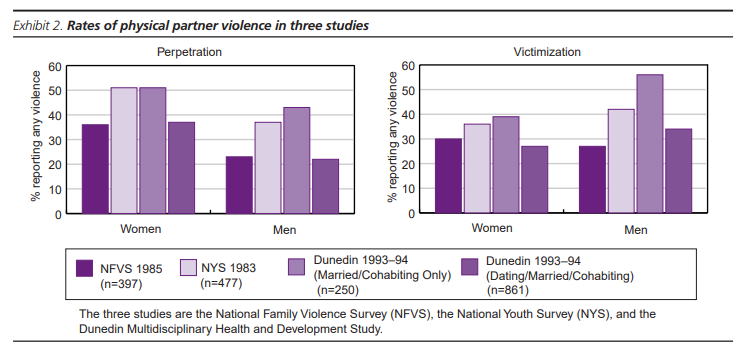
It looked specifically at physical partner violence when the cohort reached their early twenties. The United States justice department published the findings and compared them to their own:


Women were the greater perpetrators of physical partner violence which included choking, hitting, shoving, throwing objects, threatening with a knife, kicking, biting, shaking, etc. 

Are the results reliable? According to the brief, “Couples’ responses to the interview showed that agreement about whether specific abusive behaviors had happened was poor, as has been suggested by previous research. Study members and their partners did not agree about whether, for example, one of them had tried to strangle the other. However, agreement improved dramatically when the individual items were summed into scales that counted the variety of different abuse behaviors performed in the past year. Although members of a couple may not recall exactly the same acts, they can agree on whether or not abuse took place and on the extent of the abuse. Agreement was even stronger when random measurement errors were removed statistically.”

This is thirty years ago though. To check for any substantial change a 2016/17 version of the US National Family Violence survey is available. Again, the symmetry between the genders is strong.

For women, 42% reported experiencing any ‘physical violence’ by an intimate partner in their lifetime. For men the rate was 42.3 percent. (Women were more likely to experience sexual coercion or stalking than men.)

As well as evidence from the Dunedin project, Professor David Fergusson directed the Christchurch Health and Development Study which tracked 1,265 children born in 1977 and in 2005 found that men and women reported similar experiences of victimisation and perpetration of domestic violence. According to the Otago Daily Times

University of Otago Professor David Fergusson, an expert on domestic violence, said the public perception that men were the perpetrators of most domestic violence was the result of biased publicity.

"The proper message is that both gender groups have a capacity for domestic violence [and] women probably perpetrate more assaults on children then men do," Mr Fergusson said.

Unfortunately, Prof Fergusson is no longer with us, but I can attest to his frustration at being routinely ignored by politicians and feel duty bound to recall his work in this area.

The more recent longitudinal study, Growing Up in New Zealand may in time provide a source for actual experience of partner violence but at this stage the participants are only just entering adolescence.

Then again, with ministers like Marama Davidson it’s unlikely to be used to further our understanding of the real world. The last four days have shown that her negative view of men is fixed and she won’t be searching for any evidence to the contrary.

Excitable dogma may be an asset in an activist but not in a minister. She should go.