Friday, May 19, 2023

Scrapping $5 fee makes no sense

Yesterday, as part of the Wellbeing Budget 2023, the government announced the scrapping of the $5 prescription charge. This will cost $170 million annually covering around 29 million scripts.

They have done this because an estimated 3 percent of adults apparently do not collect their medicine because they can't afford the $5 fee (which is capped at $100 over a year).

But the vast majority of patients DO collect and pay for their medicines.

Yet again Labour has introduced a universal policy to solve a non-universal problem. Prior examples of this folly include the Winter Energy Payment for all superannuitants and the Best Start payment for all parents of babies aged under 12 months. Throwing money at people who do not need it is hardly testament to good governance.

But it gets worse. In this instance the government has also thrown money at businesses that don't need it.

Around 10-15 percent of the prescription market belongs to relatively new entrants into retail pharmacy. The best known is probably the Chemist Warehouse.

To gain a commercial advantage and market share the Chemist Warehouse did not charge the $5 prescription fee. They paid it themselves. By scrapping the fee Grant Robertson has effectively handed the non-chargers a $17 million subsidy (at minimum).  Far from leveling the playing field for all pharmacies, the 'big boys' now have even more disposable dollars to promote their chain and on-line services which have, by the way, been very successful due to superior product pricing and choice.

But back to the problem of people not accessing medicine due to prescription costs, the problem the Finance Minister is claiming to solve.

According to Work and Income, "If you or a family member can't cover your prescription costs, we may be able to help with a Special Needs Grant." A Special Needs Grant is not repayable.

Another option was for the patient to use one of the non-charging pharmacies if an outlet was convenient.

This move also comes against a backdrop of minimum and living wage hikes, and benefit increases. Yes, there is a cost-of-living crisis but set at $5 the fee was also inflation-proofed.

All things considered it is difficult to understand why the Labour government has chosen now to scrap the fee for low-income individuals - let alone the wealthy.

Then again, it is election year. And simplicity makes for easy soundbites and headlines. Stupidity takes a little longer to uncover and understand.

Friday, May 05, 2023

Celebrating single parents

Earlier this week Ngāti Kahungunu and Project Gender released the Mako Mama Mangopare Single Parents Project.  The research is based on seven focus groups and an on-line survey of 3,545 single parents which asks about their circumstances regarding income, work, health, experience of discrimination and domestic violence. Not unexpectedly the responses paint a picture of struggle and perceived discrimination. 

The MMM Project’s subsequent reaction to the research is twofold: 

1/ To embark on a nationwide campaign to “celebrate” single parents. 

2/ Create an “on-line Navigators portal” for single parents. 

The authors appear to be lining up future employment for themselves, anticipating further funding from the Peter McKenzie Project (commissioners of the report) and the government.

They have also noticed another gap in the market and propose, “Creating single parents’ networks that operate similar to LGBTQI+ networks, within business.” Perhaps the creation of a ‘Single Parent Tick’ akin to the pervasive Rainbow Tick?

Of course, there is no guarantee such a ‘tick’ would attract single parents off benefits. As one survey respondent remarked: “I can’t afford to work – If I work 40 hrs a week, after paying childcare I only earn $100 more than on a benefit, that’s $2.50 per hour.”

It’s worth exploring that comment. If their household budget required $100 more, surely the beneficiary couldn’t afford not to work? What the respondent seems to be saying is the marginal difference is so small they can’t afford to put in 40 hours effort at just $2.50 per hour. Someone else can put in the effort and pay the tax required to furnish their income.

Another respondent says, “We don’t just want a job, we want a career and opportunities to study/work that fit our lives as sole carers for our tamariki."

So, people doing the ‘jobs’ should provide you with ‘careers and study opportunities’?  You do know where the money for your benefit comes from, right?

Maybe not. Another said, “MSD treat me like I’m a desperate Māori trying to milk them – You would think you were asking for money from their personal bank account.”

Well, hello. Your case manager toils to pay taxes. It feels exactly like their personal bank account.

There’s a lot of people out there kidding themselves, and it’s not just beneficiaries.

Despite the continuing elevated poverty and poorer health experienced by lone parents and their children, we are exhorted to “celebrate” this family form by embarking on a “nationwide media, marketing and communications campaign … to change behaviours; mobilise communities; and address social attitudes that stigmatise single parents.”

Single parenthood is stigmatised by society because of the hardship, loneliness and vulnerability it entails for mother and child. The moral disapproval exists because many (though certainly not all) single parents expect to live at the expense of others. This societal displeasure is only exacerbated by the increasing ease with which to avoid pregnancy or find work to support a family.

Here’s the reality. This latest advocacy project is yet another bad idea from the poverty activism industry which creates lucrative employment/funding opportunities for those with an eye for riding the gravy train. It’s cynical and relies on perpetuating victimhood. We are trapped in a culture of faux kindness and silly celebration. It is sacrilege to suggest to anyone they made a mistake, or a poor choice. They don’t have to own it because we all ‘own it’ – we are all made responsible for the consequences of decisions of others we have no control over. This is the inevitable upshot of compulsory collectivism.

There is another option, but I'd be laughed out of the room for suggesting it. Avoidance and prevention just might be a better approach. 

Which makes more sense?


Numbers (not provided in the report)

Census 2018:  131,787 sole parent families with dependent children

MSD 2021: 99,000 sole parent families on a main benefit

Saturday, April 29, 2023

Are children safer or not?


The Salvation Army’s latest State of the Nation 2023 report draws on data from Oranga Tamariki (formerly CYF) and tells us, “The number of children under 2 years of age entering care is down from 440 in 2018 to 133 in 2022...”

Finally, some good news from a public service agency.

Friday, April 21, 2023

3,000 more children on benefits in just one year

The March benefit data was released yesterday. I track children on benefits. The trend is bad.

In the last year the number of children reliant on a benefit (their caregiver's) has risen by over 3,000.

In the last 6 years the increase is just a smidgen under 40,000.

This is a 24 percent increase against a population aged 0-17 years-old which grew by just 1.7 percent. 

The upward trend was accelerated by covid but began prior and has not reversed since.

I believe the increase is primarily the result of all the extra cash assistance that has gone into families with children who depend on a benefit. 

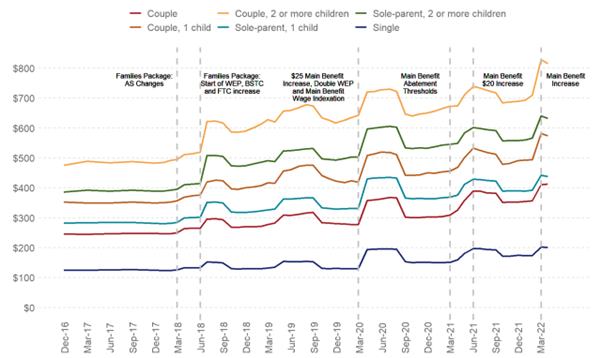
For instance, since early 2018 a sole parent with two or more children has experienced a 58 percent increase in after-housing-costs-income. 

Trends in average total income by family type (after housing costs) over time


Source: Total incomes of MSD main benefit clients as at April 2022

In addition to monetary policies a number of other changes sent new messages to parents or potential parents. Abolishing the requirement to name the father of a child(ren) included in a sole parent benefit; the removal of work obligations intended to discourage the addition of a child to an existing benefit; the non-enforcement of sanctions for beneficiaries with child-caring responsibilities; and the pass-on of child support to beneficiary parents (instead of state retention to offset the sole parent support bill) all convey a lessened emphasis on individual responsibility. 

Staying on benefits for longer

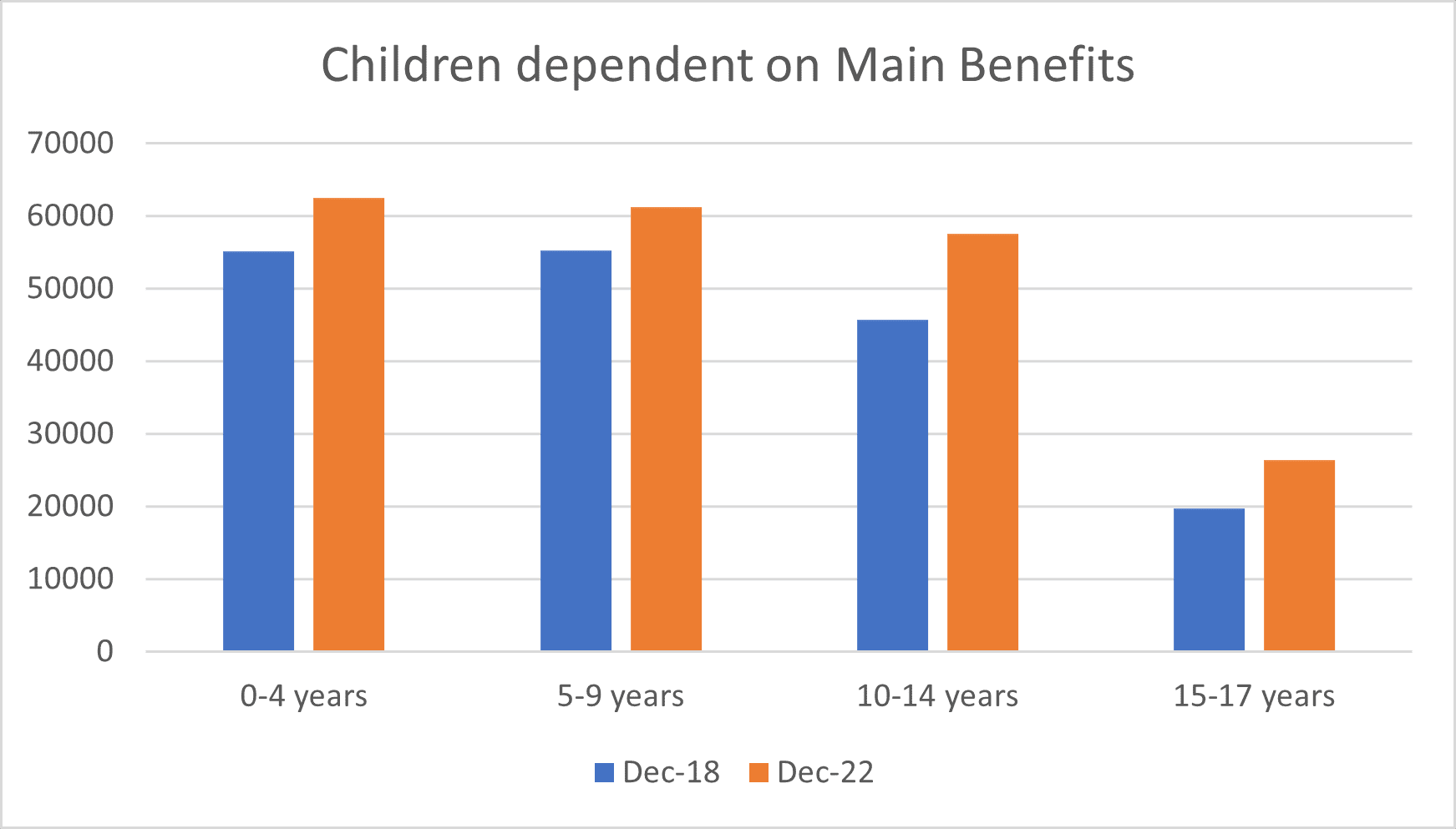
Despite a very favourable employment environment, beneficiaries are staying dependent for longer as evidenced by the ageing of their children. Usually single parents move into work as their children get older but there are significant increases in the number of older children dependent:


Source: OIA January 2023

This development is reinforced by MSD's own 'expected future years on a benefit' calculations which show:


More children being born onto a benefit

At December 2018 10,863 children aged 0 years (meaning they must have been born in the same year) were dependent on a benefit. This increased to 11,361 children at December 2022. At some point during their first year of life they were included in their caregiver’s benefit which may have been new or existing. (Cabinet papers released by a National government showed in 2010 4,800 babies were added to an existing single parent benefit but there has been no update on this statistic.)

These numbers represent 18.7 percent of all children born in 2018, rising to 19.3 percent of all children born in 2022. Almost one in five.

Children born onto a benefit stay longest. According to MSD research:

“…the age of the child at first entry into the benefit system, is an important factor associated with having long-term contact with the benefit system.”  

The longer children stay on benefits the worse their outcomes are.

For instance, the incidence of maltreatment finding was 11.3 percent in a 2010 birth cohort who had spent more than 80 percent of the previous five years on welfare. For those children who had spent no time dependent on a benefit the incidence dropped to just 0.3 percent. 

In 2016 one of Treasury’s four indicators for high risk of experiencing poor outcomes later in life was “Being mostly supported by benefits since birth.” Poor outcomes included being, “more likely to leave school with no qualifications, spend time on a benefit, and to receive a prison or community sentence.” 

Are these children to be regarded as merely collateral damage in Jacinda Ardern's ill-conceived plan for reducing child poverty which I predicted would only draw more children into welfare dependency which is intergenerational with poor outcomes?

Childrens' potential is being stolen.

Don't expect to hear about this unfortunate trend from Carmel Sepuloni or the media though.

____________________________________________________________

Children on benefits in March years. (Due to seasonal variation trends can only be established by comparing data year-on-year - not quarter to quarter):

2018 168,276

2019 172,587

2020 182,787

2021 205,872

2022 205,182

2023 208,242


Sunday, April 16, 2023

Prison policy fiasco

 Today a NZ Herald headline reads:

"Frontline police told to ‘consider necessity’ of bail arrests as NZ’s largest prison nears capacity"

There are two immediate problems with the headline.

How can any New Zealand prison be near capacity when the prison population has been actively reduced by well over twenty percent since Labour became government?


(Click on image to enlarge)

The possibility arises that one singular prison might still be "nearing capacity" but on reading that the prison in question is Rimutaka, that is also suspect.

In December 2017 the population at Rimutaka was 1,097.

At December 2022 it was 751. More than 300 fewer prisoners (and it is extremely unlikely that in the three months since it has radically changed.)

The second problem with the headline is that Rimutaka is not New Zealand's largest prison. The two Auckland facilities each have consistently larger populations.

The article mentions none of this. There is no discussion about WHY Rimutaka is "nearing capacity." Is it an issue of resourcing? Not enough staff? In recent years Rimutaka reopened some of its older buildings to house overflow from Arohata so it seems unlikely to be a physical capacity problem.

There are some fundamental questions that arise out of a directive to police to make other provision for detainees because Rimutaka is "nearing capacity" that haven't been asked.

Or if they were, they haven't been answered.

Despite Correction's high-profile recruitment campaign, I suspect the directive is based on the safety of corrections officers if staff/prisoner ratios get too high. And that is a valid concern. 

But to have come to this dangerous impasse is more evidence of a government failing and flailing with its lack of consistent, coherent policy and planning.


Wednesday, April 05, 2023

Deadly excuses

Today Health NZ, Te Whatu Ora, released its latest report on childhood immunisation which includes longstanding vaccinations against the likes of diphtheria, polio, tetanus, whooping cough, chickenpox, measles, mumps and rubella.

Compared to other ethnicities, Maori children have had consistently lower immunisation rates which the report says, "...leave tamariki Māori disproportionately vulnerable and exposes Aotearoa to significant risk of vaccination-preventable disease outbreak through inadequate herd immunity."

A concerted effort was embarked upon in 2009 to lift immunisation rates. It formed one of National's Better Public Service targets (later dropped by the incoming Labour government). The result was positive:

Maori and Pacific rates climbed markedly as did, unsurprisingly, the rate in the poorest deciles (Dep 9-10)

The next graph, from today's report, shows immunisation by age 2, a slightly different but relevant parameter:

Apart from Asian children the gains made have been lost. Some of this is due to the vaccinator workforce being diverted into covid work. However the decline  - particularly for Maori - began around 2017.

The current rates are now described as a "crisis". What has happened?

The "barriers" to vaccination are claimed to be poverty, racism, lack of trust and safety concerns.

Despite the vaccines being free, poverty affects rates in every group except Asians, who even in the highest deprivation deciles mostly manage to get their child immunised:

According to the report: "Despite childhood immunisations being free, costs are associated with getting to vaccinations, such as transport, time off employment and family members owing
money to practices. Clinic times often clash with work, school pickups, availability of child-minding for children not requiring vaccination at the same time, or other whānau responsibilities."

Yet there is a group who show none of this matters. Perhaps instead of excuse-making, policy-makers could focus on the Asian communities and why poverty doesn't affect their vaccination decisions and actions.

The next 'barrier' is racism characterized by "mono-cultural institutions which simply ignore and freeze out the cultures of those who do not belong to the majority" . Asians aren't frozen out though.

In another twist of logic, because Pacific vaccination rates are better than Maori, yet Pacific families live with "worse deprivation", this "persistent gap can only be explained by systemic racism."

So the racism is only directed towards Maori.

What are we to believe then. That racism against Maori declined up until the period 2014-17 when 2 year immunisation coverage for Maori children was 92-93 percent but it has reappeared since?

Racism is a red herring.

As such it will be far more than a mere irritant if - or when - a childhood epidemic breaks out and Maori children die.

To avoid that tragic eventuality health promoters should quit with bogus excuses and take a hard look at why one group of parents, in spite of all of the so-called "barriers" overwhelmingly safeguard their young against diseases that may be deadly.