Friday, April 06, 2012

Housing and claustrophobia

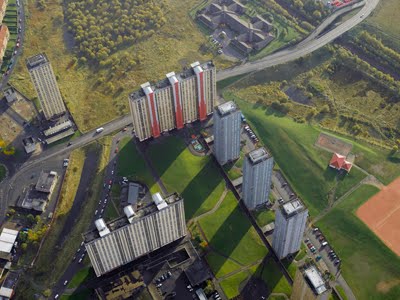
I worked in Glasgow periodically in the 1980s so retain an interest. Headlines from The Scotsman arrive daily by e-mail. This story about a Russian refugee family that fell from a 15th floor is awful but it was the accompanying image that caught me.

Red Road flats are apparently notorious. A quick search describes them visually. Eight 31 storey blocks on the outskirts of Glasgow husing 4,000. The tallest social housing in Europe when built in 1971 according to one report. I was unaware of them.

When I lived in London I accompanied my not-well-to-do brother looking to buy a flat (which I would also inhabit). We looked at some awful life-sapping dives. Yes, even the private sector built revolting concrete blocks. Some that were comfortably habitable inside looked straight into the neighbour's windows and had virtually all natural light curbed as a consequence. The sense of claustrophia was crushing.


Not a 'complainer' by nature, shown into a miniscule hotel room in a Hong Kong (with a toddler in tow), with a window no less than 2 metres away from a neighbouring highrise block, but deep down the tens of levels, I discovered I could put my foot down with a result. We were moved to a room with an outlook. (Cactus will shake her head at my 'delicacy'.)


I suppose in their favour these Scottish blocks are at least well-spaced providing some daylight and view. My psyche craves physical space and light and a horizon. Personally I would rather be in flat with an unimpeded view than in a pokey terrace house with a garden the size of a postage stamp. But the flats are earmarked for demolition. What will replace them I wonder?

On reflection I don't know I am born (a colloquialism for Fred Dagg's "You don't know how lucky you are".)

Labour MP undermines Labour policy

Is this a classic case of the left hand not knowing what the right hand is doing?

Labour's policy is to introduce one year's Paid Parental Leave (PPL). One of their MP's has just had a private member's bill drawn from the ballot to introduce 6 months PPL!

If Paid Parental Leave is such a great thing why not lobby for 2,3 ,4 or 5 years entitlement? Oh, of course, we already have that. It's the DPB. And a fine job its doing of reaping "social and economic" rewards.

In the final analysis PPL is just another scheme that forces one person to pay for another's choices. That's the principle we live with and its arbitrary application is what keeps far too many politicians, paid lobbyists, media and public relations people, unionists, etc non-productively employed.

Thursday, April 05, 2012

Crime statistics

Recorded crime is down.

Here's a couple of sub-stats.

In absolute terms there were 20,289 fewer recorded crimes in 2011 than in 2010.

In Canterbury there were 11,579 fewer crimes - that's 57 percent of the total.

David Garrett says the drop in crime is down to better policing and three strikes. He may be right that these two factors are reducing crime. But Earthquakes would have to be right up there.

In Waitemata and Counties Manukau there were 1,614 fewer crimes but in Auckland there were 4,229 more.

So I fervently hope that a downward trend is being established but would be foolish to get overly excited.

Effect of the recession on the labour market

Statistics New Zealand released an article yesterday that looks at how the labour market fared during the rescession. It summarises:

The New Zealand labour market was affected in many ways:

Each heading includes a graph. Here are a couple:


My comment: This shows the double whammy for the economy. The state has to find more money to support increased student numbers while receiving less tax revenue from the numbers employed. Latest data (first half of 2011) shows a further 3.5% increase on 2010.

The only good news is:

During the recession, New Zealand experienced a smaller rise in unemployment than a number of other OECD countries. It is possible to compare New Zealand’s unemployment rate with other countries using the seasonally adjusted harmonised unemployment rate published by the OECD. Over the recession, New Zealand’s unemployment rate rose 1.2 percentage points. During the same period, the unemployment rate rose 3.3 percentage points in the United States, 2.0 percentage points in the United Kingdom, and 1.2 percentage points in Australia.


And the conclusion:

The recession in 2008 and 2009 in New Zealand and the rest of the world continues to affect the New Zealand labour market. There have been falls in employment, falls in hours paid and worked, as well as rises in the number of people unemployed. People have responded by leaving the labour force. In some cases, they have decided to do more tertiary study.

These factors have affected companies to varying degrees, depending on firm size.

The impact of the recession on the New Zealand labour market will continue to be felt for a long time.

Wednesday, April 04, 2012

Welfare state meets Woman's day

I am only posting this out of mild amusement such has become the pervasiveness of the state in our lives. If you suspect you are in a dysfunctional relationship take one of Nanny's quizzes to either confirm or allay your fears. Welfare State meets Woman's Day.

Describing Maori to allay the fears of potential immigrants

I am off on a tangent again. Supposed to be researching another subject, I am distracted by matters Maori. This is from the 1990 New Zealand Yearbook:

The ‘native race’

The New Zealand Wars were hardly over when the Vogel period of immigration and public works began.

Many potential immigrants must still have remembered reading of the wars when they weighed up the possibilities of emigrating to New Zealand, and the 1875 Handbook was published largely to attract these immigrants to the new country. However, in allaying fears of warlike Maori, it took liberties which today may well be seen as patronising and based on ignorance. It informed readers that:

As a rule, Maoris are middle-sized and well-formed, the average height of the man being 5 ft. 6 in.; the bodies and arms being longer than those of the average Englishmen, but the leg bones being shorter, and the calves largely developed.* The skin is of an olive-brown colour, and the hair generally black; the teeth are good, except among the tribes who live in the sulphurous regions about the Hot Lakes, near the centre of the North Island; but the eyes are bleared, possibly from the amount of smoke to which they are exposed in “whares,” or cabins, destitute of chimneys. The voice is pleasant, and, when warlike excitement has not roused him to frenzy, every gesture of the Maori is graceful. Nothing can be more dignified than the bearing of chiefs assembled at a “runanga,” or council, and this peculiar composure they preserve when they adopt European habits and custom, always appearing at ease, even in the midst of what would seem a most incongruous assembly. In bodily powers, the Englishman has the advantage. As a carrier of heavy burdens, the native is the superior; but in exercises of strength and endurance, the average Englishman surpasses the average Maori. As to the character of the natives, it must be remembered—if most opposite and contradictory qualities are ascribed to them—that they are in a transition state. Some of the chiefs are with the exception of colour and language, almost Europeans; others conform, when in towns, to the dress and the customs of white men, but resume native ways, and the blanket as the sole garment, as soon as they return to the “kainga,” or native village. The great majority have ideas partly European, partly Maori; while a small section, professing to adhere to old Maori ways, depart from them so far as to buy or to procure articles of European manufacture, whenever they can do so. They are excitable and superstitious, easily worked upon at times by any one who holds the key to their inclinations and who can influence them by appeals to their traditionary legends; while at other times they are obstinate and self willed, whether for good or for evil. As is usual with races that have not a written language, they possess wonderful memories; and when discussing any subject, they cite or refer to precedent after precedent. They are fond of such discussions; for many a Maori is a natural orator, with an easy flow of words, and a delight in allegories which are often highly poetical They are brave, yet are liable to groundless panics. They are by turns open-handed and most liberal, and shamelessly mean and stingy. They have no word or phrase equivalent to gratitude, yet they possess the quality. Grief is with them reduced to a ceremony, and tears are produced at will. In their persons they are slovenly or clean according to humour; and they are fond of finery, chiefly of the gaudiest kind. They are indolent or energetic by turns. During planting time, men women, and children labour energetically; but during the rest of the year they will work or idle as the mood takes them. When they do commence a piece of work, they go through with it well; and in roadmaking they exhibit a fair amount of engineering skill.

Sunday, April 01, 2012

Strange question from an ex ACT MP

I know Deborah Coddington doesn't define herself as libertarian any more and this isn't a personal dig at her. But this morning she asks a question I have heard more than once from other sources, but wouldn't have expected from an ex ACT MP:

"...why is the taxpayer-funded ACC even expected to pay compensation to someone who, we now know, has already received a million-dollar payout from a private insurance company for her bicycle accident, the same accident for which she's seeking an ongoing benefit from ACC?"


ACC is partially tax-payer funded but anyone in employment or self-employed pays premiums, often very hefty ones. If Bronwyn Pullar paid premiums, and if her injury fit the bill, shouldn't she be entitled to an ACC pay-out?And if Bronwyn Pullar paid taxes shouldn't she be entitled to an ACC pay-out? The fact she took out private insurance as well shouldn't have any bearing (unless, of course, she was setting out to get injured which seems highly unlikely). But this is the lie that is ACC and social security in this country. You make compulsory contributions with no guarantee of cover. Our system is a sort of hybrid between insurance, social assistance and wealth redistribution to the poorest.

Either government schemes should make pay-outs linked directly to contributions or let people make their own provision (while maintaining a separate pool for non-contributors).

As it stands we get the morally repugnant but legally defensible situation of Ms Pullar getting two pay-outs and still wanting more.

Saturday, March 31, 2012

Oswald Bastable bowing out

The birth of Oswald's blog preceded mine by a few months in 2005. And my acquaintance with 'Oswald' preceded that. Today he has announced he is stopping. Lost the energy for it he says.

Far be it from me to speculate, put two and two together and make five, but I will. Are libertarians losing heart? Or do we just reach a point where everything we think has been said, and then some.

Back in the early 2000s we were more energised, had two political hinge-points (ACT and Libz) the tension between which, of itself, kept the passions stirred.

What do we have now? I am mildly mollified by a National government making some welfare reforms but in general we have the Greens in ascendency, National and Labour big-government protagonists both, ACT down the toilet and Libertarianz, for all their efforts and genuine people, gaining no traction.

And age comes into it. Our mortality looms larger daily but the desire to make our lives matter does not diminish. Making something may be giving our growing children the time and environment that launches their own adventure. It may be no more than leaving behind children and grandchildren who remember us fondly. But I speak for myself. I am not trying to second guess Oswald in this respect.

Oswald won't have made his decision lightly. Blogs become an integral part of your existence. Sometimes a welcome outlet, sometimes a tedious obligation. Certainly a habit, even an addicton, though I am sure real addictions provide more excites than blogs. Perhaps when the obligation aspect starts to overwhelm the creative vent, it is time to pack up. Even then you think, will the cessation be followed by regret or relief?

Anyway dear Ossie Bastable I will miss you.

State house utopia - not

Reading a story about 11 Somalian refugees living in a 4 bedroom home in Christchurch one can have sympathy for their situation, past and present. And the racism displayed by potential private landlords is unfortunate but no laws can change it.

However, what caught my attention came only at the very end of the coverage:

Hayden said Warsame's family had turned down three houses in Christchurch because the family thought they were in the wrong suburb or too damp.


So they continue to live 11 in a 4 bedroom house by choice. I can understand the reasons why people would turn down certain houses or neighbourhoods. I can understand why people might choose to pool extra income by sharing one home. But what I don't get is why they then feel entitled to go the media (assuming that is how the story got out) about their 'plight'. Housing New Zealand has an obligation to find them accommodation and it would appear are doing their best.

If anything the story is an indictment on the state of Housing New Zealand stock and not uncommon deterioration of neighbourhoods they proliferate. And racists.

Friday, March 30, 2012

Hide vs Franks on Close Up tonight

Rodney Hide will be taking the affirmative for Sir Doug Graham losing his knighthood and Stephen Franks the negative.

Thursday, March 29, 2012

One person a minute

Yesterday Paula Bennett told parliament:

"Last year 80,000 people went off benefits and into work. That is actually one person for every minute of every working day."

The number of working age people on benefits rose from 351,000 to 353,000 last year. Which means 82,000 must have gone onto benefits. That is actually one person for every minute of every working day.


Wednesday, March 28, 2012

"National's war on the poor"

Sue Bradford seems to pop up all over the show wearing different hats. The last one I saw her in was BAIS (Beneficiaries Advocacy and Information Service). Yesterday it was Auckland Action Against Poverty. Never short on hyperbole she describes the reforms that went to select committee yesterday as "shameful", "punitive", "paternalistic", "harassment" and "an important strand in National's war on the poor."

What is she describing?

- The expectation that beneficiary parents to be available for part-time work when their youngest turns five. Most mothers return to work before then.

- Paying young beneficiaries power and rent directly and limiting their benefit cash to an allowance.

- Providing enough childcare to allow young mothers to stay in education.

- Warning beneficiaries if they have another child while on welfare, and their existing child is at school, they will only get one year free from work expectations - the same as for non-beneficiary parents under parental leave.

Bringing beneficiaries into the real world, having the same expectations of them as everybody else, is a great thing. Sue Bradford could be reminded about the 'soft bigotry of low expectations'. That's where she seems to be at.

Tuesday, March 27, 2012

Welcome news

For a change, some welcome news from the world of politics.

Credit where it's due. Well done Labour MP Maryan Street.

This is a bill one I will be following and supporting, if it is drawn.

Encouraging all mothers to have more children

A lot of what pass for comments on The Standard are ignorant insults. Psycho Milt has also blogged about this.

But here's one that is at least civil if not misguided. By someone called Alexandra:

Mothers who have a second child  whose older child is fourteen will be forced to be available for FULL TIME  WORK when their baby is ONE YEAR OLD.

No we should not be discouraging mothers to have more than one child by punishing the child and treating the child as a second class citizen.  In fact we need more children in our society as we do not have enough workers to support the increasingly elderly population.  Mothers are bringing up the future workers who create the value from which profits and taxes are taken. If these children would  not find work  when they grew up; that  would be  the fault of the failing capitalist economy,  the rip offs of the bankers and corpoations; not the fault of the  mothers or their children . It would also be  the fault of decades of financial and social deprivation- ie poverty and ill health caused by inadequate incomes, poor housing and health care; and the kind of prejudice and discrimination favoured by people like  Lindsay.
I had commented in support of National's policy to discourage beneficiaries adding children to their benefit by exempting the caregiver from part-time work-testing for only one additional year. That part-time work, if she can find a job, could constitute as little as 12 hours. Alexandra is correct to point out that if her next youngest child is already 14 she would be full-time work-tested (30 hours). But only 1 percent of MSD clients who added a subsequent child had a youngest child aged 14+.

And the argument she uses for encouraging women to have more children - whether on a benefit or not - "we do not have enough workers to support the increasingly elderly population" - can be used for increasing the workforce participation of working-age females. Often mothers.

Sunday, March 25, 2012

Would they could


Opting out of Social Security

Probably the sort of thing Roger Douglas promoted for so long.

Research described in the Spectator (hat-tip NCPA) finds that US citizens who opted out of social security for an 'alternate' plan are much better off when it comes to retirement.


According to the Spectator,

There is also a disability benefit that pays immediately upon injury. Social Security's comparable benefit comes with a six-month wait, and includes other restrictions. 

The NCPA comments,  

The plan avoids the pitfalls of pay-as-you-go systems by giving workers only what they pay in....The experience of the three counties' employees over the past 30 years speaks to the effectiveness and efficiency of the plans. While paying out substantially higher payments to retired workers, the plans do not face burdensome unfunded liabilities that haunt many states' legislatures.


Perhaps the left would prefer the lower pay-outs because they are more even under state social security (the lower income contributors are topped up from higher). Individuals at all levels however are better off under the alternate plan.

Saturday, March 24, 2012

Welfare to work

Over on the Standard the UK is being used to cast doubt over the wisdom of contracting private service providers to get beneficiaries into work.

As I have pointed out to them, there are already over 150 private providers contracted to MSD for this very purpose. They often work with the hardest to place and, from what I have been told,  get good results. Of course, the best result would be if individuals got themselves to these agencies before they even needed a benefit. Then it would be the prospective employer and employee footing the bill.

Friday, March 23, 2012

Rodney Hide and Winston Peters together on Radio Live

Rodney Hide is co-hosting with Willie Jackson again today on Radio Live. From 2pm Winston Peters will join  them. Will be interesting. Rodney has no constraints on him now, apart of course, from  those imposed by the Broadcasting Standards Authority.

Update:  That was very hard to listen to. Winston is the worst and most wicked weasel ever. Rodney took him to task on his parliamentary insinuations about Nick Smith, and Peters barefacedly denied them, maintaining that his reference to 'sex' in the quote, "a shabby little case that involved blackmail, sex and a minister with a conflict of interest" was a reference to the sexual abuse victims whose details were wrongly sent to Bronwyn Puller. He is a revolting person.

Green MP - naive or smart?

New Green MP Holly Walker is either naive or smart. I can't figure out which. Yesterday, in response to the latest poverty inquiry, she was calling for a "co-ordinated child poverty strategy". (My immediate irreverent thought was, there is one. It's called the DPB. It creates plenty of child poverty.)

A lack of ability to find agreed solutions lies at the very heart of politics - what she signed up for.  The Greens prescription for solving child poverty is not acceptable to a majority. Until they are in government (or a compelling position of power) what they bring to the table will be rejected. They can talk and they can try to influence but they don't hold the aces. Calling for a co-ordinated approach is typical moral high-ground baloney to force their policies into the mix.

Welfare is the major factor driving child poverty but the Greens are pro-welfare. They would have more of it. Most people have either realised or are beginning to suspect that this would only increase child poverty.

And it's ironic that at the end of her post she gives Business New Zealand's Phil O'Reilly a serve. What's he doing on the panel? So she doesn't really want inclusiveness after all.

(I criticised the line up as well  but in the context of criticising the entire pointless project.)

Thursday, March 22, 2012

The archetypal gang family

The fraud is less interesting than the profile of this couple. Gang family, 12 children, on-again off-again relationship, Maori, between them living on  benefits for 53 years, drug and alcohol abuse. And are you willing to bet against some of these 12 children already having their own beneficiary broods? This scourge isn't going away any time soon.