Monday, December 04, 2006
Learning Maori
Came across this site which is very useful. You can click on words to hear their pronunciation, listen to passages, test yourself etc. Now all I need is some time.....

IQ gap persists; why and what to do.
Fascinating stuff from Reason. Charles Murray and James Flynn argue about whether the IQ gap between black and non-Hispanic white Americans has closed over the last thirty years. Murray is a libertarian and Flynn a socialist.
Flynn further observed that blacks generally do worse on vocabulary tests and he suggested that a cultural difference might explain it. The children of professionals hear about 2500 different words in a day whereas the children of welfare mothers hear about 600 different words every day. Finally, Flynn believes that the black adolescent subculture that devalues education is largely responsible for widening the IQ gap. “It is more probable than not that the black/white IQ gap results from environmental factors,” he declared.
Murray argued that general intelligence, so-called "g," a general factor that governs performance on all cognitive tasks, is highly heritable. He noted that g has a biological background in the brain. He cited differences in glucose metabolism, reaction times, and the volumes of specific grey matter in prefrontal cortices.
Sunday, December 03, 2006
'Extremists' not wanted
The following is just one sample of so many opinion pieces written about the change in National leadership. This is from The Press (with my comment below);
When former National leader Don Brash announced his resignation from Parliament this week, it marked more than the end of his personal political dream. Brash, it has become increasingly clear, was supported or advised by a small number of prominent new-Right zealots, says The Press in an editorial.
For them, the revolution that began two decades ago with Sir Roger Douglas's policies should never have ended, and Brash became their chosen champion. His exit from politics and his replacement by the team of John Key and Bill English mark the last gasp of Rogernomics and the end of an era.
Brash often talked the language of the mainstream but, as author Nicky Hager's book has confirmed, his supporters included those who were anything but this. Behind the scenes, he was encouraged or assisted by figures such as Ruth Richardson, Michael Bassett and the Business Roundtable's Diane Foreman and Roger Kerr.
These individuals are undoubtedly passionate about New Zealand and their own vision to promote economic growth and higher living standards.
Their vision and policies might sit well in their more natural home of ACT New Zealand, but they are out of step with the values of most New Zealanders and any political party which aspires to be seen as broad-based, centrist and electable.
New Zealanders are going to get what they vote for. They don't want 'extremist' politicians but are apparently happy to live in a country riddled with extremes. Extreme violence, extreme lawlessness, extreme division between living standards, extreme waiting lists, extreme illiteracy, extreme rates of imprisonment, extreme rates of stds and teenage abortion and birth.
Ironically in this age of choice nobody wants to make the hard ones. Sit on the fence, stay in the middle, don't rock the boat, sit in your comfort zone. Most people are just gutless. That's what National knows and ACT doesn't want to.
Still on Don Brash
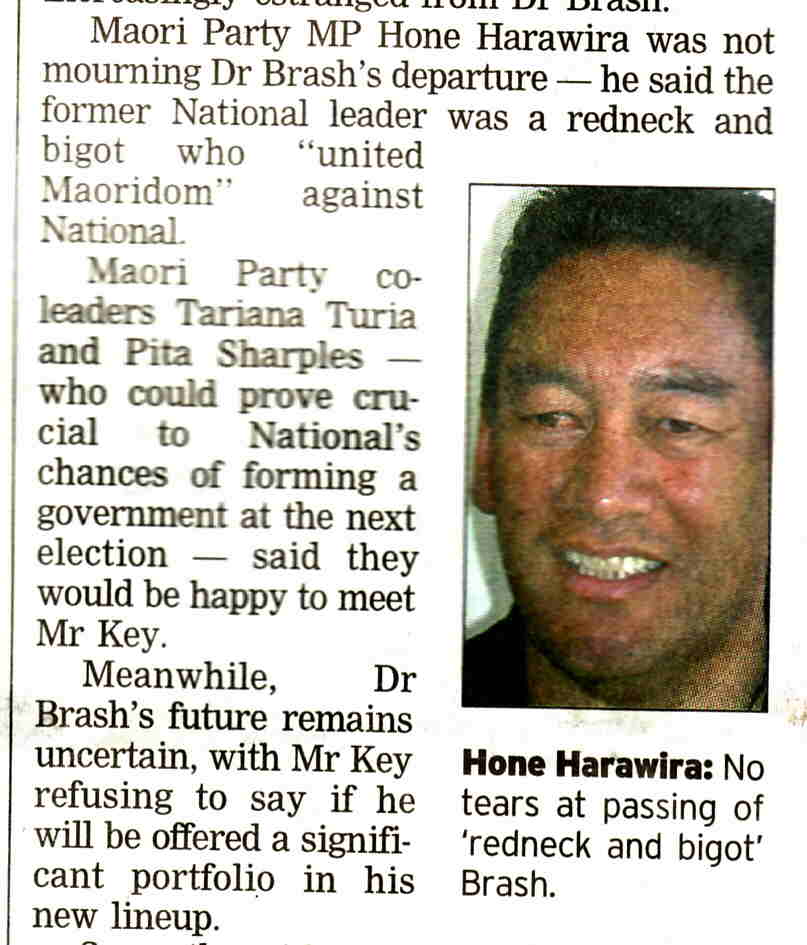
Tariana Turia says in her Beehive Comment; The Maori Party position didn’t even make the bulletin. Seems that nobody wants to hear a statement which says ‘we respect his right to make a decision’ or ‘we appreciate the impact such a difficult time can have upon the family’.
You see, nasty headlines, cutting insults are what sells papers – remarks which play on people’s fears and prejudices.
I can only conclude that Hone Harawira no longer officially represents the Maori Party.
Saturday, December 02, 2006
You get what you pay for?
Pay and display machines are being blown up by 'vigilantes'in East Sussex, UK, because they are so unpopular. Seems a bit over the top but when you consider that the authorities in Banbury go so far as to make parkers type in their registration number to prevent them handing an unused amount of time over to another motorist you begin to understand why there is such antipathy towards them.
Kiddy crisis in the 'Naki
Cinema: Parents parking kids, not cars
Children as young as eight are being dumped at the cinema by their parents
One of the lead stories in the Taranaki Daily News.
There are a couple of things I noticed. The use of the word 'dump' instead of 'drop off' inferring any parent who drops off their child is bad. I wouldn't let my eight year-old go to the cinema without an adult but I have dropped off my twelve year-old to meet friends. The reminder that the movie could be sold out is useful.
Good on the movie company for looking after the children that do get stranded.
But here's the line that really disgusts me; The New Plymouth District Council says it cannot review parking charges until next June because of the costs of retriggering the Local Government Act's need for consultation.
Isn't it pathetic? The stifling burden of rules and regulations. In fact, I'm sure if they look hard enough the council or OSH could find some reason why the cinema company shouldn't be taking care of kids in a separate area when they can't get into the movie.
Friday, December 01, 2006
National morphing into Labour
Here we go. National morphing into Labour. Jackie Blue positioning herself to be the next Minister of Women's Affairs. ACT should be putting out a press release reminding New Zealand they would abolish this archaic, politics-of-privilege department.
Let woman then go on —not asking favors, but claiming as a right the removal of all hindrances to her elevation in the scale of being —let here receive encouragement for the proper cultivation of all her powers, so that she may enter profitably into the active business of life . . . Then in the marriage union, the independence of husband and wife will be equal, their dependence mutual, and their obligations reciprocal.
— Lucretia Coffin Mott, Discourse on Woman [December 17, 1849]
Reforming Welfare
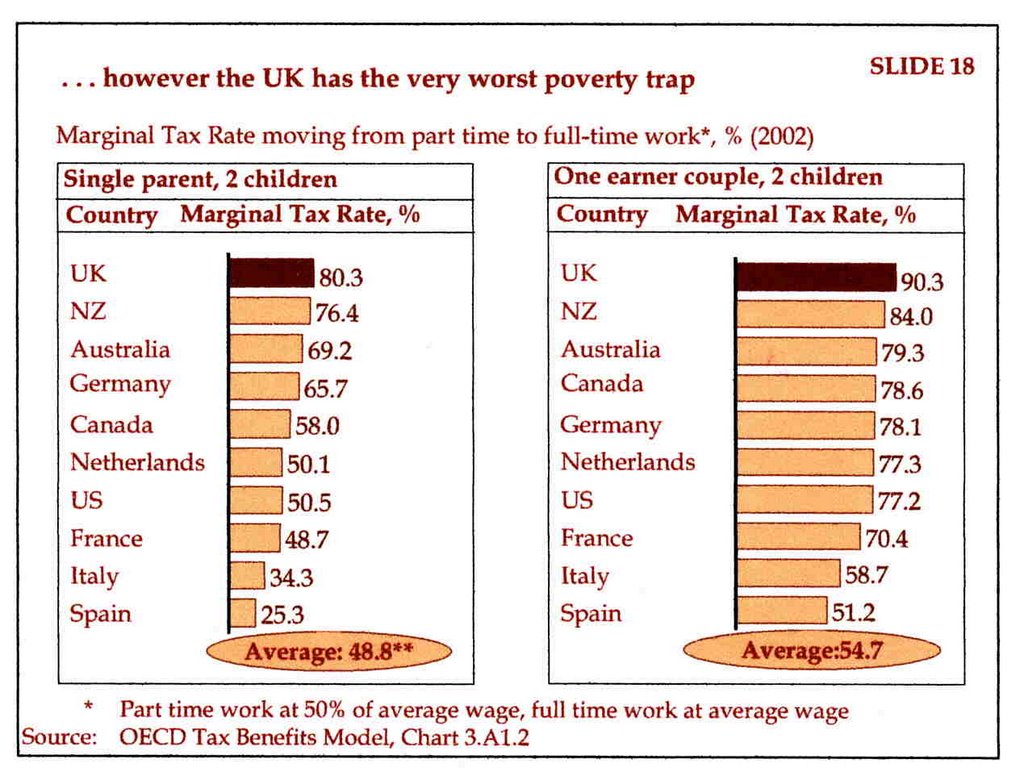
I had a flick through the UK report, Reforming Welfare, yesterday, looking for any comparative NZ data. This is all I found and it's from 2002 which devalues its usefulness.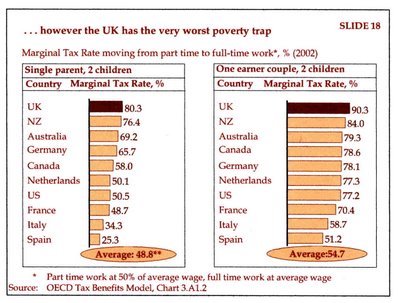
Anyway, Maxim have done a good job summarising the report as follows;
REPORT STRENGTHENS THE CASE FOR WELFARE REFORM IN UK
The already compelling case for welfare reform in the United Kingdom grew stronger recently, with the ballooning of government dependency continuing, and the release of a new report by the think tank Reform.
Reforming Welfare examines the current state of the British welfare system, showing that while spending on welfare is "colossal", the state of beneficiaries is getting worse, and the poverty trap only deeper. The British government spent £79 billion on welfare during 2005, supporting an estimated 14 percent of the working age population. At the same time, the number of government benefits has ballooned from seven in 1948 to 51 today.
The Times reported recently that under the British equivalent of New Zealand's "Working for Families" scheme, even those in the richest fifth of households are in receipt of government benefits. The paper reported that a third of the scheme's expenditure goes to the richest 50 percent of homes. It appears that more and more people are lining up for help they may not even need.
But although the welfare budget sucks more and more cash from the public purse, it delivers little in return. Reforming Welfare states that outcomes such as inequality and poverty are only getting worse, with many poorer regions worse off than 20 years ago. The report argues that the moral, social and economic consequences of welfare dependency are crippling, tracing the gradual historical shift from local structures aimed at preserving independence to the modern welfare state with its central bureaucracy and endless paperwork.
Setting the debate in much-needed context, the report lays down a tough and important challenge New Zealand cannot ignore. A welfare state which breeds a culture of entitlement is neither sustainable nor wise. As a country, we must do better when it comes to those left behind.
Anyway, Maxim have done a good job summarising the report as follows;
REPORT STRENGTHENS THE CASE FOR WELFARE REFORM IN UK
The already compelling case for welfare reform in the United Kingdom grew stronger recently, with the ballooning of government dependency continuing, and the release of a new report by the think tank Reform.
Reforming Welfare examines the current state of the British welfare system, showing that while spending on welfare is "colossal", the state of beneficiaries is getting worse, and the poverty trap only deeper. The British government spent £79 billion on welfare during 2005, supporting an estimated 14 percent of the working age population. At the same time, the number of government benefits has ballooned from seven in 1948 to 51 today.
The Times reported recently that under the British equivalent of New Zealand's "Working for Families" scheme, even those in the richest fifth of households are in receipt of government benefits. The paper reported that a third of the scheme's expenditure goes to the richest 50 percent of homes. It appears that more and more people are lining up for help they may not even need.
But although the welfare budget sucks more and more cash from the public purse, it delivers little in return. Reforming Welfare states that outcomes such as inequality and poverty are only getting worse, with many poorer regions worse off than 20 years ago. The report argues that the moral, social and economic consequences of welfare dependency are crippling, tracing the gradual historical shift from local structures aimed at preserving independence to the modern welfare state with its central bureaucracy and endless paperwork.
Setting the debate in much-needed context, the report lays down a tough and important challenge New Zealand cannot ignore. A welfare state which breeds a culture of entitlement is neither sustainable nor wise. As a country, we must do better when it comes to those left behind.
"Why won't NZ cut taxes?"
National Party associate finance spokesman, Craig Foss, has an article in the Wall St journal. Well done. NCPA summarises it.
Since the Labor Party took power in 1999, taxes have become quite burdensome:
* The top personal tax rate has been hiked to 39 percent from 33 percent.
* The corporate rate -- already a hefty 33 percent -- hasn't changed for over a quarter century.
* New Zealand's income and corporate tax-to-GDP ratio now ranks 16th among Organization for Economic Co-operation and Development (OECD) countries; seven years ago, the country placed 10th.
I take it then we can look forward to National cutting taxes.
Pregnant teenage heroin addict remanded
A pregnant teenage heroin addict was remanded in the Invercargill district court in order for CYF to arrange treatment for her and her unborn child. The story focuses on whether or not newborns of addicts are harmed by their mother's drug use, which is a bit laughable given the very strong possibility that if she uses heroin she also smokes and drinks (probably courtesy of a sickness benefit). But I am more interested in the fact she is in court. Had she committed some other crime? Or does CYF have the power to take her to court because of concerns over the unborn child?
Thursday, November 30, 2006
Good luck to the government
From Scoop;
Following yesterday's removal of this final legal obstacle, CPAG is looking forward to its chance to argue that the government's In Work Payment discriminates against some children, says Ms Wakim.
"The basis of our case is that children's needs are the same, whether or not parents are able to work. It is time to support all New Zealand's children including those whose parents may not be able to work," she says.
My argument against this is here.
Not often I find myself supporting the government.
Maori Party against Maori place names
The Maori Party would be amongst the strongest proponents of te reo. But now Tariana Turia is very angry about prisons having Maori names because of the negative connotations associated with these institutions.
"We know too, of the extreme objection that mana whenua took in the process of establishing a name for the Waikato based prison, at Spring Hill, early last year" said Mrs Turia. "Iwi had objected to the name, Puke Puna as they did not want Maori culture associated with the facility" recalled Mrs Turia.
"And yet still the Department persists with a whole new vocabulary of Maori names for their jails: Arohata (Tawa), Te Piriti, Te Wairere, Te Mahinga (Paremoremo), Kia Marama (Rolleston), Te Hikoinga, Rangipo (Tongariro), Kareo (Youth unit at Northland); and I'm sure there's plenty more where they come from" said Mrs Turia.
"Then we have all of the elaborately named programmes, such as 'Te Wairua o Nga Tangata (community probation programme) or even the expensive branding exercise to create a Maori sub-title for the Department".
"Is it meant to seduce us all into thinking these places are actually good for Maori, by virtue of having a Maori subtitle?" asked Mrs Turia.
Can anybody make any sense of her outrage?
Cheery thoughts for a dismal day
The lucky British have a 'welfare nation' that is bigger than ours! With spending of 79 billion pounds, on a per head of population basis that equates to 1,316 pounds or $3,777. Ours is only $3,601.

Gordon Brown is to thank for the wonderful expansion of welfare into the homes of "the rich". What a fantastic Prime Minister he is going to make.
Gordon Brown is to thank for the wonderful expansion of welfare into the homes of "the rich". What a fantastic Prime Minister he is going to make.
Wednesday, November 29, 2006
Come on, National
This post is an exercise in cheering myself up and finding something good to say about National. It's partly fiction. But it needn't be.
John Key will hand the welfare portfolio back to Katherine Rich who always presented a softer persona but actually did some real work in welfare when she produced her 2003 paper, Saving the next generation from welfare dependence. In it she laid out a plan which included working for the dole and work-testing, reciprocal obligations, time limits and reform of the child support system.
Rich will then front welfare reform policies using the Key approach of we will not turn our back on you but we have expectations - get off your bottom, be 'aspirational', grasp the opportunities for the sake of your children.
Key has already signalled this by insisting on adopting policies that work. There is all the evidence he needs they work in the United States.
Still, I had similar hopes for the Maori party and welfare but they were misplaced.....
Tuesday, November 28, 2006
And the Nicky Hager award goes to....
Robson-on-Politics for;
Mr Bolger promised an end to Rogernomics and won a mandate but the moment votes had been counted after the 1990 election he put a Rogernome, Ms Ruth Richardson, into the finance portfolio and in came policies like Crown Health Enterprises (you had to pay a fee to go to a hospital), asset sales (NZ Railways was sold as were the last of the public shareholding in BNZ bank), unemployment soared to above 20% for Maori and toward 9% for non-Maori and welfare dependency and drug abuse and violence rose.
Unemployment was higher or similar in the UK and Australia and Canada and France and Italy.
Welfare dependency dropped between 1990 and 1996 by 22 percent.
Drug abuse and violence rose. Just as they continue to rise today under the Clark government.
The key from debut
Policies not personalities. That's what we should be looking very closely at. Here's what Key said in his debut today;
Personal freedom, individual responsibility, a competitive economy, and support for families and communities are the very principles under which the party was formed 70 years ago, and they are as relevant today as they were then.
What you can be assured of is that our policies will always be measured against our core principles.
We'll be watching.
Early intervention in UK crime
When I read this headline I expected a story about intervening when potential criminals were still very young children. I was wrong.
Early intervention in UK crime
6.20am Tuesday November 28, 2006
British criminal psychologists are putting together a list of the 100 most dangerous murderers and rapists before they have committed any such crimes, The Times said.
Statements from previous partners, information from mental health workers, and details of past complaints are helping create the profiles.
Once an individual has been targeted, police can decide whether to plan an arrest.
Hone messes with Maori Party mana
Maori Party Statement on the resignation of Don Brash;
“As a party, we have stood firmly on our philosophy that we have practised in the House, of not belitting others. It is a practice we endeavour to uphold in all spheres of our activity. We will not compromise that practice now. E hara tenei i te wa, he whakaiti tangata” concluded Dr Sharples.
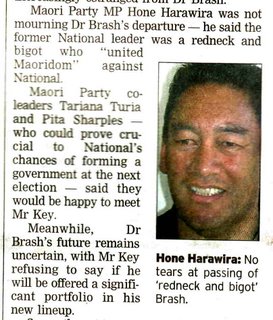
(Just goes to show all Maori do not think and act the same way. That's a bugger for the collectivists.)
“As a party, we have stood firmly on our philosophy that we have practised in the House, of not belitting others. It is a practice we endeavour to uphold in all spheres of our activity. We will not compromise that practice now. E hara tenei i te wa, he whakaiti tangata” concluded Dr Sharples.

(Just goes to show all Maori do not think and act the same way. That's a bugger for the collectivists.)
Monday, November 27, 2006
Our "great social progress"
 Another international conference is being held in Wellington today. It is about the FGC, or Family Group Conference, a process which was born in NZ in 1989. The Family Group Conference changed child and youth justice. It primarily kept offenders out of court. Today only 16-17 percent of offences go to court. 44 percent of offenders receive warnings only. Ruth Dyson opened the conference this morning with a typical ministerial speech which would have sent me to sleep in a nanosecond. Here she is winding up;
As any proud parent would, I'm going to finish by noting the international success of our baby – again. The FGC has been adopted and adapted around the world as a best practice model. As a country New Zealand can be justifiably proud of this and the great social progress we continue to make.
The great social progress we continue to make! Doesn't that take the cake. Talk about blinkered government.
"Que(e)rying Research"
Here's a conference many taxpayers will be ecstatic about paying for;
A conference looking at research into Lesbian Gay Bisexual Transgender (LGBT) issues will be held at AUT University next week.
In her address Professor Pringle will draw on a small local study of 'out' lesbian managers to argue that their lack of response to questions about gender issues in the workplace is because gender is actually heterogender - rooted in a dichotomous masculine and feminine relationship.
Identity issues for the women in this local study centred around the multi-layered process of coming out, making their sexual orientation visible within their managerial position. To some extent these lesbians were freed from gender issues, because managing gender is managing heterosexuality.
So what's the problem? What is it about academics creating problems where there are none. It's too clever for me.
Subscribe to:
Posts (Atom)


