Wednesday, August 24, 2022

MSM and poor reporting

 A TV1 news item says about the inquiry into abuse-in-care:


"A report from the Inquiry shows one in three young people placed in residential care by the state between 1950 and 1999 went on to serve a prison sentence. The research shows Māori were even more likely to end up in prison, with 42% serving a custodial sentence as an adult. For the general population during the same period less than one in 10 ended up in prison." (My emphasis)


I got stuck on the last part of that. 'Less than' is indeterminate but suggests not much less than. Which seems way too high. From the actual report:


"Although there are caveats and limitations to consider, the principal results are nevertheless clear. The incarceration rate of people who were in State residential care is high. It is much higher than that of a cohort matched in age, sex/gender, and ethnicity."


So the denominator was not the "general population". It was a matched cohort which by necessity would have been disproportionately Māori.


But the 'fact' will be repeated frequently - Heather du Plessis has just done so. And this evening's One News did the same.  I will wince every time.


Nevertheless, the data is valuable and proves NZ is no different from the countries highlighted in the 2018 report I wrote for Family First, Imprisonment and Family Structure, which stated in the Executive Summary:

"The strongest predictor for imprisonment is growing up in state care."

Saturday, August 13, 2022

Increased benefit rates drive increased deprivation

Increased benefit rates drive increased deprivation.

This is no surprise to logical thinkers. Simply upping benefits doesn't mean the extra money will be well spent. Benefit increases have the effect of drawing more people onto benefits, away from work and the structure work brings to people's lives.

But the following admission from the Rotorua Lakes District Council nevertheless surprised me:

"Millions of dollars in welfare has to deliver the desired impact of hope and positive change, instead, Rotorua has seen a steady increase in deprivation since the onset of Covid-19, largely driven by increased benefit rates."

It's an odd sentence though and I wonder if 'has' in the first line was meant to be 'was'?

If local body bureaucrats really believe that simply pouring more money into workless households will create "positive change" they are naive in the extreme. 

The report authors note also that Rotorua is second to bottom of 67 councils for crime. Yet isn't it a tenet of the left that decreasing benefits causes crime? Seems the opposite is happening.

Let's hope a few more officials start to cotton on.

Update

In this Bay of Plenty report Rotorua MP Todd McClay uses the term benefit rate to mean the number of people on benefits whereas 'benefit rates' normally mean payment rate.

Either way my contention holds up. Benefit payment rates AND benefit numbers have risen under Labour.

Tuesday, August 09, 2022

Prison population levels off

Labour's policy was to drive down the prison population. And they have.

But since March 2022 the population has levelled off. 2022 looks different to 2020 and 2021.

A change in policy? Time for a cup of tea?  Something has changed.


Source

Wednesday, August 03, 2022

Unemployment drops by a third - benefit numbers rise by a quarter

Unemployment drops by a third - benefit numbers rise by a quarter.

That's what's happened during (almost) five years under a Labour government.

The June 2022 unemployment rate has just been released. It's 3.3 percent. In June 2017 the rate was 4.8 percent so has fallen by nearly a third.

But in that same five-year period the total number on benefits increased by 25 percent - or 276,333 to 344,642.

Graphed:


If you have the constitution for it you can read Statistics NZ's technical and long-winded explanation for why the unemployment rate and benefit data are two different things. 

The point to be made is that Labour constantly, tediously, talks about the low unemployment rate (3.3%) but never the high benefit dependence rate (11.7%)

Labour affect to represent 'the workers' while quietly indulging the many thousands who are not interested in a paid job. 

Low wage workers are struggling in under-staffed workplaces because of closed borders and covid absenteeism but also because Labour has made life on a benefit increasingly easy and unpressured. 

The only rational reason people in low paid jobs continue to turn up is their work ethic and commitment to workmates and employers. 

I don't know how they tolerate a government prepared to pay their slack-arse neighbour to do nothing - let alone vote for them.


Saturday, July 30, 2022

Benefit incomes - why it's not worth working

MSD have released a report on benefit incomes. I have long held that beneficiary advocates base their poverty pleading on the basic benefit rate, but those numbers are well under total incomes once the additional top-ups are included. Here is a selection of the graphs from the report:


(Left click on image to enlarge)

In this calculation $450 is nominated for a single person's accommodation costs in a high rental area. This reflects a one-bedroom apartment in Auckland perhaps but even then, the sum is quite generous. All of the young people I know share flats and houses. And they have jobs. Most try and keep their accommodation costs below $200 per week. The example is very odd.

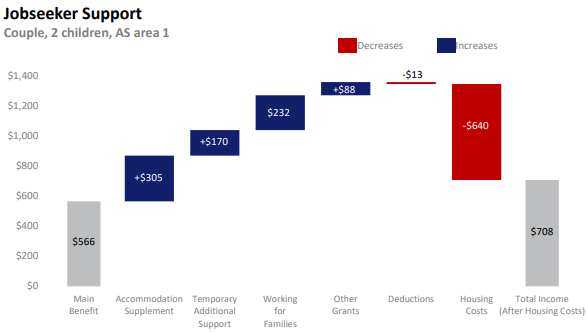
The next example shows a couple with two children. The nominated rent in this one seems reasonable:


Note that their total income is $1,348 per week or $70,096. This is though just an example. 

Below are actual average incomes by family type before and after housing costs:


Averages reflect a range of living costs around the country.

The couple with two children receives $59,644 annually net.

It is immediately obvious that one working parent - let's say the father earning around $60,000 - can only support his family as well as income from a benefit.

For example a father working in construction, education, and automotive on the median salary. 

If he worked in customer services, transport and logistics, or hospitality and tourism he'd be worse off.

And we wonder why there is a labour shortage.

I am out of time but go look at the report, especially the section on inflation. (Don't be tripped up by the 'equivalisation' process.)

Afterthought: It occurs to me that the government is going to start pushing this line hard - that they've looked after families with children on benefits but now single people are falling behind. The report nominates an unrealistically large rent in the single person example to leave a small after-housing costs income. Why?

Because they are gearing up to push the unemployment insurance scheme on New Zealand whether it is warranted or wanted.


Thursday, July 28, 2022

Graph of the Day


Heard any alarm bells ringing yet?

Friday, July 22, 2022

Carmel Sepuloni talks half of the story

 Carmel Sepuloni announces: 

Benefit numbers continue to fall

“The statistics show our investment into front line case management has worked, and while we are not out of the woods by any means, we are tracking in the right direction."

Not for children. Their numbers are going up.


Something else I would be worried about is that the "3,717 fewer people on a Main Benefit compared to March 2022" represents a 1% drop. 

Over the same period last year, the reduction was 3 percent.

Tuesday, June 21, 2022

MSD: More fraud investigators than prosecutions

The following pieces of information come from a published OIA response (the images are skewwhiff because that's how they appear at MSD's site):


But wait...there's more:


Read the response and draw your own conclusions.


Wednesday, June 15, 2022

Irreconcilable stats for April 2022

SEEK EMPLOYMENT REPORTS

SEEK Employment Report - Job ads soar to new highs in April


MSD REPORTS

Jobseeker Work Ready recipients increase by 345 in April

Main benefits cancels into work decrease by 3,678 in April

The Flaw in PM's Plan

In April this year the Prime Minister laid out the progress she has made towards child poverty reduction since taking office. She said her government has "lifted tens of thousands of children from poverty and improved the lives of many others."

She makes one specific comparison over the time frame since becoming Prime Minister - a "30% reduction in children aged 0-17 who live in low-income households after housing costs, over three years (from 2017/18)."

This was achieved primarily by lifting benefits and family tax credits - and in particular introducing a $60 weekly child payment called Best Start.

She failed to mention she has also overseen thousands more children becoming dependent on benefits.

Between March 2018 and March 2022 the number of children in benefit-dependent households grew by 22 percent or almost 37,000. To picture this increase, imagine about one hundred good-sized schools.

I spent a number of years as a volunteer working with dependent families and came to know the tragic circumstances of a typical child on a benefit. But my sample is small so let me construct a profile based on New Zealand statistics.

Let's call the child Sam. She's five and lives in Northland (which has the highest % of its working-age population on welfare). She is Maori and lives with her sole mother (more dependent sole parents are Maori than any other ethnicity). Sam's mum has debt to MSD of $4,000 (the average mean debt to MSD at June 2021) and receives hardship assistance for food (as one of  364,000 food grants issued in the March quarter). Sam lives in a private rental which is subsidised with a $160 weekly accommodation supplement. Sam has one older sibling, and her mum has been on thebenefit since leaving school (those entering the benefit system under twenty stay the longest). Sam's mum is 25 and will probably remain on a benefit well into her thirties (average future years expected on a benefit is 12.4 at 2021 - up from 10.6 in 2017).7 There is also a high chance Sam will herself become a beneficiary (looking at a group of 83,000 children born in benefit households between 1993 and 1995, 47% had entered the benefit system themselves by age 23.)

This then is a typical profile of a child in a benefit dependent household.

Less typical but still not statistically uncommon would be for Sam to have moved homes more than once since her birth; to be known to Oranga Tamariki; to have a mother with a substance use problem and/or suffering mental ill-health, and to have a father serving a community or prison sentence.

Benefit dependency is a known risk for children. The likelihood of children suffering abuse or neglect increases in proportion to time spent on a benefit. The correlation is probably due to the inherent dysfunction of non-working households. There is no need for a routine, no need to get to a job and no need for kids to get to school (Covid has only exacerbated the malaise.)

This mirrors what I saw as a volunteer called into help families in crisis (some on benefits cope admirably well but they are the exception).


   - A sixteen year-old heavily pregnant Maori girl with a controlling and menacing Pakeha boyfriend twice her age and fresh out of prison. She is living in the house of her alcoholic and criminal mother whom the Sallie Army has finally given up on.

    -A young Samoan man struggling to raise daughters (one not even his biological child) by a Maori mother who had abandoned them for gang life.

    -A self-absorbed immature European girl whose child was always exhibiting the latest Dr Phil acting-out syndrome eg pulling at her hair was apparently 'self-harming'.

    -Another older New Zealand European single mother deeply depressed and traumatised by a dark past she would hint at but never divulge. Not a fun game to participate in.

    -And yet another young, chaotic Pakeha female who'd lost custody of her child to her mother. She fantasized about being a human rights lawyer - also watching too much Oprah - but was only ever getting around to it. When I ferried her to the local polytech to be interviewed for a course in nail-care she insisted on wearing her pyjamas and dressing gown. Any excuse to stay on a benefit and watch daytime telly I expect.


None had any real incentive to change as long as the money came in.

These are the lifestyles of unemployed parents. They themselves have often not grown to adulthood but we pretend they can provide consistent and caring parenting ... if only the government just pays them more.

That's the major thrust behind the Prime Minister's mission to reduce child poverty. Paying everybody more whether or not they earn it.

That's the flaw in her plan. More money does not guarantee better child outcomes. In fact it does the very opposite when all it achieves is more children on benefits.

She is never challenged on the flaw in her plan.

Who asks the hard questions about where all the extra money goes? Who asks why New Zealand has apparently record low unemployment but over 200,000 children relying on a parent on a benefit? Who asks about appalling and worsening school absenteeism? Who asks why New Zealand ranked last in child mental well-being in the most recent UNICEF report card? Who asks why only one in five Maori babies has married parents?

Who cares so long as the PM can pat herself on the back and claim to have achieved what she came to parliament for.


Saturday, June 11, 2022

Why Luxon can't win the war on gangs

 According to the Ministry of Social Development, “The harm inflicted by gangs is a serious issue in New Zealand. We have a complex gang problem that spans social, economic and justice issues." 

That was 2014 when there were 3,960 adult gang members known to police.

Last year, in 2021, it was reported: “As of June 30, there were 8,061 gang members on the list curated by police, up from 5,343 at the end of 2017.”  

Over an examined twenty-one year period 92 percent of gang members received a benefit at some point with the average duration of receipt at 8.9 years. 

Their rents are often paid through the accommodation supplement if not through income-related rents and emergency housing in motels etc. And their food is often paid for through hardship grants. 

Gang partners are also paid single parent benefits and child tax credits. Their weekly ‘package’ can amass more than $1,000.

In 2014:

There are in the order of 6,000 to 7,000 children known to be associated with gang members who are growing up in welfare recipient families, and are subject to high rates of abuse and neglect.

A total of 3,516 children of gang members were recorded as being the victims of abuse or neglect that had been substantiated on investigation by Child, Youth and Family. This is 60 percent of the total 5,890 known children of gang members.

The alleged perpetrator of abuse or neglect of gang member’s children was more often recorded as the child’s mother than the gang member father.

Gang members do not itch to attach themselves to clever, educated, and independent females. Gang women are often the female offspring of gang parents who taught them how to care for children.

But it is important to gang members to father children, and they do it more frequently than non-gang members - 2,337 gang members had benefit spells that included 7,075 dependent children. 

Lately there’s a lot of noise over the deported 501s and their contribution to escalating gang and gun violence.

But New Zealand does very well in amplifying its homegrown problem through strong welfare incentives and weak child protection services. 

Today National leader Chris Luxon released his getting-tough-on-gangs policy. To be honest I haven't even read it.

Because a couple of days ago Chris Luxon told Guyon Espiner that National would raise benefits under his government.

Now National leader, he rules out welfare cuts and says the party will raise benefits if it wins power (without specifying when and by how much).

"I can tell you right now, I'm not dreaming up a policy to reform welfare ..."

Then you aren't serious about gangs - this generation and the next ...and the next ...

Saturday, May 21, 2022

So many elephants in the room they are becoming unremarkable

In the NZ Herald this morning ex Labour leader sort of congratulates Grant Robertson on his budget spending. Or rather, damns with faint praise really. He writes,

Housing ... not just the supply but also the quality of existing stock — continues to be the elephant in the room to addressing the growing inequity in our society.

Housing is an issue. It is some people's major issue. But...

Set me to thinking. What is mine?

It's twofold. It's stubborn and ignorant repetition of past policies that have never worked. 

And simultaneously charting dangerous territory with the assertions that democracy can't work for minorities (with flavour of the day, Maori). To that end frantically throwing out bedrock democratic principles.

Democracy doesn't work for minorities. I know. I am in one. The 5-10 percent that genuinely crave small government, free markets and personal responsibility. It doesn't follow I advocate for an overthrow of 'one person, one vote'. It means my minority has to persuade the majority their way.

But back to the point of my post. 

What is your elephant in the room?

Prove my point. There are so many elephants in the room that they are now unremarkable.


Thursday, May 19, 2022

Budget baloney

Unbelievable bullshit.

The great spin machine has it that for too long mothers on the DPB - called Sole Parent Support since 2013 - have been robbed, yes robbed, of their rightful child support payments made by the non-custodial father. Jacinda says mothers have been "denied money that is rightfully theirs."

Reality check. The state has generously paid a livable statutory entitlement to any sole parent - regardless of the reason for their single state - since 1973. If the non-custodial parent was paying child support (known as 'maintenance' at that time) the state kept it to offset the cost of the benefit to the taxpayer.

Today's announcement puts an end to that.

Some sole parents are in for a pay rise. 

Not because the father is going to pay more. But because the taxpayer is.


Wednesday, May 18, 2022

Female prison population shrinks nearly twice as fast as male


Between March 2017 and March 2022 the female prison population decreased by 39.3 percent whereas the male prison population shrank by just 22.4 percent.

A win for the ever-aggrieved feminists?

Wednesday, May 11, 2022

New Zealand today: Where facts are described as "nonsense"

 RNZ reports:

Shane Reti: Life expectancy for Māori was 30 years in the 1840s but today it is around 73.4 years.

Willie Jackson: Shane is talking nonsense.

There have been enormous health (and other) gains for Māori over the past 100 or so years. I gathered them together in one document here.

Progress is being made but constant polemic-driven politicking and redundant reforms will not hasten it.

If Andrew Little's goal is to reduce bureaucracy to improve efficiency, why develop two separate health authorities? He too is flying in the face of reality.

Ultimately, the personal decisions individuals make about their own health will have the greatest impact on their longevity.

That should be the message to Māori and every other person of every other ethnicity.


Saturday, April 30, 2022

Behind the headline

An RNZ headline reads:

High rate of suicide in pregnant and post-natal women

"Suicide is the leading cause of death during pregnancy and the postnatal period, and Māori women are three times more likely to die this way, a new report has found."

That's an alarming fact and one that somewhat surprised me.

Any suicide is a terrible tragedy but perhaps even more so when it involves an unborn child.

After a moment's reflection, my analytical mind immediately wants to know, how many?

The report is from the Helen Clark Foundation and while the assertion is made and referred to several times in the paper, no statistics are provided. The claim is referenced though and takes us to this source - the maternal section of Perinatal Mortality Review report.

In the thirteen years that span 2006 to 2018 there were 30 suicides or two annually on average.


There were 809,831 maternities in the same period. Maternal suicides are in fact very rare.

But rarity doesn't make for headlines.

Furthermore, there were 27 in the period 2006 to 2016, leaving three in 2017/ 2018.

Maternal suicides are reducing.

For context 65 young people under twenty took their lives in the year to June 2020.


Update: On TV One the maternal suicide number has grown to 10 every year. 


Thursday, April 28, 2022

Labour actually achieves something

The data for the following chart comes from StatsNZ. 

Looks like New Zealand is becoming a safer place. Fewer crimes are being committed - of every type - that warrant imprisonment.

There has been a 39.3% decrease in sentenced prisoners since 2016 from 8,958 to 5,433 total offences.

'Unlawful entry with intent/burglary, break and enter' has seen a 44.5 percent decrease. Wow.

What a great result by the Labour government.

Mr Sharma will be delighted.


Tuesday, April 26, 2022

On Māori inter-marriage and future implications

The rates of partnering between Māori and non-Māori are high and always have been. 

Historically:

 “Intermarriage with non-Maori contributed to the rapid growth of the Maori population in the post-war period. As at 2003, almost one-quarter of Maori children were born to non-Maori mothers, (Statistics New Zealand 2005).” 

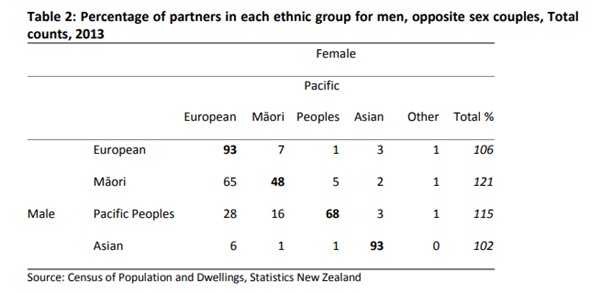
In 2013 fewer than half of Māori men had a Māori partner:

Source

The corresponding figure for Māori females is 52 percent.

Furthermore, trend-wise:

“There has been a small but important decline in the proportion of partnered Māori who have a Māori partner. In 2001, 53% of partnered Māori men had a Māori partner. In 2013 this declined to 48%. For Māori women the decline was from 52% to 47%.”

These realities pose vital questions:

1/ Is there a pervasive appetite for separatism among people who have long been attracted to those outside their own race and culture?

2/ With institutions and services increasingly split along racial lines, where will individuals of mixed ethnicity fall? This is particularly pertinent in the case of Oranga Tamariki which is pursuing a policy of keeping ‘Maori’ children with ‘Maori’ relatives as a priority. When all aspects of the child’s well-being are considered, this may be the best course of action; equally, it might not.

John Tamihere famously said New Zealand’s future, “… is being decided in our bedrooms, not our boardrooms.” He also identifies as Māori more strongly than any other ethnicity, as is his right.

Since making that proclamation as Māori Affairs Minister in 2004, Tamihere has become a strong advocate for separate systems. As Māori Party president he appears more radical in his views than when a Labour MP.

Is he now in danger of forcing those of mixed ethnicity – even children – to make difficult, possibly unbearable decisions to meet the demands for tino rangitiratanga – ‘by Māori, for Māori?’

At the risk of sounding overly dramatic the phrase ‘Let no man put asunder’ might be a reminder to those who want to divide New Zealand that ultimately, individuals make their own life choices, and those choices are sacrosanct.


Sunday, April 24, 2022

"What women want from Labour, National"

I strongly object to writers who refer to groups of people and profess to speak for them. It happens all the time with Maori, and now Paula Bennett presumes on behalf of women. 

But once a politician always a politician so it's hardly surprising. 

Political parties run 'focus groups' to find out who to woo and what to say. They put their political pinkies in the wind and blow with it. And blow is a good word.

This piece is a lot of 'blow'.

'We' this, 'we' that. Heavy on stereotypical female roles. A shout out to the sisterhood? A signal about how to behave if you want to belong? 

Identity politics, to be blunt about it. 

BUT Bennett knows more about women than I do. She has lost none of her political smarts. Her cloaked advice is for National (not Labour): "You must capture our heads and our hearts." Currently common corporate parlance.

I must have been mistaken when I thought identity politics was the domain of the left.

It squeezes out the individual who doesn't identify with any group - who gets a shiver down their spine when told WHAT THEY THINK AND WANT. Exactly what Bennett has done.

This whole device (former minister speaks for her gender to her former party) leaves me cold.

Then again, my cynicism regarding politicians has never been as deep as it is right now. 

The manipulative game they play, and which voters willingly participate in, is ruinous.


Saturday, April 16, 2022

PM: "Come to New Zealand, we're kind."

 The Prime Minister is off overseas tomorrow. RNZ reports:

Ardern will be making local media appearances and leveraging off New Zealand's Covid-19 response. She noted research suggesting those abroad now see the country in a more favourable light.

"They see us as people who look after others, and that's a really important message to send," Ardern said.

"Come to New Zealand, we're kind."

Kind of what? Kind of authoritarian? Kind of conformist? Kind of pathetic?

Jacinda said there would be no vaccine mandates. Thousands breathed.

Then she said there would. Thousands lost their livelihoods.

With nothing left to lose they went to parliament to appeal to her.

Not only did she steadfastly ignore them. She sneered and then smeared them. 

But let's shove aside the mental images still raw from the end of the protest. 

And all the hardship the government response to covid wreaked on the economy.

Covid aside, under Ardern, New Zealanders have experienced so much additional stress.

She has actively made life less tolerable for:

Farmers (unworkable regulations, new taxes, SNAs and encouraged division between rural and urban interests)

Landlords (often unnecessary onerous regulations and loss of tax exemption on mortgage interest)

Employers (more sick leave, higher legislated wages, extra public holiday and family violence leave)

The customers of farmers (all of us) are no better off. Farm produce gets more unaffordable.

Tenants are paying higher rents and now the pool of rental properties appears to be shrinking.

Employees are struggling with inflation that has both international and domestic drivers (not least the hyper spending by government on a burgeoning bureaucracy.) In a high inflation environment the poorest - and their children - hurt the most. They have the least disposable dollar.

The ratio of income to house prices - and newly legislated LVR lending restrictions - means many young people believe it is impossible to buy a home here.

The next migration outflow is imminent and unavoidable.

But... back to the PM's trip. She said, "Now is the time to get out and about, to support our exporters, and so we're willing to take on board the risks."

RNZ originally headlined their article PM says "Now is the time to get out"

An editor guarding their funding source has since changed it.

But I say it to my adult children all the time.