Friday, April 22, 2016
Must-read from Karl du Fresne
This is a powerful reminder of the grim injustice (in the name of 'justice') ideologues can wreak.

Thursday, April 21, 2016
Latest total benefit numbers - back where we started from
Well, not quite where we started from. That'd be zero. But back where we started from when National took govt.


The slow total decline continues. Down to 9.9% of the working age population.
There's a blip with JobSeeker support but nothing dramatic or necessarily trendsetting. It may be saying something about the employment situation. It might just be ageing single parents being moved onto Jobseeker support. Little to be inferred by the reduction in YP/YPP for 18+. The teenage birth rate is dropping so perhaps unsurprising. The old invalid benefit - Supported Living Payment - remains stubbornly high though any reduction is unusual compared to the past few years. Reliance on welfare due to psychological conditions continues to grow. The Sole Parent Support reduction is the biggest and best news leading to fewer children on benefits.

I don't see any smoking gun in the data tables.
Total numbers are dropping. Just not fast enough for some readers. Or me.
As the drop is post GFC it's worth looking where we were pre GFC.
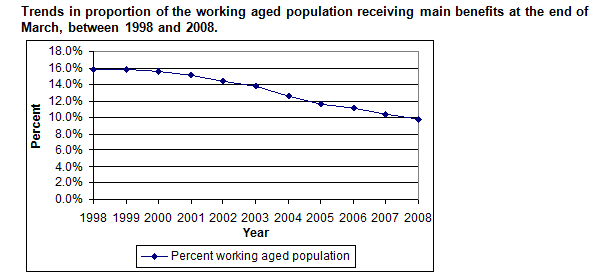
At 9.9% of the working age population.
(The Super numbers are the big growth area and while most people don't think of it as a benefit, it's included in the tables.
Almost 700,000.
Up 23% since March 2011.)
Tuesday, April 19, 2016
Quote of the Day
From a piece in this morning's DomPost about junk science by Matt Ridley (British journalist and Conservative MP), prompted by Robert De Niro joining into the anti-vaccine brigade.
"Instead of evidence-based policy making, pseudo-science specialises in policy-based evidence making."
"Instead of evidence-based policy making, pseudo-science specialises in policy-based evidence making."
Wednesday, April 13, 2016
English tells truth and gets it in the neck
A Labour MP from Palmerston North is outraged that Bill English has told the truth.
English said that there are Kiwi men who are supposed to be available for work but don't turn up; that can't read and write and are virtually unemployable. That's why NZ imports immigrant farm workers.
The Labour MP says this is the government's fault after 8 years at the helm.
Really? If the individual and the individual's family do not value education, if they prefer to make money illicitly or from benefits, if they get their kicks from a variety of law-breaking activities and spend much of their time cycling in and out of prison, is it really Bill English' fault?
The underclass, which we don't seem to talk about as much anymore, was just as bad after Labour's last 9 year innings.
This type of petty, cheap-shot politics grinds my gears. What would the Labour MP do in English' shoes? Sweep illiteracy and unemployability under the carpet and only ever present a rose-tinted picture of a certain slice of society?
Because when that happens, problems never get solved. English has probably been the most innovative and daring Finance Minister when it comes to social policy. That willingness to try new approaches is born out of his recognition and acknowledgement of just how hopeless certain people have become.
And when Bill English said that prisons are a "moral and fiscal failure" did any Labour MPs jump up and down then?
English said that there are Kiwi men who are supposed to be available for work but don't turn up; that can't read and write and are virtually unemployable. That's why NZ imports immigrant farm workers.
The Labour MP says this is the government's fault after 8 years at the helm.
Really? If the individual and the individual's family do not value education, if they prefer to make money illicitly or from benefits, if they get their kicks from a variety of law-breaking activities and spend much of their time cycling in and out of prison, is it really Bill English' fault?
The underclass, which we don't seem to talk about as much anymore, was just as bad after Labour's last 9 year innings.
This type of petty, cheap-shot politics grinds my gears. What would the Labour MP do in English' shoes? Sweep illiteracy and unemployability under the carpet and only ever present a rose-tinted picture of a certain slice of society?
Because when that happens, problems never get solved. English has probably been the most innovative and daring Finance Minister when it comes to social policy. That willingness to try new approaches is born out of his recognition and acknowledgement of just how hopeless certain people have become.
And when Bill English said that prisons are a "moral and fiscal failure" did any Labour MPs jump up and down then?
Friday, April 08, 2016
CYF overhaul: crux of the matter overlooked again
Another voluminous report into CYF; a long-winded ministerial response; multiple cabinet papers and a proposed radical overhaul promised
But when will the system that turns children into careless accidents or meal tickets be radically overhauled?
Because until then, none of these other investigations and re-inventions will matter a damn. There have been welfare reforms but the number of children being born into beneficiary families remains at the same level.

But when will the system that turns children into careless accidents or meal tickets be radically overhauled?
Because until then, none of these other investigations and re-inventions will matter a damn. There have been welfare reforms but the number of children being born into beneficiary families remains at the same level.
Of children born between 2005 and 2007 and known to CYF by age five:
39 percent had mothers who had been receiving a benefit for more than four out of the last five years preceding their birth, and 60 percent had a primary carer who was receiving a benefit at the time of their birth,
37 percent had a parent who had a criminal conviction in the five years prior to the child’s birth,
69 percent had parents where there was a family violence incident attended by Police in the five years prior to the child’s birth, and
36 percent had parents who were known to CYF as a child.

(Right-click on image to enlarge)
Thursday, April 07, 2016
Confusion in CYF report
This is from the Rebstock report into CYF released today:
"In 2014, CYF received 152,000 family violence notifications from Police involving 97,000 children. The majority of these were not acted upon as the nature of the concerns did not reach CYFs threshold for response and there was a lack of alternative services to address the needs of these families in the community."
My initial reaction to this was utter surprise. A majority not acted on? That seems shocking.
But that's because it's not right.
Consider the CYF statistics:

In 2014 there were 57,889 family violence referrals from Police and 88,768 care and protection reports of concern.
According to CYF:
Notifications comprise “reports of concern” (which may require action by Child, Youth and Family) and “Police family violence referrals” (which do not require action by Child, Youth and Family). We receive reports of concern from Education, Health, Police, Courts, social service providers, family members, and members of the public.
And:
Police family violence referrals are not assessed by Child, Youth and Family. Police family violence referrals are the result of Police attending a family violence incident where children are present or normally resident at the household concerned and where Police assess that Child, Youth and Family action is not required.So it would appear the report stats are wrong and misleading. The report goes on to state however:
These notifications represent a significant opportunity for early intervention to provide the support families need before concerns escalate into situations of harm to children.Which and how many? Can sound recommendations be made based on unsound data?
The Third Way triumphed
It's only 10 to 15 years since many of us were fighting the introduction of Paid Parental Leave, Working for Families, interest-free student loans AND Kiwibank - Jim Anderton's pet project and National's latest pragmatic point-of-sameness.
The principles behind that opposition have not changed. But our current government has abandoned them.
My son, who is no intellectual slouch, has taken to ridiculing the free market.
I point out that libertarianism cannot be blamed for the last recession. That no libertarian would support government bailing out private financial institutions. YES he says but you would support deregulation of them.
I counter that deregulation can only succeed when consequences are real; when they cannot be avoided through bail-outs.
So, he says, you would support allowing financial collapse just to teach people consequences?
You get the circular nature of these exchanges.
The up and coming voters have been taught to blame greed and exploitation on the free market (which has not actually been free) as if the free market is just a beast that governments tolerate; that governments can and should control in the pursuit of utilitarian goals.
The collective memory of a society functioning without (or at least with a smaller) welfare state - mass compulsory wealth redistribution - is fading.
Mass redistribution brings with it commandeering control of each major aspect of life - education, health and welfare. Once government assumes the responsibility for financing provision of these, it must then gradually assume control of each and every personal action which imposes an associated cost.
The idea remains abhorrent to me.
Earlier dissenters seem lulled or numbed into submission. NZ may have a so-called right-of-centre government but Labour's 'Third Way' has triumphed.
The principles behind that opposition have not changed. But our current government has abandoned them.
My son, who is no intellectual slouch, has taken to ridiculing the free market.
I point out that libertarianism cannot be blamed for the last recession. That no libertarian would support government bailing out private financial institutions. YES he says but you would support deregulation of them.
I counter that deregulation can only succeed when consequences are real; when they cannot be avoided through bail-outs.
So, he says, you would support allowing financial collapse just to teach people consequences?
You get the circular nature of these exchanges.
The up and coming voters have been taught to blame greed and exploitation on the free market (which has not actually been free) as if the free market is just a beast that governments tolerate; that governments can and should control in the pursuit of utilitarian goals.
The collective memory of a society functioning without (or at least with a smaller) welfare state - mass compulsory wealth redistribution - is fading.
Mass redistribution brings with it commandeering control of each major aspect of life - education, health and welfare. Once government assumes the responsibility for financing provision of these, it must then gradually assume control of each and every personal action which imposes an associated cost.
The idea remains abhorrent to me.
Earlier dissenters seem lulled or numbed into submission. NZ may have a so-called right-of-centre government but Labour's 'Third Way' has triumphed.
Tuesday, April 05, 2016
3,999,999
Helen Clark may feel like she has a "stadium of 4 million people" behind her - and judging by overwhelming opinion expressed today she has - but she can count me out.
I respected Clark as a PM for acknowledging the problems of chronic inter-generational despondency and dysfunction.
But even then she would not move against the prevailing feminist and socialist theory of (false) empowerment of women - the DPB.
Back on the DPB band wagon? Being petty when NZ could have the first woman heading the UN?
1/ The impoverishment of thousands of children is no small beer
2/ I do not care about nationalism or feminism. I do not get warm fuzzies about the connection Clark has to New Zealand or to my gender.
It has made me deeply uncomfortable today that so very many, John Key included, are prepared to forget not personal animosities (they are small beer) but the ideological antipathy that freedom- embracing, small govt acolytes had for Clark.
Whoever the successful candidate is (notwithstanding the arguable impotence of the UN) I would prefer someone who has not made it their life's work to advance the responsibility and power of the state to enrich lives.
I respected Clark as a PM for acknowledging the problems of chronic inter-generational despondency and dysfunction.
But even then she would not move against the prevailing feminist and socialist theory of (false) empowerment of women - the DPB.
Back on the DPB band wagon? Being petty when NZ could have the first woman heading the UN?
1/ The impoverishment of thousands of children is no small beer
2/ I do not care about nationalism or feminism. I do not get warm fuzzies about the connection Clark has to New Zealand or to my gender.
It has made me deeply uncomfortable today that so very many, John Key included, are prepared to forget not personal animosities (they are small beer) but the ideological antipathy that freedom- embracing, small govt acolytes had for Clark.
Whoever the successful candidate is (notwithstanding the arguable impotence of the UN) I would prefer someone who has not made it their life's work to advance the responsibility and power of the state to enrich lives.
Monday, April 04, 2016
Inequality an excuse for theft
Yesterday I made a prediction about the response to Rodney Hide's account of chasing a shoplifter.
Quite bizarrely the type of reaction I predicted has come about, but not in the comments section after Rodney's column.
In this mornings DomPost Jane Bowron also writes about her experience in witnessing shop-lifting from her local supermarket. There must be a lot of it going on . Here is an excerpt from her column,
But Bowron isn't just an apologist for the victims of inequality. She even sympathizes with the second group.
And earlier in her piece she refers to the "hugely profitable" status of the supermarket being ripped off, as though that also somehow balances the books.
But just as her defence of thieves is muddle-headed, so is the column in its entirety, the conclusion being citizens should arrest these offenders.
Why suggest that joe public should pursue and apprehend an individual who has just been painted as some sort of latter-day Robin Hood?
Quite bizarrely the type of reaction I predicted has come about, but not in the comments section after Rodney's column.
In this mornings DomPost Jane Bowron also writes about her experience in witnessing shop-lifting from her local supermarket. There must be a lot of it going on . Here is an excerpt from her column,
The gap between rich and poor is widening and with the long term stagnation of wages, theft for some is a desperate option while for organised habitual offenders, it's simply what they do for a job.
But Bowron isn't just an apologist for the victims of inequality. She even sympathizes with the second group.
The latter are relatively small-scale operators trying to make a buck, while corporate theft is allowed to go unchecked, is lauded and treated as a swaggering success story.
And earlier in her piece she refers to the "hugely profitable" status of the supermarket being ripped off, as though that also somehow balances the books.
But just as her defence of thieves is muddle-headed, so is the column in its entirety, the conclusion being citizens should arrest these offenders.
If we could just get over our apathy and take the global citizen's arrest principle wider, we might strike a blow against the empire of our own apathy.
Why suggest that joe public should pursue and apprehend an individual who has just been painted as some sort of latter-day Robin Hood?
Sunday, April 03, 2016
Prediction
Rodney Hide writes a column about supermarkets' inability to defend their property from shoplifters because of asinine assault laws.
I will make a prediction about the comments that will ensue.
At least some will resemble the following:
It is a tragedy that a man has to steal to feed his family. And it's your politics, Rodney, that caused mass unemployment and poverty in this country.After all, the left has been excusing theft for decades.
Never mind the small matter of job opportunities in Christchurch and the surrounding regions. The fact that Canterbury has the lowest unemployment rate in NZ is just inconvenient.
Friday, April 01, 2016
Govt closes gap between benefit and employment income
Today beneficiary parents receive a pay rise of $25 weekly or $1,300 yearly.
It is impossible without asking an OIA question to know exactly what that means in terms of percentage rise. That's because even though basic rates are known and constant, all the add-ons vary individually.
The last time the government published an average beneficiary payment was 2013:
With today's increase she would be receiving $673 a week.
The best figure to compare that to is the average weekly incomes from wages and salaries:
Female $752
Female Maori $723
Female Pacific $698
Either sex aged:
15-19 $345
20-24 $698
25-29 $852
The table I am quoting doesn't provide gender breakdown with age but female rates are overall consistently lower than male.
So, all in all, for a young sole mother - particularly Maori or Pacific - $673 is looking fairly attractive.
Yes, the work-testing has been extended to part-time (20 hours) for mothers with youngest child aged 3.
But the work obligations are only ever useful in places where there are jobs.
It'll be interesting to observe the behavioural changes over the coming 2-3 years.
Remember that the early work-testing policy implemented to stop people adding children to an existing benefit has already failed.

It is impossible without asking an OIA question to know exactly what that means in terms of percentage rise. That's because even though basic rates are known and constant, all the add-ons vary individually.
The last time the government published an average beneficiary payment was 2013:
An average sole parent with two children under thirteen, living in South Auckland would receive around $642 on benefit, including accommodation supplement and a minimal extra allowance for costs.As benefits are inflation proofed (though add-ons aren't) that would increase to $647.95 in the last quarter of 2015.
With today's increase she would be receiving $673 a week.
The best figure to compare that to is the average weekly incomes from wages and salaries:
Female $752
Female Maori $723
Female Pacific $698
Either sex aged:
15-19 $345
20-24 $698
25-29 $852
The table I am quoting doesn't provide gender breakdown with age but female rates are overall consistently lower than male.
So, all in all, for a young sole mother - particularly Maori or Pacific - $673 is looking fairly attractive.
Yes, the work-testing has been extended to part-time (20 hours) for mothers with youngest child aged 3.
But the work obligations are only ever useful in places where there are jobs.
It'll be interesting to observe the behavioural changes over the coming 2-3 years.
Remember that the early work-testing policy implemented to stop people adding children to an existing benefit has already failed.

Thursday, March 31, 2016
Now that's a scary thought
There probably are as many persons coerced into acting, not as they want, but as others want, through majority rule as through totalitarian dictatorship.
– John C. Sparks, The Freeman [May 1971]
(hat-tip FFF)
– John C. Sparks, The Freeman [May 1971]
(hat-tip FFF)
Tuesday, March 29, 2016
Grant Robertson's baseless claims
According to Grant Robertson today:
"New Zealand’s growth per person is significantly lower than countries like the UK and America, showing our economy is driven by population growth rather than productivity, says Labour’s Finance spokesperson Grant Robertson.
“Along with flat per person growth, we have seen a fall in per capita real incomes. This means on average Kiwis are getting poorer. That’s because the key driver is population growth, not new businesses, industries and exports which is what’s needed to boost growth per person."
I queried the OECD database for GDP per capita between 2008 and 2015:

(Left-click to enlarge)
This shows that the growth in the UK was 2.4%; in the US, 4.4% and in NZ, 7.5 %
Here's the data graphed.

No NZ isn't flash overall but it's comparatively better now than it was when Labour left office.
Robertson even included Japan in his headline yet their growth was lower than the UK or US between 2008 and 2014.
Monday, March 28, 2016
What globalisation looks like
Idly reading an article I was captured by the photo.
What city is that a photo from, I wondered?

I can see 3 or 4 Asian looking people, maybe a Philippine, 2 or 3 Caucasian people, a tall black man, someone who looks slightly eastern European or even middle eastern.
It just intrigued me because I can only partly see the trains logo.
Then I checked the source - the Fraser Institute. So Canada. I googled Canadian Subway logos and found this.

Toronto. Without the source clues I never would have guessed.
Globalisation. It's a wonderful thing.
Crowded subway trains are not.
What city is that a photo from, I wondered?
I can see 3 or 4 Asian looking people, maybe a Philippine, 2 or 3 Caucasian people, a tall black man, someone who looks slightly eastern European or even middle eastern.
It just intrigued me because I can only partly see the trains logo.
Then I checked the source - the Fraser Institute. So Canada. I googled Canadian Subway logos and found this.
Toronto. Without the source clues I never would have guessed.
Globalisation. It's a wonderful thing.
Crowded subway trains are not.
Sunday, March 27, 2016
Distribution of preference for new flag by electorate
Another graph from David. I don't know enough off the top of my head to see the pattern but he says the pro-change vote aligns to National seats, particularly in the South Island. Also the strong no-change vote in Winston country. Obviously the Maori seats are excluded in this picture. They all voted strongly for the status quo (but with low turn-out).

Friday, March 25, 2016
The higher the voter turn-out, the stronger the preference for change
I was looking at the voter turn-out and noticed that the higher turn-out electorates had a stronger preference for change. David made a graph for me.

The correlation is pretty strong.
(Left-click to enlarge)
A third of people couldn't be bothered
Even when voting is made as easy as a tick and a trip to the postbox, a third of people can't be bothered.
Probably the same people who don't vote in general elections.
People don't have to vote and I am utterly opposed to compulsory voting. For selfish reasons, I don't want someone who doesn't give a fig cancelling out the vote of someone who is engaged and voting with purpose and reason. Me:-)
But for all our vaunting and celebration of democracy, a segment much bigger than it should be, just doesn't give a f--k.
Probably the same people who don't vote in general elections.
People don't have to vote and I am utterly opposed to compulsory voting. For selfish reasons, I don't want someone who doesn't give a fig cancelling out the vote of someone who is engaged and voting with purpose and reason. Me:-)
But for all our vaunting and celebration of democracy, a segment much bigger than it should be, just doesn't give a f--k.
Tuesday, March 22, 2016
A profoundly stupid idea
Breaking with normal practice, I am blogging on the same subject in successive posts.
Giving every teenager $200 a week when they turn 18 is a profoundly stupid idea.
The most meaningful reform National has made is scrapping the old cash benefit available to youth and young parents. Instead their income from the state is managed and there are tight strings attached. They get a tiny sum of cash and can only increase it by meeting certain challenges. They are heavily mentored, parented in a way they have probably never been before. The idea is to get educational qualifications, work skills and self esteem into them before it is too late.
An unconditional $200 a week would reverse this whole approach. It would be madness.
It would replicate the mindset of generational dependency seen in families that encourage - even expect - their kids to go on the dole or DPB as soon as possible to boost the family's income.
Its a truly frightening prospect.
Giving every teenager $200 a week when they turn 18 is a profoundly stupid idea.
The most meaningful reform National has made is scrapping the old cash benefit available to youth and young parents. Instead their income from the state is managed and there are tight strings attached. They get a tiny sum of cash and can only increase it by meeting certain challenges. They are heavily mentored, parented in a way they have probably never been before. The idea is to get educational qualifications, work skills and self esteem into them before it is too late.
An unconditional $200 a week would reverse this whole approach. It would be madness.
It would replicate the mindset of generational dependency seen in families that encourage - even expect - their kids to go on the dole or DPB as soon as possible to boost the family's income.
Its a truly frightening prospect.
Monday, March 21, 2016
Labour's $40 billion policy (updated)
The universal basic income.
$40 billion. Yes. That's roughly what it will cost to give every New Zealander aged 18 or over $11,000 annually.
Putting aside questions of affordability, who will vote for this?
Pensioners?
It's well under what Super pays so I don't think so - not en masse anyway.
Beneficiaries? There's mention of supplementary transfers for the most disadvantaged. Vague. I doubt it.
Students? Possibly. But they'll have to be convinced to pay the substantially higher tax such a policy demands. After all they expect to form the most highly-taxed bracket ultimately.
Self-employed and business owners? They won't be keen on higher taxes either. And they aren't silly. They understand the senselessness of pay without productivity.
You would think there was some sort of massive employment crisis yet the unemployment rate is 5.3%.
Not 15.3% or even 10.3%
Time and again there have been points in history when technology has been tipped to make man redundant. Yet jobs keep inventing themselves.
And what would the effect on other services be? Education, Health, Law and Order?
Credit to Bill English for calling it without equivocation:
But nobody could put it past Labour, with their mid-2000s record of bribery, to craft this craziness into policy in time for the next election.
Update; I had forgotten Treasury's work in this area. The following is a comment I just posted at Kiwiblog
At the request of the Welfare Working Group Treasury did some modelling on Guaranteed Minimum Incomes in 2010:
“An income of $300 per week is just over the average (mean) benefit income – therefore a plausible minimum income. However, paying a guaranteed income of $300 per week to every New Zealander aged 16 years and over, excluding superannuitants, comes at considerable fiscal cost. The fiscal cost
of the GMI proposed in the first model (Model 1) is $44.5 billion (including the cost of all social transfers – in particular, New Zealand Superannuation payments, would cost $55.5 billion), requiring
a flat personal tax rate of approximately 45.4%. Note that this tax rate and the others considered below are cost-neutral – not fiscally neutral – as personal taxes currently raise approximately $6
billion in excess of current social assistance costs.
However, a consequence of Model 1 is that the higher personal taxes rates lower post-tax New Zealand Superannuation payments by approximately 44% on average. Therefore, a second model
(Model 2) was developed that removed New Zealand Superannuation and extended the GMI payment to superannuitants. As expected, the fiscal cost of the GMI increased to $52.6 billion ($55.6 billion including all social transfers) requiring a higher flat personal tax rate of 48.6%. However, it did improve the outcomes for superannuitants, evident by declining poverty levels.”
http://igps.victoria.ac.nz/WelfareWorkingGroup/Downloads/Working%20papers/Treasury-A-Guaranteed-Minimum-Income-for-New-Zealand%20.PDF
Treasury concluded:
“The GMI scheme proposed by the Welfare Working Group is a significant policy change with large
economic consequences. The scheme is fiscally very costly and would not necessarily achieve its main goal of reducing poverty. The high personal tax rates required to fund the scheme are highly
distortionary to the labour market and to savings and investment decisions, and would be likely to
induce a significant behavioural response. This has damaging effects on the tax system and economic
growth. “
$40 billion. Yes. That's roughly what it will cost to give every New Zealander aged 18 or over $11,000 annually.
Putting aside questions of affordability, who will vote for this?
Pensioners?
It's well under what Super pays so I don't think so - not en masse anyway.
Beneficiaries? There's mention of supplementary transfers for the most disadvantaged. Vague. I doubt it.
Students? Possibly. But they'll have to be convinced to pay the substantially higher tax such a policy demands. After all they expect to form the most highly-taxed bracket ultimately.
Self-employed and business owners? They won't be keen on higher taxes either. And they aren't silly. They understand the senselessness of pay without productivity.
You would think there was some sort of massive employment crisis yet the unemployment rate is 5.3%.
Not 15.3% or even 10.3%
Time and again there have been points in history when technology has been tipped to make man redundant. Yet jobs keep inventing themselves.
And what would the effect on other services be? Education, Health, Law and Order?
Credit to Bill English for calling it without equivocation:
National's Finance Minister Bill English said a universal basic income "would be very expensive and likely discourage work".Well, perhaps he could have been a tad more dismissive.
But nobody could put it past Labour, with their mid-2000s record of bribery, to craft this craziness into policy in time for the next election.
Update; I had forgotten Treasury's work in this area. The following is a comment I just posted at Kiwiblog
At the request of the Welfare Working Group Treasury did some modelling on Guaranteed Minimum Incomes in 2010:
“An income of $300 per week is just over the average (mean) benefit income – therefore a plausible minimum income. However, paying a guaranteed income of $300 per week to every New Zealander aged 16 years and over, excluding superannuitants, comes at considerable fiscal cost. The fiscal cost
of the GMI proposed in the first model (Model 1) is $44.5 billion (including the cost of all social transfers – in particular, New Zealand Superannuation payments, would cost $55.5 billion), requiring
a flat personal tax rate of approximately 45.4%. Note that this tax rate and the others considered below are cost-neutral – not fiscally neutral – as personal taxes currently raise approximately $6
billion in excess of current social assistance costs.
However, a consequence of Model 1 is that the higher personal taxes rates lower post-tax New Zealand Superannuation payments by approximately 44% on average. Therefore, a second model
(Model 2) was developed that removed New Zealand Superannuation and extended the GMI payment to superannuitants. As expected, the fiscal cost of the GMI increased to $52.6 billion ($55.6 billion including all social transfers) requiring a higher flat personal tax rate of 48.6%. However, it did improve the outcomes for superannuitants, evident by declining poverty levels.”
http://igps.victoria.ac.nz/WelfareWorkingGroup/Downloads/Working%20papers/Treasury-A-Guaranteed-Minimum-Income-for-New-Zealand%20.PDF
Treasury concluded:
“The GMI scheme proposed by the Welfare Working Group is a significant policy change with large
economic consequences. The scheme is fiscally very costly and would not necessarily achieve its main goal of reducing poverty. The high personal tax rates required to fund the scheme are highly
distortionary to the labour market and to savings and investment decisions, and would be likely to
induce a significant behavioural response. This has damaging effects on the tax system and economic
growth. “
On-line bullying the new fall guy
Social media has become the new fall guy for everything wrong with teenagers. Older generations are always looking for new evils to explain the behaviours and characteristics of teenagers. It's like blaming rock and roll in the fifties, and other nasty American influences on young people.
Here's today's silly headline
Children are more resilient at 10 years old than 15, study finds
Puberty, you egg.
At 10 life is uncomplicated.
I can't believe anyone would think that the difference between 10 and 15 is a mystery waiting to be solved. Surely I will read on and get to it.
Except, on-line bullying is a symptom, not a cause.
Keep going.
Having read the whole article, 'puberty' didn't get a look in. Must have gone out of fashion.
Here's some sense from Psychology Today:
Here's today's silly headline
Children are more resilient at 10 years old than 15, study finds
"Research shows children are at their most resilient at age 10... Ten-year-olds are at the top of their game, it's the time in their lives they are most likely to feel happy, confident and ready to take on the world. But by age 15, that resilience has plummeted. So what happens on the way to those mid-teen years?"
Puberty, you egg.
At 10 life is uncomplicated.
I can't believe anyone would think that the difference between 10 and 15 is a mystery waiting to be solved. Surely I will read on and get to it.
The 15-year-olds, usually in year 9, are far less likely to feel encouraged at school, to feel safe at school, to have an adult who listens to them or to feel "very hopeful". And in one clue to why there is such a marked difference between the older and younger children, 15-year-olds were more than twice as likely to have been bullied online in the past year.Oh, on-line bullying. Of course.
Except, on-line bullying is a symptom, not a cause.
Keep going.
As to why there is such a drop in confidence towards the mid-teen years, Fuller says parents often feel less close to their kids during adolescence and involvement in community activities and groups typically drops off around this age.Having parents less involved and peers more involved is again an effect of how the individual is adjusting to the changes his or her body and brain is going through.
Having read the whole article, 'puberty' didn't get a look in. Must have gone out of fashion.
Here's some sense from Psychology Today:
For most young people, puberty catches them at a bad time - during the early adolescent years (around ages 9 - 13) when they are separating from the shelter of childhood and begin striving for social belonging and place among their society of peers. Already feeling adrift from family and at sea in this brave new world of more social independence, puberty demonstrates how they are also out of control of their body. Developmental insecurity and early adolescence go hand in hand.For most young people, puberty is the enemy of self-esteem.
Subscribe to:
Posts (Atom)


