Friday, February 26, 2016

"Poor decisions" lead to poor lives

The NZ Initiative released a report into poverty this week. Co-author, Jenesa Jeram has a piece in this morning's DomPost explaining the various measures used to gauge poverty and how they can show very different things. She also points out that various parties are motivated to cherry pick to suit their purposes. That's fine but there needs to be transparency around exactly what the numbers they use mean.

The report is a good summary and a great reference source. Unfortunately the overriding message  taken from the report (in part because the NZ Initiative chose to highlight it) was that high housing costs are making some people poor. That is undeniably true. It is a fact. But armed with the facts people continue to expose themselves and their children to that reality.

Take a step back. Those now three famous ways to steer clear of poverty are; finish your education, have your children after you marry, and stay married. Life's expenses are manageable if people make sensible choices, and most do.

The report does allude to this in the executive summary:

Benefit levels and conditions presumably reflect public opinion about the causes of hardship. The more than four-fold increase since 1970 in the proportion of the working age population on a benefit other than the unemployment benefit could be influencing public perceptions. One survey of public perceptions suggests that many might not be accepting the most exaggerated claims of the extent of child poverty and consider poor decisions to be a material reason why some people of working age are experiencing hardship. 
Poor decisions lead to poor lives. I have made some shockers in my own but I did learn from them.

This isn't about being judgmental or on a moral high horse. People need to think ahead, take seriously the consequences of the choices they make especially about forming relationships and having children. Unfortunately welfare has relieved them of the worst outcomes and diminished that ability.

Wednesday, February 24, 2016

The rush to be state house kids

An interesting piece in today's NZ Herald highlights excerpts from speeches of various MPs deliberately personalising the "kiwi dream" by relating their own childhood experiences. It makes the MPs seem a little silly and their anecdotes contrived when thrown together but it could be coincidence. Whatever. The mad rush to be a state house kid (or grow up next to one) began with the Prime Minister.

The nostalgia for the sixties should be tempered though.

I was flipping through a book at Lower Hutt library yesterday and stopped on a page describing 1961. TV was just being introduced. A handful of restaurants were being granted licences to serve alcohol (their names were recognisable to me illustrating how few there were). The only businesses open at the weekend were dairies. Every man trundled home to his suburban housewife and kids to embark on a weekend of gardening and home maintenance  maybe with a trip to the park or some sports game or beach. Lives were quite predictable and uniform.

I also picked up Gordon McLauchlan's The Passionless People Revisited and opened it somewhere at the back. He was explaining why New Zealand wives last so long as sexual partners. Apparently because they have so few moving parts. I thought that was jolly funny and decided to take the book out. But on getting it home I was disappointed to find it opens with a deeply grudging literary assassination of John Key and a litany of every thing wrong with New Zealand. Another soul pining for regulation and state control.What a drudge. That's going back unread.

It is true we have left behind some good values, or moved away from them increasingly. But it is also true much that was undesirable has been consigned to the past - thankfully. If the sixties were put up for auction I doubt there'd be a bidder in the room.

Tuesday, February 23, 2016

The left in charge...in Wgtn anyway

Local body politics in Wellington is dominated by left activists including churches, unions, political party members and lots of troughers.

Living Wage Wellington is calling for wider implementation because,

 "Becoming a Living Wage council and paying the Living Wage to all council staff — directly employed and those employed via contractors and in CCOs — was overwhelmingly supported in public consultation for the 2014/15 Annual Plan and the 2015/25 Long Term Plan. The Council has voted for this. The people of Wellington have backed it. Now it’s time to make the commitment to the Living Wage a reality.”

So I had a quick scroll through submissions (737 pages).

The following form-submission appears many, many times. Obviously cut and paste from a source and simply e-mailed in. Now there is nothing to stop other non-Left groups encouraging people to do the same, but it tends not to happen.

Submissions

Dear Annual Plan
I write as a citizen and ratepayer of Wellington to  call on Wellington City Council, through
your 2014/2015 Annual Plan, to:
 Fully implement your decision to become a Living Wage employer and ensure all
Council workers, including directly employed and those working through CCOs and
contractors, are paid a living wage
 Make this a priority in order to address inequality in our city and recognising that the
benefits of a living wage far out-weigh the costs
 Meet the cost through a range of measures, including from the Council’s current
wage budget and through negotiation with relevant contractors. Any cost to
ratepayers will be staged as contracts come up for renegotiation.

I was astonished at the huge number of submissions from cyclists wanting better cycle ways, and other multiple submissions were from anti-fluoridation advocates.

One gets the strong impression that the left are highly organised in Wellington and accordingly, have a great deal of pull with the council.

As far as I am aware the council did not poll on the living wage issue so we cannot know that "the people of Wellington have backed it".

The only "known" is overwhelming support from the very sources you would expect.

Wellington City Council - Living Wage debate

Monday, February 22, 2016

Has the 'child poverty' barrow stopped working for the Greens?

Shedding a third of their vote (12% down to 8% in the latest Colmar Brunton poll) is either about Green MPs or their ideas. Some people think it's a strategic decision by voters to ensure a strong Labour. I'm not buying that. A vote for the Greens is a vote for a Labour-led government after all.

Child poverty is an issue the Greens own. They blatantly campaign in primary schools enticing young minds into their own victimhood mentality. They exploit children on campaign posters in the most thinly-veiled attempt to buy votes.

Never forget that the Greens are Marxist. Child poverty has been an effective way to win the public over to greater wealth redistribution compelled by government.

It doesn't matter to Metiria Turei that redistribution has so far not only failed to improve the lot of children - it's worsened their outcomes.

Doesn't matter that making more people reliant on welfare will make more people more miserable.

Instead of re-evaluating their ideas based on evidence, they forge on, most recently joining and heavily promoting a social media campaign built around the slogan "Child poverty - it's not a choice."

I believe  this slogan was arrived at exactly because of the realization that voters aren't disassociating children from their parents. Voters think that child outcomes are heavily influenced by parental decisions. Voters think that parental choices have a good deal of bearing on whether a child will experience hardship.

Next, showing exactly how out of touch they are, the Greens nominated Sue Bradford for Children's Commissioner. Perhaps they think a blast from the past (a more glorious Green past) would boost their ratings. Fail.

The next poll may very well prove me wrong but my money is on  Metiria Turei and child poverty - the MP and the idea - being a loser for the party.


Sunday, February 21, 2016

That damned flag

It’s not over yet, but it looks like the old flag, left, will win out over the new in the upcoming referendum.

In today's HOS this photo appears with the by-line: It’s not over yet, but it looks like the old flag, left, will win out over the new in the upcoming referendum. 

A friend gave me a book yesterday called Who moved my cheese? which is a little parable about accepting change. After I finished it I thought, I still don't like that damn flag.

I have listened to all the sensible arguments for change yet when I look at the photo above I feel something for the flag on the left that I don't for the flag on the right. So maybe I am letting emotion override logic? How can I have feelings for a set of colours and lines?

I suppose as an artist (I allowed myself to think in terms of being an artist when I started to sell paintings and receive commissions and had to describe how I earned income) I live and breathe colours and lines. And when it comes to what I like - which heavily influences what I produce - it's about beauty, harmony and depth. I hate art that merely serves a purpose or expresses some deep-seated anxiety or is invented only to shock.

But it is virtually impossible to describe why certain colours and lines evoke a good emotional response. And I have never wanted to analyse it.

The current flag is far more aesthetically pleasing to me than the alternative.

And that's why I can't change my mind.

Saturday, February 20, 2016

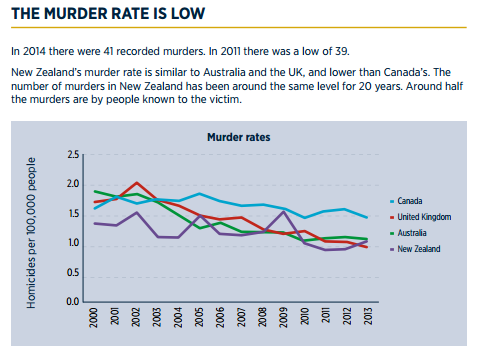
Kim Workman on the 'low' murder rate

Kim Workman kindly sent me a graph which depicts murder rates in New Zealand extending back even further than mine. I've included his commentary below it.

Hi Lindsay


You might like to post the attached graph on your blog – it shows the murder rate from 1879 through to 2010 – it was prepared by the Ministry of Justice. 


What it shows is that there was a very high rate from 1880 to 1890 – New Zealand was a very ‘atomised’ society, high numbers of single men, high levels of vagrancy, itinerant workers significant drinking culture.  A significant downward trend to around 1905, and then it was all over the place until 1950 when there was a significant rise until 1990, when it started to decline, and has been declining ever since. Well over half the murders today are within the family, or people that are in a relationship.  About 1 to 1.5 murders a year are random killings of people who are unknown to the murderer. 


There is no evidence that I know of, which shows that ethnicity is a factor – but a lot of evidence which points to general social dysfunction.   The latest NZ Crime and Safety Survey, (which is the only statistical survey that’s reliable , given the propensity of government agencies to play around with stats) shows that  3 percent of the population experienced more than half of all crime in 2013, - a greater concentration of crime than in 2008 when six percent of the population experienced 52 percent of all crime.  In other words there is a small group of chronic victims, living in marginalised communities.   And the distribution of victimisation is becoming more unequal over time. 

Thursday, February 18, 2016

Justice sector: "The murder rate is low"

You will be pleased to know that the murder rate is low:


The natural reaction of older folk like me is, Compared To What?


Not 50 years ago.

Data source

(The population grew by 126% over the same period. How to put in a secondary axis has temporarily evaded me.)

Tuesday, February 16, 2016

Pacific Islands Family Study: Fathers also victims of partner violence

There are a number of longitudinal studies underway in NZ.

The well-known Christchurch Health and Development Study (birth cohort 1977); the Dunedin Multi-disciplinary Study (birth cohort 1973); and Growing Up in New Zealand Study (birth cohort 2009-10) are those that jump to mind.

But today I learned of the Pacific Island Family Study (birth cohort 2000) reported here.

Readers might be interested in some of the findings to date.

Participants: the PIF Study recruited 1,376 mothers of a cohort of 1,398 Pacific infants (22 pairs of twins) born at Middlemore Hospital (a large tertiary hospital) in South Auckland between 15 March and 19 December 2000. An infant was deemed eligible for the study if at least one of their parents identified themselves as being of a Pacific ethnicity and was a permanent resident of New Zealand

Data collection: the PIF Study primarily collects self-reported data through structured interviews with mothers and fathers in their homes and with children in their schools. Children and their families have been visited when the children were aged six weeks, and 1, 2, 4, 6, 9 and 11 years

This one intrigues me  because fathers were less likely to smoke over time but mothers more.

This caught my eye because it shows (as often argued on this blog) that men are also victims of partner violence. At Year 11 of the survey 10% of fathers and 16% of mothers reported being victims of minor physical partner violence; 4% of fathers and 8% of mothers reported being victims of severe partner violence.

Noteworthy is this commentary:

"The PIF findings are consistent with those reported in other New Zealand groups (Magdol et al, 1977), and revealed that mothers were just as likely as fathers to perpetrate and be victims of severe IPV."


Overcrowding is not unusual in PI households but this puts some dimensions on the extent. This prompted me to speculate about the apparent poverty of PI children using the official child poverty measurements which are based on equivalised household incomes. Equivalising means adjusting for numbers of household members. So the more members, the lower the equivalised income will be.

While it is quite true that more members will require more financial resources I am nevertheless reminded that child poverty measurement is based on a constructed household income - not actual household income.

Here's a final observation I also found interesting:

The high percentage of traditional gift giving among Pacific families, and the level of financial stress associated with such practices, may play a role in reducing the financial security for some of these Pacific families. There is growing evidence that younger, New Zealand-born, Pacific people are becoming less committed to traditional gift giving to churches and other cultural obligations. 
That may be a good or bad thing depending on which side of the transfer one stands.

Monday, February 15, 2016

PM says something useful

In Parliament last week, after a great deal of belly-aching and nagging by Metiria Turei about taxing people more, the Prime Minister responded:

"...our whole system relies on people getting out of bed in the morning, working hard, and paying taxes. In my experience, there are literally millions of New Zealanders who get up every morning, who do not want the Government to give them a handout, and certainly just want to have a fair system in which to operate."

Then, with some prompting from David Seymour

"As we know, when we have a broad-based, low rate that is fairly applied, actually what you see is that New Zealanders get on and they pay their tax bills. They do not spend time trying to avoid taxes. What we know, actually, with the Green Party and, to be frank, with the Labour Party, is that all they know how to do is spend other people’s money, when the rest of the country is actually focused on how to make money."

Just thought I'd put that up this morning because we don't hear the PM nailing his colours to the mast (other than the flag mast) often enough.

Many of us don't see  a great deal of difference between National and Labour when it comes to spending. But it is also inescapable that to stay in power National has to play a pragmatic game balancing taxing and spending for the greatest political gain. It must frustrate the PM and a number of MPs equally. But in a democracy, is there a choice other than slowly,slowly, catch a monkey?


Sunday, February 14, 2016

Some religion on Sunday

My sentiments exactly, but expressed by Rodney Hide in today's Herald on Sunday. On the govt's attempt to tax smokers out of existence

"Taylor's proposal would see a packet of cigarettes priced at a $100 by 2025.
I suspect that would achieve the Government's target. New Zealand would be smoke free. Taylor would not be seeing any smokers. The job would be done.
That would be because we smokers would be holed-up, out of sight, hidden in the hills, puffing furiously on our home-grown weed - bandits and outlaws, but free.
I hope I would be with them. I would prefer the fun and the freedom compared to the prissy lot we have become."

Risk-free living is a relatively new most unwelcome religion.

After the tragic recent spate of drownings we are being told

"Never swim alone and only ever swim at patrolled beaches."

How realistic or desirable is that?

Alcohol causes cancer. Take the law into your own hands and refuse to serve a pregnant women.

Meat causes cancer. Don't barbecue.

Speed kills.  Fine the bejesus out of minor offenders. And again wrest keys of suspect drivers if you like.

Gambling is an insidious addiction further encouraged by alcohol sponsorship. Ban it like we banned tobacco sponsorship.

And while you are at it ban it from all sports. Young minds are too impressionable.

Facebook is a fiendish scourge on young minds too. It drives people to suicide.

Quad bikes. More dangerous than a loaded gun. Guns!! A horrible symbol of animal exploitation and male dominance. Ban them.

I could go on and on. But in the interests of my own safety and sanity ...well it's just too risky or  I'll end up in Them Thar Hills too, swinging off the branches of some nasty non-native tree. Or holed up in my non-consented tree house.


Saturday, February 13, 2016

"...their problems are therefore those of the Maori people..."

It has been clear for a long time that a disproportionate number of children who are reported to CYF, have a substantiated finding of abuse or neglect against their parent or caregiver, or end up in state care are Maori. But I haven't seen the statistics put in these terms before (or if I have I've forgotten):


 "...35 per cent of all Maori children are notified to CYF before age 5, compared with 11 per cent of non-Maori children."
This is from the 'interim' report by the group led by Paula Rebstock tasked with examining CYF.

Statistics relating to ethnicity are increasingly redundant as more and more New Zealand-born children report (or their parents report) more than 1, 2, or even 3 ethnicities.

The above finding is particularly intriguing because many Maori children who  also have Pacific Island, NZ European, Asian, etc parentage will be counted as Maori because of the hierarchical system government uses.


From a Families Commission report 2004:


"...if a person reports more than one ethnic identity they will be counted only once, in the following priority order: Māori, Pacific peoples, Asian, other, European." 

(Yes, some reporting  systems take account of multiple ethnicities leading to annoying and meaningless totals for the purposes of research, and  reliance on self-identification produces Maori as the overriding ethnicity anyway.) 

I came across a passage (not on-line) the other day that crystallizes the problem.


The children of a mixed marriage are also usually very readily accepted by their grandparents, both Maori and Pakeha. In the wider community such children are nearly always looked on as Maori if their ancestry is at all obvious (the term ‘half-caste’ seems to be used less now than formerly), and their problems are therefore those of the Maori people… Harre 1968

I have been reading up on mixed marriages/partnerships and the rate of partnering between Maori and non-Maori is very high especially when compared to other races in other countries.

Personally I think it's a good thing but when it comes to problems with offspring it has to be said the contributing ethnicity who is not Maori gets of scot free when it comes to the reporting of ethnic contribution.

Thursday, February 11, 2016

Anti-smacking law is bad law


The anti-smacking law has failed to reduce the abuse and neglect of children. It was never going to make a difference because lawless people don't give a damn. In fact normally law-abiding people don't give a fig for it either. On a recent plane trip, the row in front of me contained a mother and two youngsters one of whom was being stroppy. I didn't see what the child did (to her sibling I think) but what I did hear was the mother, having handled the situation saying to the daughter, "I'm sorry if I tapped you too hard but...." She followed the law by changing the language.

Many people think we should just get over it and get on with it. But this report highlights that the anti-smacking law, which is being policed, may actually be making the situation worse.

It's bad law. I've listened to people speak who have been criminalised by it and their experiences have been harrowing.

Read the  report summary here.

Tuesday, February 09, 2016

US politics - contrasting views

I noticed two editorials that related this morning. First the DomPost lamenting the bizarrenness of US politics but citing Republican candidates only. Not a  Democrat in sight. (Oh, and typically the writer manages to have a crack at ACT in the process).

 American politics may seem grotesque to New Zealanders. We have reckless demagogue politicians; but we don't have anyone as bizarrely irrational as Donald Trump.
We have narrow and fanatical politicians, but no-one as bigoted or as nasty as Ted Cruz. We have ignorant and foolish politicians, but none as breathtakingly weird as Ben Carson. 

Then a piece by a very angry American taking extreme umbrage at front-running Democrat candidate Hillary Clinton.

Hillary Rodham Clinton is not qualified to be president of the United States of America, because she doesn’t know what the United States of America are. Terry Shumaker, former U.S. ambassador to Trinidad (I wonder what that gig cost him) and current abject minion in the service of Mrs. Clinton, quotes Herself telling an audience in New Hampshire: “Service is the rent we pay for living in this great country.” There is a very old English word for people who are required to perform service as a rent for their existence, and that word is serf. Serfdom is a form of bondage.
Agree or not, at least the second writer has zest for his topic. And note he identifies himself thereby owning his thoughts unlike the DomPost editorialist.

I wonder if the US political process is considered "grotesque" simply because too many commentators in this country have become overwhelmed by political correctness allowing it too censor and comfortably numb their intellects?

Monday, February 08, 2016

Quite different pictures

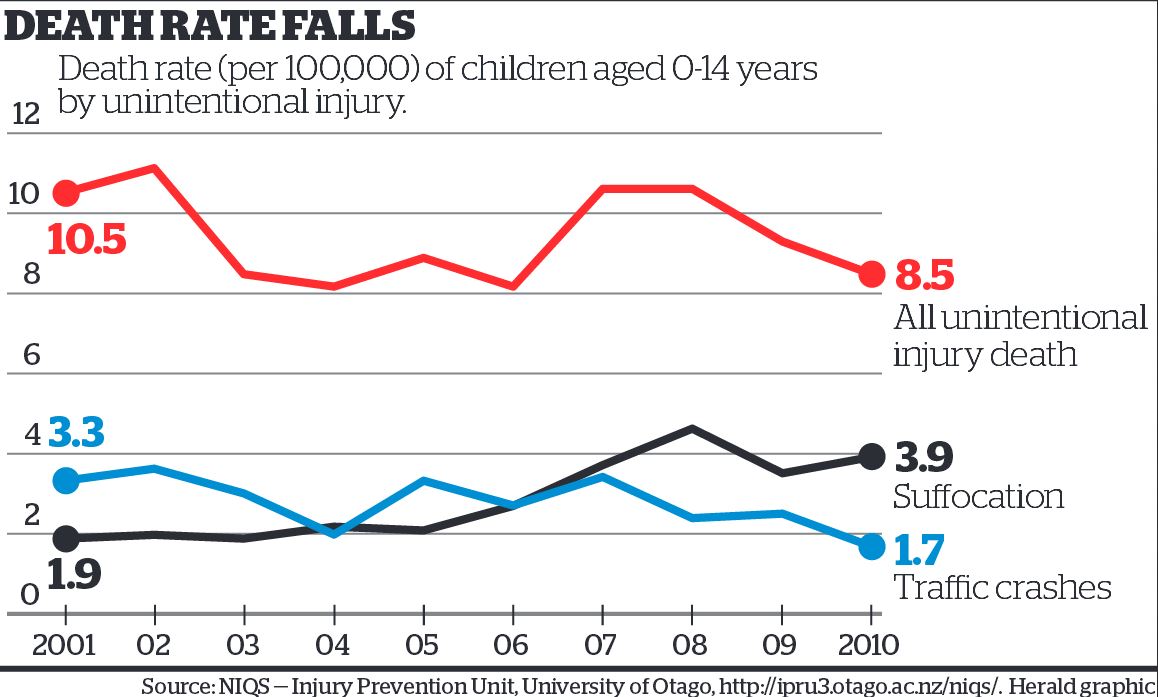
The NZ Hearld has a headline, New Zealand now much safer for children as injury cases plunge.

There must have been data availability restraints for the black and blue lines on the graph below because the writer could have taken the red line to 2012 showing even greater overall improvement.

Below the NZ Herald graph is the result of querying the NZ Injury Query System. The death rate per 100,000 children from 'unintentional injury' dropped to 6.5 by 2012. I went on to query fatalities from 'all intents'  and have graphed the difference. That produces a slightly different picture.


Sunday, February 07, 2016

Seymour vs Ardern is going to be entertaining

At the supermarket checkout this afternoon I spotted the header on the Sunday Star Times heralding two new columnists - David Seymour and Jacinda Ardern. Very nice. I expect they'll be given (or agree together) a subject each week.

Then I got an e-mail alert that Ardern had tweeted the link so took a look.

Interesting. It appears David has taken  on the subject and Jacinda has responded. I assume next week it'll reverse.

This format will make for much more entertainment.

Here's the first installment .


OPINION: Like almost all Kiwis I have always avoided Waitangi on the big day. Images of protesters, crying prime ministers, and actual mud-slinging are enough to put most people off.  If you've ever been in Sydney for Australia Day, you'll know how much better our national day could be.

But Parliament obliges me to be here, so I'm writing this from an old Paihia motel (my parliamentary colleagues had booked out the Waitangi Copthorne, but that's another story).

The trouble this time is the Trans-Pacific Partnership Agreement, or TPPA. People oppose it for the same reason people used to have mullets – fashion, not logic. Being of Ngāpuhi descent myself, it's been a real struggle to understand why local Maori are protesting a trade agreement. 

If an iwi is going to host representatives of the Crown to symbolise this 176-year-old relationship, why not rotate the host iwi and location?

The fact is, many colonial-era Maori were very entrepreneurial, and took ready advantage of the more secure property rights provided by the Treaty – more secure than being invaded by nearby tribes as happened through the musket war period around 1820 to 1840. One of the many important rights the Treaty gave was access to sea lanes protected by the most powerful navy on the planet.

I've been reading Hazel Petrie's Chiefs of Industry. It tells the story of colonial-era Maori such as Te Hemara Tauhia. In the 1850s he built a sawmill in the north and charged Pakeha to mill their timber.

Then he realised they were making money off the shipping so he commissioned a 20-tonne ship to move it, too. That guy would have favoured signing the TPPA.

He was not unusual. As another author summed up, colonial Maori "were able to leverage European technologies to build remarkable trading relationships around the world as well as forcing the world's most powerful empire into a stalemate."

Back up here at Waitangi Day 2016 the usual suspects (about 0.01 per cent of the population) have made the elected prime minister of New Zealand stay away and denied all of us a national day we can enjoy because they don't like the TPPA. It got me thinking.

The Treaty was not signed just at Waitangi. It went on tour and was signed by Chiefs all over the country.  Waitangi is just the place it was signed first.

It's never been clear why one iwi gets to monopolise the celebrations, but this year's circus has made it especially unclear. The disruptors don't know much about trade or even their own history of trade.

Even the device that one protester threw at Steven Joyce probably entered the country under the China FTA.

If an iwi is going to host representatives of the Crown to symbolise this 176-year-old relationship, why not rotate the host iwi and location? It could be in a different place each year, following the actual path that the Treaty took during 1840.

Ngāpuhi have denied the whole country a proud national day just one time too many. It is time to take this show on the road. There were 20-odd signing locations so it'll come back around in 2036. Estimates are that the TPPA will be adding an extra $3 billion to our economy every year by then.

And a bit of competition among locations might also help to lift standards of behaviour, bringing some dignity and joy back to this historic occasion.

Jacinda Ardern responds

Australia Day? Are you kidding? That is the last place we should be looking for a model of race relations, let alone a national day of celebration – unless you're into drunken, casual racism. 

I am sorry you felt a sense of duty rather than any desire to be at Waitangi, David. Or that your auto lodge didn't meet your expectations.

But your interpretation of what the pilgrimage to this place symbolises is just plain wrong. It's not about the dominance of any one iwi as you claim, it's about recognising the place where the treaty - and the relationship between Maori and the crown, all began, and what that relationship means now.  
And that's what makes your argument so ironic. You believe that moving around the country every year, presumably having the talks and debate we have at Waitangi, would be a better way to mark our national day. And yet this is the very thing that caused the difficulties this year - the fact the government didn't talk, didn't debate, an agreement that they signed on behalf of New Zealand, and Maori - the TPPA. 

I hand on heart believe in free trade, and so does my party. But we also know that this agreement was about more than trade, and it was these elements of the agreement that the government should have discussed openly- they didn't. 

There is no denying that there have been ups and downs over the years at Waitangi, but it remains a place for open debate and dialogue. That's worth celebrating.

Gang children - growing the problem

"The proportion of gang members and affiliates in New Zealand’s prison population has grown. The 2003 Department of Corrections census of prison inmates showed that gang members and affiliates accounted for 11.5 percent of the sentenced inmates. Over two thirds of those inmates belonged to either the Mongrel Mob or Black Power gangs. As of April 2013, gang members and affiliates comprised over 30 percent of inmates, with over 10 percent of the prison population belonging to the Mongrel Mob. Forty-six percent of prisoners under the age of 19 have gang affiliations."


"The literature suggests that single-faceted approaches are unlikely to be effective in dealing with gang issues. Suppression in particular has been criticised as largely ineffective in reducing involvement in gangs and offending.

In 2008, the Ministry of Social Development noted that:

A sole suppression strategy is costly…and gains are short term. Suppression has proven the least successful of all interventions and can have a negative impact as members convert stigmatisation into a symbol of status. Further … a reliance on the Police as public commentators on gang issues can be problematic, as many have narrow views of gangs and criminality, which may then be perpetuated
through the media leading to simplified notions about how best to respond.

Black Power member Denis O’Reilly similarly notes: “You have got to have an integrated response. But if the only weapon you have is a hammer then everything looks like a nail”.
Moreover, suppressing and imprisoning gang members can exacerbate the problem by providing gangs the opportunity to recruit new members in prisons, dominate prison culture and run criminal activities within prisons such as contraband trading. Prisons are a major recruiting ground for the largest ethnic gang in New Zealand – the Mongrel Mob – and a Mob chapter was formed in Auckland Maximum Security Prison in the late 1970s."

Source

Saturday, February 06, 2016

ACT Conference 2016


I've agreed to speak at the next ACT Party conference three weeks today. I'll cover what's been happening in welfare - the good and the bad - and  what further reform could look like.

Here's a list of speakers, all of whom I am keen to hear.


Further details

Friday, February 05, 2016

Growth in psych conditions in the welfare system

Here's a tidy illustration of a phenomenon I occasionally blog about; the growing incidence of benefit dependence due to psychiatric or psychological conditions.


The blue line is the old sickness benefit; the green line, the invalid benefit.

The total number at June 2015 was 53,611.

At March 1999 the total was 24,194.

A 121% increase compared to a total population increase of around 21%.

More sickness? More diagnosis? Whatever the driver, it's actually a problem for the Ministry of Health to address yet its MSD that bears the budgetary implications.

Thursday, February 04, 2016

The sky is falling ... not

Just reflecting on the back of yesterday's post, it must cause just a little bit of discomfit for politicians when they get it so wrong. No? I guess that if it did, they wouldn't be in the game.

November 2015

"New Zealand’s unemployment rate is now worse than Australia’s – an economy described as ‘fast becoming a basket case’, Labour Finance spokesperson Grant Robertson says.

“Last night Australia’s new figures put unemployment at 5.9 per cent. New Zealand’s is 6 per cent.

“Australia’s economy has been going through extremely difficult times of late. It has been a rapid downturn for a once-thriving economy.

“New Zealand has experienced a sustained period of economic growth that is now falling away. We should be doing much better than Australia. There is no way our unemployment rate should be higher than the across the Tasman.

“John Key and Bill English always blame overseas economic factors and turbulent times. But the GFC is over and other countries are doing much better. Britain, Australia and the US all have unemployment levels below 6 per cent and falling. New Zealand’s is forecast to top 7 per cent.share on twitter

“The stark truth is National hasn’t been able to turn growth into jobs. Now the economy is going downhill opportunities will be even harder to come by, even for those with jobs.

“This isn’t the Kiwi dream. It’s getting harder and harder to get into work or find a better job. Behind these figures are real people with families to support and ambitions to fulfil.

“National is failing them,” Grant Robertson said.

And just for good measure here he is talking to the Labour Party conference:


"151,000 New Zealanders are out of work, and the rate of unemployment is six per cent, with projections that it will head towards seven per cent next year. 151,000 people.  Think about that.  It is nearly twice the population of this city out of work.  It is nearly 50,000 more than when National took office.  In Gisborne one in every ten people is out of work. It is clear that John Key and Bill English see levels of unemployment like this as collateral damage in their blinkered economic vision."

Wednesday, February 03, 2016

Good fall in unemployment rate

Statistics NZ is reporting the unemployment rate has dropped to 5.3%.

It was 6 percent in the September 2015 quarter.

This is the lowest unemployment rate since March 2009.

A quick round-up from tables:


Female unemployment dropped more than male

Big fall for the 20-24 age group but small rise for 15-19

Drops for all ethnicities especially Pacific falling from 13.1 to 9.7%

Big fall in Northland from 8.2 to 6.2%

Only region showing an increase - 4.2 to 4.5% - is Otago

Ag, forestry and fishing recorded biggest employment increase in terms of numbers, followed very closely by construction

Internationally NZ moves from ranking 15th to 10th= in OECD


Bad news for Labour.

Unemployment has been considered one of National's few points of vulnerability.