Friday, November 06, 2015

State housing - it's about choice, not need

The government is reducing the number of times a prospective tenant can turn down a property from 3 to 1.

It's also increasing stated location preferences from a minimum of one to three.

That it even has to do this proves state housing is frequently not about need. It's about choice.

Nearly 10,000 social housing offers were made last year and of those 3,453 were declined, with 414 for unacceptable reasons such as wanting a garage or a bigger back yard.

Primarily people want a state house because they are cheaper than private rentals. Social agencies and budgeting organisations know this and work with the client to facilitate acquisition of state rentals.

There is an old adage "beggars can't be choosers" which means people with no other options must be content with what is offered.

They are not content because they have other options.

Yet this compromising centrist government still gets the jelly wobbles:
Under the changes people who refuse a property without a good reason may be removed from the social housing register for 13 weeks.
Why not much longer or permanently? The door is always left open to those who would play the system.

Wednesday, November 04, 2015

Herald hyping 'poverty' again

The Herald is running a series on educational under-achievement which starts today. Here's the opening gambit:

Disadvantage remains a major dictator of underachievement in schools. Poor children pass at rates well and a clear gulf in opportunities afforded to students at either end of the decile spectrum, educators say it’s below their wealthy peers, despite efforts to address the disparity. With poverty affecting one in four children, time to act, before another generation are consigned to the cycle.
Obviously there is a glaring omission in the second sentence (update: now fixed) but what struck me, after reading the entire piece, is that the media is the main party guilty of creating the stereotypes the students hate and talk about to the journalist.

It's the media, egged on by left-wing ideologues, that keeps telling children from low income homes that they are living in poverty; that poverty means deprivation, hardship, struggle and under-achievement. That poverty marks and excuses you.

Yet the 'one in four' statistic relates purely and only to relative low income.

Measuring material deprivation looks slightly different.


8 percent of children live in families that lacked seven or more of the above. 18 percent lacked 5 or more.

When will the media stop hyping 'poverty'? Young people clearly don't want or appreciate being stereotyped. 

Being a moderate type I sometimes cringe at Whale Oil's description of media, "Pimping the Poor".

But that's exactly what this series is. Using South Auckland school children to sell newspapers under the guise of social advocacy.


Tuesday, November 03, 2015

Aussies not unusually claiming undue kudos

I notice that Michelle Payne has a ride in the Melbourne Cup today. Good for her. Often there is no female presence. NZ is far more progressive in using and elevating women riders in our racing industry. It is entirely possible (and happens)  for NZ females riders to win the jockey premiership. Some say women have more affinity with their mounts. Michelle Payne's own trainer father though notes an old horsemanship saying; “Men fall like boiled eggs. Women fall like raw eggs.”

Anyway in checking out my facts I came across this from the Melbourne Cup Betting Directory:

 In 2003 the first female jockey to take part in the Melbourne Cup was Claire Lindop where she finished 19th out of twenty-three on Debben
Bull. The first female rider in the Melbourne Cup was NZ jockey, Maree Lyndon in 1987. Lindop was the first Aussie female rider.

Any way, I think I'll back Preferment today - not Payne's ride. NZ trainer based in Flemington. Any other picks out there?

Chance to be part of OIA survey

As part of the Ombudsman review, it's now the public's turn to voice their dissatisfaction with the OIA process.

User experiences of the OIA
The Chief Ombudsman now wants to hear from users of the OIA, including members of the public, journalists, Members of Parliament and their staff, people working for interest groups, and academics. We also want to hear from current and former employees and contractors in government departments and agencies.
To do this we have created three different surveys to learn about your experiences and perceptions of how the OIA is working in practice.  This will help us determine where improvements are most needed.

The only question now is can you find the time/ be bothered?

Apparently each survey takes between 20 and 45 minutes.

Thursday, October 29, 2015

Portable pensions


The just-released HLFS population estimates show that there are 642,700 people aged 65+. It's an estimate based on the last census, births, deaths etc but it's the best data available. The large majority - but not all - of this group would qualify for super.

Yet at September 2015 there were 693,409 people receiving Super or a veteran's pension.

Is the difference made up by younger partners sharing the Super?

Not according to the table which I requested from MSD earlier this year showing the numbers and ages of non-qualifying spouses receiving Super. (OK the data is 9 months apart but that wouldn't account for the discrepancy).


Does this mean that the HLFS estimate is significantly wrong? No.

The difference must lie in the number of pensions being paid to people who are not currently residing in New Zealand. Officially...

You can reside almost anywhere in the world and still get part or all of your New Zealand Superannuation or Veteran’s Pension payments. What you’ll get depends on where you go to and how long you’ve resided in New Zealand.

 Potentially there  could be upwards of 40,000 superannuitants living outside of NZ.

Tuesday, October 27, 2015

Groupies

Statistics NZ surveys on all sorts of things that are no business of government and serve no useful policy information requirements. The data is then presented in such a way as to be of relevance to the moment.

For instance here's the headline:

New Zealanders belong to a sporting nationAlmost two-thirds of Kiwis belong to a club or organisation, Statistics New Zealand said today. In keeping with a nation that takes great pride in the All Blacks, Silver Ferns, and All Whites, sporting clubs are the most popular. 
Yet 72 percent - almost three quarters - do not belong to a sporting club.

The second highest group membership belongs to religion - 21 percent. A header that said New Zealanders belong to a religious nation would be unthinkable. Especially from a government department. Yet the difference between membership of sporting and religious clubs is only 7 percentage points.


Saturday, October 24, 2015

Where does it stop?


So much more to be said.... like, individualised savings accounts would bypass a lot of the wrangling collectivised health and social security throws up, particularly of late. Of course that would require an element of compulsion.

And that this micro-management of people's lives isn't really about saving money, at least not in the overall scheme of government expenditure. It's about saving people from themselves. It's the imposition of a prescriptive set of behaviours that the state defines as acceptable, and the suppression of those it does not.

Friday, October 23, 2015

"Breaking the adoption 'taboo' "

A shift in thinking is gathering momentum in Australia as it should here. The same circumstances and questions apply in this country, where thousands of children are in state care next to a low number of adoptions.


Thursday, October 22, 2015

How much CYF resource is wasted?

New data shows a significant drop in substantiated findings of child abuse:


 Yet there were 150,905 notifications in 2014/15 - a  3 percent increase on the previous year.


Only 30 percent of notifications require further action.

16,472 substantiated findings from 150,905 notifications (allowing for some year on year overlap) represents 10.9  percent. Note though that multiple findings can apply to one child, just as multiple reports could apply to one child so it would be incorrect to simply state that 10.9 percent of notifications are substantiated. But you get the picture.

Reports are trending up; substantiations are trending down.

The level of notifications that are unnecessary - perhaps even vexatious - must be very high. Or perhaps the difference reflects a gap between CYF's standards and the community's. Certainly the public has been heavily encouraged to report their concerns, and the police are also  now required to make a notification if attending a family violence incident even if the child/ren are not directly involved.

Whatever the reasons for the difference in reports and substance are, it must be costing a fortune in resource.


Tuesday, October 20, 2015

Latest Better Public Service progress results out

The BPS target progress results have just been published. A selection of graphs of interest to this blog:


Not a lot to get excited about.

Still, setting public goals and charting progress is, of itself, an improvement in how government runs services.

You can view other graphs and each one's rating eg On Track  here.

Monday, October 19, 2015

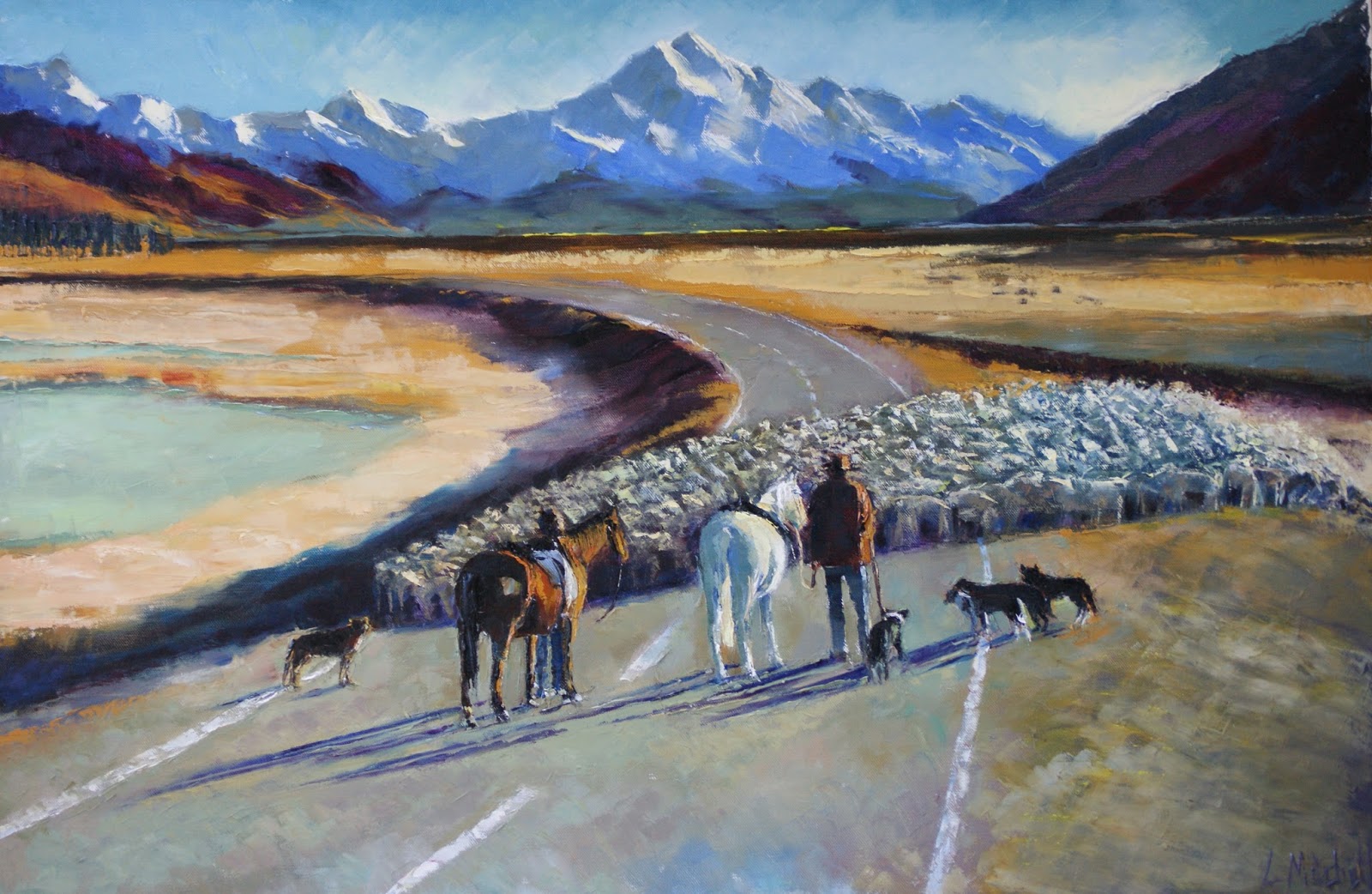
New painting

Updating my artist blog, this is a large palette knife painting of South Island drovers. It's based on a photograph (with a fair dose of artistic licence thrown in). Mt Cook in the background.

I don't often paint landscapes but the portrait commissions have been thin on the ground this year. Removed from my highly representational style this tends towards impressionistic. If the shapes and perspective are believable, the viewer's imagination will fill in the missing details. It would be truly laborious to depict each sheep.

Increasingly, painting with a knife using strong, often unmixed colours, is reducing my desire to paint with brushes and more 'natural' shades. Maybe my eyesight is degenerating.


Sunday, October 18, 2015

Abuse of the Official Information Act - Ombudsman had enough

The Ombudsman has had enough. The abuse of the Official Information Act by those subject to it must stop.

The Chief Ombudsman has slammed the Prime Minister for delay tactics of releasing official information.
Dame Beverley Wakem says she intends to introduce a new set of standards covering Official Information Act (OIA) releases, as part of a major review.
Thomas Jefferson once said "information is the currency of democracy", but it's not always easy to get information...
Information can be accessed from the Government and its agencies under the OIA. They must respond within 20 working days, but several examples have shown that is not always the case.
Several examples? That's the understatement of the year.

The Ombudsman told me that 110 complaints had been received against MSD in the 2013 financial year. 62 were about delays. Those statistics represent only the people who bothered to complain.

And that's just one department.

The TV3 report continues:

3D waited two years for information from Auckland police on burglary statistics.
A complaint to the Ombudsman's office has been with it for a year.
I've had a complaint lodged with the Ombudsman since September 18, 2014 and still no resolution.

Obviously they are unable to cope with the level of complaints being received.

It's not a good look for the National government and I am pleased to see mainstream media giving the issue some coverage.

Prime Minister John Key has previously admitted his office uses delaying tactics in releasing official information. Dame Beverley told The Nation that's unacceptable.
"There's a disregard for the law," she says.
From the top down.


Saturday, October 17, 2015

Paying out benefit-liability $ to Tuhoe

MSD has released a commissioned report about decentralising welfare to Tuhoe.

Tūhoe is a relatively young population with high levels of unemployment, welfare dependency and low incomes....
In 2011 the Crown entered into a relationship agreement with Tūhoe in which it acknowledged the mana motuhake of Tūhoe and its aspirations to self-govern. Tūhoe have their  aspirations to become independent of the Government, generate its own revenue and become self-sustaining. MSD has asked whether or not it is feasible to transfer a portion of the Crown’s liability to Tūhoe. 

 In plain English can benefits be paid forward in a lump sum to enable Tuhoe to establish employment initiatives and their own social services?

Tuhoe has high forward liability:

29 per cent of Tūhoe received a benefit payment (unemployment, sickness, invalid, or
domestic purposes) as a source of income at some time in the 12 months prior to the 2013 Census, compared to 24 percent of the Maori population, and 10 per cent of the total 


The above shows benefit receipt for the general population (col 1), then Maori, then Tuhoe.

That's snapshot data. Because young parenting and youth unemployment are high, the length of time spent on benefits is greater.

The research considers international attempts at self governance and suggests:

Experience shows that a goal of profitable business ventures is the most effective way to
increase employment opportunities in the long-run. 

It considers some NZ initiatives and describes them a s a "mixed bag". However the "risks" are less than the "lost opportunity".

The rest is essentially suggested scenarios for transferring the "liability" (cash resource) to Tuhoe.

Apparently MSD are in the process of assessing the actuarial liability of Tuhoe.

What does Tuhoe want to do with the funds?


With the return of Te Urewera together with Tūhoe current land interest brings land value in excess of 300,000 acres. Tūhoe have identified they are capable of developing a range of industries that will create employment opportunities and thereby reduce welfare
dependencies. The industries they have identified as possible within their rohe include the following:
• Pharmaceuticals
• Science and research
• Eco-tourism
• Food and technology
• Horticulture
• Agriculture
• Biodiversity
• Culture & Heritage.

Tūhoe have also identified a number of social sector initiatives such as:
• Development of charter schools that embrace tribal tikanga, set up in the rohe with
consolidated governance arrangements.
• Health centres in each of the four Tūhoe settlements that meet the needs of the rohe’s
population including mental health and addiction.

It's a reasonably lengthy document so take my speed-read summary on trust.

But I am left with questions. If it happened for Tuhoe, wouldn't it conceivably have to happen for any other tribe, group, or even individual, with a (expected)  forward liability?

And I wonder what Savage would have made of the evolution of  social security? I don't imagine his vision of providing income security to the poorest, most disadvantaged in the here and now extended to calculating forward lifetimes of income dependency to be paid in advance.

Then again the dependency is real and if Tuhoe can do a better job of reducing it than the state, why not?

And a pointless, after the fact final question. Wouldn't it have been better if the dependency hadn't been enabled in the first place?


Friday, October 16, 2015

Latest benefit numbers: continuing downward trend but.....

The general gradual downward trend, continues.

Over the year ending September 30, 2015, MSD says, "...the proportion of the working-age population in New Zealand receiving a main benefit fell slightly (from 10.7% to 10.2%)."


But here's the worrying statistic.

In the last quarter, while 43,369 people came off a benefit, 46,374 went on one. A net gain. Not such good news. In the Sept quarter last year 47,447 left; 47,566 arrived. So this year's net gain, over the same period, was significantly higher.

Now that cancellation data is being provided, I also note that the numbers leaving a benefit to go to prison are trending upwards. Interesting.


(Left click on image to enlarge)

Wednesday, October 14, 2015

On ACT and other matters

There was little chance of my voting elsewhere but David Seymour has guaranteed my tick for ACT in 2017 by lodging a new voluntary euthanasia bill. It's a huge task (if drawn) to front foot such a controversial issue as a single MP. What will stand him in good stead is the weight of opinion is now firmly on his side.

"Not working on it full-time" but you wouldn't need to be at $2000 a day. I'd have thought Rebstock negotiated a rate that is "twice the usual"? Is she worth it? I can't answer positively when another CYF  overhaul isn't the answer.

Should it be a crime to have your baby sleeping with you? It's not necessarily best practice if you are overweight and inebriated, but my second child constantly slept by my side. It was the only way any of us was going to get some rest. I fear charging a mother with "criminal nuisance" after a SUD death, with a possible jail term of one year, is a step too far. When will police begin checking bedrooms?

Tuesday, October 13, 2015

Carmel clutching at straws again

Here's Carmel Sepuloni clutching at straws again.

She is reported in today's DomPost:

Fewer people coming off a benefit and moving into work shows a "stalling economy" and a "failing Government", says Labour.

But the Government says Labour had gotten its maths wrong on figures the party obtained.

While the real numbers of beneficiaries moving into work had decreased, the overall percentage of people going into work had actually gone up, as the total pool of beneficiaries decreased, said Social Development Minister Anne Tolley.

At the end of March 2015, 284,260 working age people were receiving a main benefit.  That was down from 295,000 people in June 2014, according to the Ministry website.

"At the same time the New Zealand Income Survey shows an extra 27,500 people were receiving government transfers - primarily benefits and superannuation - as their main source of income compared to 12 months ago.

"Crucially, there was a 38.85 per cent increase in the number of people aged between 50 and 59 years on these transfers between 2014 and 2015," Sepuloni said.

The definition for 'government transfers' is

Government transfers: income from benefits, working for families tax credits, paid parental leave, student allowances, ACC payments, New Zealand Superannuation, and veteran's and war pensions.

At June 2015  1,193,800 people received income from government transfers.
At June 2014  1,166,300 people received income from government transfers.

There's the 27,500 increase she cites.

The increase relates almost entirely to people receiving Super (which is irrelevant to the working age arguments.)

In fact she could have checked exactly how many by consulting the Benefit data tables at MSD

The number of people receiving Super or a veteran's pension rose by 25,983 between June 2014 and June 2015.

The number receiving income from government transfers aged 50-59 rose from 32,600 to 40,500 or 24% not "38.85 percent". Some of this rise will be attributable to younger partners of newly qualified Super recipients becoming dependent on government transfers.


Monday, October 12, 2015

Christianity perverted

A Reverend has this to say about a landlord who is complaining about tenants taking advantage:

"He can afford for them to take advantage of him."

Is this the message of Christianity? If so, I'll stick with atheism.

People who "take advantage" of other people's generosity (in this landlord's case, child minding and rubbish removal) should be dumped or dumped on. It has nothing to do with power balance or material inequity.

A poor person can afford to be as fair as a rich person. Transactions between people, no matter what is involved, that aren't mutually satisfactory, will be very short-lived. Many people of means are generous. They enjoy being able to help. Often they want nothing in return. Their reward is the act of relieving a problem for someone else.

BUT it doesn't follow that when their generosity is abused they should turn the other cheek.

This reverend's attitude is at the heart of socialism and is essentially what makes socialism untenable. Values are not shared. Different rules apply to different people by dint of their economic status.

There is no excuse for abusing goodwill ever. Rich, poor or otherwise.

Friday, October 09, 2015

Stalled recovery?

Apropos of nothing in particular, here is the current state of unemployment. In terms of pre-GFC it's not pretty, particular for females.


Not to mention the rates for Maori and Pacific which would require a much taller graph.

The current Maori unemployment rate is 12.6% and Pacific is 11.3% (June quarter).

One thing I would note is that pre-GFC unemployment levels were unusually low. That's the only positive (spin) I can find. Oh, and NZ is still faring relatively well internationally. Though I doubt that is much consolation for the unemployed.


Wednesday, October 07, 2015

Asian upward mobility?

Statistics NZ released the latest Income Survey last Friday.

From the tables, the following caught my eye.

Asian median incomes are rising fast. Over the 2011 - 2015 period, their income from self-employment was also growing at the fastest rate; income from government transfers was the lowest and declining (largely reflecting a younger population).


In part the increases across all groups represent a recovery from the GFC but the Asian increase is a stand out.

('All people' = 15 and older.)

Tuesday, October 06, 2015

Bennett's biggest contribution

I had cause to make the following graph so thought I would post it here. The drop in Maori teenage birth is quite phenomenal. Though untested, the Youth Parent Payment reforms must be a factor. The point I was making to my correspondent was, I consider this Paula Bennett's biggest contribution as Social Development Minister. (The 10-14 years-old rates barely register but using Infoshare data I couldn't easily or quickly remove them.)