Saturday, April 26, 2014

"Teaching men to respect women a priority - Davis" TV3

TV3 is reporting on an interview with Kelvin Davis this morning.

Kelvin Davis is "determined" to lecture men on how to treat women properly, as he prepares to take his seat in The Beehive.
The Labour list candidate is due to replace outgoing MP, Shane Jones, just months out from September's general election.
Mr Davis says the recent Roastbusters' scandal has highlighted major failings in men's treatment of women.
“Men don’t have conversations with their sons about how to treat, love, and respect women,” he says.
Questions for Kelvin.

Do women have converstaions with their daughters about how to treat, love and respect men? Further, do they demonstrate those behaviours?

I always bristle when the finger points one way.

(I also wonder how men can have conversations with sons they have no knowledge of or relationship with.)

Friday, April 25, 2014

So poverty doesn't matter after all?

Conservative Perspective drew my attention to research reported in The New Zealand Herald. I cannot find any mention of it at the NatCen website.

Children raised by a single parent are no less happy than those living with two biological parents, a study has found.
Researchers from NatCen Social Research found family composition has "no significant effect" on the happiness of children. Rather, it is the quality of relationships at home which are most strongly linked to a child's well-being.
The results challenge the popular conception that children in two-parent families are more likely to be stable and content than those raised in "broken" homes.
Researchers analysed data from the Millennium Cohort Study, which was made up of 12,877 children aged seven, in 2008, from across the UK. The children came from three family types: those living with two biological parents; those living with a step-parent and a biological parent; and those with just a single parent.
The seven-year-olds were asked the question: "How often do you feel happy?"
Of the children living with a lone parent, 36 per cent said they were happy "all the time" while the remaining 64 per cent reported being happy "sometimes or never".
Exactly the same percentages were recorded when the question was put to children from the other family types.
Why weren't percentages for "sometimes" and "never" reported separately? That's what would interest me. That nearly two thirds of all children are "sometimes or never" happy tells us very little. Also how would the responses differ amongst, say, a group of 12 year-olds?

The results were largely unchanged when other factors which could influence a child's well-being - such as their parents' social class or the affluence of the area in which they live - were taken into account.
So poverty doesn't matter after all. Poor children are just as happy as rich children, so that's that.
Jenny Chanfreau, a senior researcher at NatCen, said that a "happy, harmonious family dynamic" was crucial for child happiness, adding: "It's the quality of the relationships in the home that matters, not the family composition."
I am sure that is correct, but that quality rests largely on the well-being of the adult. It is a fact that single parents suffer more stress and mental ill-health (often linked to financial worry.)  One result is the higher likelihood of children in a single parent home being abused or neglected.
Ms Chanfreau told the British Sociological Association's annual conference in Leeds: "Getting on well with siblings, having fun with the family at weekends and having a parent who reported rarely or never shouting when the child was naughty were all linked with a higher likelihood of being happy."
The study's findings contradict previous research which indicates that family division is likely to have a detrimental effect on children.
Not on what we know of the "study's findings" so far, it doesn't. The many studies that have shown poorer outcomes for children in single parent families are based on actual findings in later life. That just over a third of single parent children say they are happy "all the time"  does not nullify the abundance of evidence that finds they tend to suffer more physical and mental ill health, substance abuse, interaction with police and justice systems, poorer academic achievement and broken relationships.
One 2008 report, based on figures from the Office for National Statistics, claimed that children whose parents had split up were four and a half times more likely to develop emotional problems than those whose parents had stayed together.
- The Independent
National Statistics is the equivalent of Statistics NZ. They deal with reality as conveyed by statistics reported by many government agencies and gathered through various surveys. They are non-partisan and don't seek answers that fit a particular worldview.

Thursday, April 24, 2014

Absolutely the same applies in this country

NCPA again  highlights how much single parent families ahve contributed to inequality. Then they ask the question, why don't politicians talk aboiut it?

How much do single-parent households matter?
  • University of Virginia sociologist W. Bradford Wilcox determined that children in high-income households who experienced family breakup fared less well emotionally, psychologically, educationally, and ultimately economically than their peers in two-parent families.
  • Children of single or cohabitating, but not married, parents experience abuse, behavioral problems and psychological issues at higher rates than children of married couples, according to a study by the Centers for Disease Control.
  • Just 2 percent of children raised in two-parent families experience poverty long-term, while more than 20 percent of children in single-parent families live in long-term poverty.
  • Penn State sociologist Molly Martin estimated in 2006 that 41 percent of economic inequality generated between 1976 and 2000 was the result of changed family structure.
  • According to researchers at the Brookings Institution, the U.S. poverty rate would be a full 25 percent lower today if the U.S. family structure resembled that of 1970.
While the mainstream media and research groups have been focused on inequality, they have largely ignored family breakup. Why? Maranto and Crouch point to three reasons:
  • First, leftists do not want to side with social conservatives, despite the plethora of evidence.
  • Secondly, minority families have experienced the worst family breakup, and bringing up the issue leads to fears of charges of racism.
  • Lastly, because there is no immediate or quick fix to the family breakup problem: such a societal transformation will take decades.
Source: Robert Maranto and Michael Crouch, "Ignoring an Inequality Culprit: Single-Parent Families," Wall Street Journal, April 20, 2014.

Regarding the second reason I remember getting it in the neck from Tau Henare when the NZBR released my paper on Maori and Welfare in which I pointed out the correlation between the high rate Maori welfare dependence and ex-nuptial births. He wrote me a letter saying I was Maori bashing. In other words, racist.

Wednesday, April 23, 2014

Let's just blame the perpetrator

Conservative Perspective blogs about ACT's Three Strikes for Burglary policy. He remarks about 'Gavin' who has been burgled 5 times.
"I’m sure Gavin represents a good percentage of the population when he suggests that the causes of burglary are ‘poor education and the wealth gap between rich and poor.’  But is that really the case?"
People who blame burglary on poor education and the gap between rich and poor are often equally quick to highlight white collar crime - theft via solicited dodgy financial investments, corporate fraud etc.

Can't blame those on poor education.

There's a perversion or rejection of values at all levels of society.

Remedying problems would be much simpler if we just started blaming the perpetrators - period. Let's proceed from that position and then, maybe, permit mitigating factors.

As it is, too many look first for the fashionable, extraneous causes of crime because they've been - and continue to be -  well-versed in them. Right from school.

An American guy rang Sean Plunket yesterday and said that NZ is a great country but we are too nice to our bad people. Not like you Yanks, went through my mind, thinking large-scale imprisonment for drug offences and capital punishment.

But he has a point. Our Kiwi tolerance (and Christian forgiveness) sometimes extends into damaging excuse-making for deeply immoral, unacceptable behaviour.

What I do like about any 3 Strikes philosophy is the inherent expression of clemency and redemption - TO A POINT.

Tuesday, April 22, 2014

Questions about Jones' successor

Excuse my ignorance about  Labour Party developments and electoral law.

I do know that Shane Jones was a list MP and assume  his departure requires a replacement for the months between June and September. But I may be wrong, in which case the rest of this post is redundant.


labour-party-logo.png
Labour Party List 2011 General Election
1 GOFF, Phil
2 KING, Annette
3 CUNLIFFE, David
4 PARKER, David
5 DYSON, Ruth
6 HOROMIA, Parekura
7 STREET, Maryan
8 COSGROVE, Clayton
9 MALLARD, Trevor
10 MORONEY, Sue
11 CHAUVEL, Charles
12 MAHUTA, Nanaia
13 ARDERN, Jacinda
14 ROBERTSON, Grant
15 LITTLE, Andrew
16 JONES, Shane
17 SIO, Sua William
18 FENTON, Darien
19 MACKEY, Moana
20 PRASAD, Rajen
21 HUO, Raymond
22 BEAUMONT, Carol
23 DAVIS, Kelvin
24 SEPULONI, Carmel
25 BARKER, Rick

So, I know Prasad is still an MP because of his Easter outburst over Nigella Lawson.

I had to wiki-search the next too. Yes, they are MPs.

But I do know Kelvin Davis is not. One of the few that should be.

He has been selected for the Te Tai Tokerau but somewhere I read he isn't available for campaigning yet? So will he be available to make a swift trip south to replace Jones in the House?

And how will that affect Hone's chance of keeping the seat? Will Davis find himself in parliament for just a couple of months if he doesn't win Te Tai Tokerau,or will Labour sensibly push him up the list this time?

Or can he turn it over to the next party-lister, ex MP Carmel Sepuloni?

Who would think a sane person wanted a bar of Labour but he has put up his  hand for candidate selection. Good Guy in my opinion.

Sunday, April 20, 2014

Cell phones for ex-prisoners and misplaced outrage

I cannot believe the naysayers on the business of equipping released prisoners with mobile phones that have "pre-programmed numbers for police mentors and other support services."

The Sensible Sentencing Trust spokesperson is "outraged".

 "This is like giving a reward to offenders for completing their sentences," she said. "If free mobile phones are being handed out to anyone, it should be to victims, not criminals."
First, they have served their sentence. Second, it isn't victims who need rehabilitation assistance. Help and support yes, but not mobile phones. Thirdly SST should be supporting attempts to rehabilitate. Their attitude increases risk.

And Jacinda Ardern is just as loopy. She believes "...Vodafone should provide offenders with jobs or training rather than cellphones."

Well that's a slap in the face. It would be great if any potential employer takes on a released prisoner but they do not have an obligation.

I think it's a great idea (still only a pilot at this stage) and couldn't agree more with the sentiment expressed by Serco's director of operations Scott Nairn

"If it prevents just one person from becoming a victim, it will be worth it."


Saturday, April 19, 2014

Now for the bad news

NZ is in a precarious position according to Forbes Magazine:

12 Reasons why NZ's economic bubble will end in disaster

 Concluding with:
Here is what to expect when New Zealand’s economic bubble truly pops:
  • The property bubble will pop
  • Banks will experience losses on their mortgage portfolios
  • The country’s credit boom will turn into a bust
  • Over-leveraged consumers will default on their debts
  • Stock and bond prices will fall; the New Zealand dollar may weaken
  • Economic growth will go into reverse
  • Unemployment will rise

Also reported in Stuff


More good news - fewer sole parents on welfare

Simon Collins, writing in the NZ Herald, provides an analysis of latest benefit numbers:
Numbers on sole parent support have plunged by 8600, or 10 per cent, in the year to March. It is the biggest drop in a single year since the benefit - previously known as the domestic purposes benefit, or DPB - was created in 1974. Sole parent support is now being paid to 75,844 sole parents, fewer than in any year in the DPB's history since 1988. About 22,000 people with no children under 14 were moved to other benefits when the DPB was abolished last July, but even if they were added back in, the total number of sole parents on any kind of benefit is the lowest since 1993.

Not sure where he gets the data to make the last statement though. Did he add back the 22,000 to the 75,844, arrive at 97,844 then go back through the DPB historical numbers? Looks like it because in 1993 there were 96,335 people on the DPB and in 1994 there were 100,256.

But he wrote "any kind of benefit". He hasn't accounted for the Supported Living Payment/Invalid benefit which grew from 35,000 in 1993 to 87,000 in 2012. In 2009 over 5,000 single parents were on an invalid's benefit.

Anyway I guess I'm being pedantic. Maybe the info was provided to him by MSD because he has other data (eg the specific reasons why sole parents are leaving benefits) which isn't publicly released

Good to see him talking about 'net' reductions. Many journalists forget that there are also people constantly going onto benefits.

The biggest net reduction (13 per cent) was for parents aged 40 to 54, whose children were most likely to have turned 14. The next biggest reduction was in the 18-24 age group (down 10.4 per cent), with a smaller reduction for those aged 25 to 39 (down 9 per cent).
The number of Europeans on sole parent support also dropped sharply (down 12.5 per cent), as did Pacific numbers (down 11.5 per cent). But Maori numbers fell 7.9 per cent, so Maori increased from 44.9 per cent of those on sole parent support to 46.1 per cent.
Michelle Neho, who runs the Pikorua community centre in Papakura, said she had seen little change.
"Not many have gone off the benefit round here," she said.
The most employable people leave first welfare first. We will see how effective the reforms are when the harder cases, the intergenerational types, start leaving.

I note too that another important reason for the reduction isn't canvassed (the official line from MSD is economic trend.) That's the falling number of births, especially teenage. This will definitely be having an impact.


Here's the overall 5 year trend picture.


Friday, April 18, 2014

Good news on Good Friday: Labour/Greens down in favourite poll

According to Chris Trotter at the Daily Blog in a post he's titled "That Sinking Feeling":
THE LATEST ROY MORGAN POLL has Labour on 28.5 percent (down 3.5 percent) and the Greens on 11.5 percent (down 1.5 percent). At 40 percent, the combined vote of the two main centre-left parties has fallen 5 percentage points since Roy Morgan’s previous survey in late March. Roy Morgan has long been the Left’s favourite polling agency: a source of good news when the Colmar-Brunton, Reid Research and Ipsos agencies could offer nothing but ill-tidings. That “our poll” has begun to deliver ill-tidings of its own is bad news indeed.

Go read Trotter's explanation.


Does anyone know the whereabouts of that stalwart and courageous David Cunliffe who bore every insult that his enemies could hurl at him. The David Cunliffe who sat stoically on the back benches while his party fought for his return. The David Cunliffe who campaigned up and down the length of New Zealand for a rededication to Labour’s core values. The David Cunliffe who promised to rescue New Zealand from John Key’s “crony capitalism”. If anyone does know where he is could they please advise Moira Coatsworth and Tim Barnett immediately – he is sorely missed.
And sorely needed. Because, if that David Cunliffe is not found – and soon – the pallid and oh-so-timid fellow currently masquerading as the leader of the Opposition is going to lose the election. Not just for Labour, the Greens and Mana, but for every other New Zealander seeking a radical change in their country’s direction.
Odd because I haven't seen the timid version. But I can find him the smarmy, arrogant, nasty man. That's the real turn off.

See results poll here
Does anyone know the whereabouts of that stalwart and courageous David Cunliffe who bore every insult that his enemies could hurl at him. The David Cunliffe who sat stoically on the back benches while his party fought for his return. The David Cunliffe who campaigned up and down the length of New Zealand for a rededication to Labour’s core values. The David Cunliffe who promised to rescue New Zealand from John Key’s “crony capitalism”. If anyone does know where he is could they please advise Moira Coatsworth and Tim Barnett immediately – he is sorely missed.
And sorely needed. Because, if that David Cunliffe is not found – and soon – the pallid and oh-so-timid fellow currently masquerading as the leader of the Opposition is going to lose the election. Not just for Labour, the Greens and Mana, but for every other New Zealander seeking a radical change in their country’s direction.
- See more at: http://thedailyblog.co.nz/2014/04/18/that-sinking-feeling-labours-urgent-need-for-persuasive-words-and-courageous-deeds/#sthash.pXqs59db.dpuf

Thursday, April 17, 2014

One in four Maori baby boys won't live to 65?

A similar headline appears in today's New Scotsman:

One in four baby boys in Glasgow won’t live to 65
A QUARTER of boys born in Glasgow between 2010 and 2012 will not live to see their 65th birthday, according to research which shows the city has the lowest life expectancy in Britain.
Figures from the Office for National Statistics reveal public health problems continue to ail Scotland’s largest city, at a time when it is preparing to host the Commonwealth Games.
The findings show that only 75 per cent of boys and 85 per cent of girls born in the city will reach their 65th birthday.
The average life expectancy of babies born in Glasgow between 2010 and 2012 was 72.6 years for boys and 78.5 years for girls.

In 2010-12, the Maori male life expectancy is 72.8 - pretty close. So if the methodology stacks up here, so will the finding. (Of course it might not. Conceivably  the extremes may be greater. For example, a third of Maori baby boys might not make 65 but the survivors have longer life expectancies than the Scottish cohort.)

The good news is Maori are catching up.

Wednesday, April 16, 2014

Should NZ introduce time-limits on welfare?

Should NZ introduce time-limits on welfare?

That's the subject of a piece I provided to Muriel Newman's New Zealand Centre for Political Debate.

And Muriel asks, Has Welfare Reform Gone Far Enough?

Kenneth Wang says Labour playing the race card

Good for him:
I have lived in New Zealand since I came as a student.  I love this country and have stayed and formed my own small businesses, provide employment and made my part of a contribution to this wonderful country.
I am standing for parliament again because I am alarmed at what has happened to race relations in our country. It has got much worse.
Last year, when Winston Peters launched a vicious racial attack and pointed at the New Zealand Chinese community for creating a 'Supercity of sin', only ACT stood up openly against his attack.
This year Winston Peters again started his campaign against foreigners. Everyone knows, including we Chinese New Zealanders, that his campaign is directed at us.
Sadly, now the Labour Party has joined in, playing the race card, blaming the Chinese for New Zealand's problems. No surprise for me to hear David Cunllife said that he “respects Winston Peters greatly” because Labour is 'going in bed' with Peters!
We need racial harmony, not racial hatred or hostility.
Most of the houses owned by Chinese are not bought for speculation.  It is Chinese parents buying an apartment for their children to live in while studying at University.  Those students pay full fees and contribute to our employment and economy.  How does that hurt New Zealand?
More

Monday, April 14, 2014

Music trumps reason

I have a new obsession. A saxophone.

In December, I went halves with my daughter on an old saxophone - a Selmer Bundy 11 - from Cash Converters (via a Trade Me auction that escalated.)

With no intention to use it myself, I wanted her to afford an entry level instrument. Her motivation was an accomplished Maori guy busking at Pack'n'Save just before Xmas. She gave him $5 (she's only 15 but has a part-time job) and he told her how easy it was to play and she should try it. That was enough. Plant a seed in her musical being and it grows.

As it transpired, she found it very hard going (and is back on the guitar as I write.)

The instrument was in need of a service. But with some training on clarinet and oboe in my early teens, the muscle memory came flooding back. Soon I could get a passable sound from it and started hunting out music, watching YouTube lessons, researching options for backing and software to transcribe chords. I got the bug.

Then, wah wah wah (as KS would say about Cunliffe's remonstrations) the semi functional sax had a catastrophic malfunction. Well, not really. But for a instrument ignoramus like me it was untacklable and heartbreaking. I had to fix it. A day without playing wasn't a day I wanted to have.

So came a restless night, difficult decision. Invest in fixing the old saxophone, buy a new student model, buy a Chinese knock-off (which are reputedly very good if you can trust the web), rent, rent-to-buy, search out another secondhand quality instrument... Total dilemma.

Only now obvious to me, in a lifelong pattern, I went economically foolhardy over music. The only things I have ever bought which I can't afford are connected to music (we currently have two pianos - one is my most valuable possession - which have been preceded by other varieties, amongst them a grand.)

For some reason circumstances conspired and I found myself at the woodwind specialists in Wellington asking for a brand new P Mauriat to be demonstrated.

Yep. That's beautiful. I'll have it. Jesus, Lindsay. I walked down Willis St wondering about this uncontrolled compulsivity.

But not once have I regretted it. I've even given up the horses to channel all disposable funds that way. Now I have a healthier addiction. Need to play.

But before I go, this was only meant to be a short intro into a story I read from the World Socialist Website tonight.

Heartwarming, but ruined with a caveat by those thicko communists cutting off their noses to spite their faces.
A New York City classical radio station recently completed a drive to collect used musical instruments that will be refurbished and distributed to music programs in the city’s public schools.
A total of 2,500 instruments were collected in the 10-day drive conducted by WQXR that ended on April 7. They included flutes, guitars, clarinets and some less common instruments, including a xylophone, a Chinese pipa, accordions and mandolins.
The number greatly exceeded the original target of 1,000 instruments. The success of the drive undoubtedly reflects strong support for cultural programs in the schools, and for the instruments getting into the hands of interested students who would not otherwise have the opportunity to learn and play...
There is some talk of the instrument drive becoming an annual event. While such a development would certainly be welcome from one point of view, any suggestion that this is an adequate substitute for full and expanded arts funding in the city’s schools, as part of the provision of quality education for the city’s working class majority, must be thoroughly rejected.


NZ suicide rate 'normal'

'Normal' is, of itself, a controversial word. Here, I use it in the sense of being near the average.

I was under the impression the NZ suicide rate was relatively high. But apparently the rate isn't internationally abnormal (notwithstanding a break-down will show age and ethnic disproportionalities.)


Again I draw on the OECD 2014 Society at a Glance data which shows NZ's rate is below the OECD average, notwithstanding many countries hover around a similar rate.

That on it's own must tell us something.


Is Mana advocating cuts to benefits and Super?

Mana candidate John Minto is advocating a universal basic income. To be expected after Gareth Morgan talked to the weekend conference about exactly that. But Morgan's proposal, detailed extensively in The Big Kahuna, sets the tax free income at $11,000 per annum to replace all benefits and Super. Minto also mentioned doing away with WINZ. But $11,000 is well under the rate of Super and vastly under what a sole parent receives.

Morgan acknowledges this:

He openly admits it would also slash the incomes of superannuitants and halve average payments of the Domestic Purposes Benefit. Many pensioners would gradually lose ownership of their homes to pay the capital tax, which could depress the value of all our houses (Morgan sees this as a good thing as it would help young people to buy). Many solo parents on benefits would have to either move into cheaper housing or share with other adults to make ends meet...Solo parents on the DPB, who currently get about $20,000 to $30,000 a year depending on allowances and the number of children, would lose out badly. Morgan argues the state cannot afford to support a single person as if he or she was a two-parent household...Morgan is forthright about cutting payments to superannuitants - "they get too bloody much anyway" - despite huge political backlashes against previous governments who have dared to tamper with the pension scheme.
There are attractive aspects of a UBI eg it incentivises work by getting rid of high effective marginal tax rates.
But it penalises the rich and the poor alike.

A number of classical liberal thinkers have proposed it in the past eg Milton Friedman and more recently Charles Murray, so I try to stay open-minded about it. I recall even (some members of the) Libertarianz Party had a crack at advocating it. But I struggle to see how it fits with their overall principles given forcible transfer of wealth continues.

It seems to me that the UBI is an attempt to improve the complicated, contradictory and corrosive system social security has become. But it continues the subjugation of the individual to the state.

In a way if Mana adopt Morgan's proposal I will respect them for it.  Because they will be telling the poor, their constituency, that in the immediate future they will be worse off, but their ability to improve their lot through their own efforts will be much improved.

Update:

This line wasn't reported in the audio I heard.
Mr Minto says it would need to be more than that, although the costings haven’t been worked out.
Thought so.

Just to give you a rough idea of costing if Mana pushed it up to $15,000 (x 3 million people assuming age 18 plus) that's twice MSD's budget.


Sunday, April 13, 2014

More evidence for Mike Treen

Daily Blog poster Mike Treen is persisting with his theory that people are being denied an unemployment benefit despite my data showing the number of refusals was fairly constant between 2005 and 2013. He has repeated his original claim in a new post entitled "Right wing lies continue".
...around the mid 2000s the Labour government introduced a severe case management regime that seemed designed to prevent people accessing their entitlements rather than encouraging them to. The numbers on the unemployment benefit began to fall dramatically faster than the HLFS unemployment number until the gap hit 50,000 in 2008. The international crisis and recession of 2008-10 sent the HLFS unemployment numbers soaring but the new National government’s even more punitive regime managed to keep the numbers on a benefit from increasing anywhere near as fast....I believe that statement to be true and remains true."
I believe that statement to be true and remains true. - See more at: http://thedailyblog.co.nz/2014/04/11/right-wing-lies-continue/#sthash.0Wv5lPAt.dpuf

Mike is still of the view that before the mid 2000s everybody who was unemployed received a benefit. People were not denied.

Below is data from a Department of Social Welfare Benefits and Pensions report for the financial year 1989/90. It's a photocopy from my own files and I don't have data for other years.

It shows that 175,736 unemployment benefits were granted and 16,972 were declined. That's an application  refusal rate of 8.8%

In the 2011/12 year 110,244 unemployment benefits were granted and  13,417 were declined. That's an application refusal rate of 10.8%.


These are facts. These are not lies.

Helen Clark likens government to toothpaste


 Being interviewed by Australian media, this remark was made by Helen Clark:
Reflecting on her time in New Zealand politics, particularly towards the end, Clark said it was "regrettable" politics had become something of a consumer commodity. 
"Where you change the brand of toothpaste, you just change the brand of government without giving too much thought to the taste or what it’s going to do."
 What a strange analogy. How many people are really that flippant about who they vote for?

What influences which toothpaste you use? I don't give a rat's to be honest. I buy what someone else asks me to, or what's on special, or whatever is making the most dazzlingly bogus claim. But it's decision that occupies my consciousness for a nano second once a fortnight at best.

Whereas the world I inhabit is constantly considering politics: policy and players.  Whether I am listening to the radio, reading newspapers, blogging, having conversations or just out walking by myself, things political are there.

And I doubt anybody is just not buying toothpaste, so how does she account for the non-voters?

It's a stupid statement. But perhaps that is how Helen dealt with the ousting. Convincing herself that her rejection was just a casual choice to buy John Key because he would make our teeth whiter. Ooooh, I like the blue box better than the red one.

Doesn't it just scream of the contempt in which she holds New Zealanders? No wonder she had to get out of here.

Saturday, April 12, 2014

ACT 2014 policies

Not long ago ACT still had 2011 policies posted at their website. Now they have replaced them with a concise two paragraph overview in each area. Nobody has prompted me to them.

For instance, Welfare and Family:


ACT believes that the welfare system New Zealand developed from the 1970s onward has been a social and economic disaster.  While the intention of reducing hardship was noble, the incentive effects of the system have overwhelmed the resource provision effects.  The policies have led to dependency and indignity for hundreds of thousands of New Zealanders, with an intergenerational dimension.
ACT supports the current government’s initiatives to shift welfare from a paradigm of open-ended provision and resulting dependence to one of mutual obligation.  ACT would continue this process by reducing effective marginal tax rates for those shifting from welfare to work, outsourcing rehabilitation functions to private providers, putting lifetime limits on all welfare eligibility including Sole Parent Support, cracking down on benefit fraud, and scrapping the minimum wage.

There is a problem with putting "lifetime limits on all welfare." A small percentage of people have some form of mental or physical disability that precludes them from self-support, for some or most of their lifetime. But I can agree with lifetime limits on anybody outside of this group.

"Scrapping the minimum wage" would hopefully be accompanied by a taxfree threshold. That could be set at a level which would also enable "reducing effective marginal tax rates for those shifting from welfare to work." Otherwise achieving the second is very tricky indeed.

Here's Education:

ACT believes that education at this level is an investment in human capital that the government rightly makes.  However, the delivery of the service has been captured, at the primary, intermediate, and secondary levels at least, by a providing bureaucracy that limits choice and innovation for the purpose of self-preservation.
ACT believes that state education funding should be seen primarily as an asset of the parent and child, to be used at a school, public or private, of their choice.  ACT would diminish the role of the Ministry of Education in allocating resources, separate the property ownership role of the Ministry from the operations role, make Boards of Trustees more autonomous in their governorship of schools, introduce better mechanisms for State and Integrated schools to expand and contract according to demand, and increase the subsidy to private schools to the extent that it is expenditure neutral. 

Imagine the howls of outrage at the proposal to  increase the subsidy to private schools. But if that enables private schools to expand their rolls with a corresponding reduction in public school numbers (hence neutral expenditure change) that's a progression away from the state's near-monopoly. This policy is the headline grabber. The unions will ensure that.

One more for now. Immigration:

 ACT is and always has been the pro-immigration party.  ACT believes that immigration is a part of our natural heritage, and should continue to be so.  However, ACT also believes that government policy should seek to ensure that immigration remains a good deal for the domestic population.  To this end ACT supports the points system for new immigrants, ensuring that immigrants have readier access to work and do not have easy access to welfare, and lowering the tax burden so that the best immigrants may be attracted.  ACT is also committed to monitoring the emerging literature that suggests immigration may make the domestic population poorer through a process of capital widening.
All good with me but pleased to see that addendum about monitoring the effect on the socio economic status of the domestic population though "capital widening" may be unavoidable and only curbed by limiting immigration. The antithesis of the original  intent. But in general we don't do enough monitoring of policy.

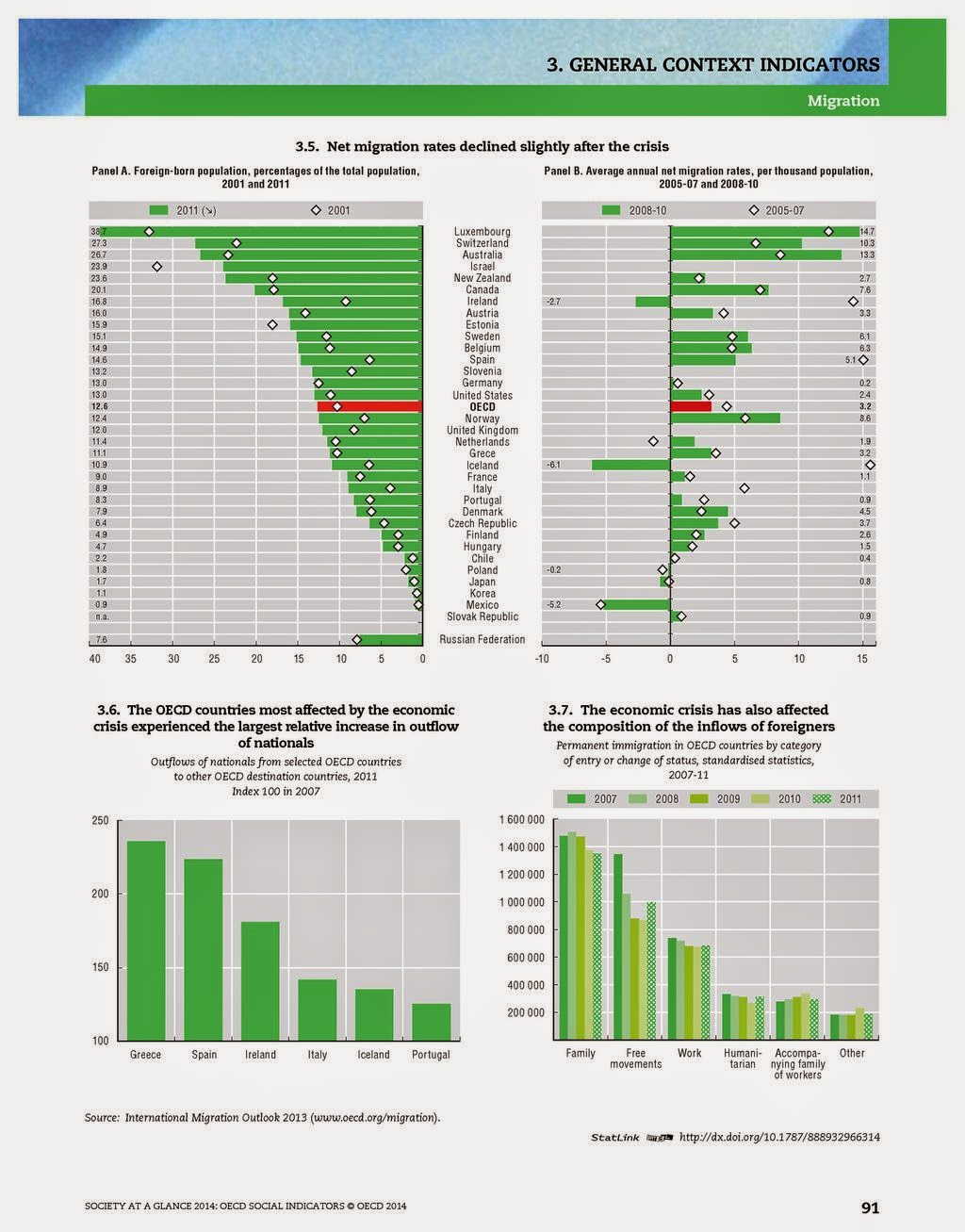
BTW, the OECD 2014 Society at a Glance had a really interesting graph showing how NZ stacks up in terms of its foreign-born population, "our natural heritage". Almost one in four (23.6%) residents was born overseas. Up from about 18 percent in 2001. Very high in OECD terms.


NZ no longer leads western world in sole parent benefit dependency?

It used to. And if you look at the latest OECD graph below (NZ data from June 2013) you'd think it still did.

The brown bar is 'lone parents'. (Unemployment assistance does not feature on this graph as it is considered 'primary'. Check out the link for more information).

For NZ the number is 3.7 percent. Australia follows with 3.3 percent, then Iceland with 3.2%. Before their welfare reforms the US probably would have outdone NZ. (The Ireland bar is suspect. They have quite a high number of sole parents supported by the state. Clue.)

3.7 percent may not seem like a huge proportion but from it flows other matters which are very important like child poverty, ill-health and under-achievement. Matters which will be highly influential in the election this year.


BUT National can spin a good news story here.

By December 2013 the percentage had dropped to 2.8%.

How come?

The balance were moved onto 'primary' out-of-work assistance. Jobseeker Support.

They disappear off the graph.

More dubious inequality claims


Research from the NZ Council of Christian Social Services (or the journalist who wrote the article)  reported in the NZ Herald, relies on 2007 - 2010 data (see below)
The OECD report says household income in New Zealand has suffered a "large decline" since 2008 - NZ was put in the same basket for income as Mexico, Spain, Estonia and Greece.

But our own latest household income data shows rises since:  


  And the rises are across all income bands:


Still as the journalist was happy to rely on outdated OECD data I wonder why he didn't include this one?

Because between 2007 and 2010 inequality actually reduced and that doesn't fit with the story (which just highlights the inherent nonsense in inequality data. If the rich take a hit - surely what the envyists want - and the poorest stay on CPI/wage proofed state incomes, inequality reduces.)