Saturday, June 16, 2012

Super sense of inevitability

It's my view that New Zealanders have a strong sense of inevitability about the eligibility age for Super going up.

So for the life of me I cannot understand the political football it has developed into.

NZ First are backing no change. Winston plays to the entitlement brigade. Key says, according to the NZ Herald:

"This is my challenge to Winston Peters - I dare him to go out there and say he will not under any conditions form a government with Labour even if Labour's policy is to raise the super age from 2020, not in the 3 year period from 2014 to 2017. I dare him to say that. He will not. He will not because he's tricky. He'll find a way around all of that stuff."

It's all so risible, really.

On gay adoption

My Friday June 8 Truth column is now on-line

What a hullabaloo the issue of gay adoption causes.

So many people theorise about its merits or otherwise. But why should anyone with the capacity to love and raise a child well be barred from doing just that? And guess what. If the gay couple were Maori, adoption would be fine.


More

Other Truth columns here.

Friday, June 15, 2012

On gay marriage

 
Bob McCoskrie sent me a two-pager explaining why libertarians should not support gay marriage. Full of woolly thinking. Bob and I agree on some things but this isn't ever going to be one of them. Below are the 4 assertions made by Maggie Gallagher and a response to them from another source. 
 
 
 1.  Government did not create marriage and has no business redefining it.   
 
1. She wants government to prevent evolution in marriage. Marriage is constantly redefined and conservatives wish to prevent that. So they do want government involvement very heavily, to the point of taxing people in 'unmarried' relationships at higher rates. Was govt. redefining marriage when it allowed divorce? Marriage is always changing and most the time government is playing catchup, it doesn't lead the charge but reluctantly brings up the rear. 


Notice also her non sequitur. She argues that marriage encourages the binding of parents to children. "If encouraging mothers and fathers for children is a key part of marriage’s public purpose, then same-sex couples simply do not fit."

There are many parts to marriage. No marriage is required to fill all of them. Certainly allowing the marriage of post-menopausal woman doesn't fit. Nor does the marriage of women, or men, who are sterile, or men who had vasectomies. There are many functions to marriage not just one.
 
 2.  When marriage declines, government expands. 
 
 2. If the decline of marriage causes government to expand, then wouldn't expanding marriage reduce the size of government, so why fight the expansion of marriage?
 
 3.  Gay marriage has no economic benefits. 
 
 
 3. No economic benefits to whom? She is very careful to define economic benefits in odd ways. The benefits to couples, who don't pay the higher tax rates, she seems to ignore. Marriage gives people backup, that is others who care for them. When they don't have that they rely on the state. So wouldn't allowing gays to marry eventually reduce welfare costs?
 
 4.  The Slope Really Is Slippery 
 
 
 4. Slippery slope arguments are mostly impossible to address. Where did the slope begin? Why is gay marriage the beginning and not interracial marriage? 

Also note she says people only have a "right to raise our natural children." Does this mean that adoptive parents do not have parental rights? Is she slipping in Catholic crap to mean no one has the right to children born through IVF? 
 
And Unsolicitedious has a good post on the subject here. 

Heaven forbid responsibility should be handed back to families

Gordon Campbell agrees with John Key. The qualifying age for Super should stay at 65. Here's one of the reasons why:
"...there’s no easy way of easing the costs involved in meeting the burden of care for our ageing population. If we simply raise the entitlement age and/or cut the pension – and National did both in the 1990s under the Shipley administration – while ignoring the employment context, we will simply privatise the social, psychological and financial costs of care, and hand the responsibility over to families."
Heaven forbid we should shift responsibility to individuals or their families. The welfare state has been such a successful experiment who would want a return to the ethos of personal responsibility?

What educational failure looks like

What educational failure looks like

Thursday, June 14, 2012

Good luck with that

The government thinks it can get money out of a DPB recipient's partner if she (usually) is done for fraudulently claiming a single parent benefit.

Just demanding it back from the recipient causes a "gender imbalance" apparently. Paying homage at the equal rights altar now.

Like they get money for unpaid fines and money for child support debt......

And if he has to pay on the principle that he 'benefited' from the fraud, what about a live-in parent or the landlord?

As I said, good luck with that.

Wednesday, June 13, 2012

Running on empty

One of my all time favourites.

 Sometimes I read stuff that just riles me anew. By now I should be de-sensitised to emotive (yet essentially empty) grandiosity; ignorance of fact and shallow thinking. Sadly a section of the upcoming generation  has been schooled to repeat seductive but superficial reasons for all manner of societal maladies.

I attempted to put a response in a letter to the editor but, I don't know. I've been arguing this so long my pen-to-paper expressions feel as trite as whatever prompts them.

In Green co-leader Metiria Turei's column about protecting children from child abuse the words women, kids, mothers,  families  and midwives appear repeatedly. The word father does not feature. The only inference to men at all appears in the line, "...protecting kids and women from violence and abuse....". This type of unconscious dismissal of fathers, and worse, the perpetuation of the idea that only men abuse women and children, is disgraceful. Official child abuse statistics show that women commit around half of all abuse and neglect, and in 2010 made up 35 percent of apprehensions for child assault.

Like it or not, all the evidence shows (and Metiria Turei calls for evidence-based policies) that children are safest in committed two-parent families, yet social policy of the past forty years has reduced the likelihood they will grow up in those environments.


Ms Turei prides herself on being a feminist and all the gains feminism has brought. But feminist-driven government intervention is also responsible for the alienation of fathers and men from the lives of children. Therein lies a substantial factor in the child abuse problem.

OECD on raising pension age

I have written in favour of raising the Super entitlement age a number of times. I once made the suggestion that as Super is linked to the average wage and the CPI, why not life expectancy? That idea makes an appearance below.

Here's what the OECD is saying:

11/06/2012 - Governments will need to raise retirement ages gradually to address increasing life expectancy in order to ensure that their national pension systems are both affordable and adequate, according to a new OECD report. At a time of heightened global economic uncertainty, such reforms can also play a crucial role in governments’ responses to the crisis, contributing to fiscal consolidation at the same time as boosting growth.

Over the next 50 years, life expectancy at birth is expected to increase by more than 7 years in developed economies. The long-term retirement age in half of OECD countries will be 65, and in 14 countries it will be between 67 and 69. The Pensions Outlook 2012 says that increases in retirement ages are underway or planned in 28 out of the 34 OECD countries. These increases, however, are expected to keep pace with improved life expectancy only in six countries for men and in 10 countries for women. Governments should thus consider formally linking retirement ages to life expectancy, as in Denmark and Italy, and make greater efforts to promote private pensions.

“Bold action is required. Breaking down the barriers that stop older people from working beyond traditional retirement ages will be a necessity to ensure that our children and grand-children can enjoy an adequate pension at the end of their working life,” said OECD Secretary-General Angel Gurría. “Though these reforms can sometimes be unpopular and painful, at this time of tight public finances and limited scope for fiscal and monetary policy, these reforms can also serve to boost much needed growth in ageing economies.”

The Pensions Outlook 2012 finds that reforms over the past decade have cut future public pension payouts, typically by 20 to 25 per cent. People starting work today can expect a net public pension of about half their net earnings on average in OECD countries, if they retire after a full career, at the official retirement age. But in nearly all the 13 countries that have made private pensions mandatory, pensioners can expect benefits of around 60% of earnings.

Conversely, in countries where public pensions are relatively low and private pensions voluntary, such as Germany, Ireland, Korea, Japan and the United States, large segments of the population can expect major falls in income upon retirement.

This could cause pensioner poverty to increase significantly. Later retirement and greater access to private pensions will be critical to closing this pension gap, says the OECD.

However, making private pensions compulsory is not necessarily the answer for every country. According to the report, such action could unfairly affect low earners and be perceived as an additional tax. Auto-enrolment schemes – where people are enrolled automatically and can then opt out within a certain time frame – might be a suitable alternative.

Italy and New Zealand have already introduced such schemes and the UK is set to roll one out in October 2012. However, the report finds that results are mixed, with a major expansion of coverage of private pensions in countries like New Zealand, and having only a small effect in others like Italy.

More broadly, reforming tax reliefs to encourage private pension savings is also needed, as low earners and younger workers are much less likely to have a private pension. Facilitating matching contributions or giving flat subsidies to savers, such as in Germany and New Zealand, would improve their incentives to contribute. To boost confidence in private pensions, governments also need to improve their oversight of funds to ensure that charges are kept low and risks minimised.

This inaugural edition of the Pensions Outlook also includes the first comprehensive evaluation of national Defined Contribution systems, which are now a central feature of many countries’ pension systems. Among other recommendations, the report argues that it is critical to set the minimum or default contribution rate in Defined Contribution systems at an appropriate level.

Contributions to these systems need to be high enough so that together with public pensions they generate sufficient income at retirement. While Australia is moving in the right direction by increasing its contribution rate from 9% to 12%, it remains too low in countries such as Mexico and New Zealand (6.5% and 3%, respectively).

For comment or further information, journalists should contact Juan Yermo of the OECD’s Financial Affairs division (tel. + 33 1 45 24 96 62) or Edward Whitehouse of the OECD’s Social Policy division (tel. + 33 6 25 89 56 67).

Highlights of the report are available at www.oecd.org/daf/pensions/outlook

Sunday, June 10, 2012

The big lie of the day

"The vast majority of child abuse is perpetrated by men."

That's according to an editorial in this morning's Herald on Sunday.

The following statistics from 2006 clearly show that females are perpetrating a great deal of child abuse.


And just released official data shows that in 2010 35 percent of the apprehensions for assault on a child were females.

It beggars belief that such inaccurate claims from what should be  reliable commentators make print. "I read it is the newspaper - it must be true...."

Saturday, June 09, 2012

A break from the serious stuff

An elderly man from Stratford is stopped by the police around 2 a.m. And is asked where he is going at this time of night.


The man replies, "I am on my way to a lecture about gambling, alcohol abuse and the effects it has on the human body, as well as smoking and staying out late."

The officer then asks, "Really? Who is giving that lecture at this time of night?"

The man replies, "That would be my wife."


And this is an absolute must for doggie types. Hilariously put together and utterly heart-warming. The Irish pug sung by the Irish Pug.

Friday, June 08, 2012

"The Empty Playground and the Welfare State"

This is a fascinating piece distributed by the NCPA. Apparently people who don't have children are 'free-riders' and socialised retirement has created more and more of them. I have a couple of problems with this. Many childless people pay disproportionate amounts of tax over their lifetimes. And thanks to other forms of working-age welfare some parents produce children that are not contributors. And the reasons behind falling fertility rates are multiple. But it's nevertheless an interesting theory.

The Empty Playground and the Welfare State

In centuries past, the traditional method for workers to prepare for retirement and ensure that their needs would be met was to have children.  Ideally, parents would invest time and resources into raising their children, who would then care for their elderly parents in their retirement, says Ramesh Ponnuru, a senior editor for the National Review.
This process has changed, but less than one might think.  The relationship between the younger and older generation remains the same (the prior financially provides for the latter) -- the primary difference is that the system is socialized.  All younger citizens pay in, and all older citizens receive.
Interestingly, the hidden effect of the socialization of this relationship is that it has created a widespread free rider problem, pitting those with children against those without them.

  • Parents must invest in their children in order to turn them into productive workers, capable of caring for themselves and contributing to government programs for the elderly.
  • Parents will then receive outlays from these programs later in life, which are presumably the fruits of their children's labor.
  • However, non-parents will have the same retirement security provided by Social Security without having to raise their own children.
  • In short, non-parents are given a free ride off of the efforts and sacrifices of parents.
This is not to say that there are no other reasons for having children than retirement security; of course, many parents gain joy from raising children while others see it as an expression of gratitude for the life they have been given.  Nevertheless, the presence of this free rider problem should, theoretically, result in people having fewer children in countries with developed Social Security programs.
  • In a 2005 paper by economists at the National Bureau of Economic Research, they found that fertility rates dropped rapidly just after World War II, just when socialized retirement security programs were expanded.
  • Additionally, fertility rates fell further in Europe, where entitlements were expanded more than they were in the United States.
  • In their model, entitlements account for roughly half of the decline in fertility.
  • They found that when a pension system expands by 10 percent of gross domestic product, the average number of children per woman drops by 0.7 to 1.6.

Wednesday, June 06, 2012

Bradford berates Bennett

At the weekend it was Metiria Turei bollocking Paula Bennett for "plunging the knife" into solo mums. Today it's Sue Bradford's turn. But first, consider the incongruity of her position.

Sue Bradford wants the state to step in when a child is smacked. She didn't want any parent to be able claim the use of 'reasonable force' when disciplining a child and get away with it.

But she wants the state to keep right out of influencing whether or not a parent previously convicted of serious child abuse or murder has a further child.  

[Paula Bennett] said the Cabinet was considering a range of options to deal with the issue of known child abusers or killers having further children - including allowing the Court to direct someone convicted of serious child abuse or neglect or murder not to have more children.

Bradford responds:

Government moves towards judicial control of some womens’ reproductive rights are another insidious step on the slippery road to State eugenics says Auckland Action Against Poverty spokesperson Sue Bradford. ‘It is abhorrent that on top of encouraging long acting contraception for all women beneficiaries and worktesting them from the time their baby is one year old, Paula Bennett now intends to find a way to stop some mothers from having children at all. ‘While the protection of children should always be paramount, our group recognises that the courts and CYFS already have the right to step in and remove babies and children if they are in danger.’

But this is after the fact and frequently these children will be damaged in utero because of their mother's (and father's) habits.

I am the last person to defend the state's desire to interfere in personal matters. But the first to concede it has a role in protecting children and adults from real harm inflicted by another individual. What I want to see is known perpetrator's paying for crimes. Not the vast majority taking the weight of interventionist legislation which attempts to find the needle in the haystack.

Truth Column Friday June 1


Last week's Truth column about TV7 and others here.

I see Bob Jones is now writing a weekly column for the NZ Herald and Rodney Hide's Herald on Sunday offering was superb.

And I am confused because I thought Deborah Coddington had finished writing for the same paper but maybe she is doing an occasional column.

Monday, June 04, 2012

NZ no longer tied to the Monarchy's apron strings

I'm not particularly interested in the Monarchy but I am in social change. Statistics New Zealand put together this pictorial for the Queen's Jubilee:


New Zealand’s population – both humans and cows – has more than doubled in the 60 years that Queen Elizabeth II has been on the throne, but it seems the price of an electric kettle is a fraction of what it once was.

Statistics New Zealand has been delving into historical data from 1952 and comparing it with the latest information available. 

Deputy Government Statistician Dallas Welch says New Zealand’s population has changed markedly. 

“Back in 1952, New Zealand broke through the 2 million population barrier and 60 years on, that’s more than doubled to 4.4 million. Coincidentally, the number of dairy cows has also more than doubled from less than 3 million, to over 6 million.” 

Mrs Welch said immigration patterns have also changed. 

“When the Queen first took the throne, more than half of our immigrants came from the United Kingdom. Today that’s more like 17 percent, although in the past year, more people still moved here from the UK than from any other place. 

“In trade, the Old Country used to contribute about two-thirds of our export earnings. Last year, 3 percent of our export earnings came from the UK.” 

And as for making a nice cup of tea, in 1952 an electric kettle cost 59 shillings and 6 pence (about $164 in today’s terms) and a 1lb (500g) pack of tea was 6 shillings and 4 pence (about $16.60). Today a kettle costs about $44 on average, and a box of 100 teabags (about 200g of tea) costs about $4.46.

Sunday, June 03, 2012

More on welfare reform and teenage birth/abortion

More discussion with Mr Puddleglum which you can ignore if you are not interested:
"Second, I see your graphs (on your blog) confirm, or don’t contradict, the claim that rates of African American ‘out of wedlock’ births were pretty constant between 1920 and 1990. So I take it you accept that point?"
I have scanned what Murray actually wrote about illegimate births in Losing Ground. He didn't dispute it either.


You say (or cite someone else saying)  black, employed and married women decreased the number of children they were having so the illegitimate percentage rose. But surely the problem is that the illegitimate babies were the ones being raised on welfare, being poor and being disadvantaged and their numbers, in absolute terms, were growing. (By the way, Charles Murray's latest idea about solving poverty and welfare reliance is a basic minimum income from the state for every adult individual. Something like Gareth Morgan's proposition.)
"Since 1990, the graphs you posted indicate significant reductions in that rate, especially amongst African Americans but also, to a much smaller degree in other groups. You think – or at least I assume you do – that that decline is associated with ‘welfare reforms’ initiated prior to and during that period? These ‘reforms’ being removal of access to cash benefits, etc. I’m interested in why you are interested in that particular possibility rather than others such as (a) the economic up-turn in the 1990s (If I recall from the link in my last response, that was the explanation for the increase in the proportion of African American ‘out of wedlock’ births prior to 1990 – more employment and therefore fewer births overall, therefore unmarried births formed a greater proportion of the birth rate) and (b) the increased funding for Medicaid and related contraception and abortion services (here and here), especially for low income groups. I’m particularly interested in the latter as I also take it that you support the current proposal to provide free, long-acting contraception to young women beneficiaries (suggesting that you think it will be an effective measure)? Given that African Americans are disproportionately represented amongst the low income groups, the effect would be particularly significant for that group."
What I said was, "In which case you would have to conclude that reforms have nothing to do with the tumbling rates after 1990. I don't accept that. Neither do I rule out other factors at play." If it were the economy alone a turn-around would have occurred during the later 2000s. It hasn't. I'd guess that the extra contraception funding was effective as part of the reforms because the abortion rate also decreased. So unless sexual behaviour has changed, falling birthrate and falling abortion rate equals more prevention.

Abortion rates

Do I think offering free long-acting contraception to women beneficiaries will help? To a degree. When female beneficiaries know that they will be work-tested when any additional child is one year-old they will be more motivated to avoid that outcome. But young women who want babies - for whatever reason - or who are disinclined to use contraception for other reasons - eg weight gain - aren't going to be persuaded.
"There’s a third possible cause for this decline in rates of unmarried births – marriage may have become popular again, especially for young teenagers (I seem to recall something about the ‘resurgence’ of marriage?). There’s also the artefactual effect stated in the footnote to the table underpinning the graphs (in the original source): “Trends in non-marital births may be affected by changes in the reporting of marital status on birth certificates and in procedures for inferring non-marital births when marital status is not reported.” (Interestingly, the rates of unmarried births reduced far less significantly for African Americans aged 18 and 19 years (about 15% between 1995-2002) than it did for 16-17 year olds (33%) – why would that be the case given that, presumably, any ‘welfare reforms’ would have affected those groups equally?)"
I wouldn't assume they were affected equally by the welfare reforms. Part of the reform process was focussed on keeping younger girls in school and living with a 'responsible adult' as a prerequisite for receiving cash assistance. Similar to what National is going to attempt. Marriage resurgence? In general marriage rates across races are down. That doesn't mean a sub-group (by age) wouldn't be following a different trend but I can't find any evidence of it among African American teenagers. Increasing co-habitation is another muddying factor but co-habitations tend to be far less stable than marriages. In fact their brevity often leads to reliance on welfare assistance with a young child.
"Given these other possible explanations why focus on an explanation that, if incorrect, could result in significant further hardship (i.e., no effect on birth rates but more instability of income for the mother)? Isn’t that quite a risk to take?"
Can I take a broad approach now because arguing individual points is interesting but very time-consuming.

Here's my position (and it encompasses your further remarks about time spent on welfare not being a problem.) In all of your discussion you haven't mentioned fathers and the role they used to play in 'poor' families. I think fathers are very important. I think men's evolved role - in western societies - has been significantly damaged by welfare in as much as low-income earners were made redundant as bread-winners. The curtailment of welfare - or at least the restoration of welfare as a genuine last resort - carries with it risks. But the greater risk in my mind is to continue to allow or encourage the demise of the two-parent family (see, I am also old-fashioned:-))

Your viewpoint appears to accept the high level of single parents and works on how best the  state should ensure their children, who are disproportionately reliant on welfare,  do well. Hence the DPB isn't a problem to you.

Whereas I believe the strongest society is built on enduring, mutually supporting, voluntarily co-dependent relationships between individuals. There will always be relative poverty but strong families compensate for this (in NZ this is illustrated by Pacific and Asian families.) I have no doubt that we both want the same end but we are going to disagree on means.

I reflect momentarily, wouldn't it be great to see the US downward trends in teenage birth and abortion happening here.

 
There is some very recent improvement but there isn't a long-term established trend.

 By the way I found a more recent table (2010) for the US:

Saturday, June 02, 2012

African American teenage birthrate and reliance on welfare

The following is posted to support a discussion I am having elsewhere. The Political Scientist is arguing, or seems to be, that teenage birth and recourse to welfare shouldn't be characterised as a problem or 'poor choice' and offering long-acting contraception is the wrong approach.

I have already responded to one claim he cites - "there was likely no correlation between the level of welfare ben­efits and the incidence of out- of-wedlock births" -  at his blog.

Below I address two more:


Claim:

 "An examination of the rate of babies born to unwed African American teenagers remains virtually unchanged from 1920 through 1990.[39]"

The "rate of babies born" means the number of births per 1,000 15-19 year-old African Americans.

The graphs below show plummeting unwed teenage births to African Americans since the early 1990s. Many individual states had their own reforms well before 1996 - the year when federal reform occurred.

The claim implies welfare benefits had nothing to do with the rate of African American illegitimacy 1920 to 1990 because of its constancy (ignores the steep rise during the 80s).

In which case you would have to conclude that reforms have nothing to do with the tumbling rates after 1990. I don't accept that. Neither do I rule out other factors at play.

The rate has continued to fall by the way with a slight blip somewhere around 2007-08 (from memory).


Source

Claim:

"...the myth of widespread permanent welfare status proved equally impossible to correct. Numerous reports and studies demonstrated that welfare was a transient state for most recipients and that it served primarily as a temporary safety net during financial crisis caused by job loss or family crisis.[42]”

 The Political Scientist reiterates this in a comment to me:

"I’m also aware that you have spent much time and energy arguing for ‘welfare reform’ on the assumption that it creates something that you, and many others, refer to as ‘welfare dependency’.

It is, of course, mistaken but, given the correlational nature of much of the research that is perhaps understandable. We are all prone to confirmation bias."

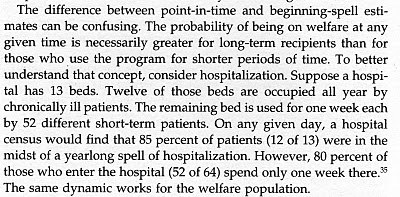
The statistical phenomenon of short-term reliance hiding long-term is explained below via NZ research into how long people rely on the DPB:

On average, sole parents receiving main benefits had more disadvantaged backgrounds than might have been expected:

·          just over half had spent at least 80% of the history period observed (the previous 10 years in most cases) supported by main benefits
·          a third appeared to have become parents in their teenage years.

This reflects the over-representation of sole parents with long stays on benefit among those in receipt at any point in time, and the longer than average stays on benefit for those who become parents as teenagers.

Had the research considered all people granted benefit as a sole parent, or all people who received benefit as a sole parent over a window of time rather than at a point in time, the overall profile of the group would have appeared less disadvantaged.


 And another explanation I have used before from The Poverty of Welfare:

8 out of 10 years reliant on the DPB is a good enough definition of 'welfare dependency' for me.

Friday, June 01, 2012

Social messaging promoted over basic safety

When you toot a horn you startle and momentarily distract every other driver or pedestrian in the vicinity. Hence Officially:

Using the horn

The horn should only be used as a reasonable traffic warning. It should not make an unnecessary or unreasonably loud, harsh or shrill noise.

 Maori Party co-leader Tariana Turia has suggested drivers should show their disapproval of others smoking in cars carrying children by tooting at them and wagging their finger like Supernanny scolding a child.

Some are so obsessed with the long-terms dangers smoking can cause that they have left their common-sense parked up somewhere.

Thursday, May 31, 2012

I've had it


This poor bastard has had enough.

 (Hat tip Sean Fitzpatrick)

Wednesday, May 30, 2012

5 kids, 2 dead, 2 years jail

None of this raises eyebrows any more. There are loads more culprits just getting away with it. Just having the luck scales tip their way. Just avoiding criminality. But the impact on their surviving children is the same. Born to incapable parents, sent to questionable second carers, set on a life of utter insecurity and incomprehension of why. This is New Zealand.

(No need to point out to me that is was probably 6 kids. It is de-humanising to squabble over the adequate and accurate  quantification of humanity.)

Crowding

For the 'sky is falling' types a paper released by Statistics NZ today describes 'crowding ' since 1921.

"The 1921 Census identified 9 percent of dwellings as crowded. These were dwellings with more than 1.5 people per room (now considered severe crowding)......According to the 1921 people per room measure, less than 1 percent of households were severely crowded in 2006."

Just under 1 in 10  down to under 1 in 100.

The world is a better place in very, many ways.