Saturday, June 02, 2012

African American teenage birthrate and reliance on welfare

The following is posted to support a discussion I am having elsewhere. The Political Scientist is arguing, or seems to be, that teenage birth and recourse to welfare shouldn't be characterised as a problem or 'poor choice' and offering long-acting contraception is the wrong approach.

I have already responded to one claim he cites - "there was likely no correlation between the level of welfare ben­efits and the incidence of out- of-wedlock births" -  at his blog.

Below I address two more:


Claim:

 "An examination of the rate of babies born to unwed African American teenagers remains virtually unchanged from 1920 through 1990.[39]"

The "rate of babies born" means the number of births per 1,000 15-19 year-old African Americans.

The graphs below show plummeting unwed teenage births to African Americans since the early 1990s. Many individual states had their own reforms well before 1996 - the year when federal reform occurred.

The claim implies welfare benefits had nothing to do with the rate of African American illegitimacy 1920 to 1990 because of its constancy (ignores the steep rise during the 80s).

In which case you would have to conclude that reforms have nothing to do with the tumbling rates after 1990. I don't accept that. Neither do I rule out other factors at play.

The rate has continued to fall by the way with a slight blip somewhere around 2007-08 (from memory).


Source

Claim:

"...the myth of widespread permanent welfare status proved equally impossible to correct. Numerous reports and studies demonstrated that welfare was a transient state for most recipients and that it served primarily as a temporary safety net during financial crisis caused by job loss or family crisis.[42]

 The Political Scientist reiterates this in a comment to me:

"I’m also aware that you have spent much time and energy arguing for ‘welfare reform’ on the assumption that it creates something that you, and many others, refer to as ‘welfare dependency’.

It is, of course, mistaken but, given the correlational nature of much of the research that is perhaps understandable. We are all prone to confirmation bias."

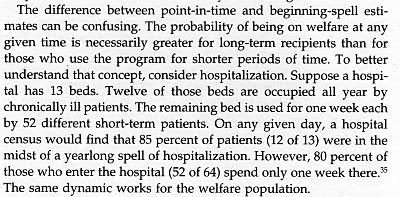
The statistical phenomenon of short-term reliance hiding long-term is explained below via NZ research into how long people rely on the DPB:

On average, sole parents receiving main benefits had more disadvantaged backgrounds than might have been expected:

·          just over half had spent at least 80% of the history period observed (the previous 10 years in most cases) supported by main benefits
·          a third appeared to have become parents in their teenage years.

This reflects the over-representation of sole parents with long stays on benefit among those in receipt at any point in time, and the longer than average stays on benefit for those who become parents as teenagers.

Had the research considered all people granted benefit as a sole parent, or all people who received benefit as a sole parent over a window of time rather than at a point in time, the overall profile of the group would have appeared less disadvantaged.


 And another explanation I have used before from The Poverty of Welfare:

8 out of 10 years reliant on the DPB is a good enough definition of 'welfare dependency' for me.
Friday, June 01, 2012

Social messaging promoted over basic safety

When you toot a horn you startle and momentarily distract every other driver or pedestrian in the vicinity. Hence Officially:

Using the horn

The horn should only be used as a reasonable traffic warning. It should not make an unnecessary or unreasonably loud, harsh or shrill noise.

 Maori Party co-leader Tariana Turia has suggested drivers should show their disapproval of others smoking in cars carrying children by tooting at them and wagging their finger like Supernanny scolding a child.

Some are so obsessed with the long-terms dangers smoking can cause that they have left their common-sense parked up somewhere.

Thursday, May 31, 2012

I've had it


This poor bastard has had enough.

 (Hat tip Sean Fitzpatrick)

Wednesday, May 30, 2012

5 kids, 2 dead, 2 years jail

None of this raises eyebrows any more. There are loads more culprits just getting away with it. Just having the luck scales tip their way. Just avoiding criminality. But the impact on their surviving children is the same. Born to incapable parents, sent to questionable second carers, set on a life of utter insecurity and incomprehension of why. This is New Zealand.

(No need to point out to me that is was probably 6 kids. It is de-humanising to squabble over the adequate and accurate  quantification of humanity.)

Crowding

For the 'sky is falling' types a paper released by Statistics NZ today describes 'crowding ' since 1921.

"The 1921 Census identified 9 percent of dwellings as crowded. These were dwellings with more than 1.5 people per room (now considered severe crowding)......According to the 1921 people per room measure, less than 1 percent of households were severely crowded in 2006."

Just under 1 in 10  down to under 1 in 100.

The world is a better place in very, many ways.

Tuesday, May 29, 2012

Families Commission - effectively gone

I didn't really want to think very hard about the implications of the Families Commission 're-structuring' but was prompted to when asked to go on Jim Mora's panel this afternoon (contact from RNZ 2 days running - did a taped interview yesterday's about the 22 percent of babies being on welfare by year-end).

I have concluded that its a de facto abolition. The money from their budget is going into projects that will support the welfare reforms. Parenting programmes for instance. And the new SuPERU unit (Social Policy Evaluation and Research Unit) will support, in particular, all the extra 'wrap-around' privately-provided youth services dovetailing with the new Youth Payment.

In 2008, prior to the election, Key told Family First he would get rid of the Families Commission and then hastily retracted his statement when it was published in the DomPost. This is the next best move. Christian conservative Peter Dunne has never been happy with his 2002 confidence and supply trophy which couldn't even define what a family is. The Commission was subsequently hijacked by Labour under Rajen Prasad, now a Labour MP and constant apologist for welfare dependence. For instance, it strongly advocated for the anti-smacking legislation which United Future vehemently opposed. And Dunne won't feel any regret about losing Christine Rankin, a current commissioner.

The Families Commission was largely a waste of time and resources though I will say that recently, some sharper,  more NZ-relevant research emerged.

But we are past talking now. We were past talking in 2003 when I submitted my opposition to select committee overseeing the formative legislation. More government isn't the answer.

Growing up in New Zealand

According to the NZ Herald, the restructured Families Commission is to take responsibility for the Growing Up in NZ study which has a sample of just under 7,000 babies born in Counties Manukau and Waikato in a period between 2009-2010.

Coincidentally I was looking at that study just yesterday. Regarding 'family resources',  at nine months of age it found 18 percent of babies had parents who received income from a main benefit in their first year. This number is too low, especially in those regions. The reason for the undercount is probably considerable drop-out from the study - 7 percent by nine months. And quite probably the very people we need to take more notice of, those families that are least able to provide good care for their children, are the ones most likely to drop out. So as long-term studies go it is already carrying a frustrating deficiency.

Nevertheless the first report is chocker full of interesting information about the babies and their parents. Things that stand out for me include the high reported use of marijuana, especially by partners; one in ten mothers smoked tobacco through pregnancy; reported relationship status doesn't match  DPB use when the baby is young - that is a fair number of people receiving the DPB actually have a partner. 457 mothers had no partner when the baby was 9 months yet 723 received income from the DPB.  And 8-9 percent slept in their parent's bed.

Monday, May 28, 2012

"Awaiting moderation" on Frogblog

Green MP Holly Walker wants to end child poverty in two terms by arriving at a parliamentary accord about the matter. As my subject today was the number of babies born last year relying on welfare by year-end contributing substantially to the child poverty problem, this afternoon I posted the following comment. It has been "awaiting moderation" ever since (now 9:10pm). I don't know why both Frogblog and Red Alert do this to my comments. I am never rude or abusive.
 
I released statistics today that show that 22 percent of babies born last year were dependent on a benefit by year-end. This isn’t an aberrant stat. Through good times and bad between one in four and one in five children is added to a new or existing benefit at or shortly after their birth. You won’t solve ‘child poverty’ without reducing this pattern of behaviour.

(BTW, who is Photonz1 who consistently puts up arguments against Green positions? Be nice to know.)

Smokers save the taxpayer money

So the latest taxes are no more than imposing state ideals and revenue gathering....

Radio NZ reports on Treasury officially acknowledging the truth.

A report by the Treasury has admitted smoking actually saves the Government money in the long run.
The fiscal benefits of smoking have long been suspected but rarely acknowledged and a report by Treasury now puts this on the record.
In its report, Treasury says smokers often die earlier than non-smokers and save the state in superannuation costs.
Treasury says smokers pay $1.3 billion a year in excise which may already exceed the direct health costs they impose.
The report then goes on to consider broader economic questions. It says smokers' shorter life expectancy reduces superannuation and aged care costs, meaning they are already "paying their way in narrowly fiscal terms"
The report was prepared for last week's Budget decision to raise the tax on cigarettes to discourage smoking.
Research by the New Zealand Institute of Economic Research has suggested that people should be able to pay increased prices into a special fund and get the money back later if they can prove they have quit.
The economic consultancy says that would be more effective than giving the money to the Government in higher taxes.

22 percent of babies born 2011 on welfare by year-end

Media Release

22 PERCENT OF BABIES BORN IN 2011 ON WELFARE BY YEAR-END

Monday, 28 May, 2012

Welfare commentator Lindsay Mitchell said that data released to her under the official Information Act  show that 22.2 percent of babies born in 2011  were dependent on a caregiver receiving a benefit by the end of the same year.

"Over one in five babies reliant on welfare by year-end is a sobering statistic. Almost half of the caregivers were Maori and half were aged 24 or younger."

"There is an established pattern of childbearing followed by reasonably rapid, if not immediate, recourse to welfare in New Zealand.  This occurs during good and bad economic periods."

"The implications for this high percentage lie in the likelihood of these children remaining on a benefit for many years. Ministry of Social Development research found, 'The older the child when they first have contact with the benefit system, the greater their likelihood of leaving benefit. Compared to those in contact at birth, those who first have contact between birth and six months have a 15% increase in the probability of leaving benefit. Between six months and one year there is a 33% increase, between one and two years there is a 41% increase, and first contact between two and three years is associated with a 56% increase in the probability of leaving benefit.' "

"These are the circumstances which are overwhelmingly contributing to New Zealand's child poverty problem."

Truth column Friday May 25

 Last Friday's Truth column:


The alcohol reform debate is boring. New Zealand has been agonising over alcohol since Adam was a boy. Parliament has tried to control its sale and consumption  since the 1800s. Then, lobby groups like the Salvation Army pushed abstinence; today, an alcohol tax hike. Dealing with lives ravaged by alcohol they forget most drinkers do not have a problem. To the contrary. People are now able to enjoy New Zealand-made boutique beers of international quality, visits to vineyards, wine and food festivals and economic benefits - like jobs - that vintners and brewers provide.


Yet all we hear is bad news about 'booze'. Particularly young drinkers. Which is somewhat forgetful of those doing much of the moaning - the middle-aged. Look back to their heyday to find a far worse culture of drink-driving for instance. In 1990, 139 15-24 year-olds affected by alcohol/drugs were involved in fatal crashes. Twenty years later the number had fallen to 54. After-match drinking was chronic and flat 'parties' were frequent. Drunken youth weren't as obvious because the 'Courtenay Places' didn't buzz all night. But young people using and abusing alcohol is no new thing.


Ironically, it is much harder for teenagers to purchase alcohol now than it was in the seventies and eighties yet  lobbyists and legislators still aren't satisfied. Some want the purchase-age put back to twenty, sales from convenience stores banned, trading hours cut and excise lifted.


As parents we want our kids to learn from our mistakes. Unfortunately human nature is such that they need to learn from their own. We hope and pray they survive those mistakes - the vast majority do. And they grow up in the process. But as a country, are we growing up?


Next month parliament will probably raise the purchase-age and impose further restrictions. Yet another exercise in punishing the responsible for the behaviour of the irresponsible. Par for the course in New Zealand I'm afraid. 


Saturday, May 26, 2012

Paula Bennett deserves recognition for breaking the mold

Yesterday MSD posted their Statement of Intent for 2012-2015 on-line. The following extract is from the Minister's forward. Now I don't expect readers of this blog to get over-excited. Some of you want no state welfare system at all. But that's not going to happen any time soon. The reason I am copying this is Bennett's willingness to put the facts on the table. This isn't typical Ministerial waffle that, at best, says we must do better. It says the system is a failure and it has to change. And amazingly even the taxpayer gets a mention:

New Zealanders want a welfare system we can be proud of. The system must support people who genuinely can’t support themselves, but those who can work should be available for work and actively looking. Better resources and support to help more people off welfare dependency and into work is a clear priority. The system has failed too many New Zealanders by creating dependence and the Ministry of Social Development is moving towards a more active approach that will see greater support in helping more people off welfare and into work.

Young people are a clear priority within welfare reform. We know that those who go on welfare young tend to stay longer than others and have poorer opportunities as a result. Of real concern are the 16 and 17 year olds who become disengaged from education, employment and training and who are on a collision course with the adult welfare system.

Teen parents also stay longer on benefits than those who become parents at an older age. On average, a teen mother will spend more than seven of the next 10 years on the Domestic Purposes Benefit.

The welfare system has allowed very young people and teen parents to gain access to a benefit, with very little support. We will not continue to fail these young people by handing them a welfare cheque and leaving them to their own devices.

The Ministry of Social Development is engaging with youth service providers who will work with these vulnerable young people in a very new way. Whether or not they receive a benefit, those 16 and 17 year olds and 16–18 year old teen parents at risk of going on or remaining on welfare long term will receive wrap-around support.

Sole parents will also receive much greater support to move into work, as previously this was a group that attracted little work expectation or assistance.

The integrity of the welfare system must be protected and the Ministry of Social Development will continue to improve systems to prevent fraud and abuse of the benefit system. This includes better, faster data matching and getting tougher on those who do abuse the welfare system which is there to support those in genuine need.

These changes are about greater expectations to ensure more New Zealanders participate fully in our economy and society. We are rebalancing the incentives and obligations and ensuring the welfare system is fair to those who use it and those who pay for it.

Friday, May 25, 2012

NZ's comparative risk rating

This morning Don Brash delivered a speech to the Institute of Chartered Accountants on the effects of yesterday's budget. This table appeared in the notes. NZ has the same risk rating as the US.

(I received the speech via e-mail so if anyone wants a copy let me know. It's not up at his website yet.)

Treasury's lack of faith in welfare reforms

Actual and forecast welfare spending:


Wednesday, May 23, 2012

"Public not fooled by media"

Here's an opinion piece that merits wider reading. From Michael Cox published in the Waikato Times;  

I think the correct word is dichotomy, but I had to look it up in the dictionary. It means when two parts are sharply opposed. So it would be fair to say that a dichotomy exists between what I read, hear and see in our media and the regularly published political polls. "Key has blown it" read one headline. "National self-destructing" said another. The guts of the comments made under these strident headlines go along the lines of, "since the November elections John Key and his National Party seem to have gone down a path of sheer political madness". "Their proposed partial asset sales, the deal-making with SkyCity, the ACC problems and the sale of the Crafar farms to a Chinese group, all spell political doom for this hapless Government." Not so, say the polls. In fact, they have shown an increase in support for Mr Key and his merry band of politicians. This hapless Government now has more support than on election night. Obviously, the public likes strong and positive leadership and doesn't believe the media's interpretation of events. So how can the press get it so wrong? Here I begin to tread carefully, for it is a writing sin to overgeneralise, but could it be that our reporters are hoping that Mr Key and his government have a serious pratfall? My many years of experience with the media have taught me that, in general, most of them lean to the Left in their personal political persuasions. The job attracts that type of thinking, with a strong emphasis on social justice and a dismissal of capitalist necessities of day-to-day economics. Those who are professional put these leanings aside and publish what they consider is true and correct and do a fair job. Some just let all their prejudices hang out. The relationship between politicians and journalists is a very delicate one. They both need each other to do their jobs properly. Both tread warily in each other's presence. I always felt journalists didn't like politicians and were envious of them. I am aware of only two journalists who have become MPs: Fred Doidge in 1936 and Brendon Burns, who lost his Labour seat in the last general election. Interestingly, in my time in that establishment, the members of the Press Gallery formed the strongest journalists' union in the country. So I think it would be fair to say that the re-election of Mr Key's Government was not greeted with overwhelming joy and elation at the bar in the Press Galleries lounge. The reporting since that time has been continuously against the Government. It's as if the professional reins have been loosened. There is a feeling that the proper Opposition has not fired under its new leadership, leaving a void that some journalists have felt they should fill. Our Fifth Estate is very powerful. While at present there is a dichotomy between what is reported and the polls, if the media are of a mind to attack Mr Key's Government over the next year or so, they will play a part in eroding its public support – they are that powerful. Someone like Kim Hill with her three hours of interviewing Left-wing international personnel every Saturday morning has an ongoing effect on people's political views. It's a bit like Chinese torture: drip, drip, drip. She is the only woman I know who can consistently get me out of bed at 8am on Saturday. Then on Sunday morning on National Radio we are gently badgered by former Labour MP Chris Laidlaw. He never pulls punches when the political Right gets in his way. Together, these two articulate and persuasive presenters are a concerted voice for the Left. I've said it is dangerous to generalise and I should acknowledge some of the editorials that have been positive about the actions taken by Mr Key particularly over events such as the SkyCity deal, which has so much of an upside for New Zealanders. Mr Key is a deal maker to the core and has been since I worked with him when he was a young foreign exchange dealer in a merchant bank in Wellington. That can only be a positive for this country and I suspect that the public appreciate that and reflect their views in the polls. 

(Sorry about the formatting. Blogger drives me nuts)

Budget 2012 - small mercies to anticipate

There may be more recent data but this will do:

Across the entire sample, 52 percent of offenders released from New Zealand prisons in 2002/03 were convicted of a new offence and were returned to prison at least once during the 60-months follow-up period. 

Yesterday in Parliament:

Hon ANNE TOLLEY (Minister of Corrections): Yesterday the Associate Minister of Corrections and I announced that Budget 2012 will contribute to a 25 percent reduction in reoffending by 2017, and 18,500 fewer victims of crime every year from 2017.

In other terms, in five years time, instead of 5 in 10 prisoners re-offending, New Zealand can look forward to 4 in 10 re-offending. I can hardly wait.

Tuesday, May 22, 2012

Welfare state not living up to expectations

In the budget run-up Every Child Counts is warning the government they must invest in children.

“As we head into Budget 2012, it is time for the government to publicly acknowledge the significant return on effective investment in children and assure the public that their policies will improve life for our most vulnerable children,” says Jenny Prince, Every Child Counts Steering Group member and CE of Plunket.
At the same time, a new study from the US  casts doubt on whether the welfare state can make up for a lack of two parent families. The study compares US and UK cohorts.

“WASHINGTON, DC, May 16, 2012 — Children in the United States and Great Britain share a number of common risk factors that increase the likelihood that they will have behavioral problems—and Britain’s broader social welfare programs don’t appear to mitigate those risks, according to a new study in the June issue of the Journal of Health and Social Behavior (JHSB)....

"We wanted to see whether the role of parents was equally important in both societies because the argument has been made that more developed welfare states—such as Great Britain—can make the role of parents less important, by providing additional supports that can help compensate for situations where households have more limited resources. This study tells us that parents are important in households, regardless of the strength of the welfare state.”
The UK Daily Mail has coverage here. They headlined coverage of the study from the Journal of Health and social Behaviour with:

Research found children from broken homes did worse regardless of how much state support is given
(Hat-tip Bob McCoskrie)

Social security wasn't unaminously welcomed - 1938

Response to Savage's Social Security proposals publicised via a radio broadcast earlier the same week;

(Source - The Evening Post, April 4, 1938)

Monday, May 21, 2012

Truth Column May 18

The following is my column published in The Truth, Friday, May 18:
When the first Old Age Pension was introduced in 1898 - over one hundred years ago - the qualifying age was 65. Fast forward to 2012 and the qualifying age is still 65. Given male life expectancy has risen from around 62 to 79 this seems astonishing.
Like so many government assistant schemes, pensions for the aged began as a tightly controlled, rather stringent programme but gradually ballooned, becoming a political football in the process. That's exactly what Super is right now with John Key staking his Prime Ministership on retaining the status quo.
Personally, I have never understood this intransigence. I asked him directly via a talk show question and answer session - why? He responded, during the 2008 election it became apparent that Labour was going to embark on a whispering campaign about his party's intention to raise the age. Thus he decided to put the mockers on it quick smart.
But it wasn't smart. Super is a huge cost with the youngest recipients accounting for a disproportionate share. The yearly bill for 65 and 66 year-olds alone is around $1.3 billion Looking ahead, as the baby-boomers age, the size of the workforce is going to shrink relative to the size of the 65 plus group. As one of them, I am uncomfortably aware of this. My kids will be (increasingly?) taxed to keep me.
So what, you may say? Hasn't that always been the way? Yes, but we haven't faced this kind of demographic change in the past. As are many European countries and the US. That's why they are lifting their entitlement ages.
Uncharacteristically Key has read this one wrong. When Phil Goff made lifting the age Labour policy in 2011 many people sensibly approved. Politicians are renowned for flip-flopping and generally we denigrate them for it. But this is one instance when a change of mind might reap kudos rather than derision.
Link not up yet but the editor's column is here.


Sunday, May 20, 2012

McCarten missing the point

More mangled logic from Matt McCarten today. About the extended free contraception to the teenagers of women on the DPB:

"If we really want to reduce teenage pregnancy and abortion it would be more principled, and just as cost-effective, to offer it to all young women."

Stupid. But I have heard this sentiment over and over. Who can believe it comes from the mouths of lefties who in the very next breath are demanding all sorts of targeted assistance for the poor.

But if we treat contraception as purely a health matter anyway, it is the poorest teenagers that become teenage mothers. DHB statistics illustrate this fact. So prevention is targeted at that group.

I wonder what McCarten thinks of the targeted funding for the reduction of rheumatic fever?

Tariana Turia:

"Today we announced that as part of Budget 2012 we are doubling the spending, from $12 million to $24 million, over the next 4 years to reduce rheumatic fever in vulnerable communities. We currently have 101 schools engaged in the rheumatic fever campaign, targeting 35,000 children in seven regions. This new funding will allow more schools and more children to be targeted in this preventive programme. Around 70 percent of children who get this Third World disease will suffer some heart damage, but with proper treatment that risk is dramatically reduced.
McCarten's idea of  "principled" policy would require the programmes to be run in all communities whether or not rheumatic fever is a problem.