Friday, June 17, 2011

Why is wowserism no longer the domain of women?
I usually don't catch up with NZ Herald columnists till the following day, given I read early and they are not published till later. Garth George yesterday called for the drinking age to be raised to 21. If you go back 100 years there are plenty of headlines about the demon drink and expunging it entirely from society. Yesterday I was reading from the Evening Post June 16, 1911 about the Women's Crusade for Prohibition in the Dominion and the eliciting of pledges from men not to drink. The campaign actually had a name. Catch my pal.
But the calls 100 years ago were largely from females. Now there are largely from men. I wonder why.
Oh and I see George is blaming alcohol for so many people being on the DPB. So if we legally withhold alcohol from them under-21s won't go on the DPB? Isn't it just better to withhold the DPB which indulges the consequences of drinking?
George blames alcohol for reliance on benefits and so reasons, take alcohol away from everyone under 21. Even those who drink responsibly.
Whereas I blame benefits for the abuse of alcohol. Nothing like a state income free of obligation to sooth a "shuddering hangover" Garth.
But the calls 100 years ago were largely from females. Now there are largely from men. I wonder why.
Oh and I see George is blaming alcohol for so many people being on the DPB. So if we legally withhold alcohol from them under-21s won't go on the DPB? Isn't it just better to withhold the DPB which indulges the consequences of drinking?
George blames alcohol for reliance on benefits and so reasons, take alcohol away from everyone under 21. Even those who drink responsibly.
Whereas I blame benefits for the abuse of alcohol. Nothing like a state income free of obligation to sooth a "shuddering hangover" Garth.
Thursday, June 16, 2011
The psychology of the welfare debate
Unusually insightful article here from one Kevin E Schiemsing.
US religionists are in disagreement about proposed cuts to welfare programmes. The disagreement isn't just between various sects but between Catholics. This arises out of how different Catholics view the role of government. Without doubt the same variance of view exists in NZ.
The proponents of government welfare programmes came up with this declaration called The Circle of Protection. It appears that signatories insist that cuts will hurt the poor.
But this is what really struck me:
Totally.
This explains why people like me are characterised as selfish and uncaring. Pro welfare types don't actually believe that I believe welfare hurts individuals. In which case I must have another evil agenda. Racism, or eugenics, whatever.
Talking to Leighton Smith the other day, the matter of my paper Maori and Welfare came up. He asked an odd question I thought. Pretty much, do you believe the things you write? Or maybe it was, do you believe the things you write to be true or factual? That was what I took from the question anyway. Which actually made me burst into laughter. Of course I believe them I said. I wouldn't write them if I didn't.
But here's another thing. I don't reflect the other side's disbelief. That is, I do not characterise proponents of government welfare as evil or having secret agendas. I describe them as well-intentioned but misguided. Patronising at best. Dangerous at worst. But nevertheless sincere in their clinging to faith in government efforts to reduce poverty.
Back to the column:
So, do you think this fellow really believes all that?
You bet. And so do I.
US religionists are in disagreement about proposed cuts to welfare programmes. The disagreement isn't just between various sects but between Catholics. This arises out of how different Catholics view the role of government. Without doubt the same variance of view exists in NZ.
The proponents of government welfare programmes came up with this declaration called The Circle of Protection. It appears that signatories insist that cuts will hurt the poor.
But this is what really struck me:
Defenders of government welfare programs not only cannot conceive of the possibility that government programs actually harm rather than help the people they target; they cannot conceive of the possibility that anyone else could conceive of the possibility. Those of us who sincerely believe that such programs are harmful are baffled at what we perceive to be stubborn resistance to the facts of the matter.
Totally.
This explains why people like me are characterised as selfish and uncaring. Pro welfare types don't actually believe that I believe welfare hurts individuals. In which case I must have another evil agenda. Racism, or eugenics, whatever.
Talking to Leighton Smith the other day, the matter of my paper Maori and Welfare came up. He asked an odd question I thought. Pretty much, do you believe the things you write? Or maybe it was, do you believe the things you write to be true or factual? That was what I took from the question anyway. Which actually made me burst into laughter. Of course I believe them I said. I wouldn't write them if I didn't.
But here's another thing. I don't reflect the other side's disbelief. That is, I do not characterise proponents of government welfare as evil or having secret agendas. I describe them as well-intentioned but misguided. Patronising at best. Dangerous at worst. But nevertheless sincere in their clinging to faith in government efforts to reduce poverty.
Back to the column:
What unemployed and impoverished people really need is not government handouts, but access to, and the capacity and inducement to engage, the market economy—as Pope John Paul II put it, to “enter the circle of exchange.” Government policy should be encouraging companies to hire and potential employees to be hired. Yet, to take but one example of recent counter productivity, economists have shown that extending unemployment benefits beyond a certain length of time correlates with higher unemployment rates. If a safety net becomes too comfortable, people are inclined to remain in it. Welfare program advocates deny this vehemently—everyone wants to work, they say; they just need the chance—but statistical evidence and a realistic understanding of human nature contradict them. It could be that the perfect job is not available; maybe finding work means picking up and moving, or taking a cut in pay, or training to acquire a new skill. People faced with these situations deserve our compassion and assistance. But if we minimize the incentive to do what is necessary to find employment, we do neither the out-of-work individual nor the overall economy any favors.
So, do you think this fellow really believes all that?
You bet. And so do I.
Wednesday, June 15, 2011
On Whaleoil's latest foray - hurray
When I thought Cameron Slater had hacked into the Labour site I was conflicted. Glad he had (intentionally or otherwise) avenged the Brash burglary, but two wrongs don't make a right.
Now it is clear he merely helped himself to what was on offer through another party's carelessness, the morality changes. And context is everything.
Although his outing of the on-line alias 'Micky Savage' (a person with views that would offend the original name-bearer) may have not been facilitated by his newly acquired database, if it has, I look forward to lots more.
Some of us have put our opinions and addresses and images out there for all to see, for some years. It gives me immense pleasure to see those who haven't, who have used the cloak of either an alias or anonymity to ridicule, malign, lie or bully, get their come-uppance.
Now it is clear he merely helped himself to what was on offer through another party's carelessness, the morality changes. And context is everything.
Although his outing of the on-line alias 'Micky Savage' (a person with views that would offend the original name-bearer) may have not been facilitated by his newly acquired database, if it has, I look forward to lots more.
Some of us have put our opinions and addresses and images out there for all to see, for some years. It gives me immense pleasure to see those who haven't, who have used the cloak of either an alias or anonymity to ridicule, malign, lie or bully, get their come-uppance.
Monday, June 13, 2011
More tripe about children in poverty
The DomPost reports that according to the school principal at Cannon's Creek School, "... about three quarters of parents are unemployed." Money is tighter than ever before apparently. It's the worst the principal has seen. In 30 years!
Slightly odd that as there are fewer people drawing an unemployment benefit in Porirua now than there was in 2006*. More on the DPB though.
Hasn't some well-meaning lefty pointed out to her that being on the DPB does not mean a parent is "unemployed"? Parenting is work afterall.
Seriously, when will 'child poverty' start being blamed on family structure instead of unemployment?
And Kidscan, who are supplying raincoats and breakfasts to the pupils only make it easier for their parents to get by on benefits.
*Porirua Unemployment Benefit March 2006 1,421 March 2011 1,261
Porirua Domestic purposes Benefit March 2006 2,108 March 2011 2,152
Slightly odd that as there are fewer people drawing an unemployment benefit in Porirua now than there was in 2006*. More on the DPB though.
Hasn't some well-meaning lefty pointed out to her that being on the DPB does not mean a parent is "unemployed"? Parenting is work afterall.
Seriously, when will 'child poverty' start being blamed on family structure instead of unemployment?
And Kidscan, who are supplying raincoats and breakfasts to the pupils only make it easier for their parents to get by on benefits.
*Porirua Unemployment Benefit March 2006 1,421 March 2011 1,261
Porirua Domestic purposes Benefit March 2006 2,108 March 2011 2,152
The Official Information Act for Officials?
Reading a NZ Herald report about households receiving high total benefits due to high total occupants had me thinking...
... how can the Herald get the sort of specific information I can't? The answer is, they can't. But the Minister can.
I can provide many examples of refusal to release information by MSD.
Ah, but now I understand. The Official Information Act is so-called because it refers to Information accessible only to Officials.
A report obtained under the Official Information Act shows 14 people, including three children, were listed at one household in Papatoetoe. Collectively it was getting over $4000 a week net in benefit payments - adding up to about $224,000 a year.
... how can the Herald get the sort of specific information I can't? The answer is, they can't. But the Minister can.
She [Paula Bennett]had asked for the breakdown of benefit payments per household as part of work a panel of ministers is doing on welfare reforms following the Welfare Working Group report.
I can provide many examples of refusal to release information by MSD.
Ah, but now I understand. The Official Information Act is so-called because it refers to Information accessible only to Officials.
Sunday, June 12, 2011
Kill some local economies
I remember the first ACT 'do' I ever attended. Still a member of the Libz, I had been very active in campaigning against the DPB from the social, economic and philosophical viewpoints. It was 2002. The local candidate had persuaded me to attend this dinner and he would sit me next to Muriel Newman and we could exchanges ideas etc about welfare. It was at the Hutt Men's club, very plush and with many grey-haired, well-heeled in attendance. I was dumbstruck when this gentlemen, who had begun the conversation about welfare, said to me, smugly I thought, "If we took away the DPB it would kill some local economies. Can't be done." Because it was such an unexpected comment with validity, because I was amongst business people who may well share the same attitude, I let it go. If it was repeated to me today I would agree and explain why those particular economies need to be killed off. Economies that survive on the money pumped into them every day by Work and Income. Places like Ruatoria, Te Kaha, Waverley, Flaxmere, Reporoa and Kawerau. And certain suburbs near all of NZ's major towns and cities. Places of hopelessness. Places where inhabitants experience small superficial highs and desperate deep lows. Where life is about day-to-day survival with no capacity to aspire to anything else.
False economies do not work on a large scale, and they do not work on a small scale. The Labour government's official recognition of this manifested in the Jobs Jolt policy, which forbade unemployed people from moving to places where there were no jobs - not if they wanted to receive taxpayer support anyway. But because they never extended the policy to other beneficiaries, particularly those on the DPB who could support a none-work inclined partner, the jobless economies survived.
The remark from the ACT dinner attendee was probably well-intentioned in his view. It may have been self-interested. But it was shallow in its ignorance of 'that which cannot be seen' and a denial of the day of reckoning which must surely come.
False economies do not work on a large scale, and they do not work on a small scale. The Labour government's official recognition of this manifested in the Jobs Jolt policy, which forbade unemployed people from moving to places where there were no jobs - not if they wanted to receive taxpayer support anyway. But because they never extended the policy to other beneficiaries, particularly those on the DPB who could support a none-work inclined partner, the jobless economies survived.
The remark from the ACT dinner attendee was probably well-intentioned in his view. It may have been self-interested. But it was shallow in its ignorance of 'that which cannot be seen' and a denial of the day of reckoning which must surely come.
Friday, June 10, 2011
The cute things children say - not
Another study from the previously mentioned June issue of the Social Policy Journal of New Zealand is into children's perceptions of violence - physical, sexual and emotional, which is how CYF also categorises abuse by the way. Over 2,000 children randomly selected from 28 schools of "various sizes, geographic areas and socio-economic neighbourhoods" filled out questionairres. Apart from telling us the overall incidence of experience ...
...there is no breakdown of socio-economic status, gender, age or ethnicity. What I would have been interested in.
Instead, because of the nature of the type of research, the report features many direct quotes from children. If you only like the cute things kids say, stop here.
"I've been punched, grabbed by the throat and hung over a trellis and then thrown on the concrete"
"I get hidings all the time and some people hurt me"
"Kicked by somebody I don't know because my dog went on their land"
"I got into a fight with my Mum and I hit her. Then she hit me with the broom and kicked me out of the house"
"Some kids tease me and do wrestling moves on me and I'm getting scabs and bruises"
"I saw people having a fight. Blood on walls and carpet. Screaming and yelling."
"My Mum and her boyfriend always get in arguments and I've seen heaps of things get smashed"
"I watched my Aunty and my Dad fighting with knives inside at night"
"My Dad hurt Mum in town and made her mouth bleed".
"In the Christmas holidays my family went away with our friends, but Dad wasn't allowed to come because Mum had a something order out on him. But on the third day we were there Dad came because he needed to talk to Mum, and Dad and my Dad's friends got in a big fight with me, all my sisters and the rest of the camp watching."
"I woke up and heard fighting and banging the walls. I thought my Mum's boyfriend was beating her up."
"When my Mum and Step-Dad broke up they started hitting each other. I was in my room in bed."
"I've been hit with metal or any objects my parents pick up. My Dad abused my Mum when I was young"
"When I got beaten up and when I got chased by a man. When my sister got beaten up by my Dad and when my sister got raped"
"I have been followed by a man six times. I got taken off my Dad. Dad went to jail for beating my Step-Mum and assaulting her. I got punched by someone in my family. But I am not telling who. And my Mum is having a bad time at the moment at home."
"People get mean to me because my Mum goes out with heaps of men"
"Dad's girlfriend yells at me and swears at me when Dad isn't around for no reason"
"People said I would be traded for a dog"
"When my Mum and Dad had a fight and my Dad wouldn't stop beating my Mum up and I can't stop thinking about it, but they don't do that any more and when my Dad yells at my brother and the way he speaks."
"I've been scared when my Mum and Dad fight because I don't know who to go to."
"I have been sexually abused and just had it sorted out and I had to move away from all my friends and family. My brothers always hurt me by calling me names about my weight and size."
"My Dad went to jail for raping me."
"My friend got body slammed before my eyes and I was too weak to help him get up."
"Mum has been quite a witch, spelt with a B, and started screaming at me. I've tried suicide two times because of her"
Enough?
You will be interested in the conclusion from the researchers:
Sixty-three percent of children reported having directly experienced physical violence at some time in their lives. Two-thirds reported having witnessed physical violence directed at other children, and nearly 90% reported having seen violence in the media. Although less common, still more than a quarter of the children (27%) reported witnessing violence against adults.
...there is no breakdown of socio-economic status, gender, age or ethnicity. What I would have been interested in.
Instead, because of the nature of the type of research, the report features many direct quotes from children. If you only like the cute things kids say, stop here.
"I've been punched, grabbed by the throat and hung over a trellis and then thrown on the concrete"
"I get hidings all the time and some people hurt me"
"Kicked by somebody I don't know because my dog went on their land"
"I got into a fight with my Mum and I hit her. Then she hit me with the broom and kicked me out of the house"
"Some kids tease me and do wrestling moves on me and I'm getting scabs and bruises"
"I saw people having a fight. Blood on walls and carpet. Screaming and yelling."
"My Mum and her boyfriend always get in arguments and I've seen heaps of things get smashed"
"I watched my Aunty and my Dad fighting with knives inside at night"
"My Dad hurt Mum in town and made her mouth bleed".
"In the Christmas holidays my family went away with our friends, but Dad wasn't allowed to come because Mum had a something order out on him. But on the third day we were there Dad came because he needed to talk to Mum, and Dad and my Dad's friends got in a big fight with me, all my sisters and the rest of the camp watching."
"I woke up and heard fighting and banging the walls. I thought my Mum's boyfriend was beating her up."
"When my Mum and Step-Dad broke up they started hitting each other. I was in my room in bed."
"I've been hit with metal or any objects my parents pick up. My Dad abused my Mum when I was young"
"When I got beaten up and when I got chased by a man. When my sister got beaten up by my Dad and when my sister got raped"
"I have been followed by a man six times. I got taken off my Dad. Dad went to jail for beating my Step-Mum and assaulting her. I got punched by someone in my family. But I am not telling who. And my Mum is having a bad time at the moment at home."
"People get mean to me because my Mum goes out with heaps of men"
"Dad's girlfriend yells at me and swears at me when Dad isn't around for no reason"
"People said I would be traded for a dog"
"When my Mum and Dad had a fight and my Dad wouldn't stop beating my Mum up and I can't stop thinking about it, but they don't do that any more and when my Dad yells at my brother and the way he speaks."
"I've been scared when my Mum and Dad fight because I don't know who to go to."
"I have been sexually abused and just had it sorted out and I had to move away from all my friends and family. My brothers always hurt me by calling me names about my weight and size."
"My Dad went to jail for raping me."
"My friend got body slammed before my eyes and I was too weak to help him get up."
"Mum has been quite a witch, spelt with a B, and started screaming at me. I've tried suicide two times because of her"
Enough?
You will be interested in the conclusion from the researchers:
The level of children's exposure to violence in this country is relatively high, and New Zealand appears to be a more violent country for children than was previously realised. The perceptions of the children in this study were that their experiences had a notable impact on their wellbeing. Furthermore, observation of violent events was rated as having a more powerful impact on children than their own victimisation. For many children the conclusion can be drawn that bullying is part of their childhood. Reporting the effects of their violent experiences highlighted the special vulnerability of children. Adults must assume responsibility to reduce our children's exposure to violence because New Zealand cannot afford the devastating effects of failing to protect its children.
Thursday, June 09, 2011
Servant? Give me a break
"Whatever I do, I would like to continue to serve our community and our country."
And get paid a hundred grand more than the average annual income of those I serve.
So "much to offer". So much magnanimity.
Brash was at the Knowledge Wave Conference too
Fran O'Sullivan was delving through old file boxes and came across one about the Knowledge Wave conference in 2001. Ten years ago already. She writes that is was a lost opportunity:
Essentially she says we are all talk. But quotes Helen Clark, mentions ex University of Auckland vice-chancellor John Hood and "political, business and social leaders from countries like Australia, Canada, Ireland, Israel, Singapore, Korea, the US and Taiwan."
She makes no allusion to Don Brash, then Reserve Bank Governor. But I was impressed enough by what he said to also keep a clipping.
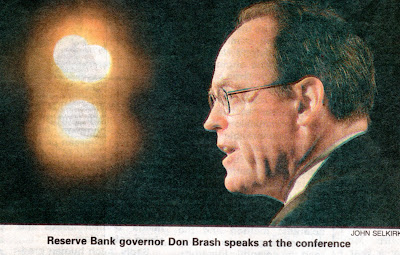
The headline reads, Let's get radical, challenges Brash. NZ could only climb back into the ranks of the wealthy with a change of attitude and behaviour but New Zealanders had " deeply ingrained cultural characteristics", a disdain for commercial success, no strong passion for education and a tendency for immediate gratification. The economy would not improve significantly while 350,000 working age people received tax-payer funded income support. He suggested lifetime limits on how long able-bodied people could claim state benefits.
But let me finish with Fran O'Sullivan's words:
Brash obviously agrees with the final sentence. But the way Key and National reacted to his political re-emergence illustrates exactly why we are going nowhere fast. Perhaps there should be an age limit on becoming the leader of a country. Too young and there is little or less sense of urgency and certainly less context.
Ten years ago my son had barely started primary school. This week he recieved his electoral enrolment form. Ten years is a bloody long time.
As Brash said ten years ago, New Zealand needs to get radical.
...Catching the Knowledge Wave project stands out as one of the key missed opportunities that also litter New Zealand's history...
Essentially she says we are all talk. But quotes Helen Clark, mentions ex University of Auckland vice-chancellor John Hood and "political, business and social leaders from countries like Australia, Canada, Ireland, Israel, Singapore, Korea, the US and Taiwan."
She makes no allusion to Don Brash, then Reserve Bank Governor. But I was impressed enough by what he said to also keep a clipping.

The headline reads, Let's get radical, challenges Brash. NZ could only climb back into the ranks of the wealthy with a change of attitude and behaviour but New Zealanders had " deeply ingrained cultural characteristics", a disdain for commercial success, no strong passion for education and a tendency for immediate gratification. The economy would not improve significantly while 350,000 working age people received tax-payer funded income support. He suggested lifetime limits on how long able-bodied people could claim state benefits.
But let me finish with Fran O'Sullivan's words:
In retrospect, Catching the Knowledge Wave was too much about conversation and too little about action. It would be too pat to put this down to the heavy infusion of public relations messaging. Although that is a factor.
The real issue is that New Zealand body politic is still far too slow and far too slack when it comes to implementing a big agenda.
The John Key Government's own growth strategy is a case in point. For example, the shambles over the mining strategy and the failure to put some ballast under the PM's financial services hub project. Until recently, NZTE has been a relative shambles ... the list goes on.
It's unfathomable that a private sector operator like Key doesn't put a few more skilled ministers alongside Steven Joyce and Tony Ryall to form a speed team to get major change bedded down.
After three years of economic crises, endlessly debating is no longer an option.
Brash obviously agrees with the final sentence. But the way Key and National reacted to his political re-emergence illustrates exactly why we are going nowhere fast. Perhaps there should be an age limit on becoming the leader of a country. Too young and there is little or less sense of urgency and certainly less context.
Ten years ago my son had barely started primary school. This week he recieved his electoral enrolment form. Ten years is a bloody long time.
As Brash said ten years ago, New Zealand needs to get radical.
Wednesday, June 08, 2011
New research into early Maori parenting skirts around the issue of incentives
The Social Policy Journal has just been released and contains a study into the early pregnancy/parenting rate of young Maori using the Christchurch Health and Development birth cohort. It agonisingly pores over the reasons for this and not once considers benefits as an incentive due to the potentially low incomes from work of Maori youth.
What is interesting is new information about the difference between those who identify as sole Maori and those who identify as Maori/other, and the results also include males who were asked if they got a partner pregnant or became a parent under 20.
The following is a quote from the ' discussion':
It "could therefore be argued?"
What are these people frightened of?
What is interesting is new information about the difference between those who identify as sole Maori and those who identify as Maori/other, and the results also include males who were asked if they got a partner pregnant or became a parent under 20.
The following is a quote from the ' discussion':
Two major findings emerged from these analyses. First, respondents having a sole Māori cultural identity had odds of early pregnancy and parenthood that were over seven times higher than those of non-Māori, while those of Māori/other cultural identity had odds of early pregnancy and parenthood that were over three times higher than non-Māori. These results were evident for both males and females. Also, those of sole Māori cultural identity had rates of pregnancy and parenthood that were significantly (p < .05) greater than those of Māori/other cultural identity. Similar findings were obtained using an alternative method of classifying Māori identity. These findings are consistent with the view that cultural identity plays an important role in ethnic differences, since rates of early pregnancy/parenthood increased steadily with increasing Māori cultural identity.
Further analysis suggested that, in part, the associations between cultural identity and early pregnancy/parenthood were due to socio-economic and family-related factors. After adjustment for these factors, those of sole Māori identity had rates of early pregnancy and parenthood that were more than three times higher than those of non-Māori and those of Māori/other identity. Again, similar results were found for males and females, and these findings were replicated in a supplementary analysis using an alternative measure of Māori identity.
Collectively these findings suggest that the higher rates of early pregnancy and parenthood among Māori are a consequence of a combination of socio-economic, family and cultural factors that combine to place young Māori at significantly increased risks of early pregnancy and parenthood. The implications of these conclusions are discussed below.
Although it has been argued that early parenting has been constructed as a problem by the health profession (e.g. Barker 1998), there is evidence that draws links between early age of pregnancy and greater likelihood of negative outcomes for offspring and parents (Coley and Chase-Lansdale 1998, Fergusson and Woodward 1999, Singh et al. 2001, Hobcraft and Kiernan 2001, Mantell et al. 2004, Ministry of Social Development 2008a, Robson and Berthoud 2006, Woodward et al. 2006, Boden et al. 2008). The results of the present study suggest that Māori, and in particular individuals of sole Māori cultural identity, are at increased risk of early pregnancy/parenthood. It could therefore be argued that at least some of the social disadvantage experienced by Māori in New Zealand may be due in part to increased rates of early pregnancy/parenthood among those of sole Māori cultural identity.
It "could therefore be argued?"
What are these people frightened of?
Monday, June 06, 2011
What timidity looks like
From Stuff:

Even if the goal is achieved, in simple terms of total number of beneficiaries, the reduction will be a worse performance than under Labour.
The welfare group's February report said the cost of welfare would go from $47 billion to $34b by 2021 if its reforms proceeded - cutting the 360,000 on welfare by 100,000, by putting work obligations on them in exchange for support such as childcare.

Even if the goal is achieved, in simple terms of total number of beneficiaries, the reduction will be a worse performance than under Labour.
Sunday, June 05, 2011
Bans to brush gangs further under the carpet
Todd McClay, who I respected for standing by his Dad but was unimpressed with at select committee when in the 3 hours I was in attendance said nothing, is proposing a ban on gang patches in all property owned by govenment. Really it's quite laughable when you consider the underlying silliness.
But it will be OK to wear your patch in your state-owned house, when you are driving on a state-owned highway, visiting your state-owned GP to get a sickness certificate signed off, visiting the chemist to get your kids state-paid prescriptions filled or visiting a cash machine to draw your state-paid benefit.
You can do all that but if you chance to work for a living and it's on government owned property - a forest perhaps - forget it.
This country is so schizophrenic about gangs. This approach can only be described a bumbling attempt to brush them further under the carpet. There still there though. And once again ACT appears to be in support.
"There will be people who will say this is an infringement on civil rights. But these are members of gangs; people who attack old ladies in the streets or sell drugs to their grandchildren. Those are bigger violations of human rights than a law that says if you want support from a government department, you must not wear gang insignia".
But it will be OK to wear your patch in your state-owned house, when you are driving on a state-owned highway, visiting your state-owned GP to get a sickness certificate signed off, visiting the chemist to get your kids state-paid prescriptions filled or visiting a cash machine to draw your state-paid benefit.
You can do all that but if you chance to work for a living and it's on government owned property - a forest perhaps - forget it.
This country is so schizophrenic about gangs. This approach can only be described a bumbling attempt to brush them further under the carpet. There still there though. And once again ACT appears to be in support.
Entitlement malaise strikes at any age
The inevitable comment arrived (also inevitably made by 'anonymous') reacting to my post about the extra handouts to over 65s:
I think I am fairly even-handed in my criticism of the entitlement malaise. I don't care what age the sufferer is. The world does not owe you a living.
Recently I wrote about how politicians play one group off against the other by using the welfare state. The commenter should read David Thompson's Selfish Generations which is a fairly good crack at showing how people born from around 1925 to 1940 got back proportionately more in benefits (broad definition) than they paid in tax throughout their lifetimes. He doesn't attack the older generation for this. Merely points out that as welfare states age, later generations fare less well. In turn, my kids are going to do it tougher than my generation.
I won't attack oldies for this either, except when they bleat about wanting even more and ignore that it is their children and grandchildren who are paying for it. And if you want to get a whopping big dose of it go to a Grey Power meeting.
If you are a socialist I will oppose your thinking regardless of age.
And why not,we have paid taxes all our lives.get the young into eork and leave the oldies alone.Remember most of the facilities the young enjoy today were paid for by these oldies.
I think I am fairly even-handed in my criticism of the entitlement malaise. I don't care what age the sufferer is. The world does not owe you a living.
Recently I wrote about how politicians play one group off against the other by using the welfare state. The commenter should read David Thompson's Selfish Generations which is a fairly good crack at showing how people born from around 1925 to 1940 got back proportionately more in benefits (broad definition) than they paid in tax throughout their lifetimes. He doesn't attack the older generation for this. Merely points out that as welfare states age, later generations fare less well. In turn, my kids are going to do it tougher than my generation.
I won't attack oldies for this either, except when they bleat about wanting even more and ignore that it is their children and grandchildren who are paying for it. And if you want to get a whopping big dose of it go to a Grey Power meeting.
If you are a socialist I will oppose your thinking regardless of age.
Friday, June 03, 2011
Extra handouts for some
It isn't unusual to hear oldies bleating about Working For Families and how much money their adult children are getting that they don't need. Probably to each other as they flash their Super Goldcard to get a 'free' ferry trip somewhere. In AUSTRALIA.
Yes. The welfare state now pays out money to enhance Kiwi pensioner's holidays to the Gold Coast. But in a rich irony called 'reciprocity', one of the many ironies inherent in the fiasco welfare has become, holiday-making Aussies over 60 will be able to enjoy handouts same-age Kiwis can't in their own country!! Wah,wah. Quick get Peters onto it. The Supergold card must be available from 60. It's not fair. Wah, wah.
Yes. The welfare state now pays out money to enhance Kiwi pensioner's holidays to the Gold Coast. But in a rich irony called 'reciprocity', one of the many ironies inherent in the fiasco welfare has become, holiday-making Aussies over 60 will be able to enjoy handouts same-age Kiwis can't in their own country!! Wah,wah. Quick get Peters onto it. The Supergold card must be available from 60. It's not fair. Wah, wah.
Thursday, June 02, 2011
Sickness and invalid benefits - try something different
In regard to welfare reform my focus has always been on the DPB for the reasons that 1/ children are being disadvantaged, sometimes very badly 2/ this benefit is at the heart of inter-generational dependence and 3/ it has the greatest potential for reform and improved lives in the process.
While I am very familiar with the history, statistics, reasons for being on and other aspects of sickness and invalid benefits I have spent far less time talking about them. But a lot of time thinking about them. Their reform is absolutely essential but much more fraught, in terms of hardship and politics. Sometimes I wonder if they aren't being handled by the wrong bureaucracy. That is, shouldn't they be part of the health system? If they were, perhaps more focus would go on getting people better, more rigorous diagnosis and attention to trends.
As it stands well people are lumped together with unwell people and are all seen under the same roof by the same people. People with no expertise in matters physical or psychological. If the money for sickness and invalid benefits was coming out of DHB funding you can bet that the focus on why more and more people are going on them would sharpen up pretty fast.
Which leads me to a further thought. Money is very tight in Health. It is also capped, whereas MSD funding is not. Does Health tacitly sign people over to the responsibility and cost of MSD because there isn't money available for whatever it would take to get them functioning?
This must be right to a degree. That is why various governments have tried programmes like Pathways to Health, bumping beneficiaries up public waiting lists in the Counties Manakau system I recall.
Some individuals may have been helped by these initiatives but overall the trend upwards continues. The percentage of working age New Zealanders reliant on one of these benefits continues to climb.
Suggestion: The existing funding pool for sickness and invalid benefits could be transferred over to the relevant DHB and thereafter managed but capped. Money saved by reducing the caseload (the current levels are artificial) and used elsewhere in the health system or invested in resources to further assist beneficiaries back to good health. Mental health exponents will tell you how badly under-funded their area is. This would give them a chance to up their funding and treat people to the best of their capacity which is surely what health professionals want to do.
While I am very familiar with the history, statistics, reasons for being on and other aspects of sickness and invalid benefits I have spent far less time talking about them. But a lot of time thinking about them. Their reform is absolutely essential but much more fraught, in terms of hardship and politics. Sometimes I wonder if they aren't being handled by the wrong bureaucracy. That is, shouldn't they be part of the health system? If they were, perhaps more focus would go on getting people better, more rigorous diagnosis and attention to trends.
As it stands well people are lumped together with unwell people and are all seen under the same roof by the same people. People with no expertise in matters physical or psychological. If the money for sickness and invalid benefits was coming out of DHB funding you can bet that the focus on why more and more people are going on them would sharpen up pretty fast.
Which leads me to a further thought. Money is very tight in Health. It is also capped, whereas MSD funding is not. Does Health tacitly sign people over to the responsibility and cost of MSD because there isn't money available for whatever it would take to get them functioning?
This must be right to a degree. That is why various governments have tried programmes like Pathways to Health, bumping beneficiaries up public waiting lists in the Counties Manakau system I recall.
Some individuals may have been helped by these initiatives but overall the trend upwards continues. The percentage of working age New Zealanders reliant on one of these benefits continues to climb.
Suggestion: The existing funding pool for sickness and invalid benefits could be transferred over to the relevant DHB and thereafter managed but capped. Money saved by reducing the caseload (the current levels are artificial) and used elsewhere in the health system or invested in resources to further assist beneficiaries back to good health. Mental health exponents will tell you how badly under-funded their area is. This would give them a chance to up their funding and treat people to the best of their capacity which is surely what health professionals want to do.
Tuesday, May 31, 2011
Gordon Campbell - is anyone on the left prepared to deal with realities?
There is opinion, and there is wilful misrepresentation.
Sickness and invalid benefit levels were at record highs and the DPB levels were not far off flat-lining. Only unemployment benefit levels were "at record lows". Yet the welfare reforms, as recommended by the WWG, barely touch on the unemployment benefit.
The main determinant of beneficiary numbers can not be a "functioning economy". If that was the case, after the economic boom under Labour, there wouldn't have been ten percent of the working age population dependent. There would have been 2 or 3 maybe.
The system is making it to "too easy for people to get on, and stay on benefits" regardless of the state of the economy.
Of course it has been a mistake. Any benefit that has 40 percent of all Maori women aged between 20 and 30 dependent on the state is a drastic error of policy.

Yesterday, Key-the-moderate was engaged in the age-old right wing election year rhetoric of welfare bashing.
More in sorrow than in anger though, of course. The current system was “broken”. It was “unaffordable” And it was “unsustainable ” – unless most of the wilder ideas of the Welfare Working Group are put into action. A Cabinet working team and government departments are now to be tasked with furthering the WWG recommendations.
These welfare alarums are bogus, of course. Only three years ago, this same allegedly broken system had benefit levels down at record lows.
Sickness and invalid benefit levels were at record highs and the DPB levels were not far off flat-lining. Only unemployment benefit levels were "at record lows". Yet the welfare reforms, as recommended by the WWG, barely touch on the unemployment benefit.
The main determinant of beneficiary numbers is a functioning economy where jobs are available – and that’s something for which Key takes no responsibility whatsoever. Instead, the government seems to be hellbent on making beneficiaries keep their side of the social contract – while taking no responsibility as managers of the economy, for failing to keep its side of the bargain.
In that respect, the government’s welfare reform rhetoric is as dishonest as the timeframe that Key chose to introduce the topic at yesterday’s press conference. In 1970, Key twice pointed out, only 2% of the working age population were on benefits, while 13% were on benefits today. Conclusion: the system is making it too easy for people to get on, and stay on benefits. No concession that he is measuring those beneficiary numbers at the employment trough of the worst global recession since the 1930s, and in the wake of one of New Zealand’s worst natural disasters.
The main determinant of beneficiary numbers can not be a "functioning economy". If that was the case, after the economic boom under Labour, there wouldn't have been ten percent of the working age population dependent. There would have been 2 or 3 maybe.
The system is making it to "too easy for people to get on, and stay on benefits" regardless of the state of the economy.
Were things really as wonderful 41 years ago as he was intimating? Back in the 1970 that he carefully chose for comparison, there was no Domestic Purposes Benefit at all. Is Mr Moderate saying that the DPB has been a mistake?
Of course it has been a mistake. Any benefit that has 40 percent of all Maori women aged between 20 and 30 dependent on the state is a drastic error of policy.

The Nat's "welfare crackdown" looks timid
Most journalists do not understand the statistics surrounding benefits. Here is an example of more mis-reporting and emotionalism on welfare;
The target is to have 100,000 fewer people on benefits in 10 years. The pool of beneficiaries is far from static. People are constantly flowing in and out of it. 1/ The target would also include discouraging people from going onto benefits 2/ Many people leave a benefit for reasons other than to go to a paid job so 3/ the target does not rest on ' pushing' 100,000 people into work.
That is why, by the way, the target is far too low. Only a few years back, early 2008, there were 80,000 fewer people on benefits but the deeply entrenched dependency remained. Reform has to focus sharply on the long-term, inter-generational group.
There is an obvious reason I don't need to spell out why one year is too long if a beneficiary is in the habit of producing babies to avoid work.
Work-test at the earliest opportunity. Then the disincentive to add children is strongest. 14 weeks was picked because it falls in line with what most working parents face. 14 weeks paid parental leave and then a return to work or make their own arrangements. If work and childcare is available why should sole parents be any different?
I am more hopeful about that statement only because it indicates that Key understands he will need a group to push through reforms. One person alone will have a great deal of difficulty dealing with the opposition (remember what happened to Katherine Rich). What opposition?
The Welfare Justice Group is a collection of many named and unnamed welfare advocates who will pull out all stops to turn the public against reforms. When churches and so-called child welfare advocates start crying foul the impact cannot be under-estimated. They think they are well-motivated. They think they have God on their side. But their short-term easy remedies for reducing the poverty of beneficiaries will only aggravate the problem of welfare dependence further. Their's is the recipe we have been following for four decades.
Dear me. Already spending money to save money? Looks like government business as usual. Oh, I suppose I could go along with a massive media campaign to tell New Zealanders that there will be no more DPB from April 1, 2012. Could you live with that?
The Prime Minister says the Government will forge ahead with some of the Welfare Working Group's recommendations, aimed at pushing 100,000 beneficiaries into work within a decade.
The target is to have 100,000 fewer people on benefits in 10 years. The pool of beneficiaries is far from static. People are constantly flowing in and out of it. 1/ The target would also include discouraging people from going onto benefits 2/ Many people leave a benefit for reasons other than to go to a paid job so 3/ the target does not rest on ' pushing' 100,000 people into work.
That is why, by the way, the target is far too low. Only a few years back, early 2008, there were 80,000 fewer people on benefits but the deeply entrenched dependency remained. Reform has to focus sharply on the long-term, inter-generational group.
The only recommendation he ruled out immediately yesterday was for solo mothers who had another child while on the benefit to return to work when that child was 14 weeks old.
But he would not rule out setting another age for that to happen - indicating the Government could be considering the group's second option of a return to work when the child was 1.
There is an obvious reason I don't need to spell out why one year is too long if a beneficiary is in the habit of producing babies to avoid work.
Work-test at the earliest opportunity. Then the disincentive to add children is strongest. 14 weeks was picked because it falls in line with what most working parents face. 14 weeks paid parental leave and then a return to work or make their own arrangements. If work and childcare is available why should sole parents be any different?
He said significant reform of the system would be steered by a group of high-ranked ministers and the proposed reforms set out before the election.
I am more hopeful about that statement only because it indicates that Key understands he will need a group to push through reforms. One person alone will have a great deal of difficulty dealing with the opposition (remember what happened to Katherine Rich). What opposition?
Auckland Poverty Action Group spokeswoman Sue Bradford said the line-up of high-powered ministers charged with the reforms showed National planned significant change.
"They are clearly going to do a 'beneficiaries and bludgers' dog-whistle campaign. And we will fight them on it the whole way. We have to because we can't afford to have those recommendations in place." She said it amounted to semi-privatisation of the welfare system and would worsen the plight of children who were already struggling.
The Welfare Justice Group is a collection of many named and unnamed welfare advocates who will pull out all stops to turn the public against reforms. When churches and so-called child welfare advocates start crying foul the impact cannot be under-estimated. They think they are well-motivated. They think they have God on their side. But their short-term easy remedies for reducing the poverty of beneficiaries will only aggravate the problem of welfare dependence further. Their's is the recipe we have been following for four decades.
The Budget set aside $40 million for the reforms, likely to be the system's largest shakeup since it began in 1938.
Dear me. Already spending money to save money? Looks like government business as usual. Oh, I suppose I could go along with a massive media campaign to tell New Zealanders that there will be no more DPB from April 1, 2012. Could you live with that?
Monday, May 30, 2011
Extreme - yes
This word extreme is a strange one. On the one hand New Zealanders seem to embrace the idea of extreme activities or extreme sports or extreme fun. Extreme branding brings adventure tourists to our shores. Imagine what bland bungying, safe snowboarding, moderate mountain climbing, or pedestrian paragliding would do for us.
Yet when it comes to politics the connotations are negative.
Perhaps instead of fruitlessly trying to point out that Don Brash' ideas are NOT extreme it would be better to go with it. Yes. ACT the extreme party. You want extremism in your sport, in your leisure time, why not in your real life? Too chicken to try it?
Just what this country needs. A bloody good dose of extremism. The yellow bellies can stick to National or Labour. All those types who are scared of their own shadow, the risk aversionists, the can't-even-hold-a-candle-to-a-hobbit mob. Shame on them.
Brash is the choice for rugged individualists - now a rare breed in dire need of revival.
Yet when it comes to politics the connotations are negative.
Perhaps instead of fruitlessly trying to point out that Don Brash' ideas are NOT extreme it would be better to go with it. Yes. ACT the extreme party. You want extremism in your sport, in your leisure time, why not in your real life? Too chicken to try it?
Just what this country needs. A bloody good dose of extremism. The yellow bellies can stick to National or Labour. All those types who are scared of their own shadow, the risk aversionists, the can't-even-hold-a-candle-to-a-hobbit mob. Shame on them.
Brash is the choice for rugged individualists - now a rare breed in dire need of revival.
Sunday, May 29, 2011
Is Maori secularism ever offered?
I suppose you and I will be paying for this:
Whatever.
The pivotal point is should the way people behave be based on reason or faith? Or perhaps a mix of both?
Mythology has long been used by all cultures to teach and provide meaning. This practice seems to particularly appeal to Maori. Or is that just the imression we get?
Surely Maori secularism also exists? But I remember a recent post where I referred to the Maori all- or- nothing view, "the scared or the profane", acknowledged in a public service policy document. So is secularism only ever bad in Maori eyes?
My secularism is based on reason. I trust myself before I trust anything I can't see or hear evidence of. But I don't think I am lacking in some degree of spiritualism which I find in music, art and nature. And, when I think about it, my love for my children who are an essential part of my wholeness emotionally.
So why would I ever abuse or neglect them? My reason tells me to do so would be an act against myself.
Isn't that what troubled people need to understand? Forget all the extraneous stuff about "you are like this because aliens taught you to be a hundred years ago."
You are in control. It's your life and you own it. The change has to come from within the individual. Otherwise when it all goes pear-shaped the out is to go on blaming someone else.
Maori culture, as described in this article, is positive. But its absence leaves a vacuum. Maori need to work on filling that vacuum with some grounded, here and now, cause and effect, education.
A new parenting programme targeted at Maori tells them they are inherently loving and nurturing caregivers and family violence has arisen only because of European missionaries.
Whatever.
The pivotal point is should the way people behave be based on reason or faith? Or perhaps a mix of both?
"Maori people want to see their own culture reflected in programmes. This is uniquely Maori and is based on our history and legends. It gives us a whole lot of values that possibly many of us didn't realise we had."
Plans are under way for Plunket to pilot the programme in Hamilton. The report researched the treatment of children using oral histories, poems, and European observations.
It traced Maori history from the separation of Ranginui the Sky Father and Papatuanuku the Earth Mother through to early Europeans' reports of children's relationships with whanau.
Mythology has long been used by all cultures to teach and provide meaning. This practice seems to particularly appeal to Maori. Or is that just the imression we get?
Surely Maori secularism also exists? But I remember a recent post where I referred to the Maori all- or- nothing view, "the scared or the profane", acknowledged in a public service policy document. So is secularism only ever bad in Maori eyes?
My secularism is based on reason. I trust myself before I trust anything I can't see or hear evidence of. But I don't think I am lacking in some degree of spiritualism which I find in music, art and nature. And, when I think about it, my love for my children who are an essential part of my wholeness emotionally.
So why would I ever abuse or neglect them? My reason tells me to do so would be an act against myself.
Isn't that what troubled people need to understand? Forget all the extraneous stuff about "you are like this because aliens taught you to be a hundred years ago."
You are in control. It's your life and you own it. The change has to come from within the individual. Otherwise when it all goes pear-shaped the out is to go on blaming someone else.
Maori culture, as described in this article, is positive. But its absence leaves a vacuum. Maori need to work on filling that vacuum with some grounded, here and now, cause and effect, education.
Subscribe to:
Posts (Atom)


