Friday, January 08, 2010

ACT and taxpayer-funded privilege
I have been mulling over ACT's scholarship policy which was under attack yesterday. This isn't the vouchers policy but a scheme Heather Roy pushed through as part of the National/ACT agreement. It wasn't campaigned on. She acquired $2.6 million for 150 scholarships for low socio-economic children to attend private schools.
The question I have been asking myself is what part of a classical liberal philosophy does the policy satisfy? And if ACT isn't a classical liberal party which other principles does this policy fulfil? Isn't it simply an example of taxpayer money being spent on privilege or special interest? There is certainly an argument that it is a better use of taxpayer than many others but is this the track ACT should be going down? Isn't that what leftists are all the time doing? Harnessing taxpayer money for what they believe in?
Personally I would have expected ACT to be encouraging private or charitable enterprises to fund scholarships.
The question I have been asking myself is what part of a classical liberal philosophy does the policy satisfy? And if ACT isn't a classical liberal party which other principles does this policy fulfil? Isn't it simply an example of taxpayer money being spent on privilege or special interest? There is certainly an argument that it is a better use of taxpayer than many others but is this the track ACT should be going down? Isn't that what leftists are all the time doing? Harnessing taxpayer money for what they believe in?
Personally I would have expected ACT to be encouraging private or charitable enterprises to fund scholarships.
Thursday, January 07, 2010
Humour in unexpected places
If you want a laugh you wouldn't ordinarily go looking for it at The Standard but this is passably funny.
Garth George should leave child abuse alone
Garth George has chosen to write about child abuse in today's column. He has struck on this theory;
Rogernomics has been blamed before for New Zealand's seemingly high rate of child abuse. But not because of fast economic growth. Tariana Turia for instance;
Poor old rogernomics. Damned if it did; damned if it didn't.
The statistics alone do not support either theory anyway because the death numbers are so low very small differences can substantially change the rate. And any debate about the rate of abuse gets incredibly muddied by changing definitions, changing attitudes and reporting rates, and changing laws and their application.
According to George;
Eight children aged between five weeks and three years died from abuse in the year just ended, which is the average for any year in this country.
Yet deaths from child maltreatment have averaged around 8 a year for a long time.
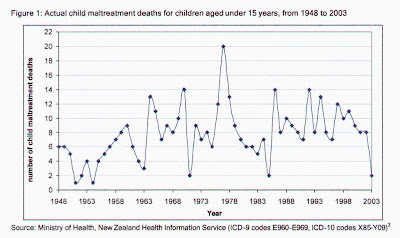
In 2004,05 and 06 the yearly average was 8.6
Then the statist in George goes looking for a quick fix. The Do something, Anything approach.
Unfortunately, to some people, money is everything. Let's strip this thing down.
Children are abused, very occasionally to the point of death, because they are not wanted. They are brought into this world oh so casually by people who do not have the maturity to look after a puppy. Why, when avoiding unwanted pregnancy is easier than it has ever been, does it keep happening? Because 'dropping sprogs' is part of a lifestyle. The same lifestyle that involves the drug and alcohol abuse George refers to.
It's a mean lifestyle that has always existed. But without a doubt, paying people to not only live it, but add children to it, has exacerbated the incidence.
Forget all the crap about slow economy/ fast economy. Like other developed countries, in our 20th century crusade to redistribute wealth - to obliterate need and inequality - we grew this group of disaffected and dysfunctional individuals.
And Garth George is calling for more of the same.
Rodger McDaniel, a lawyer, church pastor and former state legislator who is deputy director of the Wyoming Department of Health, reckons that whenever there is fast growth in an economy it brings with it a variety of social problems, including drug use, alcohol abuse and child abuse.
That makes sense, for all of those have soared with a vengeance since the economic revolution of the mid-1980s.
Rogernomics has been blamed before for New Zealand's seemingly high rate of child abuse. But not because of fast economic growth. Tariana Turia for instance;
“This latest report makes it quite clear - the peak in child deaths was from late 1980s and 1990s - the so-called experimental years in New Zealand’s economy - when unemployment was highest and when benefits were cut” says Mrs Turia.
Poor old rogernomics. Damned if it did; damned if it didn't.
The statistics alone do not support either theory anyway because the death numbers are so low very small differences can substantially change the rate. And any debate about the rate of abuse gets incredibly muddied by changing definitions, changing attitudes and reporting rates, and changing laws and their application.
According to George;
Eight children aged between five weeks and three years died from abuse in the year just ended, which is the average for any year in this country.
Yet deaths from child maltreatment have averaged around 8 a year for a long time.

In 2004,05 and 06 the yearly average was 8.6
Then the statist in George goes looking for a quick fix. The Do something, Anything approach.
And, perhaps, undo the shocking discrimination instituted by the Clark Government that denies the child-related supplement called the in-work tax credit to the poorest children and has left them further behind and well below the poverty line.
Says Susan St John, of the Campaign Against Child Poverty: "It would cost about $450 million a year to extend the in-work tax credit to all low-income children. They would then be treated the same as others regardless of the source of their parents' income - as they do in Australia.
"Money is not everything but it is a very important basic foundation. Society deliberately denies the poorest children adequate financial support and then blames them when their children become social costs."
Certainly money isn't everything, but for God's sake let us start somewhere - and soon.
Unfortunately, to some people, money is everything. Let's strip this thing down.
Children are abused, very occasionally to the point of death, because they are not wanted. They are brought into this world oh so casually by people who do not have the maturity to look after a puppy. Why, when avoiding unwanted pregnancy is easier than it has ever been, does it keep happening? Because 'dropping sprogs' is part of a lifestyle. The same lifestyle that involves the drug and alcohol abuse George refers to.
It's a mean lifestyle that has always existed. But without a doubt, paying people to not only live it, but add children to it, has exacerbated the incidence.
Forget all the crap about slow economy/ fast economy. Like other developed countries, in our 20th century crusade to redistribute wealth - to obliterate need and inequality - we grew this group of disaffected and dysfunctional individuals.
And Garth George is calling for more of the same.
Wednesday, January 06, 2010
Halfdone blog ratings for December 2009
I like Halfdone's blog ratings because so far I have only climbed the table:-)
Half Done rated 683 blogs in December 2009.
What I can't figure out is what the little yellow icon denotes.

Half Done rated 683 blogs in December 2009.
What I can't figure out is what the little yellow icon denotes.

Welfare UK-style
The following is from James Bartholemew, author of The Welfare State We Are In. Which NZ government does the opening paragraph remind you of? Hint. National hasn't even talked big - yet.
Housing benefit provides the biggest discouragement to work
In the great roll call of this government’s failures and blunders, its record on housing benefit deserves to have a prominent place. This was the government that was going to “think the unthinkable” on welfare benefits. Instead it “did the predictable”. Instead of embarking on radical reform like the administration of President Clinton in America, it opted to muddle along. It talked big and acted small.
Housing benefit is arguably the worst of all the benefit failures. Why? For two important reasons. One, it costs an amazing amount of money after nearly doubling since Labour came to power to £20 billion. That – for those who can bear the idea – amounts to £692 for every working person in Britain. Most people imagine that Jobseekers’ Allowance is the big, key welfare benefit. Not at all. Housing benefit costs more than three times as much.
The second and even more important reason why this failure matters is that housing benefit is probably the biggest single discouragement to the low-skilled unemployed to getting a job. Get a job and you lose housing benefit at a rapid rate. So housing benefit is one of the most important reason why more one in four people of working age are not working.
The official cost of £20 billion is just the beginning. Nearly all the people who are discouraged from working are also getting other benefits including Jobseekers’ Allowance and – in many cases - Incapacity Benefit or Income Support. But worse even than that is the effect on the morale and culture of those at the lower end of society who get accustomed to welfare dependency. It causes depression and alienation and contributes to uncivil and even criminal behaviour.
There is a simple rule for creating sound welfare benefits. It was described 175 years ago in the report of a Royal Commission into the operation of the poor laws. The commissioners decided that benefits should not be more advantageous than the income that would be obtained by the individual taking on low-paid work. It is as simple as that. Work must always pay. .
On radio phone-ins I have often heard people exclaim: “Do you realise how little you get on Jobseekers’ Allowance? You can’t live on that!” Unfortunately interviewers – being part of the upper middle class - rarely understand that the Jobseekers’ Allowance and other benefits are normally accompanied by other benefits such as a free school meals and, very likely, the big one: housing benefit. Only when they are all added together do they amount to a meaty discouragement to work for the low-paid.
It will come as a surprise to many people to know that not all countries pay housing benefit – or at least not to as many classes of people as Britain does. In Italy, for example, an unmarried teenage mother does not climb up the council housing queue, get income support and housing benefit. She is expected to live with her parents or other relatives or perhaps the father of the child. The result is that there is far less unmarried parenting in Italy than here. They make their decisions and live with them. That means they make better decisions.
If there were prizes for tinkering with the welfare benefit system, this government would certainly win the gold trophy. I used to get press releases from the old Department of Social Security as it was called. If I had had a strange notion of interior decoration, I could have wall-papered my bedroom with them within a few weeks.
To be fair, some reforms have gone in the right direction. James Purnell, when he was in charge, decided that people should only get benefit to pay for a maximum of five bedrooms. Yet you can see from this example just how cautious the reform has been. For people who struggling to afford accommodation with two bedrooms, it will seem outrageous that others can going on having babies and getting more and more bedrooms at the expense of taxpayers. And people sometimes get benefit at a level based on expensive housing. Hence the scandalous case recently of one family getting £2,875 a week.
America was far more radical in its reforms. President Clinton agreed to a limit to the total number of years in a lifetime during which people could claim unemployment benefit. America was determined to do something about the benefits culture. Britain under Labour has merely strutted on the stage – posing, pontificating and making precious little difference.
What could be done? One idea – from the Centre for Social Justice - is to subsume housing benefit with many benefits into just a couple of major benefits. The benefits could be withdrawn at a slower rate than now when someone gets work, thus reducing the discouragement to getting a job. The trouble is that, other things being equal, this would cost a lot more.
The truly radical idea would be do something like that but significantly reduce the amount paid and leave it to the recipient entirely what accommodation is rented – if any. That would provide a powerful incentive to lodge with relatives or to go to a different area with lower rents.
But has Britain got the guts to do this sort of thing? I would like to think so but there is every reason to doubt it. The upper middle class elite does not get the seriousness of the problem. The BBC, the readers of Guardian and the Independent believe that their support for generous benefits makes them into generous, good people. Unfortunately it does not. It results instead in the continuance of a welfare dependant lower class with tremendously damaging social effects both to the poor themselves and everyone else.
(This is the unedited version of an article that appeared in the Daily Express today.)
Housing benefit provides the biggest discouragement to work
In the great roll call of this government’s failures and blunders, its record on housing benefit deserves to have a prominent place. This was the government that was going to “think the unthinkable” on welfare benefits. Instead it “did the predictable”. Instead of embarking on radical reform like the administration of President Clinton in America, it opted to muddle along. It talked big and acted small.
Housing benefit is arguably the worst of all the benefit failures. Why? For two important reasons. One, it costs an amazing amount of money after nearly doubling since Labour came to power to £20 billion. That – for those who can bear the idea – amounts to £692 for every working person in Britain. Most people imagine that Jobseekers’ Allowance is the big, key welfare benefit. Not at all. Housing benefit costs more than three times as much.
The second and even more important reason why this failure matters is that housing benefit is probably the biggest single discouragement to the low-skilled unemployed to getting a job. Get a job and you lose housing benefit at a rapid rate. So housing benefit is one of the most important reason why more one in four people of working age are not working.
The official cost of £20 billion is just the beginning. Nearly all the people who are discouraged from working are also getting other benefits including Jobseekers’ Allowance and – in many cases - Incapacity Benefit or Income Support. But worse even than that is the effect on the morale and culture of those at the lower end of society who get accustomed to welfare dependency. It causes depression and alienation and contributes to uncivil and even criminal behaviour.
There is a simple rule for creating sound welfare benefits. It was described 175 years ago in the report of a Royal Commission into the operation of the poor laws. The commissioners decided that benefits should not be more advantageous than the income that would be obtained by the individual taking on low-paid work. It is as simple as that. Work must always pay. .
On radio phone-ins I have often heard people exclaim: “Do you realise how little you get on Jobseekers’ Allowance? You can’t live on that!” Unfortunately interviewers – being part of the upper middle class - rarely understand that the Jobseekers’ Allowance and other benefits are normally accompanied by other benefits such as a free school meals and, very likely, the big one: housing benefit. Only when they are all added together do they amount to a meaty discouragement to work for the low-paid.
It will come as a surprise to many people to know that not all countries pay housing benefit – or at least not to as many classes of people as Britain does. In Italy, for example, an unmarried teenage mother does not climb up the council housing queue, get income support and housing benefit. She is expected to live with her parents or other relatives or perhaps the father of the child. The result is that there is far less unmarried parenting in Italy than here. They make their decisions and live with them. That means they make better decisions.
If there were prizes for tinkering with the welfare benefit system, this government would certainly win the gold trophy. I used to get press releases from the old Department of Social Security as it was called. If I had had a strange notion of interior decoration, I could have wall-papered my bedroom with them within a few weeks.
To be fair, some reforms have gone in the right direction. James Purnell, when he was in charge, decided that people should only get benefit to pay for a maximum of five bedrooms. Yet you can see from this example just how cautious the reform has been. For people who struggling to afford accommodation with two bedrooms, it will seem outrageous that others can going on having babies and getting more and more bedrooms at the expense of taxpayers. And people sometimes get benefit at a level based on expensive housing. Hence the scandalous case recently of one family getting £2,875 a week.
America was far more radical in its reforms. President Clinton agreed to a limit to the total number of years in a lifetime during which people could claim unemployment benefit. America was determined to do something about the benefits culture. Britain under Labour has merely strutted on the stage – posing, pontificating and making precious little difference.
What could be done? One idea – from the Centre for Social Justice - is to subsume housing benefit with many benefits into just a couple of major benefits. The benefits could be withdrawn at a slower rate than now when someone gets work, thus reducing the discouragement to getting a job. The trouble is that, other things being equal, this would cost a lot more.
The truly radical idea would be do something like that but significantly reduce the amount paid and leave it to the recipient entirely what accommodation is rented – if any. That would provide a powerful incentive to lodge with relatives or to go to a different area with lower rents.
But has Britain got the guts to do this sort of thing? I would like to think so but there is every reason to doubt it. The upper middle class elite does not get the seriousness of the problem. The BBC, the readers of Guardian and the Independent believe that their support for generous benefits makes them into generous, good people. Unfortunately it does not. It results instead in the continuance of a welfare dependant lower class with tremendously damaging social effects both to the poor themselves and everyone else.
(This is the unedited version of an article that appeared in the Daily Express today.)
Tuesday, January 05, 2010
Maori women and smoking
If one in three Maori women is on a benefit, one in two Maori women smoke, and smoking rates are highest among low income groups, the chances are the taxpayer is paying for their cigarettes or rollies. The taxpayer is also paying for their cessation attempts, on average numbering 14 before successful.
So we pay for Maori women to smoke, and we pay for them not to. There seems a more obvious solution, although there is little political will to explore it.
Quitting smoking is tough. It is doubly tough if you are depressed, bored, idle, with nothing to look forward to and nothing else in your life that gives you pleasure - albeit fleeting pleasure. And when in such a rut the prospect of foreshortening life doesn't hold much sway either.
Kiwiblog recently ran a story about a no-smoking prison that was deterring people from committing crime. They would rather give up crime than quit smoking. Given a choice I am sure some people would rather get a job than quit smoking. Such is their desire to smoke.
While people have multiple problems in their lives, quitting smoking will never be a priority. There are more fundamental issues that need sorting first.
So we pay for Maori women to smoke, and we pay for them not to. There seems a more obvious solution, although there is little political will to explore it.
Quitting smoking is tough. It is doubly tough if you are depressed, bored, idle, with nothing to look forward to and nothing else in your life that gives you pleasure - albeit fleeting pleasure. And when in such a rut the prospect of foreshortening life doesn't hold much sway either.
Kiwiblog recently ran a story about a no-smoking prison that was deterring people from committing crime. They would rather give up crime than quit smoking. Given a choice I am sure some people would rather get a job than quit smoking. Such is their desire to smoke.
While people have multiple problems in their lives, quitting smoking will never be a priority. There are more fundamental issues that need sorting first.
Monday, January 04, 2010
Hectoring ad nauseum
The Australian holiday road toll is 68. The legal minimum driving age is 17. The Australians are blaming the state of their roads and irresponsible driving.
In NZ the holiday road toll is currently 11, which is, on a per capita basis, lower than Australia's. New Zealanders are blaming the minimum driving age of 15.
NZ and Australia are obsessed with holiday road tolls. Perhaps because it fills a gap in news stories. Perhaps because various interest groups want to use the toll as a lever. But do many more people lose their lives over this particular period?
According to the MOT;
The Christmas/New Year holiday road toll period begins at 4pm on Thursday 24 December and ends at 6am on Tuesday 5 January.
The holiday period will be 11.6 days. Last year the 2008/09 holiday period was exactly the same - from Dec 24 to Jan 5 (11.6 days).
11 deaths in 11.6 days is, so far, under the average for that time period.
In 2005 New Zealand's road toll was only very slightly above the OECD average. Per 100,000 population, NZ's average was 9.9; OECD 9.5. The NZ figure has improved since. There are a myriad of factors affecting the rate but, in the scheme of things our rate isn't really, really bad - and neither is it really, really good. Accidents, tragic accidents, happen. But, the trend is heading in the right direction - down.
I guess I am just tired of being hectored about the road toll, along with smoking, eating junk food, drinking alcohol, water safety, sun safety, ad nauseum. No wonder so many New Zealanders are neurotic nutbars. Best just stay indoors and diet. In an unhappy coincidence, Wellington, the home of hectoring, taxpayer-funded harpies, has served up the weather to make you want to do just that.
In NZ the holiday road toll is currently 11, which is, on a per capita basis, lower than Australia's. New Zealanders are blaming the minimum driving age of 15.
NZ and Australia are obsessed with holiday road tolls. Perhaps because it fills a gap in news stories. Perhaps because various interest groups want to use the toll as a lever. But do many more people lose their lives over this particular period?
According to the MOT;
The Christmas/New Year holiday road toll period begins at 4pm on Thursday 24 December and ends at 6am on Tuesday 5 January.
The holiday period will be 11.6 days. Last year the 2008/09 holiday period was exactly the same - from Dec 24 to Jan 5 (11.6 days).
11 deaths in 11.6 days is, so far, under the average for that time period.
In 2005 New Zealand's road toll was only very slightly above the OECD average. Per 100,000 population, NZ's average was 9.9; OECD 9.5. The NZ figure has improved since. There are a myriad of factors affecting the rate but, in the scheme of things our rate isn't really, really bad - and neither is it really, really good. Accidents, tragic accidents, happen. But, the trend is heading in the right direction - down.
I guess I am just tired of being hectored about the road toll, along with smoking, eating junk food, drinking alcohol, water safety, sun safety, ad nauseum. No wonder so many New Zealanders are neurotic nutbars. Best just stay indoors and diet. In an unhappy coincidence, Wellington, the home of hectoring, taxpayer-funded harpies, has served up the weather to make you want to do just that.
Sunday, January 03, 2010
What happened to Maharey's grand plan?
 In 2003, then Minister for Social Development Steve Maharey outlined his vision for people on the DPB. Labour was scrapping work-testing (which National says it will soon re-introduce) in favour of 'enhanced case management'. According to the Minister;
Work and Income will be doing more to help sole parents into work with changes to legislation that comes into effect this month, says Social Services and Employment Minister Steve Maharey.
The Social Security (Personal Development and Employment) Amendment Act, which comes into effect on 10 March 2003, delivers on government promises to develop a social security system that responds better to the needs of individuals and their families.
“The legislation abolishes the arbitrary work test on sole parents receiving the Domestic Purposes or Widows Benefits. Currently 19% or 21,924 are subjected to a work test requirement to seek part or full-time work because of the age of their youngest child.
“As a result of the change all people receiving the DPB, Widows or Emergency Maintenance Allowance will receive enhanced case management to help them in training and work planning for their future.
“All 118,098 in the three benefit groups will be required to work with their case manager to develop and implement a Personal Development and Employment Plan. The plan will outline personal development, training and employment goals and the action points required to reach those goals.
I asked MSD how many beneficiaries had a PDEP. By June 2009 the grand total was 35,161. Of those 24,096 were on the DPB. Only 23 percent of all DPB recipients. If you are thinking that the policy had been abandoned because of a change in government, hence the low number, you are wrong. 66 percent had been implemented between June 2007 and June 2008 and the remainder over the next 12 months.
The interesting thing is that only 17 people on the DPB who had a PDEP had had it put in place 3 or more years ago. Which may indicate that 1/ The plans do motivate people to move off a benefit or 2/ The ministry's record keeping is suspect.
If it is the first, no surprise. Around a third of people on the DPB are motivated to get off it. They would probably do so with or without the plan. It is easy for case managers to work with this group.
But what about the rest???
At the time of Maharey's press release there were 108,000 on the DPB.
Now there are .... 108,000 on the DPB.
Saturday, January 02, 2010

Friday, January 01, 2010
Does NZ's future success rest on skin colour?
Rawiri Taonui, head of Maori and Indigenous studies at Canterbury University, has written a piece in today's NZ Herald about the flying of two flags, entitled Time for New Zealand to show all its colour.
The flying of a Maori flag does not worry me IF it is a unifying move. Only time will tell.
What interested me here is the statement that by 2030 50 percent of New Zealanders will be brown. According to Statistics NZ data, by 2026 the population will be 5,517,600. European or other will make up 62.2 percent, Maori 14.8, Asian 14.3 and Pacific 8.7. Apart from the Asian number, not much change from today.
But what bothers me is the talk about skin colour in the first place. The title of the piece is not only a reference to flag colour but pigment. What is Rawiri Taonui getting at here? That a group exists that doesn't like Maori because they are brown, but that group, or "that lot", couldn't include people who are also brown? That Maori, Asian and Pacific people will live in a state of harmony and mutual respect because they are all brown?
He is saying that people who respect Maori and like other cultures will see flying both flags as unifying. Maybe. I would probably fit this group (with lots of provisos). And yet....
Why bring colour into it? Does he think that the more brown the country gets the more unity there will be? What, then, about the non-brown people progressively becoming a minority? Or should we hit the magic 50 percent and stop right there?
Then we can all live happily ever after?
Whether Pakeha see two flags as divisive or unifying is directly proportionate to the extent of hangups about race. Those who have difficulty relating to Maori, especially if they are dark skinned, physically large and/or overtly ethnic and tribal, and have not spent much time on a marae, will see the flag as separatist simply out of fear of difference and diversity. Fortunately, this lot are in rapid decline. New Zealand will be 50 per cent brown by 2030. Those who are at ease with themselves, respect Maori and like other cultures will see the flags as representative of an over-arching unity, of every colour, hue and creed. They are the New Zealanders of the future.
The flying of a Maori flag does not worry me IF it is a unifying move. Only time will tell.
What interested me here is the statement that by 2030 50 percent of New Zealanders will be brown. According to Statistics NZ data, by 2026 the population will be 5,517,600. European or other will make up 62.2 percent, Maori 14.8, Asian 14.3 and Pacific 8.7. Apart from the Asian number, not much change from today.
But what bothers me is the talk about skin colour in the first place. The title of the piece is not only a reference to flag colour but pigment. What is Rawiri Taonui getting at here? That a group exists that doesn't like Maori because they are brown, but that group, or "that lot", couldn't include people who are also brown? That Maori, Asian and Pacific people will live in a state of harmony and mutual respect because they are all brown?
He is saying that people who respect Maori and like other cultures will see flying both flags as unifying. Maybe. I would probably fit this group (with lots of provisos). And yet....
Why bring colour into it? Does he think that the more brown the country gets the more unity there will be? What, then, about the non-brown people progressively becoming a minority? Or should we hit the magic 50 percent and stop right there?
Then we can all live happily ever after?
Thursday, December 31, 2009
Research into casual sex surprises
The Dominion Post reproduced this column today. Essentially new research, with a reasonably large sample, found that young people having casual sex are not suffering ill effects from it. The researchers were apparently taken aback.
I'm not. Morality, values, ethics, whatever label you want to put on it, is changing constantly. Any stigma attached to casual sex is diminishing (interestingly the researchers found a mismatch between the number of males versus females admitting to causal sex and theorised that men are more likely to label their encounter as casual whereas females label it as something more).
But I think there is another reason for the result. There are most certainly people for whom casual sex will cause emotional problems - guilt, self-recrimination, etc - so those people are avoiding it. Those for whom that would be a waste of mental energy just get on and enjoy it on their own terms. Most people, despite contemporary paternalistic wisdom telling us otherwise, are capable of making sensible choices. It would just be better if 'most' was a bigger percentage.
I'm not. Morality, values, ethics, whatever label you want to put on it, is changing constantly. Any stigma attached to casual sex is diminishing (interestingly the researchers found a mismatch between the number of males versus females admitting to causal sex and theorised that men are more likely to label their encounter as casual whereas females label it as something more).
But I think there is another reason for the result. There are most certainly people for whom casual sex will cause emotional problems - guilt, self-recrimination, etc - so those people are avoiding it. Those for whom that would be a waste of mental energy just get on and enjoy it on their own terms. Most people, despite contemporary paternalistic wisdom telling us otherwise, are capable of making sensible choices. It would just be better if 'most' was a bigger percentage.
Creative accounting Douglas-style
54 percent of your and every one else’s personal tax goes towards healthcare. The growth is scary, when just two years ago the figure was 41 percent of your personal tax. Saying 54 percent can hide what this means. If you earn minimum wage, you will pay about $2500 every year for healthcare. If you earn the average wage, you will pay over $6000 for healthcare.
That's Roger Douglas on Health. It's from an e-mailed pamphlet that landed in my in-box a few days ago. It also features here.
My immediate reaction is BS. Roger is up to more creative accounting. And I didn't think much more about it.
I was reminded of it again this morning however when reading a well-written op-ed from Des Gorman, head of Auckland University's School of Medicine, and the chairman of Health Workforce New Zealand.
Health accounts for 20 per cent of Government expenditure and half of the new money in the 2009 Budget was allocated to health.
Correct. In which case 20 percent of the tax you pay goes towards healthcare. Unless the government apportions more income tax to health than it apportions to any other area of expenditure. Which it does not.
Whatever tax is paid - income, GST, corporate, excise - goes into the consolidated account and is then allocated accordingly. If we applied Roger's formula across the board government would be spending 170 percent more than it collects. For instance I could calculate that welfare spending is costing you $9,000 a year ($20 billion divided by 2.2 million individuals) or 81 percent of your "personal tax" if you earn the "average wage". See how quickly this is coming unstuck? 100 percent has already been exceeded.
As I have said before I am not totally averse to Roger's ideas - I support individual responsibility but do not like compulsion. However, creative accounting turns me off totally. Why would I trust the rest of the message when I can't trust the numbers?
Wednesday, December 30, 2009
Lifestyle welfare
Here is the Boxing Day Dominion Post editorial. I was pleased to see the writer using the term 'lifestyle' not only because it is factual, but because it labels the group needing attention as distinct from all beneficiaries.
My response was published this morning (apologies for the unintentional sizing inconsistency).


My response was published this morning (apologies for the unintentional sizing inconsistency).


Tuesday, December 29, 2009
Another false allegation?
Remember the troublesome two who claimed they had been attacked in New Plymouth earlier this year?
Can't help wondering if this isn't a similar situation. What would two youths want with a Hannah Montana teeshirt?
The disconcerting thing is, I don't know whether to hope I am right or wrong. And I feel uncomfortable about my skepticism, but that's what happens when crying wolf isn't an unusual occurence.
Can't help wondering if this isn't a similar situation. What would two youths want with a Hannah Montana teeshirt?
The disconcerting thing is, I don't know whether to hope I am right or wrong. And I feel uncomfortable about my skepticism, but that's what happens when crying wolf isn't an unusual occurence.
Monday, December 28, 2009
Douglas and ACT
This post wouldn't have happened without prompting. As it stands ACT doesn't interest me but a comment today made me mentally reflect on why.
Chuck Bird has twice made reference to ACT's constitution on this blog. As I am no longer a member I am not sure why. The constitutional excerpt;
“...maintain social and economic support for those unable to help themselves and who are in genuine need of assistance”
defines out what Chuck thinks welfare should be, which includes retaining a welfare state. He was therefore unhappy with a repetitive commentor who harps on monotonously about how we should ZERO ALL BENEFITS.
Chuck thinks he will put off ACT voters. I am flattered Chuck thinks that many people read my blog.
However, getting rid of all benefits is closer to what Douglas proposes than what is in the ACT constitution. Douglas has always wanted all New Zealanders to fund their own social security needs through individualised accounts.
From the NZ Herald;
Now, I am not averse to Douglas' thinking BUT its not going to happen any time soon. He hasn't managed to build any movement for it here or in the UK in 20 years.
Which is why I have always channelled my efforts into realistic (most would call it radical) reform of the current system. There was a period when state social security did what it was supposed to do. Can we ever return to that? Quite possibly not. But the prospect is more palatable to voters than what Douglas wants.
My approach is also what Muriel Newman pushed for a long time. When Muriel was welfare spokesperson EVERYONE knew what ACT policy was. Since Roger assumed that portfolio nobody knows what ACT policy is because he promotes ideas with the rider that "the views expressed are Sir Roger's and do not necessarily reflect the views of Act, but it features prominently on the party's website."
The situation is just mickey mouse. And it was mickey mouse going into the election. If ACT had had concrete policy based on the US reforms it could have negotiated welfare reform as part of its agreement with National. Instead it chose a platform of getting tough on crime. Well, I hate to say this, but crime is only going to increase until welfare is reformed, because welfare is breeding tomorrow's criminals as I write.
Chuck Bird has twice made reference to ACT's constitution on this blog. As I am no longer a member I am not sure why. The constitutional excerpt;
“...maintain social and economic support for those unable to help themselves and who are in genuine need of assistance”
defines out what Chuck thinks welfare should be, which includes retaining a welfare state. He was therefore unhappy with a repetitive commentor who harps on monotonously about how we should ZERO ALL BENEFITS.
Chuck thinks he will put off ACT voters. I am flattered Chuck thinks that many people read my blog.
However, getting rid of all benefits is closer to what Douglas proposes than what is in the ACT constitution. Douglas has always wanted all New Zealanders to fund their own social security needs through individualised accounts.
From the NZ Herald;
"Sir Roger's Budget would cut Government expenditure by more than a quarter within one year.
People would be expected to pay for their children's primary and secondary education directly; tax credits would be available for those whose tax cuts were insufficient to cover those costs directly.
They would also be expected to take out catastrophic health insurance and meet more minor health costs like GP visits, out of pocket. Accident, sickness and unemployment insurance would also be a matter of individual responsibility."
Now, I am not averse to Douglas' thinking BUT its not going to happen any time soon. He hasn't managed to build any movement for it here or in the UK in 20 years.
Which is why I have always channelled my efforts into realistic (most would call it radical) reform of the current system. There was a period when state social security did what it was supposed to do. Can we ever return to that? Quite possibly not. But the prospect is more palatable to voters than what Douglas wants.
My approach is also what Muriel Newman pushed for a long time. When Muriel was welfare spokesperson EVERYONE knew what ACT policy was. Since Roger assumed that portfolio nobody knows what ACT policy is because he promotes ideas with the rider that "the views expressed are Sir Roger's and do not necessarily reflect the views of Act, but it features prominently on the party's website."
The situation is just mickey mouse. And it was mickey mouse going into the election. If ACT had had concrete policy based on the US reforms it could have negotiated welfare reform as part of its agreement with National. Instead it chose a platform of getting tough on crime. Well, I hate to say this, but crime is only going to increase until welfare is reformed, because welfare is breeding tomorrow's criminals as I write.
National's fault that more people are needing foodbank parcels
That's what Ron Maynard of the Southland Food Bank Charitable Trust says;
Has National cut welfare benefits? Is National responsible for NZ experiencing a recession? Did National stop adjusting benefits for cost of living increases? Isn't it true that there are fewer people on benefits in Southland than there were 5 years ago, when Labour was mid-term?
Doesn't it just make you want to groan when people dealing with 'need' say such banal things? Instead of some serious analysis we get a political knee-jerk response.
Of course it is not the wont of food bank coordinators to question applicants. But perhaps they should be looking at the underlying reasons why the majority of low income people do not need their services, and a handful do.
Southland Food Bank Charitable Trust co-ordinator Ron Maynard said he had also noted an increase in the number of families needing handouts, which he attributed to a rise in the cost of living and the National Party coming into power.
"I think it is the times we are living in – since National (Party) come in it has got worse. That is one reason if you want to get political about it," Mr Maynard said.
Has National cut welfare benefits? Is National responsible for NZ experiencing a recession? Did National stop adjusting benefits for cost of living increases? Isn't it true that there are fewer people on benefits in Southland than there were 5 years ago, when Labour was mid-term?
Doesn't it just make you want to groan when people dealing with 'need' say such banal things? Instead of some serious analysis we get a political knee-jerk response.
Of course it is not the wont of food bank coordinators to question applicants. But perhaps they should be looking at the underlying reasons why the majority of low income people do not need their services, and a handful do.
Saturday, December 26, 2009

The escalating immorality of the welfare state
I was speed-reading through F A Harper's essay on the immorality of the welfare state. There are too many theological concepts in it for my taste. However this quote is right on the money. It it preceded by a discussion about the moral justification of theft when it is undertaken to 'do good';
Under the welfare state, this process of theft has spread from its use in alleviating catastrophe, to anticipating catastrophe, to conjuring up catastrophe, to the “need” for luxuries for those who have them not.
Tyres on a late model car springs immediately to mind. There is no arguing with this observation.
Under the welfare state, this process of theft has spread from its use in alleviating catastrophe, to anticipating catastrophe, to conjuring up catastrophe, to the “need” for luxuries for those who have them not.
Tyres on a late model car springs immediately to mind. There is no arguing with this observation.
Friday, December 25, 2009
Best Christmas song ever
Must be my Irish ancestry, with a great granddad officially described a "scavenger" who left Ireland to chance his arm not in the US, but Liverpool.
This song has everything I love; drinking, gambling, dreams, risk, failure, and utter poignancy....
And now I have a gingerbread house to decorate.....
Update;
This song has everything I love; drinking, gambling, dreams, risk, failure, and utter poignancy....
And now I have a gingerbread house to decorate.....
Update;

Subscribe to:
Posts (Atom)


