Here is some refreshing disagreement between health board members talking about health solutions for the poor, Maori and the aged. When you read comments like these it hits home forcefully that very little plain speaking ever sees the light of day.
Board member Jack Havill said it wasn't enough for the groups to rely on the DHB to fix their health problems, which ranged from obesity and diabetes to heart disease and more.
"What about personal responsibilities?" Dr Havill asked.
David Gilgen said the issue could not simply be solved within the DHB's portfolio. "We're looking at microscopic solutions to a macroscopic problem."
Dr Gilgen defended Maori, saying a prejudice in New Zealand hindered them from making a success out of their lives. "I've got Maoris who go to Australia; they're hardworking, they're reliable, they operate, but when they come back to New Zealand they're `lazy Maoris' again."
He said in a recent trip to the dentist he was asked if he was there for a Winz quote.
Gordon Blake said lower socio-economic people were jeopardising services provided by the DHB by not turning up to appointments and not supporting services in their area.
Saturday, June 16, 2007

Charles Bronson - my hero
 All my careful studying of form and breeding and performance came to fruition this week when I picked six winners in a row at Forbury Park and secured a percentage of the $75,000 Pick Six. It's a lovely feeling when the TAB doesn't have enough cash to pay you out and has to write a cheque. Over a thousand percent return. Not bad. Back in my more-protestant-than-me husband's good books.
Why the picture of Charles Bronson? Because I can't find a picture of the real Charles Bronson, the striking grey son of Christian Cullen, who was the horse of the night, getting headed in the straight (my heart sank as my chances looked like evaporating) but then valiantly fighting back for a big win. Not something you see very often. Go you good thing.
Friday, June 15, 2007
Maori stereotype of Pakeha
I've just finished reading Nga Iwi o te Motu, 1000 years of Maori History, by Michael King. We hear plenty about the Pakeha stereotype of Maori. This is the first I've read about the Maori stereotype of Pakeha.
Yesterday I attended a funeral. I hate funerals. I struggle with emotion, can't keep down the tears while marvelling at (and resenting I guess) those all around me who keep their composure and even deliver calm and occasionally comical eulogies. I took Robert with me as the lady who had passed away (prematurely) had been very kind to him as a baby and toddler. I think he was her surrogate grandchild while she waited for some of her own. Anyway, unsuccessfully trying to momentarily distract myself from thinking about Mary, I was describing to him how Maori grieve and the tangi process and, drawing on the following passage, how Maori might see Pakeha funerals by contrast;
There is no comparable body of literature to mirror Maori views of Pakeha over the same period. But what has been published by way of reminiscence by writers such as Amiria Stirling and Reweti Kohere suggests that there was a Maori stereotype of the Pakeha as someone who was self-centred, materialist, acquisitive, unfeeling about their extended family and callous about their treatment of the dead.
Regarding the last, if it is true I think it's simply misinterpretation on the part of Maori. But it's a reminder that we should all be wary of misinterpretation of attitudes, behaviours and practices we don't understand. Within and without our own culture.
Yesterday I attended a funeral. I hate funerals. I struggle with emotion, can't keep down the tears while marvelling at (and resenting I guess) those all around me who keep their composure and even deliver calm and occasionally comical eulogies. I took Robert with me as the lady who had passed away (prematurely) had been very kind to him as a baby and toddler. I think he was her surrogate grandchild while she waited for some of her own. Anyway, unsuccessfully trying to momentarily distract myself from thinking about Mary, I was describing to him how Maori grieve and the tangi process and, drawing on the following passage, how Maori might see Pakeha funerals by contrast;
There is no comparable body of literature to mirror Maori views of Pakeha over the same period. But what has been published by way of reminiscence by writers such as Amiria Stirling and Reweti Kohere suggests that there was a Maori stereotype of the Pakeha as someone who was self-centred, materialist, acquisitive, unfeeling about their extended family and callous about their treatment of the dead.
Regarding the last, if it is true I think it's simply misinterpretation on the part of Maori. But it's a reminder that we should all be wary of misinterpretation of attitudes, behaviours and practices we don't understand. Within and without our own culture.
Thursday, June 14, 2007
Abortions increase
There were 400 more abortions in 2006 than in 2005 - a 2.3% increase. All ethnicities experienced increases ACCEPT ASIANS. The largest increase in abortion rate (per 1,000) was for 15-19 year-olds. 105 11-14 year-olds had an abortion - the highest number on record. The highest percentage increase in number of abortions was for Maori. Of the countries given by Statistics NZ, in 2005 NZ was second only to Sweden.
Bits and pieces
When my mother went into labour with me my father dropped her off at the hospital on the way to rugby practice. Dean Barker's wife isn't expecting is she?
The Muliagas were entitled to (and reportedly getting) $279 a week in WFF tax credits. That's like having a job and getting a benefit. But still the PM wants more done for "vulnerable" people.
Australians apparently almost exclusively blame mothers, especially welfare mothers, for their children's obesity. Ms Malik said many articles implicitly pitched responsible mothers against "neglectful refrigerator mothers made soft by welfarism". But isn't the stuff that comes out of the fridge mostly good for you? Are they neglecting the fridge or their children?
In 2003 only 11.5 percent of prisoners were gang members. Now one quarter are. At this rate by around 2014 the prisons will be 100 percent filled with gang members. Still. Not to worry. Tariana Turia told us not all gang members are criminals.
Don't you miss Richard Prebble serving it up to the the government?
The Muliagas were entitled to (and reportedly getting) $279 a week in WFF tax credits. That's like having a job and getting a benefit. But still the PM wants more done for "vulnerable" people.
Australians apparently almost exclusively blame mothers, especially welfare mothers, for their children's obesity. Ms Malik said many articles implicitly pitched responsible mothers against "neglectful refrigerator mothers made soft by welfarism". But isn't the stuff that comes out of the fridge mostly good for you? Are they neglecting the fridge or their children?
In 2003 only 11.5 percent of prisoners were gang members. Now one quarter are. At this rate by around 2014 the prisons will be 100 percent filled with gang members. Still. Not to worry. Tariana Turia told us not all gang members are criminals.
Don't you miss Richard Prebble serving it up to the the government?
Wednesday, June 13, 2007
Death penalty prevents homicides
I am not a proponent of the death penalty. But how often do we here opponents of it say, look at the United States, it hasn't worked there. This report claims there would be even more homicides without the death penalty.
Responding to welfare apologists
This appeared in the NZ Herald on Monday. My response is below.
Louise Humpage and Susan St John: A bill the poor will pay for
Monday June 11, 2007
Work, work and more work: what ever happened to social security? Most people don't know it, but social security is undergoing significant changes.
These could affect any of us, if we were suddenly to become sick or disabled, a sole parent, or if the economy was to force employers to shed large numbers of employees.
The Social Security Amendment Bill 2006 has just passed its second reading and, if not stopped, will legislate fundamental changes to the Social Security Act 1964, which was intended to "consolidate and amend" the 1938 Social Security Act introduced by the first Labour Government.
The 1938 act became the foundation stone for the modern welfare state. "Welfare" has a bad name now but then it was about safeguarding New Zealanders from hardship arising from age, sickness, widowhood, orphanhood and unemployment to allow all to participate and belong in society.
The Royal Commission on Social Security in 1972 and the Royal Commission on Social Policy in 1988 demonstrated New Zealanders still endorsed these goals. In the 1990s many policy changes undermined the purpose of social security (user-pays in health and education, "work-for-the-dole" for the unemployed, "dob in" campaigns targeting sole mothers) but the principles were never formally challenged.
That is all about to change: the Social Security Amendment Bill wipes away any notion that our social security system is about ensuring everyone can participate as citizens. Instead, it makes getting people into a job, any job, the fundamental duty of citizenship. This principle is baldly stated "Work in paid employment offers the best opportunity for people to achieve social and economic well-being."
The bill fails to acknowledge that many undertake unpaid work looking after children, the sick and elderly or doing other community activities. This work is crucial to the running of our society but receives no value in the bill. Nor does the proposed legislation do anything to ensure that meaningful, adequately paid, secure employment is available.
Instead it punishes those who can't find work. It allows for a new pre-benefit activity to be completed before anyone is even allowed to apply for the unemployment benefit. Under a new government, this activity could include work-for-the-dole.
Being sick or disabled is no longer an excuse not to work. Sickness and invalid beneficiaries will be subject to new "planning and activity" requirements which means that if they don't start for planning for work, they could risk having their benefit suspended or reduced. Spouses are also expected to get paid work even though they may be caring for their sick spouse and/or have young children.
The rationale for these new requirements is that sickness and invalid benefit numbers are increasing at a time of low unemployment.
But rather than an epidemic of "dole-bludgers" shifting to these benefits, we are largely seeing the effects of an ageing population who, due to improvements in technology are living longer than ever but nonetheless may suffer from ill health that stops them working the last few years before retirement.
As if in hindsight, the bill does provide some social security "to help alleviate hardship". But this phrase is far more limiting than the goals of eliminating poverty and ensuring participation and belonging for all citizens that we have long embraced.
Furthermore, paid work, which is enshrined in the new act as the only source of well-being, is increasingly becoming the basis for state-provided welfare. Those outside the workforce are in grave danger of being regarded as second-class citizens. While we don't yet have health insurance tied to employment as in the US, access to a major part of Working for Families tax credits and KiwiSaver subsidies to ensure a secure old age are already conditional on being in paid work. Caregivers, who are predominantly women, should be alarmed at this trend.
That a Labour Government is undermining the original notion of "well-fare" would have Michael Joseph Savage turning in his grave.
* Dr Louise Humpage lectures in the Department of Sociology, and Dr Susan St John lectures in the Department of Economics, University of Auckland.
A Bill For the Times
Louise Humpage and Susan St John say Michael Joseph Savage would be turning over in his grave if he knew what today's Labour government is planning for social security. I very much doubt that.
What would shock Savage, were he alive today, are the effects of the then necessary and well-meaning Social Security Act of 1938.
It's all about context. The array of benefits created in 1938 - sickness, emergency, and family to name three - came on the back of very hard times, a depression and a war. But even then there wasn't a consensus for widespread social security measures. The first benefits office was apparently burnt down in a politically motivated act of arson. People have always worried about the state crowding out the private sector and costs to the public purse. Labour did have, however, majority support.
For many years the numbers of people relying on benefits remained low and steady. There was little misuse of the sytem. Changing social mores and rising unemployment saw an end to that during the sixties and seventies. The last major benefit, the domestic purposes benefit was added in 1973 and marked the beginning of a welfare explosion.
Twenty years after the introduction of social security there were 25,000 working age people on welfare (most were widows). Today there are 266,000. A ten-fold increase with less than a doubling of the population?
With 266,000 people on benefits after a long period of reasonable economic growth and sustained low unemployment, clearly welfare is longer just about genuine need - it's also about choice. Hence politicians want to restate the aims of social security, making work come first for those who can.
St John and Humpage argue that the blow out on sickness and invalid benefits is "largely" due to an "ageing" poulation but the Ministry of Development's own research showed that less than half of the dramatic rise (12,000 in 1960 to 125,000 today) is due to ageing. Much of the growth is down to huge increases in numbers experiencing psychiatric illness, transfers from other benefits, longer stays on welfare, less reliance on families (which have broken down as an effect of the father- replacing domestic purposes benefit) and changes to eligibility. Before the sixties people who had caused the incapacity which rendered them unable to work were not entitled to a benefit. This gatekeeping clause was effective. It no longer exists.
Before the DPB there was assistance for single parents, albeit limited. There had long been a deserted wives benefit and young unmarried women who became pregnant qualified for emergency assistance. Yes, adoption was far more common but in the period before the DPB, 1971/72, 60 percent of ex- nuptial babies stayed with their mothers or relatives.
Today Michael Joseph Savage would be aghast at the thousands of teenagers who pile onto welfare each year (including 3600 single parents) and, due to low or no skills, stay there, sometimes for decades. He would be especially dismayed at the damage welfare has proliferated among Maori and the intergenerational poverty of values now so entrenched.
Much is made of unpaid work that welfare provides for, especially caring for children. Most of that used to be paid for by a family's breadwinner - not the unrelated taxpayer.
But it is also surprising that St John and Humpage have become quite so upset about the bill soon to be passed. Wellington People's Centre beneficiary advocates say the "punitive" changes are largely superficial - just Labour trying to look "tough" for the benefit of voters. Many of the changes were welcomed.
What really needs to happen is a return to what the 1938 Labour government envisaged. Temporary assistance for temporary need and long term help for only those genuinely incapacitated through no fault of their own. That's all.
There is no place for lifestyle welfare at any time but especially not when we are a small country competing globally, struggling with low productivity and high taxation. Labour is absolutely right to state the principle,"Work in paid employment offers the best opportunity for people to achieve social and economic and wellbeing." Now they just need to mean it.
Louise Humpage and Susan St John: A bill the poor will pay for
Monday June 11, 2007
Work, work and more work: what ever happened to social security? Most people don't know it, but social security is undergoing significant changes.
These could affect any of us, if we were suddenly to become sick or disabled, a sole parent, or if the economy was to force employers to shed large numbers of employees.
The Social Security Amendment Bill 2006 has just passed its second reading and, if not stopped, will legislate fundamental changes to the Social Security Act 1964, which was intended to "consolidate and amend" the 1938 Social Security Act introduced by the first Labour Government.
The 1938 act became the foundation stone for the modern welfare state. "Welfare" has a bad name now but then it was about safeguarding New Zealanders from hardship arising from age, sickness, widowhood, orphanhood and unemployment to allow all to participate and belong in society.
The Royal Commission on Social Security in 1972 and the Royal Commission on Social Policy in 1988 demonstrated New Zealanders still endorsed these goals. In the 1990s many policy changes undermined the purpose of social security (user-pays in health and education, "work-for-the-dole" for the unemployed, "dob in" campaigns targeting sole mothers) but the principles were never formally challenged.
That is all about to change: the Social Security Amendment Bill wipes away any notion that our social security system is about ensuring everyone can participate as citizens. Instead, it makes getting people into a job, any job, the fundamental duty of citizenship. This principle is baldly stated "Work in paid employment offers the best opportunity for people to achieve social and economic well-being."
The bill fails to acknowledge that many undertake unpaid work looking after children, the sick and elderly or doing other community activities. This work is crucial to the running of our society but receives no value in the bill. Nor does the proposed legislation do anything to ensure that meaningful, adequately paid, secure employment is available.
Instead it punishes those who can't find work. It allows for a new pre-benefit activity to be completed before anyone is even allowed to apply for the unemployment benefit. Under a new government, this activity could include work-for-the-dole.
Being sick or disabled is no longer an excuse not to work. Sickness and invalid beneficiaries will be subject to new "planning and activity" requirements which means that if they don't start for planning for work, they could risk having their benefit suspended or reduced. Spouses are also expected to get paid work even though they may be caring for their sick spouse and/or have young children.
The rationale for these new requirements is that sickness and invalid benefit numbers are increasing at a time of low unemployment.
But rather than an epidemic of "dole-bludgers" shifting to these benefits, we are largely seeing the effects of an ageing population who, due to improvements in technology are living longer than ever but nonetheless may suffer from ill health that stops them working the last few years before retirement.
As if in hindsight, the bill does provide some social security "to help alleviate hardship". But this phrase is far more limiting than the goals of eliminating poverty and ensuring participation and belonging for all citizens that we have long embraced.
Furthermore, paid work, which is enshrined in the new act as the only source of well-being, is increasingly becoming the basis for state-provided welfare. Those outside the workforce are in grave danger of being regarded as second-class citizens. While we don't yet have health insurance tied to employment as in the US, access to a major part of Working for Families tax credits and KiwiSaver subsidies to ensure a secure old age are already conditional on being in paid work. Caregivers, who are predominantly women, should be alarmed at this trend.
That a Labour Government is undermining the original notion of "well-fare" would have Michael Joseph Savage turning in his grave.
* Dr Louise Humpage lectures in the Department of Sociology, and Dr Susan St John lectures in the Department of Economics, University of Auckland.
A Bill For the Times
Louise Humpage and Susan St John say Michael Joseph Savage would be turning over in his grave if he knew what today's Labour government is planning for social security. I very much doubt that.
What would shock Savage, were he alive today, are the effects of the then necessary and well-meaning Social Security Act of 1938.
It's all about context. The array of benefits created in 1938 - sickness, emergency, and family to name three - came on the back of very hard times, a depression and a war. But even then there wasn't a consensus for widespread social security measures. The first benefits office was apparently burnt down in a politically motivated act of arson. People have always worried about the state crowding out the private sector and costs to the public purse. Labour did have, however, majority support.
For many years the numbers of people relying on benefits remained low and steady. There was little misuse of the sytem. Changing social mores and rising unemployment saw an end to that during the sixties and seventies. The last major benefit, the domestic purposes benefit was added in 1973 and marked the beginning of a welfare explosion.
Twenty years after the introduction of social security there were 25,000 working age people on welfare (most were widows). Today there are 266,000. A ten-fold increase with less than a doubling of the population?
With 266,000 people on benefits after a long period of reasonable economic growth and sustained low unemployment, clearly welfare is longer just about genuine need - it's also about choice. Hence politicians want to restate the aims of social security, making work come first for those who can.
St John and Humpage argue that the blow out on sickness and invalid benefits is "largely" due to an "ageing" poulation but the Ministry of Development's own research showed that less than half of the dramatic rise (12,000 in 1960 to 125,000 today) is due to ageing. Much of the growth is down to huge increases in numbers experiencing psychiatric illness, transfers from other benefits, longer stays on welfare, less reliance on families (which have broken down as an effect of the father- replacing domestic purposes benefit) and changes to eligibility. Before the sixties people who had caused the incapacity which rendered them unable to work were not entitled to a benefit. This gatekeeping clause was effective. It no longer exists.
Before the DPB there was assistance for single parents, albeit limited. There had long been a deserted wives benefit and young unmarried women who became pregnant qualified for emergency assistance. Yes, adoption was far more common but in the period before the DPB, 1971/72, 60 percent of ex- nuptial babies stayed with their mothers or relatives.
Today Michael Joseph Savage would be aghast at the thousands of teenagers who pile onto welfare each year (including 3600 single parents) and, due to low or no skills, stay there, sometimes for decades. He would be especially dismayed at the damage welfare has proliferated among Maori and the intergenerational poverty of values now so entrenched.
Much is made of unpaid work that welfare provides for, especially caring for children. Most of that used to be paid for by a family's breadwinner - not the unrelated taxpayer.
But it is also surprising that St John and Humpage have become quite so upset about the bill soon to be passed. Wellington People's Centre beneficiary advocates say the "punitive" changes are largely superficial - just Labour trying to look "tough" for the benefit of voters. Many of the changes were welcomed.
What really needs to happen is a return to what the 1938 Labour government envisaged. Temporary assistance for temporary need and long term help for only those genuinely incapacitated through no fault of their own. That's all.
There is no place for lifestyle welfare at any time but especially not when we are a small country competing globally, struggling with low productivity and high taxation. Labour is absolutely right to state the principle,"Work in paid employment offers the best opportunity for people to achieve social and economic and wellbeing." Now they just need to mean it.
Uncalled for
Talk about sensationalism. The DomPost (slow off the mark as usual) has a small headline, "Teenagers die racing train".
Yet the NZ Herald, with more detailed coverage quotes an eye witness,
The 20-year-old, who did not want to be named, said he wondered if the driver had slowed to get over a hump at the crossing because the vehicle had lowered suspension.
"She slowed right down, went to go over the tracks, and didn't see the train at all," the contractor said.
There is no suggestion in the Herald piece that the driver had been racing.
When I read the DomPost this morning I thought that it was odd they had given the headline very little priority. Now I know why. It was just supposition. Tacky.
Yet the NZ Herald, with more detailed coverage quotes an eye witness,
The 20-year-old, who did not want to be named, said he wondered if the driver had slowed to get over a hump at the crossing because the vehicle had lowered suspension.
"She slowed right down, went to go over the tracks, and didn't see the train at all," the contractor said.
There is no suggestion in the Herald piece that the driver had been racing.
When I read the DomPost this morning I thought that it was odd they had given the headline very little priority. Now I know why. It was just supposition. Tacky.
Tuesday, June 12, 2007
I was a fat kid
I saw an old schoolmate on TV. He sat next to me during Intermediate. I couldn't resist googling him and sending off an e-mail. An e-mail came back. He remembered me as a "solid, pommie, blonde tom-boy". He was being kind. I was fat. At least I was compared to all the other sylph-like skinny waifs surrounding me. By College I had a complex about it and nearly starved myself to death. I developed very unhealthy eating habits which I failed to correct until I became a parent - a catalyst for many things.
Now I have a chubby kid who is my mirror image at the same age. And with all of this hysteria over obesity I am really worried he is going to start fretting the way I did when, given his genes (David and I are both reasonably slim) he is quite likely to lean out as he gets older.
So my rage at the nagging government has a personal edge to it at the moment. Robert (my chubby kid) rages with me saying all these pathetic rules and prohibitions will fail. In fact I think he is already planning a black-market in illicit food. And when I think about it, better that than take all this repressive, rubbish on board and do what I did.
Now I have a chubby kid who is my mirror image at the same age. And with all of this hysteria over obesity I am really worried he is going to start fretting the way I did when, given his genes (David and I are both reasonably slim) he is quite likely to lean out as he gets older.
So my rage at the nagging government has a personal edge to it at the moment. Robert (my chubby kid) rages with me saying all these pathetic rules and prohibitions will fail. In fact I think he is already planning a black-market in illicit food. And when I think about it, better that than take all this repressive, rubbish on board and do what I did.
Land of the free....
There is no doubt in my mind that we are too lenient with youth in New Zealand. The justice system is set up to keep them out of court for as long as possible, often for crimes against person or property, crimes which in the past would have been dealt with more severely. We also ignore the role and responsibility of the parent to the point that they may as well not exist.
BUT when I read a story about a mother, Elisa Kelly, who served beer to 15 and 16 year-olds at her son's 16th birthday party so they wouldn't drink and drive, confiscated all car keys, supervised them, didn't drink herself, half of the boys didn't drink and none were intoxicated (which was established when the police raided her property), is going to jail for 2 years and 3 months (reduced from eight years on appeal), is now bankrupt from over $150,000 of legal fees and will be separated from her sons......
well, I am very glad to be living here and not in Virginia, USA.
BUT when I read a story about a mother, Elisa Kelly, who served beer to 15 and 16 year-olds at her son's 16th birthday party so they wouldn't drink and drive, confiscated all car keys, supervised them, didn't drink herself, half of the boys didn't drink and none were intoxicated (which was established when the police raided her property), is going to jail for 2 years and 3 months (reduced from eight years on appeal), is now bankrupt from over $150,000 of legal fees and will be separated from her sons......
well, I am very glad to be living here and not in Virginia, USA.
Monday, June 11, 2007
Effects of daycare on children
Whether or not daycare is helpful or harmful is fairly controversial and complex. Various studies have contradicted each other. This report describes findings from two studies which find young children who spend significant periods of time in daycare are more prone to developing aggressive or anti-social behaviour. This is the comment however which caught my eye;
"Children from workless households were rated as less cooperative and sociable than children in centres with high levels of working parents. This indicates there is a complex mix of factors that influence a child's behaviour and that careful attention is needed to ensure children are supported appropriately."
Workless homes are often dysfunctional, to some degree or another. So it is no surprise children from them are less cooperative or sociable. These children will probably benefit from some time out of their homes, notwithstanding they can be difficult for other attendees and staff who have to deal with them.
"Children from workless households were rated as less cooperative and sociable than children in centres with high levels of working parents. This indicates there is a complex mix of factors that influence a child's behaviour and that careful attention is needed to ensure children are supported appropriately."
Workless homes are often dysfunctional, to some degree or another. So it is no surprise children from them are less cooperative or sociable. These children will probably benefit from some time out of their homes, notwithstanding they can be difficult for other attendees and staff who have to deal with them.
Not waiting for the government
We have three overly large gum trees in our garden. They were in need of a severe pruning involving some major boughs, so I called in the team who have previously worked for us. They turned up yesterday, the whole family, plus some new Samoan immigrants. They must have come from church, worked very cheerfully most of the day and did a fabulous job. As we paid we were delighted to find out they were donating the proceeds to their church as a fund-raiser, which is building a drug and alcohol rehabilitation unit. They weren't waiting for "the government to do something". These are the very people New Zealand needs lots of.
Sunday, June 10, 2007
Best let sleeping dogs lie
Deborah Coddington has today written about the Press Council decision upholding complaints against her North & South piece on Asians in NZ. I blogged very briefly on it at the time. I didn't read the N&S article - only Deborah's published defence of it, in which she used this statistic;
Here's a disturbing fact: in 2003 four of every five pregnant Asian women aborted their babies. Do we keep abortion as a last-resort method of birth control, or accept it's a casual approach to contraception?
I pointed out that in 2003 there were 5285 births to Asian mothers and 3502 Asian abortions. So 40 percent of pregnancies ended in abortion (ignoring miscarriages). In 2004 this dropped to 36 percent. Neither figure is anywhere near 80 percent or four in five.
In today's Herald on Sunday column she writes; But the council totally ignored the main complaint - that my statistics were wrong. From this omission, I can only conclude that I was correct all along, and the complainants - as I argued - wilfully used different statistics.
If Deborah used the same statistic in her original article, she made a mistake. She extrapolated the Asian teenage abortion rate to all women. Why not just admit it. I would. 'Fess up and move on. It'll do more for your credibility.
(2005 stats are now available and show a further drop in Asian abortions to 34 percent of pregnancies resulting in birth or abortion - approaching 1 in 3).
Here's a disturbing fact: in 2003 four of every five pregnant Asian women aborted their babies. Do we keep abortion as a last-resort method of birth control, or accept it's a casual approach to contraception?
I pointed out that in 2003 there were 5285 births to Asian mothers and 3502 Asian abortions. So 40 percent of pregnancies ended in abortion (ignoring miscarriages). In 2004 this dropped to 36 percent. Neither figure is anywhere near 80 percent or four in five.
In today's Herald on Sunday column she writes; But the council totally ignored the main complaint - that my statistics were wrong. From this omission, I can only conclude that I was correct all along, and the complainants - as I argued - wilfully used different statistics.
If Deborah used the same statistic in her original article, she made a mistake. She extrapolated the Asian teenage abortion rate to all women. Why not just admit it. I would. 'Fess up and move on. It'll do more for your credibility.
(2005 stats are now available and show a further drop in Asian abortions to 34 percent of pregnancies resulting in birth or abortion - approaching 1 in 3).
Friday, June 08, 2007
Hang your head in shame
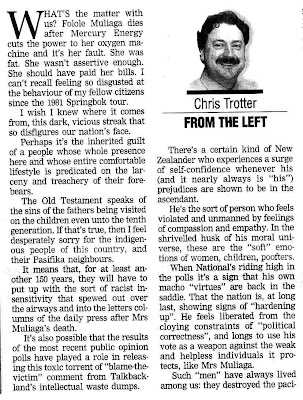
I don't know why we Wellingtonians should be the sole sufferers of Chris Trotter's emissions. Anyone of you who ever let a logical thought override emotion, hang your head in shame. There is no place for both. Certainly not in the place Mr Trotter calls "The Left";


Thursday, June 07, 2007
Ministry releases bad-news research
The Ministry of Social Development has just released research into youth justice - offending and custody trends. It says,
Good progress on Youth Justice following research
Ministry Deputy Chief Executive, Child Youth and Family Ray Smith said good progress has been achieved in the youth justice sector since the research was undertaken and since the establishment last year of the cross government Steering Group for Young People in Cells.
“We have already seen a reduction in the average length of remands in Police custody. For the month of September 2006 the average length of stay in police cells for a young person was 2.5 days. This compares with 4.4 days in 2005.
Now lets look at the report;

The trendline (the rather faint upward line) is what matters. The report says, If the current trends in offending and sentencing continue without the strengthening of community alternatives to custody and sentencing, as well as further development of CYF residential capacity, it is likely the length of remands and use of Police custody will only continue to increase.
Despite the Ministry's "good progress" spin (ambulance at the bottom of the cliff stuff) the report is actually full of bad news.
For instance;
While there was growth in the young person population, overall offending rates remained static over the same period. In fact, when considered on a per 10,000 of population basis, the ratio of apprehensions to population decreased by over 11%.
However, there were significant increases in violent offending. Apprehensions for violent offending rose by 36.4% over the previous 8 years and charges for violent offending increased by 57.6% between 2000 and 2005. This suggests it is the ferocity, not the frequency of offending which is changing. Therefore, it is predictable such increases in serious offending will amplify the number of custodial remands and sentences.
And the conclusion to this comprehensive 43 page report says;
This report establishes New Zealand has experienced a swell in the youth population and a disproportionate increase in violent offending among young people. Parallel to this, there have been significant changes in the sentencing patterns for young offenders with, a decrease in the use of Supervision with Activity and an increase in the use of Supervision with Residence. Combined, these factors have placed considerable strain on the limited custodial placements provided by CYF.
Although the increase in the youth population is at its peak in 2006, its effects will be palpable until around the year 2030.
There is no indication the increases in serious and violent youth crime will slow, anecdotal evidence suggests the 2006 statistics also show the same trend.
Unless a number of measures are developed it appears the pressure on CYF Residences will continue to increase which will result in ongoing and increasing use of Police cells for young offenders who need to be kept in custody.
Good progress on Youth Justice following research
Ministry Deputy Chief Executive, Child Youth and Family Ray Smith said good progress has been achieved in the youth justice sector since the research was undertaken and since the establishment last year of the cross government Steering Group for Young People in Cells.
“We have already seen a reduction in the average length of remands in Police custody. For the month of September 2006 the average length of stay in police cells for a young person was 2.5 days. This compares with 4.4 days in 2005.
Now lets look at the report;

The trendline (the rather faint upward line) is what matters. The report says, If the current trends in offending and sentencing continue without the strengthening of community alternatives to custody and sentencing, as well as further development of CYF residential capacity, it is likely the length of remands and use of Police custody will only continue to increase.
Despite the Ministry's "good progress" spin (ambulance at the bottom of the cliff stuff) the report is actually full of bad news.
For instance;
While there was growth in the young person population, overall offending rates remained static over the same period. In fact, when considered on a per 10,000 of population basis, the ratio of apprehensions to population decreased by over 11%.
However, there were significant increases in violent offending. Apprehensions for violent offending rose by 36.4% over the previous 8 years and charges for violent offending increased by 57.6% between 2000 and 2005. This suggests it is the ferocity, not the frequency of offending which is changing. Therefore, it is predictable such increases in serious offending will amplify the number of custodial remands and sentences.
And the conclusion to this comprehensive 43 page report says;
This report establishes New Zealand has experienced a swell in the youth population and a disproportionate increase in violent offending among young people. Parallel to this, there have been significant changes in the sentencing patterns for young offenders with, a decrease in the use of Supervision with Activity and an increase in the use of Supervision with Residence. Combined, these factors have placed considerable strain on the limited custodial placements provided by CYF.
Although the increase in the youth population is at its peak in 2006, its effects will be palpable until around the year 2030.
There is no indication the increases in serious and violent youth crime will slow, anecdotal evidence suggests the 2006 statistics also show the same trend.
Unless a number of measures are developed it appears the pressure on CYF Residences will continue to increase which will result in ongoing and increasing use of Police cells for young offenders who need to be kept in custody.
Families Commission whoopsie 2
Here is what David Benson-Pope had to say about 'research' which the Families Commission has, according to Sue Bradford, "signed off" and "paid for".
The second issue I want to raise is in relation to the comments of Ms Collins about so-called research that, as such, was presented to the Social Services Committee by Mr Paul Blair from Rotorua. It is true that Mr Blair’s research—oh, sorry, Mr Blair’s work is probably a better description—was commissioned by the Families Commission. It is not true to suggest that the Families Commission had completed a full peer review of the work, or indeed had authorised its release. In fact, that work has not subsequently been released because the Families Commission found it—shall I say, charitably—“seriously wanting”. The fact of the matter is that that work covered a sample of, we believe, fewer than 15 people. Given that the cohort we are talking about, sole parents receiving a benefit, is around 90,000—it has reduced, but it is still too many, I know, but these are people who need that support—then 15 out of 90,000 is not what one, even in National Party circles, would describe as a very robust or credible basis for any research. I guess I am therefore not surprised to hear Ms Collins basing her specious arguments on that matter.
The second issue I want to raise is in relation to the comments of Ms Collins about so-called research that, as such, was presented to the Social Services Committee by Mr Paul Blair from Rotorua. It is true that Mr Blair’s research—oh, sorry, Mr Blair’s work is probably a better description—was commissioned by the Families Commission. It is not true to suggest that the Families Commission had completed a full peer review of the work, or indeed had authorised its release. In fact, that work has not subsequently been released because the Families Commission found it—shall I say, charitably—“seriously wanting”. The fact of the matter is that that work covered a sample of, we believe, fewer than 15 people. Given that the cohort we are talking about, sole parents receiving a benefit, is around 90,000—it has reduced, but it is still too many, I know, but these are people who need that support—then 15 out of 90,000 is not what one, even in National Party circles, would describe as a very robust or credible basis for any research. I guess I am therefore not surprised to hear Ms Collins basing her specious arguments on that matter.
Not telling the truth about the DPB
The DomPost is doing a series called New Zealand By The Numbers drawing on the Census 2006 information. Today they show how people earn money. Care in interpreting this is needed. The question asked people to identify the ways in which they had earned income during the past 12 months. It is not a snapshot in time.
So although 92,172 people said they received money from an unemployment benefit during the previous year, at March 2006 only 44,549 were actually on an unemployment benefit. Likewise 70,551 people received money from a sickness benefit but at March 2006 there were only 46,072 people on a sickness benefit.
But this anomaly I don't understand. 93,090 people said they received money from the domestic purposes benefit yet at March 2006 there were 103,362 on that benefit.
That's nearly 10,000 people who either haven't filled in a form or aren't telling the truth. In fact, it's much higher than 10,000. Every year between 35,000 and 40,000 people move on and off the DPB so we should have seen a churning effect as with the unemployment and sickness benefits. The number should have been somewhere between 130,000 and 140,000.
Now why wouldn't you tell the government you were on the DPB?
The official Census 2006 net undercount, by the way, was 2 percent.
So although 92,172 people said they received money from an unemployment benefit during the previous year, at March 2006 only 44,549 were actually on an unemployment benefit. Likewise 70,551 people received money from a sickness benefit but at March 2006 there were only 46,072 people on a sickness benefit.
But this anomaly I don't understand. 93,090 people said they received money from the domestic purposes benefit yet at March 2006 there were 103,362 on that benefit.
That's nearly 10,000 people who either haven't filled in a form or aren't telling the truth. In fact, it's much higher than 10,000. Every year between 35,000 and 40,000 people move on and off the DPB so we should have seen a churning effect as with the unemployment and sickness benefits. The number should have been somewhere between 130,000 and 140,000.
Now why wouldn't you tell the government you were on the DPB?
The official Census 2006 net undercount, by the way, was 2 percent.
Wednesday, June 06, 2007
Families Commission whoopsie
Oh, this is funny. In January 2005 Paul Blair, Rotorua sole parent and beneficiaries advocate, forced a law change through an out-of-court settlement with the Ministry of Social Development.
He forced WINZ to allow sole parents who split (as opposed to shared) custody of their children to both effectively claim the DPB, and avoid work-testing. A far cry from what the DPB was intended for.
In the interim he applied for Families Commission research funding. It was granted and he went on to produce a report, 'Improving Work Life Balance for Domestic Purposes Beneficiaries Sole Parent Families'. Talk about adding insult to injury.
Anyway the report was signed off, peer-reviewed, ready for publication and PAID FOR when Mr Blair used an excerpt in a submission (no doubt opposing) the government's social security amendment bill.
David Benson Pope is understandably most unhappy and suddenly the report has been returned to the author as a 'final draft' for 'editing'.
This is worse for Benson-Pope than if I had applied for the Families Commission Blue Skies funding and used it to turn out the criticism I currently provide free of charge.
Lucky for the Minister I do not have Mr Blair's 'parasitic' tendencies.
He forced WINZ to allow sole parents who split (as opposed to shared) custody of their children to both effectively claim the DPB, and avoid work-testing. A far cry from what the DPB was intended for.
In the interim he applied for Families Commission research funding. It was granted and he went on to produce a report, 'Improving Work Life Balance for Domestic Purposes Beneficiaries Sole Parent Families'. Talk about adding insult to injury.
Anyway the report was signed off, peer-reviewed, ready for publication and PAID FOR when Mr Blair used an excerpt in a submission (no doubt opposing) the government's social security amendment bill.
David Benson Pope is understandably most unhappy and suddenly the report has been returned to the author as a 'final draft' for 'editing'.
This is worse for Benson-Pope than if I had applied for the Families Commission Blue Skies funding and used it to turn out the criticism I currently provide free of charge.
Lucky for the Minister I do not have Mr Blair's 'parasitic' tendencies.
Am I supposed to feel sympathy?
Reading the front page of the DomPost today I wonder how I am supposed to react to the news that the mother of slain Wanganui toddler was already expecting another baby. She is apparently full of rage against the Mob, hates them. Hates gangs. Not enough to say no to the dead child's Dad - who is presumably the father of the expected child - and still a Black Power member currently on remand for firearms charges. And here she is, clinging to a picture of her dead daughter, as well as him. Am I supposed to feel sympathy?
There is every likelihood I paid tax to fuel their shoddy lifestyle and now I've paid for them to parade it to the media.
There is every likelihood I paid tax to fuel their shoddy lifestyle and now I've paid for them to parade it to the media.
Tuesday, June 05, 2007
Most boring live band
The Police drummer Stewart Copeland has branded the band's second comeback performance a complete "disaster.....It usually takes about four or five shows in a tour before you get to the disaster gig. But we're The Police so we are a little ahead of schedule."
I saw The Police on their original Synchronicity tour and they were a wash-out then. Boring and lifeless in 1984, it's hardly a surprise they are a "disaster" now.

All was not lost though. Bryan Adams opened for them at Mt Smart and completely upstaged the supposed stars. And unlike The Police, he has only gotten better with age.
I saw The Police on their original Synchronicity tour and they were a wash-out then. Boring and lifeless in 1984, it's hardly a surprise they are a "disaster" now.

All was not lost though. Bryan Adams opened for them at Mt Smart and completely upstaged the supposed stars. And unlike The Police, he has only gotten better with age.
Subscribe to:
Posts (Atom)


